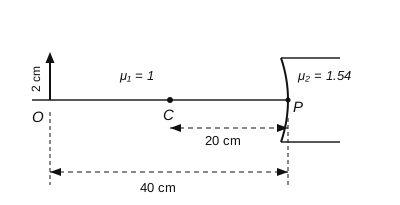
Q641.Refer the figure given below.
and
are refractive indices of air and lens material. The height of image will be ________ cm.
नीचे दिए गए चित्र को देखिए।
तथा
क्रमशः वायु तथा लेन्स के पदार्थ के अपवर्तनांक हैं। प्रतिबिम्ब की ऊँचाई ________ cm होगी।
- A1
- B0.5
- C1.2
- D0.25
Show answer
Concept: Refraction at a single spherical surface: , with magnification . Here C is the centre of curvature, so cm (concave towards the object) and cm.
- .
- cm (virtual image on the object side).
- .
- Height of image cm (erect).
Answer: (A) 1
अवधारणा: एकल गोलीय पृष्ठ पर अपवर्तन: , आवर्धन । यहाँ C वक्रता केन्द्र है, अतः cm (वस्तु की ओर अवतल) तथा cm।
- ।
- cm (वस्तु की ओर आभासी प्रतिबिम्ब)।
- ।
- प्रतिबिम्ब की ऊँचाई cm (सीधा)।
उत्तर: (A) 1
JEE Main 2026 (April) – Paper 1 (B.E./B.Tech)PhysicsRay optics – refraction at spherical surfaceJEE Main 2026 (April) – Paper 1 (B.E./B.Tech) 2026 · 2 Apr Shift 1
Q642.For a certain metal, when monochromatic light of wavelength is incident, the stopping potential for photoelectrons is . When the same metal is illuminated by light of wavelength , then the stopping potential becomes . The threshold wavelength for photoelectric emission for the given metal is . The value of is ______.
किसी धातु पर जब तरंगदैर्ध्य का एकवर्णी प्रकाश आपतित होता है, तो प्रकाश-इलेक्ट्रॉनों के लिए निरोधी विभव होता है। जब उसी धातु को तरंगदैर्ध्य के प्रकाश से प्रदीप्त किया जाता है, तो निरोधी विभव हो जाता है। दी गई धातु के लिए प्रकाश-विद्युत उत्सर्जन की देहली तरंगदैर्ध्य है। का मान ______ है।
- A1
- B4
- C2
- D3
Show answer
Concept: Einstein's equation: .
- and .
- Subtracting: .
- .
- Threshold: .
Answer: (B) 4
अवधारणा: आइंस्टीन का समीकरण: ।
- तथा ।
- घटाने पर: ।
- ।
- देहली तरंगदैर्ध्य: ।
उत्तर: (B) 4
JEE Main 2026 (April) – Paper 1 (B.E./B.Tech)PhysicsPhotoelectric effect – stopping potentialJEE Main 2026 (April) – Paper 1 (B.E./B.Tech) 2026 · 2 Apr Shift 1
Q643.An electromagnetic wave travelling in -direction is described by field equation . If the electron is restricted to move in -direction only with speed of m/s then ratio of maximum electric and magnetic forces acting on the electron is ________.
-दिशा में गमन करती एक विद्युत चुम्बकीय तरंग का क्षेत्र समीकरण है। यदि इलेक्ट्रॉन केवल -दिशा में m/s की चाल से गति करने के लिए प्रतिबन्धित है, तो इलेक्ट्रॉन पर कार्यरत अधिकतम विद्युत तथा चुम्बकीय बलों का अनुपात ________ है।
- A200
- B150
- C400
- D300
Show answer
Concept: In an EM wave ; electric force , maximum magnetic force .
- .
- .
Short trick: The ratio is simply — the field amplitude 300 V/m is a distractor.
Answer: (A) 200
अवधारणा: विद्युत चुम्बकीय तरंग में ; विद्युत बल , अधिकतम चुम्बकीय बल ।
- ।
- ।
शॉर्ट ट्रिक: अनुपात केवल है — क्षेत्र का आयाम 300 V/m भटकाने के लिए है।
उत्तर: (A) 200
JEE Main 2026 (April) – Paper 1 (B.E./B.Tech)PhysicsElectromagnetic waves – forces on a chargeJEE Main 2026 (April) – Paper 1 (B.E./B.Tech) 2026 · 2 Apr Shift 1
Q644.Angular momentum of an electron in a hydrogen atom is , then the energy of the electron is ______ eV.
हाइड्रोजन परमाणु में एक इलेक्ट्रॉन का कोणीय संवेग है, तो इलेक्ट्रॉन की ऊर्जा ______ eV है।
- A
- B
- C
- D
Show answer
Concept: Bohr quantisation: ; energy eV.
- .
- eV.
Answer: (C)
अवधारणा: बोर क्वाण्टीकरण: ; ऊर्जा eV।
- ।
- eV।
उत्तर: (C)
JEE Main 2026 (April) – Paper 1 (B.E./B.Tech)PhysicsAtoms – Bohr model energy levelsJEE Main 2026 (April) – Paper 1 (B.E./B.Tech) 2026 · 2 Apr Shift 1
Q645.A liquid drop of diameter 2 mm breaks into 512 droplets. The change in surface energy is J. The value of is ________. (Take surface tension of liquid = 0.08 N/m)
2 mm व्यास की एक द्रव की बूँद 512 छोटी बूँदों में टूट जाती है। पृष्ठ ऊर्जा में परिवर्तन J है। का मान ________ है। (द्रव का पृष्ठ तनाव = 0.08 N/m लीजिए)
- A10
- B7
- C8
- D11
Show answer
Concept: Volume is conserved: ; change in surface energy .
- mm m, , so .
- m.
- J .
Short trick: — here appears directly in the answer.
Answer: (B) 7
अवधारणा: आयतन संरक्षित रहता है: ; पृष्ठ ऊर्जा में परिवर्तन ।
- mm m, , अतः ।
- m।
- J ।
शॉर्ट ट्रिक: — यहाँ सीधे उत्तर में आता है।
उत्तर: (B) 7
JEE Main 2026 (April) – Paper 1 (B.E./B.Tech)PhysicsSurface tension – splitting of a dropJEE Main 2026 (April) – Paper 1 (B.E./B.Tech) 2026 · 2 Apr Shift 1
Q646.In single slit diffraction pattern, the wavelength of light used is 628 nm and slit width is 0.2 mm, the angular width of central maximum is degrees. The value of is ________.
एकल झिरी विवर्तन प्रतिरूप (single slit diffraction pattern) में प्रयुक्त प्रकाश की तरंगदैर्ध्य 628 nm तथा झिरी की चौड़ाई 0.2 mm है। केन्द्रीय उच्चिष्ठ (central maximum) की कोणीय चौड़ाई डिग्री है। का मान ________ है।
Show answer
Concept: The central maximum extends between the first minima on either side (), so its angular width is .
- rad.
- In degrees: .
- degrees .
Short trick: , so rad exactly.
Answer: 36
अवधारणा: केन्द्रीय उच्चिष्ठ दोनों ओर के प्रथम निम्निष्ठों () के बीच फैला होता है, अतः इसकी कोणीय चौड़ाई है।
- rad।
- डिग्री में: ।
- डिग्री ।
शॉर्ट ट्रिक: , अतः rad (यथार्थ)।
उत्तर: 36
JEE Main 2026 (April) – Paper 1 (B.E./B.Tech)PhysicsWave optics – single slit diffractionJEE Main 2026 (April) – Paper 1 (B.E./B.Tech) 2026 · 2 Apr Shift 1
Q647.A vessel contains 0.15 m of a gas at pressure 8 bar and temperature 140 °C with and . It is expanded adiabatically till pressure falls to 1 bar. The work done during this process is ________ kJ. (R is gas constant)
एक पात्र में 8 bar दाब तथा 140 °C ताप पर 0.15 m गैस है, जिसके लिए तथा है। इसे रुद्धोष्म (adiabatic) रूप से तब तक प्रसारित किया जाता है जब तक दाब घटकर 1 bar न हो जाए। इस प्रक्रम में किया गया कार्य ________ kJ है। (R गैस नियतांक है)
Show answer
Concept: For an adiabatic process = constant and , with .
- .
- m.
- J; J.
- J kJ. (The temperature 140 °C is not needed.)
Short trick: , so ; then kJ.
Answer: 120
अवधारणा: रुद्धोष्म प्रक्रम में = नियत तथा , जहाँ ।
- ।
- m।
- J; J।
- J kJ। (ताप 140 °C की आवश्यकता नहीं है।)
शॉर्ट ट्रिक: , अतः ; तब kJ।
उत्तर: 120
JEE Main 2026 (April) – Paper 1 (B.E./B.Tech)PhysicsThermodynamics – adiabatic workJEE Main 2026 (April) – Paper 1 (B.E./B.Tech) 2026 · 2 Apr Shift 1
Q648.1 μC charge moving with velocity m/s in the region of magnetic field T. The magnitude of force acting on it is N. The value of is ________.
1 μC आवेश T के चुम्बकीय क्षेत्र वाले क्षेत्र में वेग m/s से गतिमान है। इस पर कार्यरत बल का परिमाण N है। का मान ________ है।
Show answer
Concept: Magnetic force .
- .
- .
- .
- N .
Short trick: .
Answer: 171
अवधारणा: चुम्बकीय बल ।
- ।
- ।
- ।
- N ।
शॉर्ट ट्रिक: ।
उत्तर: 171
JEE Main 2026 (April) – Paper 1 (B.E./B.Tech)PhysicsMoving charges – magnetic Lorentz forceJEE Main 2026 (April) – Paper 1 (B.E./B.Tech) 2026 · 2 Apr Shift 1
Q649.A uniform wire of length of weight w is suspended from the roof with a weight of W at the other end. The stress in the wire at distance from the top is , where, A is the cross sectional area of the wire. The value of is ________.
लम्बाई तथा भार w का एक एकसमान तार छत से लटकाया गया है और इसके दूसरे सिरे पर W भार लगा है। ऊपर से दूरी पर तार में प्रतिबल (stress) है, जहाँ A तार का अनुप्रस्थ काट क्षेत्रफल है। का मान ________ है।
Show answer
Concept: The tension at a section of a hanging wire supports everything below that section: the attached load plus the weight of the wire below it.
- Length of wire below the point at from the top , whose weight is .
- Tension there: .
- Stress .
- Comparing with : .
Short trick: Only the part of the wire below the section counts — here two-thirds of it.
Answer: 3
अवधारणा: लटके तार के किसी अनुप्रस्थ काट पर तनाव उसके नीचे की हर चीज़ को सँभालता है: लगा हुआ भार तथा उस काट के नीचे के तार का भार।
- ऊपर से दूरी वाले बिन्दु के नीचे तार की लम्बाई , जिसका भार है।
- वहाँ तनाव: ।
- प्रतिबल ।
- से तुलना करने पर: ।
शॉर्ट ट्रिक: केवल उस काट के नीचे वाला तार का भाग गिना जाता है — यहाँ उसका दो-तिहाई भाग।
उत्तर: 3
JEE Main 2026 (April) – Paper 1 (B.E./B.Tech)PhysicsMechanical properties of solids – stress in hanging wireJEE Main 2026 (April) – Paper 1 (B.E./B.Tech) 2026 · 2 Apr Shift 1
Q650.A tub is filled with water and a wooden cube 10 cm × 10 cm × 10 cm is placed in the water. The wooden cube is found to float on the water with a part of it submerged in water. When a metal coin is placed on the wooden cube, the submerged part is increased by 3.87 cm. The mass of the metal coin is ________ gram.
(Take water density as 1 g/cm and density of wood as 0.4 g/cm)
एक टब पानी से भरा है और उसमें 10 cm × 10 cm × 10 cm का एक लकड़ी का घन रखा जाता है। लकड़ी का घन पानी पर इस प्रकार तैरता पाया जाता है कि उसका एक भाग पानी में डूबा रहता है। जब लकड़ी के घन पर एक धातु का सिक्का रखा जाता है, तो डूबा हुआ भाग 3.87 cm बढ़ जाता है। धातु के सिक्के का द्रव्यमान ________ ग्राम है।
(पानी का घनत्व 1 g/cm तथा लकड़ी का घनत्व 0.4 g/cm लीजिए)
Show answer
Concept: For a floating body, the extra weight added equals the weight of the extra water displaced.
- Initially submerged depth: cm, so the cube can sink 6 cm more — an extra 3.87 cm keeps it floating.
- Extra volume displaced cm.
- Mass of coin g.
Short trick: Extra mass = (base area) × (extra depth) × = g; the wood density is needed only to check that the cube still floats.
Answer: 387
अवधारणा: तैरती वस्तु पर जोड़ा गया अतिरिक्त भार, अतिरिक्त विस्थापित जल के भार के बराबर होता है।
- प्रारम्भ में डूबी गहराई: cm, अतः घन अभी 6 cm और डूब सकता है — अतिरिक्त 3.87 cm पर भी वह तैरता रहता है।
- अतिरिक्त विस्थापित आयतन cm।
- सिक्के का द्रव्यमान g।
शॉर्ट ट्रिक: अतिरिक्त द्रव्यमान = (आधार क्षेत्रफल) × (अतिरिक्त गहराई) × = g; लकड़ी का घनत्व केवल यह जाँचने के लिए है कि घन अब भी तैरता है।
उत्तर: 387
JEE Main 2026 (April) – Paper 1 (B.E./B.Tech)PhysicsFluid mechanics – buoyancy & flotationJEE Main 2026 (April) – Paper 1 (B.E./B.Tech) 2026 · 2 Apr Shift 1
Q651.The mass of iron converted into Fe3O4 by the action of 18 g of steam is :
(Given : Molar mass of H, O and Fe are 1, 16 and 56 g mol−1 respectively)
Assume iron is present in excess :
18 g भाप (steam) की क्रिया द्वारा Fe3O4 में परिवर्तित लोहे का द्रव्यमान है :
(दिया है : H, O तथा Fe के मोलर द्रव्यमान क्रमशः 1, 16 तथा 56 g mol−1 हैं)
मान लीजिए लोहा आधिक्य में उपस्थित है :
- A2.1 g
- B4.2 g
- C21 g
- D42 g
Show answer
Concept: Red-hot iron reacts with steam: 3Fe + 4H2O → Fe3O4 + 4H2.
- Moles of steam = mol; iron is in excess, so steam is the limiting reagent.
- From the equation, 4 mol H2O consume 3 mol Fe, so 1 mol steam converts mol Fe.
- Mass of Fe = g.
Short trick: mol Fe = (3/4) × mol steam, then multiply by 56.
Answer: (D) 42 g
अवधारणा: रक्त-तप्त लोहा भाप से अभिक्रिया करता है: 3Fe + 4H2O → Fe3O4 + 4H2।
- भाप के मोल = मोल; लोहा आधिक्य में है, अतः भाप सीमांत अभिकर्मक है।
- समीकरण से, 4 मोल H2O, 3 मोल Fe का उपयोग करते हैं, अतः 1 मोल भाप मोल Fe को परिवर्तित करती है।
- Fe का द्रव्यमान = g।
शॉर्ट ट्रिक: Fe के मोल = (3/4) × भाप के मोल, फिर 56 से गुणा कीजिए।
उत्तर: (D) 42 g
JEE Main 2026 (April) – Paper 1 (B.E./B.Tech)ChemistryMole Concept – stoichiometryJEE Main 2026 (April) – Paper 1 (B.E./B.Tech) 2026 · 2 Apr Shift 1
Q652.What is the energy (in J atom−1) required for the following process ?
Li2+(g) → Li3+(g) + e−
(Take the ionization energy for the H atom in the ground state as J atom−1)
निम्नलिखित प्रक्रम के लिए आवश्यक ऊर्जा (J atom−1 में) क्या है ?
Li2+(g) → Li3+(g) + e−
(मूल अवस्था में H परमाणु की आयनन ऊर्जा J atom−1 लीजिए)
- A
- B
- C
- D
Show answer
Concept: Li2+ is a hydrogen-like species (one electron, ). Ionisation energy of a hydrogen-like species = .
- The given process removes the only electron of Li2+ from its ground state ().
- J atom−1.
Short trick: For H-like ions just multiply by .
Answer: (C)
अवधारणा: Li2+ एक हाइड्रोजन-सदृश स्पीशीज़ है (एक इलेक्ट्रॉन, )। हाइड्रोजन-सदृश स्पीशीज़ की आयनन ऊर्जा = ।
- दिए गए प्रक्रम में Li2+ का एकमात्र इलेक्ट्रॉन उसकी मूल अवस्था () से निकाला जाता है।
- J atom−1।
शॉर्ट ट्रिक: H-सदृश आयनों के लिए को केवल से गुणा कीजिए।
उत्तर: (C)
JEE Main 2026 (April) – Paper 1 (B.E./B.Tech)ChemistryAtomic Structure – Bohr modelJEE Main 2026 (April) – Paper 1 (B.E./B.Tech) 2026 · 2 Apr Shift 1
Q653.Given below are two statements :
Statement (I) : The correct sequence of bond lengths in the following species is :
O2+ < O2 < O2− < O22−
Statement (II) : The correct sequence of number of unpaired electrons in the following species is :
O2 > O2+ > O2− > O22−
In the light of the above statements, choose the correct answer from the options given below :
नीचे दो कथन दिए गए हैं :
कथन (I) : निम्नलिखित स्पीशीज़ में आबंध लम्बाइयों का सही क्रम है :
O2+ < O2 < O2− < O22−
कथन (II) : निम्नलिखित स्पीशीज़ में अयुग्मित इलेक्ट्रॉनों की संख्या का सही क्रम है :
O2 > O2+ > O2− > O22−
उपर्युक्त कथनों के आलोक में, नीचे दिए गए विकल्पों में से सही उत्तर चुनिए :
- ABoth Statement I and Statement II are trueकथन I और कथन II दोनों सत्य हैं
- BBoth Statement I and Statement II are falseकथन I और कथन II दोनों असत्य हैं
- CStatement I is true but Statement II is falseकथन I सत्य है परन्तु कथन II असत्य है
- DStatement I is false but Statement II is trueकथन I असत्य है परन्तु कथन II सत्य है
Show answer
Concept: By MOT, bond order (B.O.) of O2+, O2, O2−, O22− are 2.5, 2, 1.5 and 1; bond length varies inversely with bond order.
- Bond length: higher B.O. → shorter bond, so O2+ < O2 < O2− < O22−. Statement I is true.
- Unpaired electrons: O2 has 2 (in ), O2+ has 1, O2− has 1, O22− has 0.
- Since O2+ and O2− have an equal number (1 each), the strict order O2+ > O2− is wrong. Statement II is false.
- So (A), (B) and (D) are ruled out.
Answer: (C) Statement I is true but Statement II is false
अवधारणा: MOT के अनुसार O2+, O2, O2−, O22− की आबंध कोटि क्रमशः 2.5, 2, 1.5 तथा 1 है; आबंध लम्बाई, आबंध कोटि के व्युत्क्रमानुपाती होती है।
- आबंध लम्बाई: अधिक आबंध कोटि → छोटा आबंध, अतः O2+ < O2 < O2− < O22−। कथन I सत्य है।
- अयुग्मित इलेक्ट्रॉन: O2 में 2 ( में), O2+ में 1, O2− में 1, O22− में 0।
- चूँकि O2+ तथा O2− में अयुग्मित इलेक्ट्रॉनों की संख्या समान (1-1) है, अतः O2+ > O2− का कठोर क्रम गलत है। कथन II असत्य है।
- अतः विकल्प (A), (B) तथा (D) निरस्त हो जाते हैं।
उत्तर: (C) कथन I सत्य है परन्तु कथन II असत्य है
JEE Main 2026 (April) – Paper 1 (B.E./B.Tech)ChemistryChemical Bonding – molecular orbital theoryJEE Main 2026 (April) – Paper 1 (B.E./B.Tech) 2026 · 2 Apr Shift 1
Q654.Consider the following data.
(i) 2Al(s) + 6HCl(aq) → Al2Cl6(aq) + 3H2(g) + 1200 kJ/mol
(ii) H2(g) + Cl2(g) → 2HCl(g) + 164 kJ/mol.
(iii) HCl(g) + aq → HCl(aq) + 83 kJ/mol.
(iv) Al2Cl6(s) + aq → Al2Cl6(aq) + 663 kJ/mol
The enthalpy of formation of anhydrous solid Al2Cl6 is :
निम्नलिखित आँकड़ों पर विचार कीजिए।
(i) 2Al(s) + 6HCl(aq) → Al2Cl6(aq) + 3H2(g) + 1200 kJ/mol
(ii) H2(g) + Cl2(g) → 2HCl(g) + 164 kJ/mol.
(iii) HCl(g) + aq → HCl(aq) + 83 kJ/mol.
(iv) Al2Cl6(s) + aq → Al2Cl6(aq) + 663 kJ/mol
निर्जल ठोस Al2Cl6 की विरचन एन्थैल्पी है :
- A−648 kJ mol−1
- B−1350 kJ mol−1
- C−2002 kJ mol−1
- D−1527 kJ mol−1
Show answer
Concept: Hess's law – the heats written on the product side are evolved heats, so ΔH1 = −1200, ΔH2 = −164, ΔH3 = −83, ΔH4 = −663 kJ mol−1. Target: 2Al(s) + 3Cl2(g) → Al2Cl6(s).
- Combine: target = (i) + 3 × (ii) + 6 × (iii) − (iv). [3×(ii) + 6×(iii) make 6HCl(aq); reversing (iv) converts Al2Cl6(aq) to Al2Cl6(s).]
- kJ mol−1.
Answer: (D) −1527 kJ mol−1
अवधारणा: हेस का नियम – उत्पाद की ओर लिखी ऊष्माएँ उत्सर्जित ऊष्माएँ हैं, अतः ΔH1 = −1200, ΔH2 = −164, ΔH3 = −83, ΔH4 = −663 kJ mol−1। लक्ष्य अभिक्रिया: 2Al(s) + 3Cl2(g) → Al2Cl6(s)।
- संयोजन: लक्ष्य = (i) + 3 × (ii) + 6 × (iii) − (iv)। [3×(ii) + 6×(iii) से 6HCl(aq) बनता है; (iv) को उलटने पर Al2Cl6(aq), Al2Cl6(s) में बदलता है।]
- kJ mol−1।
उत्तर: (D) −1527 kJ mol−1
JEE Main 2026 (April) – Paper 1 (B.E./B.Tech)ChemistryThermodynamics – Hess's lawJEE Main 2026 (April) – Paper 1 (B.E./B.Tech) 2026 · 2 Apr Shift 1
Q655.19.5 g of fluoro acetic acid (molar mass = 78 g mol−1) is dissolved in 500 g of water at 298 K. The depression in the freezing point of water was 1°C. What is Ka of fluoro acetic acid ? (For water, Kf = 1.86 K kg mol−1). Assume molarity and molality to have same values.
298 K पर 19.5 g फ्लुओरो ऐसीटिक अम्ल (मोलर द्रव्यमान = 78 g mol−1) को 500 g जल में घोला जाता है। जल के हिमांक में अवनमन 1°C था। फ्लुओरो ऐसीटिक अम्ल का Ka क्या है ? (जल के लिए, Kf = 1.86 K kg mol−1)। मोलरता तथा मोललता के मान समान मान लीजिए।
- A
- B
- C
- D
Show answer
Concept: ; for a weak monoprotic acid and .
- Moles of acid = ; molality mol kg−1.
- , so .
- .
Answer: (D)
अवधारणा: ; दुर्बल एकक्षारकीय अम्ल के लिए तथा ।
- अम्ल के मोल = ; मोललता mol kg−1।
- , अतः ।
- ।
उत्तर: (D)
JEE Main 2026 (April) – Paper 1 (B.E./B.Tech)ChemistrySolutions – depression in freezing pointJEE Main 2026 (April) – Paper 1 (B.E./B.Tech) 2026 · 2 Apr Shift 1
Q656.The solubility product constants of Ag2CrO4 and AgBr are and respectively at 298 K.
The value of can be expressed as :
298 K पर Ag2CrO4 तथा AgBr के विलेयता गुणनफल स्थिरांक क्रमशः तथा हैं।
का मान व्यक्त किया जा सकता है :
- A
- B
- C
- D
Show answer
Concept: For Ag2CrO4 (2:1 salt), ; for AgBr (1:1 salt), , where , are molar solubilities (molarity of saturated solution).
- Ag2CrO4: .
- AgBr: .
- Ratio .
Answer: (D)
अवधारणा: Ag2CrO4 (2:1 लवण) के लिए ; AgBr (1:1 लवण) के लिए , जहाँ , मोलर विलेयताएँ (संतृप्त विलयन की मोलरता) हैं।
- Ag2CrO4: ।
- AgBr: ।
- अनुपात ।
उत्तर: (D)
JEE Main 2026 (April) – Paper 1 (B.E./B.Tech)ChemistryIonic Equilibrium – solubility productJEE Main 2026 (April) – Paper 1 (B.E./B.Tech) 2026 · 2 Apr Shift 1
Q657.An electrochemical cell is constructed using half cells in the direction of spontaneous change
Fe(OH)2(s) + 2e− → Fe(s) + 2OH−(aq) E0 = −0.88 V
and AgBr(s) + e− → Ag(s) + Br−(aq) E0 = +0.07 V
Which of the following option is correct ?
स्वतः परिवर्तन की दिशा में अर्ध-सेलों का उपयोग करके एक विद्युत्-रासायनिक सेल बनाया गया है
Fe(OH)2(s) + 2e− → Fe(s) + 2OH−(aq) E0 = −0.88 V
तथा AgBr(s) + e− → Ag(s) + Br−(aq) E0 = +0.07 V
निम्नलिखित में से कौन सा विकल्प सही है ?
- AOverall reaction Fe(s) + 2OH−(aq) + 2AgBr(s) ⇌ Fe(OH)2(s) + 2Ag(s) + 2Br−(aq)समग्र अभिक्रिया Fe(s) + 2OH−(aq) + 2AgBr(s) ⇌ Fe(OH)2(s) + 2Ag(s) + 2Br−(aq)
- BEθcell = −0.95 V
- CFe is reduced in the electrochemical cellविद्युत्-रासायनिक सेल में Fe अपचयित होता है
- DEθcell is an extensive propertyEθcell एक विस्तीर्ण (extensive) गुणधर्म है
Show answer
Concept: For a spontaneous cell, the half cell with higher (more positive) reduction potential acts as cathode; must be positive.
- Cathode (reduction): AgBr(s) + e− → Ag(s) + Br− ( V). Anode (oxidation): Fe(s) + 2OH− → Fe(OH)2(s) + 2e−.
- Overall: Fe(s) + 2OH−(aq) + 2AgBr(s) ⇌ Fe(OH)2(s) + 2Ag(s) + 2Br−(aq) — exactly option (A).
- (B) is wrong: V, not −0.95 V.
- (C) is wrong: Fe is oxidised (Fe → Fe(OH)2), not reduced.
- (D) is wrong: electrode potential is an intensive property — it does not depend on the amount of substance.
Answer: (A)
अवधारणा: स्वतः चालित सेल में अधिक (अधिक धनात्मक) अपचयन विभव वाला अर्ध-सेल कैथोड होता है; धनात्मक होना चाहिए।
- कैथोड (अपचयन): AgBr(s) + e− → Ag(s) + Br− ( V)। ऐनोड (ऑक्सीकरण): Fe(s) + 2OH− → Fe(OH)2(s) + 2e−।
- समग्र अभिक्रिया: Fe(s) + 2OH−(aq) + 2AgBr(s) ⇌ Fe(OH)2(s) + 2Ag(s) + 2Br−(aq) — यही विकल्प (A) है।
- (B) गलत है: V, −0.95 V नहीं।
- (C) गलत है: Fe का ऑक्सीकरण होता है (Fe → Fe(OH)2), अपचयन नहीं।
- (D) गलत है: इलेक्ट्रोड विभव एक मात्रा-निरपेक्ष (intensive) गुणधर्म है — यह पदार्थ की मात्रा पर निर्भर नहीं करता।
उत्तर: (A)
JEE Main 2026 (April) – Paper 1 (B.E./B.Tech)ChemistryElectrochemistry – galvanic cellJEE Main 2026 (April) – Paper 1 (B.E./B.Tech) 2026 · 2 Apr Shift 1
Q658. is the time required for the 100% completion of the reaction while is the time required for 50% of the reaction to be completed. Which of the following option correctly represents the relation between and for zero and first order reactions respectively ?
अभिक्रिया के 100% पूर्ण होने के लिए आवश्यक समय है जबकि अभिक्रिया के 50% पूर्ण होने के लिए आवश्यक समय है। निम्नलिखित में से कौन सा विकल्प क्रमशः शून्य तथा प्रथम कोटि की अभिक्रियाओं के लिए तथा के बीच संबंध को सही रूप से निरूपित करता है ?
- A and तथा
- B and तथा
- C and तथा
- D and तथा
Show answer
Concept: Zero order: (finishes in finite time). First order: (never reaches exactly zero).
- Zero order: and , so .
- First order: the concentration decays exponentially, so 100% completion needs infinite time — represented as (i.e. infinitely many half-lives).
- Only option (B) gives this pair in the order zero, first.
Answer: (B)
अवधारणा: शून्य कोटि: (सीमित समय में पूर्ण)। प्रथम कोटि: (सांद्रता कभी ठीक शून्य नहीं होती)।
- शून्य कोटि: तथा , अतः ।
- प्रथम कोटि: सांद्रता चरघातांकी रूप से घटती है, अतः 100% पूर्णता के लिए अनंत समय चाहिए — जिसे (अर्थात् अनंत अर्ध-आयु) से निरूपित किया गया है।
- केवल विकल्प (B) ही यह युग्म शून्य, प्रथम के क्रम में देता है।
उत्तर: (B)
JEE Main 2026 (April) – Paper 1 (B.E./B.Tech)ChemistryChemical Kinetics – order of reactionJEE Main 2026 (April) – Paper 1 (B.E./B.Tech) 2026 · 2 Apr Shift 1
Q659.Given below are two statements :
Statement (I) : The first ionisation enthalpy of the elements Na, Mg, Cl and Ar follows the order Na > Mg > Cl > Ar.
Statement (II) : Among Ca, Al, Fe and B, the third ionisation enthalpy is very high for Ca.
In the light of the above statements, choose the correct answer from the options given below :
नीचे दो कथन दिए गए हैं :
कथन (I) : तत्वों Na, Mg, Cl तथा Ar की प्रथम आयनन एन्थैल्पी का क्रम Na > Mg > Cl > Ar है।
कथन (II) : Ca, Al, Fe तथा B में से, Ca के लिए तृतीय आयनन एन्थैल्पी बहुत उच्च होती है।
उपर्युक्त कथनों के आलोक में, नीचे दिए गए विकल्पों में से सही उत्तर चुनिए :
- ABoth Statement I and Statement II are trueकथन I और कथन II दोनों सत्य हैं
- BBoth Statement I and Statement II are falseकथन I और कथन II दोनों असत्य हैं
- CStatement I is true but Statement II is falseकथन I सत्य है परन्तु कथन II असत्य है
- DStatement I is false but Statement II is trueकथन I असत्य है परन्तु कथन II सत्य है
Show answer
Concept: First ionisation enthalpy generally increases across a period; removal of an electron from a noble-gas configuration needs exceptionally high energy.
- Statement I: across period 3 the actual order is Ar > Cl > Mg > Na (noble gas Ar highest, alkali metal Na lowest) — the given order Na > Mg > Cl > Ar is exactly reversed. Statement I is false.
- Statement II: Ca2+ has the stable noble-gas configuration [Ar]; removing a third electron breaks this core, so IE3(Ca) ≈ 4912 kJ mol−1 is far higher than IE3 of Al (removes 3s1 of Al2+), of Fe (gives stable 3d5 Fe3+) or of B. Statement II is true.
Answer: (D) Statement I is false but Statement II is true
अवधारणा: आवर्त में बाएँ से दाएँ प्रथम आयनन एन्थैल्पी सामान्यतः बढ़ती है; उत्कृष्ट गैस विन्यास से इलेक्ट्रॉन निकालने में असाधारण रूप से उच्च ऊर्जा लगती है।
- कथन I: आवर्त 3 में वास्तविक क्रम Ar > Cl > Mg > Na है (उत्कृष्ट गैस Ar सर्वाधिक, क्षार धातु Na न्यूनतम) — दिया गया क्रम Na > Mg > Cl > Ar ठीक उल्टा है। कथन I असत्य है।
- कथन II: Ca2+ का विन्यास स्थायी उत्कृष्ट गैस [Ar] है; तीसरा इलेक्ट्रॉन निकालने पर यह कोर टूटता है, अतः IE3(Ca) ≈ 4912 kJ mol−1, Al (Al2+ का 3s1 निकलता है), Fe (स्थायी 3d5 Fe3+ बनता है) तथा B की IE3 से कहीं अधिक है। कथन II सत्य है।
उत्तर: (D) कथन I असत्य है परन्तु कथन II सत्य है
JEE Main 2026 (April) – Paper 1 (B.E./B.Tech)ChemistryPeriodic Properties – ionisation enthalpyJEE Main 2026 (April) – Paper 1 (B.E./B.Tech) 2026 · 2 Apr Shift 1
Q660.Given below are two statements :
Statement (I) : Oxidising power of halogens decreases in the order F2 > Cl2 > Br2 > I2, which is the basis of "Layer test".
Statement (II) : "Layer test" to identify Br2 and I2 in aqueous solution involves the oxidation of bromide or iodide into Br2 or I2 respectively with Cl2, which is a type of displacement redox reaction.
In the light of the above statements, choose the correct answer from the options given below :
नीचे दो कथन दिए गए हैं :
कथन (I) : हैलोजनों की ऑक्सीकारक क्षमता F2 > Cl2 > Br2 > I2 क्रम में घटती है, जो "परत परीक्षण (Layer test)" का आधार है।
कथन (II) : जलीय विलयन में Br2 तथा I2 की पहचान के लिए "परत परीक्षण" में Cl2 द्वारा ब्रोमाइड अथवा आयोडाइड का क्रमशः Br2 अथवा I2 में ऑक्सीकरण होता है, जो एक प्रकार की विस्थापन रेडॉक्स अभिक्रिया है।
उपर्युक्त कथनों के आलोक में, नीचे दिए गए विकल्पों में से सही उत्तर चुनिए :
- ABoth Statement I and Statement II are trueकथन I और कथन II दोनों सत्य हैं
- BBoth Statement I and Statement II are falseकथन I और कथन II दोनों असत्य हैं
- CStatement I is true but Statement II is falseकथन I सत्य है परन्तु कथन II असत्य है
- DStatement I is false but Statement II is trueकथन I असत्य है परन्तु कथन II सत्य है
Show answer
Concept: A halogen higher in the group displaces a lower halide from solution because oxidising power falls down the group.
- Statement I: oxidising power F2 > Cl2 > Br2 > I2 (large negative electron-gain enthalpy + high hydration tendency for the lighter halogens). This superior oxidising power of Cl2 is indeed what the layer test exploits. True.
- Statement II: in the layer test, chlorine water oxidises Br− → Br2 (orange-brown in organic layer) and I− → I2 (violet in organic layer): Cl2 + 2Br− → 2Cl− + Br2; Cl2 + 2I− → 2Cl− + I2. This is a displacement (redox) reaction. True.
Answer: (A) Both Statement I and Statement II are true
अवधारणा: समूह में ऊपर स्थित हैलोजन, नीचे वाले हैलाइड को विलयन से विस्थापित कर देता है, क्योंकि समूह में नीचे जाने पर ऑक्सीकारक क्षमता घटती है।
- कथन I: ऑक्सीकारक क्षमता F2 > Cl2 > Br2 > I2 (हल्के हैलोजनों की उच्च ऋणात्मक इलेक्ट्रॉन-लब्धि एन्थैल्पी तथा जलयोजन प्रवृत्ति)। Cl2 की यही श्रेष्ठ ऑक्सीकारक क्षमता परत परीक्षण का आधार है। सत्य।
- कथन II: परत परीक्षण में क्लोरीन जल Br− → Br2 (कार्बनिक परत में नारंगी-भूरा) तथा I− → I2 (कार्बनिक परत में बैंगनी) का ऑक्सीकरण करता है: Cl2 + 2Br− → 2Cl− + Br2; Cl2 + 2I− → 2Cl− + I2। यह विस्थापन (रेडॉक्स) अभिक्रिया है। सत्य।
उत्तर: (A) कथन I और कथन II दोनों सत्य हैं
JEE Main 2026 (April) – Paper 1 (B.E./B.Tech)Chemistryp-Block – halogens, layer testJEE Main 2026 (April) – Paper 1 (B.E./B.Tech) 2026 · 2 Apr Shift 1

