Q721.The driver sitting inside a parked car is watching vehicles approaching from behind with the help of his side view mirror, which is a convex mirror with radius of curvature m. Another car approaches him from behind with a uniform speed of 90 km/hr. When the car is at a distance of 24 m from him, the magnitude of the acceleration of the image of the car in the side view mirror is ' '. The value of is ______ .
एक खड़ी कार में बैठा चालक अपने पार्श्व दृश्य दर्पण (side view mirror), जो m वक्रता त्रिज्या का उत्तल दर्पण है, की सहायता से पीछे से आ रहे वाहनों को देख रहा है। एक अन्य कार पीछे से 90 km/hr की एकसमान चाल से उसकी ओर आ रही है। जब वह कार उससे 24 m की दूरी पर है, तब पार्श्व दृश्य दर्पण में कार के प्रतिबिम्ब के त्वरण का परिमाण ' ' है। का मान ______ है।
Show answer
Concept: For a convex mirror, the image (behind the mirror) sits at when the object is at distance (magnitudes, ). Differentiate twice; the object moves uniformly, so only the term survives.
- ; speed , so , .
- .
- at .
- .
Short trick: for a uniformly moving object — plug in , , .
Answer: 8
अवधारणा: उत्तल दर्पण के लिए, वस्तु के दूरी पर होने पर प्रतिबिम्ब (दर्पण के पीछे) पर बनता है (परिमाणों में, )। दो बार अवकलन कीजिए; वस्तु एकसमान चाल से चलती है, अतः केवल वाला पद बचता है।
- ; चाल , अतः , ।
- ।
- ( पर)।
- ।
शॉर्ट ट्रिक: एकसमान गति वाली वस्तु के लिए — , , रखिए।
उत्तर: 8
JEE Main 2025 (January) – Paper 1 (B.E./B.Tech)PhysicsRay Optics – image motion in spherical mirrorJEE Main 2025 (January) – Paper 1 (B.E./B.Tech) 2025 · 22 Jan Shift 1
Q722.Two soap bubbles of radius 2 cm and 4 cm, respectively, are in contact with each other. The radius of curvature of the common surface, in cm, is ______.
क्रमशः 2 cm तथा 4 cm त्रिज्या के दो साबुन के बुलबुले एक-दूसरे के सम्पर्क में हैं। उभयनिष्ठ पृष्ठ की वक्रता त्रिज्या, cm में, ______ है।
Show answer
Concept: Excess pressure inside a soap bubble is . The common surface bulges into the bigger bubble, and its radius follows from the pressure difference across it.
- (smaller bubble), (bigger bubble).
- Across the common surface: .
- .
- .
Short trick: cm.
Answer: 4
अवधारणा: साबुन के बुलबुले के भीतर अतिरिक्त दाब होता है। उभयनिष्ठ पृष्ठ बड़े बुलबुले की ओर उभरता है, और उसकी त्रिज्या पृष्ठ के आर-पार दाबान्तर से मिलती है।
- (छोटा बुलबुला), (बड़ा बुलबुला)।
- उभयनिष्ठ पृष्ठ के आर-पार: ।
- ।
- ।
शॉर्ट ट्रिक: cm।
उत्तर: 4
JEE Main 2025 (January) – Paper 1 (B.E./B.Tech)PhysicsMechanical Properties of Fluids – soap bubblesJEE Main 2025 (January) – Paper 1 (B.E./B.Tech) 2025 · 22 Jan Shift 1
Q723.The position vectors of two 1 kg particles, (A) and (B), are given by m and m, respectively; , where is time, and are constants. At s, and velocities and of the particles are orthogonal to each other. At s, the magnitude of angular momentum of particle (A) with respect to the position of particle (B) is . The value of is ______.
1 kg द्रव्यमान के दो कणों (A) तथा (B) के स्थिति सदिश क्रमशः m तथा m हैं; , जहाँ समय है तथा और नियतांक हैं। s पर, तथा कणों के वेग और परस्पर लम्बवत हैं। s पर, कण (B) की स्थिति के सापेक्ष कण (A) के कोणीय संवेग का परिमाण है। का मान ______ है।
Show answer
Concept: Use the two conditions at s to find and , then .
- and at s.
- : . Orthogonality: .
- gives (impossible); gives .
- So , (check: magnitudes 3, dot product 0).
- Positions at : , ; .
- .
- .
Short trick: Since , you never need the square root — just report .
Answer: 90
अवधारणा: s की दोनों शर्तों से और निकालिए, फिर ।
- s पर तथा ।
- : । लम्बवतता: ।
- से (असम्भव); से ।
- अतः , (जाँच: दोनों परिमाण 3, अदिश गुणनफल 0)।
- पर स्थितियाँ: , ; ।
- ।
- ।
शॉर्ट ट्रिक: चूँकि , वर्गमूल की आवश्यकता ही नहीं — सीधे लिख दीजिए।
उत्तर: 90
JEE Main 2025 (January) – Paper 1 (B.E./B.Tech)PhysicsRotational Motion – angular momentumJEE Main 2025 (January) – Paper 1 (B.E./B.Tech) 2025 · 22 Jan Shift 1
Q724.Three conductors of same length having thermal conductivity
,
and
are connected as shown in figure.
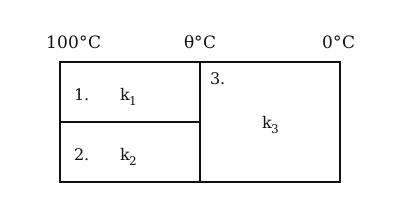
Area of cross sections of
and
conductor are same and for
conductor it is double of the
conductor. The temperatures are given in the figure. In steady state condition, the value of
is ______
C. (Given :
,
,
)
समान लम्बाई के तीन चालक, जिनकी ऊष्मा चालकताएँ
,
तथा
हैं, चित्र में दर्शाए अनुसार जुड़े हैं।
पहले तथा दूसरे चालक के अनुप्रस्थ काट के क्षेत्रफल समान हैं और तीसरे चालक का क्षेत्रफल पहले चालक का दोगुना है। ताप चित्र में दिए गए हैं। स्थायी अवस्था में
का मान ______
C है। (दिया है :
,
,
)
Show answer
Concept: In steady state, heat current into the junction heat current out: for each rod, with rods 1 and 2 in parallel feeding rod 3.
- Heat in through rods 1 and 2 (area each, from C to ): .
- Heat out through rod 3 (area , from to C): .
- .
- .
Short trick: Effective conductance ratio in : out , so divides as .
Answer: 40
अवधारणा: स्थायी अवस्था में सन्धि में आने वाली ऊष्मा धारा बाहर जाने वाली ऊष्मा धारा: प्रत्येक छड़ के लिए ; छड़ 1 व 2 समान्तर क्रम में छड़ 3 को ऊष्मा देती हैं।
- छड़ 1 व 2 से आने वाली ऊष्मा (प्रत्येक का क्षेत्रफल , C से तक): ।
- छड़ 3 से बाहर जाने वाली ऊष्मा (क्षेत्रफल , से C तक): ।
- ।
- ।
शॉर्ट ट्रिक: चालकता अनुपात (अन्दर : बाहर) , अतः ।
उत्तर: 40
JEE Main 2025 (January) – Paper 1 (B.E./B.Tech)PhysicsHeat Transfer – conductionJEE Main 2025 (January) – Paper 1 (B.E./B.Tech) 2025 · 22 Jan Shift 1
Q725.A particle is projected at an angle of from horizontal at a speed of 60 m/s. The height traversed by the particle in the first second is and height traversed in the last second, before it reaches the maximum height, is . The ratio is ______ [Take, ]
एक कण को क्षैतिज से कोण पर 60 m/s की चाल से प्रक्षेपित किया जाता है। पहले सेकण्ड में कण द्वारा तय की गई ऊँचाई है तथा अधिकतम ऊँचाई पर पहुँचने से पहले अन्तिम सेकण्ड में तय की गई ऊँचाई है। अनुपात ______ है [ लीजिए]
Show answer
Concept: Only the vertical motion matters: , , and time to the top is .
- ; time to maximum height .
- First second: .
- Last second (from s to s): .
- .
Short trick: By time reversal, the last second before the top equals the first second of free fall: m; and m.
Answer: 5
अवधारणा: केवल ऊर्ध्वाधर गति देखनी है: , , तथा शीर्ष तक का समय ।
- ; अधिकतम ऊँचाई तक समय ।
- पहला सेकण्ड: ।
- अन्तिम सेकण्ड ( s से s तक): ।
- ।
शॉर्ट ट्रिक: समय-व्युत्क्रमण से, शीर्ष से पहले का अन्तिम सेकण्ड मुक्त पतन के पहले सेकण्ड के बराबर है: m; तथा m।
उत्तर: 5
JEE Main 2025 (January) – Paper 1 (B.E./B.Tech)PhysicsKinematics – projectile motionJEE Main 2025 (January) – Paper 1 (B.E./B.Tech) 2025 · 22 Jan Shift 1
Q726.Radius of the first excited state of Helium ion is given as : → radius of first stationary state of hydrogen atom.
हीलियम आयन की प्रथम उत्तेजित अवस्था की त्रिज्या इस प्रकार दी गई है : → हाइड्रोजन परमाणु की प्रथम स्थिर अवस्था (first stationary state) की त्रिज्या।
- A
- B
- C
- D
Show answer
Concept: For a hydrogen-like species the radius of the nth Bohr orbit is .
- He+ is hydrogen-like with ; the first excited state means .
- .
Short trick: Just compute – twice the Bohr radius.
Answer: (B)
अवधारणा: हाइड्रोजन-सदृश स्पीशीज़ के लिए nवीं बोर कक्षा की त्रिज्या होती है।
- He+ हाइड्रोजन-सदृश है जिसके लिए ; प्रथम उत्तेजित अवस्था का अर्थ है ।
- ।
शॉर्ट ट्रिक: केवल निकालिए – बोर त्रिज्या का दोगुना।
उत्तर: (B)
JEE Main 2025 (January) – Paper 1 (B.E./B.Tech)ChemistryAtomic Structure – Bohr modelJEE Main 2025 (January) – Paper 1 (B.E./B.Tech) 2025 · 22 Jan Shift 1
Q727.The incorrect statements regarding geometrical isomerism are :
(A) Propene shows geometrical isomerism.
(B) Trans isomer has identical atoms/groups on the opposite sides of the double bond.
(C) Cis-but-2-ene has higher dipole moment than trans-but-2-ene.
(D) 2-methylbut-2-ene shows two geometrical isomers.
(E) Trans-isomer has lower melting point than cis isomer.
Choose the correct answer from the options given below :
ज्यामितीय समावयवता (geometrical isomerism) के संबंध में गलत कथन हैं :
(A) प्रोपीन ज्यामितीय समावयवता दर्शाता है।
(B) ट्रांस समावयवी में समान परमाणु/समूह द्विबंध के विपरीत ओर होते हैं।
(C) सिस-ब्यूट-2-ईन का द्विध्रुव आघूर्ण ट्रांस-ब्यूट-2-ईन से अधिक होता है।
(D) 2-मेथिलब्यूट-2-ईन दो ज्यामितीय समावयवी दर्शाता है।
(E) ट्रांस-समावयवी का गलनांक सिस समावयवी से कम होता है।
नीचे दिए गए विकल्पों में से सही उत्तर चुनिए :
- A(A) and (E) Onlyकेवल (A) और (E)
- B(A), (D) and (E) Onlyकेवल (A), (D) और (E)
- C(B) and (C) Onlyकेवल (B) और (C)
- D(C), (D) and (E) Onlyकेवल (C), (D) और (E)
Show answer
Concept: Geometrical isomerism requires each doubly-bonded carbon to carry two different groups; cis/trans isomers differ in dipole moment and packing.
- (A) Incorrect – in propene (CH2=CH−CH3) the terminal alkene carbon carries two identical H atoms, so no geometrical isomerism.
- (B) Correct – that is exactly the definition of a trans isomer.
- (C) Correct – in cis-but-2-ene the C−CH3 bond moments add (μ ≈ 0.33 D) while in trans they cancel (μ = 0).
- (D) Incorrect – in 2-methylbut-2-ene, (CH3)2C=CH−CH3, one alkene carbon carries two identical CH3 groups, so it shows no geometrical isomers.
- (E) Incorrect – the symmetrical trans isomer packs better in the crystal lattice, so its melting point is higher than that of the cis isomer.
Hence the incorrect statements are (A), (D) and (E).
Answer: (B) (A), (D) and (E) Only
अवधारणा: ज्यामितीय समावयवता के लिए द्विबंध के प्रत्येक कार्बन पर दो भिन्न समूह होने चाहिए; सिस/ट्रांस समावयवियों के द्विध्रुव आघूर्ण तथा संकुलन (packing) भिन्न होते हैं।
- (A) गलत – प्रोपीन (CH2=CH−CH3) में अंतिम ऐल्कीन कार्बन पर दो समान H परमाणु हैं, अतः ज्यामितीय समावयवता नहीं होती।
- (B) सही – यही ट्रांस समावयवी की परिभाषा है।
- (C) सही – सिस-ब्यूट-2-ईन में C−CH3 आबंध आघूर्ण जुड़ते हैं (μ ≈ 0.33 D) जबकि ट्रांस में निरस्त हो जाते हैं (μ = 0)।
- (D) गलत – 2-मेथिलब्यूट-2-ईन, (CH3)2C=CH−CH3, में एक ऐल्कीन कार्बन पर दो समान CH3 समूह हैं, अतः इसके ज्यामितीय समावयवी नहीं बनते।
- (E) गलत – सममित ट्रांस समावयवी क्रिस्टल जालक में बेहतर संकुलित होता है, अतः उसका गलनांक सिस से अधिक होता है।
अतः गलत कथन (A), (D) और (E) हैं।
उत्तर: (B) केवल (A), (D) और (E)
JEE Main 2025 (January) – Paper 1 (B.E./B.Tech)ChemistryIsomerism – geometrical isomerismJEE Main 2025 (January) – Paper 1 (B.E./B.Tech) 2025 · 22 Jan Shift 1
Q728.A liquid when kept inside a thermally insulated closed vessel at 25°C was mechanically stirred from outside. What will be the correct option for the following thermodynamic parameters ?
एक ऊष्मीय रूप से विलगित (thermally insulated) बंद पात्र में 25°C पर रखे द्रव को बाहर से यांत्रिक रूप से विलोडित (stirred) किया गया। निम्नलिखित ऊष्मागतिक प्राचलों के लिए सही विकल्प क्या होगा ?
- A
- B
- C
- D
Show answer
Concept: First law of thermodynamics: , where is the work done on the system.
- The vessel is thermally insulated and closed, so no heat is exchanged: .
- Stirring transfers mechanical work to the liquid: .
- Therefore – the internal energy (and temperature) of the liquid rises.
Short trick: Insulated → q = 0; anything done on the system (stirring, compression) makes w positive, so ΔU must rise.
Answer: (C)
अवधारणा: ऊष्मागतिकी का प्रथम नियम: , जहाँ निकाय पर किया गया कार्य है।
- पात्र ऊष्मीय रूप से विलगित तथा बंद है, अतः ऊष्मा का विनिमय नहीं होता: ।
- विलोडन द्वारा द्रव पर यांत्रिक कार्य होता है: ।
- अतः – द्रव की आंतरिक ऊर्जा (और ताप) बढ़ती है।
शॉर्ट ट्रिक: विलगित → q = 0; निकाय पर किया गया कोई भी कार्य (विलोडन, संपीडन) w को धनात्मक बनाता है, अतः ΔU बढ़ेगा।
उत्तर: (C)
JEE Main 2025 (January) – Paper 1 (B.E./B.Tech)ChemistryThermodynamics – first lawJEE Main 2025 (January) – Paper 1 (B.E./B.Tech) 2025 · 22 Jan Shift 1
Q729.Which of the following electronegativity order is incorrect?
निम्नलिखित में से कौन-सा विद्युत्-ऋणात्मकता (electronegativity) क्रम गलत है?
- AMg < Be < B < N
- BS < Cl < O < F
- CAl < Si < C < N
- DAl < Mg < B < N
Show answer
Concept: Pauling electronegativities: Mg 1.31, Be 1.57, B 2.04, N 3.04, S 2.58, Cl 3.16, O 3.44, F 3.98, Al 1.61, Si 1.90, C 2.55.
- (A) Mg (1.31) < Be (1.57) < B (2.04) < N (3.04) – correct order.
- (B) S (2.58) < Cl (3.16) < O (3.44) < F (3.98) – correct order.
- (C) Al (1.61) < Si (1.90) < C (2.55) < N (3.04) – correct order.
- (D) Al (1.61) < Mg (1.31) is wrong, because Al is more electronegative than Mg (electronegativity increases across the period Mg → Al). So this order is incorrect.
Short trick: Remember the pair Mg < Al (unlike the ionisation-enthalpy anomaly, electronegativity rises smoothly from Mg to Al).
Answer: (D) Al < Mg < B < N
अवधारणा: पाउलिंग विद्युत्-ऋणात्मकताएँ: Mg 1.31, Be 1.57, B 2.04, N 3.04, S 2.58, Cl 3.16, O 3.44, F 3.98, Al 1.61, Si 1.90, C 2.55।
- (A) Mg (1.31) < Be (1.57) < B (2.04) < N (3.04) – सही क्रम।
- (B) S (2.58) < Cl (3.16) < O (3.44) < F (3.98) – सही क्रम।
- (C) Al (1.61) < Si (1.90) < C (2.55) < N (3.04) – सही क्रम।
- (D) Al (1.61) < Mg (1.31) गलत है, क्योंकि Al, Mg से अधिक विद्युत्-ऋणात्मक है (आवर्त में Mg → Al पर विद्युत्-ऋणात्मकता बढ़ती है)। अतः यह क्रम गलत है।
शॉर्ट ट्रिक: Mg < Al याद रखिए (आयनन एन्थैल्पी की विषमता के विपरीत, विद्युत्-ऋणात्मकता Mg से Al तक सामान्य रूप से बढ़ती है)।
उत्तर: (D) Al < Mg < B < N
JEE Main 2025 (January) – Paper 1 (B.E./B.Tech)ChemistryPeriodic Properties – electronegativityJEE Main 2025 (January) – Paper 1 (B.E./B.Tech) 2025 · 22 Jan Shift 1
Q730.Lanthanoid ions with 4f7 configuration are :
(A) Eu2+ (B) Gd3+ (C) Eu3+ (D) Tb3+ (E) Sm2+
Choose the correct answer from the options given below :
4f7 विन्यास वाले लैंथेनॉइड आयन हैं :
(A) Eu2+ (B) Gd3+ (C) Eu3+ (D) Tb3+ (E) Sm2+
नीचे दिए गए विकल्पों में से सही उत्तर चुनिए :
- A(A) and (D) onlyकेवल (A) और (D)
- B(B) and (C) onlyकेवल (B) और (C)
- C(A) and (B) onlyकेवल (A) और (B)
- D(B) and (E) onlyकेवल (B) और (E)
Show answer
Concept: Eu (Z = 63): [Xe]4f76s2; Gd (Z = 64): [Xe]4f75d16s2; Sm (Z = 62): [Xe]4f66s2; Tb (Z = 65): [Xe]4f96s2.
- (A) Eu2+: remove the two 6s electrons → [Xe]4f7 ✓
- (B) Gd3+: remove 6s2 and 5d1 → [Xe]4f7 ✓
- (C) Eu3+: [Xe]4f6 ✗
- (D) Tb3+: [Xe]4f8 ✗
- (E) Sm2+: [Xe]4f6 ✗
Short trick: The extra-stable half-filled 4f7 shell belongs to Eu2+ and Gd3+ – a classic pair.
Answer: (C) (A) and (B) only
अवधारणा: Eu (Z = 63): [Xe]4f76s2; Gd (Z = 64): [Xe]4f75d16s2; Sm (Z = 62): [Xe]4f66s2; Tb (Z = 65): [Xe]4f96s2।
- (A) Eu2+: दोनों 6s इलेक्ट्रॉन हटाने पर → [Xe]4f7 ✓
- (B) Gd3+: 6s2 और 5d1 हटाने पर → [Xe]4f7 ✓
- (C) Eu3+: [Xe]4f6 ✗
- (D) Tb3+: [Xe]4f8 ✗
- (E) Sm2+: [Xe]4f6 ✗
शॉर्ट ट्रिक: अति-स्थायी अर्ध-पूरित 4f7 कोश Eu2+ और Gd3+ का है – एक प्रसिद्ध युग्म।
उत्तर: (C) केवल (A) और (B)
JEE Main 2025 (January) – Paper 1 (B.E./B.Tech)Chemistryd- and f-Block – lanthanoidsJEE Main 2025 (January) – Paper 1 (B.E./B.Tech) 2025 · 22 Jan Shift 1
Q731.Given below are two statements :
Statement I : One mole of propyne reacts with excess of sodium to liberate half a mole of H2 gas.
Statement II : Four g of propyne reacts with NaNH2 to liberate NH3 gas which occupies 224 mL at STP.
In the light of the above statements, choose the most appropriate answer from the options given below:
नीचे दो कथन दिए गए हैं :
कथन I : एक मोल प्रोपाइन, सोडियम के आधिक्य से अभिक्रिया करके आधा मोल H2 गैस मुक्त करता है।
कथन II : चार ग्राम प्रोपाइन, NaNH2 से अभिक्रिया करके NH3 गैस मुक्त करता है जो STP पर 224 mL आयतन घेरती है।
उपर्युक्त कथनों के आलोक में, नीचे दिए गए विकल्पों में से सबसे उपयुक्त उत्तर चुनिए:
- AStatement I is incorrect but Statement II is correctकथन I गलत है परन्तु कथन II सही है
- BBoth Statement I and Statement II are correctकथन I और कथन II दोनों सही हैं
- CStatement I is correct but Statement II is incorrectकथन I सही है परन्तु कथन II गलत है
- DBoth Statement I and Statement II are incorrectकथन I और कथन II दोनों गलत हैं
Show answer
Concept: Propyne (HC≡C−CH3, M = 40 g mol−1) has only one acidic terminal ≡C−H.
- Statement I: 2 HC≡C−CH3 + 2 Na → 2 HC≡C−CH2... in fact 2 CH3−C≡CH + 2 Na → 2 CH3−C≡CNa + H2. One acidic H per molecule, so 1 mol propyne liberates ½ mol H2 – correct.
- Statement II: 4 g propyne = 4/40 = 0.1 mol; CH3−C≡CH + NaNH2 → CH3−C≡CNa + NH3 gives 0.1 mol NH3.
- Volume at STP = 0.1 × 22400 = 2240 mL, not 224 mL – incorrect.
Answer: (C) Statement I is correct but Statement II is incorrect
अवधारणा: प्रोपाइन (HC≡C−CH3, M = 40 g mol−1) में केवल एक अम्लीय अंतस्थ ≡C−H होता है।
- कथन I: 2 CH3−C≡CH + 2 Na → 2 CH3−C≡CNa + H2। प्रति अणु एक अम्लीय H, अतः 1 मोल प्रोपाइन से ½ मोल H2 मुक्त होती है – सही।
- कथन II: 4 g प्रोपाइन = 4/40 = 0.1 मोल; CH3−C≡CH + NaNH2 → CH3−C≡CNa + NH3 से 0.1 मोल NH3 बनती है।
- STP पर आयतन = 0.1 × 22400 = 2240 mL, 224 mL नहीं – गलत।
उत्तर: (C) कथन I सही है परन्तु कथन II गलत है
JEE Main 2025 (January) – Paper 1 (B.E./B.Tech)ChemistryHydrocarbons – alkynesJEE Main 2025 (January) – Paper 1 (B.E./B.Tech) 2025 · 22 Jan Shift 1
Q732.The compounds which give positive Fehling's test are :
(A)
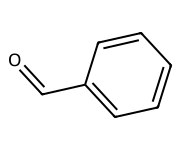
(B)
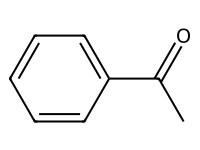
(C) HOCH
2−CO−(CHOH)
3−CH
2−OH
(D)
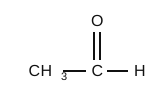
(E)
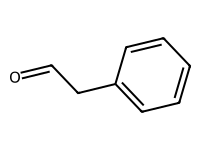
Choose the correct answer from the options given below :
वे यौगिक जो धनात्मक फेहलिंग परीक्षण (Fehling's test) देते हैं :
(A)
(B)
(C) HOCH
2−CO−(CHOH)
3−CH
2−OH
(D)
(E)
नीचे दिए गए विकल्पों में से सही उत्तर चुनिए :
- A(A), (D) and (E) Onlyकेवल (A), (D) और (E)
- B(C), (D) and (E) Onlyकेवल (C), (D) और (E)
- C(A), (C) and (D) Onlyकेवल (A), (C) और (D)
- D(A), (B) and (C) Onlyकेवल (A), (B) और (C)
Show answer
Concept: Fehling's solution is reduced (red Cu2O) by aliphatic aldehydes and by α-hydroxy ketones (reducing sugars); aromatic aldehydes and ordinary ketones do not respond.
- (A) Benzaldehyde – aromatic aldehyde, does not reduce Fehling's reagent ✗
- (B) Acetophenone – a ketone with no α-OH, negative ✗
- (C) HOCH2−CO−(CHOH)3−CH2OH (fructose) – an α-hydroxy ketone; in the alkaline medium it isomerises to the aldose form and reduces Fehling's solution ✓
- (D) Acetaldehyde – aliphatic aldehyde ✓
- (E) Phenylacetaldehyde – the CHO group is not attached directly to the ring, so it behaves as an aliphatic aldehyde ✓
Short trick: Fehling's: aliphatic CHO and reducing sugars = yes; ArCHO and simple ketones = no.
Answer: (B) (C), (D) and (E) Only
अवधारणा: फेहलिंग विलयन ऐलिफैटिक ऐल्डिहाइडों तथा α-हाइड्रॉक्सी कीटोनों (अपचायक शर्कराओं) द्वारा अपचयित होता है (लाल Cu2O); ऐरोमैटिक ऐल्डिहाइड तथा सामान्य कीटोन परीक्षण नहीं देते।
- (A) बेन्ज़ैल्डिहाइड – ऐरोमैटिक ऐल्डिहाइड, फेहलिंग अभिकर्मक को अपचयित नहीं करता ✗
- (B) ऐसीटोफ़ीनोन – कीटोन, जिसमें α-OH नहीं है, ऋणात्मक ✗
- (C) HOCH2−CO−(CHOH)3−CH2OH (फ्रक्टोस) – α-हाइड्रॉक्सी कीटोन; क्षारीय माध्यम में ऐल्डोस रूप में समावयवित होकर फेहलिंग विलयन को अपचयित करता है ✓
- (D) ऐसीटैल्डिहाइड – ऐलिफैटिक ऐल्डिहाइड ✓
- (E) फ़ेनिलऐसीटैल्डिहाइड – CHO समूह सीधे वलय से नहीं जुड़ा है, अतः यह ऐलिफैटिक ऐल्डिहाइड की तरह व्यवहार करता है ✓
शॉर्ट ट्रिक: फेहलिंग: ऐलिफैटिक CHO तथा अपचायक शर्कराएँ = हाँ; ArCHO तथा साधारण कीटोन = नहीं।
उत्तर: (B) केवल (C), (D) और (E)
JEE Main 2025 (January) – Paper 1 (B.E./B.Tech)ChemistryAldehydes & Ketones – Fehling's testJEE Main 2025 (January) – Paper 1 (B.E./B.Tech) 2025 · 22 Jan Shift 1
Q733.Which of the following electrolyte can be used to obtain H2S2O8 by the process of electrolysis?
विद्युत्-अपघटन की प्रक्रिया द्वारा H2S2O8 प्राप्त करने के लिए निम्नलिखित में से किस विद्युत्-अपघट्य का उपयोग किया जा सकता है?
- ADilute solution of sodium sulphate.सोडियम सल्फेट का तनु विलयन।
- BAcidified dilute solution of sodium sulphate.सोडियम सल्फेट का अम्लीकृत तनु विलयन।
- CDilute solution of sulphuric acidसल्फ्यूरिक अम्ल का तनु विलयन
- DConcentrated solution of sulphuric acidसल्फ्यूरिक अम्ल का सांद्र विलयन
Show answer
Concept: Peroxodisulphuric acid (H2S2O8) is manufactured by electrolysing cold, concentrated H2SO4 at a high current density.
- In concentrated H2SO4 the HSO4−/SO42− ions are oxidised at the anode: 2 HSO4− → H2S2O8 + 2e−; H2 is evolved at the cathode.
- In dilute H2SO4 or any dilute sodium sulphate solution, water is preferentially oxidised at the anode (O2 evolution), so no peroxodisulphate forms.
Answer: (D) Concentrated solution of sulphuric acid
अवधारणा: परॉक्सोडाइसल्फ्यूरिक अम्ल (H2S2O8) का निर्माण ठंडे, सांद्र H2SO4 के उच्च धारा घनत्व पर विद्युत्-अपघटन से होता है।
- सांद्र H2SO4 में ऐनोड पर HSO4−/SO42− आयनों का ऑक्सीकरण होता है: 2 HSO4− → H2S2O8 + 2e−; कैथोड पर H2 मुक्त होती है।
- तनु H2SO4 अथवा किसी भी तनु सोडियम सल्फेट विलयन में ऐनोड पर जल का ऑक्सीकरण (O2 उत्सर्जन) प्राथमिकता से होता है, अतः परॉक्सोडाइसल्फेट नहीं बनता।
उत्तर: (D) सल्फ्यूरिक अम्ल का सांद्र विलयन
JEE Main 2025 (January) – Paper 1 (B.E./B.Tech)ChemistryElectrochemistry – electrolysisJEE Main 2025 (January) – Paper 1 (B.E./B.Tech) 2025 · 22 Jan Shift 1
Q734.Given below are two statements :
Statement I : CH
3−O−CH
2−Cl will undergo S
N1 reaction though it is a primary halide.
Statement II :
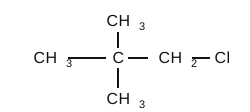
will not undergo S
N2 reaction very easily though it is a primary halide.
In the light of the above statements, choose the most appropriate answer from the options given below :
नीचे दो कथन दिए गए हैं :
कथन I : CH
3−O−CH
2−Cl प्राथमिक हैलाइड होते हुए भी S
N1 अभिक्रिया देगा।
कथन II :
प्राथमिक हैलाइड होते हुए भी S
N2 अभिक्रिया आसानी से नहीं देगा।
उपर्युक्त कथनों के आलोक में, नीचे दिए गए विकल्पों में से सबसे उपयुक्त उत्तर चुनिए :
- ABoth Statement I and Statement II are incorrectकथन I और कथन II दोनों गलत हैं
- BBoth Statement I and Statement II are correctकथन I और कथन II दोनों सही हैं
- CStatement I is incorrect but Statement II is correctकथन I गलत है परन्तु कथन II सही है
- DStatement I is correct but Statement II is incorrectकथन I सही है परन्तु कथन II गलत है
Show answer
Concept: SN1 depends on carbocation stability; SN2 depends on steric accessibility of the carbon bearing the leaving group.
- Statement I: ionisation of CH3−O−CH2−Cl gives CH3−O−CH2+, strongly stabilised by the oxygen lone pair (CH3−O+=CH2 resonance). This oxocarbenium stabilisation lets even a primary halide follow SN1 – correct.
- Statement II: in neopentyl chloride, (CH3)3C−CH2−Cl, the bulky tert-butyl group on the β-carbon blocks the backside attack of the nucleophile, so SN2 is extremely slow – correct.
Answer: (B) Both Statement I and Statement II are correct
अवधारणा: SN1 कार्बधनायन (carbocation) के स्थायित्व पर निर्भर करती है; SN2 विस्थापित समूह वाले कार्बन की त्रिविम सुलभता पर।
- कथन I: CH3−O−CH2−Cl के आयनन से CH3−O−CH2+ बनता है, जो ऑक्सीजन के एकाकी युग्म द्वारा प्रबल रूप से स्थायीकृत है (CH3−O+=CH2 अनुनाद)। इस ऑक्सोकार्बेनियम स्थायीकरण के कारण प्राथमिक हैलाइड भी SN1 पथ अपनाता है – सही।
- कथन II: निओपेन्टिल क्लोराइड, (CH3)3C−CH2−Cl, में β-कार्बन पर स्थूल tert-ब्यूटिल समूह नाभिकस्नेही के पश्च-आक्रमण (backside attack) को रोकता है, अतः SN2 अत्यंत धीमी होती है – सही।
उत्तर: (B) कथन I और कथन II दोनों सही हैं
JEE Main 2025 (January) – Paper 1 (B.E./B.Tech)ChemistryHaloalkanes – SN1/SN2JEE Main 2025 (January) – Paper 1 (B.E./B.Tech) 2025 · 22 Jan Shift 1
Q735.Which of the following acids is a vitamin?
निम्नलिखित में से कौन-सा अम्ल एक विटामिन है?
- AAdipic acidएडिपिक अम्ल
- BAscorbic acidएस्कॉर्बिक अम्ल
- CSaccharic acidसैकेरिक अम्ल
- DAspartic acidएस्पार्टिक अम्ल
Show answer
Concept: Vitamin C is chemically ascorbic acid, a water-soluble vitamin found in citrus fruits.
- (A) Adipic acid – a dicarboxylic acid used to make nylon-6,6, not a vitamin.
- (B) Ascorbic acid – vitamin C; its deficiency causes scurvy ✓
- (C) Saccharic acid – an oxidation product of glucose, not a vitamin.
- (D) Aspartic acid – an amino acid, not a vitamin.
Answer: (B) Ascorbic acid
अवधारणा: विटामिन C रासायनिक रूप से एस्कॉर्बिक अम्ल है, जो खट्टे फलों में पाया जाने वाला जल-विलेय विटामिन है।
- (A) एडिपिक अम्ल – नायलॉन-6,6 बनाने में प्रयुक्त डाइकार्बोक्सिलिक अम्ल, विटामिन नहीं।
- (B) एस्कॉर्बिक अम्ल – विटामिन C; इसकी कमी से स्कर्वी होता है ✓
- (C) सैकेरिक अम्ल – ग्लूकोस का ऑक्सीकरण उत्पाद, विटामिन नहीं।
- (D) एस्पार्टिक अम्ल – एक ऐमीनो अम्ल, विटामिन नहीं।
उत्तर: (B) एस्कॉर्बिक अम्ल
JEE Main 2025 (January) – Paper 1 (B.E./B.Tech)ChemistryBiomolecules – vitaminsJEE Main 2025 (January) – Paper 1 (B.E./B.Tech) 2025 · 22 Jan Shift 1
Q736.Match List-I with List-II.
| List-I | List-II |
|---|
| (A) | Al3+ < Mg2+ < Na+ < F− | (I) | Ionisation Enthalpy |
| (B) | B < C < O < N | (II) | Metallic character |
| (C) | B < Al < Mg < K | (III) | Electronegativity |
| (D) | Si < P < S < Cl | (IV) | Ionic radii |
Choose the correct answer from the options given below :
सूची-I का सूची-II से मिलान कीजिए।
| सूची-I | सूची-II |
|---|
| (A) | Al3+ < Mg2+ < Na+ < F− | (I) | आयनन एन्थैल्पी |
| (B) | B < C < O < N | (II) | धात्विक गुण |
| (C) | B < Al < Mg < K | (III) | विद्युत्-ऋणात्मकता |
| (D) | Si < P < S < Cl | (IV) | आयनिक त्रिज्याएँ |
नीचे दिए गए विकल्पों में से सही उत्तर चुनिए :
- A(A)-(IV), (B)-(I), (C)-(II), (D)-(III)
- B(A)-(IV), (B)-(I), (C)-(III), (D)-(II)
- C(A)-(III), (B)-(IV), (C)-(II), (D)-(I)
- D(A)-(II), (B)-(III), (C)-(IV), (D)-(I)
Show answer
Concept: Identify which periodic property each increasing order represents.
- (A) Al3+, Mg2+, Na+, F− are isoelectronic (10 e−); the higher the nuclear charge, the smaller the ion, so this is the order of ionic radii → (IV).
- (B) B < C < O < N fits ionisation enthalpy: it rises across the period but N (half-filled 2p3) lies above O → (I). It cannot be electronegativity, because electronegativity of O (3.44) is greater than that of N (3.04).
- (C) B < Al < Mg < K is the order of metallic character (increases down a group and towards the left) → (II).
- (D) Si < P < S < Cl rises smoothly across period 3 – the order of electronegativity → (III). It cannot be ionisation enthalpy because S lies below P (3p3 half-filled).
Answer: (A) (A)-(IV), (B)-(I), (C)-(II), (D)-(III)
अवधारणा: पहचानिए कि प्रत्येक बढ़ता क्रम किस आवर्त गुण को दर्शाता है।
- (A) Al3+, Mg2+, Na+, F− समइलेक्ट्रॉनिक हैं (10 e−); नाभिकीय आवेश जितना अधिक, आयन उतना छोटा, अतः यह आयनिक त्रिज्याओं का क्रम है → (IV)।
- (B) B < C < O < N आयनन एन्थैल्पी के अनुरूप है: यह आवर्त में बढ़ती है परन्तु N (अर्ध-पूरित 2p3) O से ऊपर रहता है → (I)। यह विद्युत्-ऋणात्मकता नहीं हो सकती, क्योंकि O (3.44) की विद्युत्-ऋणात्मकता N (3.04) से अधिक है।
- (C) B < Al < Mg < K धात्विक गुण का क्रम है (वर्ग में नीचे तथा बाईं ओर बढ़ता है) → (II)।
- (D) Si < P < S < Cl आवर्त 3 में क्रमिक रूप से बढ़ता है – विद्युत्-ऋणात्मकता का क्रम → (III)। यह आयनन एन्थैल्पी नहीं हो सकती क्योंकि S, P (अर्ध-पूरित 3p3) से नीचे है।
उत्तर: (A) (A)-(IV), (B)-(I), (C)-(II), (D)-(III)
JEE Main 2025 (January) – Paper 1 (B.E./B.Tech)ChemistryPeriodic Properties – trendsJEE Main 2025 (January) – Paper 1 (B.E./B.Tech) 2025 · 22 Jan Shift 1
Q737.Which of the following statement is not true for radioactive decay?
रेडियोधर्मी क्षय के लिए निम्नलिखित में से कौन-सा कथन सत्य नहीं है?
- ADecay constant increases with increase in temperature.ताप बढ़ने पर क्षय स्थिरांक बढ़ता है।
- BAmount of radioactive substance remained after three half lives is th of original amount.तीन अर्ध-आयु के बाद शेष रेडियोधर्मी पदार्थ की मात्रा मूल मात्रा की होती है।
- CDecay constant does not depend upon temperature.क्षय स्थिरांक ताप पर निर्भर नहीं करता।
- DHalf life is times of .अर्ध-आयु, का गुना होती है।
Show answer
Concept: Radioactive decay is a nuclear process: its decay constant depends only on the nuclide, not on temperature, pressure or chemical state.
- (A) "Decay constant increases with temperature" – false, so this is the statement that is not true.
- (B) After 3 half lives, N = N0/23 = N0/8 – true.
- (C) Decay constant is independent of temperature – true (this is why radiocarbon dating works).
- (D) , i.e. half life is times – true.
Answer: (A) Decay constant increases with increase in temperature.
अवधारणा: रेडियोधर्मी क्षय एक नाभिकीय प्रक्रिया है: इसका क्षय स्थिरांक केवल नाभिक (nuclide) पर निर्भर करता है, ताप, दाब या रासायनिक अवस्था पर नहीं।
- (A) "ताप बढ़ने पर क्षय स्थिरांक बढ़ता है" – असत्य, अतः यही कथन सत्य नहीं है।
- (B) 3 अर्ध-आयु के बाद, N = N0/23 = N0/8 – सत्य।
- (C) क्षय स्थिरांक ताप से स्वतंत्र है – सत्य (इसीलिए रेडियोकार्बन कालनिर्धारण संभव है)।
- (D) , अर्थात् अर्ध-आयु का गुना है – सत्य।
उत्तर: (A) ताप बढ़ने पर क्षय स्थिरांक बढ़ता है।
JEE Main 2025 (January) – Paper 1 (B.E./B.Tech)ChemistryChemical Kinetics – radioactive decayJEE Main 2025 (January) – Paper 1 (B.E./B.Tech) 2025 · 22 Jan Shift 1
Q738.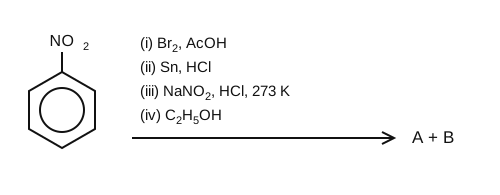
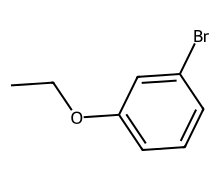
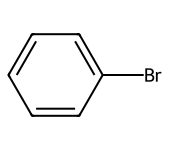
The products formed in the following reaction sequence are :
निम्नलिखित अभिक्रिया अनुक्रम में बनने वाले उत्पाद हैं :
- A
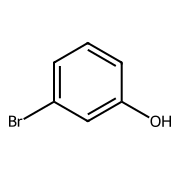 , CH3−CHO
- B
 , CH3−COOH
- C
 , CH3−CHO
- D,
Show answer
Concept: −NO2 is a meta-directing deactivator; a diazonium salt treated with ethanol is reduced to the arene (the −N2+ group is replaced by H) while ethanol is oxidised to acetaldehyde.
- Nitrobenzene + Br2/AcOH → 1-bromo-3-nitrobenzene (meta attack).
- Sn, HCl reduces −NO2 to −NH2: 3-bromoaniline.
- NaNO2, HCl at 273 K → 3-bromobenzenediazonium chloride.
- C2H5OH replaces the diazonium group by H, giving bromobenzene (A) and is itself oxidised to CH3CHO (B).
- Why the others fail: (A) and (D) need a phenol (formed by boiling the diazonium salt with water, not ethanol); (B) would need an ether as the major product and oxidation of ethanol up to acetic acid – neither happens here.
Answer: (C) bromobenzene and CH3−CHO
अवधारणा: −NO2 मेटा-निर्देशक निष्क्रियकारक है; डाइऐजोनियम लवण एथेनॉल से अपचयित होकर ऐरीन देता है (−N2+ समूह H द्वारा प्रतिस्थापित) जबकि एथेनॉल ऐसीटैल्डिहाइड में ऑक्सीकृत हो जाता है।
- नाइट्रोबेन्ज़ीन + Br2/AcOH → 1-ब्रोमो-3-नाइट्रोबेन्ज़ीन (मेटा आक्रमण)।
- Sn, HCl, −NO2 को −NH2 में अपचयित करता है: 3-ब्रोमोऐनिलीन।
- NaNO2, HCl, 273 K पर → 3-ब्रोमोबेन्ज़ीनडाइऐजोनियम क्लोराइड।
- C2H5OH डाइऐजोनियम समूह को H से प्रतिस्थापित कर ब्रोमोबेन्ज़ीन (A) देता है तथा स्वयं CH3CHO (B) में ऑक्सीकृत हो जाता है।
- अन्य विकल्प क्यों गलत हैं: (A) तथा (D) के लिए फ़ीनॉल चाहिए (जो डाइऐजोनियम लवण को जल के साथ उबालने पर बनता है, एथेनॉल से नहीं); (B) के लिए मुख्य उत्पाद ईथर तथा एथेनॉल का ऐसीटिक अम्ल तक ऑक्सीकरण चाहिए – यहाँ दोनों नहीं होते।
उत्तर: (C) ब्रोमोबेन्ज़ीन और CH3−CHO
JEE Main 2025 (January) – Paper 1 (B.E./B.Tech)ChemistryAmines – diazonium chemistryJEE Main 2025 (January) – Paper 1 (B.E./B.Tech) 2025 · 22 Jan Shift 1
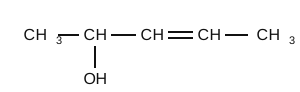
Q739.How many different stereoisomers are possible for the given molecule?
दिए गए अणु के लिए कितने भिन्न त्रिविम समावयवी (stereoisomers) संभव हैं?
- A2
- B1
- C4
- D3
Show answer
Concept: Number of stereoisomers = 2(stereocentres + stereogenic double bonds) when no symmetry makes any of them identical.
- The molecule is pent-3-en-2-ol: CH3−CH(OH)−CH=CH−CH3.
- C-2 carries four different groups (H, OH, CH3, propenyl) – one chiral centre → R/S.
- The C3=C4 double bond has different groups on each carbon – it shows cis/trans (E/Z) isomerism.
- Total stereoisomers = 2 × 2 = 4 (2R,E; 2S,E; 2R,Z; 2S,Z).
Short trick: 1 chiral centre + 1 C=C with geometrical isomerism → 22 = 4.
Answer: (C) 4
अवधारणा: त्रिविम समावयवियों की संख्या = 2(त्रिविम केंद्र + त्रिविमजनक द्विबंध), जब कोई सममिति उन्हें समान न बनाए।
- अणु पेन्ट-3-ईन-2-ऑल है: CH3−CH(OH)−CH=CH−CH3।
- C-2 पर चार भिन्न समूह (H, OH, CH3, प्रोपेनिल) हैं – एक किरैल केंद्र → R/S।
- C3=C4 द्विबंध के प्रत्येक कार्बन पर भिन्न समूह हैं – यह सिस/ट्रांस (E/Z) समावयवता दर्शाता है।
- कुल त्रिविम समावयवी = 2 × 2 = 4 (2R,E; 2S,E; 2R,Z; 2S,Z)।
शॉर्ट ट्रिक: 1 किरैल केंद्र + 1 ज्यामितीय समावयवता वाला C=C → 22 = 4।
उत्तर: (C) 4
JEE Main 2025 (January) – Paper 1 (B.E./B.Tech)ChemistryStereochemistry – stereoisomersJEE Main 2025 (January) – Paper 1 (B.E./B.Tech) 2025 · 22 Jan Shift 1
Q740.A vessel at 1000 K contains CO2 with a pressure of 0.5 atm. Some of CO2 is converted into CO on addition of graphite. If total pressure at equilibrium is 0.8 atm, then Kp is :
1000 K पर एक पात्र में 0.5 atm दाब पर CO2 है। ग्रेफाइट मिलाने पर कुछ CO2, CO में परिवर्तित हो जाती है। यदि साम्य पर कुल दाब 0.8 atm है, तो Kp है :
- A1.8 atm
- B0.3 atm
- C3 atm
- D0.18 atm
Show answer
Concept: For the heterogeneous equilibrium CO2(g) + C(s) ⇌ 2 CO(g), (solid graphite is omitted).
- Let atm of CO2 react: , .
- Total pressure: atm.
- So atm and atm.
- atm.
Answer: (A) 1.8 atm
अवधारणा: विषमांगी साम्य CO2(g) + C(s) ⇌ 2 CO(g) के लिए (ठोस ग्रेफाइट सम्मिलित नहीं होता)।
- माना atm CO2 अभिक्रिया करती है: , ।
- कुल दाब: atm।
- अतः atm तथा atm।
- atm।
उत्तर: (A) 1.8 atm
JEE Main 2025 (January) – Paper 1 (B.E./B.Tech)ChemistryChemical Equilibrium – KpJEE Main 2025 (January) – Paper 1 (B.E./B.Tech) 2025 · 22 Jan Shift 1

