JEE Main 2025 (January) – Paper 1 (B.E./B.Tech) · 750 questions

JEE Main 2025 (January) – Paper 1 (B.E./B.Tech) 2025 PYQs

Real previous year questions, subject-wise. Try the question, then open the answer and the explanation in Hindi & English – free, no login.

Courses – airGurukul

750 questions.

Q741.
A solution of aluminium chloride is electrolysed for 30 minutes using a current of 2 A. The amount of the aluminium deposited at the cathode is [Given : molar mass of aluminium and chlorine are 27 g mol−1 and 35.5 g mol−1 respectively. Faraday constant = 96500 C mol−1]
ऐलुमिनियम क्लोराइड के विलयन का 2 A धारा से 30 मिनट तक विद्युत्-अपघटन किया गया। कैथोड पर निक्षेपित ऐलुमिनियम की मात्रा है [दिया है : ऐलुमिनियम तथा क्लोरीन के मोलर द्रव्यमान क्रमशः 27 g mol−1 तथा 35.5 g mol−1 हैं। फैराडे स्थिरांक = 96500 C mol−1]
  1. A1.660 g
  2. B0.336 g
  3. C0.441 g
  4. D1.007 g
Show answer

Concept: Faraday's first law: moles of electrons passed =ItF; Al3+ + 3e− → Al needs 3 mol electrons per mol Al.

  1. Charge: Q=It=2×30×60=3600 C.
  2. Moles of electrons =360096500=0.0373 mol.
  3. Moles of Al deposited =0.03733=0.01244 mol.
  4. Mass =0.01244×27=0.336 g.

Short trick: m=ItMnF=3600×273×96500=0.336 g.

Answer: (B) 0.336 g

अवधारणा: फैराडे का प्रथम नियम: प्रवाहित इलेक्ट्रॉनों के मोल =ItF; Al3+ + 3e− → Al के लिए प्रति मोल Al, 3 मोल इलेक्ट्रॉन चाहिए।

  1. आवेश: Q=It=2×30×60=3600 C।
  2. इलेक्ट्रॉनों के मोल =360096500=0.0373 मोल।
  3. निक्षेपित Al के मोल =0.03733=0.01244 मोल।
  4. द्रव्यमान =0.01244×27=0.336 g।

शॉर्ट ट्रिक: m=ItMnF=3600×273×96500=0.336 g।

उत्तर: (B) 0.336 g

JEE Main 2025 (January) – Paper 1 (B.E./B.Tech)ChemistryElectrochemistry – Faraday's lawsJEE Main 2025 (January) – Paper 1 (B.E./B.Tech) 2025 · 22 Jan Shift 1
Q742.
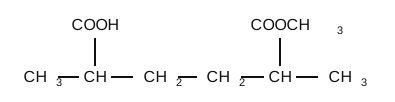
The IUPAC name of the following compound is :
निम्नलिखित यौगिक का IUPAC नाम है :
  1. AMethyl-6-carboxy-2,5-dimethylhexanoate.मेथिल-6-कार्बोक्सी-2,5-डाइमेथिलहेक्सेनोएट।
  2. B2-Carboxy-5-methoxycarbonylhexane.2-कार्बोक्सी-5-मेथॉक्सीकार्बोनिलहेक्सेन।
  3. C6-Methoxycarbonyl-2,5-dimethylhexanoic acid.6-मेथॉक्सीकार्बोनिल-2,5-डाइमेथिलहेक्सेनोइक अम्ल।
  4. DMethyl-5-carboxy-2-methylhexanoate.मेथिल-5-कार्बोक्सी-2-मेथिलहेक्सेनोएट।
Show answer

Concept: −COOH is senior to the ester group, so the compound must be named as an -oic acid with the carboxylic carbon as C-1; the −COOCH3 group is then cited as the substituent "methoxycarbonyl".

  1. (A) and (D) name the molecule as an ester (…hexanoate) with COOH as a "carboxy" substituent – this inverts the seniority order (acid > ester), so both are wrong.
  2. (B) names it as a plain hexane, ignoring the senior acid group altogether – wrong.
  3. Numbering from the acid carbon, the chain running up to the ester carbonyl is a six-carbon acid chain carrying methyl groups at C-2 and C-5, with the −COOCH3 (methoxycarbonyl) group at the far end.
  4. This gives the name 6-methoxycarbonyl-2,5-dimethylhexanoic acid.

Short trick: Acid beats ester: the name must end in "…oic acid", which only one option does.

Answer: (C) 6-Methoxycarbonyl-2,5-dimethylhexanoic acid.

अवधारणा: −COOH एस्टर समूह से वरिष्ठ है, अतः यौगिक का नाम -ओइक अम्ल के रूप में रखा जाएगा जिसमें कार्बोक्सिलिक कार्बन C-1 होगा; −COOCH3 समूह को तब "मेथॉक्सीकार्बोनिल" प्रतिस्थापी के रूप में लिखा जाता है।

  1. (A) तथा (D) अणु को एस्टर (…हेक्सेनोएट) नाम देते हैं जिसमें COOH को "कार्बोक्सी" प्रतिस्थापी बनाया गया है – यह वरिष्ठता क्रम (अम्ल > एस्टर) के विपरीत है, अतः दोनों गलत।
  2. (B) इसे साधारण हेक्सेन नाम देता है और वरिष्ठ अम्ल समूह की पूर्ण उपेक्षा करता है – गलत।
  3. अम्ल कार्बन से क्रमांकन करने पर, एस्टर कार्बोनिल तक जाने वाली शृंखला छह कार्बन की अम्ल शृंखला है जिसमें C-2 तथा C-5 पर मेथिल समूह और दूरस्थ सिरे पर −COOCH3 (मेथॉक्सीकार्बोनिल) समूह है।
  4. इससे नाम बनता है 6-मेथॉक्सीकार्बोनिल-2,5-डाइमेथिलहेक्सेनोइक अम्ल।

शॉर्ट ट्रिक: अम्ल, एस्टर से वरिष्ठ है: नाम "…ओइक अम्ल" पर समाप्त होना चाहिए, जो केवल एक विकल्प में है।

उत्तर: (C) 6-मेथॉक्सीकार्बोनिल-2,5-डाइमेथिलहेक्सेनोइक अम्ल।

JEE Main 2025 (January) – Paper 1 (B.E./B.Tech)ChemistryIUPAC NomenclatureJEE Main 2025 (January) – Paper 1 (B.E./B.Tech) 2025 · 22 Jan Shift 1
Q743.
In which of the following complexes the CFSE, Δo will be equal to zero?
निम्नलिखित में से किस संकुल में CFSE, Δo शून्य के बराबर होगी?
  1. A[Fe(en)3]Cl3
  2. BK4[Fe(CN)6]
  3. C[Fe(NH3)6]Br2
  4. DK3[Fe(SCN)6]
Show answer

Concept: For an octahedral complex CFSE = (−0.4 nt2g + 0.6 neg)Δo; it is zero for a high-spin d5 ion (t2g3eg2).

  1. (A) [Fe(en)3]3+: Fe3+ (d5) with strong-field en → low spin t2g5, CFSE = −2.0 Δo ≠ 0.
  2. (B) [Fe(CN)6]4−: Fe2+ (d6) with CN− → t2g6, CFSE = −2.4 Δo ≠ 0.
  3. (C) [Fe(NH3)6]2+: Fe2+ (d6) high spin t2g4eg2, CFSE = −0.4 Δo ≠ 0.
  4. (D) [Fe(SCN)6]3−: Fe3+ (d5) with weak-field SCN− → high spin t2g3eg2; CFSE = 3(−0.4) + 2(+0.6) = 0.

Short trick: CFSE = 0 only for high-spin d5 (and d0, d10): look for Fe3+ with a weak-field ligand.

Answer: (D) K3[Fe(SCN)6]

अवधारणा: अष्टफलकीय संकुल के लिए CFSE = (−0.4 nt2g + 0.6 neg)Δo; उच्च चक्रण d5 आयन (t2g3eg2) के लिए यह शून्य होती है।

  1. (A) [Fe(en)3]3+: Fe3+ (d5) प्रबल क्षेत्र en के साथ → निम्न चक्रण t2g5, CFSE = −2.0 Δo ≠ 0।
  2. (B) [Fe(CN)6]4−: Fe2+ (d6) CN− के साथ → t2g6, CFSE = −2.4 Δo ≠ 0।
  3. (C) [Fe(NH3)6]2+: Fe2+ (d6) उच्च चक्रण t2g4eg2, CFSE = −0.4 Δo ≠ 0।
  4. (D) [Fe(SCN)6]3−: Fe3+ (d5) दुर्बल क्षेत्र SCN− के साथ → उच्च चक्रण t2g3eg2; CFSE = 3(−0.4) + 2(+0.6) = 0।

शॉर्ट ट्रिक: CFSE = 0 केवल उच्च चक्रण d5 (तथा d0, d10) के लिए: दुर्बल क्षेत्र लिगैंड वाला Fe3+ खोजिए।

उत्तर: (D) K3[Fe(SCN)6]

JEE Main 2025 (January) – Paper 1 (B.E./B.Tech)ChemistryCoordination Compounds – CFSEJEE Main 2025 (January) – Paper 1 (B.E./B.Tech) 2025 · 22 Jan Shift 1
Q744.
Arrange the following solutions in order of their increasing boiling points.
(i) 10−4 M NaCl (ii) 10−4 M Urea (iii) 10−3 M NaCl (iv) 10−2 M NaCl
निम्नलिखित विलयनों को उनके बढ़ते क्वथनांक के क्रम में व्यवस्थित कीजिए।
(i) 10−4 M NaCl (ii) 10−4 M यूरिया (iii) 10−3 M NaCl (iv) 10−2 M NaCl
  1. A(i) < (ii) < (iii) < (iv)
  2. B(iv) < (iii) < (i) < (ii)
  3. C(ii) < (i) ≡ (iii) < (iv)
  4. D(ii) < (i) < (iii) < (iv)
Show answer

Concept: Boiling point elevation ΔTb = i Kb m: compare the product (van't Hoff factor i × concentration). NaCl gives i = 2, urea i = 1.

  1. (ii) 10−4 M urea → effective concentration 1 × 10⁻⁴.
  2. (i) 10−4 M NaCl → 2 × 10⁻⁴.
  3. (iii) 10−3 M NaCl → 2 × 10⁻³.
  4. (iv) 10−2 M NaCl → 2 × 10⁻².
  5. Increasing boiling point: (ii) < (i) < (iii) < (iv). The option with (i) ≡ (iii) is wrong because 2 × 10⁻⁴ and 2 × 10⁻³ are not equal.

Answer: (D) (ii) < (i) < (iii) < (iv)

अवधारणा: क्वथनांक उन्नयन ΔTb = i Kb m: गुणनफल (वान्ट हॉफ गुणांक i × सांद्रता) की तुलना कीजिए। NaCl के लिए i = 2, यूरिया के लिए i = 1।

  1. (ii) 10−4 M यूरिया → प्रभावी सांद्रता 1 × 10⁻⁴।
  2. (i) 10−4 M NaCl → 2 × 10⁻⁴।
  3. (iii) 10−3 M NaCl → 2 × 10⁻³।
  4. (iv) 10−2 M NaCl → 2 × 10⁻²।
  5. बढ़ता क्वथनांक: (ii) < (i) < (iii) < (iv)। (i) ≡ (iii) वाला विकल्प गलत है क्योंकि 2 × 10⁻⁴ तथा 2 × 10⁻³ बराबर नहीं हैं।

उत्तर: (D) (ii) < (i) < (iii) < (iv)

JEE Main 2025 (January) – Paper 1 (B.E./B.Tech)ChemistrySolutions – colligative propertiesJEE Main 2025 (January) – Paper 1 (B.E./B.Tech) 2025 · 22 Jan Shift 1
Q745.
From the magnetic behaviour of [NiCl4]2− (paramagnetic) and [Ni(CO)4] (diamagnetic), choose the correct geometry and oxidation state.
[NiCl4]2− (अनुचुंबकीय) तथा [Ni(CO)4] (प्रतिचुंबकीय) के चुंबकीय व्यवहार से सही ज्यामिति एवं ऑक्सीकरण अवस्था चुनिए।
  1. A[NiCl4]2− : NiII, tetrahedral [Ni(CO)4] : NiII, square planar[NiCl4]2− : NiII, चतुष्फलकीय [Ni(CO)4] : NiII, वर्ग समतलीय
  2. B[NiCl4]2− : NiII, square planar [Ni(CO)4] : Ni(0), square planar[NiCl4]2− : NiII, वर्ग समतलीय [Ni(CO)4] : Ni(0), वर्ग समतलीय
  3. C[NiCl4]2− : NiII, tetrahedral [Ni(CO)4] : Ni(0), tetrahedral[NiCl4]2− : NiII, चतुष्फलकीय [Ni(CO)4] : Ni(0), चतुष्फलकीय
  4. D[NiCl4]2− : Ni(0), tetrahedral [Ni(CO)4] : Ni(0), square planar[NiCl4]2− : Ni(0), चतुष्फलकीय [Ni(CO)4] : Ni(0), वर्ग समतलीय
Show answer

Concept: With four ligands, a weak-field ligand on Ni2+ gives sp3 tetrahedral (paramagnetic), while Ni(0) with the strong π-acceptor CO gives a 3d10 sp3 tetrahedral diamagnetic complex.

  1. [NiCl4]2−: Cl− ligands (each −1) → Ni is +2 (3d8); weak-field Cl− causes no pairing → sp3, tetrahedral, two unpaired electrons → paramagnetic.
  2. [Ni(CO)4]: CO is neutral → Ni(0) (3d84s2); strong-field CO forces the 4s electrons into 3d → 3d10, sp3, tetrahedral, diamagnetic.
  3. Both complexes are therefore tetrahedral: the options calling either of them square planar are wrong, and the one giving Ni(0) for [NiCl4]2− assigns an impossible oxidation state.

Answer: (C) [NiCl4]2− : NiII, tetrahedral; [Ni(CO)4] : Ni(0), tetrahedral

अवधारणा: चार लिगैंडों के साथ, Ni2+ पर दुर्बल क्षेत्र लिगैंड sp3 चतुष्फलकीय (अनुचुंबकीय) देता है, जबकि प्रबल π-ग्राही CO के साथ Ni(0) 3d10 sp3 चतुष्फलकीय प्रतिचुंबकीय संकुल देता है।

  1. [NiCl4]2−: Cl− लिगैंड (प्रत्येक −1) → Ni की अवस्था +2 (3d8); दुर्बल क्षेत्र Cl− युग्मन नहीं कराता → sp3, चतुष्फलकीय, दो अयुग्मित इलेक्ट्रॉन → अनुचुंबकीय।
  2. [Ni(CO)4]: CO उदासीन है → Ni(0) (3d84s2); प्रबल क्षेत्र CO 4s इलेक्ट्रॉनों को 3d में भेज देता है → 3d10, sp3, चतुष्फलकीय, प्रतिचुंबकीय।
  3. अतः दोनों संकुल चतुष्फलकीय हैं: जिन विकल्पों में किसी को वर्ग समतलीय कहा गया है वे गलत हैं, और [NiCl4]2− के लिए Ni(0) देने वाला विकल्प असंभव ऑक्सीकरण अवस्था देता है।

उत्तर: (C) [NiCl4]2− : NiII, चतुष्फलकीय; [Ni(CO)4] : Ni(0), चतुष्फलकीय

JEE Main 2025 (January) – Paper 1 (B.E./B.Tech)ChemistryCoordination Compounds – magnetism & geometryJEE Main 2025 (January) – Paper 1 (B.E./B.Tech) 2025 · 22 Jan Shift 1
Q746.
The number of molecules/ions that show linear geometry among the following is ________
SO2, BeCl2, CO2, N3−, NO2, F2O, XeF2, NO2+, I3−, O3
निम्नलिखित में से रेखीय ज्यामिति दर्शाने वाले अणुओं/आयनों की संख्या ________ है
SO2, BeCl2, CO2, N3−, NO2, F2O, XeF2, NO2+, I3−, O3
Show answer

Concept: A triatomic species is linear if the central atom has no lone pair (sp hybridisation) or if its three lone pairs occupy the equatorial plane of a trigonal bipyramid (sp3d, AX2E3).

  1. Linear: BeCl2 (sp, no lone pair), CO2 (sp), N3− (sp, 16-electron azide), XeF2 (sp3d, AX2E3), NO2+ (sp, isoelectronic with CO2), I3− (sp3d, AX2E3) → 6 species.
  2. Bent: SO2 (one lone pair), NO2 (one odd electron on N), F2O (two lone pairs), O3 (one lone pair).

Short trick: 16-valence-electron triatomics (CO2, N3−, NO2+) are always linear; add BeCl2, XeF2, I3−.

Answer: 6

अवधारणा: त्रिपरमाणुक स्पीशीज़ रेखीय होती है यदि केंद्रीय परमाणु पर कोई एकाकी युग्म न हो (sp संकरण) अथवा उसके तीन एकाकी युग्म त्रिकोणीय द्विपिरैमिड के विषुवतीय तल में हों (sp3d, AX2E3)।

  1. रेखीय: BeCl2 (sp, कोई एकाकी युग्म नहीं), CO2 (sp), N3− (sp, 16-इलेक्ट्रॉन ऐज़ाइड), XeF2 (sp3d, AX2E3), NO2+ (sp, CO2 के समइलेक्ट्रॉनिक), I3− (sp3d, AX2E3) → 6 स्पीशीज़।
  2. बंकित (bent): SO2 (एक एकाकी युग्म), NO2 (N पर एक अयुग्मित इलेक्ट्रॉन), F2O (दो एकाकी युग्म), O3 (एक एकाकी युग्म)।

शॉर्ट ट्रिक: 16-संयोजी-इलेक्ट्रॉन त्रिपरमाणुक (CO2, N3−, NO2+) सदैव रेखीय होते हैं; साथ में BeCl2, XeF2, I3− जोड़िए।

उत्तर: 6

JEE Main 2025 (January) – Paper 1 (B.E./B.Tech)ChemistryChemical Bonding – molecular geometryJEE Main 2025 (January) – Paper 1 (B.E./B.Tech) 2025 · 22 Jan Shift 1
Q747.
A → B
The molecule A changes into its isomeric form B by following a first order kinetics at a temperature of 1000 K. If the energy barrier with respect to reactant energy for such isomeric transformation is 191.48 kJ mol−1 and the frequency factor is 1020, the time required for 50% molecules of A to become B is _________ picoseconds (nearest integer). [R = 8.314 J K−1 mol−1]
A → B
अणु A, 1000 K ताप पर प्रथम कोटि बलगतिकी का पालन करते हुए अपने समावयवी रूप B में परिवर्तित होता है। यदि इस समावयवी रूपांतरण के लिए अभिकारक ऊर्जा के सापेक्ष ऊर्जा अवरोध 191.48 kJ mol−1 है तथा आवृत्ति गुणांक 1020 है, तो A के 50% अणुओं के B में बदलने में लगने वाला समय _________ पिकोसेकंड (निकटतम पूर्णांक) है। [R = 8.314 J K−1 mol−1]
Show answer

Concept: Arrhenius equation k=Ae−Ea/RT; for a first order reaction t1/2=0.693k.

  1. EaRT=1914808.314×1000=23.03=2.303×10.
  2. Hence e−Ea/RT=e−2.303×10=10−10.
  3. k=1020×10−10=1010 s−1.
  4. t1/2=0.6931010=6.93×10−11 s=69.3 ps ≈69 ps.

Short trick: Whenever Ea/RT equals 2.303×n, the exponential is simply 10−n.

Answer: 69

अवधारणा: आरेनियस समीकरण k=Ae−Ea/RT; प्रथम कोटि अभिक्रिया के लिए t1/2=0.693k।

  1. EaRT=1914808.314×1000=23.03=2.303×10।
  2. अतः e−Ea/RT=e−2.303×10=10−10।
  3. k=1020×10−10=1010 s−1।
  4. t1/2=0.6931010=6.93×10−11 s=69.3 ps ≈69 ps।

शॉर्ट ट्रिक: जब भी Ea/RT=2.303×n हो, चरघातांकी पद सीधे 10−n होता है।

उत्तर: 69

JEE Main 2025 (January) – Paper 1 (B.E./B.Tech)ChemistryChemical Kinetics – Arrhenius equationJEE Main 2025 (January) – Paper 1 (B.E./B.Tech) 2025 · 22 Jan Shift 1
Q748.

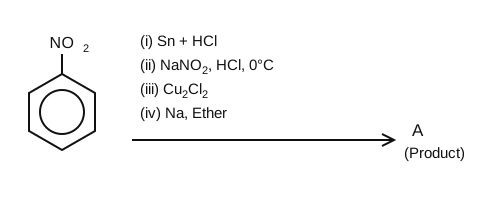
Consider the following sequence of reactions :
Molar mass of the product formed (A) is _______ g mol−1.

निम्नलिखित अभिक्रिया अनुक्रम पर विचार कीजिए :
बनने वाले उत्पाद (A) का मोलर द्रव्यमान _______ g mol−1 है।
Show answer

Concept: Diazotisation followed by Sandmeyer reaction gives a haloarene, and a haloarene with Na in dry ether (Fittig reaction) couples to a biaryl.

  1. Nitrobenzene + Sn/HCl → aniline.
  2. Aniline + NaNO2/HCl at 0°C → benzenediazonium chloride.
  3. Cu2Cl2 (Sandmeyer) → chlorobenzene.
  4. 2 C6H5Cl + 2 Na (dry ether, Fittig) → C6H5−C6H5 (biphenyl) + 2 NaCl.
  5. Molar mass of biphenyl C12H10 = 12 × 12 + 10 × 1 = 154 g mol−1.

Answer: 154

अवधारणा: डाइऐज़ोटीकरण के बाद सैंडमायर अभिक्रिया हैलोऐरीन देती है, और हैलोऐरीन शुष्क ईथर में Na के साथ (फिटिग अभिक्रिया) युग्मित होकर बाइऐरिल बनाती है।

  1. नाइट्रोबेन्ज़ीन + Sn/HCl → ऐनिलीन।
  2. ऐनिलीन + NaNO2/HCl, 0°C पर → बेन्ज़ीनडाइऐजोनियम क्लोराइड।
  3. Cu2Cl2 (सैंडमायर) → क्लोरोबेन्ज़ीन।
  4. 2 C6H5Cl + 2 Na (शुष्क ईथर, फिटिग) → C6H5−C6H5 (बाइफ़ेनिल) + 2 NaCl।
  5. बाइफ़ेनिल C12H10 का मोलर द्रव्यमान = 12 × 12 + 10 × 1 = 154 g mol−1।

उत्तर: 154

JEE Main 2025 (January) – Paper 1 (B.E./B.Tech)ChemistryHaloarenes – Fittig reactionJEE Main 2025 (January) – Paper 1 (B.E./B.Tech) 2025 · 22 Jan Shift 1
Q749.
Some CO2 gas was kept in a sealed container at a pressure of 1 atm and at 273 K. This entire amount of CO2 gas was later passed through an aqueous solution of Ca(OH)2. The excess unreacted Ca(OH)2 was later neutralized with 0.1 M of 40 mL HCl. If the volume of the sealed container of CO2 was x, then x is ________ cm3 (nearest integer).
[Given : The entire amount of CO2(g) reacted with exactly half the initial amount of Ca(OH)2 present in the aqueous solution.]
कुछ CO2 गैस को 1 atm दाब तथा 273 K पर एक बंद (sealed) पात्र में रखा गया। बाद में यह सम्पूर्ण CO2 गैस Ca(OH)2 के जलीय विलयन में प्रवाहित की गई। शेष अनभिकृत Ca(OH)2 को बाद में 0.1 M के 40 mL HCl से उदासीन किया गया। यदि CO2 के बंद पात्र का आयतन x था, तो x = ________ cm3 (निकटतम पूर्णांक)।
[दिया है : CO2(g) की सम्पूर्ण मात्रा ने जलीय विलयन में उपस्थित Ca(OH)2 की प्रारंभिक मात्रा के ठीक आधे भाग से अभिक्रिया की।]
Show answer

Concept: CO2 + Ca(OH)2 → CaCO3 + H2O (1 : 1) and Ca(OH)2 + 2 HCl → CaCl2 + 2 H2O (1 : 2); at 273 K and 1 atm one mole of gas occupies 22400 cm3.

  1. Moles of HCl used = 0.1 × 40/1000 = 4 × 10⁻³ mol.
  2. Excess Ca(OH)2 = 4 × 10⁻³/2 = 2 × 10⁻³ mol.
  3. This excess is half of the initial amount, so initial Ca(OH)2 = 4 × 10⁻³ mol, and the half that reacted = 2 × 10⁻³ mol.
  4. CO2 reacts 1 : 1, so n(CO2) = 2 × 10⁻³ mol.
  5. At 1 atm, 273 K: x = 2 × 10−3 × 22400 = 44.8 cm3 ≈ 45 cm3.

Answer: 45

अवधारणा: CO2 + Ca(OH)2 → CaCO3 + H2O (1 : 1) तथा Ca(OH)2 + 2 HCl → CaCl2 + 2 H2O (1 : 2); 273 K तथा 1 atm पर एक मोल गैस 22400 cm3 आयतन घेरती है।

  1. प्रयुक्त HCl के मोल = 0.1 × 40/1000 = 4 × 10⁻³ मोल।
  2. शेष Ca(OH)2 = 4 × 10⁻³/2 = 2 × 10⁻³ मोल।
  3. यह शेष, प्रारंभिक मात्रा का आधा है, अतः प्रारंभिक Ca(OH)2 = 4 × 10⁻³ मोल, और अभिकृत आधा भाग = 2 × 10⁻³ मोल।
  4. CO2 की अभिक्रिया 1 : 1 है, अतः n(CO2) = 2 × 10⁻³ मोल।
  5. 1 atm, 273 K पर: x = 2 × 10−3 × 22400 = 44.8 cm3 ≈ 45 cm3।

उत्तर: 45

JEE Main 2025 (January) – Paper 1 (B.E./B.Tech)ChemistryMole Concept – stoichiometryJEE Main 2025 (January) – Paper 1 (B.E./B.Tech) 2025 · 22 Jan Shift 1
Q750.
In Carius method for estimation of halogens, 180 mg of an organic compound produced 143.5 mg of AgCl. The percentage composition of chlorine in the compound is _______ %.
(Given : molar mass in g mol−1 of Ag : 108, Cl : 35.5)
हैलोजनों के आकलन की कैरियस विधि (Carius method) में 180 mg कार्बनिक यौगिक से 143.5 mg AgCl प्राप्त हुआ। यौगिक में क्लोरीन की प्रतिशत मात्रा _______ % है।
(दिया है : g mol−1 में मोलर द्रव्यमान, Ag : 108, Cl : 35.5)
Show answer

Concept: In the Carius method, % halogen =35.5143.5×mAgClmcompound×100 (M of AgCl = 108 + 35.5 = 143.5 g mol−1).

  1. Moles of AgCl =143.5 mg143.5 g mol−1=1×10⁻³ mol.
  2. Mass of Cl in it =10−3×35.5=35.5 mg.
  3. % Cl =35.5180×100=19.72≈20 %.

Short trick: 143.5 mg AgCl is exactly 1 mmol, which carries 35.5 mg Cl.

Answer: 20

अवधारणा: कैरियस विधि में, % हैलोजन =35.5143.5×mAgClmcompound×100 (AgCl का M = 108 + 35.5 = 143.5 g mol−1)।

  1. AgCl के मोल =143.5 mg143.5 g mol−1=1×10⁻³ मोल।
  2. इसमें Cl का द्रव्यमान =10−3×35.5=35.5 mg।
  3. % Cl =35.5180×100=19.72≈20 %।

शॉर्ट ट्रिक: 143.5 mg AgCl ठीक 1 mmol है, जिसमें 35.5 mg Cl होता है।

उत्तर: 20

JEE Main 2025 (January) – Paper 1 (B.E./B.Tech)ChemistryOrganic Analysis – Carius methodJEE Main 2025 (January) – Paper 1 (B.E./B.Tech) 2025 · 22 Jan Shift 1