Q221.A constant voltage of 50 V is maintained between the points A and B of the circuit shown in the figure. The current through the branch CD of the circuit is:
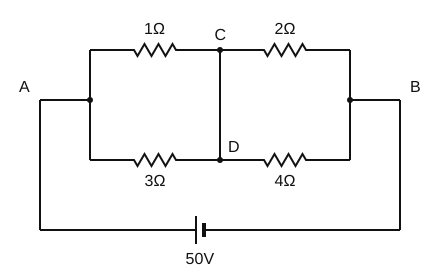
चित्र में दर्शाए गए परिपथ के बिंदुओं A और B के बीच 50 V की नियत वोल्टता बनाए रखी गई है। परिपथ की शाखा CD से गुजरने वाली धारा है:
- A2.5 A
- B3.0 A
- C1.5 A
- D2.0 A
Show answer
Concept: CD is a wire, so C and D are one node: (1 Ω ∥ 3 Ω) in series with (2 Ω ∥ 4 Ω). Then apply the junction rule at C.
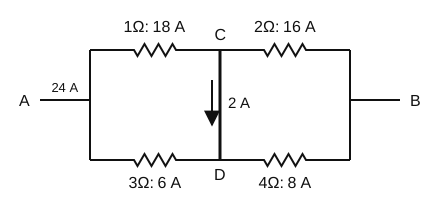
- ; A.
- Left pair (same p.d.): A, A.
- Right pair: A, A.
- At C: 18 A arrives, 16 A leaves through 2 Ω ⇒ A (from C to D).
Short trick: Current in a shorting link = difference of currents in the series-side resistors on the same rail.
Answer: (D) 2.0 A
अवधारणा: CD एक तार है, अतः C और D एक ही संधि हैं: (1 Ω ∥ 3 Ω) श्रेणी में (2 Ω ∥ 4 Ω)। फिर C पर संधि नियम लगाएँ।
- ; A।
- बायाँ युग्म (समान विभवांतर): A, A।
- दायाँ युग्म: A, A।
- C पर: 18 A आती है, 16 A, 2 Ω से निकलती है ⇒ A (C से D की ओर)।
शॉर्ट ट्रिक: शॉर्टिंग तार में धारा = एक ही ओर के प्रतिरोधों की धाराओं का अंतर।
उत्तर: (D) 2.0 A
NEET UGPhysicsCurrent electricity – Kirchhoff's lawsNEET UG 2025 · 4 May Shift 1
Q222.The plates of a parallel plate capacitor are separated by d. Two slabs of different dielectric constant and with thickness and , respectively are inserted in the capacitor. Due to this, the capacitance becomes two times larger than when there is nothing between the plates.
If , the value of is:
एक समांतर प्लेट संधारित्र की प्लेटों के बीच की दूरी d है। भिन्न परावैद्युतांक और वाली दो पट्टिकाएँ, जिनकी मोटाई क्रमशः और है, संधारित्र में डाली जाती हैं। इसके कारण धारिता, प्लेटों के बीच कुछ न होने की स्थिति से दुगुनी हो जाती है।
यदि है, तो का मान है:
- A1.60
- B1.33
- C2.66
- D2.33
Show answer
Concept: Slabs in series with the remaining air gap: .
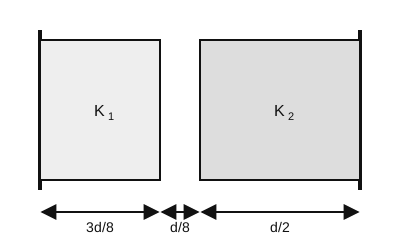
- ⇒ effective gap : .
- .
- .
- .
Short trick: Doubling C means the "air-equivalent" gap must be d/2.
Answer: (C) 2.66
अवधारणा: पट्टिकाएँ शेष वायु अंतराल के साथ श्रेणी में: ।
- ⇒ प्रभावी अंतराल : ।
- ।
- ।
- ।
शॉर्ट ट्रिक: C दुगुनी होने का अर्थ है "वायु-तुल्य" अंतराल d/2 होना चाहिए।
उत्तर: (C) 2.66
NEET UGPhysicsCapacitance – dielectric slabsNEET UG 2025 · 4 May Shift 1
Q223.Consider the dimeter of a spherical object being measured with the help of a Vernier caliper. Suppose its 10 Vernier scale Divisions (V.S.D.) are equal to its 9 Main scale Divisions (M.S.D). The least division in the M.S. is 0.1 cm and the zero of V.S. is at cm when the jaws of Vernier calipers are closed.
If the main scale reading for the diameter is M = 5 cm and the number of coinciding vernier division is 8, the measured diameter after zero error correction, is
एक वर्नियर कैलिपर्स की सहायता से एक गोलाकार वस्तु का व्यास मापा जा रहा है। माना इसके 10 वर्नियर पैमाना भाग (V.S.D.) इसके 9 मुख्य पैमाना भागों (M.S.D.) के बराबर हैं। मुख्य पैमाने का न्यूनतम भाग 0.1 cm है तथा जबड़े बंद होने पर वर्नियर पैमाने का शून्य cm पर है।
यदि व्यास के लिए मुख्य पैमाना पाठ्यांक M = 5 cm है और संपाती वर्नियर भाग 8 है, तो शून्य त्रुटि संशोधन के बाद मापा गया व्यास है
- A4.98 cm
- B5.00 cm
- C5.18 cm
- D5.08 cm
Show answer
Concept: LC = 1 MSD − 1 VSD; true reading = MSR + (VSR × LC) − zero error (positive zero error is subtracted).
- LC cm.
- Observed cm.
- Zero error cm ⇒ corrected cm.
Short trick: Option D (5.08) is the trap – it forgets the zero correction.
Answer: (A) 4.98 cm
अवधारणा: अल्पतमांक = 1 MSD − 1 VSD; सही पाठ्यांक = MSR + (VSR × LC) − शून्य त्रुटि (धनात्मक शून्य त्रुटि घटाई जाती है)।
- अल्पतमांक cm।
- प्रेक्षित cm।
- शून्य त्रुटि cm ⇒ संशोधित cm।
शॉर्ट ट्रिक: विकल्प D (5.08) जाल है – इसमें शून्य संशोधन भुला दिया गया है।
उत्तर: (A) 4.98 cm
NEET UGPhysicsUnits and measurements – vernier calipers with zero errorNEET UG 2025 · 4 May Shift 1
Q224.A 2 amp current is flowing through two different small circular copper coils having radii ratio 1: 2. The ratio of their respective magnetic moments will be
त्रिज्याओं के अनुपात 1 : 2 वाली दो भिन्न छोटी वृत्ताकार ताँबे की कुंडलियों में 2 ऐम्पियर धारा बह रही है। उनके चुंबकीय आघूर्णों का अनुपात होगा
- A2 : 1
- B4 : 1
- C1 : 4
- D1 : 2
Show answer
Concept: ; same current ⇒ .
- .
Short trick: Magnetic moment goes with AREA, so square the radius ratio.
Answer: (C) 1 : 4
अवधारणा: ; समान धारा ⇒ ।
- ।
शॉर्ट ट्रिक: चुंबकीय आघूर्ण क्षेत्रफल के अनुसार चलता है, अतः त्रिज्या अनुपात का वर्ग लें।
उत्तर: (C) 1 : 4
NEET UGPhysicsMoving charges – magnetic moment of a coilNEET UG 2025 · 4 May Shift 1
Q225.Consider a water tank shown in the figure. It has one wall at
and can be taken to be very wide in the z direction. When filled with a liquid of surface tension S and density
, the liquid surface makes angle
(
) with the x-axis at
. If
is the height of the surface then the equation for
is:
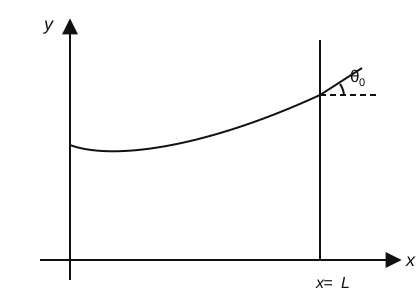
(take
, g is the acceleration due to gravity)
चित्र में दर्शाए गए एक पानी के टैंक पर विचार कीजिए। इसकी एक दीवार
पर है तथा इसे z दिशा में बहुत चौड़ा माना जा सकता है। पृष्ठ तनाव S और घनत्व
वाले द्रव से भरने पर,
पर द्रव पृष्ठ x-अक्ष से कोण
(
) बनाता है। यदि
पृष्ठ की ऊँचाई है, तो
का समीकरण है:
(
लें, g गुरुत्वीय त्वरण है)
- A
- B
- C
- D
Show answer
Concept: Balance on a thin strip of surface: pressure jump across a cylindrical (z-wide) surface is , with curvature for small slopes; this jump equals the hydrostatic pressure difference (y measured from the level where the surface would be flat).
- Vertical force on a surface element of width : .
- It balances the pressure deficit of the raised liquid: .
- .
- Why the others are wrong: A makes the curvature constant (a parabola) and independent of height; B and C tie the slope/curvature to the position , but the pressure that bends the surface depends on the height of the liquid, not on .
Short trick: Curvature ∝ height ⇒ y″ ∝ y (solution , capillary length ).
Answer: (D)
अवधारणा: पृष्ठ की एक पतली पट्टी पर संतुलन: बेलनाकार (z में चौड़े) पृष्ठ के आर-पार दाब-अंतर , छोटे ढाल के लिए वक्रता ; यह दाब-अंतर द्रवस्थैतिक दाबांतर के बराबर है (y उस स्तर से मापा गया जहाँ पृष्ठ समतल होता)।
- चौड़ाई के पृष्ठ अवयव पर ऊर्ध्वाधर बल: ।
- यह ऊपर उठे द्रव की दाब-कमी को संतुलित करता है: ।
- ।
- अन्य विकल्प गलत क्यों: A में वक्रता नियत (परवलय) है और ऊँचाई पर निर्भर नहीं करती; B और C ढाल/वक्रता को स्थिति से जोड़ते हैं, जबकि पृष्ठ को मोड़ने वाला दाब द्रव की ऊँचाई पर निर्भर करता है, पर नहीं।
शॉर्ट ट्रिक: वक्रता ∝ ऊँचाई ⇒ y″ ∝ y (हल , केशिका लंबाई )।
उत्तर: (D)
NEET UGPhysicsFluids – surface tension and meniscus shapeNEET UG 2025 · 4 May Shift 1
Q226.Identify the suitable reagent for the following conversion.
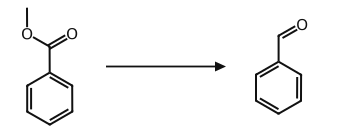
निम्नलिखित रूपांतरण के लिए उपयुक्त अभिकर्मक पहचानिए।
- A(i) NaBH4, (ii) H+/H2O
- BH2/Pd-BaSO4
- C(i) LiAlH4, (ii) H+/H2O
- D(i) AlH(iBu)2 (ii) H2O
Show answer
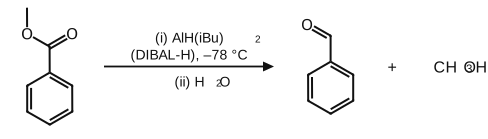
Concept: DIBAL-H [AlH(iBu)2] is a bulky, mild hydride that reduces esters (and nitriles) only up to the aldehyde stage at low temperature.
- Methyl benzoate C6H5COOCH3 must lose –OCH3 and stop at C6H5CHO.
- DIBAL-H gives a stable tetrahedral Al-intermediate at –78 °C; water then releases benzaldehyde + CH3OH.
- NaBH4 barely reduces esters; LiAlH4 over-reduces to benzyl alcohol; H2/Pd-BaSO4 (Rosenmund) works on acid chlorides, not esters.
Short trick: Ester/nitrile → aldehyde = DIBAL-H; acid chloride → aldehyde = Rosenmund; anything → alcohol = LiAlH4.
Answer: (D) (i) AlH(iBu)2 (ii) H2O
अवधारणा: DIBAL-H [AlH(iBu)2] एक भारी (bulky), मृदु हाइड्राइड है जो कम ताप पर एस्टर (और नाइट्राइल) को केवल ऐल्डिहाइड अवस्था तक अपचयित करता है।
- मेथिल बेन्ज़ोएट C6H5COOCH3 से –OCH3 हटकर अभिक्रिया C6H5CHO पर रुकनी चाहिए।
- –78 °C पर DIBAL-H एक स्थायी चतुष्फलकीय Al-मध्यवर्ती बनाता है; फिर जल मिलाने पर बेन्ज़ैल्डिहाइड + CH3OH मुक्त होते हैं।
- NaBH4 एस्टर को लगभग अपचयित नहीं करता; LiAlH4 बेन्ज़िल ऐल्कोहॉल तक अपचयित कर देता है; H2/Pd-BaSO4 (रोज़ेनमुंड) अम्ल क्लोराइड पर काम करता है, एस्टर पर नहीं।
शॉर्ट ट्रिक: एस्टर/नाइट्राइल → ऐल्डिहाइड = DIBAL-H; अम्ल क्लोराइड → ऐल्डिहाइड = रोज़ेनमुंड; ऐल्कोहॉल तक = LiAlH4।
उत्तर: (D) (i) AlH(iBu)2 (ii) H2O
NEET UGChemistryAldehydes – reduction of esters (DIBAL-H)NEET UG 2025 · 4 May Shift 1
Q227.The correct order of decreasing acidity of the following aliphatic acids is
निम्नलिखित ऐलिफैटिक अम्लों की अम्लता के घटते क्रम का सही क्रम है
- AHCOOH > CH3COOH > (CH3)2CHCOOH > (CH3)3CCOOH
- BHCOOH > (CH3)3CCOOH > (CH3)2CHCOOH > CH3COOH
- C(CH3)3CCOOH > (CH3)2CHCOOH > CH3COOH > HCOOH
- DCH3COOH > (CH3)2CHCOOH > (CH3)3CCOOH > HCOOH
Show answer
Concept: Electron-releasing (+I) alkyl groups destabilise the carboxylate anion, so acidity falls as the number of alkyl groups on the α-carbon rises.
- HCOOH has no alkyl group → most stable HCOO– → strongest (pKa ≈ 3.75).
- CH3COOH: one CH3 (pKa ≈ 4.76).
- (CH3)2CHCOOH: two CH3 → more +I → weaker.
- (CH3)3CCOOH: three CH3 → maximum +I → weakest.
- Options (B), (C), (D) all place a more alkylated acid above a less alkylated one, so they are wrong.
Short trick: More alkyl = more +I = weaker acid; formic acid always tops the aliphatic list.
Answer: (A) HCOOH > CH3COOH > (CH3)2CHCOOH > (CH3)3CCOOH
अवधारणा: इलेक्ट्रॉन-दाता (+I) ऐल्किल समूह कार्बोक्सिलेट ऋणायन को अस्थायी करते हैं, अतः α-कार्बन पर ऐल्किल समूह बढ़ने पर अम्लता घटती है।
- HCOOH में कोई ऐल्किल समूह नहीं → HCOO– सबसे स्थायी → सबसे प्रबल (pKa ≈ 3.75)।
- CH3COOH: एक CH3 (pKa ≈ 4.76)।
- (CH3)2CHCOOH: दो CH3 → अधिक +I → और दुर्बल।
- (CH3)3CCOOH: तीन CH3 → अधिकतम +I → सबसे दुर्बल।
- विकल्प (B), (C), (D) अधिक ऐल्किलित अम्ल को कम ऐल्किलित अम्ल से ऊपर रखते हैं, अतः गलत हैं।
शॉर्ट ट्रिक: जितने अधिक ऐल्किल, उतना अधिक +I, उतना दुर्बल अम्ल; ऐलिफैटिक अम्लों में फॉर्मिक अम्ल सबसे ऊपर।
उत्तर: (A) HCOOH > CH3COOH > (CH3)2CHCOOH > (CH3)3CCOOH
NEET UGChemistryCarboxylic acids – acidic strengthNEET UG 2025 · 4 May Shift 1
Q228.Which one of the following reactions does NOT belong to “Lassaigne’s test”?
निम्नलिखित में से कौन-सी अभिक्रिया “लैसे परीक्षण (Lassaigne’s test)” से संबंधित नहीं है?
- ANa + X NaX
- B2CuO + C 2Cu + CO2
- CNa + C + N NaCN
- D2Na + S Na2S
Show answer
Concept: In Lassaigne’s test the organic compound is fused with sodium metal so that N, S and halogens become ionic NaCN, Na2S and NaX (sodium fusion extract).
- (A) Na + X → NaX: halogen converted to sodium halide – part of the test.
- (C) Na + C + N → NaCN: nitrogen detected as cyanide – part of the test.
- (D) 2Na + S → Na2S: sulphur detected as sulphide – part of the test.
- (B) 2CuO + C → 2Cu + CO2 is the copper(II) oxide test for carbon (CO2 turns lime water milky) – not Lassaigne’s test.
Short trick: Lassaigne = “Na + element”; any reaction without sodium is the odd one out.
Answer: (B) 2CuO + C → 2Cu + CO2
अवधारणा: लैसे परीक्षण में कार्बनिक यौगिक को सोडियम धातु के साथ संगलित किया जाता है जिससे N, S तथा हैलोजेन आयनिक NaCN, Na2S व NaX (सोडियम संगलन निष्कर्ष) में बदल जाते हैं।
- (A) Na + X → NaX: हैलोजेन सोडियम हैलाइड में बदलता है – परीक्षण का भाग।
- (C) Na + C + N → NaCN: नाइट्रोजन सायनाइड के रूप में पहचानी जाती है – परीक्षण का भाग।
- (D) 2Na + S → Na2S: सल्फर सल्फाइड के रूप में पहचाना जाता है – परीक्षण का भाग।
- (B) 2CuO + C → 2Cu + CO2 कार्बन का कॉपर(II) ऑक्साइड परीक्षण है (CO2 चूने के पानी को दूधिया करती है) – लैसे परीक्षण नहीं।
शॉर्ट ट्रिक: लैसे = “Na + तत्व”; जिस अभिक्रिया में सोडियम नहीं, वही अलग है।
उत्तर: (B) 2CuO + C → 2Cu + CO2
NEET UGChemistryOrganic chemistry – Lassaigne’s testNEET UG 2025 · 4 May Shift 1
Q229.If the rate constant of a reaction is 0.03 s–1, how much time does it take for 7.2 mol L–1 concentration of the reactant to get reduced to 0.9 mol L–1?
(Given: log 2 = 0.301)
यदि किसी अभिक्रिया का वेग स्थिरांक 0.03 s–1 है, तो अभिकारक की सांद्रता 7.2 mol L–1 से घटकर 0.9 mol L–1 होने में कितना समय लगेगा?
(दिया है: log 2 = 0.301)
- A210 s
- B21.0 s
- C69.3 s
- D23.1 s
Show answer
Concept: The unit s–1 shows a first-order reaction: .
- , so log 8 = 3 log 2 = 0.903.
- s.
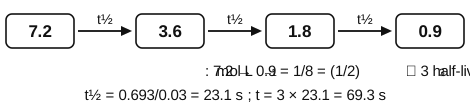
Short trick: 7.2 → 3.6 → 1.8 → 0.9 is three half-lives; t½ = 0.693/0.03 = 23.1 s, so t = 3 × 23.1 = 69.3 s (23.1 s is the trap option = one half-life).
Answer: (C) 69.3 s
अवधारणा: इकाई s–1 बताती है कि अभिक्रिया प्रथम कोटि की है: ।
- , अतः log 8 = 3 log 2 = 0.903।
- s।
शॉर्ट ट्रिक: 7.2 → 3.6 → 1.8 → 0.9 तीन अर्ध-आयु हैं; t½ = 0.693/0.03 = 23.1 s, अतः t = 3 × 23.1 = 69.3 s (23.1 s केवल एक अर्ध-आयु वाला भ्रामक विकल्प है)।
उत्तर: (C) 69.3 s
NEET UGChemistryChemical kinetics – first-order reactionNEET UG 2025 · 4 May Shift 1
Q230.Given below are two statements :
Statement I: A hypothetical diatomic molecule with bond order zero is quite stable.
Statement II: As bond order increases, the bond length increases.
In the light of the above statements, choose the most appropriate answer from the options given below :
नीचे दो कथन दिए गए हैं :
कथन I: शून्य आबंध कोटि वाला एक काल्पनिक द्विपरमाणुक अणु काफी स्थायी होता है।
कथन II: आबंध कोटि बढ़ने पर आबंध लंबाई बढ़ती है।
उपरोक्त कथनों के आलोक में, नीचे दिए गए विकल्पों में से सबसे उपयुक्त उत्तर चुनिए :
- AStatement I is true but Statement II is falseकथन I सत्य है परन्तु कथन II असत्य है
- BStatement I is false but Statement II is trueकथन I असत्य है परन्तु कथन II सत्य है
- CBoth Statement I and Statement II are trueकथन I और कथन II दोनों सत्य हैं
- DBoth Statement I and Statement II are falseकथन I और कथन II दोनों असत्य हैं
Show answer
Concept: Bond order = ½(Nb – Na). A molecule exists only if bond order > 0; bond length is inversely related to bond order.
- Statement I: bond order 0 (e.g. He2, Be2) means no net bonding – such a molecule does not exist. False.
- Statement II: higher bond order → stronger, shorter bond (N2 110 pm < O2 121 pm < F2 142 pm). Bond length decreases, so False.
Short trick: Bond order ↑ ⇒ bond energy ↑, bond length ↓, stability ↑; BO = 0 ⇒ molecule does not exist.
Answer: (D) Both Statement I and Statement II are false
अवधारणा: आबंध कोटि = ½(Nb – Na)। अणु तभी अस्तित्व में होता है जब आबंध कोटि > 0 हो; आबंध लंबाई आबंध कोटि के व्युत्क्रमानुपाती होती है।
- कथन I: आबंध कोटि 0 (जैसे He2, Be2) का अर्थ है कोई शुद्ध आबंधन नहीं – ऐसा अणु अस्तित्व में नहीं होता। असत्य।
- कथन II: अधिक आबंध कोटि → प्रबल व छोटा आबंध (N2 110 pm < O2 121 pm < F2 142 pm)। आबंध लंबाई घटती है, अतः असत्य।
शॉर्ट ट्रिक: आबंध कोटि ↑ ⇒ आबंध ऊर्जा ↑, आबंध लंबाई ↓, स्थायित्व ↑; BO = 0 ⇒ अणु का अस्तित्व नहीं।
उत्तर: (D) कथन I और कथन II दोनों असत्य हैं
NEET UGChemistryChemical bonding – bond order (MOT)NEET UG 2025 · 4 May Shift 1
Q231.Out of the following complex compounds, which of the compound will be having the minimum conductance in solution?
निम्नलिखित संकुल यौगिकों में से किस यौगिक की विलयन में चालकता न्यूनतम होगी?
- A[Co(NH3)6]Cl3
- B[Co(NH3)5Cl]Cl
- C[Co(NH3)3Cl3]
- D[Co(NH3)4Cl2]
Show answer
Concept: Molar conductance depends on the number of ions a complex gives in solution; a neutral complex (no counter-ions) gives none and has the minimum conductance.
- [Co(NH3)6]Cl3 → [Co(NH3)6]3+ + 3Cl–: 4 ions (highest).
- [Co(NH3)5Cl]Cl as written gives 2 ions (the real Co(III) compound is [Co(NH3)5Cl]Cl2, 3 ions).
- [Co(NH3)3Cl3] is a neutral Co(III) complex: 0 ions → minimum conductance.
- [Co(NH3)4Cl2] is printed with no counter-ion, i.e. as a neutral Co(II) complex – it too gives 0 ions in solution.
- So, as printed, options (C) and (D) both show zero ionisable species and are equally correct.
Short trick: Count ions outside the square bracket: none outside ⇒ non-electrolyte ⇒ lowest conductance.
Answer: Bonus – options (C) and (D) are both written as neutral, non-ionising complexes, so two options are correct as printed.
अवधारणा: मोलर चालकता इस पर निर्भर करती है कि संकुल विलयन में कितने आयन देता है; उदासीन संकुल (कोई प्रति-आयन नहीं) कोई आयन नहीं देता और उसकी चालकता न्यूनतम होती है।
- [Co(NH3)6]Cl3 → [Co(NH3)6]3+ + 3Cl–: 4 आयन (सर्वाधिक)।
- [Co(NH3)5Cl]Cl जैसा लिखा है, 2 आयन देता है (वास्तविक Co(III) यौगिक [Co(NH3)5Cl]Cl2 है, 3 आयन)।
- [Co(NH3)3Cl3] एक उदासीन Co(III) संकुल है: 0 आयन → न्यूनतम चालकता।
- [Co(NH3)4Cl2] बिना प्रति-आयन के छपा है, अर्थात उदासीन Co(II) संकुल – यह भी विलयन में 0 आयन देता है।
- अतः छपे रूप में विकल्प (C) और (D) दोनों शून्य आयन दर्शाते हैं और समान रूप से सही हैं।
शॉर्ट ट्रिक: वर्ग कोष्ठक के बाहर के आयन गिनिए: बाहर कोई नहीं ⇒ अविद्युत-अपघट्य ⇒ न्यूनतम चालकता।
उत्तर: बोनस – विकल्प (C) और (D) दोनों उदासीन, अनायनित संकुल के रूप में लिखे गए हैं, अतः छपे रूप में दो विकल्प सही हैं।
NEET UGChemistryCoordination compounds – ionisation and conductanceNEET UG 2025 · 4 May Shift 1
Q232.Which of the following aqueous solution will exhibit highest boiling point?
निम्नलिखित में से कौन-सा जलीय विलयन उच्चतम क्वथनांक प्रदर्शित करेगा?
- A0.01 M Na2SO4
- B0.015 M C6H12O6
- C0.01 M Urea0.01 M यूरिया
- D0.01 M KNO3
Show answer
Concept: ΔTb = i Kb m, so the solution with the largest i × m (effective particle concentration) boils highest.
- Na2SO4 → 2Na+ + SO42–: i = 3, i × m = 0.03.
- Glucose: non-electrolyte, i = 1, i × m = 0.015.
- Urea: i = 1, i × m = 0.01.
- KNO3 → K+ + NO3–: i = 2, i × m = 0.02.
- Largest value 0.03 → 0.01 M Na2SO4.
Short trick: Multiply concentration by number of ions and pick the biggest product – colligative = count of particles.
Answer: (A) 0.01 M Na2SO4
अवधारणा: ΔTb = i Kb m, अतः जिस विलयन का i × m (प्रभावी कण सांद्रता) सबसे अधिक है, उसका क्वथनांक सर्वाधिक होगा।
- Na2SO4 → 2Na+ + SO42–: i = 3, i × m = 0.03।
- ग्लूकोज़: अविद्युत-अपघट्य, i = 1, i × m = 0.015।
- यूरिया: i = 1, i × m = 0.01।
- KNO3 → K+ + NO3–: i = 2, i × m = 0.02।
- सबसे बड़ा मान 0.03 → 0.01 M Na2SO4।
शॉर्ट ट्रिक: सांद्रता × आयनों की संख्या – जिसका गुणनफल सबसे बड़ा, वही उत्तर; अणुसंख्य गुणधर्म = कणों की गिनती।
उत्तर: (A) 0.01 M Na2SO4
NEET UGChemistrySolutions – elevation of boiling point (van’t Hoff factor)NEET UG 2025 · 4 May Shift 1
Q233.Given below are two statements : one is labelled as Assertion (A) and the other is labelled as Reason (R).
Assertion (A):

undergoes S
N2 reaction faster than

Reason (R): Iodine is a better leaving group because of its large size.
In the light of the above statements, choose the correct answer from the options given below.
नीचे दो कथन दिए गए हैं : एक को अभिकथन (A) तथा दूसरे को कारण (R) कहा गया है।
अभिकथन (A):
,
की तुलना में S
N2 अभिक्रिया तीव्रता से करता है।
कारण (R): आयोडीन अपने बड़े आकार के कारण बेहतर अवशिष्ट समूह (leaving group) है।
उपरोक्त कथनों के आलोक में, नीचे दिए गए विकल्पों में से सही उत्तर चुनिए।
- AA is true but R is falseA सत्य है परन्तु R असत्य है
- BA is false but R is trueA असत्य है परन्तु R सत्य है
- CBoth A and R are true and R is the correct explanation of AA और R दोनों सत्य हैं तथा R, A की सही व्याख्या है
- DBoth A and R are true but R is not the correct explanation of AA और R दोनों सत्य हैं परन्तु R, A की सही व्याख्या नहीं है
Show answer
Concept: In SN2 the C–X bond breaks in the rate-determining step; with the same alkyl group, rate follows leaving-group ability I– > Br– > Cl– > F–.
- Both substrates are primary butyl halides (1-iodobutane vs 1-chlorobutane), so steric factors are identical.
- C–I bond is longer and weaker than C–Cl; the large I– spreads its charge over a big volume and is a very stable, weak base.
- Hence 1-iodobutane reacts faster – A true; R true and it is exactly the reason for A.
Short trick: Same R-group ⇒ compare only X: bigger halide = weaker C–X = better leaving group = faster SN1 and SN2.
Answer: (C) Both A and R are true and R is the correct explanation of A
अवधारणा: SN2 में C–X आबंध वेग-निर्धारक पद में टूटता है; समान ऐल्किल समूह के लिए वेग अवशिष्ट समूह की क्षमता के क्रम I– > Br– > Cl– > F– में होता है।
- दोनों अभिकर्मक प्राथमिक ब्यूटिल हैलाइड हैं (1-आयोडोब्यूटेन बनाम 1-क्लोरोब्यूटेन), अतः त्रिविम (steric) कारक समान हैं।
- C–I आबंध C–Cl से लंबा व दुर्बल है; बड़ा I– अपना आवेश बड़े आयतन में फैला देता है और बहुत स्थायी, दुर्बल क्षारक है।
- अतः 1-आयोडोब्यूटेन तेज़ी से अभिक्रिया करता है – A सत्य; R सत्य है और ठीक यही A का कारण है।
शॉर्ट ट्रिक: समान R-समूह ⇒ केवल X की तुलना: बड़ा हैलाइड = दुर्बल C–X = बेहतर अवशिष्ट समूह = तीव्र SN1 व SN2।
उत्तर: (C) A और R दोनों सत्य हैं तथा R, A की सही व्याख्या है
NEET UGChemistryHaloalkanes – S<sub>N</sub>2 reactivity and leaving groupNEET UG 2025 · 4 May Shift 1
Q234.Consider the following compounds :
KO2, H2O2 and H2SO4.
The oxidation states of the underlined elements in them are, respectively,
निम्नलिखित यौगिकों पर विचार कीजिए :
KO2, H2O2 तथा H2SO4।
इनमें रेखांकित तत्वों की ऑक्सीकरण अवस्थाएँ क्रमशः हैं
- A+1, –2, and +4+1, –2, तथा +4
- B+4, –4, and +6+4, –4, तथा +6
- C+1, –1, and +6+1, –1, तथा +6
- D+2, –2, and +6+2, –2, तथा +6
Show answer
Concept: Alkali metals are always +1; peroxide oxygen is –1; sum of oxidation numbers in a neutral molecule is zero.
- KO2 is potassium superoxide (O2–): K = +1.
- H2O2 is a peroxide: 2(+1) + 2x = 0 ⇒ O = –1.
- H2SO4: 2(+1) + S + 4(–2) = 0 ⇒ S = +6.
- Sequence +1, –1, +6 → option (C).
Short trick: Group-1 metal ⇒ +1 no matter what the anion (oxide, peroxide or superoxide); only oxygen’s number changes.
Answer: (C) +1, –1, and +6
अवधारणा: क्षार धातुएँ सदैव +1 होती हैं; परॉक्साइड ऑक्सीजन –1 होती है; उदासीन अणु में ऑक्सीकरण संख्याओं का योग शून्य होता है।
- KO2 पोटैशियम सुपरऑक्साइड (O2–) है: K = +1।
- H2O2 परॉक्साइड है: 2(+1) + 2x = 0 ⇒ O = –1।
- H2SO4: 2(+1) + S + 4(–2) = 0 ⇒ S = +6।
- क्रम +1, –1, +6 → विकल्प (C)।
शॉर्ट ट्रिक: वर्ग-1 धातु ⇒ +1, ऋणायन चाहे ऑक्साइड, परॉक्साइड या सुपरऑक्साइड हो; केवल ऑक्सीजन की संख्या बदलती है।
उत्तर: (C) +1, –1, तथा +6
NEET UGChemistryRedox reactions – oxidation numberNEET UG 2025 · 4 May Shift 1
Q235.Match List-I with List-II.
| List-I | List-II |
|---|
| A. Haber process | I. Fe catalyst |
| B. Wacker oxidation | II. PdCl2 |
| C. Wilkinson catalyst | III. [(PPh3)3RhCl] |
| D. Ziegler catalyst | IV. TiCl4 with Al(CH3)3 |
Choose the correct answer from the options given below:
सूची-I का सूची-II से मिलान कीजिए।
| सूची-I | सूची-II |
|---|
| A. हाबर प्रक्रम | I. Fe उत्प्रेरक |
| B. वेकर ऑक्सीकरण | II. PdCl2 |
| C. विल्किन्सन उत्प्रेरक | III. [(PPh3)3RhCl] |
| D. ज़ीग्लर उत्प्रेरक | IV. TiCl4 के साथ Al(CH3)3 |
नीचे दिए गए विकल्पों में से सही उत्तर चुनिए :
- AA-I, B-II, C-III, D-IV
- BA-I, B-IV, C-III, D-II
- CA-I, B-II, C-IV, D-III
- DA-II, B-III, C-I, D-IV
Show answer
Concept: Standard NCERT catalyst list for important industrial processes.
- Haber process (N2 + 3H2 → 2NH3): finely divided iron (Mo promoter) – A-I.
- Wacker process (ethene → ethanal): PdCl2 (with CuCl2) – B-II.
- Wilkinson’s catalyst for alkene hydrogenation: [(PPh3)3RhCl] – C-III.
- Ziegler–Natta catalyst for polythene/polypropene: TiCl4 + Al(CH3)3 (trialkylaluminium) – D-IV.
Short trick: Names in alphabetical order match List-II in order here: Fe, Pd, Rh, Ti → I, II, III, IV.
Answer: (A) A-I, B-II, C-III, D-IV
अवधारणा: महत्त्वपूर्ण औद्योगिक प्रक्रमों के उत्प्रेरकों की मानक NCERT सूची।
- हाबर प्रक्रम (N2 + 3H2 → 2NH3): सूक्ष्म विभाजित आयरन (Mo वर्धक) – A-I।
- वेकर प्रक्रम (एथीन → एथेनैल): PdCl2 (CuCl2 सहित) – B-II।
- ऐल्कीन के हाइड्रोजनीकरण हेतु विल्किन्सन उत्प्रेरक: [(PPh3)3RhCl] – C-III।
- पॉलिथीन/पॉलिप्रोपीन हेतु ज़ीग्लर–नाटा उत्प्रेरक: TiCl4 + Al(CH3)3 (ट्राइऐल्किलऐलुमिनियम) – D-IV।
शॉर्ट ट्रिक: यहाँ Fe, Pd, Rh, Ti क्रम से I, II, III, IV से मेल खाते हैं – सीधा मिलान।
उत्तर: (A) A-I, B-II, C-III, D-IV
NEET UGChemistryd-block & coordination – industrial catalystsNEET UG 2025 · 4 May Shift 1
Q236.Given below are two statements :
Statement I: Like nitrogen that can form ammonia, arsenic can form arsine.
Statement II: Antimony cannot form antimony pentoxide.
In the light of the above statements, choose the most appropriate answer from the options given below :
नीचे दो कथन दिए गए हैं :
कथन I: जिस प्रकार नाइट्रोजन अमोनिया बना सकती है, उसी प्रकार आर्सेनिक आर्सीन बना सकता है।
कथन II: ऐन्टिमनी, ऐन्टिमनी पेन्टॉक्साइड नहीं बना सकता।
उपरोक्त कथनों के आलोक में, नीचे दिए गए विकल्पों में से सबसे उपयुक्त उत्तर चुनिए :
- AStatement I is correct but Statement II is incorrectकथन I सही है परन्तु कथन II गलत है
- BStatement I is incorrect but Statement II is correctकथन I गलत है परन्तु कथन II सही है
- CBoth Statement I and Statement II are correctकथन I और कथन II दोनों सही हैं
- DBoth Statement I and Statement II are incorrectकथन I और कथन II दोनों गलत हैं
Show answer
Concept: All group-15 elements form hydrides EH3 and oxides E2O3 and E2O5.
- Statement I: NH3, PH3, AsH3 (arsine), SbH3, BiH3 all exist – correct.
- Statement II: Sb shows +3 and +5 states; Sb2O5 (antimony pentoxide) is a known oxide – the statement is incorrect.
- (Only bismuth has a doubtful pentoxide, because the inert-pair effect makes Bi(+5) unstable.)
Short trick: Group 15: EH3 stability falls NH3 → BiH3, and +5 stability falls down the group – but Sb(+5) still exists.
Answer: (A) Statement I is correct but Statement II is incorrect
अवधारणा: वर्ग-15 के सभी तत्व हाइड्राइड EH3 तथा ऑक्साइड E2O3 व E2O5 बनाते हैं।
- कथन I: NH3, PH3, AsH3 (आर्सीन), SbH3, BiH3 सभी अस्तित्व में हैं – सही।
- कथन II: Sb, +3 व +5 अवस्थाएँ दर्शाता है; Sb2O5 (ऐन्टिमनी पेन्टॉक्साइड) ज्ञात ऑक्साइड है – कथन गलत है।
- (केवल बिस्मथ का पेन्टॉक्साइड संदिग्ध है, क्योंकि अक्रिय युग्म प्रभाव (inert-pair effect) के कारण Bi(+5) अस्थायी है।)
शॉर्ट ट्रिक: वर्ग 15: EH3 का स्थायित्व NH3 → BiH3 घटता है, और +5 अवस्था का स्थायित्व वर्ग में नीचे घटता है – फिर भी Sb(+5) अस्तित्व में है।
उत्तर: (A) कथन I सही है परन्तु कथन II गलत है
NEET UGChemistryp-Block (Group 15) – hydrides and oxidesNEET UG 2025 · 4 May Shift 1
Q237.Given below are two statements :
Statement I: Ferromagnetism is considered as an extreme form of paramagnetism.
Statement II: The number of unpaired electrons in a Cr2+ ion (Z = 24) is the same as that of a Nd3+ ion (Z = 60).
In the light of the above statements, choose the correct answer from the options given below:
नीचे दो कथन दिए गए हैं :
कथन I: लौहचुंबकत्व (ferromagnetism) को अनुचुंबकत्व (paramagnetism) का चरम रूप माना जाता है।
कथन II: Cr2+ आयन (Z = 24) में अयुग्मित इलेक्ट्रॉनों की संख्या Nd3+ आयन (Z = 60) के समान है।
उपरोक्त कथनों के आलोक में, नीचे दिए गए विकल्पों में से सही उत्तर चुनिए:
- AStatement I is true but Statement II is falseकथन I सत्य है परन्तु कथन II असत्य है
- BStatement I is false but Statement II is trueकथन I असत्य है परन्तु कथन II सत्य है
- CBoth Statement I and Statement II are trueकथन I और कथन II दोनों सत्य हैं
- DBoth Statement I and Statement II are falseकथन I और कथन II दोनों असत्य हैं
Show answer
Concept: Ferromagnetic substances are paramagnetic substances whose unpaired spins align in domains (NCERT: “an extreme form of paramagnetism”). Unpaired electrons come from the configuration.
- Statement I is the NCERT definition – true.
- Cr (Z = 24): [Ar]3d54s1 → Cr2+: [Ar]3d4 → 4 unpaired electrons.
- Nd (Z = 60): [Xe]4f46s2 → Nd3+: [Xe]4f3 → 3 unpaired electrons.
- 4 ≠ 3, so Statement II is false.
Short trick: Ln3+ unpaired e– = number of f-electrons up to 7: Ce3+ 1, Pr3+ 2, Nd3+ 3 …
Answer: (A) Statement I is true but Statement II is false
अवधारणा: लौहचुंबकीय पदार्थ वे अनुचुंबकीय पदार्थ हैं जिनके अयुग्मित स्पिन डोमेन में संरेखित होते हैं (NCERT: “अनुचुंबकत्व का चरम रूप”)। अयुग्मित इलेक्ट्रॉन इलेक्ट्रॉनिक विन्यास से ज्ञात होते हैं।
- कथन I, NCERT की परिभाषा है – सत्य।
- Cr (Z = 24): [Ar]3d54s1 → Cr2+: [Ar]3d4 → 4 अयुग्मित इलेक्ट्रॉन।
- Nd (Z = 60): [Xe]4f46s2 → Nd3+: [Xe]4f3 → 3 अयुग्मित इलेक्ट्रॉन।
- 4 ≠ 3, अतः कथन II असत्य है।
शॉर्ट ट्रिक: Ln3+ में अयुग्मित e– = f-इलेक्ट्रॉनों की संख्या (7 तक): Ce3+ 1, Pr3+ 2, Nd3+ 3 …
उत्तर: (A) कथन I सत्य है परन्तु कथन II असत्य है
NEET UGChemistryd- and f-block – magnetism and unpaired electronsNEET UG 2025 · 4 May Shift 1
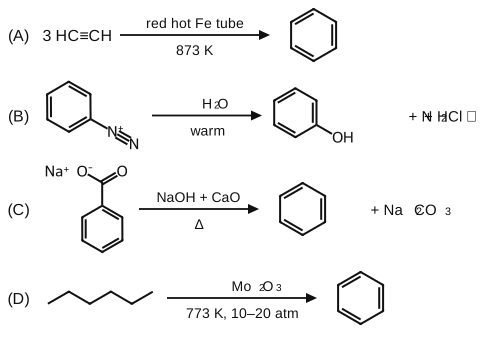
Q238.Which one of the following reactions does NOT give benzene as the product?
निम्नलिखित में से कौन-सी अभिक्रिया उत्पाद के रूप में बेन्ज़ीन नहीं देती?
- A

- B
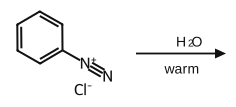
- C
- D
Show answer
Concept: Benzene is made by cyclic polymerisation of ethyne, decarboxylation of sodium benzoate and aromatisation of n-hexane; warming a diazonium salt with water gives phenol.
- (A) 3 HC≡CH, red-hot iron tube, 873 K → benzene (cyclic trimerisation).
- (B) C6H5N2+Cl– + H2O (warm) → C6H5OH + N2 + HCl – phenol, not benzene.
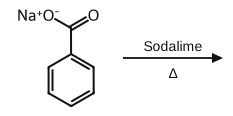
- (C) C6H5COONa + NaOH (sodalime, Δ) → C6H6 + Na2CO3 (decarboxylation).
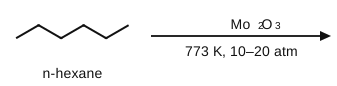
- (D) n-Hexane, Mo2O3/773 K/10–20 atm → benzene (aromatisation: cyclisation + dehydrogenation).
Short trick: Diazonium salt → benzene needs H3PO2 or ethanol (reduction); with plain warm water the N2 is replaced by –OH.
Answer: (B) Benzenediazonium chloride warmed with water
अवधारणा: बेन्ज़ीन, एथाइन के चक्रीय बहुलकीकरण, सोडियम बेन्ज़ोएट के विकार्बोक्सिलन तथा n-हेक्सेन के ऐरोमैटीकरण से बनती है; डाइऐज़ोनियम लवण को जल के साथ गर्म करने पर फ़ीनॉल बनता है।
- (A) 3 HC≡CH, रक्त-तप्त आयरन नली, 873 K → बेन्ज़ीन (चक्रीय त्रितयीकरण)।
- (B) C6H5N2+Cl– + H2O (गर्म) → C6H5OH + N2 + HCl – फ़ीनॉल, बेन्ज़ीन नहीं।
- (C) C6H5COONa + NaOH (सोडालाइम, Δ) → C6H6 + Na2CO3 (विकार्बोक्सिलन)।
- (D) n-हेक्सेन, Mo2O3/773 K/10–20 atm → बेन्ज़ीन (ऐरोमैटीकरण: चक्रीकरण + विहाइड्रोजनन)।
शॉर्ट ट्रिक: डाइऐज़ोनियम लवण → बेन्ज़ीन के लिए H3PO2 या एथेनॉल (अपचयन) चाहिए; केवल गर्म जल से N2 का स्थान –OH ले लेता है।
उत्तर: (B) बेन्ज़ीनडाइऐज़ोनियम क्लोराइड को जल के साथ गर्म करना
NEET UGChemistryHydrocarbons – preparation of benzeneNEET UG 2025 · 4 May Shift 1
Q239.Match List-I with List-II
| List-I | List-II |
|---|
| A. XeO3 | I. sp3d; linear |
| B. XeF2 | II. sp3; pyramidal |
| C. XeOF4 | III. sp3d3; distorted octahedral |
| D. XeF6 | IV. sp3d2; square pyramidal |
Choose the correct answer from the options given below:
सूची-I का सूची-II से मिलान कीजिए।
| सूची-I | सूची-II |
|---|
| A. XeO3 | I. sp3d; रैखिक |
| B. XeF2 | II. sp3; पिरामिडी |
| C. XeOF4 | III. sp3d3; विकृत अष्टफलकीय |
| D. XeF6 | IV. sp3d2; वर्ग पिरामिडी |
नीचे दिए गए विकल्पों में से सही उत्तर चुनिए :
- AA-IV, B-II, C-III, D-I
- BA-IV, B-II, C-I, D-III
- CA-II, B-I, C-IV, D-III
- DA-II, B-I, C-III, D-IV
Show answer
Concept: Steric number = σ-bonded atoms + lone pairs on Xe (8 valence electrons); π-bonds to O do not count.
- XeO3: 3 σ + 1 lp = 4 → sp3, trigonal pyramidal → II.
- XeF2: 2 σ + 3 lp = 5 → sp3d, linear → I.
- XeOF4: 5 σ + 1 lp = 6 → sp3d2, square pyramidal → IV.
- XeF6: 6 σ + 1 lp = 7 → sp3d3, distorted octahedral → III.
Short trick: Xe lone pairs = (8 – total bonding electrons used)/2; XeF2 3 lp, XeF4 2 lp, XeF6, XeO3, XeOF4 1 lp each.
Answer: (C) A-II, B-I, C-IV, D-III
अवधारणा: त्रिविम संख्या = Xe पर σ-आबंधित परमाणु + एकाकी युग्म (8 संयोजी इलेक्ट्रॉन); O के साथ π-आबंध गिने नहीं जाते।
- XeO3: 3 σ + 1 lp = 4 → sp3, त्रिकोणीय पिरामिडी → II।
- XeF2: 2 σ + 3 lp = 5 → sp3d, रैखिक → I।
- XeOF4: 5 σ + 1 lp = 6 → sp3d2, वर्ग पिरामिडी → IV।
- XeF6: 6 σ + 1 lp = 7 → sp3d3, विकृत अष्टफलकीय → III।
शॉर्ट ट्रिक: Xe के एकाकी युग्म = (8 – आबंधन में प्रयुक्त इलेक्ट्रॉन)/2; XeF2 में 3, XeF4 में 2, XeF6, XeO3, XeOF4 प्रत्येक में 1।
उत्तर: (C) A-II, B-I, C-IV, D-III
NEET UGChemistryp-Block (noble gases) – hybridisation and shapes of xenon compoundsNEET UG 2025 · 4 May Shift 1
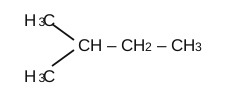
Q240.How many products (including stereoisomers) are expected from monochlorination of the following compound?
निम्नलिखित यौगिक के एकलक्लोरीनन (monochlorination) से कितने उत्पाद (त्रिविम समावयवियों सहित) अपेक्षित हैं?
- A5
- B6
- C2
- D3
Show answer
Concept: Each set of chemically different H atoms gives one structural product; every product with a new stereocentre exists as a pair of enantiomers.
- 2-Methylbutane (CH3)2CH–CH2–CH3 has 4 kinds of H: the two equivalent CH3 on C-2, the C-2 H, the CH2 and the terminal CH3.
- 1-Chloro-2-methylbutane – C-2 becomes chiral → 2 (R/S).
- 2-Chloro-2-methylbutane – no stereocentre → 1.
- 2-Chloro-3-methylbutane – chiral C → 2 (R/S).
- 1-Chloro-3-methylbutane – achiral → 1.
- Total = 2 + 1 + 2 + 1 = 6.
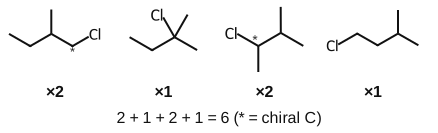
Short trick: Count H-types first (4), then add one extra for every product that has a carbon carrying 4 different groups (2) ⇒ 4 + 2 = 6.
Answer: (B) 6
अवधारणा: रासायनिक रूप से भिन्न H परमाणुओं का प्रत्येक समूह एक संरचनात्मक उत्पाद देता है; जिस उत्पाद में नया त्रिविम केंद्र (stereocentre) बनता है, वह प्रतिबिंबरूपी (enantiomer) युग्म के रूप में होता है।
- 2-मेथिलब्यूटेन (CH3)2CH–CH2–CH3 में 4 प्रकार के H हैं: C-2 पर दो तुल्य CH3, C-2 का H, CH2 तथा अंतिम CH3।
- 1-क्लोरो-2-मेथिलब्यूटेन – C-2 किरेल बनता है → 2 (R/S)।
- 2-क्लोरो-2-मेथिलब्यूटेन – कोई त्रिविम केंद्र नहीं → 1।
- 2-क्लोरो-3-मेथिलब्यूटेन – किरेल C → 2 (R/S)।
- 1-क्लोरो-3-मेथिलब्यूटेन – अकिरेल → 1।
- कुल = 2 + 1 + 2 + 1 = 6।
शॉर्ट ट्रिक: पहले H-प्रकार गिनें (4), फिर हर उस उत्पाद के लिए एक जोड़ें जिसमें 4 भिन्न समूहों वाला कार्बन है (2) ⇒ 4 + 2 = 6।
उत्तर: (B) 6
NEET UGChemistryHydrocarbons – free-radical halogenation and isomer countNEET UG 2025 · 4 May Shift 1

