Q1001.Two conducting circular loops of radii and are placed in the same plane with their centres coinciding. If , the mutual inductance M between them will be directly proportional to:
त्रिज्याओं और के दो चालक वृत्ताकार लूप एक ही तल में इस प्रकार रखे हैं कि उनके केंद्र संपाती हैं। यदि , तो उनके बीच अन्योन्य प्रेरकत्व M किसके अनुक्रमानुपाती होगा:
- A
- B
- C
- D
Show answer
Concept: Pass current I1 in the big loop; its field at the centre is nearly uniform over the small loop. .
- at the centre.
- .
- ⇒ .
Short trick: M = (field of big loop per unit current) × (area of small loop) ⇒ (1/R1) × R2².
Answer: (B)
अवधारणा: बड़े लूप में धारा I1 प्रवाहित करें; इसका केंद्र पर क्षेत्र छोटे लूप पर लगभग एकसमान है। ।
- केंद्र पर ।
- ।
- ⇒ ।
शॉर्ट ट्रिक: M = (प्रति एकांक धारा बड़े लूप का क्षेत्र) × (छोटे लूप का क्षेत्रफल) ⇒ (1/R1) × R2²।
उत्तर: (B)
NEET UGPhysicsElectromagnetic induction – mutual inductanceNEET UG 2021 · 12 Sep Shift 1
Q1002.A particle of mass ‘m’ is projected with a velocity (k < 1) from the surface of the earth. ( = escape velocity)
The maximum height above the surface reached by the particle is:
द्रव्यमान ‘m’ का एक कण पृथ्वी के पृष्ठ से वेग (k < 1) से प्रक्षेपित किया जाता है। ( = पलायन वेग)
कण द्वारा पृष्ठ से ऊपर प्राप्त अधिकतम ऊँचाई है:
- A
- B
- C
- D
Show answer
Concept: Energy conservation with and .
- .
- ⇒ .
- .
Short trick: Checks: k → 1 ⇒ H → ∞ (escape) and small k ⇒ H ≈ Rk² = u²/2g. Only (B) satisfies both.
Answer: (B)
अवधारणा: और के साथ ऊर्जा संरक्षण।
- ।
- ⇒ ।
- ।
शॉर्ट ट्रिक: जाँच: k → 1 ⇒ H → ∞ (पलायन) तथा छोटे k पर H ≈ Rk² = u²/2g। केवल (B) दोनों को संतुष्ट करता है।
उत्तर: (B)
NEET UGPhysicsGravitation – maximum height of projectileNEET UG 2021 · 12 Sep Shift 1
Q1003.A uniform rod of length 200 cm and mass 500 g is balanced on a wedge placed at 40 cm mark. A mass of 2 kg is suspended from the rod at 20 cm and another unknown mass ‘m’ is suspended from the rod at 160 cm mark as shown in the figure. Find the value of ‘m’ such that the rod is in equilibrium. (g = 10 m/s
2)
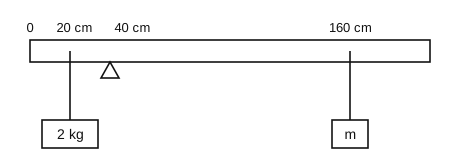
लंबाई 200 cm और द्रव्यमान 500 g की एक एकसमान छड़ 40 cm चिह्न पर रखी एक फन्नी (wedge) पर संतुलित है। चित्रानुसार छड़ से 20 cm पर 2 kg का द्रव्यमान और 160 cm चिह्न पर एक अज्ञात द्रव्यमान ‘m’ लटकाया गया है। ‘m’ का वह मान ज्ञात कीजिए जिससे छड़ साम्यावस्था में रहे। (g = 10 m/s
2)
- A1/6 kg
- B1/12 kg
- C1/2 kg
- D1/3 kg
Show answer
Concept: Take torques about the wedge (40 cm mark); the rod’s weight acts at its centre (100 cm mark).
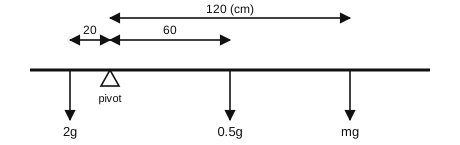
- Anticlockwise: 2 kg at 20 cm from the pivot ⇒ 2g × 20.
- Clockwise: rod 0.5 kg at 60 cm ⇒ 0.5g × 60; mass m at 120 cm ⇒ mg × 120.
- 2 × 20 = 0.5 × 60 + 120m ⇒ 40 = 30 + 120m ⇒ m = 10/120 = 1/12 kg.
Short trick: Don’t forget the rod’s own weight – ignoring it gives m = 1/3 kg (a trap option).
Answer: (B) 1/12 kg
अवधारणा: फन्नी (40 cm चिह्न) के परितः बल-आघूर्ण लें; छड़ का भार इसके केंद्र (100 cm चिह्न) पर कार्य करता है।
- वामावर्त: धुरी से 20 cm पर 2 kg ⇒ 2g × 20।
- दक्षिणावर्त: 60 cm पर छड़ 0.5 kg ⇒ 0.5g × 60; 120 cm पर द्रव्यमान m ⇒ mg × 120।
- 2 × 20 = 0.5 × 60 + 120m ⇒ 40 = 30 + 120m ⇒ m = 10/120 = 1/12 kg।
शॉर्ट ट्रिक: छड़ का अपना भार न भूलें – इसे छोड़ने पर m = 1/3 kg (जाल विकल्प) आता है।
उत्तर: (B) 1/12 kg
NEET UGPhysicsSystem of particles – rotational equilibriumNEET UG 2021 · 12 Sep Shift 1
Q1004.A ball of mass 0.15 kg is dropped from a height 10 m, strikes the ground and rebounds to the same height. The magnitude of impulse imparted to the ball is (g = 10 m/s2) nearly:
0.15 kg द्रव्यमान की एक गेंद 10 m की ऊँचाई से गिराई जाती है, धरातल से टकराती है और उसी ऊँचाई तक वापस उछलती है। गेंद को दिए गए आवेग का परिमाण (g = 10 m/s2) लगभग है:
- A21 kg m/s
- B1.4 kg m/s
- C0 kg m/s
- D4.2 kg m/s
Show answer
Concept: Impulse = change in momentum; the velocity reverses with the same magnitude.
- Speed at impact m/s; rebound speed is the same (same height).
- Impulse = m[u − (−u)] = 2mu = 2 × 0.15 × 14.14 ≈ 4.2 kg m/s.
Short trick: Rebound to same height ⇒ impulse = 2m√(2gh); 0 is the trap (momentum reverses, it does not cancel).
Answer: (D) 4.2 kg m/s
अवधारणा: आवेग = संवेग में परिवर्तन; वेग समान परिमाण के साथ उलट जाता है।
- टकराने पर चाल m/s; उछलने की चाल भी समान (समान ऊँचाई)।
- आवेग = m[u − (−u)] = 2mu = 2 × 0.15 × 14.14 ≈ 4.2 kg m/s।
शॉर्ट ट्रिक: समान ऊँचाई तक उछाल ⇒ आवेग = 2m√(2gh); 0 जाल है (संवेग उलटता है, निरस्त नहीं होता)।
उत्तर: (D) 4.2 kg m/s
NEET UGPhysicsLaws of motion – impulseNEET UG 2021 · 12 Sep Shift 1
Q1005.A particle moving in a circle of radius R with a uniform speed takes a time T to complete one revolution. If this particle were projected with the same speed at an angle ‘θ’ to the horizontal, the maximum height attained by it equals 4R. The angle of projection, θ, is then given by:
त्रिज्या R के वृत्त में एकसमान चाल से गतिमान एक कण एक परिक्रमा पूरी करने में समय T लेता है। यदि इस कण को उसी चाल से क्षैतिज से ‘θ’ कोण पर प्रक्षेपित किया जाए, तो इसके द्वारा प्राप्त अधिकतम ऊँचाई 4R के बराबर है। तब प्रक्षेपण कोण θ है:
- A
- B
- C
- D
Show answer
Concept: Uniform circular motion gives ; projectile maximum height .
- .
- .
- .
Short trick: H involves sin²θ ⇒ answer is a sin⁻¹ form; and H ∝ v² ∝ 1/T² ⇒ sinθ ∝ T, so T² must be in the numerator ⇒ (B).
Answer: (B)
अवधारणा: एकसमान वृत्तीय गति से ; प्रक्षेप्य की अधिकतम ऊँचाई ।
- ।
- ।
- ।
शॉर्ट ट्रिक: H में sin²θ है ⇒ उत्तर sin⁻¹ रूप में; और H ∝ v² ∝ 1/T² ⇒ sinθ ∝ T, अतः T² अंश में होना चाहिए ⇒ (B)।
उत्तर: (B)
NEET UGPhysicsMotion in a plane – projectile and circular motionNEET UG 2021 · 12 Sep Shift 1
Q1006.For the given circuit, the input digital signals are applied at the terminals A, B and C. What would be the output at the terminal y?
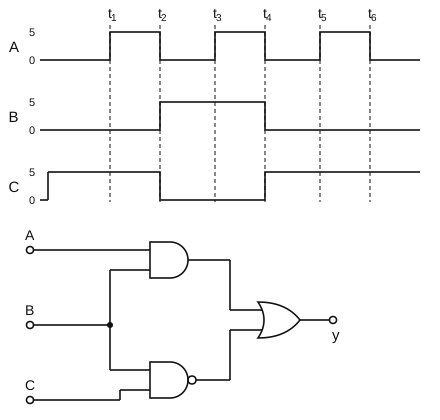
दिए गए परिपथ के लिए, निवेशी अंकीय सिग्नल टर्मिनलों A, B और C पर लगाए गए हैं। टर्मिनल y पर निर्गत क्या होगा?
- A

- B

- C

- D

Show answer
Concept: Read the circuit: AND(A, B) and NAND(B, C) feed an OR gate ⇒ .
| Interval | A | B | C | A·B | | Y |
|---|
| 0 – t1 | 0 | 0 | 1 | 0 | 1 | 1 |
| t1 – t2 | 1 | 0 | 1 | 0 | 1 | 1 |
| t2 – t3 | 0 | 1 | 0 | 0 | 1 | 1 |
| t3 – t4 | 1 | 1 | 0 | 1 | 1 | 1 |
| t4 – t5 | 0 | 0 | 1 | 0 | 1 | 1 |
| t5 – t6 | 1 | 0 | 1 | 0 | 1 | 1 |
| after t6 | 0 | 0 | 1 | 0 | 1 | 1 |
- From the waveforms, B = 1 only between t2 and t4, and exactly in that interval C = 0.
- So B·C = 0 at all times ⇒ at all times.
- An OR gate with one input permanently 1 gives Y = 1 always ⇒ a constant 5 V output.
Short trick: Look for a gate whose output never changes (here the NAND); if it feeds an OR with a constant 1, the output is constant HIGH – no full truth table needed.
Answer: (C) constant 5 V output
अवधारणा: परिपथ पढ़ें: AND(A, B) और NAND(B, C) एक OR गेट को निवेश देते हैं ⇒ ।
| अंतराल | A | B | C | A·B | | Y |
|---|
| 0 – t1 | 0 | 0 | 1 | 0 | 1 | 1 |
| t1 – t2 | 1 | 0 | 1 | 0 | 1 | 1 |
| t2 – t3 | 0 | 1 | 0 | 0 | 1 | 1 |
| t3 – t4 | 1 | 1 | 0 | 1 | 1 | 1 |
| t4 – t5 | 0 | 0 | 1 | 0 | 1 | 1 |
| t5 – t6 | 1 | 0 | 1 | 0 | 1 | 1 |
| t6 के बाद | 0 | 0 | 1 | 0 | 1 | 1 |
- तरंग-रूपों से, B = 1 केवल t2 और t4 के बीच है, और ठीक उसी अंतराल में C = 0 है।
- अतः B·C सदैव 0 ⇒ सदैव 1।
- जिस OR गेट का एक निवेश स्थायी रूप से 1 हो, उसका निर्गत Y सदैव 1 ⇒ नियत 5 V निर्गत।
शॉर्ट ट्रिक: ऐसा गेट खोजें जिसका निर्गत कभी नहीं बदलता (यहाँ NAND); यदि वह OR को नियत 1 देता है, तो निर्गत नियत उच्च (HIGH) – पूरी सत्यमान सारणी की आवश्यकता नहीं।
उत्तर: (C) नियत 5 V निर्गत
NEET UGPhysicsSemiconductor electronics – logic gatesNEET UG 2021 · 12 Sep Shift 1
Q1007.In the product
For q = 1 and and
What will be the complete expression for ?
गुणनफल में
q = 1 तथा और के लिए
का पूर्ण व्यंजक क्या होगा?
- A
- B
- C
- D
Show answer
Concept: Expand the cross product with the determinant and compare components.
- .
- : −2B = 12 ⇒ B = −6.
- : −(2B0 − 6B) = −20 ⇒ 2B0 + 36 = 20 ⇒ B0 = −8.
- Check : 4(−8) − 6(−6) = −32 + 36 = 4 ✓ ⇒ .
Short trick: Only the k̂-component (2B − 4B = −2B) needs B alone ⇒ B = −6 immediately; only (D) has −6 for both î and ĵ. Also ✓.
Answer: (D)
अवधारणा: सारणिक (determinant) से सदिश गुणनफल का विस्तार करें और घटकों की तुलना करें।
- ।
- : −2B = 12 ⇒ B = −6।
- : −(2B0 − 6B) = −20 ⇒ 2B0 + 36 = 20 ⇒ B0 = −8।
- जाँच: 4(−8) − 6(−6) = −32 + 36 = 4 ✓ ⇒ ।
शॉर्ट ट्रिक: केवल k̂-घटक (2B − 4B = −2B) में केवल B है ⇒ तुरंत B = −6; केवल (D) में î और ĵ दोनों के लिए −6 है। साथ ही ✓।
उत्तर: (D)
NEET UGPhysicsMoving charges and magnetism – Lorentz force (vector)NEET UG 2021 · 12 Sep Shift 1
Q1008.A car starts from rest and accelerates at 5 m/s2. At t = 4 s, a ball is dropped out of a window by a person sitting in the car. What is the velocity and acceleration of the ball at t = 6 s? (Take g = 10 m/s2)
एक कार विराम से प्रारंभ होकर 5 m/s2 से त्वरित होती है। t = 4 s पर कार में बैठा एक व्यक्ति खिड़की से एक गेंद गिराता है। t = 6 s पर गेंद का वेग और त्वरण क्या है? (g = 10 m/s2 लें)
- A m/s, 0
- B m/s, 10 m/s2
- C20 m/s, 5 m/s2
- D20 m/s, 0
Show answer
Concept: Once released, the ball keeps the car’s horizontal velocity at that instant and has only the acceleration g (air resistance neglected).
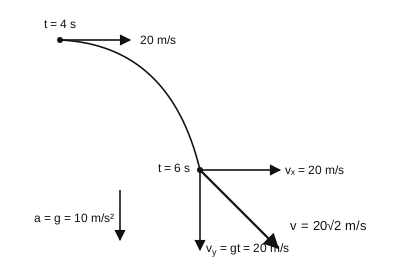
- At t = 4 s: car speed = 0 + 5 × 4 = 20 m/s ⇒ m/s (constant afterwards).
- Free fall for 2 s: m/s.
- m/s; acceleration = g = 10 m/s² (vertically down).
Short trick: After release the car’s 5 m/s² no longer acts on the ball ⇒ a = g only.
Answer: (B) m/s, 10 m/s2
अवधारणा: छोड़े जाने के बाद गेंद उस क्षण कार का क्षैतिज वेग बनाए रखती है और इस पर केवल त्वरण g होता है (वायु प्रतिरोध नगण्य)।
- t = 4 s पर: कार की चाल = 0 + 5 × 4 = 20 m/s ⇒ m/s (इसके बाद नियत)।
- 2 s का मुक्त पतन: m/s।
- m/s; त्वरण = g = 10 m/s² (ऊर्ध्वाधर नीचे)।
शॉर्ट ट्रिक: छोड़ने के बाद कार का 5 m/s² गेंद पर कार्य नहीं करता ⇒ केवल a = g।
उत्तर: (B) m/s, 10 m/s2
NEET UGPhysicsMotion in a plane – relative motion and free fallNEET UG 2021 · 12 Sep Shift 1
Q1009.Three resistors having resistance
,
and
are connected as shown in the given circuit. The ratio
of currents in terms of resistances used in the circuit is:
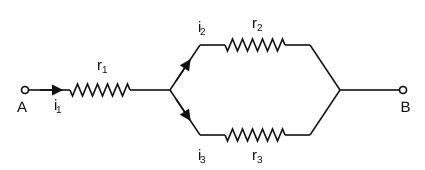
प्रतिरोध
,
और
वाले तीन प्रतिरोधक दिए गए परिपथ में दर्शाए अनुसार जुड़े हैं। परिपथ में प्रयुक्त प्रतिरोधों के पदों में धाराओं का अनुपात
है:
- A
- B
- C
- D
Show answer
Concept: In two parallel branches the current divides in the inverse ratio of resistances: .
- through splits into (through ) and (through ); same voltage: .
- ⇒ .
Short trick: Current in one branch = total × (OTHER branch resistance)/(sum); r1 (series) cannot appear ⇒ (A), (B), (C) out.
Answer: (D)
अवधारणा: दो समांतर शाखाओं में धारा प्रतिरोधों के व्युत्क्रम अनुपात में बँटती है: ।
- से होकर , ( से) और ( से) में बँटती है; समान वोल्टता: ।
- ⇒ ।
शॉर्ट ट्रिक: एक शाखा में धारा = कुल × (दूसरी शाखा का प्रतिरोध)/(योग); r1 (श्रेणी) नहीं आ सकता ⇒ (A), (B), (C) हटें।
उत्तर: (D)
NEET UGPhysicsCurrent electricity – current divisionNEET UG 2021 · 12 Sep Shift 1
Q1010.A point object is placed at a distance of 60 cm from a convex lens of focal length 30 cm. If a plane mirror were put perpendicular to the principal axis of the lens and at a distance of 40 cm from it, the final image would be formed at a distance of:
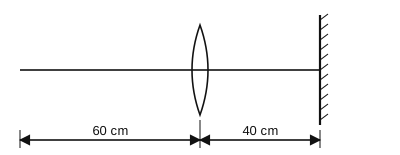
30 cm फोकस दूरी के एक उत्तल लेंस से 60 cm की दूरी पर एक बिंदु बिंब रखा है। यदि लेंस के मुख्य अक्ष के लंबवत और इससे 40 cm की दूरी पर एक समतल दर्पण रख दिया जाए, तो अंतिम प्रतिबिंब किस दूरी पर बनेगा:
- A30 cm from the plane mirror, it would be a virtual image.समतल दर्पण से 30 cm पर, यह आभासी प्रतिबिंब होगा।
- B20 cm from the plane mirror, it would be a virtual image.समतल दर्पण से 20 cm पर, यह आभासी प्रतिबिंब होगा।
- C20 cm from the lens, it would be a real image.लेंस से 20 cm पर, यह वास्तविक प्रतिबिंब होगा।
- D30 cm from the lens, it would be a real image.लेंस से 30 cm पर, यह वास्तविक प्रतिबिंब होगा।
Show answer
Concept: Treat it step by step: lens → mirror → lens again, using each time with the light’s direction as positive.
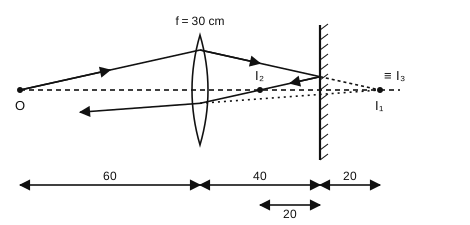
- Lens (1st pass): u = −60, f = +30 ⇒ ⇒ = +60 cm, i.e. 20 cm behind the mirror (I1).
- Mirror: I1 is a virtual object 20 cm behind it ⇒ real image I2 20 cm in front of the mirror, i.e. 20 cm from the lens.
- Lens (2nd pass, light now travelling left): object I2 at u = −20 cm, f = +30 ⇒ ⇒ = −60 cm.
- Final image is virtual, 60 cm from the lens on the mirror side ⇒ 60 − 40 = 20 cm behind the plane mirror.
Short trick: Object inside f on the return trip (20 < 30) ⇒ the lens acts as a magnifier ⇒ final image is VIRTUAL: only (A) or (B); |v| = 60 ⇒ 20 cm beyond the mirror.
Answer: (B) 20 cm from the plane mirror, it would be a virtual image.
अवधारणा: क्रमशः हल करें: लेंस → दर्पण → पुनः लेंस, प्रत्येक बार प्रकाश की दिशा को धनात्मक मानकर लगाएँ।
- लेंस (पहली बार): u = −60, f = +30 ⇒ ⇒ = +60 cm, अर्थात् दर्पण के 20 cm पीछे (I1)।
- दर्पण: I1 इसके 20 cm पीछे एक आभासी बिंब है ⇒ दर्पण के 20 cm सामने वास्तविक प्रतिबिंब I2, अर्थात् लेंस से 20 cm पर।
- लेंस (दूसरी बार, प्रकाश अब बाईं ओर): बिंब I2, u = −20 cm, f = +30 ⇒ ⇒ = −60 cm।
- अंतिम प्रतिबिंब आभासी है, लेंस से 60 cm पर दर्पण की ओर ⇒ समतल दर्पण के 60 − 40 = 20 cm पीछे।
शॉर्ट ट्रिक: वापसी में बिंब f के अंदर (20 < 30) ⇒ लेंस आवर्धक की तरह ⇒ अंतिम प्रतिबिंब आभासी: केवल (A) या (B); |v| = 60 ⇒ दर्पण के 20 cm पीछे।
उत्तर: (B) समतल दर्पण से 20 cm पर, यह आभासी प्रतिबिंब होगा।
NEET UGPhysicsRay optics – lens and plane mirror combinationNEET UG 2021 · 12 Sep Shift 1
Q1011.BF3 is planar and electron deficient compound. Hybridization and number of electrons around the central atom, respectively are
BF3 एक समतलीय तथा इलेक्ट्रॉन-न्यून यौगिक है। केन्द्रीय परमाणु का संकरण तथा उसके चारों ओर इलेक्ट्रॉनों की संख्या क्रमशः हैं
- Asp2 and 6sp2 और 6
- Bsp2 and 8sp2 और 8
- Csp3 and 4sp3 और 4
- Dsp3 and 6sp3 और 6
Show answer
Concept: Steric number = bond pairs + lone pairs decides hybridisation; electrons around the central atom = 2 × (bond pairs + lone pairs).
- B (2s22p1) has 3 valence electrons; each forms one B–F bond → 3 bond pairs, 0 lone pair.
- Steric number 3 → sp2, trigonal planar, F–B–F = 120°.
- Electrons around B = 3 × 2 = 6 (incomplete octet – that is why BF3 is electron deficient, a Lewis acid).
- sp3 would need 4 electron pairs (8 electrons) – not the case here.
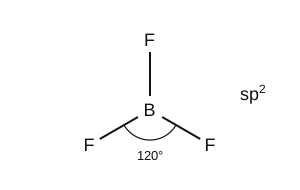
Short trick: Electron deficient + planar → sp2 with only a sextet (6 e−). Same for BCl3, AlCl3 (monomer).
Answer: (A) sp2 and 6
अवधारणा: स्टेरिक संख्या = आबंधी युग्म + एकाकी युग्म, इसी से संकरण तय होता है; केन्द्रीय परमाणु के चारों ओर इलेक्ट्रॉन = 2 × (आबंधी युग्म + एकाकी युग्म)।
- B (2s22p1) में 3 संयोजी इलेक्ट्रॉन हैं; प्रत्येक एक B–F आबंध बनाता है → 3 आबंधी युग्म, 0 एकाकी युग्म।
- स्टेरिक संख्या 3 → sp2, त्रिकोणीय समतलीय, F–B–F = 120°।
- B के चारों ओर इलेक्ट्रॉन = 3 × 2 = 6 (अपूर्ण अष्टक – इसी कारण BF3 इलेक्ट्रॉन-न्यून है, एक लुईस अम्ल)।
- sp3 के लिए 4 इलेक्ट्रॉन युग्म (8 इलेक्ट्रॉन) चाहिए – यहाँ ऐसा नहीं है।
शॉर्ट ट्रिक: इलेक्ट्रॉन-न्यून + समतलीय → केवल षष्टक (6 e−) वाला sp2। BCl3, AlCl3 (एकलक) में भी यही।
उत्तर: (A) sp2 और 6
NEET UGChemistryChemical bonding – hybridisationNEET UG 2021 · 12 Sep Shift 1
Q1012.Which of the following reactions is the metal displacement reaction? Choose the right option.
निम्नलिखित में से कौन-सी अभिक्रिया धातु विस्थापन अभिक्रिया है? सही विकल्प चुनिए।
- AFe + 2HCl ⟶ FeCl2 + H2↑
- B2Pb(NO3)2 ⟶ 2PbO + 4NO2 + O2↑
- C2KClO3 2KCl + 3O2
- DCr2O3 + 2Al Al2O3 + 2Cr
Show answer
Concept: In a metal displacement reaction a more reactive metal pushes a less reactive metal out of its compound.
- (A) Fe displaces hydrogen from HCl → hydrogen displacement, not metal displacement.
- (B) Lead nitrate breaks into PbO, NO2, O2 → thermal decomposition.
- (C) KClO3 → KCl + O2 → decomposition.
- (D) Al (more reactive) takes oxygen from Cr2O3 and sets Cr free → metal displacement (aluminothermy, like the thermite process).
Short trick: Look for “metal + compound of another metal → new compound + free metal”. Al + metal oxide is the classic example.
Answer: (D) Cr2O3 + 2Al → Al2O3 + 2Cr
अवधारणा: धातु विस्थापन अभिक्रिया में अधिक क्रियाशील धातु, कम क्रियाशील धातु को उसके यौगिक से बाहर निकाल देती है।
- (A) Fe, HCl से हाइड्रोजन को विस्थापित करता है → हाइड्रोजन विस्थापन, धातु विस्थापन नहीं।
- (B) लेड नाइट्रेट PbO, NO2, O2 में टूटता है → तापीय वियोजन।
- (C) KClO3 → KCl + O2 → वियोजन अभिक्रिया।
- (D) Al (अधिक क्रियाशील) Cr2O3 से ऑक्सीजन लेकर Cr को मुक्त करता है → धातु विस्थापन (ऐलुमिनोथर्मी, थर्माइट प्रक्रम की तरह)।
शॉर्ट ट्रिक: “धातु + दूसरी धातु का यौगिक → नया यौगिक + मुक्त धातु” खोजिए। Al + धातु ऑक्साइड इसका क्लासिक उदाहरण है।
उत्तर: (D) Cr2O3 + 2Al → Al2O3 + 2Cr
NEET UGChemistryRedox reactions – types of redox reactionsNEET UG 2021 · 12 Sep Shift 1
Q1013.The compound which shows metamerism is
मध्यावयवता (metamerism) प्रदर्शित करने वाला यौगिक है
- AC3H6O
- BC4H10O
- CC5H12
- DC3H8O
Show answer
Concept: Metamers have the same functional group (–O–, –CO–, –NH–) but different alkyl groups on its two sides.
- C4H10O ethers: CH3–O–CH2CH2CH3 and C2H5–O–C2H5 → metamers. ✔
- C3H8O: only one ether, CH3–O–C2H5 → no second arrangement.
- C3H6O: only one ketone (acetone), CH3COCH3 – no metamer.
- C5H12: alkane, no polyvalent functional group → only chain isomers.
Short trick: Ether needs at least 4 C to split carbons two ways (1+3, 2+2) – so the smallest ether metamers are C4H10O.
Answer: (B) C4H10O
अवधारणा: मध्यावयवों में एक ही क्रियात्मक समूह (–O–, –CO–, –NH–) होता है, पर उसके दोनों ओर भिन्न ऐल्किल समूह होते हैं।
- C4H10O ईथर: CH3–O–CH2CH2CH3 तथा C2H5–O–C2H5 → मध्यावयव। ✔
- C3H8O: केवल एक ईथर, CH3–O–C2H5 → दूसरी व्यवस्था सम्भव नहीं।
- C3H6O: केवल एक कीटोन (ऐसीटोन), CH3COCH3 – कोई मध्यावयव नहीं।
- C5H12: ऐल्केन, कोई बहुसंयोजी क्रियात्मक समूह नहीं → केवल शृंखला समावयव।
शॉर्ट ट्रिक: ईथर में कार्बन को दो प्रकार से बाँटने (1+3, 2+2) के लिए कम-से-कम 4 C चाहिए – अतः सबसे छोटे ईथर मध्यावयव C4H10O हैं।
उत्तर: (B) C4H10O
NEET UGChemistryOrganic chemistry – isomerism (metamerism)NEET UG 2021 · 12 Sep Shift 1
Q1014.The pKb of dimethylamine and pKa of acetic acid are 3.27 and 4.77 respectively at T(K). The correct option for the pH of dimethyl ammonium acetate solution is:
T(K) पर डाइमेथिलऐमीन का pKb तथा ऐसीटिक अम्ल का pKa क्रमशः 3.27 तथा 4.77 हैं। डाइमेथिल अमोनियम ऐसीटेट विलयन के pH के लिए सही विकल्प है:
- A7.75
- B6.25
- C8.50
- D5.50
Show answer
Concept: Salt of a weak acid and a weak base: (independent of concentration).
- pKa − pKb = 4.77 − 3.27 = 1.50
- pH = 7 + ½ (1.50) = 7 + 0.75 = 7.75
Short trick: pKb < pKa means the base is stronger → solution is basic, pH > 7. Only (A) and (C) are > 7, and the shift from 7 is half the difference = 0.75.
Answer: (A) 7.75
अवधारणा: दुर्बल अम्ल और दुर्बल क्षार का लवण: (सान्द्रता पर निर्भर नहीं)।
- pKa − pKb = 4.77 − 3.27 = 1.50
- pH = 7 + ½ (1.50) = 7 + 0.75 = 7.75
शॉर्ट ट्रिक: pKb < pKa यानी क्षार अधिक प्रबल → विलयन क्षारीय, pH > 7। केवल (A) व (C) 7 से अधिक हैं, और 7 से विचलन अन्तर का आधा = 0.75।
उत्तर: (A) 7.75
NEET UGChemistryIonic equilibrium – hydrolysis of saltsNEET UG 2021 · 12 Sep Shift 1
Q1015.The structure of beryllium chloride in solid state and vapour phase, are:
ठोस अवस्था और वाष्प प्रावस्था में बेरिलियम क्लोराइड की संरचनाएँ हैं:
- ADimer and Linear, respectivelyक्रमशः द्वितय (डाइमर) और रैखिक
- BChain in bothदोनों में शृंखला
- CChain and dimer, respectivelyक्रमशः शृंखला और द्वितय (डाइमर)
- DLinear in bothदोनों में रैखिक
Show answer
Concept: BeCl2 is electron deficient (only 4 e− on Be), so it uses Cl bridges to complete its valence shell.
- Solid state: each Be is bonded to four bridging Cl atoms → polymeric chain (upper figure).
- Vapour (below ~1200 K): Cl-bridged dimer Be2Cl4 (lower figure); only above ~1200 K does it become linear monomer.
- Hence chain (solid) and dimer (vapour).
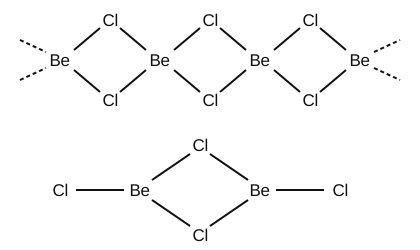
Short trick: NCERT line: “BeCl2 has a chain structure in the solid state … in the vapour phase it tends to form a chloro-bridged dimer which dissociates into the linear monomer at high temperatures of the order of 1200 K.”
Answer: (C) Chain and dimer, respectively
अवधारणा: BeCl2 इलेक्ट्रॉन-न्यून है (Be पर केवल 4 e−), इसलिए यह संयोजकता कोश पूर्ण करने हेतु Cl सेतु (ब्रिज) बनाता है।
- ठोस अवस्था: प्रत्येक Be चार सेतु Cl परमाणुओं से जुड़ा → बहुलकी शृंखला (ऊपर का चित्र)।
- वाष्प (लगभग 1200 K से नीचे): Cl-सेतु वाला द्वितय Be2Cl4 (नीचे का चित्र); लगभग 1200 K से ऊपर ही यह रैखिक एकलक बनता है।
- अतः शृंखला (ठोस) और द्वितय (वाष्प)।
शॉर्ट ट्रिक: NCERT पंक्ति: “ठोस अवस्था में BeCl2 की शृंखला संरचना होती है … वाष्प प्रावस्था में यह क्लोरो-सेतु द्वितय बनाता है जो लगभग 1200 K के उच्च ताप पर रैखिक एकलक में वियोजित हो जाता है।”
उत्तर: (C) क्रमशः शृंखला और द्वितय (डाइमर)
NEET UGChemistrys-Block elements – beryllium chlorideNEET UG 2021 · 12 Sep Shift 1
Q1016.Zr (Z = 40) and Hf (Z = 72) have similar atomic and ionic radii because of:
Zr (Z = 40) तथा Hf (Z = 72) की परमाण्वीय तथा आयनिक त्रिज्याएँ समान होती हैं, इसका कारण है:
- Alanthanoid contractionलैन्थेनॉयड आकुंचन
- Bhaving similar chemical propertiesसमान रासायनिक गुण होना
- CBelonging to same groupएक ही वर्ग से सम्बन्धित होना
- Ddiagonal relationshipविकर्ण सम्बन्ध
Show answer
Concept: The 14 lanthanoids (4f filling) come between La and Hf; 4f electrons shield poorly, so Zeff rises and size shrinks steadily.
- Normally size increases down a group (Ti → Zr increases).
- But in Hf the extra 14 protons of the 4f series are poorly shielded → the expected increase is cancelled.
- Result: r(Zr) ≈ 160 pm ≈ r(Hf) ≈ 159 pm – the effect is lanthanoid contraction.
- (B) is a consequence, not a cause; (C) alone would predict Hf bigger; (D) applies to Li–Mg, Be–Al type pairs.
Short trick: 4d and 5d elements of the same group are “twins” (Zr–Hf, Nb–Ta, Mo–W) – always because of lanthanoid contraction.
Answer: (A) lanthanoid contraction
अवधारणा: La और Hf के बीच 14 लैन्थेनॉयड (4f भरण) आते हैं; 4f इलेक्ट्रॉन दुर्बल परिरक्षण करते हैं, अतः Zeff बढ़ता है और आकार लगातार घटता है।
- सामान्यतः वर्ग में नीचे जाने पर आकार बढ़ता है (Ti → Zr बढ़ता है)।
- परन्तु Hf में 4f श्रेणी के अतिरिक्त 14 प्रोटॉन दुर्बल रूप से परिरक्षित होते हैं → अपेक्षित वृद्धि समाप्त हो जाती है।
- परिणाम: r(Zr) ≈ 160 pm ≈ r(Hf) ≈ 159 pm – यह प्रभाव लैन्थेनॉयड आकुंचन है।
- (B) परिणाम है, कारण नहीं; केवल (C) के आधार पर Hf बड़ा होना चाहिए; (D) Li–Mg, Be–Al जैसे युग्मों पर लागू होता है।
शॉर्ट ट्रिक: एक ही वर्ग के 4d और 5d तत्व “जुड़वाँ” हैं (Zr–Hf, Nb–Ta, Mo–W) – हमेशा लैन्थेनॉयड आकुंचन के कारण।
उत्तर: (A) लैन्थेनॉयड आकुंचन
NEET UGChemistryd- and f-Block elements – lanthanoid contractionNEET UG 2021 · 12 Sep Shift 1
Q1017.A particular station of All India Radio, New Delhi, broadcasts on a frequency of 1,368 KHz (kilohertz). The wavelength of the electromagnetic radiation emitted by the transmitter is: [Speed of light, c = 3 × 10⁸ ms-1]
ऑल इंडिया रेडियो, नई दिल्ली का एक विशेष केन्द्र 1,368 KHz (किलोहर्ट्ज़) आवृत्ति पर प्रसारण करता है। ट्रांसमीटर द्वारा उत्सर्जित विद्युत-चुम्बकीय विकिरण की तरंगदैर्ध्य है: [प्रकाश का वेग, c = 3 × 10⁸ ms-1]
- A2192 m
- B21.92 cm
- C219.3 m
- D219.2 m
Show answer
Concept:
- ν = 1368 kHz = 1368 × 103 Hz = 1.368 × 10⁶ s−1
- λ = (3 × 10⁸) / (1.368 × 10⁶) = 219.298 m
- Rounded correctly: 219.3 m (219.2 m is a truncation error).
Short trick: 3 × 10⁸/1.368 × 106 ≈ 300/1.368 × 10 ≈ 219.3 – watch the last digit: 0.298 rounds up.
Answer: (C) 219.3 m
अवधारणा:
- ν = 1368 kHz = 1368 × 103 Hz = 1.368 × 10⁶ s−1
- λ = (3 × 10⁸) / (1.368 × 10⁶) = 219.298 m
- सही पूर्णांकन: 219.3 m (219.2 m अंक काटने की त्रुटि है)।
शॉर्ट ट्रिक: 3 × 10⁸/1.368 × 106 ≈ 300/1.368 × 10 ≈ 219.3 – अन्तिम अंक ध्यान से: 0.298 ऊपर की ओर पूर्णांकित होता है।
उत्तर: (C) 219.3 m
NEET UGChemistryStructure of atom – electromagnetic radiationNEET UG 2021 · 12 Sep Shift 1
Q1018.An organic compound contains 78% (by wt.) carbon and remaining percentage of hydrogen. The right option for the empirical formula of this compound is: [Atomic wt. of C is 12, H is 1]
एक कार्बनिक यौगिक में 78% (भारानुसार) कार्बन तथा शेष प्रतिशत हाइड्रोजन है। इस यौगिक के मूलानुपाती सूत्र के लिए सही विकल्प है: [C का परमाणु भार 12, H का 1 है]
- ACH3
- BCH4
- CCH
- DCH2
Show answer
Concept: Divide % by atomic mass to get mole ratio, then divide by the smallest.
- C: 78/12 = 6.5 ; H: 22/1 = 22
- Ratio C : H = 1 : 22/6.5 = 1 : 3.38
- Among the options the closest whole-number ratio is 1 : 3 → CH3.
- Check others: CH4 = 75% C, CH2 = 85.7% C, CH = 92.3% C, CH3 = 80% C – nearest to 78% is CH3.
Short trick: Compute %C of each option (12/(12 + n)) and pick the one closest to the given value.
Answer: (A) CH3
अवधारणा: प्रतिशत को परमाणु द्रव्यमान से भाग देकर मोल अनुपात लें, फिर सबसे छोटे मान से भाग दें।
- C: 78/12 = 6.5 ; H: 22/1 = 22
- अनुपात C : H = 1 : 22/6.5 = 1 : 3.38
- विकल्पों में निकटतम पूर्णांक अनुपात 1 : 3 है → CH3।
- अन्य की जाँच: CH4 = 75% C, CH2 = 85.7% C, CH = 92.3% C, CH3 = 80% C – 78% के सबसे निकट CH3।
शॉर्ट ट्रिक: प्रत्येक विकल्प का %C (12/(12 + n)) निकालें और दिए गए मान के सबसे निकट वाला चुनें।
उत्तर: (A) CH3
NEET UGChemistrySome basic concepts – empirical formulaNEET UG 2021 · 12 Sep Shift 1
Q1019.Ethylenediaminetetraacetate (EDTA) ion is
एथिलीनडाइऐमीनटेट्राऐसीटेट (EDTA) आयन है
- ABidentate ligand with two “N” donor atomsदो “N” दाता परमाणुओं वाला द्विदन्तुक लिगन्ड
- BTridentate ligand with three “N” donor atoms.तीन “N” दाता परमाणुओं वाला त्रिदन्तुक लिगन्ड
- CHexadentate ligand with four “O” and two “N” donor atomsचार “O” और दो “N” दाता परमाणुओं वाला षट्दन्तुक लिगन्ड
- DUnidentate ligandएकदन्तुक लिगन्ड
Show answer
Concept: EDTA4− = (−OOCCH2)2N–CH2CH2–N(CH2COO−)2.
- Two amine N atoms each carry a lone pair → 2 donor sites.
- Four carboxylate groups each give one O− donor → 4 donor sites.
- Total 6 donor atoms → hexadentate (4 O + 2 N); it wraps the metal ion and forms very stable chelates (used in Ca2+/Mg2+ estimation, hardness of water).
Short trick: “Ethylenediaminetetraacetate” → di = 2 N, tetra = 4 O → 2 + 4 = 6 (hexa).
Answer: (C) Hexadentate ligand with four “O” and two “N” donor atoms
अवधारणा: EDTA4− = (−OOCCH2)2N–CH2CH2–N(CH2COO−)2।
- दो ऐमीन N परमाणुओं पर एकाकी युग्म है → 2 दाता स्थल।
- चार कार्बॉक्सिलेट समूह प्रत्येक एक O− दाता देते हैं → 4 दाता स्थल।
- कुल 6 दाता परमाणु → षट्दन्तुक (4 O + 2 N); यह धातु आयन को घेरकर अत्यन्त स्थायी कीलेट बनाता है (Ca2+/Mg2+ के आकलन, जल की कठोरता में प्रयुक्त)।
शॉर्ट ट्रिक: “एथिलीनडाइऐमीनटेट्राऐसीटेट” → डाइ = 2 N, टेट्रा = 4 O → 2 + 4 = 6 (षट्)।
उत्तर: (C) चार “O” और दो “N” दाता परमाणुओं वाला षट्दन्तुक लिगन्ड
NEET UGChemistryCoordination compounds – ligands (denticity)NEET UG 2021 · 12 Sep Shift 1
Q1020.Among the following alkaline earth metal halides, one which is covalent and soluble in organic solvents is:
निम्नलिखित क्षारीय मृदा धातु हैलाइडों में से वह कौन-सा है जो सहसंयोजी है तथा कार्बनिक विलायकों में विलेय है:
- AMagnesium chlorideमैग्नीशियम क्लोराइड
- BBeryllium chlorideबेरिलियम क्लोराइड
- CCalcium chlorideकैल्सियम क्लोराइड
- DStrontium chlorideस्ट्रॉन्शियम क्लोराइड
Show answer
Concept: Fajans’ rule: a small, highly charged cation polarises the anion strongly → covalent character.
- Be2+ is the smallest ion of group 2 → maximum polarising power → BeCl2 is essentially covalent and dissolves in organic solvents.
- MgCl2, CaCl2, SrCl2 have larger cations → mainly ionic, soluble in water, not in organic solvents.
Short trick: NCERT: “Except for beryllium halides, all other halides of alkaline earth metals are ionic in nature. Beryllium halides are essentially covalent and soluble in organic solvents.”
Answer: (B) Beryllium chloride
अवधारणा: फायान्स नियम: छोटा, उच्च आवेशित धनायन ऋणायन को प्रबल रूप से ध्रुवित करता है → सहसंयोजी गुण।
- Be2+ वर्ग 2 का सबसे छोटा आयन है → अधिकतम ध्रुवण क्षमता → BeCl2 मूलतः सहसंयोजी है और कार्बनिक विलायकों में घुलता है।
- MgCl2, CaCl2, SrCl2 के धनायन बड़े हैं → मुख्यतः आयनिक, जल में विलेय, कार्बनिक विलायकों में नहीं।
शॉर्ट ट्रिक: NCERT: “बेरिलियम हैलाइडों को छोड़कर क्षारीय मृदा धातुओं के सभी हैलाइड आयनिक हैं। बेरिलियम हैलाइड मूलतः सहसंयोजी हैं और कार्बनिक विलायकों में विलेय हैं।”
उत्तर: (B) बेरिलियम क्लोराइड
NEET UGChemistrys-Block elements – alkaline earth metal halidesNEET UG 2021 · 12 Sep Shift 1

