NEET UG · 2,240 questions

NEET UG 2015, 2016, 2017, 2018, 2019, 2020, 2021, 2022, 2023, 2024, 2025, 2026 PYQs

Real previous year questions, subject-wise. Try the question, then open the answer and the explanation in Hindi & English – free, no login.

Courses – airGurukul

2,240 questions.

Q1081.
The term used for transfer of pollen grains from anthers of one plant to stigma of a different plant which, during pollination, brings genetically different types of pollen grains to stigma, is:
एक पादप के परागकोशों से भिन्न पादप के वर्तिकाग्र पर परागकणों के स्थानांतरण, जो परागण के दौरान वर्तिकाग्र पर आनुवंशिक रूप से भिन्न प्रकार के परागकण लाता है, के लिए प्रयुक्त शब्द है:
  1. AChasmogamyउन्मील्य परागण (Chasmogamy)
  2. BCleistogamyअनुन्मील्य परागण (Cleistogamy)
  3. CXenogamyपरनिषेचन (Xenogamy)
  4. DGeitonogamyसजातपुष्पी परागण (Geitonogamy)
Show answer

Concept: NCERT: xenogamy – transfer of pollen from the anther to the stigma of a different plant; the only type that brings genetically different pollen to the stigma.

  1. Xenogamy – different plant, genetically different pollen – (C) correct.
  2. Geitonogamy – another flower of the same plant; functionally cross but genetically similar to autogamy – (D) wrong.
  3. Chasmogamy – flowers with exposed anthers and stigma (open flowers), not a pollen-transfer type – (A) wrong.
  4. Cleistogamy – flowers never open, assured self-pollination – (B) wrong.

Short trick: Xeno = foreign (different plant); Geiton = neighbour (same plant).

Answer: (C) Xenogamy

अवधारणा: NCERT: परनिषेचन (xenogamy) – परागकोश से भिन्न पादप के वर्तिकाग्र पर पराग का स्थानांतरण; यही एकमात्र प्रकार है जो वर्तिकाग्र पर आनुवंशिक रूप से भिन्न पराग लाता है।

  1. परनिषेचन – भिन्न पादप, आनुवंशिक रूप से भिन्न पराग – (C) सही।
  2. सजातपुष्पी परागण – उसी पादप का दूसरा पुष्प; कार्यात्मक रूप से पर-परागण पर आनुवंशिक रूप से स्वयुग्मन जैसा – (D) गलत।
  3. उन्मील्य परागण – खुले परागकोश तथा वर्तिकाग्र वाले (खुले) पुष्प, यह पराग-स्थानांतरण का प्रकार नहीं – (A) गलत।
  4. अनुन्मील्य परागण – पुष्प कभी नहीं खुलते, सुनिश्चित स्व-परागण – (B) गलत।

शॉर्ट ट्रिक: Xeno = विदेशी (भिन्न पादप); Geiton = पड़ोसी (वही पादप)।

उत्तर: (C) परनिषेचन (Xenogamy)

NEET UGBotanySexual reproduction in flowering plants – pollinationNEET UG 2021 · 12 Sep Shift 1
Q1082.
Match list I with list II.
List IList II
(a) Lenticels(i) Phellogen
(b) Cork cambium(ii) Suberin deposition
(c) Secondary cortex(iii) Exchange of gases
(d) Cork(iv) Phelloderm
सूची I का सूची II से मिलान कीजिए।
सूची Iसूची II
(a) वातरंध्र (Lenticels)(i) कागजन (Phellogen)
(b) कॉर्क एधा(ii) सुबेरिन का जमाव
(c) द्वितीयक वल्कुट(iii) गैसों का विनिमय
(d) कॉर्क(iv) काग अस्तर (Phelloderm)
  1. A(a)-(ii); (b)-(iii); (c)-(iv); (d)-(i)
  2. B(a)-(iv); (b)-(ii); (c)-(i); (d)-(iii)
  3. C(a)-(iv); (b)-(i); (c)-(iii); (d)-(ii)
  4. D(a)-(iii); (b)-(i); (c)-(iv); (d)-(ii)
Show answer

Concept: Periderm = phellem (cork) + phellogen (cork cambium) + phelloderm (secondary cortex). Cork cells have suberin; lenticels allow gas exchange.

  1. (a) Lenticels – lens-shaped openings for exchange of gases (iii).
  2. (b) Cork cambium = phellogen (i).
  3. (c) Secondary cortex = phelloderm (iv) – formed on the inner side of phellogen.
  4. (d) Cork (phellem) – walls impervious due to suberin deposition (ii).
  5. a-iii, b-i, c-iv, d-ii = (D); (C) wrongly matches lenticels with phelloderm.

Short trick: “Phell-O-gen = generator (cambium), phell-O-derm = inner skin (secondary cortex)”.

Answer: (D) (a)-(iii); (b)-(i); (c)-(iv); (d)-(ii)

अवधारणा: परिचर्म = काग (phellem/कॉर्क) + कागजन (phellogen/कॉर्क एधा) + काग अस्तर (phelloderm/द्वितीयक वल्कुट)। कॉर्क कोशिकाओं में सुबेरिन होता है; वातरंध्र गैस-विनिमय होने देते हैं।

  1. (a) वातरंध्र – गैसों के विनिमय हेतु लेंस-आकार के छिद्र (iii)।
  2. (b) कॉर्क एधा = कागजन (phellogen) (i)।
  3. (c) द्वितीयक वल्कुट = काग अस्तर (phelloderm) (iv) – कागजन के भीतरी ओर बनता है।
  4. (d) कॉर्क (phellem) – सुबेरिन जमाव के कारण भित्ति अपारगम्य (ii)।
  5. a-iii, b-i, c-iv, d-ii = (D); (C) वातरंध्र को काग अस्तर से गलत मिलाता है।

शॉर्ट ट्रिक: “Phell-O-gen = जनक (एधा), phell-O-derm = भीतरी त्वचा (द्वितीयक वल्कुट)”।

उत्तर: (D) (a)-(iii); (b)-(i); (c)-(iv); (d)-(ii)

NEET UGBotanyAnatomy – secondary growth (periderm)NEET UG 2021 · 12 Sep Shift 1
Q1083.
DNA strands on a gel stained with ethidium bromide when viewed under UV radiation, appear as:
इथीडियम ब्रोमाइड से अभिरंजित जेल पर DNA रज्जुक, UV विकिरण में देखे जाने पर, दिखाई देते हैं:
  1. ADark red bandsगहरे लाल बैंड
  2. BBright blue bandsचमकीले नीले बैंड
  3. CYellow bandsपीले बैंड
  4. DBright orange bandsचमकीले नारंगी बैंड
Show answer

Concept: NCERT: separated DNA fragments are visualised after staining with ethidium bromide followed by exposure to UV radiation – they appear as bright orange coloured bands.

  1. Ethidium bromide intercalates between DNA bases and fluoresces orange under UV – (D) correct.
  2. DNA is not visible without staining; the bands are not dark red, blue or yellow – (A), (B), (C) wrong.
  3. The bands are then cut out and DNA extracted (elution) for cloning.

Short trick: “E-B + UV = Orange” – think of an orange glow-stick.

Answer: (D) Bright orange bands

अवधारणा: NCERT: पृथक्कृत DNA खण्डों को इथीडियम ब्रोमाइड से अभिरंजित करके UV विकिरण में रखने पर देखा जाता है – वे चमकीले नारंगी रंग के बैंड के रूप में दिखाई देते हैं।

  1. इथीडियम ब्रोमाइड DNA क्षारकों के बीच अंतर्विष्ट (intercalate) होकर UV में नारंगी प्रतिदीप्ति देता है – (D) सही।
  2. अभिरंजन के बिना DNA दिखाई नहीं देता; बैंड गहरे लाल, नीले या पीले नहीं होते – (A), (B), (C) गलत।
  3. इसके बाद बैंड काटकर DNA निकाला जाता है (इल्यूशन) तथा क्लोनिंग में प्रयुक्त होता है।

शॉर्ट ट्रिक: “E-B + UV = नारंगी” – नारंगी चमक याद रखें।

उत्तर: (D) चमकीले नारंगी बैंड

NEET UGBotanyBiotechnology – gel electrophoresisNEET UG 2021 · 12 Sep Shift 1
Q1084.
Which of the following stages of meiosis involves division of centromere?
अर्धसूत्री विभाजन की निम्नलिखित में से किस अवस्था में गुणसूत्रबिन्दु का विभाजन होता है?
  1. AAnaphase IIपश्चावस्था II
  2. BTelophase IIअन्त्यावस्था II
  3. CMetaphase Iमध्यावस्था I
  4. DMetaphase IIमध्यावस्था II
Show answer

Concept: NCERT: anaphase II begins with the simultaneous splitting of the centromere of each chromosome (which was holding the sister chromatids together), allowing chromatids to move to opposite poles.

  1. Anaphase II – centromere splits, sister chromatids separate – (A) correct.
  2. Anaphase I – homologous chromosomes separate; centromeres do not divide.
  3. Metaphase I / II – chromosomes only align at the equator – (C), (D) wrong.
  4. Telophase II – nuclear envelope re-forms around chromatid groups – (B) wrong.

Short trick: Meiosis I separates homologues, meiosis II separates sisters → centromere splits only in Anaphase II.

Answer: (A) Anaphase II

अवधारणा: NCERT: पश्चावस्था II का आरम्भ प्रत्येक गुणसूत्र के गुणसूत्रबिन्दु के एकसाथ विभाजन से होता है (जो सहोदर अर्धगुणसूत्रों को साथ रखे था), जिससे अर्धगुणसूत्र विपरीत ध्रुवों की ओर जाते हैं।

  1. पश्चावस्था II – गुणसूत्रबिन्दु विभाजित, सहोदर अर्धगुणसूत्र अलग – (A) सही।
  2. पश्चावस्था I – समजात गुणसूत्र अलग होते हैं; गुणसूत्रबिन्दु विभाजित नहीं होते।
  3. मध्यावस्था I / II – गुणसूत्र केवल मध्यरेखा पर संरेखित होते हैं – (C), (D) गलत।
  4. अन्त्यावस्था II – अर्धगुणसूत्र समूहों के चारों ओर केन्द्रक आवरण पुनः बनता है – (B) गलत।

शॉर्ट ट्रिक: अर्धसूत्री I समजातों को, अर्धसूत्री II सहोदरों को अलग करता है → गुणसूत्रबिन्दु केवल पश्चावस्था II में विभाजित।

उत्तर: (A) पश्चावस्था II

NEET UGBotanyCell cycle – meiosisNEET UG 2021 · 12 Sep Shift 1
Q1085.
The production of gametes by the parents, formation of zygotes, the F1 and F2 plants can be understood from a diagram called
जनकों द्वारा युग्मकों का उत्पादन, युग्मनजों का निर्माण, F1 तथा F2 पादपों को जिस आरेख से समझा जा सकता है, वह कहलाता है
  1. APunnett squareपनेट वर्ग
  2. BNet squareनेट वर्ग
  3. CBullet squareबुलेट वर्ग
  4. DPunch squareपंच वर्ग
Show answer

Concept: NCERT: the production of gametes by the parents, the formation of zygotes, the F1 and F2 plants can be understood from a diagram called the Punnett square, developed by British geneticist Reginald C. Punnett.

  1. It is a graphical grid used to calculate the probability of all possible genotypes of offspring – (A) correct.
  2. “Net”, “Bullet”, “Punch” squares are not genetics terms – (B), (C), (D) wrong.
  3. Example: Tt × Tt → TT : Tt : tt = 1 : 2 : 1.

Short trick: Punnett square → named after R. C. Punnett.

Answer: (A) Punnett square

अवधारणा: NCERT: जनकों द्वारा युग्मकों का उत्पादन, युग्मनजों का निर्माण, F1 तथा F2 पादपों को पनेट वर्ग नामक आरेख से समझा जा सकता है, जिसे ब्रिटिश आनुवंशिकीविद रेजिनाल्ड सी. पनेट ने विकसित किया।

  1. यह एक आलेखीय ग्रिड है जिससे संतति के सभी संभावित जीनप्ररूपों की प्रायिकता ज्ञात की जाती है – (A) सही।
  2. “नेट”, “बुलेट”, “पंच” वर्ग आनुवंशिकी के शब्द नहीं हैं – (B), (C), (D) गलत।
  3. उदाहरण: Tt × Tt → TT : Tt : tt = 1 : 2 : 1।

शॉर्ट ट्रिक: पनेट वर्ग → आर. सी. पनेट के नाम पर।

उत्तर: (A) पनेट वर्ग

NEET UGBotanyPrinciples of inheritance – Punnett squareNEET UG 2021 · 12 Sep Shift 1
Q1086.
Plants follow different pathways in response to environment or phases of life to form different kinds of structures. This ability is called
पादप पर्यावरण या जीवन की प्रावस्थाओं के प्रति अनुक्रिया में विभिन्न प्रकार की संरचनाएँ बनाने हेतु भिन्न-भिन्न पथ अपनाते हैं। इस क्षमता को कहते हैं
  1. APlasticityसुघट्यता (Plasticity)
  2. BMaturityपरिपक्वता (Maturity)
  3. CElasticityप्रत्यास्थता (Elasticity)
  4. DFlexibilityलचीलापन (Flexibility)
Show answer

Concept: NCERT: plants follow different pathways in response to environment or phases of life to form different kinds of structures – this ability is called plasticity (e.g. heterophylly).

  1. Heterophylly in cotton, coriander, larkspur (phase of life) and in buttercup (environment: aerial vs submerged leaves) are examples – (A) correct.
  2. Maturity – a stage of development, not an ability to change form – (B) wrong.
  3. Elasticity / flexibility – physical properties, not developmental terms – (C), (D) wrong.

Short trick: Plasticity ⇄ heterophylly: one plant, many leaf forms.

Answer: (A) Plasticity

अवधारणा: NCERT: पादप पर्यावरण या जीवन की प्रावस्थाओं के अनुसार विभिन्न पथ अपनाकर भिन्न प्रकार की संरचनाएँ बनाते हैं – इस क्षमता को सुघट्यता (plasticity) कहते हैं (जैसे विषमपर्णता)।

  1. कपास, धनिया, लार्कस्पर (जीवन प्रावस्था) तथा बटरकप (पर्यावरण: वायवीय बनाम जलमग्न पत्तियाँ) में विषमपर्णता इसके उदाहरण हैं – (A) सही।
  2. परिपक्वता – परिवर्धन की एक अवस्था है, रूप बदलने की क्षमता नहीं – (B) गलत।
  3. प्रत्यास्थता / लचीलापन – भौतिक गुण हैं, परिवर्धन संबंधी शब्द नहीं – (C), (D) गलत।

शॉर्ट ट्रिक: सुघट्यता ⇄ विषमपर्णता: एक पौधा, पत्तियों के अनेक रूप।

उत्तर: (A) सुघट्यता (Plasticity)

NEET UGBotanyPlant growth and development – plasticityNEET UG 2021 · 12 Sep Shift 1
Q1087.
Amensalism can be represented as :
अमेन्सेलिज़्म (Amensalism) को किस प्रकार निरूपित किया जा सकता है?
  1. ASpecies A ( - ) ; Species B ( - )जाति A ( - ) ; जाति B ( - )
  2. BSpecies A ( + ) ; Species B (0)जाति A ( + ) ; जाति B (0)
  3. CSpecies A ( - ) ; Species B (0)जाति A ( - ) ; जाति B (0)
  4. DSpecies A ( + ) ; Species B ( + )जाति A ( + ) ; जाति B ( + )
Show answer

Concept: NCERT: in amensalism one species is harmed (−) while the other is unaffected (0).

  1. (−, −) = competition – (A) wrong.
  2. (+, 0) = commensalism – (B) wrong.
  3. (−, 0) = amensalism – (C) correct (e.g. Penicillium secreting penicillin harms bacteria).
  4. (+, +) = mutualism – (D) wrong.

Short trick: “A-mensalism = A minus, other zero”; Commensalism = comfortable (+, 0).

Answer: (C) Species A ( - ) ; Species B (0)

अवधारणा: NCERT: अमेन्सेलिज़्म में एक जाति को हानि (−) होती है जबकि दूसरी अप्रभावित (0) रहती है।

  1. (−, −) = स्पर्धा – (A) गलत।
  2. (+, 0) = सहभोजिता – (B) गलत।
  3. (−, 0) = अमेन्सेलिज़्म – (C) सही (जैसे Penicillium द्वारा स्रावित पेनिसिलिन जीवाणुओं को हानि पहुँचाता है)।
  4. (+, +) = सहोपकारिता – (D) गलत।

शॉर्ट ट्रिक: “A-mensalism = A माइनस, दूसरा शून्य”; सहभोजिता = आराम से (+, 0)।

उत्तर: (C) जाति A ( - ) ; जाति B (0)

NEET UGBotanyOrganisms and populations – population interactionsNEET UG 2021 · 12 Sep Shift 1
Q1088.
Match list I with list II.
List IList II
(a) Protoplast fusion(i) Totipotency
(b) Plant tissue culture(ii) Pomato
(c) Meristem culture(iii) Somaclones
(d) Micropropagation(iv) Virus free plants
सूची I का सूची II से मिलान कीजिए।
सूची Iसूची II
(a) जीवद्रव्यक संलयन(i) पूर्णशक्तता (Totipotency)
(b) पादप ऊतक संवर्धन(ii) पोमेटो
(c) विभज्योतक संवर्धन(iii) कायक्लोन (Somaclones)
(d) सूक्ष्मप्रवर्धन(iv) विषाणुमुक्त पादप
  1. A(a)-(iii); (b)-(iv); (c)-(i); (d)-(ii)
  2. B(a)-(iv); (b)-(iii); (c)-(ii); (d)-(i)
  3. C(a)-(iii); (b)-(iv); (c)-(ii); (d)-(i)
  4. D(a)-(ii); (b)-(i); (c)-(iv); (d)-(iii)
Show answer

Concept: NCERT (Food production): tissue culture rests on totipotency; micropropagation gives genetically identical somaclones; meristem (apical/axillary) is virus-free; somatic hybridisation by protoplast fusion gave the pomato.

  1. (a) Protoplast fusion → somatic hybrid pomato (potato + tomato) (ii).
  2. (b) Plant tissue culture → based on totipotency (i).
  3. (c) Meristem culture → virus-free plants (iv) because meristem is free of virus.
  4. (d) Micropropagation → genetically identical somaclones (iii).
  5. a-ii, b-i, c-iv, d-iii = (D); (A), (B), (C) all mismatch (a).

Short trick: Fix (a) = pomato (ii) → only option (D).

Answer: (D) (a)-(ii); (b)-(i); (c)-(iv); (d)-(iii)

अवधारणा: NCERT (खाद्य उत्पादन): ऊतक संवर्धन पूर्णशक्तता पर आधारित है; सूक्ष्मप्रवर्धन से आनुवंशिक रूप से समान कायक्लोन बनते हैं; विभज्योतक (शीर्ष/कक्षस्थ) विषाणुमुक्त होता है; जीवद्रव्यक संलयन द्वारा कायिक संकरण से पोमेटो बना।

  1. (a) जीवद्रव्यक संलयन → कायिक संकर पोमेटो (आलू + टमाटर) (ii)।
  2. (b) पादप ऊतक संवर्धन → पूर्णशक्तता पर आधारित (i)।
  3. (c) विभज्योतक संवर्धन → विषाणुमुक्त पादप (iv), क्योंकि विभज्योतक विषाणुमुक्त होता है।
  4. (d) सूक्ष्मप्रवर्धन → आनुवंशिक रूप से समान कायक्लोन (iii)।
  5. a-ii, b-i, c-iv, d-iii = (D); (A), (B), (C) सभी (a) में गलत हैं।

शॉर्ट ट्रिक: (a) = पोमेटो (ii) तय कीजिए → केवल विकल्प (D)।

उत्तर: (D) (a)-(ii); (b)-(i); (c)-(iv); (d)-(iii)

NEET UGBotanyBiotechnology in plant breeding – tissue cultureNEET UG 2021 · 12 Sep Shift 1
Q1089.
Inspite of interspecific competition in nature, which mechanism the competing species might have evolved for their survival?
प्रकृति में अंतरजातीय स्पर्धा के बावजूद, स्पर्धी जातियों ने अपनी उत्तरजीविता के लिए कौन-सी क्रियाविधि विकसित की होगी?
  1. AMutualismसहोपकारिता
  2. BPredationपरभक्षण
  3. CResource partitioningसंसाधन विभाजन
  4. DCompetitive releaseस्पर्धी विमोचन
Show answer

Concept: NCERT: if two species compete for the same resource, they could avoid competition by choosing different times for feeding or different foraging patterns – resource partitioning (MacArthur’s warblers on the same tree).

  1. Resource partitioning lets competitors co-exist – (C) correct.
  2. Mutualism is a (+, +) interaction, not a way of dealing with competition – (A) wrong.
  3. Predation is (+, −) between predator and prey – (B) wrong.
  4. Competitive release is expansion of a species’ range when the superior competitor is removed – a result, not a survival mechanism evolved by both – (D) wrong.

Short trick: Same tree, different branches (warblers) = partitioning.

Answer: (C) Resource partitioning

अवधारणा: NCERT: यदि दो जातियाँ एक ही संसाधन के लिए स्पर्धा करती हैं, तो वे भोजन के लिए भिन्न समय या भिन्न आहार-खोज प्रतिरूप चुनकर स्पर्धा से बच सकती हैं – संसाधन विभाजन (एक ही पेड़ पर मैकआर्थर की वार्बलर पक्षी)।

  1. संसाधन विभाजन से स्पर्धी सह-अस्तित्व में रह पाते हैं – (C) सही।
  2. सहोपकारिता (+, +) पारस्परिक क्रिया है, स्पर्धा से निपटने का तरीका नहीं – (A) गलत।
  3. परभक्षण परभक्षी तथा शिकार के बीच (+, −) है – (B) गलत।
  4. स्पर्धी विमोचन = श्रेष्ठ स्पर्धी हटाए जाने पर किसी जाति के क्षेत्र का विस्तार – यह परिणाम है, दोनों द्वारा विकसित उत्तरजीविता क्रियाविधि नहीं – (D) गलत।

शॉर्ट ट्रिक: एक पेड़, अलग शाखाएँ (वार्बलर) = विभाजन।

उत्तर: (C) संसाधन विभाजन

NEET UGBotanyOrganisms and populations – competitionNEET UG 2021 · 12 Sep Shift 1
Q1090.
Which of the following algae contains mannitol as reserve food material?
निम्नलिखित में से किस शैवाल में संचित खाद्य पदार्थ के रूप में मैनिटॉल होता है?
  1. AVolvox
  2. BUlothrix
  3. CEctocarpus
  4. DGracilaria
Show answer

Concept: NCERT: brown algae (Phaeophyceae) store food as complex carbohydrates – laminarin or mannitol; green algae store starch; red algae store floridean starch.

  1. Ectocarpus – brown alga → mannitol/laminarin – (C) correct.
  2. Volvox – green alga → starch – (A) wrong.
  3. Ulothrix – green alga → starch – (B) wrong.
  4. Gracilaria – red alga → floridean starch – (D) wrong.

Short trick: Brown algae examples “E-D-L-F-S”: Ectocarpus, Dictyota, Laminaria, Fucus, Sargassum → Mannitol.

Answer: (C) Ectocarpus

अवधारणा: NCERT: भूरे शैवाल (फियोफाइसी) भोजन को जटिल कार्बोहाइड्रेट – लैमिनेरिन या मैनिटॉल – के रूप में संचित करते हैं; हरे शैवाल स्टार्च तथा लाल शैवाल फ्लोरिडियन स्टार्च संचित करते हैं।

  1. Ectocarpus – भूरा शैवाल → मैनिटॉल/लैमिनेरिन – (C) सही।
  2. Volvox – हरा शैवाल → स्टार्च – (A) गलत।
  3. Ulothrix – हरा शैवाल → स्टार्च – (B) गलत।
  4. Gracilaria – लाल शैवाल → फ्लोरिडियन स्टार्च – (D) गलत।

शॉर्ट ट्रिक: भूरे शैवाल उदाहरण “E-D-L-F-S”: Ectocarpus, Dictyota, Laminaria, Fucus, Sargassum → मैनिटॉल।

उत्तर: (C) Ectocarpus

NEET UGBotanyPlant kingdom – algae (Phaeophyceae)NEET UG 2021 · 12 Sep Shift 1
Q1091.
The site of perception of light in plants during photoperiodism is:
दीप्तिकालिता (photoperiodism) के दौरान पादपों में प्रकाश के संवेदन का स्थल है:
  1. AAxillary budकक्षस्थ कलिका
  2. BLeafपत्ती
  3. CShoot apexप्ररोह शीर्ष
  4. DStemतना
Show answer

Concept: NCERT: while shoot apices modify into floral meristems, the site of perception of light/dark duration is the leaves; a hormonal substance (florigen) migrates from leaves to the shoot apex.

  1. Leaf perceives photoperiod – (B) correct.
  2. Shoot apex / axillary bud is where flowering occurs (response), not perception – (A), (C) wrong.
  3. Stem only conducts the stimulus – (D) wrong.

Short trick: “Leaf senses, apex flowers” (florigen travels leaf → apex).

Answer: (B) Leaf

अवधारणा: NCERT: यद्यपि प्ररोह शीर्ष पुष्पी विभज्योतक में रूपांतरित होते हैं, परन्तु प्रकाश/अंधकार की अवधि के संवेदन का स्थल पत्तियाँ हैं; एक हॉर्मोनी पदार्थ (फ्लोरिजन) पत्तियों से प्ररोह शीर्ष तक जाता है।

  1. पत्ती दीप्तिकाल का संवेदन करती है – (B) सही।
  2. प्ररोह शीर्ष / कक्षस्थ कलिका पर पुष्पन (अनुक्रिया) होता है, संवेदन नहीं – (A), (C) गलत।
  3. तना केवल उद्दीपन का संवहन करता है – (D) गलत।

शॉर्ट ट्रिक: “पत्ती महसूस करती है, शीर्ष फूलता है” (फ्लोरिजन पत्ती → शीर्ष)।

उत्तर: (B) पत्ती

NEET UGBotanyPlant growth and development – photoperiodismNEET UG 2021 · 12 Sep Shift 1
Q1092.
The first stable product of CO2 fixation in sorghum is:
ज्वार (sorghum) में CO2 स्थिरीकरण का प्रथम स्थायी उत्पाद है:
  1. ASuccinic acidसक्सिनिक अम्ल
  2. BPhosphoglyceric acidफॉस्फोग्लिसरिक अम्ल
  3. CPyruvic acidपाइरुविक अम्ल
  4. DOxaloacetic acidऑक्सैलोऐसीटिक अम्ल
Show answer

Concept: Sorghum is a C4 plant (like maize, sugarcane). In mesophyll cells PEP (3C) accepts CO2 via PEP carboxylase forming the 4C oxaloacetic acid (OAA).

  1. PEP + CO2 → OAA (first stable product, 4C) – (D) correct.
  2. Phosphoglyceric acid (3-PGA) is the first product in C3 plants – (B) wrong.
  3. Pyruvic acid is formed in bundle-sheath cells after decarboxylation of malate – (C) wrong.
  4. Succinic acid is a Krebs-cycle intermediate – (A) wrong.

Short trick: C4 plants: “Maize, Sugarcane, Sorghum = MSS → OAA”.

Answer: (D) Oxaloacetic acid

अवधारणा: ज्वार एक C4 पादप है (मक्का, गन्ने की तरह)। पर्णमध्योतक कोशिकाओं में PEP (3C) PEP कार्बोक्सिलेज़ द्वारा CO2 ग्रहण करके 4C ऑक्सैलोऐसीटिक अम्ल (OAA) बनाता है।

  1. PEP + CO2 → OAA (प्रथम स्थायी उत्पाद, 4C) – (D) सही।
  2. फॉस्फोग्लिसरिक अम्ल (3-PGA) C3 पादपों में प्रथम उत्पाद है – (B) गलत।
  3. पाइरुविक अम्ल पूलाच्छद कोशिकाओं में मैलेट के विकार्बोक्सिलन के बाद बनता है – (C) गलत।
  4. सक्सिनिक अम्ल क्रेब्स चक्र का मध्यवर्ती है – (A) गलत।

शॉर्ट ट्रिक: C4 पादप: “मक्का, गन्ना, ज्वार → OAA”।

उत्तर: (D) ऑक्सैलोऐसीटिक अम्ल

NEET UGBotanyPhotosynthesis – C4 pathwayNEET UG 2021 · 12 Sep Shift 1
Q1093.
Match List -I with List – II
List IList II
(a) Cristae(i) Primary constriction in chromosome
(b) Thylakoide(ii) Disc-shaped sacs in Golgi apparatus
(c) Centromere(iii) Infoldings in mitochondria
(d) Cisternae(iv) Flattened membranous sacs in stroma of plastids
सूची-I का सूची-II से मिलान कीजिए
सूची Iसूची II
(a) क्रिस्टी(i) गुणसूत्र में प्राथमिक संकीर्णन
(b) थाइलेकॉइड(ii) गॉल्जी उपकरण में चक्रिकाकार कोष
(c) गुणसूत्रबिन्दु(iii) सूत्रकणिका (माइटोकॉन्ड्रिया) में अंतर्वलन
(d) सिस्टर्नी(iv) लवक के पीठिका (स्ट्रोमा) में चपटे झिल्लीमय कोष
  1. A(a)-(iii), (b)-(iv), (c)-(i), (d)-(ii)
  2. B(a)-(ii), (b)-(iii), (c)-(iv), (d)-(i)
  3. C(a)-(iv), (b)-(iii), (c)-(ii), (d)-(i)
  4. D(a)-(i), (b)-(iv), (c)-(iii), (d)-(ii)
Show answer

Concept: NCERT (Cell): the inner mitochondrial membrane forms infoldings called cristae; thylakoids are flattened sacs in the chloroplast stroma; the centromere is the primary constriction; Golgi consists of flat disc-shaped cisternae.

  1. (a) Cristae → infoldings in mitochondria (iii).
  2. (b) Thylakoid → flattened membranous sacs in stroma of plastids (iv).
  3. (c) Centromere → primary constriction (i).
  4. (d) Cisternae → disc-shaped sacs of Golgi (ii).
  5. a-iii, b-iv, c-i, d-ii = (A).

Short trick: “Cristae = Crinkles of mitochondria; Cisternae = Golgi stack”.

Answer: (A) (a)-(iii), (b)-(iv), (c)-(i), (d)-(ii)

अवधारणा: NCERT (कोशिका): सूत्रकणिका की भीतरी झिल्ली क्रिस्टी नामक अंतर्वलन बनाती है; थाइलेकॉइड हरितलवक की पीठिका में चपटे कोष हैं; गुणसूत्रबिन्दु प्राथमिक संकीर्णन है; गॉल्जी चपटे चक्रिकाकार सिस्टर्नी से बना होता है।

  1. (a) क्रिस्टी → सूत्रकणिका में अंतर्वलन (iii)।
  2. (b) थाइलेकॉइड → लवक की पीठिका में चपटे झिल्लीमय कोष (iv)।
  3. (c) गुणसूत्रबिन्दु → प्राथमिक संकीर्णन (i)।
  4. (d) सिस्टर्नी → गॉल्जी के चक्रिकाकार कोष (ii)।
  5. a-iii, b-iv, c-i, d-ii = (A)।

शॉर्ट ट्रिक: “क्रिस्टी = सूत्रकणिका की सिलवटें; सिस्टर्नी = गॉल्जी का ढेर”।

उत्तर: (A) (a)-(iii), (b)-(iv), (c)-(i), (d)-(ii)

NEET UGBotanyCell – cell organellesNEET UG 2021 · 12 Sep Shift 1
Q1094.
Complete the flow chart on central dogma.
केन्द्रीय सिद्धान्त (central dogma) पर आधारित प्रवाह चार्ट को पूर्ण कीजिए।
  1. A(a)-Replication; (b)-Transcription; (c)-Translation; (d)-Protein(a)-प्रतिकृतियन (Replication); (b)-अनुलेखन (Transcription); (c)-स्थानांतरण (Translation); (d)-प्रोटीन
  2. B(a)-Transduction; (b)-Translation; (c)-Replication; (d)-Protein(a)-पारक्रमण (Transduction); (b)-स्थानांतरण (Translation); (c)-प्रतिकृतियन (Replication); (d)-प्रोटीन
  3. C(a)-Replication; (b)-Transcription; (c)-Transduction; (d)-Protein(a)-प्रतिकृतियन (Replication); (b)-अनुलेखन (Transcription); (c)-पारक्रमण (Transduction); (d)-प्रोटीन
  4. D(a)-Translation; (b)-Replication; (c)-Transcription; (d)-Transduction(a)-स्थानांतरण (Translation); (b)-प्रतिकृतियन (Replication); (c)-अनुलेखन (Transcription); (d)-पारक्रमण (Transduction)
Show answer

Concept: Central dogma (Crick): DNA → mRNA → protein. The curved arrow on DNA shows DNA copying itself.

  1. (a) the circular arrow on DNA = replication.
  2. (b) DNA → mRNA = transcription.
  3. (c) mRNA → (d) = translation, product (d) = protein.
  4. Transduction is gene transfer by phages, not a step of the central dogma – (B), (C), (D) wrong.

Short trick: Write it like a sentence: DNA copies itself, writes (transcribes) mRNA, which is translated to protein.

Answer: (A) (a)-Replication; (b)-Transcription; (c)-Translation; (d)-Protein

अवधारणा: केन्द्रीय सिद्धान्त (क्रिक): DNA → mRNA → प्रोटीन। DNA पर बना वक्र तीर DNA के स्वयं की प्रतिलिपि बनाने को दर्शाता है।

  1. (a) DNA पर वृत्ताकार तीर = प्रतिकृतियन (replication)।
  2. (b) DNA → mRNA = अनुलेखन (transcription)।
  3. (c) mRNA → (d) = स्थानांतरण (translation), उत्पाद (d) = प्रोटीन।
  4. पारक्रमण (transduction) फेज द्वारा जीन स्थानांतरण है, केन्द्रीय सिद्धान्त का चरण नहीं – (B), (C), (D) गलत।

शॉर्ट ट्रिक: वाक्य की तरह याद रखें: DNA स्वयं की प्रतिलिपि बनाता है, mRNA लिखता (अनुलेखन) है, जो प्रोटीन में अनुवादित (स्थानांतरित) होता है।

उत्तर: (A) (a)-प्रतिकृतियन; (b)-अनुलेखन; (c)-स्थानांतरण; (d)-प्रोटीन

NEET UGBotanyMolecular basis of inheritance – central dogmaNEET UG 2021 · 12 Sep Shift 1
Q1095.
Match List -I with List – II
List IList II
(a) Cohesion(i) More attraction in liquid phase
(b) Adhesion(ii) Mutual attraction among water molecules
(c) Surface tension(iii) Water loss in liquid phase
(d) Guttation(iv) Attraction towards polar surfaces
Choose the correct answer from the options given below.
सूची-I का सूची-II से मिलान कीजिए
सूची Iसूची II
(a) संसंजन (Cohesion)(i) द्रव प्रावस्था में अधिक आकर्षण
(b) आसंजन (Adhesion)(ii) जल अणुओं के बीच परस्पर आकर्षण
(c) पृष्ठ तनाव(iii) द्रव प्रावस्था में जल की हानि
(d) बिन्दुस्राव (Guttation)(iv) ध्रुवीय सतहों की ओर आकर्षण
नीचे दिए गए विकल्पों में से सही उत्तर चुनिए।
  1. A(a)-(iii), (b)-(i), (c)-(iv), (d)-(ii)
  2. B(a)-(ii), (b)-(i), (c)-(iv), (d)-(iii)
  3. C(a)-(ii), (b)-(iv), (c)-(i), (d)-(iii)
  4. D(a)-(iv), (b)-(iii), (c)-(ii), (d)-(i)
Show answer

Concept: NCERT (Transport in plants): cohesion – mutual attraction between water molecules; adhesion – attraction of water to polar surfaces (e.g. xylem walls); surface tension – water molecules attracted to each other more in the liquid than in the gas phase; guttation – loss of water in liquid form through hydathodes.

  1. (a) Cohesion → (ii).
  2. (b) Adhesion → (iv).
  3. (c) Surface tension → (i).
  4. (d) Guttation → (iii).
  5. a-ii, b-iv, c-i, d-iii = (C); (B) wrongly gives adhesion (i).

Short trick: Cohesion = co-workers (water–water); Adhesion = address to wall (water–surface).

Answer: (C) (a)-(ii), (b)-(iv), (c)-(i), (d)-(iii)

अवधारणा: NCERT (पादपों में परिवहन): संसंजन – जल अणुओं के बीच परस्पर आकर्षण; आसंजन – जल का ध्रुवीय सतहों (जैसे जाइलम भित्ति) की ओर आकर्षण; पृष्ठ तनाव – जल अणु गैस प्रावस्था की तुलना में द्रव प्रावस्था में परस्पर अधिक आकर्षित होते हैं; बिन्दुस्राव – जलरंध्रों (hydathodes) द्वारा द्रव रूप में जल की हानि।

  1. (a) संसंजन → (ii)।
  2. (b) आसंजन → (iv)।
  3. (c) पृष्ठ तनाव → (i)।
  4. (d) बिन्दुस्राव → (iii)।
  5. a-ii, b-iv, c-i, d-iii = (C); (B) आसंजन को गलत रूप से (i) देता है।

शॉर्ट ट्रिक: Cohesion = साथी-साथी (जल–जल); Adhesion = दीवार से चिपकना (जल–सतह)।

उत्तर: (C) (a)-(ii), (b)-(iv), (c)-(i), (d)-(iii)

NEET UGBotanyTransport in plants – properties of waterNEET UG 2021 · 12 Sep Shift 1
Q1096.
Which of the following statements is incorrect?
निम्नलिखित में से कौन-सा कथन गलत है?
  1. AGrana lamellae have both PS I and PS IIग्रैना पटलिकाओं में PS I तथा PS II दोनों होते हैं
  2. BCyclic photophosphorylation involves both PS I and PS II.चक्रीय प्रकाश फॉस्फोरिलीकरण में PS I तथा PS II दोनों भाग लेते हैं।
  3. CBoth ATP and NADPH + H+ are synthesized during non-cyclic photophosphorylation.अचक्रीय प्रकाश फॉस्फोरिलीकरण के दौरान ATP तथा NADPH + H+ दोनों संश्लेषित होते हैं।
  4. DStroma lamellae have PS I only and lack NADP reductaseस्ट्रोमा पटलिकाओं में केवल PS I होता है तथा NADP रिडक्टेज़ अनुपस्थित होता है
Show answer

Concept: NCERT: cyclic photophosphorylation takes place in the stroma lamellae, involves only PS I (P700); electrons cycle back and only ATP is formed.

  1. (A) correct – grana lamellae carry both PS I and PS II.
  2. (B) incorrect – cyclic flow uses PS I only.
  3. (C) correct – non-cyclic (Z-scheme) forms both ATP and NADPH + H+.
  4. (D) correct – stroma lamellae lack PS II and NADP reductase, hence only cyclic flow there.

Short trick: “Cyclic = 1 PS, 1 product (ATP)”; non-cyclic = 2 PS, 2 products.

Answer: (B) Cyclic photophosphorylation involves both PS I and PS II.

अवधारणा: NCERT: चक्रीय प्रकाश फॉस्फोरिलीकरण स्ट्रोमा पटलिकाओं में होता है, इसमें केवल PS I (P700) भाग लेता है; इलेक्ट्रॉन चक्र में वापस लौटते हैं तथा केवल ATP बनता है।

  1. (A) सही – ग्रैना पटलिकाओं में PS I तथा PS II दोनों होते हैं।
  2. (B) गलत – चक्रीय प्रवाह में केवल PS I प्रयुक्त होता है।
  3. (C) सही – अचक्रीय (Z-योजना) में ATP तथा NADPH + H+ दोनों बनते हैं।
  4. (D) सही – स्ट्रोमा पटलिकाओं में PS II तथा NADP रिडक्टेज़ नहीं होते, इसलिए वहाँ केवल चक्रीय प्रवाह होता है।

शॉर्ट ट्रिक: “चक्रीय = 1 PS, 1 उत्पाद (ATP)”; अचक्रीय = 2 PS, 2 उत्पाद।

उत्तर: (B) चक्रीय प्रकाश फॉस्फोरिलीकरण में PS I तथा PS II दोनों…

NEET UGBotanyPhotosynthesis – photophosphorylationNEET UG 2021 · 12 Sep Shift 1
Q1097.
Select the correct pair.
सही युग्म का चयन कीजिए।
  1. ACells of medullary rays that form part of cambial ring - Interfascicular cambiumमज्जा किरणों की वे कोशिकाएँ जो एधा वलय का भाग बनाती हैं - अंतरापूलीय एधा
  2. BLoose parenchyma cells rupturing the epidermis and forming a lens-shaped opening in bark - Spongy parenchymaशिथिल मृदूतक कोशिकाएँ जो बाह्यत्वचा को फाड़कर छाल में लेंस-आकार का छिद्र बनाती हैं - स्पंजी मृदूतक
  3. CLarge colorless empty cells in the epidermis of grass leaves – Subsidiary cellsघासों की पत्तियों की बाह्यत्वचा में बड़ी रंगहीन रिक्त कोशिकाएँ – सहायक कोशिकाएँ
  4. DIn dicot leaves, vascular bundles are surrounded by large thick-walled cells– Conjunctive tissueद्विबीजपत्री पत्तियों में संवहन पूल बड़ी मोटी भित्ति वाली कोशिकाओं से घिरे रहते हैं – संयोजी ऊतक
Show answer

Concept: NCERT: in dicot stem, cells of medullary rays adjoining the intrafascicular cambium become meristematic and form the interfascicular cambium, completing the cambial ring.

  1. (A) correct pair.
  2. (B) wrong – these loose cells (complementary cells) form lenticels; spongy parenchyma is in leaf mesophyll.
  3. (C) wrong – large colourless empty cells in grass-leaf epidermis are bulliform cells; subsidiary cells surround guard cells.
  4. (D) wrong – the large thick-walled cells around leaf vascular bundles are the bundle sheath; conjunctive tissue is parenchyma between xylem and phloem in roots.

Short trick: Each wrong option has a “swapped name”: lenticel, bulliform, bundle sheath → only (A) is untouched.

Answer: (A) Cells of medullary rays … – Interfascicular cambium

अवधारणा: NCERT: द्विबीजपत्री तने में अंतःपूलीय एधा से सटी मज्जा किरणों की कोशिकाएँ विभज्योतकी होकर अंतरापूलीय एधा बनाती हैं, जिससे एधा वलय पूर्ण होता है।

  1. (A) सही युग्म।
  2. (B) गलत – ये शिथिल कोशिकाएँ (पूरक कोशिकाएँ) वातरंध्र (lenticels) बनाती हैं; स्पंजी मृदूतक पत्ती के पर्णमध्योतक में होता है।
  3. (C) गलत – घास की पत्ती की बाह्यत्वचा में बड़ी रंगहीन रिक्त कोशिकाएँ आवर्ध त्वक कोशिकाएँ (bulliform cells) हैं; सहायक कोशिकाएँ द्वार कोशिकाओं को घेरती हैं।
  4. (D) गलत – पत्ती के संवहन पूलों के चारों ओर बड़ी मोटी भित्ति वाली कोशिकाएँ पूलाच्छद (bundle sheath) हैं; संयोजी ऊतक जड़ों में जाइलम तथा फ्लोएम के बीच का मृदूतक है।

शॉर्ट ट्रिक: प्रत्येक गलत विकल्प में “नाम बदला हुआ” है: वातरंध्र, आवर्ध त्वक, पूलाच्छद → केवल (A) अपरिवर्तित।

उत्तर: (A) मज्जा किरणों की कोशिकाएँ … – अंतरापूलीय एधा

NEET UGBotanyAnatomy – tissues of leaf and stemNEET UG 2021 · 12 Sep Shift 1
Q1098.
Identify the correct statement.
सही कथन की पहचान कीजिए।
  1. AThe coding strand in a transcription unit is copied to an mRNAअनुलेखन इकाई का कूटलेखन रज्जुक (coding strand) mRNA में प्रतिलिपित होता है
  2. BSplit gene arrangement is characteristic of prokaryotesखण्डित जीन (split gene) व्यवस्था प्रोकैरियोट की विशेषता है
  3. CIn capping, methyl guanosine triphosphate is added to the 3’ end of hnRNA.कैपिंग में, मेथिल ग्वानोसीन ट्राइफॉस्फेट hnRNA के 3’ सिरे पर जोड़ा जाता है।
  4. DRNA polymerase binds with Rho factor to terminate the process of transcription in bacteria.जीवाणुओं में अनुलेखन की प्रक्रिया को समाप्त करने के लिए RNA पॉलिमरेज़ Rho कारक से जुड़ता है।
Show answer

Concept: NCERT: in bacteria, RNA polymerase associates transiently with the initiation factor σ (sigma) to start and with the termination factor ρ (rho) to terminate transcription.

  1. (A) wrong – the template strand (3’→5’) is copied; the coding strand has the same sequence as mRNA (T in place of U).
  2. (B) wrong – split genes (exons + introns) are characteristic of eukaryotes.
  3. (C) wrong – the methyl guanosine triphosphate cap is added to the 5’ end; poly-A tail is added at the 3’ end.
  4. (D) correct – rho factor terminates transcription in bacteria.

Short trick: “σ starts, ρ stops”; “Cap at 5’, tail at 3’”.

Answer: (D) RNA polymerase binds with Rho factor…

अवधारणा: NCERT: जीवाणुओं में RNA पॉलिमरेज़ अनुलेखन शुरू करने के लिए प्रारम्भन कारक σ (सिग्मा) से तथा समाप्त करने के लिए समापन कारक ρ (रो) से अस्थायी रूप से जुड़ता है।

  1. (A) गलत – टेम्पलेट (साँचा) रज्जुक (3’→5’) प्रतिलिपित होता है; कूटलेखन रज्जुक का अनुक्रम mRNA जैसा ही होता है (U के स्थान पर T)।
  2. (B) गलत – खण्डित जीन (एक्सॉन + इन्ट्रॉन) यूकैरियोट की विशेषता है।
  3. (C) गलत – मेथिल ग्वानोसीन ट्राइफॉस्फेट कैप 5’ सिरे पर जोड़ा जाता है; पॉली-A पुच्छ 3’ सिरे पर जुड़ती है।
  4. (D) सही – जीवाणुओं में रो कारक अनुलेखन समाप्त करता है।

शॉर्ट ट्रिक: “σ शुरू करता है, ρ रोकता है”; “कैप 5’ पर, पुच्छ 3’ पर”।

उत्तर: (D) RNA पॉलिमरेज़ Rho कारक से जुड़ता है…

NEET UGBotanyMolecular basis of inheritance – transcriptionNEET UG 2021 · 12 Sep Shift 1
Q1099.
Match List -I with List – II
List IList II
(a) S phase(i) Proteins are synthesized
(b) G2 phase(ii) Inactive phase
(c) Quiescent stage(iii) Interval between mitosis and initiation of DNA replication
(d) G1 phase(iv) DNA replication
सूची-I का सूची-II से मिलान कीजिए
सूची Iसूची II
(a) S प्रावस्था(i) प्रोटीन संश्लेषित होते हैं
(b) G2 प्रावस्था(ii) निष्क्रिय प्रावस्था
(c) शांत (quiescent) अवस्था(iii) समसूत्री विभाजन तथा DNA प्रतिकृतियन के प्रारम्भ के बीच का अंतराल
(d) G1 प्रावस्था(iv) DNA प्रतिकृतियन
  1. A(a)-(iv), (b)-(i), (c)-(ii), (d)-(iii)
  2. B(a)-(ii), (b)-(iv), (c)-(iii), (d)-(i)
  3. C(a)-(iii), (b)-(ii), (c)-(i), (d)-(iv)
  4. D(a)-(iv), (b)-(ii), (c)-(iii), (d)-(i)
Show answer

Concept: NCERT: G1 = interval between mitosis and initiation of DNA replication; S = DNA synthesis/replication; G2 = proteins synthesised in preparation for mitosis; G0 (quiescent stage) = metabolically active but no longer proliferating (inactive phase of the cycle).

  1. (a) S phase → DNA replication (iv).
  2. (b) G2 → proteins synthesised (i).
  3. (c) Quiescent stage (G0) → inactive phase (ii).
  4. (d) G1 → interval between mitosis and DNA replication (iii).
  5. a-iv, b-i, c-ii, d-iii = (A); (D) wrongly makes G2 inactive.

Short trick: S = Synthesis of DNA; G1 comes before S, G2 after S; G0 = “zero activity” (quiescent).

Answer: (A) (a)-(iv), (b)-(i), (c)-(ii), (d)-(iii)

अवधारणा: NCERT: G1 = समसूत्री विभाजन तथा DNA प्रतिकृतियन के प्रारम्भ के बीच का अंतराल; S = DNA संश्लेषण/प्रतिकृतियन; G2 = समसूत्री विभाजन की तैयारी में प्रोटीन संश्लेषण; G0 (शांत अवस्था) = उपापचयी रूप से सक्रिय पर विभाजित नहीं होती (चक्र की निष्क्रिय प्रावस्था)।

  1. (a) S प्रावस्था → DNA प्रतिकृतियन (iv)।
  2. (b) G2 → प्रोटीन संश्लेषण (i)।
  3. (c) शांत अवस्था (G0) → निष्क्रिय प्रावस्था (ii)।
  4. (d) G1 → समसूत्री विभाजन तथा DNA प्रतिकृतियन के बीच अंतराल (iii)।
  5. a-iv, b-i, c-ii, d-iii = (A); (D) G2 को गलत रूप से निष्क्रिय बताता है।

शॉर्ट ट्रिक: S = DNA का संश्लेषण; G1 S से पहले, G2 S के बाद; G0 = “शून्य सक्रियता” (शांत)।

उत्तर: (A) (a)-(iv), (b)-(i), (c)-(ii), (d)-(iii)

NEET UGBotanyCell cycle – phases of interphaseNEET UG 2021 · 12 Sep Shift 1
Q1100.
Match list I with list II.
List IList II
(a) Nitrococcus(i) Denitrification
(b) Rhizobium(ii) Conversion of ammonia to nitrite
(c) Thiobacillus(iii) Conversion of nitrite to nitrate
(d) Nitrobacter(iv) Conversion of atmospheric nitrogen to ammonia
सूची I का सूची II से मिलान कीजिए।
सूची Iसूची II
(a) Nitrococcus(i) विनाइट्रीकरण
(b) Rhizobium(ii) अमोनिया का नाइट्राइट में रूपांतरण
(c) Thiobacillus(iii) नाइट्राइट का नाइट्रेट में रूपांतरण
(d) Nitrobacter(iv) वायुमंडलीय नाइट्रोजन का अमोनिया में रूपांतरण
  1. A(a)-(iii); (b)-(i); (c)-(iv); (d)-(ii)
  2. B(a)-(iv); (b)-(iii); (c)-(ii); (d)-(i)
  3. C(a)-(ii); (b)-(iv); (c)-(i); (d)-(iii)
  4. D(a)-(i); (b)-(ii); (c)-(iii); (d)-(iv)
Show answer

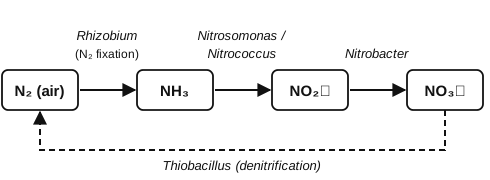
Concept: NCERT (Mineral nutrition): ammonia is oxidised to nitrite by Nitrosomonas/Nitrococcus, nitrite to nitrate by Nitrobacter; Rhizobium fixes N2 to ammonia in root nodules; Pseudomonas and Thiobacillus carry out denitrification.

  1. (a) Nitrococcus → NH3 to NO2− (ii).
  2. (b) Rhizobium → N2 to NH3 (iv).
  3. (c) Thiobacillus → denitrification (i).
  4. (d) Nitrobacter → NO2− to NO3− (iii).
  5. a-ii, b-iv, c-i, d-iii = (C).

Short trick: Alphabet order of the oxidation: Nitroso/coccus come first (→ nitrite), Nitrobacter “becomes nitrate”.

Answer: (C) (a)-(ii); (b)-(iv); (c)-(i); (d)-(iii)

अवधारणा: NCERT (खनिज पोषण): अमोनिया का नाइट्राइट में ऑक्सीकरण Nitrosomonas/Nitrococcus द्वारा, नाइट्राइट का नाइट्रेट में Nitrobacter द्वारा होता है; Rhizobium मूल ग्रंथिकाओं में N2 को अमोनिया में स्थिर करता है; Pseudomonas तथा Thiobacillus विनाइट्रीकरण करते हैं।

  1. (a) Nitrococcus → NH3 से NO2− (ii)।
  2. (b) Rhizobium → N2 से NH3 (iv)।
  3. (c) Thiobacillus → विनाइट्रीकरण (i)।
  4. (d) Nitrobacter → NO2− से NO3− (iii)।
  5. a-ii, b-iv, c-i, d-iii = (C)।

शॉर्ट ट्रिक: ऑक्सीकरण का क्रम: Nitroso/coccus पहले (→ नाइट्राइट), Nitrobacter बाद में (→ नाइट्रेट)।

उत्तर: (C) (a)-(ii); (b)-(iv); (c)-(i); (d)-(iii)

NEET UGBotanyMineral nutrition – nitrogen cycleNEET UG 2021 · 12 Sep Shift 1