Q1181.The body of the ovule is fused within the funicle at
बीजांड का काय बीजांडवृंत (funicle) से किस स्थान पर संगलित होता है?
- ANucellusबीजांडकाय
- BChalazaनिभाग (चैलाज़ा)
- CHilumनाभिका (हाइलम)
- DMicropyleबीजांडद्वार
Show answer
Concept: NCERT: "The body of the ovule fuses with funicle in the region called hilum. Thus, hilum represents the junction between ovule and funicle."
- Hilum – junction of ovule body and funicle ✔ (C).
- Nucellus – mass of cells inside the integuments that has the embryo sac – (A) wrong.
- Chalaza – basal part opposite the micropyle where integuments arise – (B) wrong.
- Micropyle – small opening at the tip of integuments – (D) wrong.
Short trick: Hilum = "scar" seen on a seed (e.g. bean) – the place where the stalk was attached.
Answer: (C) Hilum
अवधारणा: NCERT: "बीजांड का काय बीजांडवृंत से नाभिका (hilum) नामक क्षेत्र में संगलित होता है। अतः नाभिका बीजांड और बीजांडवृंत का संधि-स्थल है।"
- नाभिका – बीजांड काय और बीजांडवृंत का संधि-स्थल ✔ (C)।
- बीजांडकाय – अध्यावरणों के भीतर कोशिकाओं का पुंज जिसमें भ्रूणकोष होता है – (A) गलत।
- निभाग – बीजांडद्वार के विपरीत आधारी भाग जहाँ से अध्यावरण निकलते हैं – (B) गलत।
- बीजांडद्वार – अध्यावरणों के शीर्ष पर छोटा छिद्र – (D) गलत।
शॉर्ट ट्रिक: नाभिका = बीज (जैसे सेम) पर दिखने वाला "निशान" – जहाँ डंठल जुड़ा था।
उत्तर: (C) नाभिका (हाइलम)
NEET UGBiologySexual reproduction in flowering plants – ovuleNEET UG 2020 · 13 Sep Shift 1
Q1182.The process of growth is maximum during
वृद्धि की प्रक्रिया अधिकतम किसके दौरान होती है?
- ASenescenceजीर्णता
- BDormancyप्रसुप्ति
- CLog phaseलॉग प्रावस्था
- DLag phaseलैग प्रावस्था
Show answer
Concept: The sigmoid growth curve has a lag phase (slow), a log/exponential phase (fastest) and a stationary phase.
- Log (exponential) phase – all cells divide, growth rate is maximum ✔ (C).
- Lag phase – initial slow growth – (D) wrong.
- Senescence – ageing, growth stops and decline begins – (A) wrong.
- Dormancy – temporary suspension of growth – (B) wrong.
Short trick: Sigmoid "S": Lag = Lazy, Log = Leap, Stationary = Stop.
Answer: (C) Log phase
अवधारणा: सिग्मॉइड वृद्धि वक्र में लैग प्रावस्था (धीमी), लॉग/चरघातांकी प्रावस्था (सबसे तीव्र) और स्थिर प्रावस्था होती है।
- लॉग (चरघातांकी) प्रावस्था – सभी कोशिकाएँ विभाजित होती हैं, वृद्धि दर अधिकतम ✔ (C)।
- लैग प्रावस्था – प्रारंभिक धीमी वृद्धि – (D) गलत।
- जीर्णता – वृद्धावस्था, वृद्धि रुककर ह्रास आरंभ – (A) गलत।
- प्रसुप्ति – वृद्धि का अस्थायी स्थगन – (B) गलत।
शॉर्ट ट्रिक: सिग्मॉइड "S": Lag = सुस्त, Log = छलाँग, Stationary = ठहराव।
उत्तर: (C) लॉग प्रावस्था
NEET UGBiologyPlant growth and development – phases of growthNEET UG 2020 · 13 Sep Shift 1
Q1183.Bilaterally symmetrical and acoelomate animals are exemplified by
द्विपार्श्व सममित और अप्रगुही (acoelomate) जंतुओं का उदाहरण है
- AAschelminthesऐस्केल्मिंथीज़
- BAnnelidaऐनेलिडा
- CCtenophoraटीनोफोरा
- DPlatyhelminthesप्लैटिहेल्मिंथीज़
Show answer
Concept: NCERT: Platyhelminthes (flatworms) are "bilaterally symmetrical, triploblastic and acoelomate animals with organ level of organisation".
- Platyhelminthes – bilateral + acoelomate ✔ (D).
- Aschelminthes – bilateral but pseudocoelomate – (A) wrong.
- Annelida – bilateral, true coelomate – (B) wrong.
- Ctenophora – radially symmetrical, diploblastic – (C) wrong.
Short trick: Coelom ladder: Flat = none, Round = pseudo, Ring (Annelida) onwards = true.
Answer: (D) Platyhelminthes
अवधारणा: NCERT: प्लैटिहेल्मिंथीज़ (चपटे कृमि) "द्विपार्श्व सममित, त्रिकोरकी और अप्रगुही जंतु हैं, जिनमें अंग स्तर का संगठन है"।
- प्लैटिहेल्मिंथीज़ – द्विपार्श्व + अप्रगुही ✔ (D)।
- ऐस्केल्मिंथीज़ – द्विपार्श्व पर कूटप्रगुही – (A) गलत।
- ऐनेलिडा – द्विपार्श्व, वास्तविक प्रगुही – (B) गलत।
- टीनोफोरा – अरीय सममित, द्विकोरकी – (C) गलत।
शॉर्ट ट्रिक: प्रगुहा सीढ़ी: चपटे = कोई नहीं, गोल = कूट, ऐनेलिडा से आगे = वास्तविक।
उत्तर: (D) प्लैटिहेल्मिंथीज़
NEET UGBiologyAnimal kingdom – basis of classificationNEET UG 2020 · 13 Sep Shift 1
Q1184.Which of the following is put into Anaerobic sludge digester for further sewage treatment?
आगे के वाहित मल उपचार के लिए निम्नलिखित में से किसे अवायवीय आपंक संपाचित्र (anaerobic sludge digester) में डाला जाता है?
- AEffluents of primary treatmentप्राथमिक उपचार का बहिःस्राव
- BActivated sludgeसक्रियित आपंक (activated sludge)
- CPrimary sludgeप्राथमिक आपंक
- DFloating debrisतैरता मलबा
Show answer
Concept: NCERT: "A small part of the activated sludge is pumped back into the aeration tank to serve as the inoculum. The remaining major part of the sludge is pumped into large tanks called anaerobic sludge digesters."
- After secondary (biological) treatment, the settled activated sludge goes to the anaerobic digester, where anaerobic bacteria digest it and produce biogas → (B) ✔.
- Primary effluent goes to the aeration tank for secondary treatment – (A) wrong.
- Primary sludge and floating debris are removed by sedimentation/filtration in primary treatment – (C), (D) wrong.
Short trick: Order: Primary (physical) → effluent → aeration tank (flocs) → activated sludge → anaerobic digester → biogas.
Answer: (B) Activated sludge
अवधारणा: NCERT: "सक्रियित आपंक का एक छोटा भाग निवेश द्रव्य (inoculum) के रूप में वायवीय टैंक में वापस पंप किया जाता है। आपंक का शेष बड़ा भाग अवायवीय आपंक संपाचित्र नामक बड़े टैंकों में पंप किया जाता है।"
- द्वितीयक (जैविक) उपचार के बाद, बैठा हुआ सक्रियित आपंक अवायवीय संपाचित्र में जाता है, जहाँ अवायवीय जीवाणु उसे पचाकर जैव गैस बनाते हैं → (B) ✔।
- प्राथमिक बहिःस्राव द्वितीयक उपचार हेतु वायवीय टैंक में जाता है – (A) गलत।
- प्राथमिक आपंक और तैरता मलबा प्राथमिक उपचार में अवसादन/निस्यंदन से हटाए जाते हैं – (C), (D) गलत।
शॉर्ट ट्रिक: क्रम: प्राथमिक (भौतिक) → बहिःस्राव → वायवीय टैंक (फ्लॉक) → सक्रियित आपंक → अवायवीय संपाचित्र → जैव गैस।
उत्तर: (B) सक्रियित आपंक (activated sludge)
NEET UGBiologyMicrobes in human welfare – sewage treatmentNEET UG 2020 · 13 Sep Shift 1
Q1185.Match the following columns and select the correct option.
| Column I | Column-II |
|---|
| (a) Floating Ribs | (i) Located between second & seventh ribs |
| (b) Acromion | (ii) Head of the Humerus |
| (c) Scapula | (iii) Clavicle |
| (d) Glenoid cavity | (iv) Do not connect with the sternum |
निम्नलिखित स्तंभों का मिलान कीजिए और सही विकल्प चुनिए।
| स्तंभ-I | स्तंभ-II |
|---|
| (a) प्लावी पसलियाँ (floating ribs) | (i) दूसरी और सातवीं पसलियों के बीच स्थित |
| (b) ऐक्रोमियन | (ii) ह्यूमरस का सिर |
| (c) स्कैपुला | (iii) क्लैविकल (हँसली) |
| (d) ग्लीनॉइड गुहा | (iv) उरोस्थि (sternum) से नहीं जुड़तीं |
- A(a) - (iii); (b) - (ii); (c) - (iv); (d) - (i)
- B(a) - (iv); (b) - (iii); (c) - (i); (d) - (ii)
- C(a) - (ii); (b) - (iv); (c) - (i); (d) - (iii)
- D(a) - (i); (b) - (iii); (c) - (ii); (d) - (iv)
Show answer
Concept: NCERT – ribs and pectoral girdle.
- Floating ribs (11th, 12th pairs) are not connected ventrally to the sternum = (iv).
- Acromion – flat expanded process of the scapula that articulates with the clavicle = (iii).
- Scapula – large triangular flat bone situated in the dorsal part of the thorax between the second and seventh ribs = (i).
- Glenoid cavity – depression below the acromion that articulates with the head of the humerus (shoulder joint) = (ii).
- a-iv, b-iii, c-i, d-ii = (B). (A) and (C) mismatch floating ribs; (D) gives scapula the head of humerus – all wrong.
Short trick: Shoulder chain: clavicle ↔ acromion; humerus head ↔ glenoid; scapula spans ribs 2–7.
Answer: (B) (a) - (iv); (b) - (iii); (c) - (i); (d) - (ii)
अवधारणा: NCERT – पसलियाँ और अंस मेखला।
- प्लावी पसलियाँ (11वीं, 12वीं जोड़ी) अधर रूप से उरोस्थि से नहीं जुड़तीं = (iv)।
- ऐक्रोमियन – स्कैपुला का चपटा विस्तारित प्रवर्ध जो क्लैविकल से संधि बनाता है = (iii)।
- स्कैपुला – वक्ष के पृष्ठ भाग में दूसरी और सातवीं पसलियों के बीच स्थित बड़ी त्रिभुजाकार चपटी अस्थि = (i)।
- ग्लीनॉइड गुहा – ऐक्रोमियन के नीचे का गर्त जो ह्यूमरस के सिर से संधि बनाता है (कंधे का जोड़) = (ii)।
- a-iv, b-iii, c-i, d-ii = (B)। (A) और (C) में प्लावी पसलियों का मिलान गलत है; (D) स्कैपुला को ह्यूमरस का सिर देता है – सभी गलत।
शॉर्ट ट्रिक: कंधे की शृंखला: क्लैविकल ↔ ऐक्रोमियन; ह्यूमरस सिर ↔ ग्लीनॉइड; स्कैपुला पसली 2–7 तक फैली।
उत्तर: (B) (a) - (iv); (b) - (iii); (c) - (i); (d) - (ii)
NEET UGBiologyLocomotion and movement – skeletal systemNEET UG 2020 · 13 Sep Shift 1
Q1186.Identify the wrong statement with regard to Restriction Enzymes.
प्रतिबंधन एंजाइमों के संबंध में गलत कथन को पहचानिए।
- AThey are useful in genetic engineeringये आनुवंशिक इंजीनियरी में उपयोगी हैं
- BSticky ends can be joined by using DNA ligasesचिपचिपे सिरों को DNA लाइगेज़ द्वारा जोड़ा जा सकता है
- CEach restriction enzyme functions by inspecting the length of a DNA sequenceप्रत्येक प्रतिबंधन एंजाइम DNA अनुक्रम की लंबाई का "निरीक्षण" करके कार्य करता है
- DThey cut the strand of DNA at palindromic sitesये DNA रज्जुक को पैलिंड्रोमिक स्थलों पर काटते हैं
Show answer
Concept: NCERT lines on restriction enzymes: "Each restriction endonuclease functions by 'inspecting' the length of a DNA sequence"; they "cut the strand of DNA a little away from the centre of the palindrome sites"; and they are the key tools of genetic engineering. Sticky ends are called so because they form hydrogen bonds with their complementary cut counterparts – DNA ligase only seals the sugar-phosphate backbone afterwards.
- (A) Restriction enzymes are the 'molecular scissors' of genetic engineering – correct.
- (C) Is the NCERT sentence word-for-word ('inspecting' the length of DNA until the recognition sequence is found) – correct.
- (D) The cut is made within the palindromic recognition site (a little away from its centre) – correct.
- (B) Sticky ends join with complementary sticky ends by themselves through hydrogen bonding (that is their 'stickiness'); DNA ligase does not join the sticky ends – it only seals the nicks by phosphodiester bonds, and it is not a property of restriction enzymes at all. Hence (B) is the statement taken as wrong.
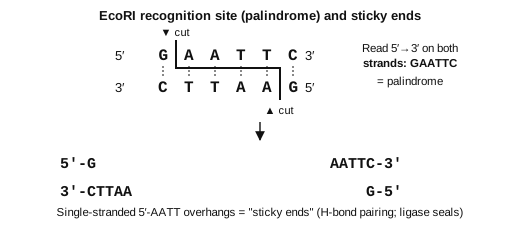
Short trick: In 'wrong statement' questions on restriction enzymes, keep the three NCERT lines (useful tool, 'inspecting the length', cuts palindromes) as true; the odd one out talks about a different enzyme (ligase) – sticky ends stick by H-bonds, ligase only seals.
Answer: (B) Sticky ends can be joined by using DNA ligases
अवधारणा: प्रतिबंधन एंजाइमों पर NCERT की पंक्तियाँ: "प्रत्येक प्रतिबंधन एंडोन्यूक्लिएज़ DNA अनुक्रम की लंबाई का 'निरीक्षण' करके कार्य करता है"; वे "DNA रज्जुक को पैलिंड्रोम स्थलों के केंद्र से थोड़ा हटकर काटते हैं"; और वे आनुवंशिक इंजीनियरी के मुख्य उपकरण हैं। चिपचिपे सिरे इसलिए कहलाते हैं क्योंकि वे अपने पूरक कटे सिरों से हाइड्रोजन बंध बनाते हैं – DNA लाइगेज़ बाद में केवल शर्करा-फॉस्फेट आधार-रज्जु को सील करता है।
- (A) प्रतिबंधन एंजाइम आनुवंशिक इंजीनियरी की 'आणविक कैंचियाँ' हैं – सही।
- (C) यह NCERT का शब्दशः वाक्य है (पहचान अनुक्रम मिलने तक DNA की लंबाई का 'निरीक्षण') – सही।
- (D) कटाव पैलिंड्रोमिक पहचान स्थल के भीतर (उसके केंद्र से थोड़ा हटकर) होता है – सही।
- (B) चिपचिपे सिरे पूरक चिपचिपे सिरों से स्वयं हाइड्रोजन बंधों द्वारा जुड़ते हैं (यही उनकी 'चिपचिपाहट' है); DNA लाइगेज़ चिपचिपे सिरों को नहीं जोड़ता – वह केवल फॉस्फोडाइएस्टर बंधों द्वारा खाँचों (nicks) को सील करता है, और यह प्रतिबंधन एंजाइमों का गुण भी नहीं है। अतः (B) गलत माना गया कथन है।
शॉर्ट ट्रिक: प्रतिबंधन एंजाइमों के 'गलत कथन' प्रश्नों में NCERT की तीन पंक्तियाँ (उपयोगी उपकरण, 'लंबाई का निरीक्षण', पैलिंड्रोम पर काटना) सही मानें; अलग कथन किसी दूसरे एंजाइम (लाइगेज़) की बात करता है – चिपचिपे सिरे H-बंधों से चिपकते हैं, लाइगेज़ केवल सील करता है।
उत्तर: (B) चिपचिपे सिरों को DNA लाइगेज़ द्वारा जोड़ा जा सकता है
NEET UGBiologyBiotechnology – restriction enzymesNEET UG 2020 · 13 Sep Shift 1
Q1187.Match the following columns and select the correct option.
| Column-I | Column-II |
|---|
| (a) Gregarious, polyphagous pest | (i) Asterias |
| (b) Adult with radial symmetry & larva with bilateral symmetry | (ii) Scorpion |
| (c) Book lungs | (iii) Ctenoplana |
| (d) Bioluminescence | (iv) Locusta |
निम्नलिखित स्तंभों का मिलान कीजिए और सही विकल्प चुनिए।
| स्तंभ-I | स्तंभ-II |
|---|
| (a) यूथचारी (gregarious), बहुभक्षी पीड़क | (i) Asterias |
| (b) अरीय सममित वयस्क और द्विपार्श्व सममित लार्वा | (ii) बिच्छू |
| (c) पुस्त फुप्फुस (book lungs) | (iii) Ctenoplana |
| (d) जैवदीप्ति (bioluminescence) | (iv) Locusta |
- A(a) - (iii); (b) - (ii); (c) - (i); (d) - (iv)
- B(a) - (ii); (b) - (i); (c) - (iii); (d) - (iv)
- C(a) - (i); (b) - (iii); (c) - (ii); (d) - (iv)
- D(a) - (iv); (b) - (i); (c) - (ii); (d) - (iii)
Show answer
Concept: NCERT, Animal Kingdom – characteristic examples.
- Locusta (locust) – gregarious, polyphagous pest (Arthropoda) = (iv).
- Asterias (starfish, Echinodermata) – adult radially symmetrical, larva bilaterally symmetrical = (i).
- Scorpion (Arachnida) – respires by book lungs = (ii).
- Ctenoplana (Ctenophora) – bioluminescence is well marked = (iii).
- a-iv, b-i, c-ii, d-iii = (D); others put Locusta or Ctenoplana wrong.
Short trick: Comb jellies glow, starfish larvae are bilateral, scorpions read "book" lungs, locusts swarm.
Answer: (D) (a) - (iv); (b) - (i); (c) - (ii); (d) - (iii)
अवधारणा: NCERT, प्राणि जगत – विशिष्ट उदाहरण।
- Locusta (टिड्डी) – यूथचारी, बहुभक्षी पीड़क (आर्थ्रोपोडा) = (iv)।
- Asterias (तारामीन, इकाइनोडर्मेटा) – वयस्क अरीय सममित, लार्वा द्विपार्श्व सममित = (i)।
- बिच्छू (ऐरेक्निडा) – पुस्त फुप्फुसों से श्वसन = (ii)।
- Ctenoplana (टीनोफोरा) – जैवदीप्ति स्पष्ट = (iii)।
- a-iv, b-i, c-ii, d-iii = (D); अन्य विकल्पों में Locusta या Ctenoplana गलत है।
शॉर्ट ट्रिक: कंकत जेली चमकती है, तारामीन का लार्वा द्विपार्श्व, बिच्छू के "पुस्त" फुप्फुस, टिड्डी झुंड में।
उत्तर: (D) (a) - (iv); (b) - (i); (c) - (ii); (d) - (iii)
NEET UGBiologyAnimal kingdom – examples and featuresNEET UG 2020 · 13 Sep Shift 1
Q1188.If the head of cockroach is removed, it may live for few days because:
यदि कॉकरोच का सिर हटा दिया जाए, तो वह कुछ दिनों तक जीवित रह सकता है, क्योंकि:
- AThe head holds a small proportion of a nervous system while the rest is situated along the ventral part of its bodyसिर में तंत्रिका तंत्र का एक छोटा भाग होता है जबकि शेष भाग शरीर के अधर भाग के साथ स्थित होता है
- BThe head holds a 1/3rd of a nervous system while the rest is situated along the dorsal part of its bodyसिर में तंत्रिका तंत्र का 1/3 भाग होता है जबकि शेष भाग शरीर के पृष्ठ भाग के साथ स्थित होता है
- CThe supra-oesophageal ganglia of the cockroach are situated in ventral part of abdomenकॉकरोच के अधिग्रसनी (supra-oesophageal) गुच्छिका उदर के अधर भाग में स्थित होते हैं
- DThe cockroach does not have nervous systemकॉकरोच में तंत्रिका तंत्र नहीं होता
Show answer
Concept: NCERT: "The nervous system of cockroach is spread throughout the body. The head holds a bit of a nervous system while the rest is situated along the ventral (belly-side) part of its body. So… if the head of a cockroach is cut off, it will still live for as long as one week."
- Ganglia joined by paired ventral nerve cords run through thorax and abdomen → most of the nervous system is ventral and outside the head → (A) ✔.
- Nerve cord is ventral, not dorsal – (B) wrong.
- Supra-oesophageal ganglia (the "brain") lie in the head, above the oesophagus – (C) wrong.
- Cockroach does have a well-developed nervous system – (D) wrong.
Short trick: Insects: ventral, solid, ganglionated nerve cord (opposite of chordates: dorsal, hollow).
Answer: (A) The head holds a small proportion of a nervous system while the rest is situated along the ventral part of its body
अवधारणा: NCERT: "कॉकरोच का तंत्रिका तंत्र पूरे शरीर में फैला होता है। सिर में तंत्रिका तंत्र का थोड़ा-सा भाग होता है जबकि शेष शरीर के अधर (पेट की ओर) भाग में स्थित होता है। अतः… कॉकरोच का सिर कट जाने पर भी वह लगभग एक सप्ताह तक जीवित रहता है।"
- युग्मित अधर तंत्रिका रज्जु से जुड़ी गुच्छिकाएँ वक्ष और उदर में फैली होती हैं → अधिकांश तंत्रिका तंत्र अधर और सिर से बाहर है → (A) ✔।
- तंत्रिका रज्जु अधर है, पृष्ठ नहीं – (B) गलत।
- अधिग्रसनी गुच्छिका ("मस्तिष्क") सिर में ग्रसिका के ऊपर स्थित होती है – (C) गलत।
- कॉकरोच में सुविकसित तंत्रिका तंत्र होता है – (D) गलत।
शॉर्ट ट्रिक: कीट: अधर, ठोस, गुच्छिकायुक्त तंत्रिका रज्जु (कॉर्डेटों के विपरीत: पृष्ठ, खोखली)।
उत्तर: (A) सिर में तंत्रिका तंत्र का एक छोटा भाग होता है जबकि शेष भाग शरीर के अधर भाग के साथ स्थित होता है
NEET UGBiologyStructural organisation in animals – cockroach nervous systemNEET UG 2020 · 13 Sep Shift 1
Q1189.Which of the following regions of the globe exhibits highest species diversity?
विश्व के निम्नलिखित में से किस क्षेत्र में सर्वाधिक जाति विविधता पाई जाती है?
- AHimalayasहिमालय
- BAmazon forestsअमेज़न वन
- CWestern Ghats of Indiaभारत के पश्चिमी घाट
- DMadagascarमेडागास्कर
Show answer
Concept: NCERT: "The largely tropical Amazonian rain forest in South America has the greatest biodiversity on earth – it is home to more than 40,000 species of plants, 3,000 of fishes, 1,300 of birds, 427 of mammals…"
- Amazon rain forest – highest species diversity on the earth ✔ (B).
- Western Ghats, Himalayas (Indo-Burma), Madagascar – biodiversity hotspots, rich in endemics, but less total diversity than the Amazon – (A), (C), (D) wrong.
Short trick: Latitudinal gradient: diversity rises towards the equator – Amazon = "lungs of the planet", maximum biodiversity.
Answer: (B) Amazon forests
अवधारणा: NCERT: "दक्षिण अमेरिका के अधिकांशतः उष्णकटिबंधीय अमेज़न वर्षा वन में पृथ्वी पर सबसे अधिक जैव विविधता है – यहाँ पादपों की 40,000 से अधिक, मछलियों की 3,000, पक्षियों की 1,300, स्तनधारियों की 427 जातियाँ हैं…"
- अमेज़न वर्षा वन – पृथ्वी पर सर्वाधिक जाति विविधता ✔ (B)।
- पश्चिमी घाट, हिमालय (इंडो-बर्मा), मेडागास्कर – जैव विविधता हॉटस्पॉट, स्थानिक जातियों से समृद्ध, पर कुल विविधता अमेज़न से कम – (A), (C), (D) गलत।
शॉर्ट ट्रिक: अक्षांशीय प्रवणता: भूमध्य रेखा की ओर विविधता बढ़ती है – अमेज़न = "पृथ्वी के फेफड़े", अधिकतम जैव विविधता।
उत्तर: (B) अमेज़न वन
NEET UGBiologyBiodiversity and conservation – patterns of diversityNEET UG 2020 · 13 Sep Shift 1
Q1190.Which is the important site of formation of glycoproteins and glycolipids in eukaryotic cells?
सुकेंद्रकी कोशिकाओं में ग्लाइकोप्रोटीन और ग्लाइकोलिपिड के निर्माण का महत्त्वपूर्ण स्थल कौन-सा है?
- AGolgi bodiesगॉल्जी काय
- BPolysomesपॉलीसोम
- CEndoplasmic reticulumअंतर्द्रव्यी जालिका
- DPeroxisomesपरॉक्सीसोम
Show answer
Concept: NCERT: "Golgi apparatus is the important site of formation of glycoproteins and glycolipids."
- Proteins and lipids from the ER are glycosylated in the Golgi cisternae → (A) ✔.
- Polysomes – many ribosomes on one mRNA, make proteins – (B) wrong.
- ER – synthesises proteins (RER) and lipids/steroids (SER), but glycoprotein/glycolipid formation is the Golgi’s role – (C) wrong.
- Peroxisomes – contain catalase, photorespiration/β-oxidation – (D) wrong.
Short trick: Golgi = "Glyco-factory + packing & dispatch" (cis = forming face, trans = maturing face).
Answer: (A) Golgi bodies
अवधारणा: NCERT: "गॉल्जी उपकरण ग्लाइकोप्रोटीन और ग्लाइकोलिपिड के निर्माण का महत्त्वपूर्ण स्थल है।"
- ER से आए प्रोटीन और लिपिड गॉल्जी कुंडिकाओं में ग्लाइकोसिलीकृत होते हैं → (A) ✔।
- पॉलीसोम – एक mRNA पर अनेक राइबोसोम, प्रोटीन बनाते हैं – (B) गलत।
- ER – प्रोटीन (RER) और लिपिड/स्टेरॉइड (SER) बनाता है, पर ग्लाइकोप्रोटीन/ग्लाइकोलिपिड निर्माण गॉल्जी का कार्य है – (C) गलत।
- परॉक्सीसोम – केटेलेज़ युक्त, प्रकाश-श्वसन/β-ऑक्सीकरण – (D) गलत।
शॉर्ट ट्रिक: गॉल्जी = "ग्लाइको-कारखाना + पैकिंग व प्रेषण" (cis = निर्माण सतह, trans = परिपक्व सतह)।
उत्तर: (A) गॉल्जी काय
NEET UGBiologyCell: the unit of life – Golgi apparatusNEET UG 2020 · 13 Sep Shift 1
Q1191.Which of the following pairs is of unicellular algae?
निम्नलिखित में से कौन-सा युग्म एककोशिक शैवालों का है?
- AAnabaena and VolvoxAnabaena और Volvox
- BChlorella and SpirulinaChlorella और Spirulina
- CLaminaria and SargassumLaminaria और Sargassum
- DGelidium and GracilariaGelidium और Gracilaria
Show answer
Concept: NCERT: "Certain unicellular algae like Chlorella and Spirulina are rich in proteins and are used as food supplements even by space travellers."
- Chlorella (green alga) and Spirulina (cyanobacterium/blue-green alga) – unicellular ✔ (B).
- Anabaena – filamentous; Volvox – colonial – (A) wrong.
- Laminaria, Sargassum – large multicellular brown algae (kelps) – (C) wrong.
- Gelidium, Gracilaria – multicellular red algae, sources of agar – (D) wrong.
Short trick: "Space food" = Chlorella + Spirulina (SCP); agar = Gelidium + Gracilaria; kelps = Laminaria.
Answer: (B) Chlorella and Spirulina
अवधारणा: NCERT: "कुछ एककोशिक शैवाल जैसे Chlorella और Spirulina प्रोटीन से भरपूर हैं और अंतरिक्ष यात्री भी इन्हें खाद्य पूरक के रूप में लेते हैं।"
- Chlorella (हरा शैवाल) और Spirulina (सायनोबैक्टीरिया/नील-हरित शैवाल) – एककोशिक ✔ (B)।
- Anabaena – तंतुमय; Volvox – निवही (colonial) – (A) गलत।
- Laminaria, Sargassum – बड़े बहुकोशिक भूरे शैवाल (केल्प) – (C) गलत।
- Gelidium, Gracilaria – बहुकोशिक लाल शैवाल, ऐगार के स्रोत – (D) गलत।
शॉर्ट ट्रिक: "अंतरिक्ष भोजन" = Chlorella + Spirulina (SCP); ऐगार = Gelidium + Gracilaria; केल्प = Laminaria।
उत्तर: (B) Chlorella और Spirulina
NEET UGBiologyBiological classification / Plant kingdom – unicellular algaeNEET UG 2020 · 13 Sep Shift 1
Q1192.Which one of the following is the most abundant protein in the animals?
निम्नलिखित में से कौन-सा जंतुओं में सर्वाधिक प्रचुर प्रोटीन है?
- ALectinलेक्टिन
- BInsulinइंसुलिन
- CHaemoglobinहीमोग्लोबिन
- DCollagenकोलेजन
Show answer
Concept: NCERT: "Collagen is the most abundant protein in animal world and Ribulose bisphosphate Carboxylase-Oxygenase (RuBisCO) is the most abundant protein in the whole of the biosphere."
- Collagen – structural protein of connective tissue, bone, tendon, skin → most abundant in animals ✔ (D).
- Lectin – carbohydrate-binding protein (in plants mainly) – (A) wrong.
- Insulin – hormone, needed only in small amounts – (B) wrong.
- Haemoglobin – abundant in blood but far less than collagen – (C) wrong.
Short trick: Animals → Collagen; Biosphere → RuBisCO.
Answer: (D) Collagen
अवधारणा: NCERT: "कोलेजन जंतु जगत में सर्वाधिक प्रचुर प्रोटीन है और राइबुलोस बिसफॉस्फेट कार्बोक्सिलेज़-ऑक्सीजिनेज़ (RuBisCO) पूरे जीवमंडल में सर्वाधिक प्रचुर प्रोटीन है।"
- कोलेजन – संयोजी ऊतक, अस्थि, कंडरा, त्वचा का संरचनात्मक प्रोटीन → जंतुओं में सर्वाधिक प्रचुर ✔ (D)।
- लेक्टिन – कार्बोहाइड्रेट से जुड़ने वाला प्रोटीन (मुख्यतः पादपों में) – (A) गलत।
- इंसुलिन – हॉर्मोन, बहुत कम मात्रा में आवश्यक – (B) गलत।
- हीमोग्लोबिन – रक्त में प्रचुर, पर कोलेजन से बहुत कम – (C) गलत।
शॉर्ट ट्रिक: जंतु → कोलेजन; जीवमंडल → RuBisCO।
उत्तर: (D) कोलेजन
NEET UGBiologyBiomolecules – proteinsNEET UG 2020 · 13 Sep Shift 1
Q1193.Dissolution of the synaptonemal complex occurs during:
सिनैप्टोनीमल सम्मिश्र (synaptonemal complex) का विघटन कब होता है?
- ADiploteneडिप्लोटीन
- BLeptoteneलेप्टोटीन
- CPachyteneपैकिटीन
- DZygoteneज़ाइगोटीन
Show answer
Concept: NCERT: "The beginning of diplotene is recognised by the dissolution of the synaptonemal complex and the tendency of the recombined homologous chromosomes of the bivalents to separate from each other except at the sites of crossovers (chiasmata)."
- Diplotene – SC dissolves, chiasmata become visible ✔ (A).
- Leptotene – chromosomes become visible and compact; no SC yet – (B) wrong.
- Zygotene – SC forms during synapsis – (D) wrong.
- Pachytene – SC present; crossing over occurs – (C) wrong.
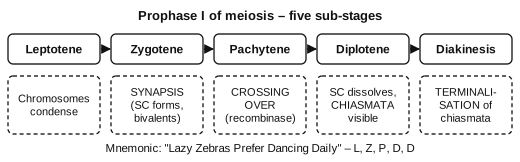
Short trick: SC: born in Zygotene, works in Pachytene, dies in Diplotene.
Answer: (A) Diplotene
अवधारणा: NCERT: "डिप्लोटीन की शुरुआत सिनैप्टोनीमल सम्मिश्र के विघटन से पहचानी जाती है और द्विसंयोजकों के पुनर्योजित समजात गुणसूत्र जीन-विनिमय स्थलों (काइऐज़्मेटा) को छोड़कर एक-दूसरे से अलग होने लगते हैं।"
- डिप्लोटीन – SC का विघटन, काइऐज़्मेटा दिखाई देने लगते हैं ✔ (A)।
- लेप्टोटीन – गुणसूत्र दिखाई देने और संघनित होने लगते हैं; SC अभी नहीं – (B) गलत।
- ज़ाइगोटीन – सूत्रयुग्मन (synapsis) में SC बनता है – (D) गलत।
- पैकिटीन – SC उपस्थित; जीन-विनिमय होता है – (C) गलत।
शॉर्ट ट्रिक: SC: ज़ाइगोटीन में जन्म, पैकिटीन में कार्य, डिप्लोटीन में विघटन।
उत्तर: (A) डिप्लोटीन
NEET UGBiologyCell cycle and cell division – meiosis INEET UG 2020 · 13 Sep Shift 1
Q1194.How many true breeding pea plant varieties did Mendel select as pairs, which were similar except in one character with contrasting traits?
मेंडल ने मटर के कितने शुद्ध प्रजनन (true breeding) पादप किस्मों को युग्मों के रूप में चुना, जो विपरीत लक्षणों वाले एक गुण को छोड़कर समान थीं?
- A14
- B8
- C4
- D2
Show answer
Concept: NCERT: "Mendel selected 14 true-breeding pea plant varieties, as pairs which were similar except for one character with contrasting traits."
- Mendel studied 7 characters, each with 2 contrasting traits → 7 pairs × 2 = 14 varieties ✔ (A).
- 8, 4 and 2 do not match 7 × 2 – (B), (C), (D) wrong.
Short trick: 7 characters × 2 contrasting forms = 14 true-breeding varieties.
Answer: (A) 14
अवधारणा: NCERT: "मेंडल ने मटर की 14 शुद्ध प्रजनन किस्मों को युग्मों के रूप में चुना, जो विपरीत लक्षणों वाले एक गुण को छोड़कर समान थीं।"
- मेंडल ने 7 गुणों का अध्ययन किया, प्रत्येक के 2 विपरीत लक्षण → 7 युग्म × 2 = 14 किस्में ✔ (A)।
- 8, 4 और 2, 7 × 2 से मेल नहीं खाते – (B), (C), (D) गलत।
शॉर्ट ट्रिक: 7 गुण × 2 विपरीत रूप = 14 शुद्ध प्रजनन किस्में।
उत्तर: (A) 14
NEET UGBiologyPrinciples of inheritance – Mendel’s experimentsNEET UG 2020 · 13 Sep Shift 1
Q1195.Cuboidal epithelium with brush border of microvilli is found in:
सूक्ष्मांकुरों (microvilli) की ब्रश बॉर्डर वाली घनाकार उपकला कहाँ पाई जाती है?
- AProximal convoluted tubule of nephronवृक्काणु (नेफ्रॉन) की समीपस्थ संवलित नलिका
- BEustachian tubeयूस्टेकियन नलिका
- CLining of intestineआंत्र का अस्तर
- DDucts of salivary glandsलार ग्रंथियों की वाहिनियाँ
Show answer
Concept: NCERT: "Cuboidal epithelium is commonly found in ducts of glands and tubular parts of nephrons in kidneys… In proximal convoluted tubule (PCT) of nephron, cells have microvilli."
- PCT – cuboidal cells with brush border of microvilli for reabsorption ✔ (A).
- Lining of intestine – columnar epithelium with microvilli – (C) wrong.
- Eustachian tube – ciliated epithelium – (B) wrong.
- Salivary gland ducts – cuboidal but without brush border – (D) wrong.
Short trick: Cuboidal + brush border = PCT; Columnar + microvilli = intestine.
Answer: (A) Proximal convoluted tubule of nephron
अवधारणा: NCERT: "घनाकार उपकला सामान्यतः ग्रंथियों की वाहिनियों और वृक्क के वृक्काणुओं के नलिकाकार भागों में पाई जाती है… वृक्काणु की समीपस्थ संवलित नलिका (PCT) की कोशिकाओं में सूक्ष्मांकुर होते हैं।"
- PCT – पुनरवशोषण हेतु सूक्ष्मांकुरों की ब्रश बॉर्डर वाली घनाकार कोशिकाएँ ✔ (A)।
- आंत्र का अस्तर – सूक्ष्मांकुर युक्त स्तंभाकार उपकला – (C) गलत।
- यूस्टेकियन नलिका – पक्ष्माभी उपकला – (B) गलत।
- लार ग्रंथि वाहिनियाँ – घनाकार पर ब्रश बॉर्डर रहित – (D) गलत।
शॉर्ट ट्रिक: घनाकार + ब्रश बॉर्डर = PCT; स्तंभाकार + सूक्ष्मांकुर = आंत्र।
उत्तर: (A) वृक्काणु (नेफ्रॉन) की समीपस्थ संवलित नलिका
NEET UGBiologyStructural organisation in animals – epitheliumNEET UG 2020 · 13 Sep Shift 1
Q1196.Match the following with respect to meiosis:
| |
|---|
| (a) Zygotene | (i) Terminalization |
| (b) Pachytene | (ii) Chiasmata |
| (c) Diplotene | (iii) Crossing over |
| (d) Diakinesis | (iv) Synapsis |
Select the correct option from the following:
अर्धसूत्रण के संदर्भ में निम्नलिखित का मिलान कीजिए:
| |
|---|
| (a) ज़ाइगोटीन | (i) उपांतीभवन (terminalization) |
| (b) पैकिटीन | (ii) काइऐज़्मेटा |
| (c) डिप्लोटीन | (iii) जीन-विनिमय (crossing over) |
| (d) डायाकाइनेसिस | (iv) सूत्रयुग्मन (synapsis) |
नीचे दिए गए विकल्पों में से सही उत्तर चुनिए:
- Aa-(i), b-(ii), c-(iv), d-(iii)
- Ba-(ii), b-(iv), c-(iii), d-(i)
- Ca-(iii), b-(iv), c-(i), d-(ii)
- Da-(iv), b-(iii), c-(ii), d-(i)
Show answer
Concept: Each sub-stage of prophase I has one key event (NCERT).
- Zygotene – pairing of homologues = synapsis (iv).
- Pachytene – exchange of segments = crossing over (iii).
- Diplotene – SC dissolves, X-shaped chiasmata seen (ii).
- Diakinesis – terminalisation of chiasmata (i).
- a-iv, b-iii, c-ii, d-i = (D). The other options shift events to wrong stages.
Short trick: Events follow the stage order: Synapsis → Crossing over → Chiasmata → Terminalisation = (iv) (iii) (ii) (i) – just a reverse count!
Answer: (D) a-(iv), b-(iii), c-(ii), d-(i)
अवधारणा: पूर्वावस्था I के प्रत्येक उप-चरण की एक मुख्य घटना है (NCERT)।
- ज़ाइगोटीन – समजातों का युग्मन = सूत्रयुग्मन (iv)।
- पैकिटीन – खंडों का आदान-प्रदान = जीन-विनिमय (iii)।
- डिप्लोटीन – SC विघटित, X-आकार के काइऐज़्मेटा दिखते हैं (ii)।
- डायाकाइनेसिस – काइऐज़्मेटा का उपांतीभवन (i)।
- a-iv, b-iii, c-ii, d-i = (D)। अन्य विकल्प घटनाओं को गलत चरणों में रखते हैं।
शॉर्ट ट्रिक: घटनाएँ चरणों के क्रम में: सूत्रयुग्मन → जीन-विनिमय → काइऐज़्मेटा → उपांतीभवन = (iv) (iii) (ii) (i) – बस उलटी गिनती!
उत्तर: (D) a-(iv), b-(iii), c-(ii), d-(i)
NEET UGBiologyCell cycle and cell division – prophase INEET UG 2020 · 13 Sep Shift 1
Q1197.Which of the following statements about inclusion bodies is incorrect?
अंतर्विष्ट पिंडों (inclusion bodies) के बारे में निम्नलिखित में से कौन-सा कथन गलत है?
- AThey lie free in the cytoplasmये कोशिकाद्रव्य में स्वतंत्र रूप से पड़े रहते हैं
- BThese represent reserve material in cytoplasmये कोशिकाद्रव्य में संचित पदार्थ को दर्शाते हैं
- CThey are not bound by any membraneये किसी झिल्ली से घिरे नहीं होते
- DThese are involved in ingestion of food particlesये भोजन कणों के अंतर्ग्रहण में सम्मिलित होते हैं
Show answer
Concept: NCERT (prokaryotic cell): "Reserve material in prokaryotic cells are stored in the cytoplasm in the form of inclusion bodies. These are not bounded by any membrane system and lie free in the cytoplasm, e.g. phosphate granules, cyanophycean granules and glycogen granules."
- (A), (B), (C) are exactly the NCERT description ✔.
- (D) Inclusion bodies are inert stores; they play no role in ingestion of food (that is phagocytosis/food vacuoles) → incorrect → answer.
Short trick: Inclusion bodies = "pantry", not "mouth" – store food, never eat it.
Answer: (D) These are involved in ingestion of food particles
अवधारणा: NCERT (प्रोकैरियोटिक कोशिका): "प्रोकैरियोटिक कोशिकाओं में संचित पदार्थ कोशिकाद्रव्य में अंतर्विष्ट पिंडों के रूप में रहता है। ये किसी झिल्ली तंत्र से घिरे नहीं होते और कोशिकाद्रव्य में स्वतंत्र रूप से पड़े रहते हैं, जैसे फॉस्फेट कणिकाएँ, सायनोफाइसी कणिकाएँ और ग्लाइकोजन कणिकाएँ।"
- (A), (B), (C) बिल्कुल NCERT का वर्णन हैं ✔।
- (D) अंतर्विष्ट पिंड निष्क्रिय भंडार हैं; भोजन के अंतर्ग्रहण में इनकी कोई भूमिका नहीं (वह भक्षकाणुक्रिया/खाद्य रिक्तिका का कार्य है) → गलत → उत्तर।
शॉर्ट ट्रिक: अंतर्विष्ट पिंड = "भंडार-घर", "मुँह" नहीं – भोजन संचित करते हैं, खाते नहीं।
उत्तर: (D) ये भोजन कणों के अंतर्ग्रहण में सम्मिलित होते हैं
NEET UGBiologyCell: the unit of life – inclusion bodiesNEET UG 2020 · 13 Sep Shift 1
Q1198.Which of the following would help in prevention of diuresis?
निम्नलिखित में से कौन-सा मूत्रलता (diuresis) को रोकने में सहायता करेगा?
- AAtrial natriuretic factor causes vasoconstrictionआलिंद नेट्रियूरेटिक कारक वाहिकासंकीर्णन करता है
- BDecrease in secretion of renin by JG cellsJG कोशिकाओं द्वारा रेनिन स्राव में कमी
- CMore water reabsorption due to undersecretion of ADHADH के अल्पस्राव के कारण अधिक जल पुनरवशोषण
- DReabsorption of Na+ and water from renal tubules due to aldosteroneऐल्डोस्टेरॉन के कारण वृक्क नलिकाओं से Na+ और जल का पुनरवशोषण
Show answer
Concept: Diuresis = excess urine output. It is prevented by anything that increases reabsorption of water – ADH and the RAAS (aldosterone).
- Aldosterone causes reabsorption of Na+ and water from the distal parts of the tubule → less urine → prevents diuresis ✔ (D).
- ANF causes vasodilation (not vasoconstriction) and promotes Na+/water loss – (A) wrong on both counts.
- Less renin → less angiotensin II and aldosterone → more urine – (B) wrong.
- Under-secretion of ADH reduces water reabsorption (diabetes insipidus) – the statement contradicts itself – (C) wrong.
Short trick: ADH ↑, Aldosterone ↑ → urine ↓; ANF is the "check" on RAAS (urine ↑).
Answer: (D) Reabsorption of Na+ and water from renal tubules due to aldosterone
अवधारणा: मूत्रलता = अत्यधिक मूत्र उत्सर्जन। जल का पुनरवशोषण बढ़ाने वाला कोई भी कारक – ADH और RAAS (ऐल्डोस्टेरॉन) – इसे रोकता है।
- ऐल्डोस्टेरॉन नलिका के दूरस्थ भागों से Na+ और जल का पुनरवशोषण कराता है → कम मूत्र → मूत्रलता रुकती है ✔ (D)।
- ANF वाहिकाविस्फारण करता है (संकीर्णन नहीं) और Na+/जल की हानि बढ़ाता है – (A) दोनों प्रकार से गलत।
- कम रेनिन → कम ऐंजियोटेंसिन II और ऐल्डोस्टेरॉन → अधिक मूत्र – (B) गलत।
- ADH का अल्पस्राव जल पुनरवशोषण घटाता है (डायबिटीज़ इन्सिपिडस) – कथन स्वयं-विरोधी है – (C) गलत।
शॉर्ट ट्रिक: ADH ↑, ऐल्डोस्टेरॉन ↑ → मूत्र ↓; ANF, RAAS पर "रोक" है (मूत्र ↑)।
उत्तर: (D) ऐल्डोस्टेरॉन के कारण वृक्क नलिकाओं से Na+ और जल का पुनरवशोषण
NEET UGBiologyExcretory products – regulation of kidney functionNEET UG 2020 · 13 Sep Shift 1
Q1199.The transverse section of a plant shows following anatomical features:
(a) Large number of scattered vascular bundles surrounded by bundle sheath
(b) Large conspicuous parenchymatous ground tissues
(c) Vascular bundles conjoint and closed
(d) Phloem parenchyma absent
किसी पादप के अनुप्रस्थ काट में निम्नलिखित शारीरिक लक्षण दिखते हैं:
(a) पूलाच्छद (bundle sheath) से घिरे अनेक बिखरे संवहन पूल
(b) बड़ा, स्पष्ट मृदूतकी भरण ऊतक
(c) संवहन पूल संयुक्त और बंद (conjoint and closed)
(d) फ्लोएम मृदूतक अनुपस्थित
- ADicotyledonous stemद्विबीजपत्री तना
- BDicotyledonous rootद्विबीजपत्री मूल
- CMonocotyledonous stemएकबीजपत्री तना
- DMonocotyledonous rootएकबीजपत्री मूल
Show answer
Concept: NCERT: "The monocot stem has… a large number of scattered vascular bundles, each surrounded by a sclerenchymatous bundle sheath, and a large, conspicuous parenchymatous ground tissue. Vascular bundles are conjoint and closed… Phloem parenchyma is absent."
- All four features are textbook features of monocot stem ✔ (C).
- Dicot stem – bundles in a ring, open (with cambium) – (A) wrong.
- Roots (dicot or monocot) have radial vascular bundles, not conjoint – (B), (D) wrong.
Short trick: Scattered + closed + no phloem parenchyma = monocot stem (e.g. maize).
Answer: (C) Monocotyledonous stem
अवधारणा: NCERT: "एकबीजपत्री तने में… अनेक बिखरे संवहन पूल होते हैं, प्रत्येक दृढ़ोतकी पूलाच्छद से घिरा, तथा बड़ा, स्पष्ट मृदूतकी भरण ऊतक होता है। संवहन पूल संयुक्त और बंद होते हैं… फ्लोएम मृदूतक अनुपस्थित होता है।"
- चारों लक्षण एकबीजपत्री तने के पाठ्यपुस्तकीय लक्षण हैं ✔ (C)।
- द्विबीजपत्री तना – पूल वलय में, खुले (एधा सहित) – (A) गलत।
- मूलों (द्विबीजपत्री या एकबीजपत्री) में अरीय संवहन पूल होते हैं, संयुक्त नहीं – (B), (D) गलत।
शॉर्ट ट्रिक: बिखरे + बंद + फ्लोएम मृदूतक नहीं = एकबीजपत्री तना (जैसे मक्का)।
उत्तर: (C) एकबीजपत्री तना
NEET UGBiologyAnatomy of flowering plants – monocot stemNEET UG 2020 · 13 Sep Shift 1
Q1200.Which of the following statements is correct?
निम्नलिखित में से कौन-सा कथन सही है?
- AAdenine pairs with thymine through three H-bondsऐडेनीन, थाइमीन से तीन H-बंधों द्वारा युग्मित होता है
- BAdenine does not pair with thymineऐडेनीन, थाइमीन से युग्मित नहीं होता
- CAdenine pairs with thymine through two H-bondsऐडेनीन, थाइमीन से दो H-बंधों द्वारा युग्मित होता है
- DAdenine pairs with thymine through one H-bondऐडेनीन, थाइमीन से एक H-बंध द्वारा युग्मित होता है
Show answer
Concept: NCERT (Watson–Crick model): "Adenine forms two hydrogen bonds with Thymine from opposite strand and vice-versa. Similarly, Guanine is bonded with Cytosine with three H-bonds."
- A = T through 2 H-bonds ✔ (C).
- Three H-bonds are between G and C – (A) wrong.
- A always pairs with T in DNA (Chargaff: A = T) – (B) wrong.
- One H-bond is not the A–T pairing – (D) wrong.
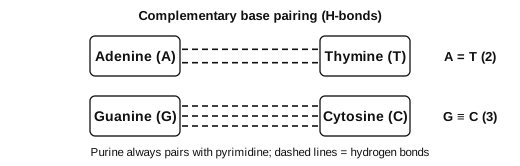
Short trick: Count the letters' "arms": A = T (two lines), G ≡ C (three lines) – more GC = higher melting point.
Answer: (C) Adenine pairs with thymine through two H-bonds
अवधारणा: NCERT (वॉटसन–क्रिक मॉडल): "ऐडेनीन विपरीत रज्जुक के थाइमीन के साथ दो हाइड्रोजन बंध बनाता है और इसका उल्टा भी। इसी प्रकार ग्वानीन, साइटोसीन से तीन H-बंधों द्वारा जुड़ा होता है।"
- A = T दो H-बंधों द्वारा ✔ (C)।
- तीन H-बंध G और C के बीच होते हैं – (A) गलत।
- DNA में A सदैव T से युग्मित होता है (शारगाफ: A = T) – (B) गलत।
- एक H-बंध A–T युग्मन नहीं है – (D) गलत।
शॉर्ट ट्रिक: रेखाएँ गिनें: A = T (दो रेखाएँ), G ≡ C (तीन रेखाएँ) – अधिक GC = उच्च गलनांक।
उत्तर: (C) ऐडेनीन, थाइमीन से दो H-बंधों द्वारा युग्मित होता है
NEET UGBiologyMolecular basis of inheritance – DNA structureNEET UG 2020 · 13 Sep Shift 1

