NEET UG · 2,240 questions

NEET UG 2015, 2016, 2017, 2018, 2019, 2020, 2021, 2022, 2023, 2024, 2025, 2026 PYQs

Real previous year questions, subject-wise. Try the question, then open the answer and the explanation in Hindi & English – free, no login.

Courses – airGurukul

2,240 questions.

Q1281.
An iron rod of susceptibility 599 is subjected to a magnetising field of 1200 A m−1. The permeability of the material of the rod is : (μ0=4π×10−7 T m A−1)
599 प्रवृत्ति (susceptibility) वाली एक लोहे की छड़ को 1200 A m−1 के चुंबकन क्षेत्र में रखा जाता है। छड़ के पदार्थ की चुंबकशीलता (permeability) है : (μ0=4π×10−7 T m A−1)
  1. A2.4π×10−5 T m A−1
  2. B2.4π×10−7 T m A−1
  3. C2.4π×10−4 T m A−1
  4. D8.0×10−5 T m A−1
Show answer

Concept: μr=1+χ and μ=μ0μr.

  1. μr=1+599=600
  2. μ=4π×10−7×600=2400π×10−7=2.4π×10−4 T m A−1
  3. The field 1200 A m−1 is not needed.

Short trick: 4×600=2400 → 2.4×103×10−7=2.4×10⁻⁴; keep π.

Answer: (C) 2.4π×10−4 T m A−1

अवधारणा: μr=1+χ तथा μ=μ0μr।

  1. μr=1+599=600
  2. μ=4π×10−7×600=2400π×10−7=2.4π×10−4 T m A−1
  3. चुंबकन क्षेत्र 1200 A m−1 की आवश्यकता नहीं है।

शॉर्ट ट्रिक: 4×600=2400 → 2.4×103×10−7=2.4×10⁻⁴; π बनाए रखें।

उत्तर: (C) 2.4π×10−4 T m A−1

NEET UGPhysicsMagnetism and matter – permeabilityNEET UG 2020 · 13 Sep Shift 1
Q1282.
Find the torque about the origin when a force of 3j^ N acts on a particle whose position vector is 2k^ m.
मूल बिंदु के परितः बल-आघूर्ण ज्ञात कीजिए जब 3j^ N का बल एक कण पर कार्य करता है जिसका स्थिति सदिश 2k^ m है।
  1. A−6i^ N m
  2. B6k^ N m
  3. C6i^ N m
  4. D6j^ N m
Show answer

Concept: τ→=r→×F→, with i^×j^=k^, j^×k^=i^, k^×i^=j^.

  1. τ→=2k^×3j^=6(k^×j^)
  2. k^×j^=−i^ (anticyclic order) ⇒ τ→=−6i^ N m

Short trick: Torque is ⊥ to both r→ (z) and F→ (y) ⇒ along x – only (A) or (C); order k→j is anticyclic ⇒ negative.

Answer: (A) −6i^ N m

अवधारणा: τ→=r→×F→, जहाँ i^×j^=k^, j^×k^=i^, k^×i^=j^।

  1. τ→=2k^×3j^=6(k^×j^)
  2. k^×j^=−i^ (विपरीत चक्रीय क्रम) ⇒ τ→=−6i^ N m

शॉर्ट ट्रिक: बल-आघूर्ण r→ (z) तथा F→ (y) दोनों के लंबवत ⇒ x-अक्ष के अनुदिश – केवल (A) या (C); क्रम k→j विपरीत चक्रीय ⇒ ऋणात्मक।

उत्तर: (A) −6i^ N m

NEET UGPhysicsRotational motion – torque as cross productNEET UG 2020 · 13 Sep Shift 1
Q1283.
The average thermal energy for a mono-atomic gas is : (kB is Boltzmann constant and T, absolute temperature)
एकपरमाणुक गैस के लिए औसत तापीय ऊर्जा है : (kB बोल्ट्ज़मान नियतांक तथा T परम ताप है)
  1. A52kBT
  2. B72kBT
  3. C12kBT
  4. D32kBT
Show answer

Concept: Equipartition: each degree of freedom carries 12kBT per molecule.

  1. Monoatomic gas: only 3 translational degrees of freedom, f=3.
  2. Average energy =f2kBT=32kBT.
  3. 52kBT is for a rigid diatomic molecule, 72kBT for a diatomic one with vibration, 12kBT is per degree of freedom.

Short trick: Mono → 3/2, Di → 5/2, Di + vibration → 7/2.

Answer: (D) 32kBT

अवधारणा: समविभाजन: प्रत्येक स्वातंत्र्य कोटि (degree of freedom) प्रति अणु 12kBT ऊर्जा रखती है।

  1. एकपरमाणुक गैस: केवल 3 स्थानांतरीय स्वातंत्र्य कोटियाँ, f=3।
  2. औसत ऊर्जा =f2kBT=32kBT।
  3. 52kBT दृढ़ द्विपरमाणुक अणु के लिए, 72kBT कंपन सहित द्विपरमाणुक के लिए, 12kBT प्रति स्वातंत्र्य कोटि है।

शॉर्ट ट्रिक: एक → 3/2, द्वि → 5/2, द्वि + कंपन → 7/2।

उत्तर: (D) 32kBT

NEET UGPhysicsKinetic theory – equipartition of energyNEET UG 2020 · 13 Sep Shift 1
Q1284.
Assume that light of wavelength 600 nm is coming from a star. The limit of resolution of telescope whose objective has a diameter of 2 m is :
मान लीजिए कि किसी तारे से 600 nm तरंगदैर्ध्य का प्रकाश आ रहा है। उस दूरदर्शक की विभेदन सीमा, जिसके अभिदृश्यक का व्यास 2 m है, होगी :
  1. A7.32×10−7 rad
  2. B6.00×10−7 rad
  3. C3.66×10−7 rad
  4. D1.83×10−7 rad
Show answer

Concept: Limit of resolution of a telescope Δθ=1.22λD.

  1. Δθ=1.22×600×10−92
  2. =1.22×300×10−9=3.66×10⁻⁷ rad

Short trick: λD=3×10⁻⁷; × 1.22 = 3.66. (A) forgets ÷2, (D) uses 0.61.

Answer: (C) 3.66×10⁻⁷ rad

अवधारणा: दूरदर्शक की विभेदन सीमा Δθ=1.22λD।

  1. Δθ=1.22×600×10−92
  2. =1.22×300×10−9=3.66×10⁻⁷ rad

शॉर्ट ट्रिक: λD=3×10⁻⁷; × 1.22 = 3.66। (A) में ÷2 भूल गए, (D) में 0.61 लिया गया।

उत्तर: (C) 3.66×10⁻⁷ rad

NEET UGPhysicsWave optics – resolving power of telescopeNEET UG 2020 · 13 Sep Shift 1
Q1285.
Light with an average flux of 20 W/cm2 falls on a non-reflecting surface at normal incidence having surface area 20 cm2. The energy received by the surface during time span of 1 minute is :
20 W/cm2 औसत फ्लक्स वाला प्रकाश 20 cm2 पृष्ठ क्षेत्रफल वाले एक अपरावर्ती पृष्ठ पर अभिलंबवत आपतित होता है। 1 मिनट की समयावधि में पृष्ठ द्वारा प्राप्त ऊर्जा है :
  1. A24×103 J
  2. B48×103 J
  3. C10×103 J
  4. D12×103 J
Show answer

Concept: Energy = intensity × area × time (non-reflecting, normal incidence ⇒ all energy absorbed).

  1. Power =20 W/cm2×20 cm2=400 W
  2. E=400×60=24000 J=24×103 J

Short trick: Keep cm² with cm² – no SI conversion needed. Reflection would double momentum, not energy, so (B) is a trap.

Answer: (A) 24×103 J

अवधारणा: ऊर्जा = तीव्रता × क्षेत्रफल × समय (अपरावर्ती, अभिलंब आपतन ⇒ सारी ऊर्जा अवशोषित)।

  1. शक्ति =20 W/cm2×20 cm2=400 W
  2. E=400×60=24000 J=24×103 J

शॉर्ट ट्रिक: cm² को cm² के साथ रखें – SI में बदलने की आवश्यकता नहीं। परावर्तन संवेग को दोगुना करता है, ऊर्जा को नहीं, अतः (B) एक जाल है।

उत्तर: (A) 24×103 J

NEET UGPhysicsElectromagnetic waves – intensity and energyNEET UG 2020 · 13 Sep Shift 1
Q1286.
The ratio of contributions made by the electric field and magnetic field components to the intensity of an electromagnetic wave is : (c = speed of electromagnetic waves)
किसी विद्युतचुंबकीय तरंग की तीव्रता में विद्युत क्षेत्र तथा चुंबकीय क्षेत्र घटकों के योगदानों का अनुपात है : (c = विद्युतचुंबकीय तरंगों की चाल)
  1. A1 : c
  2. B1 : c2
  3. Cc : 1
  4. D1 : 1
Show answer

Concept: Energy densities: uE=12ε0E2, uB=B22μ0, with E=cB and c2=1μ0ε0.

  1. uEuB=μ0ε0E2B2=μ0ε0c2=1
  2. Intensity = (energy density) × c, so contributions are in the ratio 1 : 1.

Short trick: NCERT: electric and magnetic fields share the energy of an EM wave equally.

Answer: (D) 1 : 1

अवधारणा: ऊर्जा घनत्व: uE=12ε0E2, uB=B22μ0, जहाँ E=cB तथा c2=1μ0ε0।

  1. uEuB=μ0ε0E2B2=μ0ε0c2=1
  2. तीव्रता = (ऊर्जा घनत्व) × c, अतः योगदानों का अनुपात 1 : 1 है।

शॉर्ट ट्रिक: NCERT: विद्युतचुंबकीय तरंग की ऊर्जा विद्युत व चुंबकीय क्षेत्रों में बराबर बँटती है।

उत्तर: (D) 1 : 1

NEET UGPhysicsElectromagnetic waves – energy sharing of E and BNEET UG 2020 · 13 Sep Shift 1
Q1287.
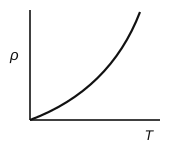
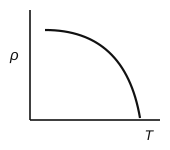
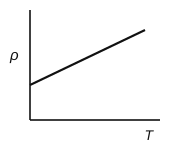
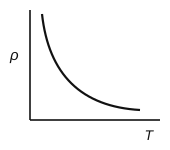
Which of the following graph represents the variation of resistivity (ρ) with temperature (T) for copper?
निम्नलिखित में से कौन-सा ग्राफ ताँबे के लिए ताप (T) के साथ प्रतिरोधकता (ρ) के परिवर्तन को निरूपित करता है?
  1. A
  2. B
  3. C
  4. D
Show answer

Concept: For metals like copper, ρ increases with T; at low T the rise is non-linear and ρ becomes very small near 0 K (NCERT figure of ρ vs T for copper).

  1. Copper is a metal ⇒ positive temperature coefficient ⇒ ρ increases with T: rules out (B) and (D) (falling curves, typical of semiconductors).
  2. Near absolute zero ρ of copper becomes very small and rises slowly, then increases faster – the curved graph starting near the origin, (A).
  3. (C) is the linear approximation ρT=ρ0[1+α(T−T0)], valid only over a limited range – not the full variation.

Short trick: Metal ⇒ rising curve; the NCERT copper graph bends upward from almost zero.

Answer: (A) Graph (A) – rising curve from near the origin

अवधारणा: ताँबे जैसी धातुओं के लिए ρ, T के साथ बढ़ता है; निम्न T पर यह वृद्धि अरैखिक है तथा 0 K के निकट ρ बहुत कम हो जाता है (ताँबे के ρ–T का NCERT चित्र)।

  1. ताँबा धातु है ⇒ धनात्मक ताप गुणांक ⇒ ρ, T के साथ बढ़ता है: (B) व (D) (घटते वक्र, अर्धचालकों जैसे) बाहर।
  2. परम शून्य के निकट ताँबे का ρ बहुत कम होता है और धीरे-धीरे, फिर तेज़ी से बढ़ता है – मूल बिंदु के पास से आरंभ होने वाला वक्र, (A)।
  3. (C) रैखिक सन्निकटन ρT=ρ0[1+α(T−T0)] है, जो केवल सीमित परास में मान्य है – पूर्ण परिवर्तन नहीं।

शॉर्ट ट्रिक: धातु ⇒ बढ़ता वक्र; NCERT का ताँबे वाला ग्राफ लगभग शून्य से ऊपर की ओर मुड़ता है।

उत्तर: (A) ग्राफ (A) – मूल बिंदु के निकट से बढ़ता वक्र

NEET UGPhysicsCurrent electricity – resistivity vs temperatureNEET UG 2020 · 13 Sep Shift 1
Q1288.
The quantities of heat required to raise the temperature of two solid copper spheres of radii r1 and r2 (r1=1.5r2) through 1 K are in the ratio :
त्रिज्याओं r1 तथा r2 (r1=1.5r2) वाले ताँबे के दो ठोस गोलों का ताप 1 K बढ़ाने के लिए आवश्यक ऊष्मा की मात्राओं का अनुपात है :
  1. A32
  2. B53
  3. C278
  4. D94
Show answer

Concept: Q=msΔT; same material and same ΔT ⇒ Q∝m∝r3.

  1. Q1Q2=m1m2=(r1r2)3
  2. =(1.5)3=(32)3=278

Short trick: Solid sphere ⇒ volume ⇒ cube of radius. 94 (D) would be for a thin shell (∝ r²).

Answer: (C) 278

अवधारणा: Q=msΔT; समान पदार्थ तथा समान ΔT ⇒ Q∝m∝r3।

  1. Q1Q2=m1m2=(r1r2)3
  2. =(1.5)3=(32)3=278

शॉर्ट ट्रिक: ठोस गोला ⇒ आयतन ⇒ त्रिज्या का घन। 94 (D) पतले खोल (∝ r²) के लिए होता।

उत्तर: (C) 278

NEET UGPhysicsThermal properties – heat capacityNEET UG 2020 · 13 Sep Shift 1
Q1289.
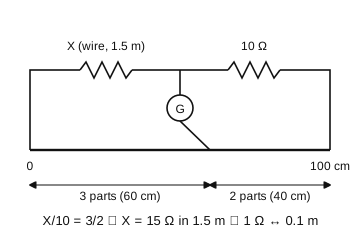
A resistance wire connected in the left gap of a metre bridge balances a 10 Ω resistance in the right gap at a point which divides the bridge wire in the ratio 3 : 2. If the length of the resistance wire is 1.5 m, then the length of 1 Ω of the resistance wire is :
मीटर सेतु के बाएँ अंतराल में जुड़ा एक प्रतिरोध तार दाएँ अंतराल में लगे 10 Ω प्रतिरोध को उस बिंदु पर संतुलित करता है जो सेतु तार को 3 : 2 के अनुपात में विभाजित करता है। यदि प्रतिरोध तार की लंबाई 1.5 m है, तो प्रतिरोध तार के 1 Ω की लंबाई है :
  1. A1.5×10−1 m
  2. B1.5×10−2 m
  3. C1.0×10−2 m
  4. D1.0×10−1 m
Show answer

Concept: Balanced metre bridge: XR=l100−l.

  1. X10=32 ⇒ X=15 Ω
  2. 15 Ω ↔ 1.5 m ⇒ 1 Ω ↔ 1.515=0.1 m =1.0×10⁻¹ m

Short trick: Resistance per metre = 15/1.5 = 10 Ω/m ⇒ 1 Ω in 0.1 m.

Answer: (D) 1.0×10⁻¹ m

अवधारणा: संतुलित मीटर सेतु: XR=l100−l।

  1. X10=32 ⇒ X=15 Ω
  2. 15 Ω ↔ 1.5 m ⇒ 1 Ω ↔ 1.515=0.1 m =1.0×10⁻¹ m

शॉर्ट ट्रिक: प्रति मीटर प्रतिरोध = 15/1.5 = 10 Ω/m ⇒ 1 Ω, 0.1 m में।

उत्तर: (D) 1.0×10⁻¹ m

NEET UGPhysicsCurrent electricity – metre bridgeNEET UG 2020 · 13 Sep Shift 1
Q1290.
The increase in the width of the depletion region in a p-n junction diode is due to :
p-n संधि डायोड में ह्रासी क्षेत्र (depletion region) की चौड़ाई में वृद्धि का कारण है :
  1. Aboth forward bias and reverse biasअग्र अभिनति तथा पश्च अभिनति दोनों
  2. Bincrease in forward currentअग्र धारा में वृद्धि
  3. Cforward bias onlyकेवल अग्र अभिनति
  4. Dreverse bias onlyकेवल पश्च अभिनति
Show answer

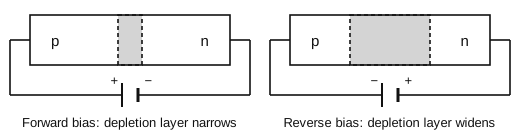
Concept: Reverse bias adds to the barrier potential and pulls majority carriers away from the junction; forward bias does the opposite.

  1. Reverse bias: holes pulled to the negative terminal, electrons to the positive ⇒ more uncovered ions ⇒ depletion layer widens.
  2. Forward bias (and larger forward current) reduces the barrier ⇒ depletion layer narrows – so (A), (B), (C) are wrong.

Short trick: Reverse = Raise barrier = wider depletion layer.

Answer: (D) reverse bias only

अवधारणा: पश्च अभिनति रोधिका विभव में जुड़ती है और बहुसंख्यक वाहकों को संधि से दूर खींचती है; अग्र अभिनति इसका विपरीत करती है।

  1. पश्च अभिनति: होल ऋण टर्मिनल की ओर, इलेक्ट्रॉन धन टर्मिनल की ओर खिंचते हैं ⇒ अधिक अनावृत आयन ⇒ ह्रासी परत चौड़ी।
  2. अग्र अभिनति (तथा अधिक अग्र धारा) रोधिका घटाती है ⇒ ह्रासी परत संकरी – अतः (A), (B), (C) गलत।

शॉर्ट ट्रिक: पश्च (Reverse) = रोधिका बढ़ाओ (Raise) = चौड़ी ह्रासी परत।

उत्तर: (D) केवल पश्च अभिनति

NEET UGPhysicsSemiconductors – p-n junction depletion regionNEET UG 2020 · 13 Sep Shift 1
Q1291.
A 40 μF capacitor is connected to a 200 V, 50 Hz ac supply. The rms value of the current in the circuit is, nearly :
एक 40 μF संधारित्र 200 V, 50 Hz ac आपूर्ति से जुड़ा है। परिपथ में धारा का वर्ग माध्य मूल (rms) मान लगभग है :
  1. A2.5 A
  2. B25.1 A
  3. C1.7 A
  4. D2.05 A
Show answer

Concept: XC=1ωC, Irms=VrmsXC=VrmsωC.

  1. ω=2π×50=100π rad/s
  2. Irms=200×100π×40×10−6=0.8π
  3. Irms≈2.51 A ≈ 2.5 A

Short trick: I=VωC=200×314×40×10−6≈2.5 A.

Answer: (A) 2.5 A

अवधारणा: XC=1ωC, Irms=VrmsXC=VrmsωC।

  1. ω=2π×50=100π rad/s
  2. Irms=200×100π×40×10−6=0.8π
  3. Irms≈2.51 A ≈ 2.5 A

शॉर्ट ट्रिक: I=VωC=200×314×40×10−6≈2.5 A।

उत्तर: (A) 2.5 A

NEET UGPhysicsAlternating current – capacitive circuitNEET UG 2020 · 13 Sep Shift 1
Q1292.
Taking into account of the significant figures, what is the value of 9.99 m − 0.0099 m?
सार्थक अंकों को ध्यान में रखते हुए, 9.99 m − 0.0099 m का मान क्या है?
  1. A9.980 m
  2. B9.9 m
  3. C9.9801 m
  4. D9.98 m
Show answer

Concept: In addition/subtraction, the result keeps as many decimal places as the term with the fewest decimal places.

  1. 9.99 − 0.0099 = 9.9801 (raw).
  2. 9.99 has 2 decimal places ⇒ round to 2 decimal places ⇒ 9.98 m.
  3. 9.980 and 9.9801 show false precision; 9.9 drops a valid digit.

Short trick: Add/subtract → count decimal places; multiply/divide → count significant figures.

Answer: (D) 9.98 m

अवधारणा: योग/व्यवकलन में परिणाम में उतने ही दशमलव स्थान रखे जाते हैं जितने न्यूनतम दशमलव स्थानों वाले पद में हैं।

  1. 9.99 − 0.0099 = 9.9801 (कच्चा मान)।
  2. 9.99 में 2 दशमलव स्थान ⇒ 2 दशमलव स्थानों तक पूर्णांकन ⇒ 9.98 m।
  3. 9.980 और 9.9801 झूठी परिशुद्धता दर्शाते हैं; 9.9 में एक वैध अंक छूट जाता है।

शॉर्ट ट्रिक: योग/व्यवकलन → दशमलव स्थान गिनें; गुणा/भाग → सार्थक अंक गिनें।

उत्तर: (D) 9.98 m

NEET UGPhysicsUnits and measurement – significant figuresNEET UG 2020 · 13 Sep Shift 1
Q1293.
A charged particle having drift velocity of 7.5×10⁻⁴ m s−1 in an electric field of 3×10⁻¹⁰ V m−1, has a mobility in m2 V−1 s−1 of :
3×10⁻¹⁰ V m−1 के विद्युत क्षेत्र में 7.5×10⁻⁴ m s−1 अपवाह वेग वाले एक आवेशित कण की गतिशीलता (mobility), m2 V−1 s−1 में, है :
  1. A2.5×10−6
  2. B2.25×10−15
  3. C2.25×1015
  4. D2.5×106
Show answer

Concept: Mobility μ=vdE.

  1. μ=7.5×10−43×10−10
  2. =2.5×10⁶ m2V−1s−1

Short trick: Divide, don’t multiply: 10−4/10−10=10+6. (B)/(C) come from multiplying.

Answer: (D) 2.5×10⁶

अवधारणा: गतिशीलता μ=vdE।

  1. μ=7.5×10−43×10−10
  2. =2.5×10⁶ m2V−1s−1

शॉर्ट ट्रिक: भाग करें, गुणा नहीं: 10−4/10−10=10+6। (B)/(C) गुणा करने से आते हैं।

उत्तर: (D) 2.5×10⁶

NEET UGPhysicsCurrent electricity – drift velocity and mobilityNEET UG 2020 · 13 Sep Shift 1
Q1294.
In a guitar, two strings A and B made of same material are slightly out of tune and produce beats of frequency 6 Hz. When tension in B is slightly decreased, the beat frequency increases to 7 Hz. If the frequency of A is 530 Hz, the original frequency of B will be :
एक गिटार में, समान पदार्थ से बनी दो डोरियाँ A और B थोड़ी बेसुरी हैं और 6 Hz आवृत्ति के विस्पंद उत्पन्न करती हैं। जब B में तनाव थोड़ा कम किया जाता है, तो विस्पंद आवृत्ति बढ़कर 7 Hz हो जाती है। यदि A की आवृत्ति 530 Hz है, तो B की मूल आवृत्ति होगी :
  1. A536 Hz
  2. B537 Hz
  3. C523 Hz
  4. D524 Hz
Show answer

Concept: For a string f=12LTμ ⇒ f∝T; beats = |fA−fB|.

  1. fB=530±6 = 536 Hz or 524 Hz.
  2. Decreasing tension lowers fB.
  3. If fB=536: lowering it brings it towards 530 ⇒ beats decrease ✗.
  4. If fB=524: lowering it moves it away from 530 ⇒ beats increase to 7 ✓ ⇒ fB=524 Hz.

Short trick: Beats increase when the changed source moves away from the other: fB goes down ⇒ it was already below 530.

Answer: (D) 524 Hz

अवधारणा: डोरी के लिए f=12LTμ ⇒ f∝T; विस्पंद = |fA−fB|।

  1. fB=530±6 = 536 Hz या 524 Hz।
  2. तनाव घटाने से fB घटती है।
  3. यदि fB=536: घटने पर यह 530 के निकट आएगी ⇒ विस्पंद घटेंगे ✗।
  4. यदि fB=524: घटने पर यह 530 से दूर जाएगी ⇒ विस्पंद बढ़कर 7 ✓ ⇒ fB=524 Hz।

शॉर्ट ट्रिक: विस्पंद तब बढ़ते हैं जब परिवर्तित स्रोत दूसरे से दूर जाता है: fB घटी ⇒ यह पहले से 530 से कम थी।

उत्तर: (D) 524 Hz

NEET UGPhysicsWaves – beatsNEET UG 2020 · 13 Sep Shift 1
Q1295.
Two particles of mass 5 kg and 10 kg respectively are attached to the two ends of a rigid rod of length 1 m with negligible mass. The centre of mass of the system from the 5 kg particle is nearly at a distance of :
क्रमशः 5 kg और 10 kg द्रव्यमान के दो कण नगण्य द्रव्यमान की 1 m लंबी एक दृढ़ छड़ के दोनों सिरों से जुड़े हैं। 5 kg कण से निकाय के द्रव्यमान केंद्र की दूरी लगभग है :
  1. A67 cm
  2. B80 cm
  3. C33 cm
  4. D50 cm
Show answer

Concept: Taking the 5 kg particle at the origin, xcm=m1x1+m2x2m1+m2.

  1. xcm=5(0)+10(1)5+10=1015 m
  2. =0.667 m ≈ 67 cm (closer to the heavier mass).

Short trick: Distance from m1 = m2m1+m2L=23×100 cm. 33 cm (C) is the distance from the 10 kg particle.

Answer: (A) 67 cm

अवधारणा: 5 kg कण को मूल बिंदु पर लेने पर, xcm=m1x1+m2x2m1+m2।

  1. xcm=5(0)+10(1)5+10=1015 m
  2. =0.667 m ≈ 67 cm (भारी द्रव्यमान के अधिक निकट)।

शॉर्ट ट्रिक: m1 से दूरी = m2m1+m2L=23×100 cm। 33 cm (C), 10 kg कण से दूरी है।

उत्तर: (A) 67 cm

NEET UGPhysicsSystem of particles – centre of massNEET UG 2020 · 13 Sep Shift 1
Q1296.
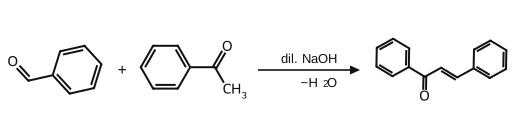
Reaction between benzaldehyde and acetophenone in presence of dilute NaOH is known as:
तनु NaOH की उपस्थिति में बेन्ज़ैल्डिहाइड और ऐसीटोफ़ीनोन के बीच होने वाली अभिक्रिया कहलाती है:
  1. ACross Cannizzaro's reactionक्रॉस कैनिज़ारो अभिक्रिया
  2. BCross Aldol condensationक्रॉस ऐल्डॉल संघनन
  3. CAldol condensationऐल्डॉल संघनन
  4. DCannizzaro's reactionकैनिज़ारो अभिक्रिया
Show answer

Concept: Aldol condensation between two different carbonyl compounds (at least one having α-H) is called cross aldol condensation. When an aromatic aldehyde condenses with a ketone it is also called the Claisen–Schmidt reaction.

  1. Benzaldehyde (C6H5CHO) has no α-H; acetophenone (C6H5COCH3) has three α-H.
  2. OH− removes an α-H of acetophenone → enolate, which attacks the C=O of benzaldehyde.
  3. The β-hydroxy ketone loses H2O → C6H5CH=CH–CO–C6H5 (benzalacetophenone, chalcone).
  4. (A)/(D) Cannizzaro needs concentrated alkali and aldehydes without α-H only; (C) plain aldol means two molecules of the same carbonyl compound.

Short trick: Two different carbonyls + dilute base = cross aldol; no α-H + concentrated base = Cannizzaro.

Answer: (B) Cross Aldol condensation

अवधारणा: दो भिन्न कार्बोनिल यौगिकों (जिनमें से कम-से-कम एक में α-H हो) के बीच ऐल्डॉल संघनन को क्रॉस ऐल्डॉल संघनन कहते हैं। ऐरोमैटिक ऐल्डिहाइड और कीटोन के बीच इसे क्लेसेन–श्मिट अभिक्रिया भी कहते हैं।

  1. बेन्ज़ैल्डिहाइड (C6H5CHO) में α-H नहीं है; ऐसीटोफ़ीनोन (C6H5COCH3) में तीन α-H हैं।
  2. OH− ऐसीटोफ़ीनोन का α-H हटाकर इनोलेट बनाता है, जो बेन्ज़ैल्डिहाइड के C=O पर आक्रमण करता है।
  3. β-हाइड्रॉक्सी कीटोन से H2O निकलता है → C6H5CH=CH–CO–C6H5 (बेन्ज़ैल-ऐसीटोफ़ीनोन, चाल्कोन)।
  4. (A)/(D) कैनिज़ारो के लिए सांद्र क्षार और α-H रहित ऐल्डिहाइड चाहिए; (C) साधारण ऐल्डॉल एक ही कार्बोनिल यौगिक के दो अणुओं के बीच होता है।

शॉर्ट ट्रिक: दो भिन्न कार्बोनिल + तनु क्षार = क्रॉस ऐल्डॉल; α-H रहित + सांद्र क्षार = कैनिज़ारो।

उत्तर: (B) क्रॉस ऐल्डॉल संघनन

NEET UGChemistryAldehydes and ketones – cross aldol condensationNEET UG 2020 · 13 Sep Shift 1
Q1297.
Measuring Zeta potential is useful in determining which property of colloidal solution?
ज़ीटा विभव (Zeta potential) का मापन कोलॉइडी विलयन के किस गुण को ज्ञात करने में उपयोगी है?
  1. AStability of the colloidal particlesकोलॉइडी कणों का स्थायित्व
  2. BSize of the colloidal particlesकोलॉइडी कणों का आकार
  3. CViscosityश्यानता
  4. DSolubilityविलेयता
Show answer

Concept: Zeta (electrokinetic) potential is the potential difference between the fixed layer and the diffused layer of charges around a colloidal particle.

  1. A high zeta potential means strong mutual repulsion between like-charged particles → they do not come together → sol is stable.
  2. A low zeta potential lets the particles approach each other → coagulation.
  3. Zeta potential does not measure particle size (B), viscosity (C) or solubility (D).

Short trick: Zeta potential = 'charge guard' of a colloid → it tells you stability.

Answer: (A) Stability of the colloidal particles

अवधारणा: ज़ीटा (विद्युत-गतिक) विभव कोलॉइडी कण के चारों ओर आवेशों की स्थिर परत और विसरित परत के बीच का विभवान्तर है।

  1. उच्च ज़ीटा विभव का अर्थ है समान आवेशित कणों के बीच प्रबल प्रतिकर्षण → कण पास नहीं आते → सॉल स्थायी रहता है।
  2. निम्न ज़ीटा विभव पर कण पास आ जाते हैं → स्कंदन (coagulation) होता है।
  3. ज़ीटा विभव कण का आकार (B), श्यानता (C) या विलेयता (D) नहीं मापता।

शॉर्ट ट्रिक: ज़ीटा विभव = कोलॉइड का 'आवेश रक्षक' → यह स्थायित्व बताता है।

उत्तर: (A) कोलॉइडी कणों का स्थायित्व

NEET UGChemistrySurface chemistry – colloids (zeta potential)NEET UG 2020 · 13 Sep Shift 1
Q1298.
A tertiary butyl carbocation is more stable than a secondary butyl carbocation because of which of the following?
एक तृतीयक ब्यूटिल कार्बोधनायन (carbocation), एक द्वितीयक ब्यूटिल कार्बोधनायन से अधिक स्थायी है, निम्नलिखित में से किस कारण से?
  1. A−R effect of −CH3 group−CH3 समूह का −R प्रभाव
  2. BHyperconjugationअतिसंयुग्मन (Hyperconjugation)
  3. C−I effect of −CH3 groups−CH3 समूहों का −I प्रभाव
  4. D+R effect of −CH3 groups−CH3 समूहों का +R प्रभाव
Show answer

Concept: Alkyl groups stabilise a carbocation by hyperconjugation (σ C–H → empty p orbital) and by +I effect.

  1. (CH3)3C+ has 9 α-H atoms; CH3CH2C+HCH3 has 5 α-H atoms.
  2. More α-H → more hyperconjugative structures → greater delocalisation of + charge → more stable.
  3. (A), (D): CH3 has no π/lone pair, so it shows no resonance (R) effect; (C): CH3 is +I, not −I.

Short trick: Count α-H atoms: 9 (3°) > 5 (2°) > 2 (1°) – more α-H, more stable cation.

Answer: (B) Hyperconjugation

अवधारणा: ऐल्किल समूह कार्बोधनायन को अतिसंयुग्मन (σ C–H → रिक्त p कक्षक) तथा +I प्रभाव द्वारा स्थायी करते हैं।

  1. (CH3)3C+ में 9 α-H परमाणु हैं; CH3CH2C+HCH3 में 5 α-H परमाणु हैं।
  2. अधिक α-H → अधिक अतिसंयुग्मी संरचनाएँ → धन आवेश का अधिक विस्थानीकरण → अधिक स्थायित्व।
  3. (A), (D): CH3 में π-बंध/एकाकी युग्म नहीं, अतः अनुनाद (R) प्रभाव नहीं; (C): CH3 +I है, −I नहीं।

शॉर्ट ट्रिक: α-H गिनें: 9 (3°) > 5 (2°) > 2 (1°) – जितने अधिक α-H, उतना स्थायी धनायन।

उत्तर: (B) अतिसंयुग्मन

NEET UGChemistryOrganic chemistry basics – carbocation stabilityNEET UG 2020 · 13 Sep Shift 1
Q1299.
The correct option for free expansion of an ideal gas under adiabatic condition is
रुद्धोष्म (adiabatic) परिस्थिति में किसी आदर्श गैस के मुक्त प्रसार के लिए सही विकल्प है
  1. Aq<0, ΔT=0 and w=0q<0, ΔT=0 तथा w=0
  2. Bq>0, ΔT>0 and w>0q>0, ΔT>0 तथा w>0
  3. Cq=0, ΔT=0 and w=0q=0, ΔT=0 तथा w=0
  4. Dq=0, ΔT<0 and w>0q=0, ΔT<0 तथा w>0
Show answer

Concept: Free expansion = expansion against zero external pressure; adiabatic = no heat exchange.

  1. w=−pextΔV=0 because pext=0.
  2. Adiabatic ⇒ q=0.
  3. ΔU=q+w=0; for an ideal gas U depends only on T ⇒ ΔT=0.

Short trick: Free + adiabatic + ideal = 'everything zero': q = w = ΔU = ΔT = 0.

Answer: (C) q=0, ΔT=0 and w=0

अवधारणा: मुक्त प्रसार = शून्य बाह्य दाब के विरुद्ध प्रसार; रुद्धोष्म = ऊष्मा का कोई आदान-प्रदान नहीं।

  1. w=−pextΔV=0 क्योंकि pext=0।
  2. रुद्धोष्म ⇒ q=0।
  3. ΔU=q+w=0; आदर्श गैस के लिए U केवल T पर निर्भर ⇒ ΔT=0।

शॉर्ट ट्रिक: मुक्त + रुद्धोष्म + आदर्श = 'सब शून्य': q = w = ΔU = ΔT = 0।

उत्तर: (C) q=0, ΔT=0 तथा w=0

NEET UGChemistryThermodynamics – free expansionNEET UG 2020 · 13 Sep Shift 1
Q1300.
Match the following :
OxideNature
(a) CO(i) Basic
(b) BaO(ii) Neutral
(c) Al2O3(iii) Acidic
(d) Cl2O7(iv) Amphoteric
Which of the following is correct option?
निम्नलिखित का मिलान कीजिए:
ऑक्साइडप्रकृति
(a) CO(i) क्षारीय
(b) BaO(ii) उदासीन
(c) Al2O3(iii) अम्लीय
(d) Cl2O7(iv) उभयधर्मी
निम्नलिखित में से कौन-सा विकल्प सही है?
  1. A(a) (iii); (b) (iv); (c) (i); (d) (ii)
  2. B(a) (iv); (b) (iii); (c) (ii); (d) (i)
  3. C(a) (i); (b) (ii); (c) (iii); (d) (iv)
  4. D(a) (ii); (b) (i); (c) (iv); (d) (iii)
Show answer

Concept: Metal oxides of electropositive metals are basic, those of non-metals in high oxidation state are acidic, Al2O3 is amphoteric, and CO, NO, N2O are neutral.

  1. (a) CO – neutral → (ii)
  2. (b) BaO – basic (Ba is an alkaline-earth metal) → (i)
  3. (c) Al2O3 – amphoteric (reacts with both acids and bases) → (iv)
  4. (d) Cl2O7 – acidic (anhydride of HClO4) → (iii)
  5. Only option (D) has a → ii first; it also has b → i, c → iv, d → iii.

Short trick: Neutral oxides to remember: CO, NO, N2O. Spot CO → (ii) and only one option survives.

Answer: (D) (a) (ii); (b) (i); (c) (iv); (d) (iii)

अवधारणा: विद्युत-धनी धातुओं के ऑक्साइड क्षारीय, उच्च ऑक्सीकरण अवस्था वाले अधातु ऑक्साइड अम्लीय, Al2O3 उभयधर्मी, तथा CO, NO, N2O उदासीन होते हैं।

  1. (a) CO – उदासीन → (ii)
  2. (b) BaO – क्षारीय (Ba क्षारीय मृदा धातु है) → (i)
  3. (c) Al2O3 – उभयधर्मी (अम्ल व क्षार दोनों से अभिक्रिया) → (iv)
  4. (d) Cl2O7 – अम्लीय (HClO4 का ऐनहाइड्राइड) → (iii)
  5. केवल विकल्प (D) में a → ii है; इसमें b → i, c → iv, d → iii भी है।

शॉर्ट ट्रिक: उदासीन ऑक्साइड याद रखें: CO, NO, N2O। CO → (ii) पहचानते ही एक ही विकल्प बचता है।

उत्तर: (D) (a) (ii); (b) (i); (c) (iv); (d) (iii)

NEET UGChemistryp-Block elements – nature of oxidesNEET UG 2020 · 13 Sep Shift 1