NEET UG · 2,240 questions

NEET UG 2015, 2016, 2017, 2018, 2019, 2020, 2021, 2022, 2023, 2024, 2025, 2026 PYQs

Real previous year questions, subject-wise. Try the question, then open the answer and the explanation in Hindi & English – free, no login.

Courses – airGurukul

2,240 questions.

Q1361.
A solid cylinder of mass 2 kg and radius 4 cm rotating about its axis at the rate of 3 rpm. The torque required to stop after 2π revolutions is
2 kg द्रव्यमान तथा 4 cm त्रिज्या का एक ठोस बेलन अपनी अक्ष के परितः 3 rpm की दर से घूर्णन कर रहा है। 2π परिक्रमणों के बाद इसे रोकने के लिए आवश्यक बल-आघूर्ण है
  1. A2×10−6 N m
  2. B2×10−3 N m
  3. C12×10−4 N m
  4. D2×106 N m
Show answer

Concept: ω2=ω02−2αθ and τ=Iα, with I=12MR2.

  1. I=12×2×(0.04)2=1.6×10⁻³ kg m2
  2. ω0=3×2π60=π10 rad/s; θ=2π rev=2π×2π=4π2 rad
  3. α=ω022θ=π2/1008π2=1800 rad/s2
  4. τ=Iα=1.6×10−3800=2×10⁻⁶ N m

Short trick: Work–energy: τθ=12Iω02; the π2 cancels, so the answer has no π – only (A) and (B) survive, and tiny I gives (A).

Answer: (A) 2×10⁻⁶ N m

अवधारणा: ω2=ω02−2αθ तथा τ=Iα, जहाँ I=12MR2।

  1. I=12×2×(0.04)2=1.6×10⁻³ kg m2
  2. ω0=3×2π60=π10 rad/s; θ=2π परिक्रमण =2π×2π=4π2 rad
  3. α=ω022θ=π2/1008π2=1800 rad/s2
  4. τ=Iα=1.6×10−3800=2×10⁻⁶ N m

शॉर्ट ट्रिक: कार्य–ऊर्जा: τθ=12Iω02; π2 कट जाता है, अतः उत्तर में π नहीं – केवल (A) व (B) बचते हैं, और बहुत छोटा I (A) देता है।

उत्तर: (A) 2×10⁻⁶ N m

NEET UGPhysicsRotational motion – torque and angular retardationNEET UG 2019 · 5 May Shift 1
Q1362.
A force F = 20 + 10 y acts on a particle in y-direction where F is in newton and y in meter. Work done by this force to move the particle from y = 0 to y = 1 m is
y-दिशा में एक कण पर बल F = 20 + 10 y लगता है, जहाँ F न्यूटन में तथा y मीटर में है। कण को y = 0 से y = 1 m तक ले जाने में इस बल द्वारा किया गया कार्य है
  1. A30 J
  2. B5 J
  3. C25 J
  4. D20 J
Show answer

Concept: W=∫Fdy for a variable force.

  1. W=∫01(20+10y)dy=[20y+5y2]01
  2. W=20+5=25 J

Short trick: Linear force → W = average force × distance = (20 + 30)/2 × 1 = 25 J.

Answer: (C) 25 J

अवधारणा: परिवर्ती बल के लिए W=∫Fdy।

  1. W=∫01(20+10y)dy=[20y+5y2]01
  2. W=20+5=25 J

शॉर्ट ट्रिक: रैखिक बल → W = औसत बल × दूरी = (20 + 30)/2 × 1 = 25 J।

उत्तर: (C) 25 J

NEET UGPhysicsWork, energy and power – work by variable forceNEET UG 2019 · 5 May Shift 1
Q1363.
Which of the following acts as a circuit protects device?
निम्नलिखित में से कौन परिपथ रक्षक युक्ति के रूप में कार्य करता है?
  1. AConductorचालक
  2. BInductorप्रेरक
  3. CSwitchस्विच
  4. DFuseफ्यूज़
Show answer

Concept: A fuse wire (low melting point, high resistivity alloy) melts when current exceeds its rating and breaks the circuit.

  1. Fuse – melts on overload/short-circuit, protecting appliances → correct.
  2. Conductor only carries current; inductor opposes change of current; switch is manual on/off – none of them protects automatically.

Short trick: Fuse = sacrificial weak link: it dies so the circuit survives.

Answer: (D) Fuse

अवधारणा: फ्यूज़ तार (कम गलनांक, उच्च प्रतिरोधकता वाली मिश्रधातु) धारा के निर्धारित मान से अधिक होने पर पिघलकर परिपथ तोड़ देता है।

  1. फ्यूज़ – अधिभार/लघु-परिपथ पर पिघलकर उपकरणों की रक्षा करता है → सही।
  2. चालक केवल धारा प्रवाहित करता है; प्रेरक धारा-परिवर्तन का विरोध करता है; स्विच हाथ से चालू/बंद होता है – कोई भी स्वतः रक्षा नहीं करता।

शॉर्ट ट्रिक: फ्यूज़ = बलिदानी कमज़ोर कड़ी: वह स्वयं नष्ट होकर परिपथ को बचाता है।

उत्तर: (D) फ्यूज़

NEET UGPhysicsCurrent electricity – circuit protectionNEET UG 2019 · 5 May Shift 1
Q1364.
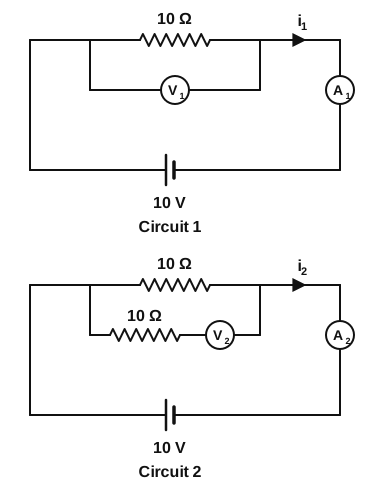
In the circuits shown below, the readings of voltmeters and the ammeters will be
नीचे दर्शाए गए परिपथों में वोल्टमीटरों तथा अमीटरों के पाठ्यांक होंगे
  1. AV2>V1 and i1=i2V2>V1 तथा i1=i2
  2. BV1=V2 and i1>i2V1=V2 तथा i1>i2
  3. CV1=V2 and i1=i2V1=V2 तथा i1=i2
  4. DV2>V1 and i1>i2V2>V1 तथा i1>i2
Show answer

Concept: An ideal voltmeter has infinite resistance – no current flows through it or through anything in series with it.

  1. Circuit 1: i1=1010=1 A; V1 reads across 10 Ω → V1=10 V.
  2. Circuit 2: the branch (10 Ω + V2) carries zero current, so the extra 10 Ω has no drop; i2=1 A and V2 reads the full 10 V across the parallel 10 Ω.
  3. Hence V1=V2 and i1=i2.

Short trick: A resistor in series with an ideal voltmeter is "invisible" – zero current → zero drop.

Answer: (C) V1=V2 and i1=i2

अवधारणा: आदर्श वोल्टमीटर का प्रतिरोध अनंत होता है – इसमें अथवा इसके श्रेणी में जुड़े किसी अवयव में धारा नहीं बहती।

  1. परिपथ 1: i1=1010=1 A; V1 10 Ω के सिरों पर → V1=10 V।
  2. परिपथ 2: शाखा (10 Ω + V2) में धारा शून्य है, अतः अतिरिक्त 10 Ω पर कोई विभवपात नहीं; i2=1 A तथा V2 समांतर 10 Ω के पूरे 10 V पढ़ता है।
  3. अतः V1=V2 तथा i1=i2।

शॉर्ट ट्रिक: आदर्श वोल्टमीटर के श्रेणी में जुड़ा प्रतिरोधक "अदृश्य" है – शून्य धारा → शून्य विभवपात।

उत्तर: (C) V1=V2 तथा i1=i2

NEET UGPhysicsCurrent electricity – ideal voltmeter and ammeterNEET UG 2019 · 5 May Shift 1
Q1365.
A hollow metal sphere of radius R is uniformly charged. The electric field due to the sphere at a distance r from the centre
R त्रिज्या का एक खोखला धातु गोला एकसमान रूप से आवेशित है। केंद्र से r दूरी पर गोले के कारण विद्युत क्षेत्र
  1. AIncreases as r increases for r < R and for r > Rr < R तथा r > R दोनों के लिए r बढ़ने पर बढ़ता है
  2. BZero as r increases for r < R, decreases as r increases for r > Rr < R के लिए r बढ़ने पर शून्य रहता है, r > R के लिए r बढ़ने पर घटता है
  3. CZero as r increases for r < R, increases as r increases for r > Rr < R के लिए r बढ़ने पर शून्य रहता है, r > R के लिए r बढ़ने पर बढ़ता है
  4. DDecreases as r increases for r < R and for r > Rr < R तथा r > R दोनों के लिए r बढ़ने पर घटता है
Show answer

Concept: Gauss law: inside a charged conducting shell E=0; outside E=Q4πε0r2.

  1. r < R: enclosed charge = 0 → E = 0 everywhere inside.
  2. r > R: E∝1r2 → decreases with r. Matches (B).

Short trick: Hollow/conducting sphere: "zero inside, inverse-square outside".

Answer: (B) Zero as r increases for r < R, decreases as r increases for r > R

अवधारणा: गाउस नियम: आवेशित चालक कोश के भीतर E=0; बाहर E=Q4πε0r2।

  1. r < R: परिबद्ध आवेश = 0 → भीतर सर्वत्र E = 0।
  2. r > R: E∝1r2 → r के साथ घटता है। (B) से मेल।

शॉर्ट ट्रिक: खोखला/चालक गोला: "भीतर शून्य, बाहर व्युत्क्रम-वर्ग"।

उत्तर: (B) r < R के लिए r बढ़ने पर शून्य रहता है, r > R के लिए r बढ़ने पर घटता है

NEET UGPhysicsElectrostatics – field of a charged spherical shellNEET UG 2019 · 5 May Shift 1
Q1366.
At a point A on the earth’s surface the angle of dip, δ=+25∘. At a point B on the earth’s surface the angle of dip, δ=−25∘. We can interpret that:
पृथ्वी के पृष्ठ पर बिंदु A पर नति कोण δ=+25∘ है। पृथ्वी के पृष्ठ पर बिंदु B पर नति कोण δ=−25∘ है। हम यह निष्कर्ष निकाल सकते हैं कि:
  1. AA and B are both located in the northern hemisphere.A तथा B दोनों उत्तरी गोलार्ध में स्थित हैं।
  2. BA is located in the southern hemisphere and B is located in the northern hemisphere.A दक्षिणी गोलार्ध में तथा B उत्तरी गोलार्ध में स्थित है।
  3. CA is located in the northern hemisphere and B is located in the southern hemisphere.A उत्तरी गोलार्ध में तथा B दक्षिणी गोलार्ध में स्थित है।
  4. DA and B are both located in the southern hemisphere.A तथा B दोनों दक्षिणी गोलार्ध में स्थित हैं।
Show answer

Concept: Dip is taken positive when the north pole of the dip needle points downward – this happens in the northern (magnetic) hemisphere.

  1. δ = +25° at A → north end dips down → A in northern hemisphere.
  2. δ = −25° at B → north end points up (south end dips) → B in southern hemisphere.

Short trick: + dip = North, − dip = South; zero dip = magnetic equator.

Answer: (C) A is located in the northern hemisphere and B is located in the southern hemisphere.

अवधारणा: जब नति सुई का उत्तरी ध्रुव नीचे झुकता है तब नति धनात्मक ली जाती है – ऐसा उत्तरी (चुंबकीय) गोलार्ध में होता है।

  1. A पर δ = +25° → उत्तरी सिरा नीचे झुकता है → A उत्तरी गोलार्ध में।
  2. B पर δ = −25° → उत्तरी सिरा ऊपर (दक्षिणी सिरा नीचे) → B दक्षिणी गोलार्ध में।

शॉर्ट ट्रिक: + नति = उत्तर, − नति = दक्षिण; शून्य नति = चुंबकीय विषुवत रेखा।

उत्तर: (C) A उत्तरी गोलार्ध में तथा B दक्षिणी गोलार्ध में स्थित है।

NEET UGPhysicsMagnetism – angle of dipNEET UG 2019 · 5 May Shift 1
Q1367.
The total energy of an electron in an atom in an orbit is −3.4 eV. Its kinetic and potential energies are, respectively:
किसी परमाणु की एक कक्षा में इलेक्ट्रॉन की कुल ऊर्जा −3.4 eV है। इसकी गतिज तथा स्थितिज ऊर्जाएँ क्रमशः हैं:
  1. A−3.4 eV, −3.4 eV
  2. B−3.4 eV, −6.8 eV
  3. C3.4 eV, −6.8 eV
  4. D3.4 eV, 3.4 eV
Show answer

Concept: In a Bohr orbit: KE = −E, PE = 2E (since PE = −2 KE).

  1. KE = −(−3.4) = +3.4 eV
  2. PE = 2 × (−3.4) = −6.8 eV

Short trick: KE is never negative – eliminates (A), (B); PE = −2KE eliminates (D).

Answer: (C) 3.4 eV, −6.8 eV

अवधारणा: बोर कक्षा में: KE = −E, PE = 2E (क्योंकि PE = −2 KE)।

  1. KE = −(−3.4) = +3.4 eV
  2. PE = 2 × (−3.4) = −6.8 eV

शॉर्ट ट्रिक: गतिज ऊर्जा कभी ऋणात्मक नहीं – (A), (B) हटते हैं; PE = −2KE से (D) हटता है।

उत्तर: (C) 3.4 eV, −6.8 eV

NEET UGPhysicsAtoms – energies in Bohr orbitNEET UG 2019 · 5 May Shift 1
Q1368.
In total internal reflection when the angle of incidence is equal to the critical angle for the pair of media in contact, what will be angle of refraction?
पूर्ण आंतरिक परावर्तन में, जब आपतन कोण संपर्क में स्थित माध्यमों के युग्म के क्रांतिक कोण के बराबर हो, तो अपवर्तन कोण क्या होगा?
  1. A180°
  2. B0°
  3. CEqual to angle of incidenceआपतन कोण के बराबर
  4. D90°
Show answer

Concept: Critical angle is defined as the angle of incidence (in the denser medium) for which the angle of refraction is 90°.

  1. μsin⁡C=1×sin⁡r with sin⁡C=1μ → sin⁡r=1 → r=90∘.
  2. The refracted ray grazes along the interface.

Short trick: At i = C the ray just skims the surface (r = 90°); for i > C it is totally reflected.

Answer: (D) 90°

अवधारणा: क्रांतिक कोण वह आपतन कोण (सघन माध्यम में) है जिसके लिए अपवर्तन कोण 90° होता है।

  1. μsin⁡C=1×sin⁡r, जहाँ sin⁡C=1μ → sin⁡r=1 → r=90∘।
  2. अपवर्तित किरण अंतरापृष्ठ के अनुदिश सरकती है।

शॉर्ट ट्रिक: i = C पर किरण पृष्ठ को छूती हुई निकलती है (r = 90°); i > C पर पूर्ण परावर्तन।

उत्तर: (D) 90°

NEET UGPhysicsRay optics – critical angleNEET UG 2019 · 5 May Shift 1
Q1369.
The work done to raise a mass m from the surface of the earth to a height h, which is equal to the radius of the earth, is:
किसी द्रव्यमान m को पृथ्वी के पृष्ठ से पृथ्वी की त्रिज्या के बराबर ऊँचाई h तक उठाने में किया गया कार्य है:
  1. AmgR
  2. B2mgR
  3. C12mgR
  4. D32mgR
Show answer

Concept: W=ΔU=GMmR−GMmR+h=mgh1+h/R.

  1. With h=R: W=mgR1+1
  2. W=12mgR

Short trick: mgh is valid only for h ≪ R; at h = R the true value is exactly half of mgR.

Answer: (C) 12mgR

अवधारणा: W=ΔU=GMmR−GMmR+h=mgh1+h/R।

  1. h=R रखने पर: W=mgR1+1
  2. W=12mgR

शॉर्ट ट्रिक: mgh केवल h ≪ R के लिए मान्य है; h = R पर वास्तविक मान mgR का ठीक आधा।

उत्तर: (C) 12mgR

NEET UGPhysicsGravitation – work against gravityNEET UG 2019 · 5 May Shift 1
Q1370.
When an object is shot from the bottom of a long smooth inclined plane kept at an angle 60° with horizontal, it can travel a distance x1 along the plane. But when the inclination is decreased to 30° and the same object is shot with the same velocity, it can travel x2 distance. Then x1:x2 will be:
क्षैतिज से 60° के कोण पर रखे एक लंबे चिकने आनत तल की तली से किसी वस्तु को प्रक्षेपित करने पर वह तल के अनुदिश x1 दूरी तय कर पाती है। जब आनति घटाकर 30° कर दी जाती है और उसी वस्तु को समान वेग से प्रक्षेपित किया जाता है, तो वह x2 दूरी तय करती है। तब x1:x2 होगा:
  1. A1:2
  2. B2:1
  3. C1:3
  4. D1:23
Show answer

Concept: Along a smooth incline the retardation is gsin⁡θ, so x=u22gsin⁡θ.

  1. x1x2=sin⁡30∘sin⁡60∘=1/23/2
  2. x1:x2=1:3

Short trick: x∝1sin⁡θ – steeper plane, shorter run; so x1<x2 and the ratio is just sin values swapped.

Answer: (C) 1:3

अवधारणा: चिकने आनत तल के अनुदिश मंदन gsin⁡θ है, अतः x=u22gsin⁡θ।

  1. x1x2=sin⁡30∘sin⁡60∘=1/23/2
  2. x1:x2=1:3

शॉर्ट ट्रिक: x∝1sin⁡θ – अधिक ढाल, कम दूरी; अतः x1<x2 और अनुपात बस sin मानों की अदला-बदली है।

उत्तर: (C) 1:3

NEET UGPhysicsKinematics – motion on a smooth inclineNEET UG 2019 · 5 May Shift 1
Q1371.
α-particle consists of :
α-कण बना होता है :
  1. A2 protons and 2 neutrons onlyकेवल 2 प्रोटॉन तथा 2 न्यूट्रॉन से
  2. B2 electrons, 2 protons and 2 neutrons2 इलेक्ट्रॉन, 2 प्रोटॉन तथा 2 न्यूट्रॉन से
  3. C2 electrons and 4 protons onlyकेवल 2 इलेक्ट्रॉन तथा 4 प्रोटॉन से
  4. D2 protons onlyकेवल 2 प्रोटॉन से
Show answer

Concept: An α-particle is a helium nucleus 24He2+.

  1. Z = 2 → 2 protons; A = 4 → 2 neutrons; no electrons (charge +2e).
  2. With 2 electrons it would be a neutral He atom (B) – wrong; (C), (D) give wrong mass number.

Short trick: α = He²⁺ = "bare" helium nucleus: 2p + 2n.

Answer: (A) 2 protons and 2 neutrons only

अवधारणा: α-कण हीलियम का नाभिक 24He2+ है।

  1. Z = 2 → 2 प्रोटॉन; A = 4 → 2 न्यूट्रॉन; कोई इलेक्ट्रॉन नहीं (आवेश +2e)।
  2. 2 इलेक्ट्रॉन होने पर यह उदासीन He परमाणु (B) होगा – गलत; (C), (D) द्रव्यमान संख्या गलत देते हैं।

शॉर्ट ट्रिक: α = He²⁺ = "नग्न" हीलियम नाभिक: 2p + 2n।

उत्तर: (A) केवल 2 प्रोटॉन तथा 2 न्यूट्रॉन से

NEET UGPhysicsNuclei – alpha particleNEET UG 2019 · 5 May Shift 1
Q1372.
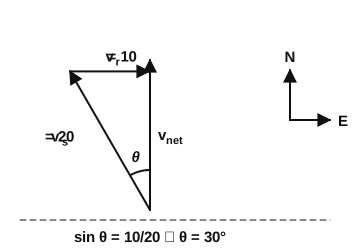
The speed of a swimmer in still water is 20 m/s. The speed of river water is 10 m/s and is flowing due east. If he is standing on the south bank and wishes to cross the river along the shortest path the angle at which he should make his strokes w.r.t. north is given by :
शांत जल में एक तैराक की चाल 20 m/s है। नदी के जल की चाल 10 m/s है तथा यह ठीक पूर्व की ओर बह रहा है। यदि वह दक्षिणी तट पर खड़ा है और नदी को लघुतम पथ से पार करना चाहता है, तो उसे उत्तर के सापेक्ष किस कोण पर हाथ मारने (strokes) चाहिए?
  1. A30° west30° पश्चिम
  2. B0°
  3. C60° west60° पश्चिम
  4. D45° west45° पश्चिम
Show answer

Concept: Shortest path = straight across (due north): the swimmer must head upstream so that the west component of his velocity cancels the river flow.

  1. vssin⁡θ=vr → 20sin⁡θ=10
  2. sin⁡θ=12 → θ=30∘, towards west (river flows east).

Short trick: Shortest path: sin⁡θ=vrvs (upstream); shortest time: θ = 0°. Do not mix them.

Answer: (A) 30° west

अवधारणा: लघुतम पथ = सीधे पार (ठीक उत्तर): तैराक को धारा के विपरीत झुककर तैरना होगा, ताकि उसके वेग का पश्चिमी घटक नदी के प्रवाह को निरस्त करे।

  1. vssin⁡θ=vr → 20sin⁡θ=10
  2. sin⁡θ=12 → θ=30∘, पश्चिम की ओर (नदी पूर्व की ओर बहती है)।

शॉर्ट ट्रिक: लघुतम पथ: sin⁡θ=vrvs (धारा के विपरीत); लघुतम समय: θ = 0°। दोनों को न मिलाएँ।

उत्तर: (A) 30° पश्चिम

NEET UGPhysicsMotion in a plane – river crossingNEET UG 2019 · 5 May Shift 1
Q1373.
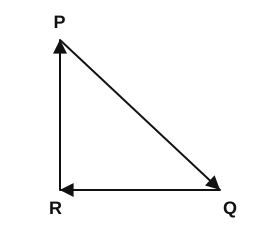
A particle moving with velocity V→ is acted by three forces shown by the vector triangle PQR. The velocity of the particle will :
V→ वेग से गतिमान एक कण पर सदिश त्रिभुज PQR द्वारा दर्शाए गए तीन बल कार्य करते हैं। कण का वेग :
  1. Aincreaseबढ़ेगा
  2. Bdecreaseघटेगा
  3. Cremain constantनियत रहेगा
  4. Dchange according to the smallest force QR―सबसे छोटे बल QR― के अनुसार बदलेगा
Show answer

Concept: Three forces represented by the sides of a triangle taken in the same cyclic order add to zero (triangle law).

  1. Arrows go R → P → Q → R: RP→+PQ→+QR→=0.
  2. F→net=0 → a→=0 → velocity remains constant (Newton’s first law).

Short trick: Closed head-to-tail triangle = zero resultant. Same cyclic order → equilibrium.

Answer: (C) remain constant

अवधारणा: त्रिभुज की भुजाओं द्वारा एक ही चक्रीय क्रम में निरूपित तीन बलों का योग शून्य होता है (त्रिभुज नियम)।

  1. तीर R → P → Q → R: RP→+PQ→+QR→=0।
  2. F→net=0 → a→=0 → वेग नियत रहता है (न्यूटन का प्रथम नियम)।

शॉर्ट ट्रिक: शीर्ष-से-पुच्छ बंद त्रिभुज = शून्य परिणामी। समान चक्रीय क्रम → संतुलन।

उत्तर: (C) नियत रहेगा

NEET UGPhysicsLaws of motion – equilibrium of concurrent forcesNEET UG 2019 · 5 May Shift 1
Q1374.
Two particles A and B are moving in uniform circular motion in concentric circles of radii rA and rB with speed vA and vB respectively. Their time period of rotation is the same. The ratio of angular speed of A to that of B will be :
दो कण A तथा B क्रमशः rA तथा rB त्रिज्या के संकेंद्री वृत्तों में vA तथा vB चाल से एकसमान वृत्तीय गति कर रहे हैं। उनका घूर्णन आवर्तकाल समान है। A तथा B की कोणीय चालों का अनुपात होगा :
  1. ArA:rB
  2. BvA:vB
  3. CrB:rA
  4. D1 : 1
Show answer

Concept: ω=2πT depends only on the period.

  1. TA=TB → ωA=ωB → ratio 1 : 1.
  2. (Linear speeds differ: v∝r, so vA:vB=rA:rB – that is a distractor.)

Short trick: Same T ⇔ same ω, whatever the radii.

Answer: (D) 1 : 1

अवधारणा: ω=2πT केवल आवर्तकाल पर निर्भर है।

  1. TA=TB → ωA=ωB → अनुपात 1 : 1।
  2. (रेखीय चालें भिन्न हैं: v∝r, अतः vA:vB=rA:rB – यह भ्रामक विकल्प है।)

शॉर्ट ट्रिक: समान T ⇔ समान ω, त्रिज्याएँ कुछ भी हों।

उत्तर: (D) 1 : 1

NEET UGPhysicsCircular motion – angular speedNEET UG 2019 · 5 May Shift 1
Q1375.
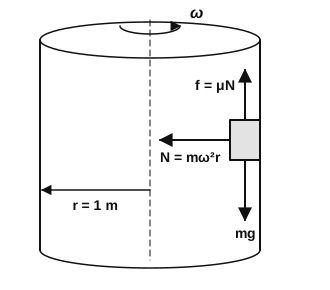
A block of mass 10 kg is in contact against the inner wall of a hollow cylindrical drum of radius 1 m. The coefficient of friction between the block and the inner wall of the cylinder is 0.1. The minimum angular velocity needed for the cylinder to keep the block stationary when the cylinder is vertical and rotating about its axis, will be : (g=10 m/s2)
10 kg द्रव्यमान का एक गुटका 1 m त्रिज्या के एक खोखले बेलनाकार ड्रम की भीतरी दीवार के संपर्क में है। गुटके तथा बेलन की भीतरी दीवार के बीच घर्षण गुणांक 0.1 है। जब बेलन ऊर्ध्वाधर हो तथा अपनी अक्ष के परितः घूर्णन कर रहा हो, तब गुटके को स्थिर रखने के लिए बेलन का न्यूनतम कोणीय वेग होगा : (g=10 m/s2)
  1. A10 rad/s
  2. B102π rad/s
  3. C10 rad/s
  4. D10π rad/s
Show answer

Concept: Wall’s normal reaction supplies the centripetal force, N=mω2r; friction μN must balance weight.

  1. μmω2r≥mg → ωmin=gμr
  2. ωmin=100.1×1=100=10 rad/s

Short trick: Mass cancels – "rotor" formula ω = √(g/μr).

Answer: (C) 10 rad/s

अवधारणा: दीवार का अभिलंब प्रतिक्रिया बल अभिकेंद्र बल देता है, N=mω2r; घर्षण μN भार को संतुलित करे।

  1. μmω2r≥mg → ωmin=gμr
  2. ωmin=100.1×1=100=10 rad/s

शॉर्ट ट्रिक: द्रव्यमान कट जाता है – "रोटर" सूत्र ω = √(g/μr)।

उत्तर: (C) 10 rad/s

NEET UGPhysicsLaws of motion – friction in a rotating drumNEET UG 2019 · 5 May Shift 1
Q1376.
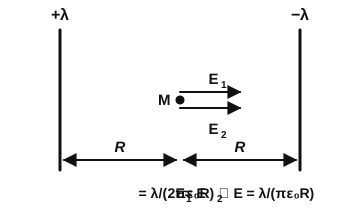
Two parallel infinite line charges with linear charge densities +λ C/m and −λ C/m are placed at a distance of 2R in free space. What is the electric field mid-way between the two line charges?
रेखीय आवेश घनत्व +λ C/m तथा −λ C/m वाले दो समांतर अनंत रेखीय आवेश मुक्त आकाश में 2R दूरी पर रखे हैं। दोनों रेखीय आवेशों के ठीक मध्य में विद्युत क्षेत्र क्या है?
  1. AZeroशून्य
  2. B2λπε0R N/C
  3. Cλπε0R N/C
  4. Dλ2πε0R N/C
Show answer

Concept: Field of an infinite line charge: E=λ2πε0r.

  1. At the midpoint r = R from each line: each field =λ2πε0R.
  2. Field of +λ points away from it, field of −λ points towards it → both point towards −λ (they add).
  3. E=2×λ2πε0R=λπε0R N/C

Short trick: Opposite charges → fields add at the midpoint (like charges would cancel to zero).

Answer: (C) λπε0R N/C

अवधारणा: अनंत रेखीय आवेश का क्षेत्र: E=λ2πε0r।

  1. मध्य बिंदु पर प्रत्येक रेखा से r = R: प्रत्येक क्षेत्र =λ2πε0R।
  2. +λ का क्षेत्र उससे दूर, −λ का क्षेत्र उसकी ओर → दोनों −λ की ओर (जुड़ते हैं)।
  3. E=2×λ2πε0R=λπε0R N/C

शॉर्ट ट्रिक: विपरीत आवेश → मध्य बिंदु पर क्षेत्र जुड़ते हैं (समान आवेशों के लिए शून्य होता)।

उत्तर: (C) λπε0R N/C

NEET UGPhysicsElectrostatics – field of infinite line chargesNEET UG 2019 · 5 May Shift 1
Q1377.
Two point charges A and B, having charges +Q and −Q respectively, are placed at certain distance apart and force acting between them is F. If 25% charge of A is transferred to B, then force between the charges becomes :
दो बिंदु आवेश A तथा B, जिन पर क्रमशः +Q तथा −Q आवेश हैं, एक निश्चित दूरी पर रखे हैं तथा उनके बीच बल F है। यदि A का 25% आवेश B को स्थानांतरित कर दिया जाए, तो आवेशों के बीच बल हो जाता है :
  1. AF
  2. B9F16
  3. C16F9
  4. D4F3
Show answer

Concept: F∝qAqB at fixed distance.

  1. Charge transferred =Q4. A: Q−Q4=3Q4; B: −Q+Q4=−3Q4.
  2. F′=F×(3Q/4)2Q2=9F16

Short trick: Both magnitudes become 3/4 → force × (3/4)² = 9/16.

Answer: (B) 9F16

अवधारणा: नियत दूरी पर F∝qAqB।

  1. स्थानांतरित आवेश =Q4। A: Q−Q4=3Q4; B: −Q+Q4=−3Q4।
  2. F′=F×(3Q/4)2Q2=9F16

शॉर्ट ट्रिक: दोनों परिमाण 3/4 हो जाते हैं → बल × (3/4)² = 9/16।

उत्तर: (B) 9F16

NEET UGPhysicsElectrostatics – Coulomb’s lawNEET UG 2019 · 5 May Shift 1
Q1378.
A small hole of area of cross-section 2 mm2 is present near the bottom of a fully filled open tank of height 2 m. Taking g = 10 m/s2, the rate of flow of water through the open hole would be nearly
2 m ऊँचाई के पूर्णतः भरे खुले टैंक की तली के पास 2 mm2 अनुप्रस्थ-काट क्षेत्रफल का एक छोटा छिद्र है। g = 10 m/s2 लेने पर खुले छिद्र से जल के प्रवाह की दर लगभग होगी
  1. A12.6×10−6 m3/s
  2. B8.9×10−6 m3/s
  3. C2.23×10−6 m3/s
  4. D6.4×10−6 m3/s
Show answer

Concept: Efflux speed v=2gh; volume flow rate Q=Av.

  1. v=2×10×2=40=6.32 m/s
  2. A=2 mm2=2×10⁻⁶ m2
  3. Q=2×10−6×6.32=12.6×10⁻⁶ m3/s

Short trick: 40≈6.3; double it → 12.6. Remember mm² = 10⁻⁶ m².

Answer: (A) 12.6×10⁻⁶ m3/s

अवधारणा: बहिःस्राव वेग v=2gh; आयतन प्रवाह दर Q=Av।

  1. v=2×10×2=40=6.32 m/s
  2. A=2 mm2=2×10⁻⁶ m2
  3. Q=2×10−6×6.32=12.6×10⁻⁶ m3/s

शॉर्ट ट्रिक: 40≈6.3; इसका दोगुना → 12.6। याद रखें mm² = 10⁻⁶ m²।

उत्तर: (A) 12.6×10⁻⁶ m3/s

NEET UGPhysicsFluids – Torricelli’s theoremNEET UG 2019 · 5 May Shift 1
Q1379.

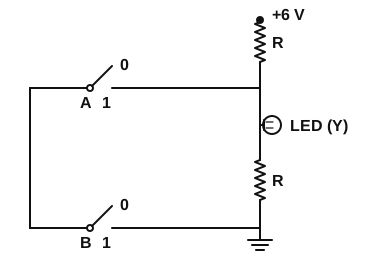
The correct Boolean operation represented by the circuit diagram drawn is :

ऊपर बनाए गए परिपथ आरेख द्वारा निरूपित सही बूलियन संक्रिया है :
  1. AAND
  2. BOR
  3. CNAND
  4. DNOR
Show answer

Concept: Switches A and B are in series, and this series path is connected in parallel with the LED branch (from the junction below the upper R to ground).

  1. If either switch is open (0), the series path is broken → current flows through the LED → Y = 1.
  2. Only when A = 1 and B = 1 does the series path short the LED branch to ground → LED off → Y = 0.
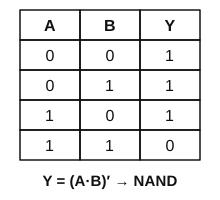
  3. Truth table: 00→1, 01→1, 10→1, 11→0 → Y=A⋅B― = NAND.

Short trick: Series switches = AND; switches placed across (shorting) the output invert it → NAND. (Parallel switches across output → NOR.)

Answer: (C) NAND

अवधारणा: स्विच A तथा B श्रेणी में हैं, और यह श्रेणी पथ LED शाखा के समांतर (ऊपरी R के नीचे की संधि से भू-संपर्क तक) जुड़ा है।

  1. यदि कोई भी स्विच खुला (0) है, तो श्रेणी पथ टूटा है → धारा LED से बहती है → Y = 1।
  2. केवल A = 1 तथा B = 1 होने पर श्रेणी पथ LED शाखा को भू-संपर्क से लघुपथित कर देता है → LED बंद → Y = 0।
  3. सत्यमान सारणी: 00→1, 01→1, 10→1, 11→0 → Y=A⋅B― = NAND।

शॉर्ट ट्रिक: श्रेणी स्विच = AND; आउटपुट के आर-पार (लघुपथन करते) स्विच उसे उलट देते हैं → NAND। (आउटपुट के आर-पार समांतर स्विच → NOR।)

उत्तर: (C) NAND

NEET UGPhysicsSemiconductor electronics – logic gatesNEET UG 2019 · 5 May Shift 1
Q1380.
In which of the following processes, heat is neither absorbed nor released by a system?
निम्नलिखित में से किस प्रक्रम में निकाय द्वारा ऊष्मा न तो अवशोषित होती है और न ही मुक्त होती है?
  1. AIsothermalसमतापीय
  2. BAdiabaticरुद्धोष्म
  3. CIsobaricसमदाबी
  4. DIsochoricसमआयतनिक
Show answer

Concept: Adiabatic process: no heat exchange with surroundings, ΔQ = 0.

  1. Isothermal: ΔT = 0 but heat is exchanged (Q = W).
  2. Isobaric: Q = nCPΔT ≠ 0.
  3. Isochoric: Q = nCVΔT ≠ 0.
  4. Adiabatic: Q = 0 by definition.

Short trick: Adia-batic = "not passing through" – heat cannot cross the walls.

Answer: (B) Adiabatic

अवधारणा: रुद्धोष्म प्रक्रम: परिवेश के साथ ऊष्मा का कोई आदान-प्रदान नहीं, ΔQ = 0।

  1. समतापीय: ΔT = 0 परंतु ऊष्मा का आदान-प्रदान होता है (Q = W)।
  2. समदाबी: Q = nCPΔT ≠ 0।
  3. समआयतनिक: Q = nCVΔT ≠ 0।
  4. रुद्धोष्म: परिभाषा से Q = 0।

शॉर्ट ट्रिक: रुद्ध + ऊष्म = ऊष्मा का मार्ग रुद्ध – दीवारों से ऊष्मा पार नहीं होती।

उत्तर: (B) रुद्धोष्म

NEET UGPhysicsThermodynamics – adiabatic processNEET UG 2019 · 5 May Shift 1