Q1521.The volume (V) of a monatomic gas varies with its temperature (T), as shown in the graph. The ratio of work done by the gas, to the heat absorbed by it, when it undergoes a change from state A to state B, is
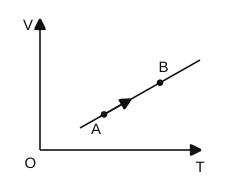
एक एकपरमाणुक गैस का आयतन (V) उसके ताप (T) के साथ ग्राफ में दर्शाए अनुसार परिवर्तित होता है। अवस्था A से अवस्था B में परिवर्तन के दौरान गैस द्वारा किए गए कार्य तथा उसके द्वारा अवशोषित ऊष्मा का अनुपात है
- A
- B
- C
- D
Show answer
Concept: A straight V–T line through the origin means , i.e. pressure is constant (isobaric). Then and .
- Monatomic gas: .
Short trick: For an isobaric process ; for monatomic gives .
Answer: (C)
अवधारणा: मूल बिंदु से गुजरने वाली सीधी V–T रेखा का अर्थ है , अर्थात दाब नियत है (समदाबी प्रक्रम)। तब तथा ।
- एकपरमाणुक गैस के लिए: ।
शॉर्ट ट्रिक: समदाबी प्रक्रम में ; एकपरमाणुक के लिए से ।
उत्तर: (C)
NEET UGPhysicsThermodynamics – isobaric processNEET UG 2018 · 6 May Shift 1
Q1522.The fundamental frequency in an open organ pipe is equal to the third harmonic of a closed organ pipe. If the length of the closed organ pipe is 20 cm, the length of the open organ pipe is
एक खुले ऑर्गन पाइप की मूल आवृत्ति, एक बंद ऑर्गन पाइप के तृतीय हार्मोनिक के बराबर है। यदि बंद ऑर्गन पाइप की लंबाई 20 cm है, तो खुले ऑर्गन पाइप की लंबाई है
- A12.5 cm
- B8 cm
- C13.2 cm
- D16 cm
Show answer
Concept: Closed pipe: (n odd). Open pipe fundamental: .
- Third harmonic of closed pipe
- Equate:
- cm ≈ 13.2 cm (nearest option)
Short trick: directly (open fundamental = closed 3rd harmonic) cm.
Answer: (C) 13.2 cm
अवधारणा: बंद पाइप: (n विषम)। खुले पाइप की मूल आवृत्ति: ।
- बंद पाइप का तृतीय हार्मोनिक
- बराबर रखने पर:
- cm ≈ 13.2 cm (निकटतम विकल्प)
शॉर्ट ट्रिक: सीधे (खुले का मूल = बंद का तृतीय हार्मोनिक) cm।
उत्तर: (C) 13.2 cm
NEET UGPhysicsWaves – organ pipesNEET UG 2018 · 6 May Shift 1
Q1523.At what temperature will the rms speed of oxygen molecules become just sufficient for escaping from the Earth's atmosphere?
(Given :
Mass of oxygen molecule (m) = kg
Boltzmann's constant )
किस ताप पर ऑक्सीजन अणुओं की वर्ग-माध्य-मूल (rms) चाल पृथ्वी के वायुमंडल से पलायन करने के लिए ठीक पर्याप्त हो जाएगी?
(दिया है :
ऑक्सीजन अणु का द्रव्यमान (m) = kg
बोल्ट्ज़मान नियतांक )
- A K
- B K
- C K
- D K
Show answer
Concept: ; set it equal to the escape speed of Earth, km/s.
- K
Short trick: , so K.
Answer: (B) K
अवधारणा: ; इसे पृथ्वी की पलायन चाल km/s के बराबर रखें।
- K
शॉर्ट ट्रिक: , अतः K।
उत्तर: (B) K
NEET UGPhysicsKinetic theory – rms speed and escape speedNEET UG 2018 · 6 May Shift 1
Q1524.The efficiency of an ideal heat engine working between the freezing point and boiling point of water, is
जल के हिमांक तथा क्वथनांक के बीच कार्यरत एक आदर्श ऊष्मा इंजन की दक्षता है
- A6.25%
- B20%
- C26.8%
- D12.5%
Show answer
Concept: Ideal (Carnot) engine: with temperatures in kelvin.
- K (source), K (sink)
Short trick: – slightly more than , so only 26.8% fits.
Answer: (C) 26.8%
अवधारणा: आदर्श (कार्नो) इंजन: , ताप केल्विन में।
- K (स्रोत), K (सिंक)
शॉर्ट ट्रिक: – से थोड़ा अधिक, अतः केवल 26.8% सही बैठता है।
उत्तर: (C) 26.8%
NEET UGPhysicsThermodynamics – Carnot engine efficiencyNEET UG 2018 · 6 May Shift 1
Q1525.A carbon resistor of (47 ± 4.7) kΩ is to be marked with rings of different colours for its identification. The colour code sequence will be
(47 ± 4.7) kΩ के एक कार्बन प्रतिरोधक की पहचान के लिए उस पर विभिन्न रंगों के वलय अंकित करने हैं। वर्ण कोड का क्रम होगा
- AYellow – Green – Violet – Goldपीला – हरा – बैंगनी – सुनहरा
- BYellow – Violet – Orange – Silverपीला – बैंगनी – नारंगी – रजत
- CViolet – Yellow – Orange – Silverबैंगनी – पीला – नारंगी – रजत
- DGreen – Orange – Violet – Goldहरा – नारंगी – बैंगनी – सुनहरा
Show answer
Concept: Colour code: Black 0, Brown 1, Red 2, Orange 3, Yellow 4, Green 5, Blue 6, Violet 7, Grey 8, White 9; tolerance Gold 5%, Silver 10%.
- 47 kΩ Ω → digits 4 (Yellow), 7 (Violet), multiplier (Orange).
- Tolerance: → Silver.
- Sequence: Yellow – Violet – Orange – Silver.
Short trick: "B B ROY of Great Britain had a Very Good Wife" gives 0–9; first band must be Yellow (4) and second Violet (7) – only (B) matches.
Answer: (B) Yellow – Violet – Orange – Silver
अवधारणा: वर्ण कोड: काला 0, भूरा 1, लाल 2, नारंगी 3, पीला 4, हरा 5, नीला 6, बैंगनी 7, धूसर 8, सफेद 9; सहनशीलता (tolerance) सुनहरा 5%, रजत 10%।
- 47 kΩ Ω → अंक 4 (पीला), 7 (बैंगनी), गुणक (नारंगी)।
- सहनशीलता: → रजत।
- क्रम: पीला – बैंगनी – नारंगी – रजत।
शॉर्ट ट्रिक: "B B ROY of Great Britain had a Very Good Wife" से 0–9; पहला वलय पीला (4) और दूसरा बैंगनी (7) होना चाहिए – केवल (B) मेल खाता है।
उत्तर: (B) पीला – बैंगनी – नारंगी – रजत
NEET UGPhysicsCurrent electricity – colour code of resistorsNEET UG 2018 · 6 May Shift 1
Q1526.A set of 'n' equal resistors, of value 'R' each, are connected in series to a battery of emf 'E' and internal resistance 'R'. The current drawn is I. Now, the 'n' resistors are connected in parallel to the same battery. Then the current drawn from battery becomes 10 I. The value of 'n' is
प्रत्येक 'R' मान के 'n' समान प्रतिरोधकों का एक समूह, विद्युत वाहक बल 'E' तथा आंतरिक प्रतिरोध 'R' वाली एक बैटरी से श्रेणीक्रम में जुड़ा है। ली गई धारा I है। अब इन 'n' प्रतिरोधकों को उसी बैटरी से समांतर क्रम में जोड़ा जाता है। तब बैटरी से ली गई धारा 10 I हो जाती है। 'n' का मान है
- A20
- B11
- C10
- D9
Show answer
Concept: Current ; series , parallel .
- Series:
- Parallel:
- Divide:
Short trick: The ratio of currents exactly when – so equals the current ratio, 10.
Answer: (C) 10
अवधारणा: धारा ; श्रेणी में , समांतर में ।
- श्रेणी:
- समांतर:
- भाग देने पर:
शॉर्ट ट्रिक: जब हो, तो धाराओं का अनुपात – अतः धारा-अनुपात 10 के बराबर है।
उत्तर: (C) 10
NEET UGPhysicsCurrent electricity – internal resistance, series and parallelNEET UG 2018 · 6 May Shift 1
Q1527.A battery consists of a variable number 'n' of identical cells (having internal resistance 'r' each) which are connected in series. The terminals of the battery are short-circuited and the current I is measured. Which of the graphs shows the correct relationship between I and n?
एक बैटरी में श्रेणीक्रम में जुड़े 'n' (परिवर्ती संख्या) सर्वसम सेल हैं (प्रत्येक का आंतरिक प्रतिरोध 'r' है)। बैटरी के टर्मिनलों को लघुपथित (short-circuit) करके धारा I मापी जाती है। निम्नलिखित में से कौन-सा ग्राफ I तथा n के बीच सही संबंध दर्शाता है?
- A
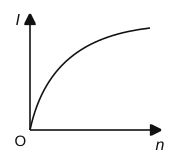
- B
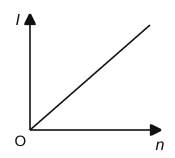
- C
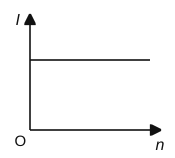
- D
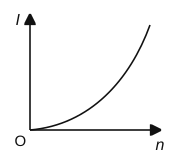
Show answer
Concept: Short-circuit current of a battery .
- n cells in series: emf , internal resistance .
- Short circuit (no external resistance):
- I does not depend on n → horizontal straight line.
Short trick: Both emf and resistance scale with n, so n cancels – look for the flat line.
Answer: (C) Horizontal line (I independent of n)
अवधारणा: बैटरी की लघुपथ धारा ।
- श्रेणी में n सेल: वि. वा. बल , आंतरिक प्रतिरोध ।
- लघुपथ (कोई बाह्य प्रतिरोध नहीं):
- I, n पर निर्भर नहीं → क्षैतिज सरल रेखा।
शॉर्ट ट्रिक: वि. वा. बल और प्रतिरोध दोनों n के अनुपात में बढ़ते हैं, अतः n कट जाता है – सपाट रेखा चुनें।
उत्तर: (C) क्षैतिज रेखा (I, n से स्वतंत्र)
NEET UGPhysicsCurrent electricity – cells in seriesNEET UG 2018 · 6 May Shift 1
Q1528.Unpolarised light is incident from air on a plane surface of a material of refractive index ''. At a particular angle of incidence 'i', it is found that the reflected and refracted rays are perpendicular to each other. Which of the following options is correct for this situation?
अध्रुवित प्रकाश वायु से अपवर्तनांक '' वाले पदार्थ के समतल पृष्ठ पर आपतित होता है। एक विशेष आपतन कोण 'i' पर यह पाया जाता है कि परावर्तित तथा अपवर्तित किरणें परस्पर लंबवत हैं। इस स्थिति के लिए निम्नलिखित में से कौन-सा विकल्प सही है?
- A
- BReflected light is polarised with its electric vector perpendicular to the plane of incidenceपरावर्तित प्रकाश ध्रुवित है और उसका विद्युत सदिश आपतन तल के लंबवत है
- CReflected light is polarised with its electric vector parallel to the plane of incidenceपरावर्तित प्रकाश ध्रुवित है और उसका विद्युत सदिश आपतन तल के समांतर है
- D
Show answer
Concept: When reflected and refracted rays are perpendicular, is Brewster's angle: , and the reflected light is completely plane-polarised with perpendicular to the plane of incidence.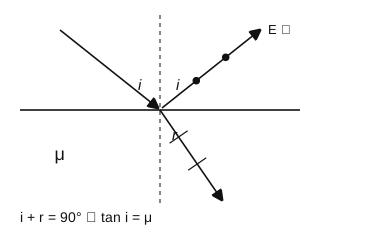
- and ⇒ , so (A) and (D) are wrong.
- The component of in the plane of incidence is not reflected at this angle; only the component perpendicular to the plane (dots) survives in the reflected ray ⇒ (B) correct, (C) wrong.
Short trick: "Brewster – reflected is perpendicular (s-polarised)": dots on the reflected ray, .
Answer: (B) Reflected light is polarised with its electric vector perpendicular to the plane of incidence
अवधारणा: जब परावर्तित और अपवर्तित किरणें लंबवत हों, तो ब्रूस्टर कोण है: , तथा परावर्तित प्रकाश पूर्णतः समतल-ध्रुवित होता है जिसका आपतन तल के लंबवत होता है।
- तथा ⇒ , अतः (A) और (D) गलत हैं।
- इस कोण पर आपतन तल में स्थित का घटक परावर्तित नहीं होता; परावर्तित किरण में केवल तल के लंबवत घटक (बिंदु) बचता है ⇒ (B) सही, (C) गलत।
शॉर्ट ट्रिक: "ब्रूस्टर – परावर्तित लंबवत (s-ध्रुवित)": परावर्तित किरण पर बिंदु, ।
उत्तर: (B) परावर्तित प्रकाश ध्रुवित है और उसका विद्युत सदिश आपतन तल के लंबवत है
NEET UGPhysicsWave optics – polarisation by reflection (Brewster)NEET UG 2018 · 6 May Shift 1
Q1529.In Young's double slit experiment the separation d between the slits is 2 mm, the wavelength of the light used is 5896 Å and distance D between the screen and slits is 100 cm. It is found that the angular width of the fringes is . To increase the fringe angular width to (with same and D) the separation between the slits needs to be changed to
यंग के द्वि-झिरी प्रयोग में झिरियों के बीच की दूरी d = 2 mm है, प्रयुक्त प्रकाश की तरंगदैर्ध्य = 5896 Å है तथा पर्दे और झिरियों के बीच की दूरी D = 100 cm है। फ्रिंजों की कोणीय चौड़ाई पाई जाती है। फ्रिंज की कोणीय चौड़ाई को तक बढ़ाने के लिए (समान तथा D के साथ) झिरियों के बीच की दूरी को बदलकर करना होगा
- A2.1 mm
- B1.9 mm
- C1.8 mm
- D1.7 mm
Show answer
Concept: Angular fringe width (independent of D), so .
- mm ≈ 1.9 mm
Short trick: Angle up by 5% ⇒ d down by about 5%: mm. D and λ are distractors.
Answer: (B) 1.9 mm
अवधारणा: कोणीय फ्रिंज चौड़ाई (D पर निर्भर नहीं), अतः ।
- mm ≈ 1.9 mm
शॉर्ट ट्रिक: कोण 5% बढ़ा ⇒ d लगभग 5% घटेगा: mm। D और λ केवल भ्रमित करने के लिए हैं।
उत्तर: (B) 1.9 mm
NEET UGPhysicsWave optics – Young's double slit (angular width)NEET UG 2018 · 6 May Shift 1
Q1530.An astronomical refracting telescope will have large angular magnification and high angular resolution, when it has an objective lens of
एक खगोलीय अपवर्ती दूरदर्शक की कोणीय आवर्धन क्षमता अधिक तथा कोणीय विभेदन (resolution) उच्च होगा, जब उसके अभिदृश्यक लेंस की
- ALarge focal length and large diameterफोकस दूरी अधिक तथा व्यास अधिक हो
- BLarge focal length and small diameterफोकस दूरी अधिक तथा व्यास कम हो
- CSmall focal length and large diameterफोकस दूरी कम तथा व्यास अधिक हो
- DSmall focal length and small diameterफोकस दूरी कम तथा व्यास कम हो
Show answer
Concept: Magnifying power ; resolving power .
- Large ⇒ large objective focal length (rules out (C), (D)).
- High resolution ⇒ large aperture (diameter) of the objective (rules out (B)).
- So the objective needs large focal length and large diameter.
Short trick: Telescope objective: "long and wide" – long focus for magnification, wide aperture for resolution and brightness.
Answer: (A) Large focal length and large diameter
अवधारणा: आवर्धन क्षमता ; विभेदन क्षमता ।
- अधिक ⇒ अभिदृश्यक की फोकस दूरी अधिक ((C), (D) गलत)।
- उच्च विभेदन ⇒ अभिदृश्यक का द्वारक (व्यास) अधिक ((B) गलत)।
- अतः अभिदृश्यक की फोकस दूरी अधिक तथा व्यास अधिक होना चाहिए।
शॉर्ट ट्रिक: दूरदर्शक का अभिदृश्यक: "लंबा और चौड़ा" – आवर्धन के लिए लंबी फोकस दूरी, विभेदन व चमक के लिए चौड़ा द्वारक।
उत्तर: (A) फोकस दूरी अधिक तथा व्यास अधिक हो
NEET UGPhysicsRay optics – astronomical telescopeNEET UG 2018 · 6 May Shift 1
Q1531.The ratio of kinetic energy to the total energy of an electron in a Bohr orbit of the hydrogen atom, is
हाइड्रोजन परमाणु की बोर कक्षा में एक इलेक्ट्रॉन की गतिज ऊर्जा तथा कुल ऊर्जा का अनुपात है
- A2 : –1
- B1 : –1
- C1 : 1
- D1 : –2
Show answer
Concept: In a Bohr orbit (inverse-square attraction): , , .
Short trick: Remember for any circular orbit under force.
Answer: (B) 1 : –1
अवधारणा: बोर कक्षा में (व्युत्क्रम-वर्ग आकर्षण): , , ।
शॉर्ट ट्रिक: बल के अधीन किसी भी वृत्तीय कक्षा के लिए याद रखें ।
उत्तर: (B) 1 : –1
NEET UGPhysicsAtoms – energy in Bohr orbitNEET UG 2018 · 6 May Shift 1
Q1532.An electron of mass m with an initial velocity enters an electric field ( = constant > 0) at t = 0. If is its de-Broglie wavelength initially, then its de-Broglie wavelength at time t is
m द्रव्यमान का एक इलेक्ट्रॉन प्रारंभिक वेग के साथ t = 0 पर विद्युत क्षेत्र ( = नियतांक > 0) में प्रवेश करता है। यदि प्रारंभ में इसकी दे-ब्रॉग्ली तरंगदैर्ध्य है, तो समय t पर इसकी दे-ब्रॉग्ली तरंगदैर्ध्य है
- A
- B
- C
- D
Show answer
Concept: . Force on an electron is opposite to : , i.e. along the velocity, so the electron speeds up.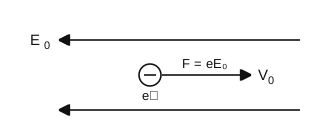
- along
Short trick: Speed increases ⇒ λ must decrease with t: only (C) decreases ((A), (B) increase, (D) constant).
Answer: (C)
अवधारणा: । इलेक्ट्रॉन पर बल के विपरीत होता है: , अर्थात वेग की दिशा में, अतः इलेक्ट्रॉन की चाल बढ़ती है।
- , दिशा में
शॉर्ट ट्रिक: चाल बढ़ती है ⇒ λ समय के साथ घटनी चाहिए: केवल (C) घटती है ((A), (B) बढ़ती हैं, (D) नियत है)।
उत्तर: (C)
NEET UGPhysicsDual nature – de Broglie wavelength in electric fieldNEET UG 2018 · 6 May Shift 1
Q1533.For a radioactive material, half-life is 10 minutes. If initially there are 600 number of nuclei, the time taken (in minutes) for the disintegration of 450 nuclei is
एक रेडियोऐक्टिव पदार्थ की अर्ध-आयु 10 मिनट है। यदि प्रारंभ में 600 नाभिक हैं, तो 450 नाभिकों के विघटन में लगा समय (मिनट में) है
- A30
- B10
- C20
- D15
Show answer
Concept: .
- Remaining nuclei
- ⇒ 2 half-lives
- min
Short trick: 600 → 300 → 150: two halvings = 2 × 10 min.
Answer: (C) 20
अवधारणा: ।
- शेष नाभिक
- ⇒ 2 अर्ध-आयु
- मिनट
शॉर्ट ट्रिक: 600 → 300 → 150: दो बार आधा = 2 × 10 मिनट।
उत्तर: (C) 20
NEET UGPhysicsNuclei – radioactive decay and half-lifeNEET UG 2018 · 6 May Shift 1
Q1534.When the light of frequency (where is threshold frequency), is incident on a metal plate, the maximum velocity of electrons emitted is . When the frequency of the incident radiation is increased to , the maximum velocity of electrons emitted from the same plate is . The ratio of to is
जब आवृत्ति का प्रकाश (जहाँ देहली आवृत्ति है) एक धातु प्लेट पर आपतित होता है, तो उत्सर्जित इलेक्ट्रॉनों का अधिकतम वेग है। जब आपतित विकिरण की आवृत्ति बढ़ाकर कर दी जाती है, तो उसी प्लेट से उत्सर्जित इलेक्ट्रॉनों का अधिकतम वेग है। तथा का अनुपात है
- A4 : 1
- B1 : 4
- C1 : 2
- D2 : 1
Show answer
Concept: Einstein's equation: .
- ⇒
Short trick: : .
Answer: (C) 1 : 2
अवधारणा: आइंस्टीन का समीकरण: ।
- ⇒
शॉर्ट ट्रिक: : ।
उत्तर: (C) 1 : 2
NEET UGPhysicsDual nature – photoelectric effectNEET UG 2018 · 6 May Shift 1
Q1535.In the circuit shown in the figure, the input voltage
is 20 V,
and
. The values of
,
and
are given by
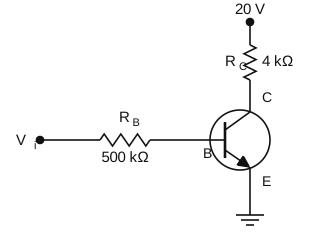
चित्र में दर्शाए गए परिपथ में निवेशी वोल्टता
= 20 V,
तथा
है।
,
तथा
के मान हैं
- A, mA,
- B, mA,
- C, mA,
- D, mA,
Show answer
Concept: Apply KVL to the base loop and the collector loop; .
- Base loop: ⇒
- Collector loop: ⇒ mA
Short trick: A already leaves (C) and (D); mA picks (D).
Answer: (D) A, mA,
अवधारणा: आधार लूप तथा संग्राहक लूप पर किरखॉफ का वोल्टता नियम (KVL) लगाएँ; ।
- आधार लूप: ⇒
- संग्राहक लूप: ⇒ mA
शॉर्ट ट्रिक: A से केवल (C) और (D) बचते हैं; mA से (D)।
उत्तर: (D) A, mA,
NEET UGPhysicsSemiconductors – transistor biasingNEET UG 2018 · 6 May Shift 1
Q1536.In a p-n junction diode, change in temperature due to heating
एक p-n संधि डायोड में, गर्म करने के कारण ताप में परिवर्तन
- ADoes not affect resistance of p-n junctionp-n संधि के प्रतिरोध को प्रभावित नहीं करता
- BAffects only forward resistanceकेवल अग्र प्रतिरोध को प्रभावित करता है
- CAffects only reverse resistanceकेवल पश्च प्रतिरोध को प्रभावित करता है
- DAffects the overall V - I characteristics of p-n junctionp-n संधि के संपूर्ण V - I अभिलक्षणों को प्रभावित करता है
Show answer
Concept: Heating generates more electron–hole pairs (intrinsic carriers rise steeply with temperature) and lowers the barrier/knee voltage.
- Forward bias: knee voltage falls and current rises for the same voltage → forward resistance changes.
- Reverse bias: minority-carrier (saturation) current roughly doubles every ~10 °C → reverse resistance changes.
- Hence the whole V–I characteristic shifts; (A), (B), (C) are each incomplete or wrong.
Short trick: "Heat touches everything" – both forward and reverse branches change, so choose the "overall" option.
Answer: (D) Affects the overall V - I characteristics of p-n junction
अवधारणा: गर्म करने पर अधिक इलेक्ट्रॉन–होल युग्म बनते हैं (नैज वाहक ताप के साथ तेजी से बढ़ते हैं) तथा विभव-प्राचीर/नी (knee) वोल्टता घटती है।
- अग्र बायस: नी वोल्टता घटती है और समान वोल्टता पर धारा बढ़ती है → अग्र प्रतिरोध बदलता है।
- पश्च बायस: अल्पसंख्यक-वाहक (संतृप्त) धारा लगभग हर ~10 °C पर दोगुनी होती है → पश्च प्रतिरोध बदलता है।
- अतः संपूर्ण V–I अभिलक्षण बदल जाता है; (A), (B), (C) अधूरे या गलत हैं।
शॉर्ट ट्रिक: "ताप सब कुछ बदलता है" – अग्र और पश्च दोनों भाग बदलते हैं, अतः "संपूर्ण" वाला विकल्प चुनें।
उत्तर: (D) p-n संधि के संपूर्ण V - I अभिलक्षणों को प्रभावित करता है
NEET UGPhysicsSemiconductors – effect of temperature on p-n junctionNEET UG 2018 · 6 May Shift 1
Q1537.In the combination of the following gates the output Y can be written in terms of inputs A and B as
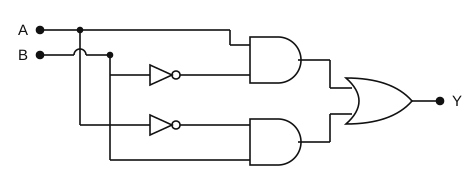
निम्नलिखित गेटों के संयोजन में निर्गत Y को निवेशों A तथा B के पदों में इस प्रकार लिखा जा सकता है
- A
- B
- C
- D
Show answer
Concept: Trace each gate: the upper AND gets A and , the lower AND gets and B, and the OR adds them.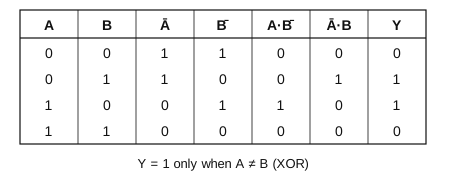
- Upper AND output
- Lower AND output
- (XOR gate)
Short trick: Test inputs: A = B = 1 gives Y = 0 but (A) gives 1; A = 1, B = 0 gives Y = 1 but (D) gives 0; A = B = 0 gives Y = 0 but (C) gives 1 – only (B) survives (XOR: output 1 when inputs differ).
Answer: (B)
अवधारणा: प्रत्येक गेट को देखें: ऊपरी AND को A तथा मिलते हैं, निचले AND को तथा B, और OR दोनों को जोड़ता है।
- ऊपरी AND का निर्गत
- निचले AND का निर्गत
- (XOR गेट)
शॉर्ट ट्रिक: निवेश जाँचें: A = B = 1 पर Y = 0 पर (A) 1 देता है; A = 1, B = 0 पर Y = 1 पर (D) 0 देता है; A = B = 0 पर Y = 0 पर (C) 1 देता है – केवल (B) बचता है (XOR: निवेश भिन्न होने पर निर्गत 1)।
उत्तर: (B)
NEET UGPhysicsSemiconductors – logic gatesNEET UG 2018 · 6 May Shift 1
Q1538.An em wave is propagating in a medium with a velocity . The instantaneous oscillating electric field of this em wave is along +y axis. Then the direction of oscillating magnetic field of the em wave will be along
एक विद्युतचुंबकीय तरंग किसी माध्यम में वेग से संचरित हो रही है। इस तरंग का तात्क्षणिक दोलनी विद्युत क्षेत्र +y अक्ष के अनुदिश है। तब इस तरंग के दोलनी चुंबकीय क्षेत्र की दिशा होगी
- A–y direction–y दिशा
- B+z direction+z दिशा
- C–z direction–z दिशा
- D–x direction–x दिशा
Show answer
Concept: In an em wave the direction of propagation is along .
- Since ,
- B oscillates along +z (it must also be ⊥ to both E and the propagation direction, ruling out (A) and (D)).
Short trick: Cyclic order x → y → z: E along y, wave along x ⇒ B along z ().
Answer: (B) +z direction
अवधारणा: विद्युतचुंबकीय तरंग में संचरण की दिशा के अनुदिश होती है।
- चूँकि , अतः
- B, +z के अनुदिश दोलन करता है (यह E तथा संचरण दिशा दोनों के लंबवत भी होना चाहिए, अतः (A) और (D) गलत)।
शॉर्ट ट्रिक: चक्रीय क्रम x → y → z: E, y के अनुदिश, तरंग x के अनुदिश ⇒ B, z के अनुदिश ()।
उत्तर: (B) +z दिशा
NEET UGPhysicsElectromagnetic waves – direction of E, B and propagationNEET UG 2018 · 6 May Shift 1
Q1539.The refractive index of the material of a prism is and the angle of the prism is . One of the two refracting surfaces of the prism is made a mirror inwards, by silver coating. A beam of monochromatic light entering the prism from the other face will retrace its path (after reflection from the silvered surface) if its angle of incidence on the prism is
एक प्रिज़्म के पदार्थ का अपवर्तनांक तथा प्रिज़्म कोण है। प्रिज़्म के दो अपवर्तक पृष्ठों में से एक को रजत लेपन द्वारा अंदर की ओर दर्पण बना दिया गया है। दूसरे फलक से प्रिज़्म में प्रवेश करने वाला एकवर्णी प्रकाश-पुंज (रजतित पृष्ठ से परावर्तन के बाद) अपना पथ पुनः अनुरेखित करेगा, यदि प्रिज़्म पर उसका आपतन कोण हो
- A
- B
- C
- DZeroशून्य
Show answer
Concept: To retrace its path, the ray inside the prism must strike the silvered face normally. Then the angle of refraction at the first face (since with ).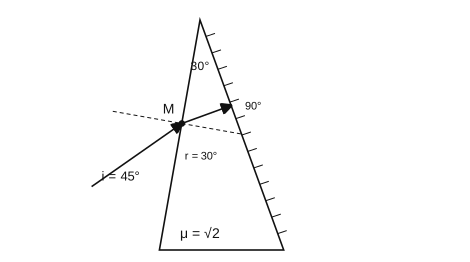
- Snell at first face:
Short trick: Retrace condition: . With , the familiar pair gives .
Answer: (B)
अवधारणा: पथ पुनः अनुरेखित करने के लिए प्रिज़्म के भीतर किरण को रजतित फलक पर लंबवत टकराना चाहिए। तब पहले फलक पर अपवर्तन कोण (क्योंकि तथा )।
- पहले फलक पर स्नेल नियम:
शॉर्ट ट्रिक: पुनः अनुरेखण की शर्त: । , से परिचित जोड़ी देती है।
उत्तर: (B)
NEET UGPhysicsRay optics – prism with silvered faceNEET UG 2018 · 6 May Shift 1
Q1540.An object is placed at a distance of 40 cm from a concave mirror of focal length 15 cm. If the object is displaced through a distance of 20 cm towards the mirror, the displacement of the image will be
15 cm फोकस दूरी वाले एक अवतल दर्पण से 40 cm की दूरी पर एक बिंब रखा है। यदि बिंब को दर्पण की ओर 20 cm विस्थापित किया जाए, तो प्रतिबिंब का विस्थापन होगा
- A30 cm towards the mirrorदर्पण की ओर 30 cm
- B36 cm away from the mirrorदर्पण से दूर 36 cm
- C30 cm away from the mirrorदर्पण से दूर 30 cm
- D36 cm towards the mirrorदर्पण की ओर 36 cm
Show answer
Concept: Mirror formula with cm (sign convention).
- : ⇒ cm
- : ⇒ cm
- Image moves from 24 cm to 60 cm in front of the mirror: shift cm away from the mirror.
Short trick: Object moving towards F (from beyond 2F) pushes a real image away from the mirror – so the answer is "away"; .
Answer: (B) 36 cm away from the mirror
अवधारणा: दर्पण सूत्र , cm (चिह्न परिपाटी)।
- : ⇒ cm
- : ⇒ cm
- प्रतिबिंब दर्पण के सामने 24 cm से 60 cm पर चला जाता है: विस्थापन cm, दर्पण से दूर।
शॉर्ट ट्रिक: बिंब के F की ओर (2F से परे से) आने पर वास्तविक प्रतिबिंब दर्पण से दूर जाता है – अतः "दूर"; ।
उत्तर: (B) दर्पण से दूर 36 cm
NEET UGPhysicsRay optics – concave mirror, image shiftNEET UG 2018 · 6 May Shift 1

