Q541.Evaluate .
का मान ज्ञात कीजिए।
- A
- B
- C
- D
Show answer
Concept: For a mixed recurring decimal: .
- .
- .
- Difference .
Short trick: Both repeat the same digit 1, so the repeating tails cancel: (check ).
Answer: (C)
अवधारणा: मिश्रित आवर्ती दशमलव: .
- .
- .
- अंतर .
शॉर्ट ट्रिक: दोनों में आवर्ती अंक 1 समान है, अतः आवर्ती भाग कट जाता है: .
उत्तर: (C)
RRB ALP CBT 1MathematicsRecurring decimalsRRB ALP CBT 1 2025 · 16 Feb Shift 3
Q542.Which of the following ratios is the least?
निम्नलिखित में से कौन-सा अनुपात सबसे छोटा है?
- A7 : 13
- B4 : 7
- C5 : 9
- D8 : 15
Show answer
Concept: Compare how much each fraction exceeds ½.
- , .
- , .
- Smallest excess → is the least.
Short trick: For fractions type (7/13, 4/7, 5/9, 8/15 are all ), larger → closer to ½ → smaller; is largest.
Answer: (D) 8 : 15
अवधारणा: देखें प्रत्येक भिन्न ½ से कितनी अधिक है।
- , .
- , .
- सबसे कम → सबसे छोटा।
शॉर्ट ट्रिक: सभी रूप में हैं; जितना बड़ा, भिन्न उतनी छोटी → .
उत्तर: (D) 8 : 15
RRB ALP CBT 1MathematicsComparison of ratiosRRB ALP CBT 1 2025 · 16 Feb Shift 3
Q543.During a sale, 48% of the goods are sold at a 31% profit, 25% of the remaining goods are sold at a 16% profit, and the rest are sold at a loss of 32%. If the overall profit is x%, what is the value of x?
एक सेल के दौरान, 48% माल 31% लाभ पर बेचा जाता है, शेष माल का 25% 16% लाभ पर बेचा जाता है और बाकी 32% हानि पर बेचा जाता है। यदि कुल लाभ x% है, तो x का मान क्या है?
- A8
- B7
- C7.5
- D4.48
Show answer
Concept: Overall profit% = weighted average of the individual profit/loss %.
- Out of 100 units: 48 at +31%, remaining 52 → 25% of 52 = 13 at +16%, rest 39 at −32%.
- .
- Overall .
Short trick: Take 100 units of goods, so weights are 48, 13, 39 and the answer is (sum)/100 directly.
Answer: (D) 4.48
अवधारणा: कुल लाभ% = व्यक्तिगत लाभ/हानि % का भारित औसत।
- 100 इकाइयों में: 48 पर +31%, शेष 52 का 25% = 13 पर +16%, बाकी 39 पर −32%.
- .
- कुल .
शॉर्ट ट्रिक: 100 इकाई माल मानें, भार 48, 13, 39 → योग/100 ही उत्तर।
उत्तर: (D) 4.48
RRB ALP CBT 1MathematicsProfit and loss – weighted averageRRB ALP CBT 1 2025 · 16 Feb Shift 3
Q544.Gopal distributed ₹25200 between his two grandsons 13-year-old Akshay and 14-year-old Atul such that they get equal money when they turn 23 years old. Till then the money is in a bank getting compound interest at 10% per annum, compounded annually. How much (in ₹) Gopal deposited in the name of Atul?
गोपाल ने ₹25200 अपने दो पोतों, 13 वर्षीय अक्षय और 14 वर्षीय अतुल के बीच इस प्रकार बाँटे कि 23 वर्ष के होने पर दोनों को बराबर धनराशि मिले। तब तक यह धन बैंक में 10% वार्षिक चक्रवृद्धि ब्याज (वार्षिक रूप से संयोजित) पर जमा रहता है। गोपाल ने अतुल के नाम पर कितनी राशि (₹ में) जमा की?
- A12000
- B11750
- C13550
- D13200
Show answer
Concept: Equal amounts at the same age: deposits are in the ratio .
- Akshay's money grows for 10 years, Atul's for 9 years.
- → → .
- Atul .
Short trick: Age gap 1 year at 10% → ratio 11 : 10 for the older (shorter time) child; , ×11.
Answer: (D) 13200
अवधारणा: समान आयु पर समान राशि: जमा राशियों का अनुपात .
- अक्षय का धन 10 वर्ष, अतुल का 9 वर्ष बढ़ता है।
- → → .
- अतुल .
शॉर्ट ट्रिक: 1 वर्ष का अंतर, 10% दर → बड़े (कम समय वाले) बच्चे का अनुपात 11 : 10; , ×11.
उत्तर: (D) 13200
RRB ALP CBT 1MathematicsCompound interest – equal amountsRRB ALP CBT 1 2025 · 16 Feb Shift 3
Q545.Raj had a cake in the shape of a sphere of radius 8 cm. He then dipped it in chocolate and kept it in the freezer. After some time, he observed that the chocolate formed a layer of thickness 2 cm over the cake. What is the percentage increase of the surface area of the cake after it is dipped in chocolate?
राज के पास 8 cm त्रिज्या वाले गोले के आकार का एक केक था। उसने उसे चॉकलेट में डुबोकर फ्रीजर में रख दिया। कुछ समय बाद उसने देखा कि चॉकलेट ने केक के ऊपर 2 cm मोटी परत बना ली है। चॉकलेट में डुबोने के बाद केक के पृष्ठीय क्षेत्रफल में कितने प्रतिशत की वृद्धि हुई?
- A52.25%
- B56.25%
- C58.25%
- D62.25%
Show answer
Concept: Surface area , so it changes as .
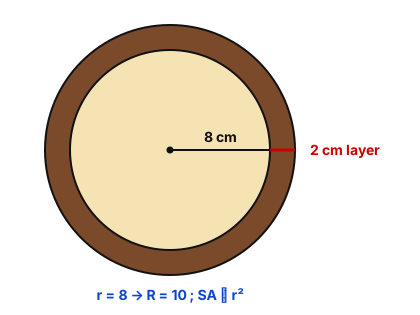
- New radius cm.
- Ratio .
- Increase .
Short trick: Radius rises 25% → area rises .
Answer: (B) 56.25%
अवधारणा: पृष्ठीय क्षेत्रफल , अतः यह के अनुसार बदलता है।
- नई त्रिज्या cm.
- अनुपात .
- वृद्धि .
शॉर्ट ट्रिक: त्रिज्या 25% बढ़ी → क्षेत्रफल बढ़ा।
उत्तर: (B) 56.25%
RRB ALP CBT 1MathematicsSphere – percentage change in surface areaRRB ALP CBT 1 2025 · 16 Feb Shift 3
Q546.Nikhil sold his cycle to Ravi at a loss of 24%. Ravi spent ₹486 on its repairs and sold the cycle to Vikas for ₹2,875, thereby making a profit of 15%. Find the cost price of the cycle for Nikhil.
निखिल ने अपनी साइकिल 24% की हानि पर रवि को बेच दी। रवि ने उसकी मरम्मत पर ₹486 खर्च किए और साइकिल विकास को ₹2,875 में बेचकर 15% का लाभ कमाया। निखिल के लिए साइकिल का क्रय मूल्य ज्ञात कीजिए।
- A₹2,460
- B₹2,540
- C₹2,650
- D₹2,710
Show answer
Concept: Work backwards from the final selling price.
- Ravi's total cost .
- Ravi's purchase price .
- Nikhil's CP .
Short trick: Check options: ✓, and , ✓.
Answer: (C) ₹2,650
अवधारणा: अंतिम विक्रय मूल्य से पीछे की ओर हल करें।
- रवि की कुल लागत .
- रवि का क्रय मूल्य .
- निखिल का क्रय मूल्य .
शॉर्ट ट्रिक: विकल्प जाँच: ✓.
उत्तर: (C) ₹2,650
RRB ALP CBT 1MathematicsProfit and loss – chainRRB ALP CBT 1 2025 · 16 Feb Shift 3
Q547.The price of an article was ₹1600. It increased by 15% in the first year and by 20% in the second year. What is the price (in ₹) of the article after two years?
एक वस्तु का मूल्य ₹1600 था। पहले वर्ष में इसमें 15% और दूसरे वर्ष में 20% की वृद्धि हुई। दो वर्ष बाद वस्तु का मूल्य (₹ में) क्या है?
- A1920
- B1840
- C2106
- D2208
Show answer
Concept: Multiply by each growth factor in turn.
- .
- .
Short trick: Net ; .
Answer: (D) 2208
अवधारणा: प्रत्येक वृद्धि गुणक से क्रम से गुणा करें।
- .
- .
शॉर्ट ट्रिक: कुल ; .
उत्तर: (D) 2208
RRB ALP CBT 1MathematicsSuccessive percentage increaseRRB ALP CBT 1 2025 · 16 Feb Shift 3
Q548.Two trains, A and B, of lengths 180 m and 220 m, respectively, are running on parallel tracks in opposite directions. They cross each other in 12 seconds. If the same two trains are moving in the same direction, they take 60 seconds for the faster train to completely cross the slower one. Find the speed (in km/h) of the faster train.
दो रेलगाड़ियाँ A और B, जिनकी लंबाई क्रमशः 180 m और 220 m है, समानांतर पटरियों पर विपरीत दिशाओं में चल रही हैं। वे एक-दूसरे को 12 सेकंड में पार करती हैं। यदि वही दोनों रेलगाड़ियाँ एक ही दिशा में चलें, तो तेज रेलगाड़ी को धीमी रेलगाड़ी को पूरी तरह पार करने में 60 सेकंड लगते हैं। तेज रेलगाड़ी की चाल (km/h में) ज्ञात कीजिए।
- A72
- B80
- C64
- D48
Show answer
Concept: Crossing distance = sum of lengths = 400 m. Opposite → speeds add; same direction → speeds subtract.
- m/s.
- m/s.
- m/s km/h.
Short trick: Faster speed m/s = 72 km/h.
Answer: (A) 72
अवधारणा: पार करने की दूरी = लंबाइयों का योग = 400 m. विपरीत दिशा → चालें जुड़ती हैं; एक ही दिशा → घटती हैं।
- m/s.
- m/s.
- m/s km/h.
शॉर्ट ट्रिक: तेज चाल m/s = 72 km/h.
उत्तर: (A) 72
RRB ALP CBT 1MathematicsTrains – relative speedRRB ALP CBT 1 2025 · 16 Feb Shift 3
Q549.A tank has three pipes A, B and C. A and B are inlet pipes while C is an outlet pipe. Pipe A can fill the tank in 15 minutes. Pipe B can fill it in 20 minutes. Pipe C can empty it in 30 minutes. The pipes are opened in the following cycle.
Minute 1: Only A
Minute 2: Only B
Minute 3: Only C
The cycle repeats till the tank is full. How much time would it take to completely fill the tank?
एक टंकी में तीन पाइप A, B और C हैं। A और B भरने वाले पाइप हैं, जबकि C खाली करने वाला पाइप है। पाइप A टंकी को 15 मिनट में भर सकता है। पाइप B उसे 20 मिनट में भर सकता है। पाइप C उसे 30 मिनट में खाली कर सकता है। पाइप निम्नलिखित चक्र में खोले जाते हैं।
मिनट 1: केवल A
मिनट 2: केवल B
मिनट 3: केवल C
टंकी भरने तक यह चक्र दोहराया जाता है। टंकी को पूरी तरह भरने में कितना समय लगेगा?
- A minutes मिनट
- B32 minutes32 मिनट
- C36 minutes36 मिनट
- D minutes मिनट
Show answer
Concept: Take tank capacity = LCM(15, 20, 30) = 60 units: A = +4, B = +3, C = −2 units per minute.
- One 3-minute cycle adds 4 + 3 − 2 = 5 units.
- After 10 cycles (30 min) → 50 units.
- Min 31: A → 54; min 32: B → 57; min 33: C → 55; min 34: A → 59; then B needs 1 more unit → min.
- Total minutes.
Short trick: Leave room for the best 2-minute burst (A + B = 7 units): run full cycles till 60 − 7 = 53 and then simulate minute by minute.
Answer: (D) minutes
अवधारणा: टंकी की क्षमता = LCM(15, 20, 30) = 60 इकाई: A = +4, B = +3, C = −2 इकाई प्रति मिनट।
- एक 3-मिनट चक्र में 4 + 3 − 2 = 5 इकाई।
- 10 चक्र (30 मिनट) के बाद → 50 इकाई।
- मिनट 31: A → 54; मिनट 32: B → 57; मिनट 33: C → 55; मिनट 34: A → 59; फिर B को 1 इकाई के लिए मिनट।
- कुल मिनट।
शॉर्ट ट्रिक: A + B के 2 मिनट में अधिकतम 7 इकाई: 60 − 7 = 53 तक पूरे चक्र चलाएँ, फिर मिनट-दर-मिनट गिनें।
उत्तर: (D) मिनट
RRB ALP CBT 1MathematicsPipes and cisterns – cyclic workingRRB ALP CBT 1 2025 · 16 Feb Shift 3
Q550.An electronics store offers two successive discounts on a laptop priced at ₹51,000. The first discount is 10%, and the second discount is 5%. What is the final price after both discounts are applied?
एक इलेक्ट्रॉनिक्स स्टोर ₹51,000 मूल्य वाले लैपटॉप पर दो क्रमागत छूट देता है। पहली छूट 10% और दूसरी छूट 5% है। दोनों छूटों के बाद अंतिम मूल्य क्या है?
- A₹43,605
- B₹46,305
- C₹44,305
- D₹43,506
Show answer
Concept: Net discount .
- .
- Final price .
Short trick: ; 5% of 45900 = 2295 → .
Answer: (A) ₹43,605
अवधारणा: कुल छूट .
- .
- अंतिम मूल्य .
शॉर्ट ट्रिक: ; 45900 का 5% = 2295 → .
उत्तर: (A) ₹43,605
RRB ALP CBT 1MathematicsSuccessive discountsRRB ALP CBT 1 2025 · 16 Feb Shift 3
Q551.A question is followed by two statements numbered (I) and (II). You have to decide whether the data provided in the statements are sufficient to answer the question. Read both the statements and select the most appropriate answer.
Question:
Among 5 poles, I, L, O, M and D each having a different height, which pole is the tallest?
Statements:
(I) O is shorter than D.
(II) M is taller than D.
एक प्रश्न के बाद दो कथन (I) और (II) दिए गए हैं। आपको यह तय करना है कि कथनों में दिए गए आँकड़े प्रश्न का उत्तर देने के लिए पर्याप्त हैं या नहीं। दोनों कथनों को पढ़ें और सबसे उपयुक्त उत्तर चुनें।
प्रश्न:
5 खंभों I, L, O, M और D में से प्रत्येक की ऊँचाई अलग-अलग है, सबसे ऊँचा खंभा कौन-सा है?
कथन:
(I) O, D से छोटा है।
(II) M, D से ऊँचा है।
- AData in both statements I and II together are not sufficient to answer the question.कथन I और II दोनों में दिए गए आँकड़े मिलकर भी प्रश्न का उत्तर देने के लिए पर्याप्त नहीं हैं।
- BData in both statements I and II together (and not statement I alone or statement II alone) are sufficient to answer the question.कथन I और II दोनों के आँकड़े मिलकर (न कि अकेला कथन I या अकेला कथन II) प्रश्न का उत्तर देने के लिए पर्याप्त हैं।
- CData in statement II alone is sufficient to answer the question while data in statement I is not.केवल कथन II के आँकड़े प्रश्न का उत्तर देने के लिए पर्याप्त हैं, जबकि कथन I के आँकड़े पर्याप्त नहीं हैं।
- DData in statement I alone is sufficient to answer the question while data in statement II is not.केवल कथन I के आँकड़े प्रश्न का उत्तर देने के लिए पर्याप्त हैं, जबकि कथन II के आँकड़े पर्याप्त नहीं हैं।
Show answer
Concept: To name the tallest, every pole must be compared (directly or through a chain).
- (I) + (II): O < D < M.
- Poles I and L are not compared with anyone – either could be taller than M.
- So even together the tallest cannot be fixed.
Short trick: Check first: is any pole never mentioned? I and L never appear → answer is 'not sufficient' at once.
Answer: (A) Data in both statements together are not sufficient.
अवधारणा: सबसे ऊँचा खंभा बताने के लिए हर खंभे की तुलना (सीधे या शृंखला से) होनी चाहिए।
- (I) + (II): O < D < M.
- खंभे I और L की किसी से तुलना नहीं है – इनमें से कोई भी M से ऊँचा हो सकता है।
- अतः दोनों कथन मिलकर भी उत्तर तय नहीं होता।
शॉर्ट ट्रिक: पहले देखें: क्या कोई खंभा कहीं आया ही नहीं? I और L नहीं आए → सीधे 'पर्याप्त नहीं'।
उत्तर: (A) दोनों कथन मिलकर भी पर्याप्त नहीं।
RRB ALP CBT 1General Intelligence and ReasoningData sufficiency – tallest poleRRB ALP CBT 1 2025 · 16 Feb Shift 3
Q552.D, E, F, G, I, J and K are sitting around a circular table, facing the centre of the table. G is the immediate neighbour of both D and J. J sits third to the left of I. K sits to the immediate left of I. F is not an immediate neighbour of J.
Who sits third to the left of E?
D, E, F, G, I, J और K एक वृत्ताकार मेज के चारों ओर केंद्र की ओर मुख करके बैठे हैं। G, D और J दोनों का निकटतम पड़ोसी है। J, I के बाएँ से तीसरे स्थान पर बैठा है। K, I के ठीक बाएँ बैठा है। F, J का निकटतम पड़ोसी नहीं है।
E के बाएँ से तीसरे स्थान पर कौन बैठा है?
- AI
- BD
- CF
- DK
Show answer
Concept: Facing the centre, 'left' means clockwise. Fix I and place K, J from it.
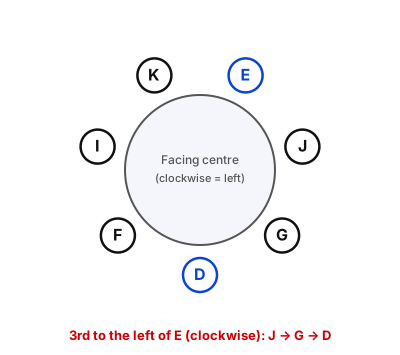
- K is immediately left of I; J is 3rd to the left of I → I, K, _, J clockwise.
- G neighbours both D and J → D, G, J together; F is not next to J → F sits next to I's other side.
- Clockwise from D: D, F, I, K, E, J, G.
- 3rd to the left of E: J → G → D.
Short trick: Count 3 to the left of E = 4 to the right in a 7-seat circle; whichever direction is shorter.
Answer: (B) D
अवधारणा: केंद्र की ओर मुख होने पर 'बाएँ' = दक्षिणावर्त। I को स्थिर करके K, J रखें।
- K, I के ठीक बाएँ है; J, I के बाएँ से तीसरा → दक्षिणावर्त I, K, _, J.
- G, D और J दोनों का पड़ोसी → D, G, J साथ; F, J के पास नहीं → F, I के दूसरी ओर।
- D से दक्षिणावर्त: D, F, I, K, E, J, G.
- E के बाएँ से तीसरा: J → G → D.
शॉर्ट ट्रिक: 7 सीटों में बाएँ से तीसरा = दाएँ से चौथा; जो छोटा हो उसी दिशा में गिनें।
उत्तर: (B) D
RRB ALP CBT 1General Intelligence and ReasoningCircular seating arrangementRRB ALP CBT 1 2025 · 16 Feb Shift 3
Q553.Read the given statement(s) and conclusions carefully. Assuming that the information given in the statements is true, even if it appears to be at variance with commonly known facts, decide which of the given conclusions logically follow(s) from the statement(s).
Statements:
All kings are bombs.
No parrots are kings.
Conclusions:
(I) Some bombs are not parrots.
(II) Some bombs are kings.
दिए गए कथनों और निष्कर्षों को ध्यानपूर्वक पढ़ें। यह मानते हुए कि कथनों में दी गई जानकारी सत्य है, भले ही वह सामान्य रूप से ज्ञात तथ्यों से भिन्न प्रतीत होती हो, निर्णय लें कि दिए गए निष्कर्षों में से कौन-सा/से निष्कर्ष कथनों का तार्किक रूप से अनुसरण करता/करते है/हैं।
कथन:
सभी राजा, बम हैं।
कोई तोता, राजा नहीं है।
निष्कर्ष:
(I) कुछ बम, तोते नहीं हैं।
(II) कुछ बम, राजा हैं।
- AOnly conclusion (II) follows.केवल निष्कर्ष (II) अनुसरण करता है।
- BBoth conclusions (I) and (II) follow.निष्कर्ष (I) और (II) दोनों अनुसरण करते हैं।
- CNeither conclusion (I) nor (II) follows.न तो निष्कर्ष (I) और न ही (II) अनुसरण करता है।
- DOnly conclusion (I) follows.केवल निष्कर्ष (I) अनुसरण करता है।
Show answer
Concept: Draw the least-overlap Venn diagram and test each conclusion.
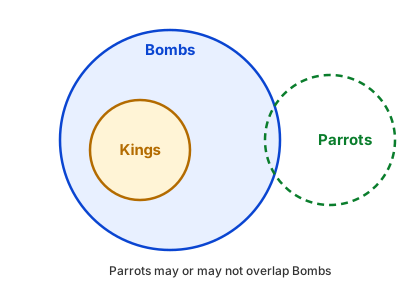
- All kings are bombs → Kings circle lies inside Bombs.
- No parrot is a king → Parrots do not touch Kings.
- (I) The bombs that are kings are not parrots → 'Some bombs are not parrots' follows.
- (II) 'All kings are bombs' → converse 'Some bombs are kings' follows.
Short trick: 'All A are B' always gives 'Some B are A'; and those B (which are A) cannot be C if 'No C is A' → 'Some B are not C'.
Answer: (B) Both conclusions (I) and (II) follow.
अवधारणा: न्यूनतम अतिव्यापन वाला वेन आरेख बनाकर प्रत्येक निष्कर्ष जाँचें।
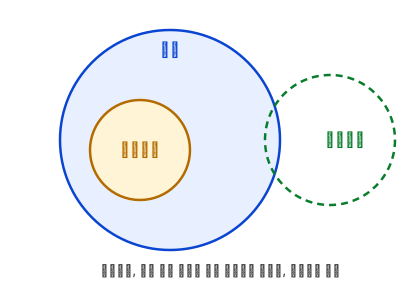
- सभी राजा बम हैं → राजा का वृत्त बम के भीतर।
- कोई तोता राजा नहीं → तोते, राजा को नहीं छूते।
- (I) जो बम राजा हैं, वे तोते नहीं हैं → 'कुछ बम तोते नहीं हैं' अनुसरण करता है।
- (II) 'सभी राजा बम हैं' का विलोम 'कुछ बम राजा हैं' अनुसरण करता है।
शॉर्ट ट्रिक: 'सभी A, B हैं' से सदैव 'कुछ B, A हैं'; और यदि 'कोई C, A नहीं' तो 'कुछ B, C नहीं हैं'।
उत्तर: (B) निष्कर्ष (I) और (II) दोनों अनुसरण करते हैं।
RRB ALP CBT 1General Intelligence and ReasoningSyllogismRRB ALP CBT 1 2025 · 16 Feb Shift 3
Q554.Select the set in which the numbers are related in the same way as are the numbers of the following sets.
(NOTE : Operations should be performed on the whole numbers, without breaking down the numbers into its constituent digits. E.g. 13 – Operations on 13 such as adding / subtracting /multiplying etc. to 13 can be performed. Breaking down 13 into 1 and 3 and then performing mathematical operations on 1 and 3 is not allowed)
(156,12,13)
(126,14,9)
उस समुच्चय का चयन कीजिए जिसमें संख्याएँ उसी प्रकार संबंधित हैं जिस प्रकार निम्नलिखित समुच्चयों की संख्याएँ संबंधित हैं।
(नोट: संक्रियाएँ संख्याओं को उनके घटक अंकों में तोड़े बिना, पूर्ण संख्याओं पर की जानी चाहिए। उदाहरण: 13 – 13 पर संक्रियाएँ जैसे 13 में जोड़ना/घटाना/गुणा करना आदि की जा सकती हैं। 13 को 1 और 3 में तोड़कर फिर 1 और 3 पर गणितीय संक्रियाएँ करने की अनुमति नहीं है।)
(156,12,13)
(126,14,9)
- A(198,24,8)
- B(196,15,13)
- C(176,16,11)
- D(240,45,5)
Show answer
Concept: First number = product of the other two.
- ; .
- (A) ; (B) ; (C) ✓; (D) .
Short trick: Unit-digit check: 6×1 → 6 matches 176 instantly; 4×8 → 2 ≠ 8, 5×3 → 5 ≠ 6, 5×5 → 5 ≠ 0.
Answer: (C) (176,16,11)
अवधारणा: पहली संख्या = बाकी दो संख्याओं का गुणनफल।
- ; .
- (A) ; (B) ; (C) ✓; (D) .
शॉर्ट ट्रिक: इकाई अंक जाँच: 6×1 → 6, 176 से मेल; बाकी के इकाई अंक मेल नहीं खाते।
उत्तर: (C) (176,16,11)
RRB ALP CBT 1General Intelligence and ReasoningNumber analogy – setsRRB ALP CBT 1 2025 · 16 Feb Shift 3
Q555.M is the mother of O. O is the sister of J. T is the daughter of K. T is the sister of J. J is the father of B. B is the wife of F. How is M related to K?
M, O की माता है। O, J की बहन है। T, K की पुत्री है। T, J की बहन है। J, B का पिता है। B, F की पत्नी है। M का K से क्या संबंध है?
- ABrotherभाई
- BHusbandपति
- CSisterबहन
- DWifeपत्नी
Show answer
Concept: Join everyone into one family tree; mark genders from the words used.
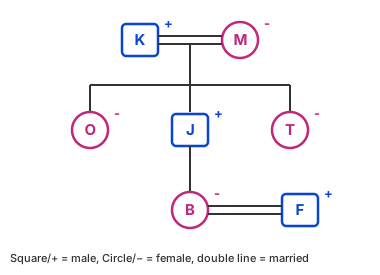
- O, J and T are siblings (O sister of J; T sister of J).
- M is the mother of O, hence of J and T; T is the daughter of K → K is the other parent.
- So K is the father and M is K's wife. (J → B → F is the next generation.)
Short trick: Two parents of the same child: one is 'mother' → the other is her husband. So M = wife of K.
Answer: (D) Wife
अवधारणा: सभी को एक वंश-वृक्ष में जोड़ें; प्रयुक्त शब्दों से लिंग तय करें।
- O, J और T भाई-बहन हैं (O, J की बहन; T, J की बहन)।
- M, O की माता है, अतः J और T की भी; T, K की पुत्री है → K दूसरा अभिभावक है।
- अतः K पिता है और M, K की पत्नी है। (J → B → F अगली पीढ़ी है।)
शॉर्ट ट्रिक: एक ही संतान के दो अभिभावक: एक 'माता' → दूसरा उसका पति। अतः M = K की पत्नी।
उत्तर: (D) पत्नी
RRB ALP CBT 1General Intelligence and ReasoningBlood relationRRB ALP CBT 1 2025 · 16 Feb Shift 3
Q556.AL8 is related to EQ40 in a certain way. In the same way, MF13 is related to QK65. To which of the given options is UO5 related, following the same logic?
AL8 एक निश्चित प्रकार से EQ40 से संबंधित है। उसी प्रकार, MF13, QK65 से संबंधित है। समान तर्क का अनुसरण करते हुए, UO5 दिए गए विकल्पों में से किससे संबंधित है?
- AXT20
- BMT25
- CZT20
- DYT25
Show answer
Concept: First letter +4, second letter +5, number ×5.
- A(1)+4 = E, L(12)+5 = Q, 8×5 = 40 → EQ40.
- M+4 = Q, F+5 = K, 13×5 = 65 → QK65.
- U(21)+4 = Y, O(15)+5 = T, 5×5 = 25 → YT25.
Short trick: Number part first: 5×5 = 25 → only MT25 or YT25; U+4 = Y → YT25.
Answer: (D) YT25
अवधारणा: पहला अक्षर +4, दूसरा अक्षर +5, संख्या ×5.
- A(1)+4 = E, L(12)+5 = Q, 8×5 = 40 → EQ40.
- M+4 = Q, F+5 = K, 13×5 = 65 → QK65.
- U(21)+4 = Y, O(15)+5 = T, 5×5 = 25 → YT25.
शॉर्ट ट्रिक: पहले संख्या: 5×5 = 25 → MT25 या YT25; U+4 = Y → YT25.
उत्तर: (D) YT25
RRB ALP CBT 1General Intelligence and ReasoningAlpha-numeric analogyRRB ALP CBT 1 2025 · 16 Feb Shift 3
Q557.Based on the English alphabetical order, three of the following four letter-clusters are alike in a certain way and thus form a group. Which letter-cluster DOES NOT belong to that group?
(Note: The odd one out is not based on the number of consonants/vowels or their position in the letter-cluster.)
अंग्रेजी वर्णमाला क्रम के आधार पर, निम्नलिखित चार अक्षर-समूहों में से तीन किसी निश्चित प्रकार से एकसमान हैं और इस प्रकार एक समूह बनाते हैं। कौन-सा अक्षर-समूह उस समूह से संबंधित नहीं है?
(नोट: असंगत का निर्धारण व्यंजनों/स्वरों की संख्या या अक्षर-समूह में उनके स्थान के आधार पर नहीं है।)
- APUZ
- BCHN
- CLQW
- DINT
Show answer
Concept: Find the gaps between consecutive letters.
| PUZ | P→U +5 | U→Z +5 |
| CHN | +5 | +6 |
| LQW | +5 | +6 |
| INT | +5 | +6 |
Short trick: Three clusters follow +5, +6; PUZ follows +5, +5.
Answer: (A) PUZ
अवधारणा: क्रमागत अक्षरों के बीच का अंतर ज्ञात करें।
| PUZ | P→U +5 | U→Z +5 |
| CHN | +5 | +6 |
| LQW | +5 | +6 |
| INT | +5 | +6 |
शॉर्ट ट्रिक: तीन समूहों में +5, +6; PUZ में +5, +5.
उत्तर: (A) PUZ
RRB ALP CBT 1General Intelligence and ReasoningOdd one out – letter gapsRRB ALP CBT 1 2025 · 16 Feb Shift 3
Q558.What will come in place of the question mark (?) in the following equation, if '+' and '÷' are interchanged and '−' and '×' are interchanged?
368 + 46 × 7 − 23 ÷ 183 = ?
यदि '+' और '÷' को आपस में बदल दिया जाए तथा '−' और '×' को आपस में बदल दिया जाए, तो निम्नलिखित समीकरण में प्रश्न चिह्न (?) के स्थान पर क्या आएगा?
368 + 46 × 7 − 23 ÷ 183 = ?
- A30
- B39
- C33
- D38
Show answer
Concept: Swap the signs, then apply BODMAS.
- New expression: .
- .
- .
Short trick: (since ); , .
Answer: (A) 30
अवधारणा: चिह्न बदलें, फिर BODMAS लगाएँ।
- नया व्यंजक: .
- .
- .
शॉर्ट ट्रिक: ; , .
उत्तर: (A) 30
RRB ALP CBT 1General Intelligence and ReasoningMathematical operations – interchangeRRB ALP CBT 1 2025 · 16 Feb Shift 3
Q559.Refer to the following letter series and answer the question that follows. Counting to be done from left to right only.
(Left) W U G E K L T Q J W U J V E S C V K J T C (Right)
How many such vowels are there, each of which is immediately preceded by a vowel and also immediately followed by a consonant?
निम्नलिखित अक्षर श्रृंखला को देखें और नीचे दिए गए प्रश्न का उत्तर दें। गिनती केवल बाएँ से दाएँ की जानी है।
(बाएँ) W U G E K L T Q J W U J V E S C V K J T C (दाएँ)
ऐसे कितने स्वर हैं जिनमें से प्रत्येक के ठीक पहले एक स्वर है और ठीक बाद एक व्यंजन है?
- ANoneकोई नहीं
- BMore than threeतीन से अधिक
- COneएक
- DTwoदो
Show answer
Concept: Look only at vowels and check the letter before each.
- Vowels: U (2nd), E (4th), U (11th), E (14th).
- Before them: W, G, W, V – all consonants.
- No vowel is preceded by a vowel.
Short trick: Find vowel-vowel pairs first: there is none (no two vowels side by side) → answer 'None'.
Answer: (A) None
अवधारणा: केवल स्वरों को देखें और उनके ठीक पहले का अक्षर जाँचें।
- स्वर: U (दूसरा), E (चौथा), U (11वाँ), E (14वाँ)।
- इनके ठीक पहले: W, G, W, V – सभी व्यंजन।
- किसी स्वर के ठीक पहले स्वर नहीं है।
शॉर्ट ट्रिक: पहले स्वर-स्वर जोड़ी खोजें: कोई नहीं → उत्तर 'कोई नहीं'।
उत्तर: (A) कोई नहीं
RRB ALP CBT 1General Intelligence and ReasoningLetter series – position conditionsRRB ALP CBT 1 2025 · 16 Feb Shift 3
Q560.Based on the English alphabetical order, three of the following four letter-clusters are alike in a certain way and thus form a group. Which letter-cluster DOES NOT belong to that group? (Note: The odd one out is not based on the number of consonants/vowels or their position in the letter-cluster.)
अंग्रेजी वर्णमाला क्रम के आधार पर, निम्नलिखित चार अक्षर-समूहों में से तीन किसी निश्चित प्रकार से एकसमान हैं और इस प्रकार एक समूह बनाते हैं। कौन-सा अक्षर-समूह उस समूह से संबंधित नहीं है?
(नोट: असंगत का निर्धारण व्यंजनों/स्वरों की संख्या या अक्षर-समूह में उनके स्थान के आधार पर नहीं है।)
- ADUP
- BJAV
- CXPJ
- DQHC
Show answer
Concept: Move forward cyclically (after Z comes A) and measure the gaps.
| DUP | D→U +17 | U→P +21 |
| JAV | J→A +17 | A→V +21 |
| QHC | Q→H +17 | H→C +21 |
| XPJ | X→P +18 | P→J +20 |
Short trick: Count the second gap backwards: U→P −5, A→V −5, H→C −5, but P→J −6 → XPJ is odd.
Answer: (C) XPJ
अवधारणा: चक्रीय रूप से आगे गिनें (Z के बाद A) और अंतर मापें।
| DUP | D→U +17 | U→P +21 |
| JAV | J→A +17 | A→V +21 |
| QHC | Q→H +17 | H→C +21 |
| XPJ | X→P +18 | P→J +20 |
शॉर्ट ट्रिक: +21 आगे = −5 पीछे: U→P, A→V, H→C में −5, परंतु P→J में −6 → XPJ असंगत।
उत्तर: (C) XPJ
RRB ALP CBT 1General Intelligence and ReasoningOdd one out – letter gaps (cyclic)RRB ALP CBT 1 2025 · 16 Feb Shift 3

