Q581.This question is based on the five, three-digit numbers given below.
(Left) 627 458 347 491 567 (Right)
(Example- 697 – First digit = 6, second digit = 9 and third digit = 7)
What will be the resultant if the second digit of the second highest number is added to the third digit of the lowest number?
यह प्रश्न नीचे दी गई पाँच, तीन-अंकीय संख्याओं पर आधारित है।
(बाएँ) 627 458 347 491 567 (दाएँ)
(उदाहरण- 697 – पहला अंक = 6, दूसरा अंक = 9 और तीसरा अंक = 7)
यदि दूसरी सबसे बड़ी संख्या के दूसरे अंक को सबसे छोटी संख्या के तीसरे अंक में जोड़ा जाए, तो परिणाम क्या होगा?
- A11
- B13
- C12
- D14
Show answer
Concept: Arrange the numbers in order, then pick the required digits.
- Descending: 627 > 567 > 491 > 458 > 347.
- Second highest = 567 → second digit 6.
- Lowest = 347 → third digit 7. Sum = 6 + 7 = 13.
Short trick: Compare only first digits: 6, 5, 4, 4, 3 → 2nd highest 567, lowest 347.
Answer: (B) 13
अवधारणा: संख्याओं को क्रम में रखें, फिर आवश्यक अंक चुनें।
- घटते क्रम में: 627 > 567 > 491 > 458 > 347.
- दूसरी सबसे बड़ी = 567 → दूसरा अंक 6.
- सबसे छोटी = 347 → तीसरा अंक 7. योग = 6 + 7 = 13.
शॉर्ट ट्रिक: केवल पहले अंक देखें: 6, 5, 4, 4, 3 → दूसरी बड़ी 567, सबसे छोटी 347.
उत्तर: (B) 13
RRB ALP CBT 1General Intelligence and ReasoningNumber arrangement – digitsRRB ALP CBT 1 2025 · 16 Feb Shift 3
Q582.Refer to the following number, symbol series and answer the question that follows. Counting to be done from left to right only. All numbers are single-digit numbers.
(Left) ? + > * 1 + 7 & ^ 1 ^ 7 2 8 ? & > # ? 4 @ (Right)
How many such numbers are there, each of which is immediately preceded by another number and also immediately followed by a symbol?
निम्नलिखित संख्या, प्रतीक श्रृंखला को देखें और नीचे दिए गए प्रश्न का उत्तर दें। गिनती केवल बाएँ से दाएँ की जानी है। सभी संख्याएँ एक-अंकीय हैं।
(बाएँ) ? + > * 1 + 7 & ^ 1 ^ 7 2 8 ? & > # ? 4 @ (दाएँ)
ऐसी कितनी संख्याएँ हैं जिनमें से प्रत्येक के ठीक पहले एक अन्य संख्या है और ठीक बाद एक प्रतीक है?
- AThreeतीन
- BFourचार
- COneएक
- DTwoदो
Show answer
Concept: Look for the pattern number – number – symbol.
- Pairs of adjacent numbers: 7 2, 2 8.
- 7 2 8: 2 is followed by 8 (a number) ✗; 2 8 ?: 8 is followed by ? (a symbol) ✓.
- Count = 1.
Short trick: Only a run of digits can give 'number before number' – the single run 7 2 8 gives exactly its last digit → 1.
Answer: (C) One
अवधारणा: संख्या – संख्या – प्रतीक का क्रम खोजें।
- लगातार संख्याओं के जोड़े: 7 2, 2 8.
- 7 2 8: 2 के बाद 8 (संख्या) ✗; 2 8 ?: 8 के बाद ? (प्रतीक) ✓.
- संख्या = 1.
शॉर्ट ट्रिक: केवल अंकों की लगातार कड़ी (7 2 8) ही योग्य – उसका अंतिम अंक → 1.
उत्तर: (C) एक
RRB ALP CBT 1General Intelligence and ReasoningNumber-symbol seriesRRB ALP CBT 1 2025 · 16 Feb Shift 3
Q583.Based on the English alphabetical order, three of the following four letter-clusters are alike in a certain way and thus form a group. Which letter-cluster DOES NOT belong to that group? (Note: The odd one out is not based on the number of consonants/vowels or their position in the letter-cluster.)
अंग्रेजी वर्णमाला क्रम के आधार पर, निम्नलिखित चार अक्षर-समूहों में से तीन किसी निश्चित प्रकार से एकसमान हैं और इस प्रकार एक समूह बनाते हैं। कौन-सा अक्षर-समूह उस समूह से संबंधित नहीं है?
(नोट: असंगत का निर्धारण व्यंजनों/स्वरों की संख्या या अक्षर-समूह में उनके स्थान के आधार पर नहीं है।)
- AOSV
- BGKN
- CLOS
- DTXA
Show answer
Concept: Find the gaps between consecutive letters.
| OSV | +4 | +3 |
| GKN | +4 | +3 |
| TXA | +4 | +3 (X→Y→Z→A) |
| LOS | +3 | +4 |
Short trick: Three follow +4, +3; LOS reverses it (+3, +4).
Answer: (C) LOS
अवधारणा: क्रमागत अक्षरों के बीच का अंतर ज्ञात करें।
| OSV | +4 | +3 |
| GKN | +4 | +3 |
| TXA | +4 | +3 (X→Y→Z→A) |
| LOS | +3 | +4 |
शॉर्ट ट्रिक: तीन में +4, +3; LOS में उल्टा (+3, +4).
उत्तर: (C) LOS
RRB ALP CBT 1General Intelligence and ReasoningOdd one out – letter gapsRRB ALP CBT 1 2025 · 16 Feb Shift 3
Q584.Soham starts from Point A and drives 59 km towards west. He then takes a left turn, drives 67 km, turns left and drives 67 km. He then takes a left turn and drives 78 km. He takes a final left turn, drives 8 km and stops at Point P. How far (shortest distance) and towards which direction should he drive in order to reach Point A again? (All turns are 90 degrees turns only unless specified)
सोहम बिंदु A से शुरू करता है और पश्चिम की ओर 59 km गाड़ी चलाता है। फिर वह बाएँ मुड़ता है, 67 km चलाता है, बाएँ मुड़ता है और 67 km चलाता है। फिर वह बाएँ मुड़ता है और 78 km चलाता है। वह अंतिम बार बाएँ मुड़ता है, 8 km चलाता है और बिंदु P पर रुक जाता है। बिंदु A पर फिर से पहुँचने के लिए उसे कितनी दूर (न्यूनतम दूरी) और किस दिशा में गाड़ी चलानी चाहिए? (जब तक निर्दिष्ट न हो, सभी मोड़ केवल 90 डिग्री के हैं)
- A10 km to the south10 km दक्षिण की ओर
- B13 km to the south13 km दक्षिण की ओर
- C11 km to the south11 km दक्षिण की ओर
- D12 km to the north12 km उत्तर की ओर
Show answer
Concept: Take A as origin; add east-west and north-south moves separately.
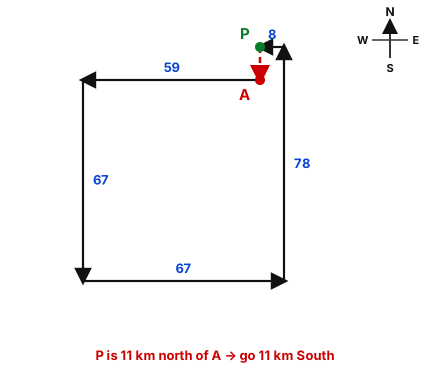
- West 59; left → South 67; left → East 67; left → North 78; left → West 8.
- East-west: −59 + 67 − 8 = 0.
- North-south: −67 + 78 = +11 → P is 11 km north of A.
- To return: 11 km towards the South.
Short trick: Net E-W cancels (59 + 8 = 67), so only N-S matters: 78 − 67 = 11 north → go south.
Answer: (C) 11 km to the south
अवधारणा: A को मूल बिंदु मानें; पूर्व-पश्चिम और उत्तर-दक्षिण गतियाँ अलग-अलग जोड़ें।
- पश्चिम 59; बाएँ → दक्षिण 67; बाएँ → पूर्व 67; बाएँ → उत्तर 78; बाएँ → पश्चिम 8.
- पूर्व-पश्चिम: −59 + 67 − 8 = 0.
- उत्तर-दक्षिण: −67 + 78 = +11 → P, A से 11 km उत्तर में।
- वापस जाने के लिए: 11 km दक्षिण की ओर।
शॉर्ट ट्रिक: पूर्व-पश्चिम कट जाता है (59 + 8 = 67), केवल उत्तर-दक्षिण: 78 − 67 = 11 उत्तर → दक्षिण जाएँ।
उत्तर: (C) 11 km दक्षिण की ओर
RRB ALP CBT 1General Intelligence and ReasoningDirection senseRRB ALP CBT 1 2025 · 16 Feb Shift 3
Q585.Refer to the following series and answer the question (All numbers are single digit numbers only. Counting to be done from left to right.)
(Left) 3 7 2 6 2 7 3 8 7 3 7 6 4 2 4 5 4 9 5 7 7 2 4 (Right)
How many such even digits are there each of which is immediately preceded by an odd digit and also immediately followed by an even digit?
निम्नलिखित श्रृंखला को देखें और प्रश्न का उत्तर दें (सभी संख्याएँ केवल एक-अंकीय हैं। गिनती बाएँ से दाएँ की जानी है।)
(बाएँ) 3 7 2 6 2 7 3 8 7 3 7 6 4 2 4 5 4 9 5 7 7 2 4 (दाएँ)
ऐसे कितने सम अंक हैं जिनमें से प्रत्येक के ठीक पहले एक विषम अंक है और ठीक बाद एक सम अंक है?
- AThreeतीन
- BNoneकोई नहीं
- CTwoदो
- DOneएक
Show answer
Concept: Look for the pattern odd – even – even.
- 7 2 6 ✓ (2 after 7, before 6).
- 7 6 4 ✓ (6 after 7, before 4).
- 7 2 4 ✓ (last three digits). Others like 3 8 7, 5 4 9 fail.
- Count = 3.
Short trick: Scan for every even digit right after an odd digit, then just look one step ahead.
Answer: (A) Three
अवधारणा: विषम – सम – सम का क्रम खोजें।
- 7 2 6 ✓ (2 के पहले 7, बाद में 6)।
- 7 6 4 ✓ (6 के पहले 7, बाद में 4)।
- 7 2 4 ✓ (अंतिम तीन अंक)। 3 8 7, 5 4 9 आदि नहीं।
- संख्या = 3.
शॉर्ट ट्रिक: विषम के ठीक बाद आने वाला हर सम अंक खोजें, फिर केवल अगला अंक देखें।
उत्तर: (A) तीन
RRB ALP CBT 1General Intelligence and ReasoningNumber series – position conditionsRRB ALP CBT 1 2025 · 16 Feb Shift 3
Q586.In a certain code language, ‘HATS’ is coded as ‘2743’ and ‘AHUS’ is coded as ‘7483’. What is the code for ‘U’ in the given code language?
एक निश्चित कूट भाषा में, 'HATS' को '2743' और 'AHUS' को '7483' लिखा जाता है। दी गई कूट भाषा में 'U' का कूट क्या है?
- A4
- B7
- C8
- D3
Show answer
Concept: Letters common to both words share the common digits.
- HATS = 2743, AHUS = 7483.
- Common letters H, A, S ↔ common digits 7, 4, 3.
- Remaining: T = 2 and U = 8.
Short trick: Remove common digits from AHUS's code (7, 4, 3) → leftover 8 is U.
Answer: (C) 8
अवधारणा: दोनों शब्दों के उभयनिष्ठ अक्षरों के कूट भी उभयनिष्ठ होते हैं।
- HATS = 2743, AHUS = 7483.
- उभयनिष्ठ अक्षर H, A, S ↔ उभयनिष्ठ अंक 7, 4, 3.
- शेष: T = 2 और U = 8.
शॉर्ट ट्रिक: AHUS के कूट से उभयनिष्ठ अंक (7, 4, 3) हटाएँ → बचा 8 = U.
उत्तर: (C) 8
RRB ALP CBT 1General Intelligence and ReasoningCoding – common lettersRRB ALP CBT 1 2025 · 16 Feb Shift 3
Q587.Namit starts from Point A and drives 26 km towards the east. He then takes a left turn, drives 25 km, turns left and drives 33 km. He then takes a left turn and drives 35 km. He takes a final left turn, drives 7 km and stops at Point P. How far (shortest distance) and towards which direction should he drive in order to reach Point A again? (All turns are 90-degree turns only unless specified.)
नमित बिंदु A से शुरू करता है और पूर्व की ओर 26 km गाड़ी चलाता है। फिर वह बाएँ मुड़ता है, 25 km चलाता है, बाएँ मुड़ता है और 33 km चलाता है। फिर वह बाएँ मुड़ता है और 35 km चलाता है। वह अंतिम बार बाएँ मुड़ता है, 7 km चलाता है और बिंदु P पर रुक जाता है। बिंदु A पर फिर से पहुँचने के लिए उसे कितनी दूर (न्यूनतम दूरी) और किस दिशा में गाड़ी चलानी चाहिए? (जब तक निर्दिष्ट न हो, सभी मोड़ केवल 90 डिग्री के हैं।)
- A11 km to the North11 km उत्तर की ओर
- B10 km to the North10 km उत्तर की ओर
- C12 km to the South12 km दक्षिण की ओर
- D13 km to the South13 km दक्षिण की ओर
Show answer
Concept: Take A as origin; add east-west and north-south moves separately.
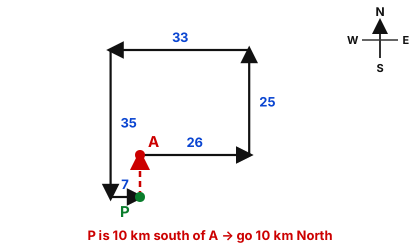
- East 26; left → North 25; left → West 33; left → South 35; left → East 7.
- East-west: 26 − 33 + 7 = 0.
- North-south: 25 − 35 = −10 → P is 10 km south of A.
- To return: 10 km towards the North.
Short trick: E-W: 26 + 7 = 33 cancels; N-S: 35 − 25 = 10 south → go north.
Answer: (B) 10 km to the North
अवधारणा: A को मूल बिंदु मानें; पूर्व-पश्चिम और उत्तर-दक्षिण गतियाँ अलग-अलग जोड़ें।
- पूर्व 26; बाएँ → उत्तर 25; बाएँ → पश्चिम 33; बाएँ → दक्षिण 35; बाएँ → पूर्व 7.
- पूर्व-पश्चिम: 26 − 33 + 7 = 0.
- उत्तर-दक्षिण: 25 − 35 = −10 → P, A से 10 km दक्षिण में।
- वापस जाने के लिए: 10 km उत्तर की ओर।
शॉर्ट ट्रिक: पूर्व-पश्चिम: 26 + 7 = 33 कट जाता है; उत्तर-दक्षिण: 35 − 25 = 10 दक्षिण → उत्तर जाएँ।
उत्तर: (B) 10 km उत्तर की ओर
RRB ALP CBT 1General Intelligence and ReasoningDirection senseRRB ALP CBT 1 2025 · 16 Feb Shift 3
Q588.Select the set in which the numbers are related in the same way as are the numbers of the given sets.
(NOTE: Operations should be performed on the whole numbers, without breaking down the numbers into their constituent digits. E.g. 13 – Operations on 13 such as adding to/subtracting from/multiplying with 13 can be performed. Breaking down 13 into 1 and 3 and then performing mathematical operations on 1 and 3 is not allowed.)
(29, 116, 348)
(22, 88, 264)
उस समुच्चय का चयन कीजिए जिसमें संख्याएँ उसी प्रकार संबंधित हैं जिस प्रकार दिए गए समुच्चयों की संख्याएँ संबंधित हैं।
(नोट: संक्रियाएँ संख्याओं को उनके घटक अंकों में तोड़े बिना, पूर्ण संख्याओं पर की जानी चाहिए। उदाहरण: 13 – 13 पर संक्रियाएँ जैसे 13 में जोड़ना/घटाना/गुणा करना आदि की जा सकती हैं। 13 को 1 और 3 में तोड़कर फिर 1 और 3 पर गणितीय संक्रियाएँ करने की अनुमति नहीं है।)
(29, 116, 348)
(22, 88, 264)
- A(26, 104, 332)
- B(17, 68, 204)
- C(15, 60, 120)
- D(21, 94, 252)
Show answer
Concept: Second = first × 4; third = second × 3.
- , ; , .
- (B) , ✓. (A) ; (C) ; (D) .
Short trick: Third = first × 12: 17 × 12 = 204 ✓ in one step.
Answer: (B) (17, 68, 204)
अवधारणा: दूसरी = पहली × 4; तीसरी = दूसरी × 3.
- , ; , .
- (B) , ✓. (A) ; (C) ; (D) .
शॉर्ट ट्रिक: तीसरी = पहली × 12: 17 × 12 = 204 ✓.
उत्तर: (B) (17, 68, 204)
RRB ALP CBT 1General Intelligence and ReasoningNumber analogy – setsRRB ALP CBT 1 2025 · 16 Feb Shift 3
Q589.If ‘A’ stands for ‘÷’, ‘B’ stands for ‘×’, ‘C’ stands for ‘+’ and ‘D’ stands for ‘−’, then what will come in place of the question mark (?) in the following equation?
75 A 3 D 14 C 9 B 4 = ?
यदि 'A' का अर्थ '÷', 'B' का अर्थ '×', 'C' का अर्थ '+' और 'D' का अर्थ '−' है, तो निम्नलिखित समीकरण में प्रश्न चिह्न (?) के स्थान पर क्या आएगा?
75 A 3 D 14 C 9 B 4 = ?
- A47
- B59
- C63
- D31
Show answer
Concept: Replace letters by signs, then apply BODMAS.
- .
- .
Short trick: Do ÷ and × first: 25 and 36; then 25 + 36 − 14 = 47.
Answer: (A) 47
अवधारणा: अक्षरों के स्थान पर चिह्न रखें, फिर BODMAS लगाएँ।
- .
- .
शॉर्ट ट्रिक: पहले ÷ और ×: 25 और 36; फिर 25 + 36 − 14 = 47.
उत्तर: (A) 47
RRB ALP CBT 1General Intelligence and ReasoningMathematical operations – symbol substitutionRRB ALP CBT 1 2025 · 16 Feb Shift 3
Q590.What should come in place of the question mark (?) in the given series based on the English alphabetical order?
HBU NHA TNG ZTM ?
अंग्रेजी वर्णमाला क्रम के आधार पर दी गई श्रृंखला में प्रश्न चिह्न (?) के स्थान पर क्या आना चाहिए?
HBU NHA TNG ZTM ?
- AFXS
- BFDR
- CFSE
- DFZS
Show answer
Concept: Each letter of a term moves +6 to give the next term.
- 1st letters: H, N, T, Z → +6 → F (cyclic).
- 2nd letters: B, H, N, T → +6 → Z.
- 3rd letters: U, A, G, M → +6 → S.
Short trick: Middle letter T + 6 = Z decides at once → FZS.
Answer: (D) FZS
अवधारणा: प्रत्येक पद का हर अक्षर +6 बढ़कर अगला पद देता है।
- पहले अक्षर: H, N, T, Z → +6 → F (चक्रीय)।
- दूसरे अक्षर: B, H, N, T → +6 → Z.
- तीसरे अक्षर: U, A, G, M → +6 → S.
शॉर्ट ट्रिक: बीच का अक्षर T + 6 = Z → सीधे FZS.
उत्तर: (D) FZS
RRB ALP CBT 1General Intelligence and ReasoningLetter seriesRRB ALP CBT 1 2025 · 16 Feb Shift 3
Q591.If an object is placed between infinity and the pole (P) in front of a convex mirror, what type of image will be formed?
यदि किसी वस्तु को उत्तल दर्पण के सामने अनंत और ध्रुव (P) के बीच रखा जाए, तो किस प्रकार का प्रतिबिंब बनेगा?
- AReal, inverted, and enlargedवास्तविक, उल्टा और आवर्धित
- BReal, inverted, and diminishedवास्तविक, उल्टा और छोटा
- CVirtual, erect, and diminished (smaller in size)आभासी, सीधा और छोटा (आकार में छोटा)
- DReal, erect, and same size as the objectवास्तविक, सीधा और वस्तु के समान आकार का
Show answer
Concept: A convex mirror always forms a virtual, erect and diminished image behind the mirror, between P and F, wherever the object is.
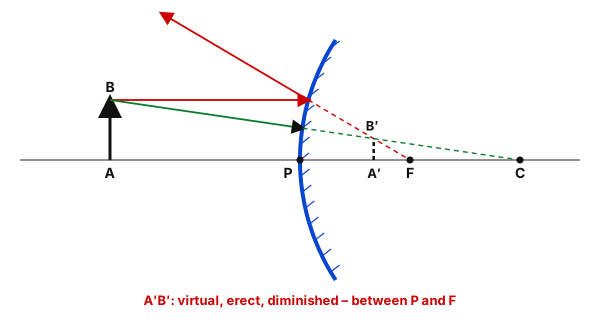
- A ray parallel to the axis reflects as if coming from F (behind the mirror).
- A ray aimed at C reflects back along itself.
- The reflected rays diverge; their backward extensions meet behind the mirror → virtual, erect, smaller image.
Short trick: Convex = 'Always V-E-D' (Virtual, Erect, Diminished) – that is why it is used as a rear-view mirror.
Answer: (C) Virtual, erect, and diminished
अवधारणा: उत्तल दर्पण वस्तु कहीं भी हो, सदैव दर्पण के पीछे P और F के बीच आभासी, सीधा और छोटा प्रतिबिंब बनाता है।
- मुख्य अक्ष के समांतर किरण परावर्तन के बाद F (दर्पण के पीछे) से आती प्रतीत होती है।
- C की ओर जाने वाली किरण उसी मार्ग से लौटती है।
- परावर्तित किरणें अपसारित होती हैं; उनके पीछे के विस्तार दर्पण के पीछे मिलते हैं → आभासी, सीधा, छोटा प्रतिबिंब।
शॉर्ट ट्रिक: उत्तल = 'सदा आ-सी-छो' (आभासी, सीधा, छोटा) – इसी कारण वाहनों में पीछे देखने का दर्पण उत्तल होता है।
उत्तर: (C) आभासी, सीधा और छोटा
RRB ALP CBT 1General ScienceImage formation – convex mirrorRRB ALP CBT 1 2025 · 16 Feb Shift 3
Q592.The double-layered covering of the nucleus is called as ______
केंद्रक के दोहरी परत वाले आवरण को ______ कहा जाता है।
- ACell wallकोशिका भित्ति
- BNuclear membraneकेंद्रक झिल्ली
- CChromatin wallक्रोमैटिन भित्ति
- DPlasma membraneप्लाज्मा झिल्ली
Show answer
Concept: The nucleus is bounded by a double-layered nuclear membrane (nuclear envelope) with pores.
- The nuclear membrane separates the nucleus from the cytoplasm.
- Its pores allow movement of RNA and proteins in and out.
- Cell wall and plasma membrane cover the whole cell, not the nucleus; 'chromatin wall' does not exist.
Short trick: Memory hook: Nucleus → Nuclear membrane (double layer, with pores) – the name itself tells the answer.
Answer: (B) Nuclear membrane
अवधारणा: केंद्रक, छिद्रयुक्त दोहरी परत वाली केंद्रक झिल्ली (केंद्रकीय आवरण) से घिरा होता है।
- केंद्रक झिल्ली केंद्रक को कोशिकाद्रव्य से अलग करती है।
- इसके छिद्रों से RNA और प्रोटीन अंदर-बाहर आते-जाते हैं।
- कोशिका भित्ति और प्लाज्मा झिल्ली पूरी कोशिका को ढकती हैं, केंद्रक को नहीं; 'क्रोमैटिन भित्ति' नाम की कोई संरचना नहीं है।
शॉर्ट ट्रिक: याद रखें: केंद्रक → केंद्रक झिल्ली (दोहरी परत, छिद्रयुक्त)।
उत्तर: (B) केंद्रक झिल्ली
RRB ALP CBT 1General ScienceCell – nucleusRRB ALP CBT 1 2025 · 16 Feb Shift 3
Q593.Which of the following substance groups represents the non-biodegradable substances?
निम्नलिखित में से कौन-सा पदार्थ-समूह जैव-अनिम्नीकरणीय (non-biodegradable) पदार्थों को दर्शाता है?
- APlastic bubble pack, regular milk packets, medicine plastic bottlesप्लास्टिक बबल पैक, सामान्य दूध के पैकेट, दवा की प्लास्टिक बोतलें
- BSpoilt food, vegetable peels, used tea leavesखराब भोजन, सब्जियों के छिलके, इस्तेमाल की गई चाय की पत्ती
- CGrasses, spoilt food, vegetable peelsघास, खराब भोजन, सब्जियों के छिलके
- DVegetable peels, flowers, paperसब्जियों के छिलके, फूल, कागज
Show answer
Concept: Non-biodegradable substances cannot be broken down by microbes (bacteria, fungi) in a reasonable time.
- Plastic bubble pack, plastic milk packets and plastic medicine bottles are all plastics → non-biodegradable.
- Food, peels, tea leaves, grass, flowers and paper are organic → biodegradable.
Short trick: Memory hook: 'If it was never alive (plastic, polythene, glass, metal), microbes cannot eat it.'
Answer: (A) Plastic bubble pack, regular milk packets, medicine plastic bottles
अवधारणा: जैव-अनिम्नीकरणीय पदार्थ सूक्ष्मजीवों (जीवाणु, कवक) द्वारा उचित समय में अपघटित नहीं होते।
- प्लास्टिक बबल पैक, दूध के प्लास्टिक पैकेट और दवा की प्लास्टिक बोतलें – सभी प्लास्टिक → जैव-अनिम्नीकरणीय।
- भोजन, छिलके, चाय पत्ती, घास, फूल और कागज जैविक हैं → जैव-निम्नीकरणीय।
शॉर्ट ट्रिक: याद रखें: 'जो कभी जीवित नहीं था (प्लास्टिक, पॉलीथीन, काँच, धातु), उसे सूक्ष्मजीव नहीं खा सकते।'
उत्तर: (A) प्लास्टिक बबल पैक, दूध के पैकेट, दवा की प्लास्टिक बोतलें
RRB ALP CBT 1General ScienceEnvironment – biodegradable wasteRRB ALP CBT 1 2025 · 16 Feb Shift 3
Q594.Which of the following equations correctly relates the resistance (R) of a conductor to its length (l), area of cross-section (A), and resistivity (ρ)?
निम्नलिखित में से कौन-सा समीकरण किसी चालक के प्रतिरोध (R) का उसकी लंबाई (l), अनुप्रस्थ काट के क्षेत्रफल (A) और प्रतिरोधकता (ρ) से सही संबंध दर्शाता है?
- AR=l/ρA
- BR=ρl/A
- CR=A/ρl
- DR=ρA/l
Show answer
Concept: Resistance is directly proportional to length and inversely proportional to area of cross-section: .
- (longer wire, more collisions of electrons).
- (thicker wire, more paths for current).
- Constant of proportionality is resistivity (unit Ω m).
Short trick: Unit check: Ω = (Ω m)(m)/m² ✓ only for ρl/A. Hook: 'Long and thin → high R'.
Answer: (B) R = ρl/A
अवधारणा: प्रतिरोध लंबाई के अनुक्रमानुपाती और अनुप्रस्थ काट के क्षेत्रफल के व्युत्क्रमानुपाती होता है: .
- (लंबा तार, इलेक्ट्रॉनों की अधिक टक्कर)।
- (मोटा तार, धारा के लिए अधिक मार्ग)।
- आनुपातिकता स्थिरांक प्रतिरोधकता (मात्रक Ω m) है।
शॉर्ट ट्रिक: मात्रक जाँच: Ω = (Ω m)(m)/m² ✓ केवल ρl/A में। याद रखें: 'लंबा और पतला → अधिक R'।
उत्तर: (B) R = ρl/A
RRB ALP CBT 1General ScienceElectricity – resistivityRRB ALP CBT 1 2025 · 16 Feb Shift 3
Q595.Which breed of cattle is primarily used for dairy purposes in India?
भारत में मुख्य रूप से डेयरी (दुग्ध उत्पादन) के लिए मवेशियों की किस नस्ल का उपयोग किया जाता है?
- ASahiwalसाहीवाल
- BOngoleओंगोल
- CGirगिर
- DKankrejकांकरेज
Show answer
Concept: Indian cattle breeds are grouped as milch (dairy), draught and dual-purpose.
- Milch (dairy) breeds: Sahiwal, Gir, Red Sindhi, Rathi.
- Draught breeds: Ongole (also dual), Nagori, Hallikar, Amritmahal.
- Dual-purpose: Kankrej, Tharparkar, Hariana.
- Sahiwal (Punjab region) is regarded as the best indigenous dairy breed – but Gir (Gujarat) is also a dairy breed, so as printed two options (A and C) are correct.
Short trick: Hook for milch breeds: 'SaGiRed' – Sahiwal, Gir, Red Sindhi.
Answer: (A) and (C) Sahiwal and Gir – both are dairy (milch) breeds
अवधारणा: भारतीय मवेशी नस्लें दुधारू, भारवाही और द्वि-उद्देशीय में बाँटी जाती हैं।
- दुधारू (डेयरी) नस्लें: साहीवाल, गिर, रेड सिंधी, राठी।
- भारवाही नस्लें: ओंगोल (द्वि-उद्देशीय भी), नागोरी, हल्लीकर, अमृतमहल।
- द्वि-उद्देशीय: कांकरेज, थारपारकर, हरियाणा।
- साहीवाल सर्वश्रेष्ठ देशी दुधारू नस्ल मानी जाती है – परंतु गिर (गुजरात) भी दुधारू नस्ल है, अतः छपे रूप में दो विकल्प (A और C) सही हैं।
शॉर्ट ट्रिक: दुधारू नस्लें याद रखें: 'साहीगिरेड' – साहीवाल, गिर, रेड सिंधी।
उत्तर: (A) और (C) साहीवाल और गिर – दोनों दुधारू नस्लें हैं
RRB ALP CBT 1General ScienceAnimal husbandry – cattle breedsRRB ALP CBT 1 2025 · 16 Feb Shift 3
Q596.The ability of the eye lens to adjust its focal length to see objects clearly at different distances is called:
अलग-अलग दूरियों पर रखी वस्तुओं को स्पष्ट देखने के लिए नेत्र लेंस की अपनी फोकस दूरी को समायोजित करने की क्षमता कहलाती है:
- APower of accommodationसमंजन क्षमता
- BPower of convergenceअभिसरण क्षमता
- CRange of visionदृष्टि परास
- DPersistence of visionदृष्टि निर्बंध (दृष्टि की स्थिरता)
Show answer
Concept: The ciliary muscles change the curvature (and hence focal length) of the eye lens – this ability is the power of accommodation.
- Distant object: ciliary muscles relax, lens thin, focal length large.
- Near object: ciliary muscles contract, lens thick, focal length small.
- Range: near point 25 cm to far point infinity for a normal eye.
Short trick: Hook: 'Accommodate = adjust' – the lens adjusts itself.
Answer: (A) Power of accommodation
अवधारणा: पक्ष्माभी पेशियाँ नेत्र लेंस की वक्रता (और फोकस दूरी) बदलती हैं – इस क्षमता को समंजन क्षमता कहते हैं।
- दूर की वस्तु: पक्ष्माभी पेशियाँ शिथिल, लेंस पतला, फोकस दूरी अधिक।
- निकट की वस्तु: पेशियाँ संकुचित, लेंस मोटा, फोकस दूरी कम।
- सामान्य नेत्र: निकट बिंदु 25 cm, दूर बिंदु अनंत।
शॉर्ट ट्रिक: याद रखें: 'समंजन = समायोजन' – लेंस स्वयं को समायोजित करता है।
उत्तर: (A) समंजन क्षमता
RRB ALP CBT 1General ScienceHuman eye – accommodationRRB ALP CBT 1 2025 · 16 Feb Shift 3
Q597.When a positively charged alpha particle is passed through a thin gold foil, most of the particles pass straight through without deflection. Based on Thomson’s model of the atom, which of the following best explains this observation?
जब धनावेशित अल्फा कण को सोने की पतली पन्नी से गुजारा जाता है, तो अधिकांश कण बिना विक्षेपित हुए सीधे निकल जाते हैं। थॉमसन के परमाणु मॉडल के आधार पर, निम्नलिखित में से कौन-सा कथन इस प्रेक्षण की सबसे अच्छी व्याख्या करता है?
- AThe positive charge and mass are concentrated at the centre of the atom.धनावेश और द्रव्यमान परमाणु के केंद्र में संकेंद्रित होते हैं।
- BThe atom contains a small, dense nucleus that repels alpha particles.परमाणु में एक छोटा, सघन नाभिक होता है जो अल्फा कणों को प्रतिकर्षित करता है।
- CThe positive charge is uniformly distributed throughout the atom, and electrons are embedded in it.धनावेश पूरे परमाणु में समान रूप से वितरित होता है और इलेक्ट्रॉन उसमें धँसे रहते हैं।
- DElectrons revolve around the nucleus in fixed orbits.इलेक्ट्रॉन नाभिक के चारों ओर निश्चित कक्षाओं में घूमते हैं।
Show answer
Concept: Thomson's 'plum-pudding' model: positive charge spread uniformly through the atom with electrons embedded in it.
- Because the positive charge is spread out (not concentrated), there is no strong repelling centre in this model.
- So, according to Thomson's picture, alpha particles would pass almost undeflected.
- Options A and B describe Rutherford's nucleus; D describes Bohr's orbits.
Short trick: Hook: Thomson = 'watermelon' – red pulp (positive) everywhere, seeds (electrons) embedded.
Answer: (C) The positive charge is uniformly distributed throughout the atom, and electrons are embedded in it.
अवधारणा: थॉमसन का 'प्लम-पुडिंग' मॉडल: धनावेश पूरे परमाणु में समान रूप से फैला है और इलेक्ट्रॉन उसमें धँसे हैं।
- धनावेश फैला हुआ है (संकेंद्रित नहीं), अतः इस मॉडल में कोई प्रबल प्रतिकर्षी केंद्र नहीं है।
- इसलिए थॉमसन के अनुसार अल्फा कण लगभग बिना विक्षेपण के निकल जाएँगे।
- विकल्प A और B रदरफोर्ड के नाभिक का, तथा D बोर की कक्षाओं का वर्णन है।
शॉर्ट ट्रिक: याद रखें: थॉमसन = 'तरबूज' – लाल गूदा (धनावेश) हर जगह, बीज (इलेक्ट्रॉन) धँसे हुए।
उत्तर: (C) धनावेश पूरे परमाणु में समान रूप से वितरित है और इलेक्ट्रॉन उसमें धँसे हैं।
RRB ALP CBT 1General ScienceStructure of atom – Thomson's modelRRB ALP CBT 1 2025 · 16 Feb Shift 3
Q598.What happens at the boiling point of a liquid?
किसी द्रव के क्वथनांक पर क्या होता है?
- AParticles remain fixed and do not move at all.कण स्थिर रहते हैं और बिल्कुल भी गति नहीं करते।
- BParticles expand slightly and remain in liquid form.कण थोड़ा फैलते हैं और द्रव अवस्था में ही रहते हैं।
- CParticles lose energy and move closer together.कण ऊर्जा खोते हैं और एक-दूसरे के निकट आ जाते हैं।
- DParticles gain enough energy to change into vapour.कण इतनी ऊर्जा प्राप्त कर लेते हैं कि वाष्प में बदल जाते हैं।
Show answer
Concept: At the boiling point, particles of the liquid gain enough energy (latent heat of vaporisation) to overcome attractive forces and change into vapour.
- Temperature stays constant during boiling – the heat supplied is used as latent heat.
- Particles move faster and farther apart, not closer.
- Boiling occurs throughout the liquid, unlike evaporation which is a surface process.
Short trick: Hook: 'Boil = particles break free' – energy in, attraction out.
Answer: (D) Particles gain enough energy to change into vapour.
अवधारणा: क्वथनांक पर द्रव के कण इतनी ऊर्जा (वाष्पन की गुप्त ऊष्मा) प्राप्त कर लेते हैं कि वे आकर्षण बलों को पार कर वाष्प में बदल जाते हैं।
- क्वथन के दौरान ताप स्थिर रहता है – दी गई ऊष्मा गुप्त ऊष्मा के रूप में उपयोग होती है।
- कण तेज़ गति करते हैं और दूर होते हैं, पास नहीं आते।
- क्वथन पूरे द्रव में होता है, जबकि वाष्पन केवल सतह पर।
शॉर्ट ट्रिक: याद रखें: 'उबलना = कणों का मुक्त होना' – ऊर्जा अंदर, आकर्षण बाहर।
उत्तर: (D) कण इतनी ऊर्जा प्राप्त कर लेते हैं कि वाष्प में बदल जाते हैं।
RRB ALP CBT 1General ScienceStates of matter – boilingRRB ALP CBT 1 2025 · 16 Feb Shift 3
Q599.Where was the first Lokpal Day commemoration held in 2025?
2025 में पहला लोकपाल दिवस समारोह कहाँ आयोजित किया गया था?
- ASupreme Court Auditorium, New Delhiसुप्रीम कोर्ट ऑडिटोरियम, नई दिल्ली
- BZorawar Auditorium, Manekshaw Centre, Delhi Canttज़ोरावर ऑडिटोरियम, मानेकशॉ सेंटर, दिल्ली कैंट
- CParliament House, New Delhiसंसद भवन, नई दिल्ली
- DVigyan Bhawan, New Delhiविज्ञान भवन, नई दिल्ली
Show answer
Concept: The Lokpal of India observed its first Foundation Day ('Lokpal Day') on 16 January 2025.
- Venue: Zorawar Auditorium, Manekshaw Centre, Delhi Cantonment.
- 16 January marks the day the Lokpal and Lokayuktas Act, 2013 came into force (2014).
- Chief Justice of India Sanjiv Khanna was the chief guest.
Short trick: Hook: first Lokpal Day was held at an Army venue – the Manekshaw Centre named after Field Marshal Sam Manekshaw.
Answer: (B) Zorawar Auditorium, Manekshaw Centre, Delhi Cantt
अवधारणा: भारत के लोकपाल ने 16 जनवरी 2025 को अपना पहला स्थापना दिवस ('लोकपाल दिवस') मनाया।
- स्थान: ज़ोरावर ऑडिटोरियम, मानेकशॉ सेंटर, दिल्ली छावनी।
- 16 जनवरी वह दिन है जब लोकपाल और लोकायुक्त अधिनियम, 2013 लागू हुआ (2014)।
- मुख्य अतिथि भारत के मुख्य न्यायाधीश संजीव खन्ना थे।
शॉर्ट ट्रिक: याद रखें: पहला लोकपाल दिवस सेना के स्थल – फील्ड मार्शल सैम मानेकशॉ के नाम वाले मानेकशॉ सेंटर – में हुआ।
उत्तर: (B) ज़ोरावर ऑडिटोरियम, मानेकशॉ सेंटर, दिल्ली कैंट
RRB ALP CBT 1General AwarenessCurrent affairs – LokpalRRB ALP CBT 1 2025 · 16 Feb Shift 3
Q600.Which of the following articles in the Indian Constitution states that there shall be a Council of Ministers with the Prime Minister at the head to aid and advise the President who shall, in the exercise of his functions, act in accordance with such advice?
भारतीय संविधान का निम्नलिखित में से कौन-सा अनुच्छेद यह कहता है कि राष्ट्रपति को सहायता और सलाह देने के लिए प्रधानमंत्री की अध्यक्षता में एक मंत्रिपरिषद होगी और राष्ट्रपति अपने कार्यों के निर्वहन में ऐसी सलाह के अनुसार कार्य करेगा?
- AArticle 84अनुच्छेद 84
- BArticle 74अनुच्छेद 74
- CArticle 70अनुच्छेद 70
- DArticle 50अनुच्छेद 50
Show answer
Concept: Article 74 provides a Council of Ministers headed by the Prime Minister to aid and advise the President, who shall act according to that advice.
- Art. 74 – Council of Ministers to aid and advise the President (advice binding after the 42nd Amendment).
- Art. 75 – other provisions (appointment of PM and ministers).
- Art. 70 – President's functions in other contingencies; Art. 84 – qualification for membership of Parliament; Art. 50 – separation of judiciary from executive.
Short trick: Hook: '74 – PM advises; 75 – PM appointed' (advice comes first, then the appointment details).
Answer: (B) Article 74
अवधारणा: अनुच्छेद 74 के अनुसार राष्ट्रपति को सहायता और सलाह देने के लिए प्रधानमंत्री की अध्यक्षता में एक मंत्रिपरिषद होगी, और राष्ट्रपति उसी सलाह के अनुसार कार्य करेगा।
- अनु. 74 – राष्ट्रपति को सहायता और सलाह हेतु मंत्रिपरिषद (42वें संशोधन के बाद सलाह बाध्यकारी)।
- अनु. 75 – मंत्रियों से संबंधित अन्य उपबंध (प्रधानमंत्री और मंत्रियों की नियुक्ति)।
- अनु. 70 – अन्य आकस्मिकताओं में राष्ट्रपति के कार्य; अनु. 84 – संसद की सदस्यता की योग्यता; अनु. 50 – न्यायपालिका का कार्यपालिका से पृथक्करण।
शॉर्ट ट्रिक: याद रखें: '74 – PM सलाह देते हैं; 75 – PM की नियुक्ति'।
उत्तर: (B) अनुच्छेद 74
RRB ALP CBT 1General AwarenessIndian Polity – Council of MinistersRRB ALP CBT 1 2025 · 16 Feb Shift 3

