RRB NTPC Graduate CBT 1 · 4,700 questions

RRB NTPC Graduate CBT 1 2024 PYQs

Real previous year questions, subject-wise. Try the question, then open the answer and the explanation in Hindi & English – free, no login.

Courses – airGurukul

4,700 questions.

Q2861.
The cost of 6 pens and 5 pencils is ₹259. If the cost of a pen decreases by ₹9 and the cost of a pencil increases by ₹4, then the cost of 19 pens and 2 pencils is ₹90. What is the original cost of 13 pens and 2 pencils?
6 पेन और 5 पेंसिल का मूल्य ₹259 है। यदि एक पेन का मूल्य ₹9 कम हो जाए और एक पेंसिल का मूल्य ₹4 बढ़ जाए, तो 19 पेन और 2 पेंसिल का मूल्य ₹90 है। 13 पेन और 2 पेंसिल का मूल मूल्य क्या है?
  1. A₹202
  2. B₹199
  3. C₹195
  4. D₹197
Show answer

Concept: Let a pen cost ₹p and a pencil ₹c; form two equations.

  1. 6p+5c=259 … (i)
  2. 19(p−9)+2(c+4)=90⇒19p+2c=253 … (ii)
  3. (i)×2: 12p+10c=518; (ii)×5: 95p+10c=1265 → 83p=747, p=9
  4. 5c=259−54=205⇒c=41
  5. 13p+2c=117+82=199

Trick: Eliminate the variable whose coefficients are easy to equalise (5c and 2c → 10c).

Answer: (B) ₹199

अवधारणा: मान लें पेन का मूल्य ₹p और पेंसिल का ₹c; दो समीकरण बनाएँ।

  1. 6p+5c=259 … (i)
  2. 19(p−9)+2(c+4)=90⇒19p+2c=253 … (ii)
  3. (i)×2: 12p+10c=518; (ii)×5: 95p+10c=1265 → 83p=747, p=9
  4. 5c=259−54=205⇒c=41
  5. 13p+2c=117+82=199

ट्रिक: जिस चर के गुणांक आसानी से बराबर हों उसे हटाएँ (5c और 2c → 10c)।

उत्तर: (B) ₹199

RRB NTPC Graduate CBT 1MathematicsLinear EquationsRRB NTPC Graduate CBT 1 2024 · 13 Jun Shift 1
Q2862.
Find the value of 'c' so that the quadratic equation 2x2 − 3x + c = 0 and x2 - 9x − 22 = 0 may have one common root 11.
'c' का वह मान ज्ञात कीजिए जिससे द्विघात समीकरण 2x2 − 3x + c = 0 और x2 - 9x − 22 = 0 का एक उभयनिष्ठ मूल 11 हो।
  1. A−157
  2. B−237
  3. C−107
  4. D−209
Show answer

Concept: A root of an equation satisfies it: substitute the common root.

  1. Check: 112−9(11)−22=121−99−22=0 ✓
  2. Put x=11 in 2x2−3x+c=0: 2(121)−33+c=0
  3. 242−33+c=0⇒c=−209

Trick: Only the equation containing c needs the substitution; the second one only confirms 11 is a root.

Answer: (D) −209

अवधारणा: किसी समीकरण का मूल उसे संतुष्ट करता है: उभयनिष्ठ मूल रखें।

  1. जाँच: 112−9(11)−22=121−99−22=0 ✓
  2. 2x2−3x+c=0 में x=11 रखें: 2(121)−33+c=0
  3. 242−33+c=0⇒c=−209

ट्रिक: केवल c वाले समीकरण में मान रखना है; दूसरा समीकरण सिर्फ़ पुष्टि करता है कि 11 मूल है।

उत्तर: (D) −209

RRB NTPC Graduate CBT 1MathematicsQuadratic EquationsRRB NTPC Graduate CBT 1 2024 · 13 Jun Shift 1
Q2863.
The value of 49 + [7 + {63 - (27 ÷ 9)} ÷ 6] is:
49 + [7 + {63 - (27 ÷ 9)} ÷ 6] का मान है:
  1. A76
  2. B63
  3. C74
  4. D66
Show answer

Concept: Solve brackets from inside out: ( ) → { } → [ ].

  1. (27÷9)=3
  2. {63−3}=60, then 60÷6=10
  3. [7+10]=17
  4. 49+17=66

Trick: Innermost bracket first, then division before addition.

Answer: (D) 66

अवधारणा: कोष्ठक अंदर से बाहर हल करें: ( ) → { } → [ ]।

  1. (27÷9)=3
  2. {63−3}=60, फिर 60÷6=10
  3. [7+10]=17
  4. 49+17=66

ट्रिक: सबसे भीतरी कोष्ठक पहले, फिर जोड़ से पहले भाग।

उत्तर: (D) 66

RRB NTPC Graduate CBT 1MathematicsSimplification (BODMAS)RRB NTPC Graduate CBT 1 2024 · 13 Jun Shift 1
Q2864.
The sum of five numbers is 655. The average of the first two numbers is 77 and the third number is 129. Find the average of the remaining two numbers.
पाँच संख्याओं का योग 655 है। पहली दो संख्याओं का औसत 77 है और तीसरी संख्या 129 है। शेष दो संख्याओं का औसत ज्ञात कीजिए।
  1. A187
  2. B186
  3. C206
  4. D207
Show answer

Concept: Sum=Average×Count

  1. First two numbers: 77×2=154; third =129
  2. Remaining two =655−154−129=372
  3. Their average =3722=186

Trick: Subtract known parts from the total, then divide by how many are left.

Answer: (B) 186

अवधारणा: योग=औसत×संख्या

  1. पहली दो संख्याएँ: 77×2=154; तीसरी =129
  2. शेष दो का योग =655−154−129=372
  3. उनका औसत =3722=186

ट्रिक: कुल में से ज्ञात भाग घटाएँ, फिर बची संख्याओं से भाग दें।

उत्तर: (B) 186

RRB NTPC Graduate CBT 1MathematicsAverageRRB NTPC Graduate CBT 1 2024 · 13 Jun Shift 1
Q2865.
The mode of the observations 9, 6, 4, 2, 5, 2, 9, 2, 1, 9, 4, 5, 9, 5, 4 and 8 is:
प्रेक्षणों 9, 6, 4, 2, 5, 2, 9, 2, 1, 9, 4, 5, 9, 5, 4 और 8 का बहुलक है:
  1. A2
  2. B4
  3. C6
  4. D9
Show answer

Concept: Mode is the value that occurs most often.

  1. Count: 9 → 4 times; 2 → 3 times; 4 → 3 times; 5 → 3 times
  2. 1, 6, 8 → once each
  3. Highest frequency belongs to 9.

Trick: Tally only the repeated values – the one with the longest tally is the mode.

Answer: (D) 9

अवधारणा: बहुलक वह मान है जो सबसे अधिक बार आता है।

  1. गिनती: 9 → 4 बार; 2 → 3 बार; 4 → 3 बार; 5 → 3 बार
  2. 1, 6, 8 → एक-एक बार
  3. सबसे अधिक बारंबारता 9 की है।

ट्रिक: केवल दोहराए गए मानों का मिलान करें – सबसे लंबा मिलान वाला मान बहुलक है।

उत्तर: (D) 9

RRB NTPC Graduate CBT 1MathematicsStatistics – ModeRRB NTPC Graduate CBT 1 2024 · 13 Jun Shift 1
Q2866.
Simplify the following:
28+28+116+28−1
निम्नलिखित को सरल कीजिए:
28+28+116+28−1
  1. A116
  2. B416
  3. C−316
  4. D−816
Show answer

Concept: Convert all fractions to the common denominator 16.

  1. 28=416, so 416+416+116+416=1316
  2. 1=1616
  3. 1316−1616=−316

Trick: 3×28=34; 34+116 is less than 1, so the answer must be negative.

Answer: (C) −316

अवधारणा: सभी भिन्नों का हर 16 बनाएँ।

  1. 28=416, अतः 416+416+116+416=1316
  2. 1=1616
  3. 1316−1616=−316

ट्रिक: 3×28=34; 34+116 एक से कम है, अतः उत्तर ऋणात्मक होगा।

उत्तर: (C) −316

RRB NTPC Graduate CBT 1MathematicsFractions – SimplificationRRB NTPC Graduate CBT 1 2024 · 13 Jun Shift 1
Q2867.
If the mode of the following data is 165, then what is the value of x?
Class150-155155-160160-165165-170170-175
Frequency132637x27
यदि निम्नलिखित आँकड़ों का बहुलक 165 है, तो x का मान क्या है?
वर्ग150-155155-160160-165165-170170-175
बारंबारता132637x27
  1. A54
  2. B27
  3. C37
  4. D57
Show answer

Concept: Mode=l+f1−f02f1−f0−f2×h

  1. Mode 165 lies at the end of 160–165, so take modal class 160–165: l=160, h=5, f1=37, f0=26, f2=x
  2. 165=160+37−2674−26−x×5
  3. 5=5548−x⇒48−x=11
  4. x=37

Trick: Plug the options in: only x=37 makes 1148−x×5=5.

Answer: (C) 37

अवधारणा: बहुलक=l+f1−f02f1−f0−f2×h

  1. बहुलक 165 वर्ग 160–165 के अंत पर है, अतः बहुलक वर्ग 160–165: l=160, h=5, f1=37, f0=26, f2=x
  2. 165=160+37−2674−26−x×5
  3. 5=5548−x⇒48−x=11
  4. x=37

ट्रिक: विकल्प रखकर देखें: केवल x=37 से 1148−x×5=5 होता है।

उत्तर: (C) 37

RRB NTPC Graduate CBT 1MathematicsStatistics – Mode of Grouped DataRRB NTPC Graduate CBT 1 2024 · 13 Jun Shift 1
Q2868.
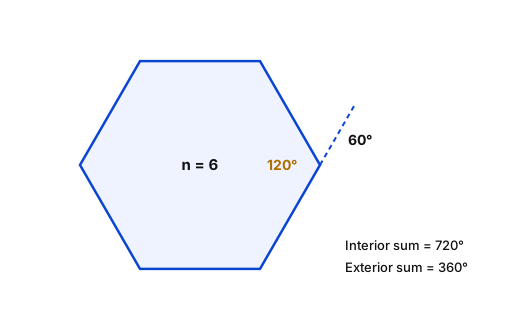
For a regular polygon, the sum of the interior angles is 100% more than the sum of its exterior angles. Each interior angle of the polygon measures x°. What is the value of x?
एक सम बहुभुज के अंतः कोणों का योग उसके बाह्य कोणों के योग से 100% अधिक है। बहुभुज का प्रत्येक अंतः कोण x° है। x का मान क्या है?
  1. A100
  2. B125
  3. C140
  4. D120
Show answer

Concept: Sum of exterior angles of any polygon =360∘; sum of interior angles =(n−2)×180∘.

  1. Interior sum =360∘+100% of 360∘=720∘
  2. (n−2)×180=720⇒n=6
  3. Each interior angle =7206=120∘

Trick: Interior sum =k×360∘ → n=2k+2. Here k=2, so n=6.

Answer: (D) 120

अवधारणा: किसी भी बहुभुज के बाह्य कोणों का योग =360∘; अंतः कोणों का योग =(n−2)×180∘।

  1. अंतः कोणों का योग =360∘+360∘ का 100%=720∘
  2. (n−2)×180=720⇒n=6
  3. प्रत्येक अंतः कोण =7206=120∘

ट्रिक: अंतः योग =k×360∘ → n=2k+2; यहाँ k=2, अतः n=6।

उत्तर: (D) 120

RRB NTPC Graduate CBT 1MathematicsGeometry – PolygonsRRB NTPC Graduate CBT 1 2024 · 13 Jun Shift 1
Q2869.
Find a single discount (rounded up to two decimal places) to equal three consecutive discounts of 6%, 28% and 15%.
6%, 28% और 15% की तीन क्रमिक छूटों के बराबर एकल छूट (दशमलव के दो स्थानों तक पूर्णांकित) ज्ञात कीजिए।
  1. A44.65%
  2. B42.63%
  3. C45.25%
  4. D42.47%
Show answer

Concept: Successive discounts multiply the remaining fractions: Remaining=(1−d1)(1−d2)(1−d3).

  1. 0.94×0.72=0.6768
  2. 0.6768×0.85=0.57528
  3. Single discount =1−0.57528=0.42472=42.47%

Trick: Two at a time: 6%,28%→6+28−6×28100=32.32%; then with 15%: 32.32+15−32.32×15100=42.47%.

Answer: (D) 42.47%

अवधारणा: क्रमागत छूट में बची हुई राशियाँ गुणा होती हैं: शेष=(1−d1)(1−d2)(1−d3)।

  1. 0.94×0.72=0.6768
  2. 0.6768×0.85=0.57528
  3. एकल छूट =1−0.57528=0.42472=42.47%

ट्रिक: दो-दो करके: 6%,28%→6+28−6×28100=32.32%; फिर 15% के साथ: 32.32+15−32.32×15100=42.47%।

उत्तर: (D) 42.47%

RRB NTPC Graduate CBT 1MathematicsSuccessive DiscountsRRB NTPC Graduate CBT 1 2024 · 13 Jun Shift 1
Q2870.
Which of the following ratios is greatest?
निम्नलिखित में से कौन-सा अनुपात सबसे बड़ा है?
  1. A16 : 57
  2. B24 : 54
  3. C17 : 53
  4. D28 : 60
Show answer

Concept: Convert each ratio to a decimal (or compare by cross-multiplication).

  1. 1657≈0.281, 1753≈0.321
  2. 2454=49≈0.444
  3. 2860=715≈0.467
  4. Check: 28×54=1512>24×60=1440, so 28:60 is the greatest.

Trick: Simplify first: 49 vs 715 → cross-multiply 60 vs 63.

Answer: (D) 28:60

अवधारणा: हर अनुपात को दशमलव में बदलें (या तिर्यक गुणा से तुलना करें)।

  1. 1657≈0.281, 1753≈0.321
  2. 2454=49≈0.444
  3. 2860=715≈0.467
  4. जाँच: 28×54=1512>24×60=1440, अतः 28:60 सबसे बड़ा है।

ट्रिक: पहले सरल करें: 49 बनाम 715 → तिर्यक गुणा 60 बनाम 63।

उत्तर: (D) 28:60

RRB NTPC Graduate CBT 1MathematicsRatio ComparisonRRB NTPC Graduate CBT 1 2024 · 13 Jun Shift 1
Q2871.
Read the given statements and conclusions carefully. Assuming that the information given in the statements is true, even if it appears to be at variance with commonly known facts, decide which of the given conclusion(s) logically follow(s) from the statements.
Statements:
All bikes are roads.
Some roads are TVs.
Some TVs are cups.
Conclusions:
(I) All roads are bikes.
(II) All roads are TVs.
दिए गए कथनों और निष्कर्षों को ध्यानपूर्वक पढ़िए। यह मानते हुए कि कथनों में दी गई जानकारी सत्य है, भले ही वह सामान्यतः ज्ञात तथ्यों से भिन्न प्रतीत होती हो, निर्णय कीजिए कि दिए गए निष्कर्षों में से कौन-सा/कौन-से निष्कर्ष कथनों का तार्किक रूप से अनुसरण करता है/करते हैं।
कथन:
सभी बाइक, सड़कें हैं।
कुछ सड़कें, TV हैं।
कुछ TV, कप हैं।
निष्कर्ष:
(I) सभी सड़कें, बाइक हैं।
(II) सभी सड़कें, TV हैं।
  1. ABoth conclusion (I) and (II) followनिष्कर्ष (I) और (II) दोनों अनुसरण करते हैं
  2. BOnly conclusion (II) followsकेवल निष्कर्ष (II) अनुसरण करता है
  3. CNeither conclusion (I) nor (II) followsन तो निष्कर्ष (I) और न ही (II) अनुसरण करता है
  4. DOnly conclusion (I) followsकेवल निष्कर्ष (I) अनुसरण करता है
Show answer

Concept: A conclusion follows only if it is true in every possible Venn diagram of the statements.

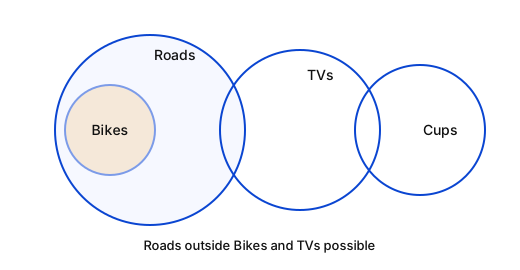
  1. "All bikes are roads" puts Bikes inside Roads – it never makes all roads bikes, so (I) does not follow.
  2. "Some roads are TVs" means only a part of Roads meets TVs; roads outside TVs are possible, so (II) does not follow.
  3. Both conclusions are "All" type, but the statements give no such link.

Trick: "All A are B" never gives "All B are A" – the reverse of an All statement is only "Some B are A".

Answer: (C) Neither conclusion (I) nor (II) follows

अवधारणा: निष्कर्ष तभी सही है जब वह कथनों के हर संभव वेन आरेख में सत्य हो।

  1. "All bikes are roads" से Bikes, Roads के अंदर हैं – इससे "सभी roads bikes हैं" नहीं निकलता, अतः (I) अनुसरण नहीं करता।
  2. "Some roads are TVs" में Roads का केवल कुछ भाग TVs से मिलता है; TVs के बाहर roads संभव हैं, अतः (II) भी नहीं।
  3. दोनों निष्कर्ष "All" प्रकार के हैं, पर कथनों में ऐसा कोई निश्चित संबंध नहीं है।

ट्रिक: "All A are B" का उल्टा कभी "All B are A" नहीं होता – केवल "Some B are A" निकलता है।

उत्तर: (C) न तो निष्कर्ष (I) और न ही (II) अनुसरण करता है

RRB NTPC Graduate CBT 1General Intelligence and ReasoningSyllogismRRB NTPC Graduate CBT 1 2024 · 13 Jun Shift 1
Q2872.
Select the triad that follows the same pattern as that followed by the two triads given below. Both triads follow the same pattern.
OL-QN-SU
LI-NK-PR
उस त्रयी का चयन कीजिए जो उसी पैटर्न का अनुसरण करती है जिसका अनुसरण नीचे दी गई दो त्रयियाँ करती हैं। दोनों त्रयियाँ समान पैटर्न का अनुसरण करती हैं।
OL-QN-SU
LI-NK-PR
  1. ASO-TR-VY
  2. BRO-TQ-VX
  3. CRO-TQ-VY
  4. DSO-TQ-VY
Show answer

Concept: Find the shift of the first letters and of the second letters separately.

  1. OL-QN-SU: O→Q→S is +2,+2; L→N→U is +2,+7.
  2. LI-NK-PR: L→N→P is +2,+2; I→K→R is +2,+7. Same rule.
  3. RO-TQ-VX: R→T→V is +2,+2; O→Q→X is +2,+7 ✔. In (C) Q→Y is +8, in (A)/(D) O→T or O→R breaks +2.

Trick: Check only the last letter first: second-letter jump must be +7 (Q→X).

Answer: (B) RO-TQ-VX

अवधारणा: पहले अक्षरों और दूसरे अक्षरों का अंतर अलग-अलग देखें।

  1. OL-QN-SU: O→Q→S में +2,+2; L→N→U में +2,+7।
  2. LI-NK-PR: L→N→P में +2,+2; I→K→R में +2,+7। वही नियम।
  3. RO-TQ-VX: R→T→V +2,+2; O→Q→X +2,+7 ✔। (C) में Q→Y +8 है, (A)/(D) में +2 टूटता है।

ट्रिक: सबसे पहले अंतिम अक्षर जाँचें: दूसरे अक्षर में +7 की छलांग होनी चाहिए (Q→X)।

उत्तर: (B) RO-TQ-VX

RRB NTPC Graduate CBT 1General Intelligence and ReasoningLetter triads – analogyRRB NTPC Graduate CBT 1 2024 · 13 Jun Shift 1
Q2873.
What will come in place of the question mark (?) in the following equation if '÷' and '–' are interchanged and '×' and '+' are interchanged?
89 ÷ 4984 – 89 × 9 + 2 = ?
यदि '÷' और '–' को आपस में बदल दिया जाए तथा '×' और '+' को आपस में बदल दिया जाए, तो निम्नलिखित समीकरण में प्रश्न चिह्न (?) के स्थान पर क्या आएगा?
89 ÷ 4984 – 89 × 9 + 2 = ?
  1. A15
  2. B51
  3. C55
  4. D92
Show answer

Concept: Interchange the signs first, then solve using BODMAS.

  1. Swap ÷ ↔ – and × ↔ +: 89−4984÷89+9×2
  2. 4984÷89=56 and 9×2=18
  3. 89−56+18=51

Trick: Rewrite the whole expression once with new signs before calculating – avoids half-swapped mistakes.

Answer: (B) 51

अवधारणा: पहले चिह्न बदलें, फिर BODMAS से हल करें।

  1. ÷ ↔ – और × ↔ + बदलने पर: 89−4984÷89+9×2
  2. 4984÷89=56 तथा 9×2=18
  3. 89−56+18=51

ट्रिक: गणना से पहले पूरा व्यंजक एक बार नए चिह्नों के साथ लिख लें – गलती नहीं होगी।

उत्तर: (B) 51

RRB NTPC Graduate CBT 1General Intelligence and ReasoningMathematical operations – sign interchangeRRB NTPC Graduate CBT 1 2024 · 13 Jun Shift 1
Q2874.
What will come in the place of the question mark (?) in the following equation, if ‘+’ and ‘−’ are interchanged and ‘×’ and ‘÷’ are interchanged?
405 ÷ 2 + 369 × 9 − 32 = ?
यदि ‘+’ और ‘−’ को आपस में बदल दिया जाए तथा ‘×’ और ‘÷’ को आपस में बदल दिया जाए, तो निम्नलिखित समीकरण में प्रश्न चिह्न (?) के स्थान पर क्या आएगा?
405 ÷ 2 + 369 × 9 − 32 = ?
  1. A804
  2. B801
  3. C803
  4. D802
Show answer

Concept: Interchange the signs, then apply BODMAS.

  1. Swap + ↔ − and × ↔ ÷: 405×2−369÷9+32
  2. 405×2=810, 369÷9=41
  3. 810−41+32=801

Trick: Do division/multiplication first; only then add and subtract left to right.

Answer: (B) 801

अवधारणा: चिह्न बदलें, फिर BODMAS लगाएँ।

  1. + ↔ − और × ↔ ÷ बदलने पर: 405×2−369÷9+32
  2. 405×2=810, 369÷9=41
  3. 810−41+32=801

ट्रिक: पहले भाग/गुणा, फिर बाएँ से दाएँ जोड़-घटाव।

उत्तर: (B) 801

RRB NTPC Graduate CBT 1General Intelligence and ReasoningMathematical operations – sign interchangeRRB NTPC Graduate CBT 1 2024 · 13 Jun Shift 1
Q2875.
JKL is related to KMO in a certain way based on the English alphabetical order. In the same way, PQR is related to QSU. To which of the following is XYZ related, following the same logic?
अंग्रेज़ी वर्णमाला क्रम के आधार पर JKL एक निश्चित प्रकार से KMO से संबंधित है। उसी प्रकार, PQR, QSU से संबंधित है। समान तर्क का अनुसरण करते हुए, XYZ निम्नलिखित में से किससे संबंधित है?
  1. AYZA
  2. BFED
  3. CABC
  4. DYAC
Show answer

Concept: Compare letter positions of the pair: each letter moves by a different step.

  1. J→K (+1), K→M (+2), L→O (+3); PQR→QSU also +1,+2,+3.
  2. X +1 = Y; Y +2 = A (Z, A – wrapping after Z); Z +3 = C (A, B, C).
  3. So XYZ → YAC.

Trick: After Z, count again from A (circular alphabet).

Answer: (D) YAC

अवधारणा: जोड़े में अक्षरों की स्थिति की तुलना करें: हर अक्षर अलग कदम से बढ़ता है।

  1. J→K (+1), K→M (+2), L→O (+3); PQR→QSU भी +1,+2,+3।
  2. X +1 = Y; Y +2 = A (Z के बाद फिर A); Z +3 = C (A, B, C)।
  3. अतः XYZ → YAC।

ट्रिक: Z के बाद फिर A से गिनें (वृत्ताकार वर्णमाला)।

उत्तर: (D) YAC

RRB NTPC Graduate CBT 1General Intelligence and ReasoningLetter analogyRRB NTPC Graduate CBT 1 2024 · 13 Jun Shift 1
Q2876.
This question is based on the five, three-digit numbers given below.
(Left) 740 636 787 884 316 (Right)
(Example- 697 – First digit = 6, second digit = 9 and third digit = 7)
(NOTE: All operations to be done from left to right.)
What will be the resultant if the second digit of the highest number is added to the third digit of the lowest number?
यह प्रश्न नीचे दी गई तीन अंकों वाली पाँच संख्याओं पर आधारित है।
(बाएँ) 740 636 787 884 316 (दाएँ)
(उदाहरण- 697 – पहला अंक = 6, दूसरा अंक = 9 और तीसरा अंक = 7)
(नोट: सभी संक्रियाएँ बाएँ से दाएँ की जानी हैं।)
यदि सबसे बड़ी संख्या के दूसरे अंक को सबसे छोटी संख्या के तीसरे अंक में जोड़ा जाए, तो परिणाम क्या होगा?
  1. A14
  2. B17
  3. C13
  4. D15
Show answer

Concept: Identify the highest and lowest numbers, then pick the required digits.

  1. Highest number = 884 → second digit = 8.
  2. Lowest number = 316 → third digit = 6.
  3. 8+6=14

Trick: Compare only first digits to find highest/lowest quickly: 8 (884) and 3 (316).

Answer: (A) 14

अवधारणा: सबसे बड़ी और सबसे छोटी संख्या पहचानें, फिर आवश्यक अंक लें।

  1. सबसे बड़ी संख्या = 884 → दूसरा अंक = 8।
  2. सबसे छोटी संख्या = 316 → तीसरा अंक = 6।
  3. 8+6=14

ट्रिक: बड़ी/छोटी संख्या के लिए पहले सिर्फ़ पहले अंक देखें: 8 (884) और 3 (316)।

उत्तर: (A) 14

RRB NTPC Graduate CBT 1General Intelligence and ReasoningNumber-based questionsRRB NTPC Graduate CBT 1 2024 · 13 Jun Shift 1
Q2877.
A, B, C, D, E, F and G are sitting around a circular table facing the centre. D sits third to the right of C. A sits second to the right of B. B is not an immediate neighbour of C. G sits to the immediate right of F. C sits to the immediate left of F. How many people sit between G and E when counted from the left of G?
A, B, C, D, E, F और G एक वृत्ताकार मेज़ के चारों ओर केंद्र की ओर मुख करके बैठे हैं। D, C के दाईं ओर तीसरे स्थान पर बैठा है। A, B के दाईं ओर दूसरे स्थान पर बैठा है। B, C का निकटतम पड़ोसी नहीं है। G, F के ठीक दाईं ओर बैठा है। C, F के ठीक बाईं ओर बैठा है। G के बाईं ओर से गिनने पर G और E के बीच कितने व्यक्ति बैठे हैं?
  1. AThreeतीन
  2. BNoneकोई नहीं
  3. CTwoदो
  4. DOneएक
Show answer

Concept: Facing the centre: right = anticlockwise, left = clockwise.

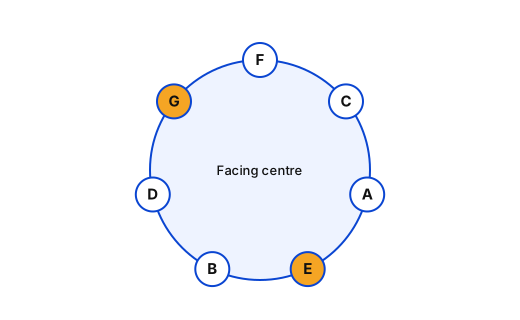
  1. Fix F. C is immediate left of F, G is immediate right of F ⇒ G, F, C are together.
  2. D is third to the right of C. B is not next to C and A is second to the right of B ⇒ only B with A two places right of it fits, so E takes the last seat.
  3. Clockwise order: F, C, A, E, B, D, G.
  4. Going left (clockwise) from G: F, C, A, then E ⇒ three persons between.

Trick: Fix the pair with "immediate" clues first, then place third/second-to clues.

Answer: (A) Three

अवधारणा: केंद्र की ओर मुख होने पर: दायाँ = वामावर्त, बायाँ = दक्षिणावर्त।

  1. F को तय करें। C, F के ठीक बाएँ और G, F के ठीक दाएँ ⇒ G, F, C साथ हैं।
  2. D, C के दाएँ तीसरा। B, C का पड़ोसी नहीं और A, B के दाएँ दूसरा ⇒ यही स्थिति बैठती है; बचा स्थान E का।
  3. दक्षिणावर्त क्रम: F, C, A, E, B, D, G।
  4. G से बाएँ (दक्षिणावर्त) गिनें: F, C, A, फिर E ⇒ बीच में तीन व्यक्ति।

ट्रिक: पहले "ठीक बगल" वाले संकेत लगाएँ, फिर दूसरे/तीसरे स्थान वाले।

उत्तर: (A) तीन

RRB NTPC Graduate CBT 1General Intelligence and ReasoningCircular seating arrangementRRB NTPC Graduate CBT 1 2024 · 13 Jun Shift 1
Q2878.
If 1 is added to each odd digit and 2 is subtracted from each even digit in the number 3762184, what will be the sum of the highest and lowest digits in the number thus formed?
यदि संख्या 3762184 में प्रत्येक विषम अंक में 1 जोड़ा जाए और प्रत्येक सम अंक में से 2 घटाया जाए, तो इस प्रकार बनी संख्या में सबसे बड़े और सबसे छोटे अंक का योग क्या होगा?
  1. A6
  2. B9
  3. C7
  4. D8
Show answer

Concept: Apply the rule to each digit separately.

  1. 3762184: odd digits +1 → 3→4, 7→8, 1→2.
  2. Even digits −2 → 6→4, 2→0, 8→6, 4→2.
  3. New number 4840262: highest 8, lowest 0 ⇒ 8+0=8.

Trick: Write the new digit under each old digit – no mix-ups.

Answer: (D) 8

अवधारणा: नियम हर अंक पर अलग-अलग लगाएँ।

  1. 3762184: विषम अंक +1 → 3→4, 7→8, 1→2।
  2. सम अंक −2 → 6→4, 2→0, 8→6, 4→2।
  3. नई संख्या 4840262: सबसे बड़ा 8, सबसे छोटा 0 ⇒ 8+0=8।

ट्रिक: हर पुराने अंक के नीचे नया अंक लिखें – गलती नहीं होगी।

उत्तर: (D) 8

RRB NTPC Graduate CBT 1General Intelligence and ReasoningNumber operations – digit changeRRB NTPC Graduate CBT 1 2024 · 13 Jun Shift 1
Q2879.
Which of the following letter-number-clusters will replace the question mark (?) in the given series to make it logically complete?
GOQ 35, HPR 32, IQS 29, JRT 26, ?
निम्नलिखित में से कौन-सा अक्षर-संख्या समूह दी गई श्रृंखला में प्रश्न चिह्न (?) के स्थान पर आकर उसे तार्किक रूप से पूर्ण करेगा?
GOQ 35, HPR 32, IQS 29, JRT 26, ?
  1. AKSU 23
  2. BKPN 22
  3. CRQM 22
  4. DRPM 23
Show answer

Concept: Track the letters and the numbers separately.

  1. First letters: G, H, I, J → K (+1). Second: O, P, Q, R → S. Third: Q, R, S, T → U.
  2. Numbers: 35, 32, 29, 26 → 26−3=23.
  3. Next term = KSU 23.

Trick: Number pattern (−3) alone removes the 22 options; letters +1 give KSU.

Answer: (A) KSU 23

अवधारणा: अक्षरों और संख्याओं को अलग-अलग देखें।

  1. पहले अक्षर: G, H, I, J → K (+1)। दूसरे: O, P, Q, R → S। तीसरे: Q, R, S, T → U।
  2. संख्याएँ: 35, 32, 29, 26 → 26−3=23।
  3. अगला पद = KSU 23।

ट्रिक: केवल संख्या (−3) से 22 वाले विकल्प हट जाते हैं; अक्षर +1 से KSU।

उत्तर: (A) KSU 23

RRB NTPC Graduate CBT 1General Intelligence and ReasoningLetter-number seriesRRB NTPC Graduate CBT 1 2024 · 13 Jun Shift 1
Q2880.
G, H, I, J, K and X live on six different floors of the same building. The lowermost floor in the building is numbered 1, the floor above it, number 2 and so on, till the topmost floor is numbered 6. K lives on an odd numbered floor but not on the lowermost floor. Only two people live between K and G. Only two people live between I and H. X lives immediately below K. No one lives above I. How many people live between J and X?
G, H, I, J, K और X एक ही इमारत की छह अलग-अलग मंज़िलों पर रहते हैं। इमारत की सबसे निचली मंज़िल की संख्या 1 है, उसके ऊपर वाली मंज़िल की संख्या 2 है और इसी प्रकार सबसे ऊपरी मंज़िल की संख्या 6 है। K एक विषम संख्या वाली मंज़िल पर रहता है, परंतु सबसे निचली मंज़िल पर नहीं। K और G के बीच केवल दो व्यक्ति रहते हैं। I और H के बीच केवल दो व्यक्ति रहते हैं। X, K के ठीक नीचे रहता है। I के ऊपर कोई नहीं रहता है। J और X के बीच कितने व्यक्ति रहते हैं?
  1. ATwoदो
  2. BThreeतीन
  3. CFourचार
  4. DOneएक
Show answer

Concept: Start with the fixed clues ("no one above", "immediately below"), then use gap clues.

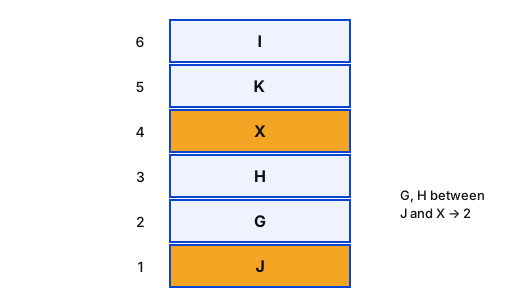
  1. No one above I ⇒ I on floor 6. Two between I and H ⇒ H on 3.
  2. K odd, not 1, not 3 ⇒ K on 5; X immediately below ⇒ X on 4.
  3. Two between K and G ⇒ G on 2; J on the remaining floor 1.
  4. Between J (1) and X (4): G and H ⇒ two persons.

Trick: A "top" clue (no one above) is the best anchor – place it first.

Answer: (A) Two

अवधारणा: पहले निश्चित संकेत ("ऊपर कोई नहीं", "ठीक नीचे") लगाएँ, फिर अंतर वाले संकेत।

  1. I के ऊपर कोई नहीं ⇒ I मंज़िल 6 पर। I और H के बीच दो ⇒ H मंज़िल 3 पर।
  2. K विषम, 1 नहीं, 3 नहीं ⇒ K मंज़िल 5; X ठीक नीचे ⇒ X मंज़िल 4।
  3. K और G के बीच दो ⇒ G मंज़िल 2; शेष मंज़िल 1 पर J।
  4. J (1) और X (4) के बीच: G और H ⇒ दो व्यक्ति।

ट्रिक: "सबसे ऊपर" वाला संकेत सबसे अच्छा आधार है – पहले उसे लगाएँ।

उत्तर: (A) दो

RRB NTPC Graduate CBT 1General Intelligence and ReasoningFloor puzzleRRB NTPC Graduate CBT 1 2024 · 13 Jun Shift 1