Q2961.Simplify:
सरल कीजिए:
- A27
- B18
- C23
- D21
Show answer
Concept: Write everything as powers of small primes, then cancel.
- Numerator: .
- Denominator: .
- Value .
Trick: and , so .
Answer: (B) 18
अवधारणा: सभी को छोटी अभाज्य संख्याओं की घात में लिखें और काटें।
- अंश: ।
- हर: ।
- मान ।
ट्रिक: और , अतः ।
उत्तर: (B) 18
RRB NTPC Graduate CBT 1MathematicsSimplification (Powers and Roots)RRB NTPC Graduate CBT 1 2024 · 12 Jun Shift 3
Q2962.The sum of 2 times Priya's present age and Jaya's present age is 48 years. Sanjay's is presently 2 times as old as Jaya. Mohit's present age is 4 years more than Priya's present age. The sum of the present ages of Sanjay and Mohit is 46 years. What is the sum of the present ages (in years) of Priya and Jaya?
प्रिया की वर्तमान आयु के 2 गुने और जया की वर्तमान आयु का योग 48 वर्ष है। संजय की वर्तमान आयु जया की आयु की 2 गुनी है। मोहित की वर्तमान आयु प्रिया की वर्तमान आयु से 4 वर्ष अधिक है। संजय और मोहित की वर्तमान आयु का योग 46 वर्ष है। प्रिया और जया की वर्तमान आयु का योग (वर्षों में) क्या है?
- A40
- B38
- C30
- D15
Show answer
Concept: Convert each statement into an equation and add the two final equations.
- … (i)
- , and … (ii)
- Add (i) and (ii): .
Trick: When coefficients are swapped ( and ), just add and divide by 3.
Answer: (C) 30
अवधारणा: हर कथन को समीकरण में बदलें और अंतिम दोनों समीकरण जोड़ें।
- … (i)
- , और … (ii)
- (i) + (ii): ।
ट्रिक: गुणांक उलटे हों ( और ) तो जोड़कर 3 से भाग दें।
उत्तर: (C) 30
RRB NTPC Graduate CBT 1MathematicsProblems on AgesRRB NTPC Graduate CBT 1 2024 · 12 Jun Shift 3
Q2963.If 25% of k is 10 less than 1200% of 25, then k is:
यदि k का 25%, 25 के 1200% से 10 कम है, तो k है:
- A1200
- B1120
- C1140
- D1160
Show answer
Concept: Translate the sentence directly into an equation.
- of .
- of .
- .
Trick: , so multiply by 4: .
Answer: (D) 1160
अवधारणा: वाक्य को सीधे समीकरण में बदलें।
- 25 का ।
- का ।
- ।
ट्रिक: , अतः ।
उत्तर: (D) 1160
RRB NTPC Graduate CBT 1MathematicsPercentageRRB NTPC Graduate CBT 1 2024 · 12 Jun Shift 3
Q2964.Pipes A and B can fill an empty cistern in 21 minutes and 42 minutes, respectively. Both Pipe A and Pipe B are opened together. After how much time should Pipe B be turned off so that the empty cistern is completely filled in a total of 16 minutes?
पाइप A और B एक खाली टंकी को क्रमशः 21 मिनट और 42 मिनट में भर सकते हैं। पाइप A और पाइप B दोनों को एक साथ खोला जाता है। पाइप B को कितने समय बाद बंद कर देना चाहिए ताकि खाली टंकी कुल 16 मिनट में पूरी भर जाए?
- A5 minutes5 मिनट
- B10 minutes10 मिनट
- C15 minutes15 मिनट
- D12 minutes12 मिनट
Show answer
Concept: Take tank capacity = LCM of times; work = rate × time for each pipe.
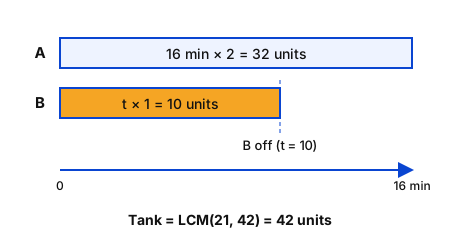
- Capacity units. Rate of A units/min, B unit/min.
- A runs all 16 minutes: units.
- Remaining units are filled by B ⇒ B runs minutes.
Trick: Fill-time of the pipe kept open for the full period first; the shortfall gives the other pipe's time.
Answer: (B) 10 minutes
अवधारणा: टंकी की क्षमता = समयों का LCM; हर पाइप का कार्य = दर × समय।
- क्षमता इकाई। A की दर इकाई/मिनट, B इकाई/मिनट।
- A पूरे 16 मिनट चलता है: इकाई।
- शेष इकाई B भरता है ⇒ B मिनट चलता है।
ट्रिक: पूरे समय चलने वाले पाइप का कार्य पहले निकालें; बची कमी दूसरे पाइप का समय देती है।
उत्तर: (B) 10 मिनट
RRB NTPC Graduate CBT 1MathematicsPipes and CisternRRB NTPC Graduate CBT 1 2024 · 12 Jun Shift 3
Q2965.Find the discriminant of the quadratic equation 3x2− 4x + 2 = 0, and hence determine the nature of its roots.
द्विघात समीकरण 3x2− 4x + 2 = 0 का विविक्तकर (discriminant) ज्ञात कीजिए, और इससे इसके मूलों की प्रकृति निर्धारित कीजिए।
- ADiscriminant = −8, roots are imaginaryविविक्तकर = −8, मूल काल्पनिक हैं
- BDiscriminant = 8, roots are real and equalविविक्तकर = 8, मूल वास्तविक और समान हैं
- CDiscriminant = −8, roots are real and distinctविविक्तकर = −8, मूल वास्तविक और भिन्न हैं
- DDiscriminant = 8, roots are real and distinctविविक्तकर = 8, मूल वास्तविक और भिन्न हैं
Show answer
Concept: For , ; ⇒ roots imaginary, ⇒ real and equal, ⇒ real and distinct.
- , , .
- .
- ⇒ the roots are imaginary (not real).
Trick: A negative discriminant can never give real roots – options with and "real" are impossible.
Answer: (A) Discriminant , roots are imaginary
अवधारणा: के लिए ; ⇒ काल्पनिक मूल, ⇒ वास्तविक व बराबर, ⇒ वास्तविक व भिन्न।
- , , ।
- ।
- ⇒ मूल काल्पनिक (imaginary) हैं।
ट्रिक: ऋणात्मक विविक्तकर से कभी वास्तविक मूल नहीं मिलते।
उत्तर: (A) विविक्तकर , मूल काल्पनिक हैं
RRB NTPC Graduate CBT 1MathematicsQuadratic Equations – Nature of RootsRRB NTPC Graduate CBT 1 2024 · 12 Jun Shift 3
Q2966.What is the third proportional of 10x2 and 30xy?
10x2 और 30xy का तृतीयानुपाती क्या है?
- A92y2
- B87y2
- C93y2
- D90y2
Show answer
Concept: Third proportional of and is where , i.e. .
- , .
- .
- .
Trick: Numbers alone: ; variables: .
Answer: (D)
अवधारणा: और का तृतीयानुपाती है जहाँ , अर्थात् ।
- , ।
- ।
- ।
ट्रिक: केवल संख्याएँ: ; चर: ।
उत्तर: (D)
RRB NTPC Graduate CBT 1MathematicsThird ProportionalRRB NTPC Graduate CBT 1 2024 · 12 Jun Shift 3
Q2967.Simplify:
सरल कीजिए:
- A
- B
- C
- D
Show answer
Concept: BODMAS – brackets first, and "of" is done before ÷ and ×.
- .
- .
- .
Trick: , so the bracket is just .
Answer: (B)
अवधारणा: BODMAS – पहले कोष्ठक, और "का (of)" ÷ और × से पहले।
- ।
- ।
- ।
ट्रिक: , अतः कोष्ठक ।
उत्तर: (B)
RRB NTPC Graduate CBT 1MathematicsSimplification (BODMAS)RRB NTPC Graduate CBT 1 2024 · 12 Jun Shift 3
Q2968.Two transversal lines S and T cut a set of distinct parallel lines. S cuts the parallel lines in points A, B, C and D and T cuts the parallel lines in points E, F, G and H. If AB = 5 cm, CD = 3 cm and EF = 15 cm, then the length (in cm) of GH is:
दो तिर्यक रेखाएँ S और T भिन्न समांतर रेखाओं के एक समूह को काटती हैं। S समांतर रेखाओं को बिंदुओं A, B, C और D पर काटती है तथा T समांतर रेखाओं को बिंदुओं E, F, G और H पर काटती है। यदि AB = 5 cm, CD = 3 cm और EF = 15 cm है, तो GH की लंबाई (cm में) है:
- A9
- B6
- C8
- D4
Show answer
Concept: Parallel lines cut any two transversals proportionally: .
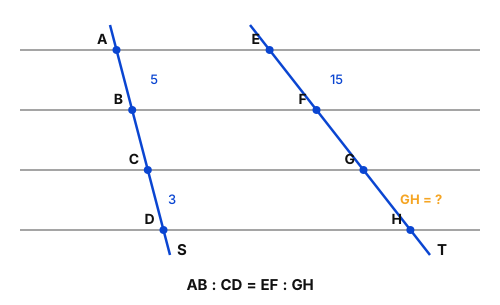
- .
- .
Trick: T's intercepts are times S's, so .
Answer: (A) 9
अवधारणा: समानांतर रेखाएँ किन्हीं दो तिर्यक रेखाओं (transversals) को समानुपात में काटती हैं: ।
- ।
- ।
ट्रिक: T के अंतःखंड S के गुना हैं, अतः ।
उत्तर: (A) 9
RRB NTPC Graduate CBT 1MathematicsGeometry – Basic Proportionality (Intercepts)RRB NTPC Graduate CBT 1 2024 · 12 Jun Shift 3
Q2969.A 120 m long train overtakes a man moving at a speed of 9 km/hr (in same direction) in 18 seconds. How much time (in seconds) will this train take to completely cross another 230 m long train, moving in the opposite direction at a speed of 27 km/hr?
120 m लंबी एक रेलगाड़ी 9 km/hr की चाल से (समान दिशा में) चल रहे एक व्यक्ति को 18 सेकंड में पार करती है। यह रेलगाड़ी विपरीत दिशा में 27 km/hr की चाल से चल रही 230 m लंबी एक अन्य रेलगाड़ी को पूरी तरह पार करने में कितना समय (सेकंड में) लेगी?
- A17
- B35
- C21
- D33
Show answer
Concept: Same direction ⇒ relative speed = difference; opposite ⇒ sum. Distance = total length.
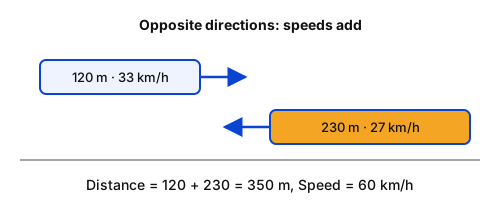
- Overtaking the man: relative speed ⇒ train speed .
- Opposite direction: relative speed .
- Distance .
- Time .
Trick: : .
Answer: (C) 21
अवधारणा: एक ही दिशा ⇒ सापेक्ष चाल = अंतर; विपरीत ⇒ योग। दूरी = दोनों लंबाइयों का योग।
- व्यक्ति को पार करना: सापेक्ष चाल ⇒ ट्रेन की चाल ।
- विपरीत दिशा: सापेक्ष चाल ।
- दूरी ।
- समय ।
ट्रिक: : ।
उत्तर: (C) 21
RRB NTPC Graduate CBT 1MathematicsSpeed – TrainsRRB NTPC Graduate CBT 1 2024 · 12 Jun Shift 3
Q2970.In an isosceles triangle, the vertex angle measures 14°. What is the measure of each of the base angles?
एक समद्विबाहु त्रिभुज में, शीर्ष कोण का माप 14° है। प्रत्येक आधार कोण का माप क्या है?
- A103° and 103°103° और 103°
- B86° and 86°86° और 86°
- C83° and 83°83° और 83°
- D79° and 79°79° और 79°
Show answer
Concept: In an isosceles triangle the two base angles are equal and all angles sum to .
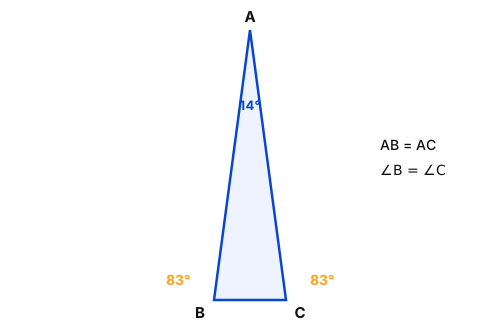
- Base angles together .
- Each base angle .
Trick: Each base angle .
Answer: (C) and
अवधारणा: समद्विबाहु त्रिभुज के दोनों आधार कोण बराबर होते हैं और कोणों का योग है।
- दोनों आधार कोणों का योग ।
- प्रत्येक आधार कोण ।
ट्रिक: आधार कोण ।
उत्तर: (C) और
RRB NTPC Graduate CBT 1MathematicsGeometry – Isosceles TriangleRRB NTPC Graduate CBT 1 2024 · 12 Jun Shift 3
Q2971.What should come in place of the question mark (?) in the given series?
982 980 976 970 962 ?
दी गई श्रृंखला में प्रश्न चिह्न (?) के स्थान पर क्या आना चाहिए?
982 980 976 970 962 ?
- A952
- B954
- C948
- D950
Show answer
Concept: Check the differences between consecutive terms.
- , , , .
- Differences are even numbers increasing by 2, so the next difference is .
- .
Trick: Subtract consecutive even numbers: .
Answer: (A) 952
अवधारणा: क्रमागत पदों का अंतर देखें।
- , , , ।
- अंतर सम संख्याएँ हैं जो 2-2 बढ़ रही हैं, अतः अगला अंतर होगा।
- ।
ट्रिक: क्रमागत सम संख्याएँ घटाएँ: ।
उत्तर: (A) 952
RRB NTPC Graduate CBT 1General Intelligence and ReasoningNumber SeriesRRB NTPC Graduate CBT 1 2024 · 12 Jun Shift 3
Q2972.If 2 is added to each even digit and 3 is subtracted from each odd digit in the number 596432, what will be the sum of the greatest and smallest digits in the new number thus formed?
यदि संख्या 596432 में प्रत्येक सम अंक में 2 जोड़ा जाए और प्रत्येक विषम अंक में से 3 घटाया जाए, तो इस प्रकार बनी नई संख्या में सबसे बड़े और सबसे छोटे अंक का योग क्या होगा?
- A8
- B12
- C6
- D10
Show answer
Concept: Apply the rule digit by digit.
- 596432: odd digits become ; even digits become .
- New number: 2 6 8 6 0 4.
- Greatest digit , smallest digit , sum .
Trick: Only the extreme digits matter: largest even digit and odd digit .
Answer: (A) 8
अवधारणा: प्रत्येक अंक पर नियम लगाएँ।
- 596432 में विषम अंक बनते हैं ; सम अंक बनते हैं ।
- नई संख्या: 2 6 8 6 0 4।
- सबसे बड़ा अंक , सबसे छोटा , योग ।
ट्रिक: केवल सबसे बड़ा और सबसे छोटा अंक देखें: और ।
उत्तर: (A) 8
RRB NTPC Graduate CBT 1General Intelligence and ReasoningNumber OperationsRRB NTPC Graduate CBT 1 2024 · 12 Jun Shift 3
Q2973.If ‘A’ stands for ‘÷’, ‘B’ stands for ‘×’, ‘C’ stands for ‘+’ and ‘D’ stands for ‘−’, then what will come in place of question mark (?) in the following equation?
43 D 15 C 7 B 9 D (28 A 2) = ?
यदि 'A' का अर्थ '÷', 'B' का अर्थ '×', 'C' का अर्थ '+' और 'D' का अर्थ '−' है, तो निम्नलिखित समीकरण में प्रश्न चिह्न (?) के स्थान पर क्या आएगा?
43 D 15 C 7 B 9 D (28 A 2) = ?
- A83
- B92
- C64
- D77
Show answer
Concept: Replace the letters by signs, then use BODMAS.
- Expression: .
- Bracket: ; multiplication: .
- .
Trick: Write the sign-converted expression first, then solve bracket → ×/÷ → +/−.
Answer: (D) 77
अवधारणा: अक्षरों को चिह्नों से बदलें, फिर BODMAS लगाएँ।
- व्यंजक: ।
- कोष्ठक: ; गुणा: ।
- ।
ट्रिक: पहले चिह्न बदलकर पूरा व्यंजक लिखें, फिर कोष्ठक → ×/÷ → +/−।
उत्तर: (D) 77
RRB NTPC Graduate CBT 1General Intelligence and ReasoningMathematical OperationsRRB NTPC Graduate CBT 1 2024 · 12 Jun Shift 3
Q2974.Seven people, I, J, K, L, O, P and Q are sitting in a row, facing north. No one sits to the left of J. Only four people sit between J and K. Only three people sit to the right of O. I sits to the immediate left of L. P is not an immediate neighbour of O. Who sits at the rightmost end of the line?
सात व्यक्ति, I, J, K, L, O, P और Q एक पंक्ति में उत्तर की ओर मुख करके बैठे हैं। J के बाईं ओर कोई नहीं बैठा है। J और K के बीच केवल चार व्यक्ति बैठे हैं। O के दाईं ओर केवल तीन व्यक्ति बैठे हैं। I, L के ठीक बाईं ओर बैठा है। P, O का निकटतम पड़ोसी नहीं है। पंक्ति के सबसे दाएँ छोर पर कौन बैठा है?
- AP
- BJ
- CI
- DL
Show answer
Concept: Fix definite positions first (number the seats 1–7 from left).
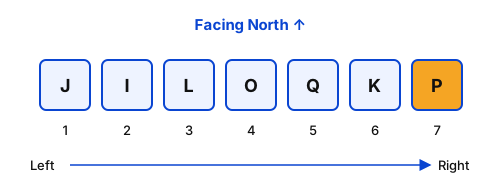
- No one to the left of J → J at 1; four people between J and K → K at 6.
- Three people to the right of O → O at 4.
- I immediately left of L: only free adjacent pair is 2–3 → I at 2, L at 3.
- P and Q take 5 and 7; P is not next to O → P at 7, Q at 5.
Trick: 'No one to the left' = extreme left end; use the count clues next.
Answer: (A) P
अवधारणा: पहले निश्चित स्थान तय करें (बाएँ से सीटें 1–7)।
- J के बाएँ कोई नहीं → J स्थान 1 पर; J और K के बीच चार व्यक्ति → K स्थान 6 पर।
- O के दाएँ तीन व्यक्ति → O स्थान 4 पर।
- I, L के ठीक बाएँ: खाली सटी जोड़ी केवल 2–3 → I = 2, L = 3।
- P और Q के लिए 5 व 7; P, O का पड़ोसी नहीं → P = 7, Q = 5।
ट्रिक: 'बाएँ कोई नहीं' = सबसे बायाँ सिरा; फिर गिनती वाले संकेत लगाएँ।
उत्तर: (A) P
RRB NTPC Graduate CBT 1General Intelligence and ReasoningSeating ArrangementRRB NTPC Graduate CBT 1 2024 · 12 Jun Shift 3
Q2975.Shaan starts from Point A and drives 6 km towards North. He then takes a right turn, drives 7 km, turns right and drives 12 km. He then takes a right turn and drives 8 km. He takes a final right turn, drives 6 km and stops at Point P. How far (shortest distance) and towards which direction should he drive in order to reach Point A again? (All turns are 90° turns only unless specified)
शान बिंदु A से शुरू करता है और उत्तर की ओर 6 km गाड़ी चलाता है। फिर वह दाएँ मुड़ता है, 7 km गाड़ी चलाता है, दाएँ मुड़ता है और 12 km गाड़ी चलाता है। फिर वह दाएँ मुड़ता है और 8 km गाड़ी चलाता है। वह अंतिम बार दाएँ मुड़ता है, 6 km गाड़ी चलाता है और बिंदु P पर रुक जाता है। बिंदु A पर फिर से पहुँचने के लिए उसे कितनी दूरी (न्यूनतम दूरी) और किस दिशा में गाड़ी चलानी चाहिए? (जब तक निर्दिष्ट न किया जाए, सभी मोड़ केवल 90° के मोड़ हैं)
- A2 km to the eastपूर्व की ओर 2 km
- B3 km to the eastपूर्व की ओर 3 km
- C4 km to the eastपूर्व की ओर 4 km
- D1 km to the eastपूर्व की ओर 1 km
Show answer
Concept: Track the position on a coordinate grid, taking A as .
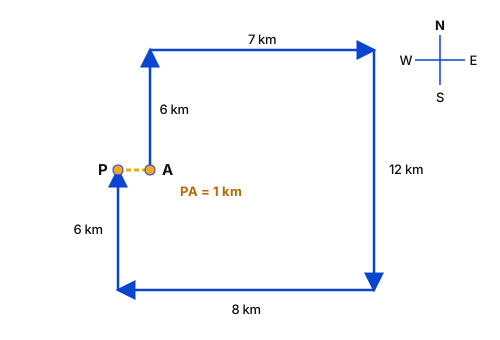
- 6 km North → ; right turn = East 7 km → .
- Right = South 12 km → ; right = West 8 km → .
- Right = North 6 km → P .
- P is 1 km west of A, so he must drive 1 km towards the East.
Trick: Net East–West ; net North–South .
Answer: (D) 1 km to the east
अवधारणा: A को मानकर निर्देशांक से स्थिति ट्रैक करें।
- 6 km उत्तर → ; दाएँ मुड़कर पूर्व 7 km → ।
- दाएँ = दक्षिण 12 km → ; दाएँ = पश्चिम 8 km → ।
- दाएँ = उत्तर 6 km → P ।
- P, A से 1 km पश्चिम में है, अतः उसे 1 km पूर्व की ओर जाना होगा।
ट्रिक: शुद्ध पूर्व–पश्चिम ; शुद्ध उत्तर–दक्षिण ।
उत्तर: (D) 1 km पूर्व की ओर
RRB NTPC Graduate CBT 1General Intelligence and ReasoningDirection and DistanceRRB NTPC Graduate CBT 1 2024 · 12 Jun Shift 3
Q2976.In a certain code language, ‘FARE’ is coded as ‘8432’ and ‘FEAT’ is coded as ‘3287’. What is the code for ‘R’ in the given code language?
एक निश्चित कूट भाषा में, 'FARE' को '8432' और 'FEAT' को '3287' के रूप में कूटबद्ध किया जाता है। दी गई कूट भाषा में 'R' के लिए कूट क्या है?
- A2
- B3
- C8
- D4
Show answer
Concept: Match common letters with common digits.
- FARE → 8, 4, 3, 2 and FEAT → 3, 2, 8, 7.
- Common letters F, A, E ↔ common digits 8, 3, 2.
- Letter only in FARE is R; digit only in its code is 4. So R = 4 (and T = 7).
Trick: Uncommon letter ↔ uncommon digit in the same word.
Answer: (D) 4
अवधारणा: उभयनिष्ठ अक्षरों को उभयनिष्ठ अंकों से मिलाएँ।
- FARE → 8, 4, 3, 2 तथा FEAT → 3, 2, 8, 7।
- उभयनिष्ठ अक्षर F, A, E ↔ उभयनिष्ठ अंक 8, 3, 2।
- केवल FARE में R है और उसके कोड में केवल 4 बचा है। अतः R = 4 (और T = 7)।
ट्रिक: एक शब्द का बचा अक्षर ↔ उसी कोड का बचा अंक।
उत्तर: (D) 4
RRB NTPC Graduate CBT 1General Intelligence and ReasoningCoding-DecodingRRB NTPC Graduate CBT 1 2024 · 12 Jun Shift 3
Q2977.Refer to the following number and symbol series and answer the question that follows. Counting to be done from left to right only.
(Left) 1 @ 2 2 7 © & 8 6 * # 9 3 6 & 6 # & * © @ 8 (Right)
How many such numbers are there each of which is immediately preceded by a number and also immediately followed by a number?
निम्नलिखित संख्या और प्रतीक श्रृंखला को देखिए और उसके बाद आने वाले प्रश्न का उत्तर दीजिए। गिनती केवल बाएँ से दाएँ की जानी है।
(बाएँ) 1 @ 2 2 7 © & 8 6 * # 9 3 6 & 6 # & * © @ 8 (दाएँ)
ऐसी कितनी संख्याएँ हैं जिनमें से प्रत्येक के ठीक पहले एक संख्या है और ठीक बाद भी एक संख्या है?
- A1
- B3
- C2
- D4
Show answer
Concept: Look for the pattern number–number–number.
- 2 2 7: the second 2 is preceded by 2 and followed by 7 ✔.
- 9 3 6: 3 is preceded by 9 and followed by 6 ✔.
- Others fail (e.g. 8 6 *: 6 is followed by a symbol; 3 6 &: 6 is followed by a symbol).
Trick: Find runs of 3 or more consecutive numbers; each run of length gives answers.
Answer: (C) 2
अवधारणा: संख्या–संख्या–संख्या का पैटर्न खोजें।
- 2 2 7: दूसरे 2 से पहले 2 और बाद में 7 ✔।
- 9 3 6: 3 से पहले 9 और बाद में 6 ✔।
- बाकी असफल (जैसे 8 6 *: 6 के बाद चिह्न; 3 6 &: 6 के बाद चिह्न)।
ट्रिक: लगातार 3 या अधिक संख्याओं के समूह खोजें; लंबाई का समूह उत्तर देता है।
उत्तर: (C) 2
RRB NTPC Graduate CBT 1General Intelligence and ReasoningAlphanumeric SeriesRRB NTPC Graduate CBT 1 2024 · 12 Jun Shift 3
Q2978.This question is based on the five, three-digit numbers given below.
(Left) 325 503 158 391 144 (Right)
(Example- 697 – First digit = 6, second digit = 9 and third digit = 7)
(NOTE: All operations to be done from left to right.)
What will be the resultant if the second digit of the highest number is added to the first digit of the lowest number?
यह प्रश्न नीचे दी गई तीन अंकों वाली पाँच संख्याओं पर आधारित है।
(बाएँ) 325 503 158 391 144 (दाएँ)
(उदाहरण- 697 – पहला अंक = 6, दूसरा अंक = 9 और तीसरा अंक = 7)
(नोट: सभी संक्रियाएँ बाएँ से दाएँ की जानी हैं।)
यदि सबसे बड़ी संख्या के दूसरे अंक को सबसे छोटी संख्या के पहले अंक में जोड़ा जाए, तो परिणाम क्या होगा?
- A2
- B0
- C4
- D1
Show answer
Concept: Identify the highest and lowest numbers, then pick the required digits.
- Highest number → second digit .
- Lowest number → first digit .
- .
Trick: Compare the hundreds digits first: 5 is highest, 1 lowest (144 is less than 158).
Answer: (D) 1
अवधारणा: सबसे बड़ी और सबसे छोटी संख्या पहचानें, फिर अंक चुनें।
- सबसे बड़ी संख्या → दूसरा अंक ।
- सबसे छोटी संख्या → पहला अंक ।
- ।
ट्रिक: पहले सैकड़े का अंक देखें: 5 सबसे बड़ा; 1 वाले में 144, 158 से छोटा।
उत्तर: (D) 1
RRB NTPC Graduate CBT 1General Intelligence and ReasoningNumber PuzzleRRB NTPC Graduate CBT 1 2024 · 12 Jun Shift 3
Q2979.In this question, a group of letters is coded by using numbers and symbols as per the table given below and the conditions which follow.
Conditions:
1. If the 1
st letter is a vowel and the 3
rd letter is a consonant, both are to be coded as the code for that 3
rd letter consonant.
2. If the 1
st and last letters are vowels, both are to be coded as ‘N’.
3. If the 2
nd and last letters are vowels, their codes are to be interchanged.
What is the correct combination of codes (by following only the applicable condition(s)) for the following letters?
AJSPT
इस प्रश्न में, नीचे दी गई तालिका और उसके बाद दी गई शर्तों के अनुसार अक्षरों के एक समूह को संख्याओं और प्रतीकों का उपयोग करके कूटबद्ध किया गया है।
शर्तें:
1. यदि पहला अक्षर स्वर है और तीसरा अक्षर व्यंजन है, तो दोनों को उस तीसरे अक्षर (व्यंजन) के कूट के रूप में कूटबद्ध किया जाना है।
2. यदि पहला और अंतिम अक्षर स्वर हैं, तो दोनों को 'N' के रूप में कूटबद्ध किया जाना है।
3. यदि दूसरा और अंतिम अक्षर स्वर हैं, तो उनके कूट आपस में बदल दिए जाने हैं।
निम्नलिखित अक्षरों के लिए कूटों का सही संयोजन (केवल लागू शर्त/शर्तों का पालन करते हुए) क्या है?
AJSPT
- A3 $ % @ *
- B3 $ @ % *
- C3 $ 3 % *
- D@ $ @ % *
Show answer
Concept: Check each condition against AJSPT, then code letter by letter.
- Condition 1: 1st letter A is a vowel and 3rd letter S is a consonant → applies; both A and S get the code of S, i.e. @.
- Condition 2: last letter T is not a vowel → not applicable. Condition 3: 2nd letter J is not a vowel → not applicable.
- Codes: A → @, J → $, S → @, P → %, T → *.
Trick: Test the conditions first; only then use the table.
Answer: (D) @ $ @ % *
अवधारणा: AJSPT पर हर शर्त जाँचें, फिर अक्षरवार कोड लिखें।
- शर्त 1: पहला अक्षर A स्वर और तीसरा S व्यंजन → लागू; A और S दोनों को S का कोड @ मिलेगा।
- शर्त 2: अंतिम अक्षर T स्वर नहीं → लागू नहीं। शर्त 3: दूसरा अक्षर J स्वर नहीं → लागू नहीं।
- कोड: A → @, J → $, S → @, P → %, T → *।
ट्रिक: पहले शर्तें जाँचें, फिर तालिका देखें।
उत्तर: (D) @ $ @ % *
RRB NTPC Graduate CBT 1General Intelligence and ReasoningCoding with ConditionsRRB NTPC Graduate CBT 1 2024 · 12 Jun Shift 3
Q2980.M, N, O, S, T and U live on six different floors of the same building. The lowermost floor in the building is numbered 1, the floor above it, number 2 and so on till the topmost floor is numbered 6. S lives on floor numbered 5. O lives on a floor above S. Only T lives below N. U lives on an even numbered floor. How many people live below M?
M, N, O, S, T और U एक ही इमारत की छह अलग-अलग मंज़िलों पर रहते हैं। इमारत की सबसे निचली मंज़िल की संख्या 1 है, उसके ऊपर वाली मंज़िल की संख्या 2 है और इसी प्रकार आगे सबसे ऊपरी मंज़िल की संख्या 6 है। S मंज़िल संख्या 5 पर रहता है। O, S के ऊपर वाली किसी मंज़िल पर रहता है। N के नीचे केवल T रहता है। U एक सम संख्या वाली मंज़िल पर रहता है। M के नीचे कितने व्यक्ति रहते हैं?
- AThreeतीन
- BOneएक
- CTwoदो
- DFourचार
Show answer
Concept: Place the fixed persons first, then use the remaining clues.
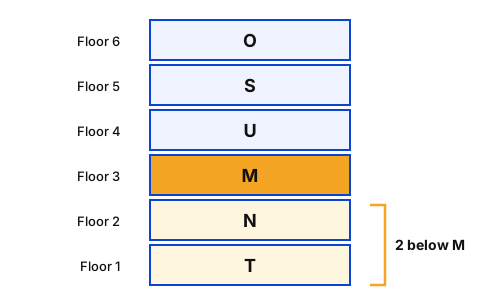
- S on floor 5; O above S → O on floor 6.
- Only T lives below N → T on floor 1, N on floor 2.
- U on an even floor; only 4 is left even → U on floor 4, so M on floor 3.
- Below M: T and N → two people.
Trick: 'Only X lives below Y' fixes X at the bottom and Y just above it.
Answer: (C) Two
अवधारणा: पहले निश्चित व्यक्तियों को रखें, फिर बाकी संकेत लगाएँ।
- S मंज़िल 5 पर; O, S से ऊपर → O मंज़िल 6 पर।
- केवल T, N से नीचे → T मंज़िल 1, N मंज़िल 2।
- U सम मंज़िल पर; केवल 4 बची → U मंज़िल 4, M मंज़िल 3।
- M से नीचे: T और N → दो व्यक्ति।
ट्रिक: 'केवल X, Y से नीचे' → X सबसे नीचे, Y उसके ठीक ऊपर।
उत्तर: (C) दो
RRB NTPC Graduate CBT 1General Intelligence and ReasoningFloor PuzzleRRB NTPC Graduate CBT 1 2024 · 12 Jun Shift 3

