Q3061.Ravi travels from City A to City B. If Ravi drives his car at of his normal speed, then he reaches City B 30 minutes late. Find the time (in minutes) that Ravi would have taken to travel from City A to City B if he drove at his normal speed.
रवि शहर A से शहर B तक यात्रा करता है। यदि रवि अपनी कार को अपनी सामान्य चाल की चाल से चलाता है, तो वह शहर B 30 मिनट देर से पहुँचता है। यदि वह अपनी सामान्य चाल से कार चलाता, तो शहर A से शहर B तक यात्रा करने में रवि को कितना समय (मिनट में) लगता, ज्ञात कीजिए।
- A5
- B12
- C3
- D19
Show answer
Concept: For a fixed distance, time .
- Speed becomes of normal ⇒ time becomes of normal time .
- Extra time min.
- min.
Trick: Speed ratio ⇒ time ratio ; difference 5 parts ⇒ 1 part , normal .
Answer: (B)
अवधारणा: निश्चित दूरी के लिए समय ।
- चाल सामान्य की ⇒ समय सामान्य समय का गुना।
- अतिरिक्त समय मिनट।
- मिनट।
ट्रिक: चाल अनुपात ⇒ समय अनुपात ; अंतर 5 भाग ⇒ 1 भाग , सामान्य समय ।
उत्तर: (B)
RRB NTPC Graduate CBT 1MathematicsTime, Speed & DistanceRRB NTPC Graduate CBT 1 2024 · 12 Jun Shift 2
Q3062.How much will a sum of ₹72,000 become after one year if the interest is compounded half-yearly at 10% per annum compound interest?
यदि ब्याज 10% वार्षिक चक्रवृद्धि ब्याज की दर से अर्धवार्षिक रूप से संयोजित होता है, तो ₹72,000 की राशि एक वर्ष बाद कितनी हो जाएगी?
- A₹79,510
- B₹78,632
- C₹80,378
- D₹79,380
Show answer
Concept: Half-yearly compounding: rate per half-year, periods ; .
- Rate per half-year , periods .
- .
- .
Trick: Two periods at ⇒ effective rate : of .
Answer: (D) ₹
अवधारणा: अर्धवार्षिक चक्रवृद्धि: दर प्रति छमाही, अवधियाँ ; ।
- प्रति छमाही दर , अवधियाँ ।
- ।
- ।
ट्रिक: की दो अवधियाँ ⇒ प्रभावी दर : का जोड़ें ।
उत्तर: (D) ₹
RRB NTPC Graduate CBT 1MathematicsCompound Interest (Half-yearly)RRB NTPC Graduate CBT 1 2024 · 12 Jun Shift 2
Q3063.On selling a stool for ₹8,378, the value of gain is 20% more than the value of loss incurred on selling it for ₹1,756. In order to gain 50%, find the selling price (in ₹).
एक स्टूल को ₹8,378 में बेचने पर प्राप्त लाभ की राशि, उसे ₹1,756 में बेचने पर हुई हानि की राशि से 20% अधिक है। 50% लाभ प्राप्त करने के लिए विक्रय मूल्य (₹ में) ज्ञात कीजिए।
- A7,150
- B7,148
- C7,151
- D7,149
Show answer
Concept: Gain , Loss .
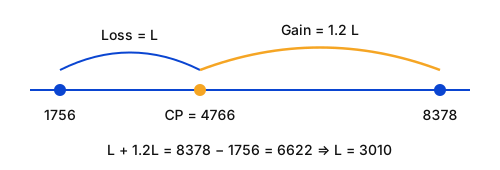
- Let loss ; gain .
- ⇒ .
- .
- For gain: .
Trick: Gain + Loss always equals the gap between the two selling prices.
Answer: (D)
अवधारणा: लाभ , हानि ।
- मान लें हानि ; लाभ ।
- ⇒ ।
- ।
- लाभ के लिए: ।
ट्रिक: लाभ + हानि = दोनों विक्रय मूल्यों का अंतर।
उत्तर: (D)
RRB NTPC Graduate CBT 1MathematicsProfit and LossRRB NTPC Graduate CBT 1 2024 · 12 Jun Shift 2
Q3064.For what values of b, the quadratic equation 4x2 + bx + 16 = 0 has equal real roots?
b के किन मानों के लिए द्विघात समीकरण 4x2 + bx + 16 = 0 के मूल वास्तविक और बराबर हैं?
- A4 and −44 और −4
- B16 and −1616 और −16
- C−4 and −8−4 और −8
- D8 and −88 और −8
Show answer
Concept: has equal real roots when .
- Here , .
- ⇒ .
- .
Trick: Equal roots ⇒ perfect square: .
Answer: (B) and
अवधारणा: के मूल बराबर व वास्तविक होंगे जब ।
- यहाँ , ।
- ⇒ ।
- ।
ट्रिक: बराबर मूल ⇒ पूर्ण वर्ग: ।
उत्तर: (B) और
RRB NTPC Graduate CBT 1MathematicsQuadratic Equations – Nature of RootsRRB NTPC Graduate CBT 1 2024 · 12 Jun Shift 2
Q3065.Mohan invested ₹1,320 at 6% per annum simple interest in a bank. What amount (in ₹) will he get after 6 years?
मोहन ने एक बैंक में 6% वार्षिक साधारण ब्याज की दर पर ₹1,320 निवेश किए। 6 वर्ष बाद उसे कितनी राशि (₹ में) प्राप्त होगी?
- A1,695.2
- B1,795.2
- C575.2
- D475.2
Show answer
Concept: , Amount .
- .
- Amount .
Trick: Total rate ⇒ Amount .
Answer: (B)
अवधारणा: , मिश्रधन ।
- ।
- मिश्रधन ।
ट्रिक: कुल दर ⇒ मिश्रधन ।
उत्तर: (B)
RRB NTPC Graduate CBT 1MathematicsSimple InterestRRB NTPC Graduate CBT 1 2024 · 12 Jun Shift 2
Q3066.Gopal bought 51 books at ₹1,120 per book from one shop and 45 books at ₹920 per book from another. What is the average price (in ₹) he paid per book?
गोपाल ने एक दुकान से ₹1,120 प्रति पुस्तक की दर से 51 पुस्तकें और दूसरी दुकान से ₹920 प्रति पुस्तक की दर से 45 पुस्तकें खरीदीं। उसने प्रति पुस्तक औसतन कितना मूल्य (₹ में) चुकाया?
- A1,026.25
- B1,041.25
- C1,036.25
- D1,016.25
Show answer
Concept:
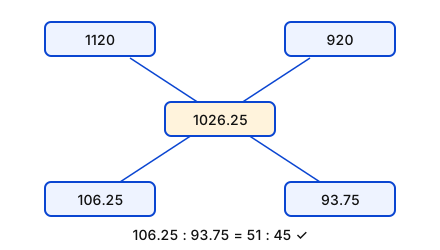
- Cost .
- Books .
- Average .
Trick: Check by alligation: ✓.
Answer: (A)
अवधारणा:
- लागत ।
- पुस्तकें ।
- औसत ।
ट्रिक: एलिगेशन से जाँच: ✓।
उत्तर: (A)
RRB NTPC Graduate CBT 1MathematicsAverage / Weighted AverageRRB NTPC Graduate CBT 1 2024 · 12 Jun Shift 2
Q3067.A cylinder is made by rolling a rectangular paper along its breadth. Find the curved surface area of the cylinder, if the length and breadth of the rectangle are 12 m and 7.48 m, respectively. (Use )
एक आयताकार कागज़ को उसकी चौड़ाई के अनुदिश मोड़कर एक बेलन बनाया जाता है। यदि आयत की लंबाई और चौड़ाई क्रमशः 12 m और 7.48 m हैं, तो बेलन का वक्र पृष्ठीय क्षेत्रफल ज्ञात कीजिए। ( का प्रयोग कीजिए)
- A98.66 m2
- B44.88 m2
- C100.24 m2
- D89.76 m2
Show answer
Concept: When a sheet is rolled into a cylinder, its whole area becomes the curved surface area.
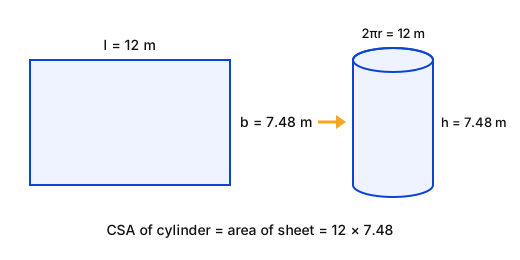
- Rolling along the breadth: length becomes the circumference ; breadth becomes the height.
- .
- .
Trick: CSA of a rolled sheet = – no need to use .
Answer: (D)
अवधारणा: जब कागज़ को बेलन में मोड़ा जाता है, तो उसका पूरा क्षेत्रफल वक्र पृष्ठीय क्षेत्रफल (CSA) बन जाता है।
- चौड़ाई के अनुदिश मोड़ने पर लंबाई परिधि बनती है और चौड़ाई ऊँचाई।
- ।
- ।
ट्रिक: मोड़ी गई शीट का CSA – की ज़रूरत नहीं।
उत्तर: (D)
RRB NTPC Graduate CBT 1MathematicsMensuration – CylinderRRB NTPC Graduate CBT 1 2024 · 12 Jun Shift 2
Q3068.Three numbers are in the ratio . The difference between the largest and the smallest number is 30. Find the largest number.
तीन संख्याएँ के अनुपात में हैं। सबसे बड़ी और सबसे छोटी संख्या का अंतर 30 है। सबसे बड़ी संख्या ज्ञात कीजिए।
- A40
- B39
- C41
- D42
Show answer
Concept: Convert a ratio of fractions to whole numbers by multiplying by the LCM of denominators.
- LCM of : .
- Largest − smallest parts .
- 1 part ; largest .
Trick: Same denominators for 1st and 3rd: largest:smallest ⇒ diff 15 parts of … largest .
Answer: (A)
अवधारणा: भिन्नों के अनुपात को हरों के LCM से गुणा करके पूर्णांकों में बदलें।
- का LCM : ।
- सबसे बड़ी − सबसे छोटी भाग ।
- 1 भाग ; सबसे बड़ी ।
ट्रिक: पहली और तीसरी का हर समान: बड़ी : छोटी , अंतर 15 भाग ⇒ सबसे बड़ी ।
उत्तर: (A)
RRB NTPC Graduate CBT 1MathematicsRatio and ProportionRRB NTPC Graduate CBT 1 2024 · 12 Jun Shift 2
Q3069.The value of 57 + [ 5 + { 72 - ( 24 ÷ 6 )} ÷ 4 ] is:
57 + [ 5 + { 72 - ( 24 ÷ 6 )} ÷ 4 ] का मान है:
- A81
- B79
- C89
- D82
Show answer
Concept: Solve brackets from innermost: ( ) → { } → [ ].
- .
- ; .
- ; .
Trick: Inside-out: small bracket first, then curly, then square.
Answer: (B)
अवधारणा: कोष्ठक अंदर से बाहर हल करें: ( ) → { } → [ ]।
- ।
- ; ।
- ; ।
ट्रिक: अंदर से बाहर: पहले छोटा, फिर मझला, फिर बड़ा कोष्ठक।
उत्तर: (B)
RRB NTPC Graduate CBT 1MathematicsSimplification (BODMAS)RRB NTPC Graduate CBT 1 2024 · 12 Jun Shift 2
Q3070.The average weight of 7 boys of a group is 54 kg. When a new boy joined the group, the average weight increased by 2 kg. Find the weight of the new boy.
एक समूह के 7 लड़कों का औसत भार 54 kg है। जब एक नया लड़का समूह में शामिल हुआ, तो औसत भार 2 kg बढ़ गया। नए लड़के का भार ज्ञात कीजिए।
- A70 kg
- B74 kg
- C72 kg
- D77 kg
Show answer
Concept: New member's value old average (new count increase).
- Old total .
- New total .
- New boy .
Trick: – the newcomer brings his share plus 2 kg for each of the 8 members.
Answer: (A)
अवधारणा: नए सदस्य का मान पुराना औसत (नई संख्या वृद्धि)।
- पुराना योग ।
- नया योग ।
- नया लड़का ।
ट्रिक: – नया लड़का अपना हिस्सा और 8 सदस्यों के लिए 2-2 kg लाता है।
उत्तर: (A)
RRB NTPC Graduate CBT 1MathematicsAverageRRB NTPC Graduate CBT 1 2024 · 12 Jun Shift 2
Q3071.Refer to the following number and symbol series and answer the question that follows. Counting to be done from left to right only.
(Left) £ @ 5 6 3 © & 4 9 % * $ $ % 6 & # & € © 5 8 (Right)
How many such numbers are there each of which is immediately preceded by a symbol and also immediately followed by a symbol?
निम्नलिखित संख्या और प्रतीक श्रृंखला को देखिए और उसके बाद दिए गए प्रश्न का उत्तर दीजिए। गिनती केवल बाएँ से दाएँ की जानी है।
(बाएँ) £ @ 5 6 3 © & 4 9 % * $ $ % 6 & # & € © 5 8 (दाएँ)
ऐसी कितनी संख्याएँ हैं जिनमें से प्रत्येक के ठीक पहले एक प्रतीक है और ठीक बाद भी एक प्रतीक है?
- A3
- B2
- C0
- D1
Show answer
Concept: Check every number: the element just before it and just after it must both be symbols.
- Numbers in order: 5, 6, 3, 4, 9, 6, 5, 8.
- 5 (after @) is followed by 6 – no; 3 and 9 are preceded by numbers – no; 4 is followed by 9 – no.
- 6 in '% 6 &' has symbols on both sides – yes; 5 in '© 5 8' is followed by 8 – no; 8 is the last element.
Trick: Scan only numbers that start a number-run of length 1 – a single number sandwiched between symbols.
Answer: (D) 1
अवधारणा: हर संख्या के ठीक पहले और ठीक बाद वाला तत्व देखें – दोनों प्रतीक होने चाहिए।
- संख्याएँ क्रम से: 5, 6, 3, 4, 9, 6, 5, 8।
- @ के बाद वाला 5, आगे 6 – नहीं; 3 और 9 से पहले संख्या – नहीं; 4 के बाद 9 – नहीं।
- '% 6 &' वाला 6 दोनों ओर प्रतीक – हाँ; '© 5 8' में 5 के बाद 8 – नहीं; 8 अंतिम है।
ट्रिक: केवल वही संख्या गिनें जो अकेली हो और दोनों तरफ प्रतीक से घिरी हो।
उत्तर: (D) 1
RRB NTPC Graduate CBT 1General Intelligence and ReasoningNumber–symbol seriesRRB NTPC Graduate CBT 1 2024 · 12 Jun Shift 2
Q3072.A, B, C, D, E and F live on six different floors of the same building. The lowermost floor in the building is numbered 1, the floor above it, number 2 and so on, till the topmost floor is numbered 6. B lives on a floor that is a prime number. The product of floors on which B and D live is 3. Only 2 people live above C. F lives immediately below A. How many people live between A and C?
A, B, C, D, E और F एक ही इमारत की छह अलग-अलग मंज़िलों पर रहते हैं। इमारत की सबसे निचली मंज़िल की संख्या 1 है, उसके ऊपर वाली मंज़िल की संख्या 2 है और इसी प्रकार सबसे ऊपरी मंज़िल की संख्या 6 है। B उस मंज़िल पर रहता है जो एक अभाज्य संख्या है। B और D जिन मंज़िलों पर रहते हैं, उनका गुणनफल 3 है। C के ऊपर केवल 2 व्यक्ति रहते हैं। F, A के ठीक नीचे रहता है। A और C के बीच कितने व्यक्ति रहते हैं?
- A2
- B1
- C3
- D4
Show answer
Concept: Fix the sure clues first (product, 'only 2 above'), then place the pair clue.
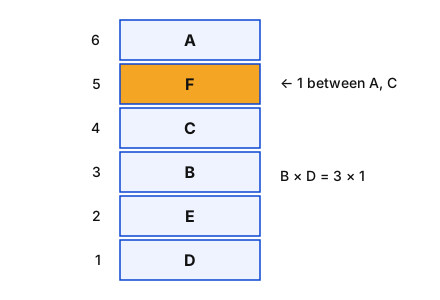
- B is on a prime floor and , so .
- Only 2 people above C → C is on floor 4.
- F immediately below A: free floors are 2, 5, 6 → F = 5, A = 6; E = 2.
- Between A (6) and C (4) only F lives → 1 person.
Trick: Product clues like fix two people at once – always start there.
Answer: (B) 1
अवधारणा: पहले पक्के संकेत (गुणनफल, 'ऊपर केवल 2') लगाएँ, फिर जोड़ी वाला संकेत।
- B अभाज्य मंज़िल पर और , अतः ।
- C के ऊपर केवल 2 लोग → C मंज़िल 4 पर।
- F, A के ठीक नीचे: खाली मंज़िल 2, 5, 6 → F = 5, A = 6; E = 2।
- A (6) और C (4) के बीच केवल F → 1 व्यक्ति।
ट्रिक: जैसे गुणनफल संकेत एक साथ दो लोगों को तय कर देते हैं – वहीं से शुरू करें।
उत्तर: (B) 1
RRB NTPC Graduate CBT 1General Intelligence and ReasoningFloor-based puzzleRRB NTPC Graduate CBT 1 2024 · 12 Jun Shift 2
Q3073.Which of the following letter-number clusters will replace the question mark (?) in the given series to make it logically complete?
GM17, IO25, KQ33, MS41, ?
निम्नलिखित में से कौन-सा अक्षर-संख्या समूह दी गई श्रृंखला में प्रश्न चिह्न (?) के स्थान पर आकर उसे तार्किक रूप से पूर्ण करेगा?
GM17, IO25, KQ33, MS41, ?
- AOU49
- BOU48
- COV49
- DOV48
Show answer
Concept: Track the first letter, second letter and number separately.
- 1st letters: G, I, K, M → +2 each → O.
- 2nd letters: M, O, Q, S → +2 each → U.
- Numbers: 17, 25, 33, 41 → +8 each → 49.
Trick: Three independent +2, +2, +8 patterns – check the number first to eliminate options fast.
Answer: (A) OU49
अवधारणा: पहला अक्षर, दूसरा अक्षर और संख्या अलग-अलग देखें।
- पहले अक्षर: G, I, K, M → +2 → O।
- दूसरे अक्षर: M, O, Q, S → +2 → U।
- संख्याएँ: 17, 25, 33, 41 → +8 → 49।
ट्रिक: तीन स्वतंत्र पैटर्न +2, +2, +8 – पहले संख्या से विकल्प हटाएँ।
उत्तर: (A) OU49
RRB NTPC Graduate CBT 1General Intelligence and ReasoningLetter-number seriesRRB NTPC Graduate CBT 1 2024 · 12 Jun Shift 2
Q3074.Read the given statements and conclusions carefully. Assuming that the information given in the statements is true, even if it appears to be at variance with commonly known facts, decide which of the given conclusion(s) logically follow(s) from the statements.
Statements:
Some trees are flowers.
All flowers are beautiful.
Some beautiful are girls.
Conclusions:
(I) Some flowers are trees.
(II) Some beautiful are flowers.
दिए गए कथनों और निष्कर्षों को ध्यानपूर्वक पढ़िए। कथनों में दी गई जानकारी को सत्य मानते हुए, भले ही वह सामान्य रूप से ज्ञात तथ्यों से भिन्न प्रतीत होती हो, निर्णय कीजिए कि दिए गए निष्कर्षों में से कौन-सा/कौन-से निष्कर्ष कथनों का तार्किक रूप से अनुसरण करता है/करते हैं।
कथन:
कुछ पेड़, फूल हैं।
सभी फूल, सुंदर हैं।
कुछ सुंदर, लड़कियाँ हैं।
निष्कर्ष:
(I) कुछ फूल, पेड़ हैं।
(II) कुछ सुंदर, फूल हैं।
- AOnly conclusion (I) follows.केवल निष्कर्ष (I) अनुसरण करता है।
- BOnly conclusion (II) follows.केवल निष्कर्ष (II) अनुसरण करता है।
- CBoth conclusions (I) and (II) follow.निष्कर्ष (I) और (II) दोनों अनुसरण करते हैं।
- DNeither conclusion (I) nor (II) follows.न तो निष्कर्ष (I) और न ही (II) अनुसरण करता है।
Show answer
Concept: A 'Some' statement and an 'All' statement both give valid 'Some' conversions.
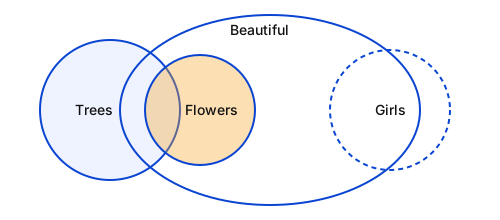
- 'Some trees are flowers' converts to 'Some flowers are trees' → (I) follows.
- 'All flowers are beautiful' → 'Some beautiful are flowers' → (II) follows.
- The 'girls' statement is not needed.
Yaad rakhein: Some A are B ⇔ Some B are A; All A are B ⇒ Some B are A.
Answer: (C) Both conclusions (I) and (II) follow.
अवधारणा: 'कुछ' कथन और 'सभी' कथन – दोनों से वैध 'कुछ' रूपांतरण बनता है।
- 'कुछ पेड़ फूल हैं' → 'कुछ फूल पेड़ हैं' → (I) अनुसरण करता है।
- 'सभी फूल सुंदर हैं' → 'कुछ सुंदर फूल हैं' → (II) अनुसरण करता है।
- 'लड़कियाँ' वाला कथन आवश्यक नहीं।
ट्रिक: कुछ A, B हैं ⇔ कुछ B, A हैं; सभी A, B हैं ⇒ कुछ B, A हैं।
उत्तर: (C) निष्कर्ष (I) और (II) दोनों
RRB NTPC Graduate CBT 1General Intelligence and ReasoningSyllogismRRB NTPC Graduate CBT 1 2024 · 12 Jun Shift 2
Q3075.Refer to the following number and symbol series and answer the question that follows. Counting to be done from left to right only.
(Left) £ % * 3 6 £ 1 © & 8 1 5 5 3 * # © 7 1 7 3 @ (Right)
How many such symbols are there each of which is immediately preceded by a number and also immediately followed by a number?
निम्नलिखित संख्या और प्रतीक श्रृंखला को देखिए और उसके बाद दिए गए प्रश्न का उत्तर दीजिए। गिनती केवल बाएँ से दाएँ की जानी है।
(बाएँ) £ % * 3 6 £ 1 © & 8 1 5 5 3 * # © 7 1 7 3 @ (दाएँ)
ऐसे कितने प्रतीक हैं जिनमें से प्रत्येक के ठीक पहले एक संख्या है और ठीक बाद भी एक संख्या है?
- A1
- B0
- C3
- D2
Show answer
Concept: For each symbol, both neighbours must be numbers.
- '6 £ 1' → £ has numbers on both sides – yes.
- '1 © &', '3 * #', '# © 7' → one neighbour is a symbol – no.
- Leading '£ % *' and final '@' fail.
Trick: Look only for the pattern number–symbol–number.
Answer: (A) 1
अवधारणा: हर प्रतीक के दोनों पड़ोसी संख्याएँ होनी चाहिए।
- '6 £ 1' → £ के दोनों ओर संख्या – हाँ।
- '1 © &', '3 * #', '# © 7' → एक ओर प्रतीक – नहीं।
- शुरुआत के '£ % *' और अंतिम '@' भी नहीं।
ट्रिक: केवल 'संख्या–प्रतीक–संख्या' पैटर्न खोजें।
उत्तर: (A) 1
RRB NTPC Graduate CBT 1General Intelligence and ReasoningNumber–symbol seriesRRB NTPC Graduate CBT 1 2024 · 12 Jun Shift 2
Q3076.What will come in the place of ‘?’ in the following equation, if ‘+’ and ‘−‘ are
interchanged and ‘×’ and ‘÷’ are interchanged?
45 ÷ 12 − 75 × 5 + 13 = ?
यदि '+' और '−' को आपस में बदल दिया जाए तथा '×' और '÷' को आपस में
बदल दिया जाए, तो निम्नलिखित समीकरण में '?' के स्थान पर क्या आएगा?
45 ÷ 12 − 75 × 5 + 13 = ?
- A546
- B542
- C545
- D544
Show answer
Concept: Swap the signs first, then apply BODMAS.
- After swapping:
Trick: Rewrite the whole expression with new signs before calculating – avoids mixing old and new signs.
Answer: (B) 542
अवधारणा: पहले चिह्न बदलें, फिर BODMAS लगाएँ।
- बदलने के बाद:
ट्रिक: गणना से पहले पूरा व्यंजक नए चिह्नों से लिख लें।
उत्तर: (B) 542
RRB NTPC Graduate CBT 1General Intelligence and ReasoningMathematical operationsRRB NTPC Graduate CBT 1 2024 · 12 Jun Shift 2
Q3077.Shubham ranked 19th from the top and 46th from the bottom in his class. How many students are there in his class?
शुभम की अपनी कक्षा में ऊपर से 19वाँ और नीचे से 46वाँ स्थान है। उसकी कक्षा में कितने विद्यार्थी हैं?
- A62
- B65
- C63
- D64
Show answer
Concept: Total = rank from top + rank from bottom − 1.
Trick: Subtract 1 because the person is counted twice.
Answer: (D) 64
अवधारणा: कुल = ऊपर से रैंक + नीचे से रैंक − 1।
ट्रिक: व्यक्ति दो बार गिना जाता है, इसलिए 1 घटाएँ।
उत्तर: (D) 64
RRB NTPC Graduate CBT 1General Intelligence and ReasoningRankingRRB NTPC Graduate CBT 1 2024 · 12 Jun Shift 2
Q3078.Which of the following letter-number-clusters will replace the question mark (?) in the given series to make it logically complete?
VRO 6, UQN 11, TPM 16, SOL 21, ?
निम्नलिखित में से कौन-सा अक्षर-संख्या समूह दी गई श्रृंखला में प्रश्न चिह्न (?) के स्थान पर आकर उसे तार्किक रूप से पूर्ण करेगा?
VRO 6, UQN 11, TPM 16, SOL 21, ?
- ARPM 25
- BPQM 25
- CRNK 26
- DPRN 26
Show answer
Concept: Each letter moves back by 1; the number rises by 5.
- 1st letters V, U, T, S → R.
- 2nd letters R, Q, P, O → N.
- 3rd letters O, N, M, L → K.
- Numbers 6, 11, 16, 21 → 26.
Trick: Option check by number first: only RNK 26 and PRN 26 have 26; letters −1 give RNK.
Answer: (C) RNK 26
अवधारणा: हर अक्षर 1 पीछे जाता है; संख्या 5 बढ़ती है।
- पहले अक्षर V, U, T, S → R।
- दूसरे अक्षर R, Q, P, O → N।
- तीसरे अक्षर O, N, M, L → K।
- संख्याएँ 6, 11, 16, 21 → 26।
ट्रिक: पहले संख्या से जाँचें: 26 वाले दो विकल्प; अक्षर −1 से RNK।
उत्तर: (C) RNK 26
RRB NTPC Graduate CBT 1General Intelligence and ReasoningLetter-number seriesRRB NTPC Graduate CBT 1 2024 · 12 Jun Shift 2
Q3079.Select the triad that follows the same pattern as that followed by the two triads given below. Both triads follow the same pattern.
EA-GC-JL
GC-IE-LN
उस त्रिक का चयन कीजिए जो उसी पैटर्न का अनुसरण करता है जिसका अनुसरण नीचे दिए गए दो त्रिक करते हैं। दोनों त्रिक एक ही पैटर्न का अनुसरण करते हैं।
EA-GC-JL
GC-IE-LN
- ALG-MJ-PS
- BKG-MI-PS
- CKG-MI-PR
- DLG-MI-PS
Show answer
Concept: Find the letter shifts between the three pairs.
- EA → GC: each letter +2; GC → JL: 1st +3, 2nd +9.
- Check GC-IE-LN: +2, +2; then I+3 = L, E+9 = N ✓.
- KG-MI-PR: K+2 = M, G+2 = I; M+3 = P, I+9 = R ✓.
Trick: Option B fails only at the last letter (I+9 = R, not S) – check the final step carefully.
Answer: (C) KG-MI-PR
अवधारणा: तीनों जोड़ों के बीच अक्षरों का खिसकाव देखें।
- EA → GC: हर अक्षर +2; GC → JL: पहला +3, दूसरा +9।
- GC-IE-LN: +2, +2; फिर I+3 = L, E+9 = N ✓।
- KG-MI-PR: K+2 = M, G+2 = I; M+3 = P, I+9 = R ✓।
ट्रिक: विकल्प B केवल अंतिम अक्षर पर गलत (I+9 = R, S नहीं)।
उत्तर: (C) KG-MI-PR
RRB NTPC Graduate CBT 1General Intelligence and ReasoningLetter triads analogyRRB NTPC Graduate CBT 1 2024 · 12 Jun Shift 2
Q3080.RR 14 is related to UN 3 in a certain way. In the same way, BV 10 is related to ER −1. To which of the given options is PE 1 related, following the same logic?
RR 14 एक निश्चित प्रकार से UN 3 से संबंधित है। उसी प्रकार, BV 10, ER −1 से संबंधित है। समान तर्क का अनुसरण करते हुए, PE 1 दिए गए विकल्पों में से किससे संबंधित है?
- ARI 8
- BSA −10
- CVS −9
- DPV 2
Show answer
Concept: Find the rule for each part from both examples.
- RR 14 → UN 3: R+3 = U, R−4 = N, .
- BV 10 → ER −1: B+3 = E, V−4 = R, ✓.
- PE 1 → P+3 = S, E−4 = A, → SA −10.
Trick: The number part () alone eliminates three options.
Answer: (B) SA −10
अवधारणा: दोनों उदाहरणों से हर भाग का नियम निकालें।
- RR 14 → UN 3: R+3 = U, R−4 = N, ।
- BV 10 → ER −1: B+3 = E, V−4 = R, ✓।
- PE 1 → P+3 = S, E−4 = A, → SA −10।
ट्रिक: केवल संख्या () से ही तीन विकल्प हट जाते हैं।
उत्तर: (B) SA −10
RRB NTPC Graduate CBT 1General Intelligence and ReasoningLetter-number analogyRRB NTPC Graduate CBT 1 2024 · 12 Jun Shift 2

