Q3081.Refer to the following number and symbol series and answer the question that follows. Counting to be done from left to right only.
(Left) 2 @ % * 2 7 4 8 € @ % © $ 7 6 6 * $ 7 £ 7 6 (Right)
How many such numbers are there each of which is immediately preceded by a number and also immediately followed by a symbol?
निम्नलिखित संख्या और प्रतीक श्रृंखला को देखिए और उसके बाद दिए गए प्रश्न का उत्तर दीजिए। गिनती केवल बाएँ से दाएँ की जानी है।
(बाएँ) 2 @ % * 2 7 4 8 € @ % © $ 7 6 6 * $ 7 £ 7 6 (दाएँ)
ऐसी कितनी संख्याएँ हैं जिनमें से प्रत्येक के ठीक पहले एक संख्या है और ठीक बाद एक प्रतीक है?
- A4
- B1
- C2
- D3
Show answer
Concept: Pattern needed: number – NUMBER – symbol.
- '4 8 €' → 8 qualifies.
- '6 6 *' → second 6 qualifies.
- Others: '2 7 4' (7 followed by number), '£ 7 6' (6 is last) – no.
Trick: Find the last number of each run of 2+ numbers that is followed by a symbol.
Answer: (C) 2
अवधारणा: चाहिए पैटर्न: संख्या – संख्या – प्रतीक।
- '4 8 €' → 8 योग्य।
- '6 6 *' → दूसरा 6 योग्य।
- बाकी: '2 7 4' (7 के बाद संख्या), '£ 7 6' (6 अंतिम) – नहीं।
ट्रिक: 2 या अधिक संख्याओं के समूह की अंतिम संख्या, जिसके बाद प्रतीक हो।
उत्तर: (C) 2
RRB NTPC Graduate CBT 1General Intelligence and ReasoningNumber–symbol seriesRRB NTPC Graduate CBT 1 2024 · 12 Jun Shift 2
Q3082.In the following triads, each group of letters is related to the subsequent one following a certain logic. Select from the given options, the one that follows the same logic. REAL - LRAE - RLEA
MAKE - EMKA - MEAK
निम्नलिखित त्रिकों में, अक्षरों का प्रत्येक समूह एक निश्चित तर्क के अनुसार अपने बाद वाले समूह से संबंधित है। दिए गए विकल्पों में से उस विकल्प का चयन कीजिए जो समान तर्क का अनुसरण करता है। REAL - LRAE - RLEA
MAKE - EMKA - MEAK
- APOUR - RPUO - PORU
- BHUGS - UHGS - SUGH
- CKEYS - SKEY - EYSK
- DCOPE - ECPO - CEOP
Show answer
Concept: Track positions: word 1234 → 4132 → swap adjacent pairs.
- REAL (R1 E2 A3 L4) → L R A E = 4,1,3,2; LRAE → RLEA (swap 1–2 and 3–4).
- MAKE → EMKA → MEAK follows the same rule.
- COPE → ECPO (4,1,3,2) → CEOP (pair swap) ✓.
Trick: Check option D's middle word first; the others break the 4,1,3,2 order.
Answer: (D) COPE - ECPO - CEOP
अवधारणा: स्थान देखें: शब्द 1234 → 4132 → पास-पास के जोड़े बदलें।
- REAL (R1 E2 A3 L4) → L R A E = 4,1,3,2; LRAE → RLEA (1–2 और 3–4 अदला-बदली)।
- MAKE → EMKA → MEAK भी यही नियम।
- COPE → ECPO (4,1,3,2) → CEOP (जोड़ा अदला-बदली) ✓।
ट्रिक: पहले बीच वाला शब्द जाँचें; बाकी विकल्प 4,1,3,2 क्रम तोड़ते हैं।
उत्तर: (D) COPE - ECPO - CEOP
RRB NTPC Graduate CBT 1General Intelligence and ReasoningLetter rearrangementRRB NTPC Graduate CBT 1 2024 · 12 Jun Shift 2
Q3083.M, N, O, P, Y and Z live on six different floors of the same building. The lowermost floor in the building is numbered 1, the floor above it, number 2 and so on till the topmost floor is numbered 6. Only three people live between Y and Z, where Y lives below Z. P lives on an odd numbered floor and immediately above Y. O lives on one of the floors below M and on one of the floors above N. Who lives on floor numbered 4?
M, N, O, P, Y और Z एक ही इमारत की छह अलग-अलग मंज़िलों पर रहते हैं। इमारत की सबसे निचली मंज़िल की संख्या 1 है, उसके ऊपर वाली मंज़िल की संख्या 2 है और इसी प्रकार सबसे ऊपरी मंज़िल की संख्या 6 है। Y और Z के बीच केवल तीन व्यक्ति रहते हैं, जहाँ Y, Z के नीचे रहता है। P एक विषम संख्या वाली मंज़िल पर और Y के ठीक ऊपर रहता है। O, M के नीचे की किसी एक मंज़िल पर और N के ऊपर की किसी एक मंज़िल पर रहता है। मंज़िल संख्या 4 पर कौन रहता है?
- AM
- BZ
- CP
- DO
Show answer
Concept: Use the gap clue for Y–Z, then the odd-floor clue for P.
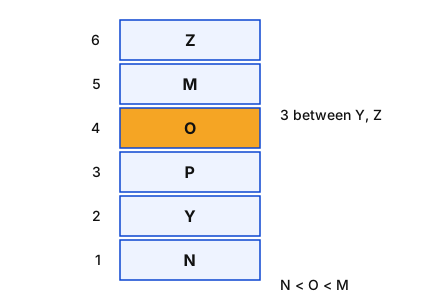
- 3 people between Y and Z, Y below: (Y1, Z5) or (Y2, Z6).
- P is on an odd floor just above Y → Y2, P3, Z6.
- N < O < M among floors 1, 4, 5 → N1, O4, M5.
Trick: P odd & immediately above Y forces Y on an even floor – this kills the (Y1, Z5) case.
Answer: (D) O
अवधारणा: Y–Z के अंतर वाले संकेत से शुरू करें, फिर P का विषम मंज़िल संकेत।
- Y और Z के बीच 3 लोग, Y नीचे: (Y1, Z5) या (Y2, Z6)।
- P विषम मंज़िल पर, Y के ठीक ऊपर → Y2, P3, Z6।
- बची मंज़िलें 1, 4, 5 पर N < O < M → N1, O4, M5।
ट्रिक: P विषम और Y के ठीक ऊपर ⇒ Y सम मंज़िल पर – (Y1, Z5) हट जाता है।
उत्तर: (D) O
RRB NTPC Graduate CBT 1General Intelligence and ReasoningFloor-based puzzleRRB NTPC Graduate CBT 1 2024 · 12 Jun Shift 2
Q3084.Mr. O starts from Point L and drives 3 km towards the south. He then takes a left turn, drives 3 km, turns right and drives 4 km. He then takes a left turn and drives 4 km. He takes a final left turn, drives 7 km and stops at Point M. How far (shortest distance) and towards which direction should he drive in order to reach Point L again? (All turns are 90 degree turns only unless specified.)
श्री O बिंदु L से चलना शुरू करते हैं और दक्षिण की ओर 3 km गाड़ी चलाते हैं। फिर वे बाएँ मुड़ते हैं, 3 km गाड़ी चलाते हैं, दाएँ मुड़ते हैं और 4 km गाड़ी चलाते हैं। फिर वे बाएँ मुड़ते हैं और 4 km गाड़ी चलाते हैं। वे अंतिम बार बाएँ मुड़ते हैं, 7 km गाड़ी चलाते हैं और बिंदु M पर रुक जाते हैं। पुनः बिंदु L पर पहुँचने के लिए उन्हें कितनी दूरी (न्यूनतम दूरी) तक और किस दिशा में गाड़ी चलानी चाहिए? (जब तक निर्दिष्ट न किया जाए, सभी मोड़ केवल 90 डिग्री के मोड़ हैं।)
- A3 km towards the northउत्तर की ओर 3 km
- B7 km towards the eastपूर्व की ओर 7 km
- C7 km towards the westपश्चिम की ओर 7 km
- D4 km towards the southदक्षिण की ओर 4 km
Show answer
Concept: Plot each leg with coordinates (L at origin).
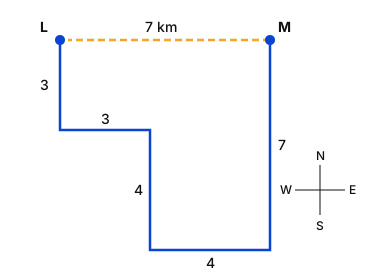
- South 3 → ; left (east) 3 → .
- Right (south) 4 → ; left (east) 4 → .
- Left (north) 7 → M , on the same level as L, 7 km east of it.
- So he must drive 7 km west.
Trick: Net south = and the final 7 km north cancels it, leaving only the east shift .
Answer: (C) 7 km towards the west
अवधारणा: हर चरण को निर्देशांक से लिखें (L मूल बिंदु पर)।
- दक्षिण 3 → ; बाएँ (पूर्व) 3 → ।
- दाएँ (दक्षिण) 4 → ; बाएँ (पूर्व) 4 → ।
- बाएँ (उत्तर) 7 → M , L से 7 km पूर्व।
- अतः उसे 7 km पश्चिम जाना होगा।
ट्रिक: कुल दक्षिण को अंतिम 7 km उत्तर काट देता है; बचता है पूर्व ।
उत्तर: (C) 7 km पश्चिम की ओर
RRB NTPC Graduate CBT 1General Intelligence and ReasoningDirection and distanceRRB NTPC Graduate CBT 1 2024 · 12 Jun Shift 2
Q3085.Based on the English alphabetical order, three of the following four letter-cluster pairs are alike in a certain way and thus form a group. Which letter-cluster pair DOES NOT belong to that group?
(Note: The odd one out is not based on the number of consonants/vowels or their position in the letter-cluster.)
अंग्रेज़ी वर्णमाला क्रम के आधार पर, निम्नलिखित चार अक्षर-समूह युग्मों में से तीन किसी निश्चित प्रकार से एकसमान हैं और इस प्रकार एक समूह बनाते हैं। कौन-सा अक्षर-समूह युग्म उस समूह से संबंधित नहीं है?
(ध्यान दें: असंगत अक्षर-समूह, उस अक्षर-समूह में व्यंजनों/स्वरों की संख्या या उनके स्थान पर आधारित नहीं है।)
- AKC – PT
- BIA – NR
- CBT – GK
- DDV – IN
Show answer
Concept: Compare letter positions within each pair.
- KC – PT: K+5 = P, C+17 = T.
- IA – NR: +5, +17 ✓; BT – GK: B+5 = G, T+17 = K (20+17−26 = 11) ✓.
- DV – IN: D+5 = I but V+17 = M, not N → odd.
Trick: Check the second shift with 'reverse' too: +17 = −9 (T−9 = K, V−9 = M).
Answer: (D) DV – IN
अवधारणा: हर युग्म में अक्षरों के स्थान की तुलना करें।
- KC – PT: K+5 = P, C+17 = T।
- IA – NR: +5, +17 ✓; BT – GK: B+5 = G, T+17 = K (20+17−26 = 11) ✓।
- DV – IN: D+5 = I पर V+17 = M, N नहीं → विषम।
ट्रिक: +17 को −9 मानकर भी जाँच सकते हैं (T−9 = K, V−9 = M)।
उत्तर: (D) DV – IN
RRB NTPC Graduate CBT 1General Intelligence and ReasoningOdd one out – letter pairsRRB NTPC Graduate CBT 1 2024 · 12 Jun Shift 2
Q3086.DG 24 is related to WT 20 in a certain way based on the English alphabetical order. In the same way, IL 18 is related to BY 14. To which of the following is QT 30 related, following the same logic?
अंग्रेज़ी वर्णमाला क्रम के आधार पर DG 24 एक निश्चित प्रकार से WT 20 से संबंधित है। उसी प्रकार, IL 18, BY 14 से संबंधित है। समान तर्क का अनुसरण करते हुए, QT 30 निम्नलिखित में से किससे संबंधित है?
- ARU 26
- BJG 34
- CHF 28
- DJG 26
Show answer
Concept: Find the shift of each letter and the change in the number.
- DG 24 → WT 20: D−7 = W, G+13 = T, .
- IL 18 → BY 14: I−7 = B, L+13 = Y, ✓.
- QT 30: Q−7 = J, T+13 = G, → JG 26.
Trick: Number rule () leaves RU 26 and JG 26; letters decide JG.
Answer: (D) JG 26
अवधारणा: हर अक्षर का खिसकाव और संख्या का बदलाव देखें।
- DG 24 → WT 20: D−7 = W, G+13 = T, ।
- IL 18 → BY 14: I−7 = B, L+13 = Y, ✓।
- QT 30: Q−7 = J, T+13 = G, → JG 26।
ट्रिक: संख्या () से RU 26 और JG 26 बचते हैं; अक्षर से JG।
उत्तर: (D) JG 26
RRB NTPC Graduate CBT 1General Intelligence and ReasoningLetter-number analogyRRB NTPC Graduate CBT 1 2024 · 12 Jun Shift 2
Q3087.Town N is to the east of Town O. Town P is to the north of Town N. Town Q is to the south of Town P. Town R is to the west of Town Q. Town O is to the north-east of Town R. What is the position of Town N with respect to Town Q?
नगर N, नगर O के पूर्व में है। नगर P, नगर N के उत्तर में है। नगर Q, नगर P के दक्षिण में है। नगर R, नगर Q के पश्चिम में है। नगर O, नगर R के उत्तर-पूर्व में है। नगर Q के सापेक्ष नगर N की स्थिति क्या है?
- AEastपूर्व
- BWestपश्चिम
- CNorthउत्तर
- DSouthदक्षिण
Show answer
Concept: Place the towns step by step on a sketch.
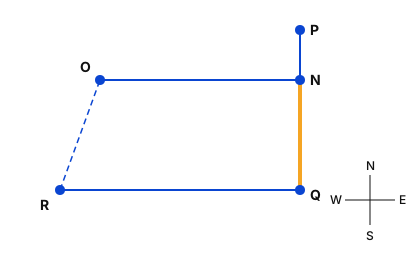
- O—N on one east–west line; P north of N; Q south of P, so N and Q are both on the vertical line through P.
- R is west of Q, and O is north-east of R, so the O–N line is north of the R–Q line.
- Hence N is north of Q.
Trick: N and Q share a vertical line; the diagonal O–R decides which is higher.
Answer: (C) North
अवधारणा: चित्र बनाकर कस्बों को क्रम से रखें।
- O—N एक पूर्व–पश्चिम रेखा पर; P, N के उत्तर में; Q, P के दक्षिण में – N और Q दोनों P वाली ऊर्ध्व रेखा पर।
- R, Q के पश्चिम में और O, R के उत्तर-पूर्व में – अतः O–N रेखा R–Q रेखा से उत्तर में।
- इसलिए N, Q के उत्तर में है।
ट्रिक: N और Q एक ऊर्ध्व रेखा पर; विकर्ण O–R तय करता है कि कौन ऊपर है।
उत्तर: (C) उत्तर
RRB NTPC Graduate CBT 1General Intelligence and ReasoningDirection senseRRB NTPC Graduate CBT 1 2024 · 12 Jun Shift 2
Q3088.In a certain code language,
'A + B' means 'A is the sister of B'
'A – B' means 'A is the brother of B'
'A × B' means 'A is the wife of B'
'A ÷ B' means 'A is the father of B'.
Based on the above, how is M related to Q if 'M ÷ N × O − P + Q'?
एक निश्चित कूट भाषा में,
'A + B' का अर्थ है 'A, B की बहन है'
'A – B' का अर्थ है 'A, B का भाई है'
'A × B' का अर्थ है 'A, B की पत्नी है'
'A ÷ B' का अर्थ है 'A, B का पिता है'।
उपर्युक्त के आधार पर, यदि 'M ÷ N × O − P + Q' है, तो M, Q से किस प्रकार संबंधित है?
- ABrother's Wife's Brotherभाई की पत्नी का भाई
- BWife's Fatherपत्नी का पिता
- CBrother's Wife's Fatherभाई की पत्नी का पिता
- DWife's Brotherपत्नी का भाई
Show answer
Concept: Decode each symbol left to right and build the tree.
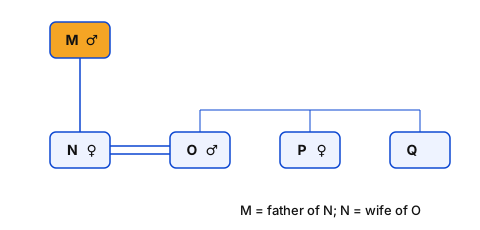
- M ÷ N: M is father of N.
- N × O: N is wife of O.
- O − P: O is brother of P; P + Q: P is sister of Q → O, P, Q are siblings.
- So O is Q's brother, N is his wife and M is her father.
Trick: Read the chain backwards from Q: brother (O) → wife (N) → father (M).
Answer: (C) Brother's Wife's Father
अवधारणा: हर चिह्न को बाएँ से दाएँ खोलें और वंश-वृक्ष बनाएँ।
- M ÷ N: M, N का पिता।
- N × O: N, O की पत्नी।
- O − P: O, P का भाई; P + Q: P, Q की बहन → O, P, Q भाई-बहन।
- अतः O, Q का भाई; N उसकी पत्नी; M उसका पिता।
ट्रिक: Q से उल्टा पढ़ें: भाई (O) → पत्नी (N) → पिता (M)।
उत्तर: (C) भाई की पत्नी के पिता
RRB NTPC Graduate CBT 1General Intelligence and ReasoningCoded blood relationsRRB NTPC Graduate CBT 1 2024 · 12 Jun Shift 2
Q3089.What should come in place of the question mark (?) in the given series?
43 27 43 41 43 55 43 ?
दी गई श्रृंखला में प्रश्न चिह्न (?) के स्थान पर क्या आना चाहिए?
43 27 43 41 43 55 43 ?
- A69
- B77
- C73
- D43
Show answer
Concept: Alternate series: odd positions and even positions follow separate rules.
- Odd positions: – constant.
- Even positions: – each .
- Next even term .
Trick: When one number keeps repeating, split the series into two alternate series.
Answer: (A)
अवधारणा: एकांतर श्रृंखला: विषम और सम स्थानों के पद अलग-अलग नियम से चलते हैं।
- विषम स्थान: – स्थिर।
- सम स्थान: – हर बार ।
- अगला सम पद ।
ट्रिक: जब कोई संख्या बार-बार दोहराई जाए, तो श्रृंखला को दो एकांतर श्रृंखलाओं में तोड़ें।
उत्तर: (A)
RRB NTPC Graduate CBT 1General Intelligence and ReasoningNumber SeriesRRB NTPC Graduate CBT 1 2024 · 12 Jun Shift 2
Q3090.If ‘W’ stands for ‘÷’, ‘X’ stands for ‘×’, ‘Y’ stands for ‘+’ and ‘Z’ stands for ‘−’, then the resultant of which of the following would be 908?
यदि 'W' का अर्थ '÷', 'X' का अर्थ '×', 'Y' का अर्थ '+' और 'Z' का अर्थ '−' है, तो निम्नलिखित में से किसका परिणाम 908 होगा?
- A128 X 32 Y 120 Z 64 W 16
- B128 W 32 Z 120 Y 64 X 16
- C128 Y 32 Z 120 X 64 W 16
- D128 Z 32 X 120 Y 64 Z 16
Show answer
Concept: Replace letters by signs (W , X , Y , Z ) and apply BODMAS.
- (B): .
- ✓.
- (A) , so not 908.
Trick: Check the option where a big product (like ) appears near 908.
Answer: (B) 128 W 32 Z 120 Y 64 X 16
अवधारणा: अक्षरों को चिह्नों से बदलें (W , X , Y , Z ) और BODMAS लगाएँ।
- (B): ।
- ✓।
- (A) , अतः 908 नहीं।
ट्रिक: उस विकल्प को पहले जाँचें जिसमें बड़ा गुणनफल () 908 के पास हो।
उत्तर: (B) 128 W 32 Z 120 Y 64 X 16
RRB NTPC Graduate CBT 1General Intelligence and ReasoningMathematical OperationsRRB NTPC Graduate CBT 1 2024 · 12 Jun Shift 2
Q3091.In a certain code language, ‘WIND’ is coded as ‘6482’ and ‘DOGS’ is coded as ‘3671’. What is the code for ‘D’ in the given code language?
एक निश्चित कूट भाषा में, 'WIND' को '6482' के रूप में और 'DOGS' को '3671' के रूप में कूटबद्ध किया जाता है। दी गई कूट भाषा में 'D' का कूट क्या है?
- A2
- B6
- C3
- D1
Show answer
Concept: A letter common to two words takes the digit common to their two codes.
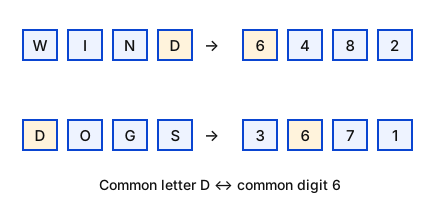
- WIND → 6482 and DOGS → 3671.
- Only common letter: D. Only common digit: 6.
- So D .
Trick: Common letter ↔ common digit.
Answer: (B)
अवधारणा: दो शब्दों में उभयनिष्ठ अक्षर का कोड उनके कोडों में उभयनिष्ठ अंक होता है।
- WIND → 6482 और DOGS → 3671।
- उभयनिष्ठ अक्षर केवल D; उभयनिष्ठ अंक केवल 6।
- अतः D ।
ट्रिक: उभयनिष्ठ अक्षर ↔ उभयनिष्ठ अंक।
उत्तर: (B)
RRB NTPC Graduate CBT 1General Intelligence and ReasoningCoding–DecodingRRB NTPC Graduate CBT 1 2024 · 12 Jun Shift 2
Q3092.In this question, a group of letters is coded by using numbers and symbols as per the table given below and the conditions which follow.
| Letter | U | M | S | J | P | T | F | E | A |
| Code | 7 | 4 | @ | $ | % | * | 6 | 2 | 3 |
Conditions:
1. If the 1
st letter is a vowel and the 3
rd letter is a consonant, both to be coded as the code of the consonant.
2. If the 1
st and last letters are vowels, both are to be coded as ‘N’.
3. If the 2
nd and last letters are vowels, their codes are to be interchanged.
What is the correct combination of codes (by following only the applicable condition(s)) for the following letters?
UJEPA
इस प्रश्न में, अक्षरों के एक समूह को नीचे दी गई तालिका और उसके बाद दी गई शर्तों के अनुसार संख्याओं और प्रतीकों का उपयोग करके कूटबद्ध किया गया है।
| अक्षर | U | M | S | J | P | T | F | E | A |
| कूट | 7 | 4 | @ | $ | % | * | 6 | 2 | 3 |
शर्तें:
1. यदि पहला अक्षर स्वर है और तीसरा अक्षर व्यंजन है, तो दोनों को व्यंजन के कूट के रूप में कूटबद्ध किया जाना है।
2. यदि पहला और अंतिम अक्षर स्वर हैं, तो दोनों को 'N' के रूप में कूटबद्ध किया जाना है।
3. यदि दूसरा और अंतिम अक्षर स्वर हैं, तो उनके कूटों को आपस में बदल दिया जाना है।
निम्नलिखित अक्षरों के लिए कूटों का सही संयोजन (केवल लागू होने वाली शर्त/शर्तों का अनुसरण करते हुए) क्या है?
UJEPA
- A7 $ 2 % 3
- BN $ 2 % N
- CN $ 2 % 3
- D7 $ 2 % N
Show answer
Concept: Check each condition on the given word; apply only those that are satisfied.
- UJEPA: 1st U (vowel), 3rd E (vowel) → condition 1 not applicable.
- 1st U and last A are vowels → condition 2 applies: both coded N.
- 2nd J is a consonant → condition 3 not applicable.
- Codes: U→N, J→$, E→2, P→%, A→N ⇒ N $ 2 % N.
Trick: Write vowel/consonant pattern first (V C V C V) – conditions become obvious.
Answer: (B) N $ 2 % N
अवधारणा: दिए गए शब्द पर हर शर्त जाँचें; केवल लागू होने वाली शर्तें ही अपनाएँ।
- UJEPA: पहला U (स्वर), तीसरा E (स्वर) → शर्त 1 लागू नहीं।
- पहला U और अंतिम A स्वर हैं → शर्त 2 लागू: दोनों का कोड N।
- दूसरा J व्यंजन है → शर्त 3 लागू नहीं।
- कोड: U→N, J→$, E→2, P→%, A→N ⇒ N $ 2 % N।
ट्रिक: पहले स्वर/व्यंजन पैटर्न लिखें (V C V C V) – शर्तें तुरंत दिखेंगी।
उत्तर: (B) N $ 2 % N
RRB NTPC Graduate CBT 1General Intelligence and ReasoningCoding with ConditionsRRB NTPC Graduate CBT 1 2024 · 12 Jun Shift 2
Q3093.What will come in the place of ‘?’ in the following equation, if ‘+’ and ‘−‘ are
interchanged and ‘×’ and ‘÷’ are interchanged?
41 ÷ 19 + 448 × 4 − 26 = ?
यदि '+' और '−' को आपस में बदल दिया जाए तथा '×' और '÷' को आपस में
बदल दिया जाए, तो निम्नलिखित समीकरण में '?' के स्थान पर क्या आएगा?
41 ÷ 19 + 448 × 4 − 26 = ?
- A696
- B691
- C699
- D693
Show answer
Concept: Interchange the signs first, then solve with BODMAS.
- becomes .
- .
- .
Trick: Rewrite the whole expression with new signs before calculating – avoids mistakes.
Answer: (D)
अवधारणा: पहले चिह्न बदलें, फिर BODMAS से हल करें।
- बनता है ।
- ।
- ।
ट्रिक: गणना से पहले पूरा व्यंजक नए चिह्नों के साथ दोबारा लिखें।
उत्तर: (D)
RRB NTPC Graduate CBT 1General Intelligence and ReasoningInterchange of SignsRRB NTPC Graduate CBT 1 2024 · 12 Jun Shift 2
Q3094.What should come in place of the question mark (?) in the given series?
962 960 956 950 942 ?
दी गई श्रृंखला में प्रश्न चिह्न (?) के स्थान पर क्या आना चाहिए?
962 960 956 950 942 ?
- A936
- B930
- C932
- D934
Show answer
Concept: Look at successive differences.
- Differences: , , , .
- Next difference .
- .
Trick: Differences in an even-number pattern () are very common.
Answer: (C)
अवधारणा: क्रमागत अंतर देखें।
- अंतर: , , , ।
- अगला अंतर ।
- ।
ट्रिक: अंतर का सम-संख्या पैटर्न () बहुत आम है।
उत्तर: (C)
RRB NTPC Graduate CBT 1General Intelligence and ReasoningNumber SeriesRRB NTPC Graduate CBT 1 2024 · 12 Jun Shift 2
Q3095.Select the set in which the numbers are related in the same way as are the numbers of the following sets.
(NOTE: Operations should be performed on the whole numbers, without breaking down the numbers into their constituent digits. E.g. 13 – Operations on 13 such as
adding/subtracting/multiplying to 13 can be performed. Breaking down 13 into 1 and 3 and then performing mathematical operations on 1 and 3 is not allowed.)
(25, 900, 18)
(23, 874, 19)
उस समुच्चय का चयन कीजिए जिसमें संख्याएँ उसी प्रकार संबंधित हैं जिस प्रकार निम्नलिखित समुच्चयों की संख्याएँ संबंधित हैं।
(ध्यान दें: संक्रियाएँ संख्याओं को उनके घटक अंकों में विभाजित किए बिना, पूर्ण संख्याओं पर की जानी चाहिए। उदाहरण के लिए 13 – 13 पर संक्रियाएँ जैसे 13 में
जोड़ना/घटाना/गुणा करना आदि की जा सकती हैं। 13 को 1 और 3 में विभाजित करना और फिर 1 और 3 पर गणितीय संक्रियाएँ करना वर्जित है।)
(25, 900, 18)
(23, 874, 19)
- A(40, 807, 10)
- B(42, 1176, 14)
- C(30, 1147, 19)
- D(49, 1575, 16)
Show answer
Concept: Find how the middle number comes from the first and third.
- : .
- : .
- (B) : ✓.
Trick: Middle number much bigger than both → try product × small constant.
Answer: (B)
अवधारणा: बीच की संख्या पहली और तीसरी से कैसे बनती है, यह खोजें।
- : ।
- : ।
- (B) : ✓।
ट्रिक: बीच की संख्या दोनों से बहुत बड़ी हो → गुणनफल × छोटा स्थिरांक आज़माएँ।
उत्तर: (B)
RRB NTPC Graduate CBT 1General Intelligence and ReasoningNumber Set AnalogyRRB NTPC Graduate CBT 1 2024 · 12 Jun Shift 2
Q3096.A, B, C, D, R, S and T are sitting around a circular table facing the centre of the table. S sits fourth to the left of C. R sits fourth to the right of A. Only two people sit between C and A when counted from the left of C. D is not an immediate neighbour of R or C. B is not an immediate neighbour of D. Who sits fourth to the right of T?
A, B, C, D, R, S और T एक वृत्ताकार मेज़ के चारों ओर मेज़ के केंद्र की ओर मुख करके बैठे हैं। S, C के बाएँ से चौथे स्थान पर बैठा है। R, A के दाएँ से चौथे स्थान पर बैठा है। C के बाएँ से गिनने पर C और A के बीच केवल दो व्यक्ति बैठे हैं। D, R या C का निकटतम पड़ोसी नहीं है। B, D का निकटतम पड़ोसी नहीं है। T के दाएँ से चौथे स्थान पर कौन बैठा है?
- AA
- BC
- CS
- DR
Show answer
Concept: Facing the centre, 'left' means clockwise and 'right' means anticlockwise.
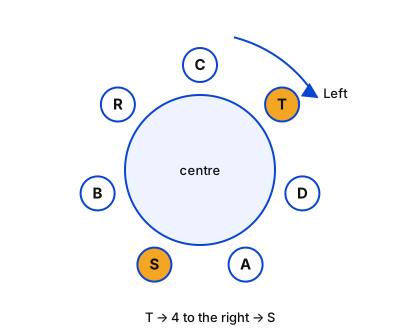
- Fix C. A is 3rd to the left of C (two people between them); S is 4th to the left of C.
- R is 4th to the right of A ⇒ R is just right of C.
- Empty seats: 1st and 2nd to the left of C, and the seat between S and R. D cannot touch R or C ⇒ D is 2nd to the left of C (next to A).
- B is not next to D ⇒ B sits between S and R, so T sits between C and D.
- 4th to the right of T: T → C → R → B → S.
Trick: With 7 seats, 4th to the right = 3rd to the left – count the shorter way.
Answer: (C) S
अवधारणा: केंद्र की ओर मुख होने पर 'बाएँ' = दक्षिणावर्त (clockwise), 'दाएँ' = वामावर्त।
- C को स्थिर करें। A, C के बाएँ तीसरे स्थान पर (बीच में दो व्यक्ति); S, C के बाएँ चौथे स्थान पर।
- R, A के दाएँ चौथे ⇒ R, C के ठीक दाएँ।
- खाली सीटें: C के बाएँ पहली व दूसरी, और S व R के बीच वाली। D, R या C का पड़ोसी नहीं ⇒ D, C के बाएँ दूसरी सीट पर (A के बगल में)।
- B, D का पड़ोसी नहीं ⇒ B, S और R के बीच; T, C और D के बीच।
- T के दाएँ चौथा: T → C → R → B → S।
ट्रिक: 7 सीटों में दाएँ चौथा = बाएँ तीसरा – छोटी दिशा में गिनें।
उत्तर: (C) S
RRB NTPC Graduate CBT 1General Intelligence and ReasoningCircular Seating ArrangementRRB NTPC Graduate CBT 1 2024 · 12 Jun Shift 2
Q3097.D, E, F, G, M, N and O are sitting around a circular table, facing the centre of the table. Only E sits between N and M. M sits third to the left of O. G sits to the immediate left of O. D is not an immediate neighbour of M. Who sits third to the left of F?
D, E, F, G, M, N और O एक वृत्ताकार मेज़ के चारों ओर मेज़ के केंद्र की ओर मुख करके बैठे हैं। N और M के बीच केवल E बैठा है। M, O के बाएँ से तीसरे स्थान पर बैठा है। G, O के ठीक बाएँ बैठा है। D, M का निकटतम पड़ोसी नहीं है। F के बाएँ से तीसरे स्थान पर कौन बैठा है?
- AM
- BN
- CE
- DD
Show answer
Concept: Facing the centre, 'left' means clockwise and 'right' means anticlockwise.
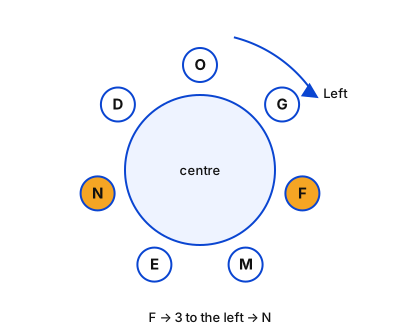
- Fix O. G is immediately left of O; M is 3rd to the left of O.
- Only E sits between N and M, so E is next to M. E cannot be between G and M (that seat would put N on G's seat) ⇒ E is 4th left of O and N is 5th left of O.
- Remaining seats: between G and M, and between N and O. D is not next to M ⇒ D sits between N and O; F sits between G and M.
- 3rd to the left of F: F → M → E → N.
Trick: Place fixed clues (3rd left, immediate left) first; 'only E between' locks the rest.
Answer: (B) N
अवधारणा: केंद्र की ओर मुख होने पर 'बाएँ' = दक्षिणावर्त, 'दाएँ' = वामावर्त।
- O को स्थिर करें। G, O के ठीक बाएँ; M, O के बाएँ तीसरे स्थान पर।
- N और M के बीच केवल E ⇒ E, M के बगल में। यदि E, G और M के बीच हो तो N को G की सीट चाहिए – असंभव ⇒ E, O के बाएँ चौथे और N पाँचवें स्थान पर।
- बची सीटें: G–M के बीच और N–O के बीच। D, M का पड़ोसी नहीं ⇒ D, N और O के बीच; F, G और M के बीच।
- F के बाएँ तीसरा: F → M → E → N।
ट्रिक: पहले निश्चित संकेत (तीसरा बाएँ, ठीक बाएँ) रखें; 'केवल E बीच में' बाकी तय कर देता है।
उत्तर: (B) N
RRB NTPC Graduate CBT 1General Intelligence and ReasoningCircular Seating ArrangementRRB NTPC Graduate CBT 1 2024 · 12 Jun Shift 2
Q3098.A group of numbers and symbols is coded using letter codes as per the codes given below and the conditions that follow. Study the given codes and conditions and answer the question that follows.
Note: If none of the conditions apply, then codes for the respective number/symbol are to be followed directly as given in the table.
| Number/symbol | @ | 4 | 6 | 9 | $ | + | 3 | % | # | 7 | & | 5 | $ | 2 |
| Code | L | V | C | M | K | P | B | Q | Z | Y | R | B | U | F |
Conditions:
1. If the first element is a symbol and the last an odd number, the codes for these two (the first and the last elements) are to be interchanged.
2. If the first element is an odd number and the last an even number, the first and last elements are to be coded as ©.
3. If both second and third elements are perfect squares, the third element is to be coded as the code for the second element.
What will be the code for the following group?
+ 6 # 5
संख्याओं और प्रतीकों के एक समूह को नीचे दिए गए कूटों और उसके बाद दी गई शर्तों के अनुसार अक्षर कूटों का उपयोग करके कूटबद्ध किया गया है। दिए गए कूटों और शर्तों का अध्ययन कीजिए और उसके बाद दिए गए प्रश्न का उत्तर दीजिए।
ध्यान दें: यदि कोई भी शर्त लागू नहीं होती है, तो संबंधित संख्या/प्रतीक के लिए तालिका में दिए गए कूटों का सीधे अनुसरण किया जाना है।
| संख्या/प्रतीक | @ | 4 | 6 | 9 | $ | + | 3 | % | # | 7 | & | 5 | $ | 2 |
| कूट | L | V | C | M | K | P | B | Q | Z | Y | R | B | U | F |
शर्तें:
1. यदि पहला अवयव एक प्रतीक है और अंतिम एक विषम संख्या है, तो इन दोनों (पहले और अंतिम अवयवों) के कूटों को आपस में बदल दिया जाना है।
2. यदि पहला अवयव एक विषम संख्या है और अंतिम एक सम संख्या है, तो पहले और अंतिम अवयवों को © के रूप में कूटबद्ध किया जाना है।
3. यदि दूसरा और तीसरा दोनों अवयव पूर्ण वर्ग हैं, तो तीसरे अवयव को दूसरे अवयव के कूट के रूप में कूटबद्ध किया जाना है।
निम्नलिखित समूह के लिए कूट क्या होगा?
+ 6 # 5
- APCCB
- BPCZB
- CBCZP
- DPZZB
Show answer
Concept: Write the direct codes, then apply only the conditions that fit the group.
- Direct codes: + → P, 6 → C, # → Z, 5 → B ⇒ P C Z B.
- First element '+' is a symbol and last '5' is odd ⇒ condition 1 applies: interchange first and last codes.
- Condition 2 fails (first is not a number); condition 3 fails (6 and # are not perfect squares).
- Code: B C Z P.
Trick: Classify each element (symbol / odd / even / square) before reading conditions.
Answer: (C) BCZP
अवधारणा: पहले सीधे कोड लिखें, फिर केवल लागू होने वाली शर्तें अपनाएँ।
- सीधे कोड: + → P, 6 → C, # → Z, 5 → B ⇒ P C Z B।
- पहला तत्व '+' चिह्न है और अंतिम '5' विषम ⇒ शर्त 1 लागू: पहले और अंतिम के कोड आपस में बदलें।
- शर्त 2 लागू नहीं (पहला अंक नहीं); शर्त 3 लागू नहीं (6 और # पूर्ण वर्ग नहीं)।
- कोड: B C Z P।
ट्रिक: शर्तें पढ़ने से पहले हर तत्व को वर्गीकृत करें (चिह्न / विषम / सम / पूर्ण वर्ग)।
उत्तर: (C) BCZP
RRB NTPC Graduate CBT 1General Intelligence and ReasoningCoding with ConditionsRRB NTPC Graduate CBT 1 2024 · 12 Jun Shift 2
Q3099.Based on the English alphabetical order, three of the following four letter-clusters are alike in a certain way and thus form a group. Which letter-cluster DOES NOT belong to that group?
(Note: The odd one out is not based on the number of consonants/vowels or their position in the letter-cluster.)
अंग्रेज़ी वर्णमाला क्रम के आधार पर, निम्नलिखित चार अक्षर-समूहों में से तीन किसी निश्चित प्रकार से एकसमान हैं और इस प्रकार एक समूह बनाते हैं। कौन-सा अक्षर-समूह उस समूह से संबंधित नहीं है?
(ध्यान दें: असंगत अक्षर-समूह, उस अक्षर-समूह में व्यंजनों/स्वरों की संख्या या उनके स्थान पर आधारित नहीं है।)
- APWR
- BJQL
- CMTO
- DGNJ
Show answer
Concept: Find the alphabet-position gaps between consecutive letters.
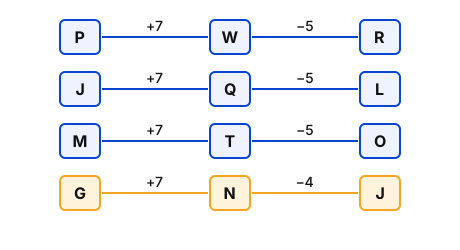
- PWR: P → W, W → R.
- JQL: , ; MTO: , .
- GNJ: G → N, N → J ✗ – pattern breaks.
Trick: Use EJOTY (5, 10, 15, 20, 25) to find positions fast.
Answer: (D) GNJ
अवधारणा: क्रमागत अक्षरों के बीच वर्णमाला-स्थान का अंतर देखें।
- PWR: P → W, W → R।
- JQL: , ; MTO: , ।
- GNJ: G → N, N → J ✗ – पैटर्न टूटता है।
ट्रिक: स्थान जल्दी निकालने के लिए EJOTY (5, 10, 15, 20, 25) याद रखें।
उत्तर: (D) GNJ
RRB NTPC Graduate CBT 1General Intelligence and ReasoningOdd One Out – Letter ClustersRRB NTPC Graduate CBT 1 2024 · 12 Jun Shift 2
Q3100.If 1 is added to each odd digit and 2 is subtracted from each even digit in the number 8132574, how many digits will appear more than once in the new number thus formed?
यदि संख्या 8132574 में प्रत्येक विषम अंक में 1 जोड़ा जाए और प्रत्येक सम अंक में से 2 घटाया जाए, तो इस प्रकार बनी नई संख्या में कितने अंक एक से अधिक बार आएँगे?
- A2
- B3
- C1
- D4
Show answer
Concept: Change each digit by the rule, then count repeated digits.
- 8132574: odd digits (1→2, 3→4, 5→6, 7→8); even digits (8→6, 2→0, 4→2).
- New number: 6 2 4 0 6 8 2.
- 6 appears twice, 2 appears twice ⇒ 2 digits repeat.
Trick: Write the new digits directly under the old ones to avoid slips.
Answer: (A)
अवधारणा: नियम से हर अंक बदलें, फिर दोहराए गए अंक गिनें।
- 8132574: विषम अंक (1→2, 3→4, 5→6, 7→8); सम अंक (8→6, 2→0, 4→2)।
- नई संख्या: 6 2 4 0 6 8 2।
- 6 दो बार, 2 दो बार ⇒ 2 अंक दोहराए गए।
ट्रिक: नए अंक पुराने अंकों के ठीक नीचे लिखें – गलती नहीं होगी।
उत्तर: (A)
RRB NTPC Graduate CBT 1General Intelligence and ReasoningDigit OperationsRRB NTPC Graduate CBT 1 2024 · 12 Jun Shift 2

