Q3161.A ladder leans against a wall, making an angle of 30° with the ground. If the ladder is 8 m long, what is the height it reaches on the wall?
एक सीढ़ी दीवार के सहारे टिकी है, जो भूमि के साथ 30° का कोण बनाती है। यदि सीढ़ी 8 m लंबी है, तो वह दीवार पर कितनी ऊँचाई तक पहुँचती है?
- A4 m
- B6 m
- C10 m
- D8 m
Show answer
Concept: Ladder, wall and ground form a right triangle; the ladder is the hypotenuse, height is opposite to the 30° angle.
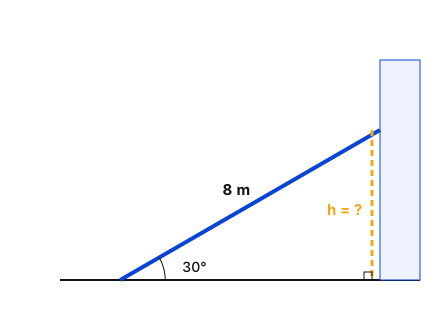
Trick: In a 30°-60°-90° triangle, side opposite 30° = half of the hypotenuse.
Answer: (A)
अवधारणा: सीढ़ी, दीवार और ज़मीन समकोण त्रिभुज बनाते हैं; सीढ़ी कर्ण है और ऊँचाई 30° कोण के सामने की भुजा है।
ट्रिक: 30°-60°-90° त्रिभुज में 30° के सामने की भुजा = कर्ण का आधा।
उत्तर: (A)
RRB NTPC Graduate CBT 1MathematicsHeights and distancesRRB NTPC Graduate CBT 1 2024 · 12 Jun Shift 1
Q3162.Find the volume (in cm3) of a hemispherical cap having a radius of 24 cm.
24 cm त्रिज्या वाले एक अर्धगोलाकार कैप का आयतन (cm3 में) ज्ञात कीजिए।
- A9220π
- B9208π
- C9216π
- D9212π
Show answer
Concept: Volume of a hemisphere .
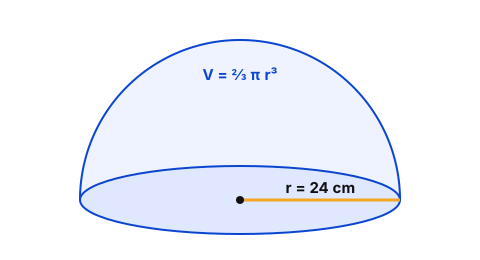
Trick: Divide by 3 first: , then double.
Answer: (C)
अवधारणा: अर्धगोले का आयतन ।
ट्रिक: पहले 3 से भाग दें: , फिर दोगुना करें।
उत्तर: (C)
RRB NTPC Graduate CBT 1MathematicsMensuration – HemisphereRRB NTPC Graduate CBT 1 2024 · 12 Jun Shift 1
Q3163.Train A running at a speed of 99 km/hr takes 46 seconds to completely cross train B running at 72 km/hr in the opposite direction. The length of train B is 1.5 times the length of train A. Train B crosses a bridge completely in 82 seconds. The length of the bridge (in m) is:
99 km/hr की चाल से चल रही ट्रेन A, विपरीत दिशा में 72 km/hr की चाल से चल रही ट्रेन B को पूरी तरह पार करने में 46 सेकंड लेती है। ट्रेन B की लंबाई ट्रेन A की लंबाई की 1.5 गुना है। ट्रेन B एक पुल को 82 सेकंड में पूरी तरह पार करती है। पुल की लंबाई (m में) है:
- A426
- B424
- C369
- D329
Show answer
Concept: Opposite directions: relative speed = sum of speeds; distance covered while crossing = sum of the lengths.
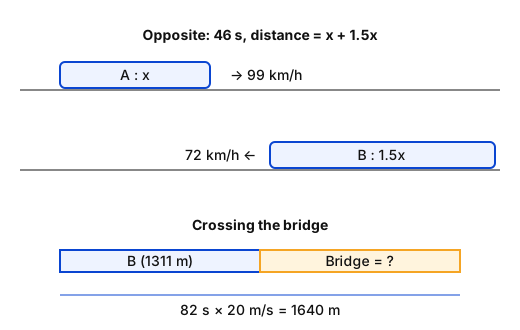
- Relative speed .
- ; length of B .
- Speed of B ; in 82 s it covers .
- Bridge .
Trick: Train crossing a bridge covers (train + bridge) length.
Answer: (D) 329
अवधारणा: विपरीत दिशा: सापेक्ष चाल = चालों का योग; पार करने में तय दूरी = दोनों लंबाइयों का योग।
- सापेक्ष चाल ।
- ; B की लंबाई ।
- B की चाल ; 82 सेकंड में दूरी ।
- पुल ।
ट्रिक: पुल पार करते समय ट्रेन (ट्रेन + पुल) की लंबाई तय करती है।
उत्तर: (D) 329
RRB NTPC Graduate CBT 1MathematicsTrains – relative speedRRB NTPC Graduate CBT 1 2024 · 12 Jun Shift 1
Q3164.Simplify the given expression.
(5z − 9y)2+ (9z + 5y)2 − 81z2
दिए गए व्यंजक को सरल कीजिए।
(5z − 9y)2+ (9z + 5y)2 − 81z2
- A30z2 + 105y2
- B16z2 + 114y2
- C25z2 + 106y2
- D15z2 + 103y2
Show answer
Concept: and .
- Sum (the terms cancel).
Trick: .
Answer: (C)
अवधारणा: तथा ।
- योग ( पद कट जाते हैं)।
ट्रिक: ।
उत्तर: (C)
RRB NTPC Graduate CBT 1MathematicsAlgebra – SimplificationRRB NTPC Graduate CBT 1 2024 · 12 Jun Shift 1
Q3165.Three numbers are in the ratio 8 : 2 : 1, and their LCM is 7552. Their HCF is:
तीन संख्याएँ 8 : 2 : 1 के अनुपात में हैं, और उनका LCM 7552 है। उनका HCF है:
- A502
- B472
- C486
- D456
Show answer
Concept: If numbers are in the ratio with HCF of the ratio terms 1, the numbers are ; HCF and LCM .
- Numbers . , so LCM .
- , so HCF .
- is not among the options (502, 472, 486, 456), so no option is correct.
- If the ratio had been , LCM gives , option (B).
Note: For a ratio like , the largest number is itself the LCM. In the exam, every candidate gets full marks (bonus) for such a question.
Answer: Bonus – no option is correct as printed; full marks to all.
अवधारणा: यदि संख्याएँ के अनुपात में हों (अनुपात के पदों का म.स. 1), तो संख्याएँ होंगी; म.स. और ल.स. ।
- संख्याएँ । , अतः ल.स. ।
- , अतः म.स. ।
- विकल्पों (502, 472, 486, 456) में नहीं है, अतः कोई विकल्प सही नहीं।
- यदि अनुपात होता, तो ल.स. से , विकल्प (B) होता।
नोट: जैसे अनुपात में सबसे बड़ी संख्या ही ल.स. होती है। परीक्षा में ऐसे प्रश्न पर सभी अभ्यर्थियों को पूरे अंक (बोनस) दिए जाते हैं।
उत्तर: बोनस – छपे प्रश्न के अनुसार कोई विकल्प सही नहीं; सभी को पूरे अंक।
RRB NTPC Graduate CBT 1MathematicsHCF and LCMRRB NTPC Graduate CBT 1 2024 · 12 Jun Shift 1
Q3166.The roots of the quadratic equation 9x2 - 9x + 1 = 0 are:
द्विघात समीकरण 9x2 - 9x + 1 = 0 के मूल हैं:
- A & और
- B & और
- C & और
- D & और
Show answer
Concept: For : .
Trick: Check: sum of roots ✓; options with denominator 9 or 4.5 fail this.
Answer: (A) &
अवधारणा: के लिए: ।
ट्रिक: जाँच: मूलों का योग ✓; हर 9 या 4.5 वाले विकल्प इसमें विफल।
उत्तर: (A) व
RRB NTPC Graduate CBT 1MathematicsQuadratic equationsRRB NTPC Graduate CBT 1 2024 · 12 Jun Shift 1
Q3167.If the eight-digit number 32043p88 is divisible by 4, then the maximum value of p is:
यदि आठ अंकों की संख्या 32043p88, 4 से विभाज्य है, तो p का अधिकतम मान है:
- A7
- B5
- C4
- D9
Show answer
Concept: A number is divisible by 4 if the number formed by its last two digits is divisible by 4.
- In 32043p88, the last two digits are 88.
- ✓ – divisible for every value of .
- So can be any digit 0–9; maximum .
Trick: If is not among the last two digits, it is free – take the largest digit 9.
Answer: (D) 9
अवधारणा: कोई संख्या 4 से विभाज्य है यदि उसके अंतिम दो अंकों से बनी संख्या 4 से विभाज्य हो।
- 32043p88 के अंतिम दो अंक 88 हैं।
- ✓ – के हर मान पर विभाज्य।
- अतः कोई भी अंक 0–9 हो सकता है; अधिकतम ।
ट्रिक: यदि अंतिम दो अंकों में नहीं है, तो वह स्वतंत्र है – सबसे बड़ा अंक 9 लें।
उत्तर: (D) 9
RRB NTPC Graduate CBT 1MathematicsNumber system – DivisibilityRRB NTPC Graduate CBT 1 2024 · 12 Jun Shift 1
Q3168.Yash travels 204 km at 68 km/hr, the next 424 km at 53 km/hr and the next 366 km at 61 km/hr. What is his average speed (in km/hr) for the whole journey? (Corrected to two decimal places)
यश 204 km की दूरी 68 km/hr की चाल से, अगली 424 km की दूरी 53 km/hr की चाल से और अगली 366 km की दूरी 61 km/hr की चाल से तय करता है। पूरी यात्रा के लिए उसकी औसत चाल (km/hr में) क्या है? (दो दशमलव स्थानों तक सही)
- A67.92
- B57.62
- C58.47
- D65.87
Show answer
Concept: Average speed (never the average of speeds).
- Times: , , ; total .
- Distance .
- Average speed .
Trick: All divisions are exact (3, 8, 6) – a sign you are on the right track.
Answer: (C) 58.47
अवधारणा: औसत चाल (चालों का औसत नहीं)।
- समय: , , ; कुल ।
- दूरी ।
- औसत चाल ।
ट्रिक: सभी भाग पूरे-पूरे (3, 8, 6) – सही रास्ते का संकेत।
उत्तर: (C) 58.47
RRB NTPC Graduate CBT 1MathematicsSpeed – Average speedRRB NTPC Graduate CBT 1 2024 · 12 Jun Shift 1
Q3169.A shopkeeper expects a gain of 30% on his cost price. If, in a week, his sales proceeds were ₹2,938, what was his profit (in ₹)?
एक दुकानदार अपने क्रय मूल्य पर 30% लाभ की अपेक्षा करता है। यदि एक सप्ताह में उसकी बिक्री से प्राप्त राशि ₹2,938 थी, तो उसका लाभ (₹ में) कितना था?
- A680
- B676
- C678
- D679
Show answer
Concept: With 30% gain, SP CP, so profit SP.
- CP = ₹
- Profit = ₹
Trick: Profit .
Answer: (C) 678
अवधारणा: 30% लाभ पर विक्रय मूल्य क्रय मूल्य, अतः लाभ विक्रय मूल्य।
- क्रय मूल्य = ₹
- लाभ = ₹
ट्रिक: लाभ ।
उत्तर: (C) 678
RRB NTPC Graduate CBT 1MathematicsProfit and lossRRB NTPC Graduate CBT 1 2024 · 12 Jun Shift 1
Q3170.Find a single discount (rounded up to two decimal places) to equal three consecutive discounts of 29%, 28% and 13%.
29%, 28% और 13% की तीन क्रमिक छूटों के बराबर एकल छूट (दो दशमलव स्थानों तक पूर्णांकित) ज्ञात कीजिए।
- A58.85%
- B57.27%
- C55.53%
- D56.92%
Show answer
Concept: Successive discounts multiply the remaining fractions: net price .
- Remaining fraction .
- ; .
- Single discount .
Trick: Two at a time: ; then with : .
Answer: (C)
अवधारणा: क्रमागत छूटों में बचे भागों का गुणा होता है: शुद्ध मूल्य ।
- बचा भाग ।
- ; ।
- एकल छूट ।
ट्रिक: दो-दो करके: ; फिर के साथ: ।
उत्तर: (C)
RRB NTPC Graduate CBT 1MathematicsDiscount – Successive discountsRRB NTPC Graduate CBT 1 2024 · 12 Jun Shift 1
Q3171.MP 14 is related to LS −1 in a certain way. In the same way, NK 5 is related to MN −10. To which of the given options is SW −1 related, following the same logic?
MP 14 एक निश्चित प्रकार से LS −1 से संबंधित है। उसी प्रकार, NK 5, MN −10 से संबंधित है। समान तर्क का अनुसरण करते हुए, SW −1 दिए गए विकल्पों में से किससे संबंधित है?
- ATR −18
- BVW −20
- CVC −13
- DRZ −16
Show answer
Concept: Find the change in each letter and in the number.
- MP 14 → LS −1: M−1=L, P+3=S, .
- NK 5 → MN −10: N−1=M, K+3=N, ✓.
- SW −1: S−1=R, W+3=Z, → RZ −16.
Trick: Pattern: first letter −1, second letter +3, number −15.
Answer: (D) RZ −16
अवधारणा: हर अक्षर और संख्या में परिवर्तन ज्ञात करें।
- MP 14 → LS −1: M−1=L, P+3=S, ।
- NK 5 → MN −10: N−1=M, K+3=N, ✓।
- SW −1: S−1=R, W+3=Z, → RZ −16।
ट्रिक: पहला अक्षर −1, दूसरा +3, संख्या −15।
उत्तर: (D) RZ −16
RRB NTPC Graduate CBT 1General Intelligence and ReasoningAnalogy (Letter-Number)RRB NTPC Graduate CBT 1 2024 · 12 Jun Shift 1
Q3172.Two sets of numbers are given below. In each set of numbers, certain mathematical operation(s) on the first number result(s) in the second number. Similarly, certain mathematical operation(s) on the second number result(s) in the third number and so on. Which of the given options follows the same set of operations as in the given sets? (NOTE: Operations should be performed on the whole numbers, without breaking down the numbers into their constituent digits. E.g. 13 – Operations on 13 such as adding / subtracting /multiplying to 13 can be performed. Breaking down 13 into 1 and 3 and then performing mathematical operations on 1 and 3 is not allowed.)
5 - 6 - 10 - 20 ; 12 - 13 - 17 - 34
नीचे संख्याओं के दो समुच्चय दिए गए हैं। संख्याओं के प्रत्येक समुच्चय में, पहली संख्या पर कुछ गणितीय संक्रिया/संक्रियाएँ करने पर दूसरी संख्या प्राप्त होती है। इसी प्रकार, दूसरी संख्या पर कुछ गणितीय संक्रिया/संक्रियाएँ करने पर तीसरी संख्या प्राप्त होती है, और इसी प्रकार आगे भी। दिए गए विकल्पों में से कौन-सा विकल्प संक्रियाओं के उसी समुच्चय का अनुसरण करता है जैसा कि दिए गए समुच्चयों में है? (ध्यान दें: संक्रियाएँ संख्याओं को उनके घटक अंकों में विभाजित किए बिना, पूर्ण संख्याओं पर की जानी चाहिए। उदाहरण के लिए 13 – 13 पर संक्रियाएँ जैसे 13 में जोड़ना/घटाना/गुणा करना आदि की जा सकती हैं। 13 को 1 और 3 में विभाजित करके फिर 1 और 3 पर गणितीय संक्रियाएँ करने की अनुमति नहीं है।)
5 - 6 - 10 - 20 ; 12 - 13 - 17 - 34
- A17 - 18 - 22 - 44
- B15 - 16 - 20 - 30
- C7 - 8 - 12 - 26
- D23 - 24 - 28 - 54
Show answer
Concept: Find the fixed chain of operations in both given sets.
- (+1), (+4), (×2).
- (+1), (+4), (×2) ✓.
- (A): (+1), (+4), (×2) ✓. Others fail at the last step (e.g. ).
Trick: Check the last step (×2) first — it eliminates options fastest.
Answer: (A) 17 - 18 - 22 - 44
अवधारणा: दोनों समूहों में संक्रियाओं का एक-सा क्रम खोजें।
- (+1), (+4), (×2)।
- में भी यही क्रम ✓।
- (A): ✓। अन्य विकल्प अंतिम चरण पर विफल (जैसे )।
ट्रिक: पहले अंतिम चरण (×2) जाँचें — विकल्प जल्दी हटते हैं।
उत्तर: (A) 17 - 18 - 22 - 44
RRB NTPC Graduate CBT 1General Intelligence and ReasoningNumber Operations SeriesRRB NTPC Graduate CBT 1 2024 · 12 Jun Shift 1
Q3173.A group of numbers and symbols is coded using letter codes as per the codes given below and the conditions that follow. Study the given codes and conditions and answer the question that follows.
Note: If none of the conditions apply, then codes for the respective number/symbol are to be followed directly as given in the table.
| Number/symbol | * | 2 | 5 | 7 | $ | + | 8 | % | # | 9 | & | 6 | $ | 4 |
|---|
| Code | H | D | O | A | B | P | B | Q | Z | Y | R | B | U | F |
|---|
Conditions:
If the first element is a symbol and the last an odd number, the codes for these two (the first and the last elements) are to be interchanged.
If the first element is an odd number and the last an even number, the first and last elements are to be coded as ©.
If both second and third elements are perfect cubes, the third element is to be coded as the code for the second element.
What will be the code for the following group?
# 8 9 $
संख्याओं और प्रतीकों के एक समूह को नीचे दिए गए कोड और उसके बाद दी गई शर्तों के अनुसार अक्षर कोड द्वारा कूटबद्ध किया गया है। दिए गए कोड और शर्तों का अध्ययन करें और उसके बाद दिए गए प्रश्न का उत्तर दें।
नोट: यदि कोई भी शर्त लागू नहीं होती है, तो संबंधित संख्या/प्रतीक के लिए तालिका में दिए गए कोड का सीधे पालन करना है।
| Number/symbol | * | 2 | 5 | 7 | $ | + | 8 | % | # | 9 | & | 6 | $ | 4 |
|---|
| Code | H | D | O | A | B | P | B | Q | Z | Y | R | B | U | F |
|---|
शर्तें:
यदि पहला तत्व एक प्रतीक है और अंतिम तत्व एक विषम संख्या है, तो इन दोनों (पहले और अंतिम तत्व) के कोड आपस में बदल दिए जाने हैं।
यदि पहला तत्व एक विषम संख्या है और अंतिम तत्व एक सम संख्या है, तो पहले और अंतिम तत्व को © के रूप में कूटबद्ध किया जाना है।
यदि दूसरा और तीसरा दोनों तत्व पूर्ण घन हैं, तो तीसरे तत्व को दूसरे तत्व के कोड के रूप में कूटबद्ध किया जाना है।
निम्नलिखित समूह का कोड क्या होगा?
# 8 9 $
- AZYYU
- BUBYZ
- CZBBU
- DZBYU
Show answer
Concept: Check each condition for the group; if none applies, code directly from the table.
- Group: # 8 9 $. Direct codes: # = Z, 8 = B, 9 = Y, $ = U.
- Condition 1: first is a symbol but last ($) is not an odd number ✗. Condition 2: first is not an odd number ✗.
- Condition 3: 8 is a perfect cube but 9 is not ✗.
- So code directly: Z B Y U.
Trick: Test the conditions in order; when all fail, just read the table.
Answer: (D) ZBYU
अवधारणा: समूह पर हर शर्त जाँचें; कोई लागू न हो तो सीधे तालिका से कोड लिखें।
- समूह: # 8 9 $। सीधे कोड: # = Z, 8 = B, 9 = Y, $ = U।
- शर्त 1: पहला प्रतीक है पर अंतिम ($) विषम संख्या नहीं ✗। शर्त 2: पहला विषम संख्या नहीं ✗।
- शर्त 3: 8 पूर्ण घन है पर 9 नहीं ✗।
- अतः सीधे: Z B Y U।
ट्रिक: शर्तें क्रम से जाँचें; कोई न लगे तो तालिका पढ़ें।
उत्तर: (D) ZBYU
RRB NTPC Graduate CBT 1General Intelligence and ReasoningCoding-Decoding (Conditions)RRB NTPC Graduate CBT 1 2024 · 12 Jun Shift 1
Q3174.What should come in place of the question mark (?) in the given series?
61 54 61 47 61 40 61 ?
दी गई श्रृंखला में प्रश्न चिह्न (?) के स्थान पर क्या आना चाहिए?
61 54 61 47 61 40 61 ?
- A37
- B33
- C31
- D40
Show answer
Concept: Two interleaved series.
- Odd positions: 61, 61, 61, 61 (constant).
- Even positions: 54, 47, 40, ? → each −7.
- .
Trick: When a number keeps repeating, separate the alternate terms.
Answer: (B) 33
अवधारणा: दो एकांतर (alternate) श्रृंखलाएँ।
- विषम स्थान: 61, 61, 61, 61 (स्थिर)।
- सम स्थान: 54, 47, 40, ? → हर बार −7।
- ।
ट्रिक: कोई संख्या बार-बार आए तो एकांतर पद अलग करें।
उत्तर: (B) 33
RRB NTPC Graduate CBT 1General Intelligence and ReasoningNumber Series (Alternate)RRB NTPC Graduate CBT 1 2024 · 12 Jun Shift 1
Q3175.In a certain code language,
'A+ B' means 'A is the sister of B'
'A – B' means 'A is the brother of B'
'A × B' means 'A is the wife of B'
'A ÷ B' means 'A is the father of B'
Based on the above, how is M related to Q if 'M × N ÷ O – P + Q'?
एक निश्चित कूट भाषा में,
'A+ B' का अर्थ है 'A, B की बहन है'
'A – B' का अर्थ है 'A, B का भाई है'
'A × B' का अर्थ है 'A, B की पत्नी है'
'A ÷ B' का अर्थ है 'A, B का पिता है'
उपरोक्त के आधार पर, यदि 'M × N ÷ O – P + Q' है, तो M का Q से क्या संबंध है?
- AWifeपत्नी
- BMotherमाता
- CSisterबहन
- DDaughterपुत्री
Show answer
Concept: Decode each symbol and draw the family tree.
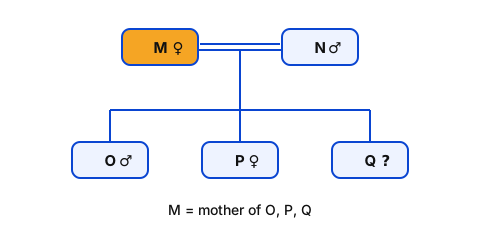
- M × N: M is the wife of N.
- N ÷ O: N is the father of O → M is the mother of O.
- O – P: O is the brother of P; P + Q: P is the sister of Q.
- So O, P, Q are siblings and M is the mother of Q.
Trick: Wife of the father = mother; siblings share the same mother.
Answer: (B) Mother
अवधारणा: हर चिह्न को खोलें और वंश-वृक्ष बनाएँ।
- M × N: M, N की पत्नी है।
- N ÷ O: N, O का पिता है → M, O की माता है।
- O – P: O, P का भाई; P + Q: P, Q की बहन।
- अतः O, P, Q भाई-बहन हैं और M, Q की माता है।
ट्रिक: पिता की पत्नी = माता; भाई-बहनों की माता एक ही।
उत्तर: (B) माता (Mother)
RRB NTPC Graduate CBT 1General Intelligence and ReasoningBlood Relation (Coded)RRB NTPC Graduate CBT 1 2024 · 12 Jun Shift 1
Q3176.Based on the English alphabetical order, three of the following four letter-cluster pairs are alike in a certain way and thus form a group. Which letter-cluster pair DOES NOT belong to that group?
(Note: The odd one out is not based on the number of consonants/vowels or their position in the letter-cluster.)
अंग्रेज़ी वर्णमाला क्रम के आधार पर, निम्नलिखित चार अक्षर-समूह युग्मों में से तीन किसी निश्चित प्रकार से एकसमान हैं और इस प्रकार एक समूह बनाते हैं। कौन-सा अक्षर-समूह युग्म उस समूह से संबंधित नहीं है?
(ध्यान दें: असंगत अक्षर-समूह, उस अक्षर-समूह में व्यंजनों/स्वरों की संख्या या उनके स्थान पर आधारित नहीं है।)
- AUO-ZG
- BBV-GN
- CJD-OW
- DWQ-BI
Show answer
Concept: Compare the shift of each letter from the first cluster to the second.
- UO-ZG: U+5=Z, O−8=G.
- BV-GN: B+5=G, V−8=N. WQ-BI: W+5=B, Q−8=I.
- JD-OW: J+5=O ✓ but D−8=V, not W ✗.
Trick: Use positions: D=4, = V.
Answer: (C) JD-OW
अवधारणा: पहले समूह से दूसरे समूह में हर अक्षर का खिसकाव देखें।
- UO-ZG: U+5=Z, O−8=G।
- BV-GN: B+5=G, V−8=N। WQ-BI: W+5=B, Q−8=I।
- JD-OW: J+5=O ✓ पर D−8=V, W नहीं ✗।
ट्रिक: स्थान मान: D=4, = V।
उत्तर: (C) JD-OW
RRB NTPC Graduate CBT 1General Intelligence and ReasoningOdd One Out (Letter Pairs)RRB NTPC Graduate CBT 1 2024 · 12 Jun Shift 1
Q3177.If ‘P’ stands for ‘÷’, ‘Q’ stands for ‘×’, ‘R’ stands for ‘+’ and ‘S’ stands for ‘−’, then the resultant of which of the following would be 200?
यदि ‘P’ का अर्थ ‘÷’, ‘Q’ का अर्थ ‘×’, ‘R’ का अर्थ ‘+’ और ‘S’ का अर्थ ‘−’ है, तो निम्नलिखित में से किसका परिणाम 200 होगा?
- A64 P 16 S 60 R 32 Q 8
- B64 R 16 Q 32 S 60 P 8
- C64 Q 16 P 60 R 32 S 8
- D64 S 16 R 60 P 32 Q 8
Show answer
Concept: Replace letters by signs and apply BODMAS.
- (A): .
- ✓.
- (B) gives , so not 200.
Trick: Do ÷ and × first; the big product already hints at 200.
Answer: (A) 64 P 16 S 60 R 32 Q 8
अवधारणा: अक्षरों को चिह्नों से बदलें और BODMAS लगाएँ।
- (A): ।
- ✓।
- (B) से आता है, 200 नहीं।
ट्रिक: पहले ÷ और ×; से ही 200 का संकेत मिलता है।
उत्तर: (A) 64 P 16 S 60 R 32 Q 8
RRB NTPC Graduate CBT 1General Intelligence and ReasoningSymbol SubstitutionRRB NTPC Graduate CBT 1 2024 · 12 Jun Shift 1
Q3178.Which of the following letter-clusters should replace # and % so that the pattern and relationship followed between the letter-cluster pair on the left side of :: is the same as that on the right side of ::?
# : TVS :: IKH : %
निम्नलिखित में से कौन-से अक्षर-समूह # और % को प्रतिस्थापित करने चाहिए ताकि :: के बाईं ओर के अक्षर-समूह युग्म के बीच अनुसरण किया गया पैटर्न और संबंध वही हो, जो :: के दाईं ओर के अक्षर-समूह युग्म के बीच है?
# : TVS :: IKH : %
- A# = WYV, % = FHE
- B# = IOV, % = WEE
- C# = WOZ, % = UQE
- D# = KNV, % = FXC
Show answer
Concept: Find the rule linking # to TVS and apply it to IKH.
- (A): WYV → TVS: W−3=T, Y−3=V, V−3=S.
- IKH → each −3: I−3=F, K−3=H, H−3=E → FHE ✓.
Trick: Check the right pair first with the same rule (−3 each).
Answer: (A) # = WYV, % = FHE
अवधारणा: # से TVS का नियम खोजकर IKH पर लगाएँ।
- (A): WYV → TVS: हर अक्षर −3।
- IKH → −3: F, H, E → FHE ✓।
ट्रिक: हर अक्षर में −3 का समान नियम।
उत्तर: (A) # = WYV, % = FHE
RRB NTPC Graduate CBT 1General Intelligence and ReasoningLetter AnalogyRRB NTPC Graduate CBT 1 2024 · 12 Jun Shift 1
Q3179.Which of the following letter-clusters should replace # and % so that the pattern and relationship followed between the letter-cluster pair on the left side of :: is the same as that on the right side of :: ?
# : OJR :: QLT : %
निम्नलिखित में से कौन-से अक्षर-समूह # और % को प्रतिस्थापित करने चाहिए ताकि :: के बाईं ओर के अक्षर-समूह युग्म के बीच अनुसरण किया गया पैटर्न और संबंध वही हो, जो :: के दाईं ओर के अक्षर-समूह युग्म के बीच है?
# : OJR :: QLT : %
- A# = NIQ, % = RMU
- B# = NIQ, % = RNU
- C# = NIQ, % = RMV
- D# = NIR, % = RMU
Show answer
Concept: Find the rule from # to OJR and apply it to QLT.
- NIQ → OJR: each letter +1.
- QLT +1 each: R, M, U → RMU ✓.
Trick: All options share # = NIQ (except D); only check % for +1 shift.
Answer: (A) # = NIQ, % = RMU
अवधारणा: # से OJR का नियम खोजकर QLT पर लगाएँ।
- NIQ → OJR: हर अक्षर +1।
- QLT +1: R, M, U → RMU ✓।
ट्रिक: केवल % के लिए +1 नियम जाँचें।
उत्तर: (A) # = NIQ, % = RMU
RRB NTPC Graduate CBT 1General Intelligence and ReasoningLetter AnalogyRRB NTPC Graduate CBT 1 2024 · 12 Jun Shift 1
Q3180.If 2 is added to each even digit and 1 is subtracted from each odd digit in the number 6193425, how many digits will appear more than once in the new number thus formed?
यदि संख्या 6193425 में प्रत्येक सम अंक में 2 जोड़ा जाए और प्रत्येक विषम अंक में से 1 घटाया जाए, तो इस प्रकार बनी नई संख्या में कितने अंक एक से अधिक बार आएँगे?
- ATwoदो
- BThreeतीन
- CNoneकोई नहीं
- DOneएक
Show answer
Concept: Apply +2 to even digits and −1 to odd digits one by one.
- 6193425 → 6→8, 1→0, 9→8, 3→2, 4→6, 2→4, 5→4.
- New number: 8082644.
- 8 appears twice, 4 appears twice; 0, 2, 6 once → two digits repeat.
Trick: Write the new digits under the old ones to avoid slips.
Answer: (A) Two
अवधारणा: सम अंकों में +2 और विषम अंकों में −1 एक-एक करके लगाएँ।
- 6193425 → 8, 0, 8, 2, 6, 4, 4।
- नई संख्या: 8082644।
- 8 दो बार, 4 दो बार; 0, 2, 6 एक बार → दो अंक दोहराए।
ट्रिक: पुराने अंकों के नीचे नए अंक लिखें।
उत्तर: (A) दो
RRB NTPC Graduate CBT 1General Intelligence and ReasoningDigit OperationsRRB NTPC Graduate CBT 1 2024 · 12 Jun Shift 1

