Q1961.A, B and C alone can do a piece of work in 5, 55 and 66 days, respectively. They all started the work together, but A left after 4 days. In how many days was the whole work completed?
A, B और C अकेले किसी कार्य को क्रमशः 5, 55 और 66 दिनों में कर सकते हैं। सभी ने एक साथ कार्य शुरू किया, लेकिन A 4 दिन बाद चला गया। पूरा कार्य कितने दिनों में पूरा हुआ?
- A7
- B3
- C2
- D6
Show answer
Concept: Take total work = LCM(5, 55, 66) = 330 units.
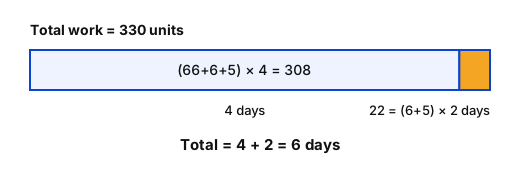
- Efficiencies: A , B , C units/day
- 4 days together: units
- Left: units by B + C at 11/day ⇒ days
- Total days
Trick: Units method avoids fractions – always use LCM as total work.
Answer: (D) 6
अवधारणा: कुल कार्य = LCM(5, 55, 66) = 330 इकाई मानें।
- क्षमता: A , B , C इकाई/दिन
- 4 दिन साथ में: इकाई
- शेष: इकाई, B + C 11 प्रतिदिन ⇒ दिन
- कुल दिन
ट्रिक: LCM को कुल कार्य मानने से भिन्नें नहीं आतीं।
उत्तर: (D) 6
RRB NTPC Graduate CBT 1MathematicsTime and WorkRRB NTPC Graduate CBT 1 2024 · 17 Jun Shift 2
Q1962.Namita travels a certain distance at a speed of 88 km/hr and double the earlier distance at 16 km/hr. She then returns to the starting point through the same route. If her average speed for the entire journey is 33 km/hr, then what is her speed (in km/hr) for the return journey?
नमिता एक निश्चित दूरी 88 km/hr की चाल से और उससे दोगुनी दूरी 16 km/hr की चाल से तय करती है। फिर वह उसी मार्ग से प्रारंभिक बिंदु पर लौटती है। यदि पूरी यात्रा के लिए उसकी औसत चाल 33 km/hr है, तो वापसी यात्रा के लिए उसकी चाल (km/hr में) क्या है?
- A64
- B65.4
- C66
- D71.2
Show answer
Concept: Average speed . Let first part , second part .
- Onward time
- Total distance ; total time
- Return time
- Return speed
Trick: Take : onward time 12 h, total time 16 h, return time 4 h for 264 km ⇒ 66 km/h.
Answer: (C) 66
अवधारणा: औसत चाल । पहला भाग , दूसरा मानें।
- जाने का समय
- कुल दूरी ; कुल समय
- वापसी का समय
- वापसी चाल
ट्रिक: लें: जाने में 12 घंटे, कुल 16 घंटे, वापसी 4 घंटे में 264 km ⇒ 66 km/h।
उत्तर: (C) 66
RRB NTPC Graduate CBT 1MathematicsAverage SpeedRRB NTPC Graduate CBT 1 2024 · 17 Jun Shift 2
Q1963.Find the circumference (in m) of the largest circle that can be inscribed in a rectangle whose dimensions are given as 112 m and 281 m.
Take
उस सबसे बड़े वृत्त की परिधि (m में) ज्ञात कीजिए जो 112 m और 281 m विमाओं वाले एक आयत के अंदर बनाया जा सकता है।
लीजिए
- A352
- B348
- C354
- D342
Show answer
Concept: The largest circle inside a rectangle touches the two longer sides, so its diameter = the shorter side.
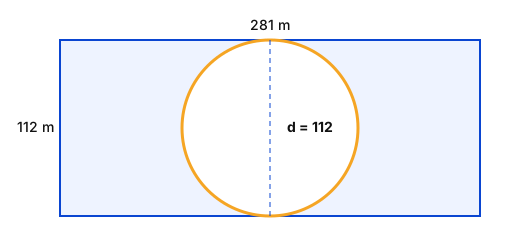
- Diameter
- Circumference
Trick: Diameter = smaller side of the rectangle; the longer side (281) is irrelevant.
Answer: (A) 352
अवधारणा: आयत के अंदर सबसे बड़ा वृत्त दो लंबी भुजाओं को छूता है, अतः उसका व्यास = छोटी भुजा।
- व्यास
- परिधि
ट्रिक: व्यास = आयत की छोटी भुजा; लंबी भुजा (281) का कोई उपयोग नहीं।
उत्तर: (A) 352
RRB NTPC Graduate CBT 1MathematicsMensuration – CircleRRB NTPC Graduate CBT 1 2024 · 17 Jun Shift 2
Q1964.Find the value of :
का मान ज्ञात कीजिए:
- A18
- B29
- C10
- D21
Show answer
Concept: Take square roots of numerator and denominator separately.
- and
Trick: in one step.
Answer: (C) 10
अवधारणा: अंश और हर का वर्गमूल अलग-अलग निकालें।
- और
ट्रिक: एक ही चरण में: ।
उत्तर: (C) 10
RRB NTPC Graduate CBT 1MathematicsSquare Roots of DecimalsRRB NTPC Graduate CBT 1 2024 · 17 Jun Shift 2
Q1965.The cost of 8 pens and 2 pencils is ₹96 and the cost of 4 pens and 7 pencils ₹72. The cost of 2 pens and 8 pencils is:
8 पेन और 2 पेंसिल का मूल्य ₹96 है तथा 4 पेन और 7 पेंसिल का मूल्य ₹72 है। 2 पेन और 8 पेंसिल का मूल्य है:
- A₹53
- B₹55
- C₹54
- D₹56
Show answer
Concept: Let pen , pencil and solve the two equations.
- and
- Double the second: ; subtract:
Trick: Make the pen coefficients equal (8) and subtract to get pencils first.
Answer: (C) ₹54
अवधारणा: पेन , पेंसिल मानकर दोनों समीकरण हल करें।
- और
- दूसरे को 2 से गुणा: ; घटाएँ:
ट्रिक: पेन के गुणांक बराबर (8) करके घटाएँ, पहले पेंसिल का मान मिलेगा।
उत्तर: (C) ₹54
RRB NTPC Graduate CBT 1MathematicsLinear EquationsRRB NTPC Graduate CBT 1 2024 · 17 Jun Shift 2
Q1966.In a regular polygon with n sides, the sum of the interior angles is 1800°. What is the number of sides (n) of the polygon?
n भुजाओं वाले एक सम बहुभुज में अंतः कोणों का योग 1800° है। बहुभुज की भुजाओं की संख्या (n) क्या है?
- A14
- B10
- C12
- D16
Show answer
Concept: Sum of interior angles of an -sided polygon .
Trick: Divide the sum by 180 and add 2: .
Answer: (C) 12
अवधारणा: भुजाओं वाले बहुभुज के अंतःकोणों का योग ।
ट्रिक: योग को 180 से भाग देकर 2 जोड़ें: ।
उत्तर: (C) 12
RRB NTPC Graduate CBT 1MathematicsPolygonsRRB NTPC Graduate CBT 1 2024 · 17 Jun Shift 2
Q1967.Find the simplified value of [160 ÷ {30 + 7 × (2 - 6)}].
[160 ÷ {30 + 7 × (2 - 6)}] का सरलीकृत मान ज्ञात कीजिए।
- A80
- B79
- C85
- D78
Show answer
Concept: Solve innermost brackets first, then multiplication, then addition, then division.
Trick: Watch the sign: is negative, so the curly bracket becomes just 2.
Answer: (A) 80
अवधारणा: पहले सबसे भीतरी कोष्ठक, फिर गुणा, फिर जोड़, फिर भाग।
ट्रिक: चिह्न पर ध्यान दें: ऋणात्मक है, अतः मझला कोष्ठक केवल 2 बनता है।
उत्तर: (A) 80
RRB NTPC Graduate CBT 1MathematicsSimplification (BODMAS)RRB NTPC Graduate CBT 1 2024 · 17 Jun Shift 2
Q1968.A retailer allows a 22% discount on the marked price. What should be the marked price (in ₹) of an item whose cost price is ₹546, in order to make a profit of 60%?
एक खुदरा विक्रेता अंकित मूल्य पर 22% की छूट देता है। 60% लाभ प्राप्त करने के लिए, ₹546 क्रय मूल्य वाली वस्तु का अंकित मूल्य (₹ में) कितना होना चाहिए?
- A1,122
- B1,120
- C1,118
- D1,123
Show answer
Concept: and .
Trick: , and , so MP .
Answer: (B) 1,120
अवधारणा: और ।
ट्रिक: , और , अतः MP ।
उत्तर: (B) 1,120
RRB NTPC Graduate CBT 1MathematicsDiscount and ProfitRRB NTPC Graduate CBT 1 2024 · 17 Jun Shift 2
Q1969.A person saves 30% of his income. If his expenditure is ₹840, then his income (in ₹) is:
एक व्यक्ति अपनी आय का 30% बचाता है। यदि उसका व्यय ₹840 है, तो उसकी आय (₹ में) है:
- A1,240
- B588
- C252
- D1,200
Show answer
Concept: Income = Expenditure + Savings. Savings 30% ⇒ expenditure is 70% of income.
Trick: ⇒ ⇒ .
Answer: (D) 1,200
अवधारणा: आय = व्यय + बचत। बचत 30% ⇒ व्यय आय का 70% है।
ट्रिक: ⇒ ⇒ ।
उत्तर: (D) 1,200
RRB NTPC Graduate CBT 1MathematicsIncome and SavingsRRB NTPC Graduate CBT 1 2024 · 17 Jun Shift 2
Q1970.If the discriminant of a quadratic equation is negative, then the roots are:
यदि किसी द्विघात समीकरण का विविक्तकर (discriminant) ऋणात्मक है, तो उसके मूल होते हैं:
- Areal and distinctवास्तविक और भिन्न
- Bcomplex conjugatesसम्मिश्र संयुग्मी (complex conjugates)
- Creal and equalवास्तविक और समान
- Dreal and negativeवास्तविक और ऋणात्मक
Show answer
Concept: For , discriminant decides the nature of roots.
- : real and distinct; : real and equal
- : is imaginary, so roots are – a pair of complex conjugates (for real coefficients).
Trick: Negative D ⇒ no real roots ⇒ complex pair .
Answer: (B) complex conjugates
अवधारणा: के लिए विविक्तकर (discriminant) मूलों की प्रकृति तय करता है।
- : वास्तविक और भिन्न; : वास्तविक और समान
- : काल्पनिक है, अतः मूल – सम्मिश्र संयुग्मी (complex conjugates) युग्म।
ट्रिक: D ऋणात्मक ⇒ कोई वास्तविक मूल नहीं ⇒ सम्मिश्र युग्म ।
उत्तर: (B) complex conjugates
RRB NTPC Graduate CBT 1MathematicsQuadratic Equations – Nature of RootsRRB NTPC Graduate CBT 1 2024 · 17 Jun Shift 2
Q1971.In a certain code language, ‘CART’ is coded as ‘4268’ and ‘RISE’ is coded as ‘3527’. What is the code for ‘R’ in the given code language?
एक निश्चित कूट भाषा में, ‘CART’ को ‘4268’ और ‘RISE’ को ‘3527’ के रूप में कूटबद्ध किया जाता है। दी गई कूट भाषा में ‘R’ का कूट क्या है?
- A2
- B6
- C7
- D3
Show answer
Concept: When two words share a letter, the digit common to both codes is the code of that letter.
- CART → 4268 and RISE → 3527.
- The only common letter is R.
- The only common digit in the two codes is 2.
Trick: Common letter ↔ common digit; ignore order of digits.
Answer: (A) 2
अवधारणा: जब दो शब्दों में एक अक्षर समान हो, तो दोनों कोड में समान अंक उसी अक्षर का कोड होता है।
- CART → 4268 और RISE → 3527।
- दोनों शब्दों में केवल R समान है।
- दोनों कोड में केवल 2 समान अंक है।
ट्रिक: समान अक्षर ↔ समान अंक; अंकों का क्रम मायने नहीं रखता।
उत्तर: (A) 2
RRB NTPC Graduate CBT 1General Intelligence and ReasoningCoding-DecodingRRB NTPC Graduate CBT 1 2024 · 17 Jun Shift 2
Q1972.A is married to E. E is the sister of R. R is married to D. D is the only brother of Z. B is the only daughter of R. How is A related to B?
A का विवाह E से हुआ है। E, R की बहन है। R का विवाह D से हुआ है। D, Z का एकमात्र भाई है। B, R की एकमात्र पुत्री है। A का B से क्या संबंध है?
- AMother’s sister's husbandमाँ की बहन का पति
- BFather's sister's husbandपिता की बहन का पति
- CMother's sister's fatherमाँ की बहन का पिता
- DMother's brother's wifeमाँ के भाई की पत्नी
Show answer
Concept: Fix genders from marriages and 'brother' clues, then trace the path from B to A.
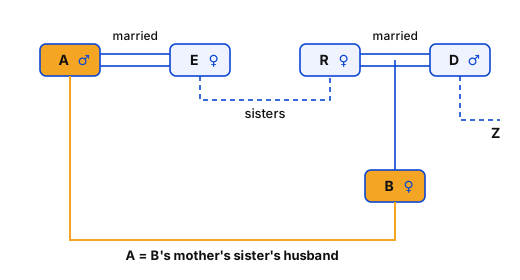
- D is a brother (male), so his wife R is female – B's mother.
- E is R's sister, so E is B's mother's sister (maasi).
- A is married to E, so A is the husband of B's mother's sister.
Trick: Mother's sister's husband = maasa (मौसा).
Answer: (A) Mother's sister's husband
अवधारणा: विवाह और 'भाई' वाले कथनों से लिंग तय करें, फिर B से A तक का रास्ता देखें।
- D भाई (पुरुष) है, अतः उसकी पत्नी R महिला है – B की माँ।
- E, R की बहन है, अतः E = B की मौसी।
- A का विवाह E से है, अतः A = B की माँ की बहन का पति (मौसा)।
ट्रिक: माँ की बहन का पति = मौसा।
उत्तर: (A) माँ की बहन का पति
RRB NTPC Graduate CBT 1General Intelligence and ReasoningBlood RelationRRB NTPC Graduate CBT 1 2024 · 17 Jun Shift 2
Q1973.In a certain code language, ‘HUNT’ is coded as ‘6438’ and ‘USER’ is coded as ‘5723’. What is the code for ‘U’ in the given code language?
एक निश्चित कूट भाषा में, ‘HUNT’ को ‘6438’ और ‘USER’ को ‘5723’ के रूप में कूटबद्ध किया जाता है। दी गई कूट भाषा में ‘U’ का कूट क्या है?
- A3
- B5
- C7
- D4
Show answer
Concept: A letter common to two words takes the digit common to both codes.
- HUNT → 6438 and USER → 5723.
- Common letter: U.
- Common digit: 3.
Trick: Match common letter with common digit.
Answer: (A) 3
अवधारणा: दो शब्दों में समान अक्षर का कोड दोनों कोड में समान अंक होता है।
- HUNT → 6438 और USER → 5723।
- समान अक्षर: U।
- समान अंक: 3।
ट्रिक: समान अक्षर = समान अंक।
उत्तर: (A) 3
RRB NTPC Graduate CBT 1General Intelligence and ReasoningCoding-DecodingRRB NTPC Graduate CBT 1 2024 · 17 Jun Shift 2
Q1974.Refer to the following number and symbol series and answer the question that follows. Counting to be done from left to right only.
(NOTE: All numbers are single digit numbers only.)
(Left) © © 4 3 5 6 7 # * 1 3 % 9 2 7 5 9 & £ @ 7 * (Right)
How many such numbers are there each of which is immediately preceded by a number and also immediately followed by a number?
निम्नलिखित संख्या और प्रतीक श्रृंखला को देखें और उसके बाद दिए गए प्रश्न का उत्तर दें। गणना केवल बाएँ से दाएँ की जानी है।
(नोट: सभी संख्याएँ केवल एक अंक वाली संख्याएँ हैं।)
(बाएँ) © © 4 3 5 6 7 # * 1 3 % 9 2 7 5 9 & £ @ 7 * (दाएँ)
ऐसी कितनी संख्याएँ हैं जिनमें से प्रत्येक के ठीक पहले एक संख्या है और ठीक बाद भी एक संख्या है?
- A5
- B6
- C8
- D7
Show answer
Concept: Check each number: the element just before it and just after it must both be numbers.
- Run 4 3 5 6 7: inside numbers 3, 5, 6 → 3 qualify.
- Run 9 2 7 5 9 (after %): inside numbers 2, 7, 5 → 3 qualify.
- 1 3 (between * and %) and lone 7 have a symbol on one side.
Trick: In a run of k consecutive numbers, exactly qualify: .
Answer: (B) 6
अवधारणा: प्रत्येक संख्या के ठीक पहले और ठीक बाद दोनों ओर संख्या होनी चाहिए।
- क्रम 4 3 5 6 7: बीच की संख्याएँ 3, 5, 6 → 3।
- क्रम 9 2 7 5 9 (% के बाद): बीच की 2, 7, 5 → 3।
- 1 3 और अकेला 7 – एक ओर प्रतीक है, गिनती नहीं।
ट्रिक: k लगातार संख्याओं के समूह में संख्याएँ योग्य: ।
उत्तर: (B) 6
RRB NTPC Graduate CBT 1General Intelligence and ReasoningNumber-Symbol SeriesRRB NTPC Graduate CBT 1 2024 · 17 Jun Shift 2
Q1975.Refer to the following number and symbol series and answer the question that follows. Counting to be done from left to right only.
(NOTE: All numbers are single digit numbers only.)
(Left) @ 9 7 8 2 @ @ 9 3 * 2 6 2 © # 9 & 7 8 9 @ 4 (Right)
How many such symbols are there each of which is immediately preceded by a number and also immediately followed by a number?
निम्नलिखित संख्या और प्रतीक श्रृंखला को देखें और उसके बाद दिए गए प्रश्न का उत्तर दें। गणना केवल बाएँ से दाएँ की जानी है।
(नोट: सभी संख्याएँ केवल एक अंक वाली संख्याएँ हैं।)
(बाएँ) @ 9 7 8 2 @ @ 9 3 * 2 6 2 © # 9 & 7 8 9 @ 4 (दाएँ)
ऐसे कितने प्रतीक हैं जिनमें से प्रत्येक के ठीक पहले एक संख्या है और ठीक बाद भी एक संख्या है?
- A2
- B4
- C5
- D3
Show answer
Concept: Look only at symbols; each must have a number immediately on both sides.
- 3 * 2 → * qualifies.
- 9 & 7 → & qualifies.
- 9 @ 4 → last @ qualifies; other @, © and # touch another symbol or the end.
Trick: Scan for the pattern number–symbol–number.
Answer: (D) 3
अवधारणा: केवल प्रतीकों को देखें; हर प्रतीक के दोनों ओर तुरंत संख्या होनी चाहिए।
- 3 * 2 → * योग्य।
- 9 & 7 → & योग्य।
- 9 @ 4 → अंतिम @ योग्य; अन्य @, © व # किसी प्रतीक या किनारे से सटे हैं।
ट्रिक: संख्या–प्रतीक–संख्या पैटर्न खोजें।
उत्तर: (D) 3
RRB NTPC Graduate CBT 1General Intelligence and ReasoningNumber-Symbol SeriesRRB NTPC Graduate CBT 1 2024 · 17 Jun Shift 2
Q1976.Select the set in which the numbers are related in the same way as are the numbers of the following sets.
(NOTE: Operations should be performed on the whole numbers, without breaking down the numbers into their constituent digits. E.g. 13 – Operations on 13 such as adding to/subtracting from/multiplying with 13 can be performed. Breaking down 13 into 1 and 3 and then performing mathematical operations on 1 and 3 is not allowed.)
(22, 28, 31)
(39, 45, 48)
उस समुच्चय का चयन कीजिए जिसमें संख्याएँ उसी प्रकार संबंधित हैं जिस प्रकार निम्नलिखित समुच्चयों की संख्याएँ संबंधित हैं।
(नोट: संक्रियाएँ संख्याओं को उनके घटक अंकों में विभाजित किए बिना, पूर्ण संख्याओं पर की जानी चाहिए। उदाहरण के लिए 13 – 13 पर संक्रियाएँ जैसे 13 में जोड़ना/घटाना/गुणा करना आदि की जा सकती हैं। 13 को 1 और 3 में विभाजित करना और फिर 1 और 3 पर गणितीय संक्रियाएँ करना वर्जित है।)
(22, 28, 31)
(39, 45, 48)
- A(53, 59, 65)
- B(44, 47, 50)
- C(17, 20, 26)
- D(27, 33, 36)
Show answer
Concept: Find the step pattern inside each set.
- (22, 28, 31):
- (39, 45, 48):
- (27, 33, 36): ✓; others fail (e.g. 53, 59, 65 is +6, +6).
Trick: Pattern +6, +3 → also first and third differ by 9.
Answer: (D) (27, 33, 36)
अवधारणा: हर समूह में अंतर का पैटर्न देखें।
- (22, 28, 31):
- (39, 45, 48):
- (27, 33, 36): ✓; बाकी विकल्प मेल नहीं खाते।
ट्रिक: पहली व तीसरी संख्या का अंतर 9 होना चाहिए।
उत्तर: (D) (27, 33, 36)
RRB NTPC Graduate CBT 1General Intelligence and ReasoningNumber AnalogyRRB NTPC Graduate CBT 1 2024 · 17 Jun Shift 2
Q1977.Read the given statements and conclusions carefully. Assuming that the information given in the statements is true, even if it appears to be at variance with commonly known facts, decide which of the given conclusion(s) logically follow(s) from the statements.
Statements:
All sparrows are parrots.
All parrots are macau.
Some sparrows are dove.
Conclusions:
(I) Some sparrows are macau.
(II) Some doves are parrots.
दिए गए कथनों और निष्कर्षों को ध्यानपूर्वक पढ़िए। कथनों में दी गई जानकारी को सत्य मानते हुए, भले ही वह सामान्यतः ज्ञात तथ्यों से भिन्न प्रतीत होती हो, निर्णय लीजिए कि दिए गए निष्कर्षों में से कौन-सा/कौन-से निष्कर्ष तार्किक रूप से कथनों का अनुसरण करता है/करते हैं।
कथन:
सभी गौरैया, तोते हैं।
सभी तोते, मकाउ हैं।
कुछ गौरैया, कबूतर हैं।
निष्कर्ष:
(I) कुछ गौरैया, मकाउ हैं।
(II) कुछ कबूतर, तोते हैं।
- ABoth conclusions (I) and (II) followनिष्कर्ष (I) और (II) दोनों अनुसरण करते हैं
- BOnly conclusion (I) followsकेवल निष्कर्ष (I) अनुसरण करता है
- COnly conclusion (II) followsकेवल निष्कर्ष (II) अनुसरण करता है
- DNeither conclusion (I) nor conclusion (II) followsन तो निष्कर्ष (I) और न ही निष्कर्ष (II) अनुसरण करता है
Show answer
Concept: Draw the minimum Venn diagram consistent with all statements.
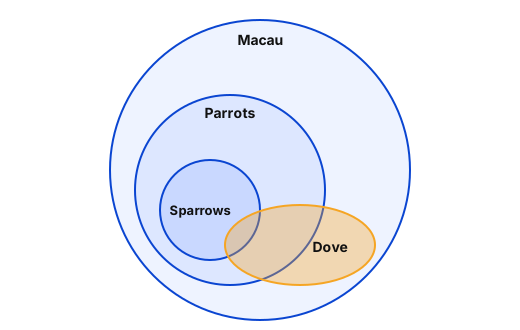
- Sparrows ⊂ Parrots ⊂ Macau, so every sparrow is a macau → I follows.
- Some sparrows are doves; those sparrows are parrots, so some doves are parrots → II follows.
Trick: 'All A are B' + 'Some A are C' → 'Some C are B' is always definite.
Answer: (A) Both conclusions (I) and (II) follow
अवधारणा: सभी कथनों के अनुरूप न्यूनतम वेन आरेख बनाएँ।
- गौरैया ⊂ तोता ⊂ मकाउ, अतः हर गौरैया मकाउ है → I सही।
- कुछ गौरैया कबूतर (dove) हैं; वे गौरैया तोते भी हैं, अतः कुछ कबूतर तोते हैं → II सही।
ट्रिक: 'सभी A, B हैं' + 'कुछ A, C हैं' → 'कुछ C, B हैं' निश्चित।
उत्तर: (A) I और II दोनों अनुसरण करते हैं
RRB NTPC Graduate CBT 1General Intelligence and ReasoningSyllogismRRB NTPC Graduate CBT 1 2024 · 17 Jun Shift 2
Q1978.Which of the following letter-clusters should replace # and % so that the pattern and relationship followed between the letter-cluster pair on the left side of :: is the same as that on the right side of :: ?
# : RWS :: INJ : %
निम्नलिखित में से कौन-से अक्षर-समूह # और % को प्रतिस्थापित करने चाहिए ताकि :: के बाईं ओर के अक्षर-समूह युग्म के बीच अनुसरित पैटर्न और संबंध वही हो जो :: के दाईं ओर है?
# : RWS :: INJ : %
- A# = NGV, % = FLP
- B# = PIV, % = MJU
- C# = UZV, % = FKG
- D# = CDR, % = KJI
Show answer
Concept: Find the shift from the right pair's rule and test the options.
- Take # = UZV: U−3 = R, Z−3 = W, V−3 = S → RWS ✓
- Apply the same −3 to INJ: I−3 = F, N−3 = K, J−3 = G → FKG
- So # = UZV and % = FKG.
Trick: Positions: U(21)→R(18), I(9)→F(6): a uniform −3.
Answer: (C) # = UZV, % = FKG
अवधारणा: दाएँ जोड़े का नियम निकालकर विकल्प जाँचें।
- # = UZV: U−3 = R, Z−3 = W, V−3 = S → RWS ✓
- INJ पर −3: I→F, N→K, J→G → FKG
- अतः # = UZV, % = FKG।
ट्रिक: स्थान: U(21)→R(18), I(9)→F(6): हर अक्षर −3।
उत्तर: (C) # = UZV, % = FKG
RRB NTPC Graduate CBT 1General Intelligence and ReasoningLetter AnalogyRRB NTPC Graduate CBT 1 2024 · 17 Jun Shift 2
Q1979.Dhiraj starts from Point Y and drives 22 km towards the east. He then takes a right turn, drives 33 km, turns left and drives 25 km. He then takes a left turn and drives 51 km. He takes a left turn, drives 47 km. He then turns left, drives 23 km and stops at Point Z. How far (shortest distance) and towards which direction should he drive in order to reach Point Y again? (All turns are 90-degree turns only unless specified.)
धीरज बिंदु Y से चलना शुरू करता है और पूर्व की ओर 22 km गाड़ी चलाता है। फिर वह दाएँ मुड़ता है, 33 km गाड़ी चलाता है, बाएँ मुड़ता है और 25 km गाड़ी चलाता है। फिर वह बाएँ मुड़ता है और 51 km गाड़ी चलाता है। वह बाएँ मुड़ता है, 47 km गाड़ी चलाता है। फिर वह बाएँ मुड़ता है, 23 km गाड़ी चलाता है और बिंदु Z पर रुक जाता है। बिंदु Y पर फिर से पहुँचने के लिए उसे कितनी दूरी (न्यूनतम दूरी) और किस दिशा में गाड़ी चलानी चाहिए? (जब तक निर्दिष्ट न हो, सभी मोड़ केवल 90 डिग्री के मोड़ हैं।)
- A5 km towards the northउत्तर की ओर 5 km
- B5 km towards the eastपूर्व की ओर 5 km
- C7 km towards the northउत्तर की ओर 7 km
- D7 km towards the southदक्षिण की ओर 7 km
Show answer
Concept: Track coordinates (east +x, north +y) after every turn.
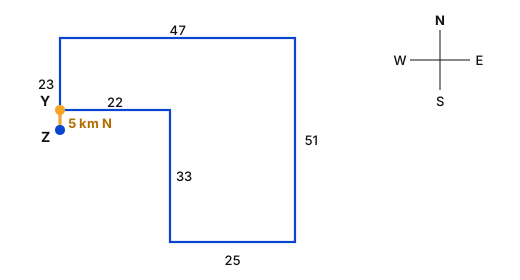
- Y(0, 0) → E 22 → (22, 0); right = S 33 → (22, −33); left = E 25 → (47, −33)
- Left = N 51 → (47, 18); left = W 47 → (0, 18); left = S 23 → Z(0, −5)
- Z is 5 km directly south of Y, so he must go 5 km north.
Trick: Net E–W: ; net N–S: → 5 km north to return.
Answer: (A) 5 km towards the north
अवधारणा: हर मोड़ के बाद निर्देशांक (पूर्व +x, उत्तर +y) लिखें।
- Y(0, 0) → पूर्व 22 → (22, 0); दाएँ = दक्षिण 33 → (22, −33); बाएँ = पूर्व 25 → (47, −33)
- बाएँ = उत्तर 51 → (47, 18); बाएँ = पश्चिम 47 → (0, 18); बाएँ = दक्षिण 23 → Z(0, −5)
- Z, Y से 5 km दक्षिण में है, अतः 5 km उत्तर जाना होगा।
ट्रिक: पूर्व–पश्चिम: ; उत्तर–दक्षिण: ।
उत्तर: (A) 5 km उत्तर की ओर
RRB NTPC Graduate CBT 1General Intelligence and ReasoningDirection & DistanceRRB NTPC Graduate CBT 1 2024 · 17 Jun Shift 2
Q1980.Seven boxes, D, E, F, G, S, T and U, are kept one over the other but not necessarily in the same order. Only two boxes are kept below T. Only one box is kept above U. Only one box is kept between U and D. G is kept immediately above S. F is kept at some place below E. How many boxes are kept between E and G?
सात बक्से D, E, F, G, S, T और U एक के ऊपर एक रखे गए हैं, लेकिन आवश्यक नहीं कि इसी क्रम में हों। T के नीचे केवल दो बक्से रखे गए हैं। U के ऊपर केवल एक बक्सा रखा गया है। U और D के बीच केवल एक बक्सा रखा गया है। G को S के ठीक ऊपर रखा गया है। F को E के नीचे किसी स्थान पर रखा गया है। E और G के बीच कितने बक्से रखे गए हैं?
- ATwoदो
- BOneएक
- CThreeतीन
- DFourचार
Show answer
Concept: Number positions 1 (bottom) to 7 (top) and place fixed boxes first.
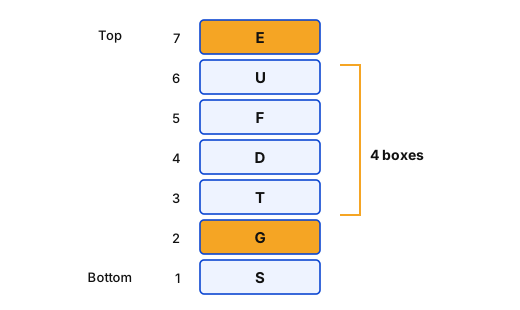
- Two below T → T = 3; one above U → U = 6; one box between U and D → D = 4.
- Free: 1, 2, 5, 7. G just above S → only S = 1, G = 2 works.
- F below E → F = 5, E = 7.
- Between E (7) and G (2): U, F, D, T → four boxes.
Trick: Boxes between positions p and q .
Answer: (D) Four
अवधारणा: स्थान 1 (नीचे) से 7 (ऊपर) तक संख्या दें और निश्चित डिब्बे पहले रखें।
- T के नीचे दो → T = 3; U के ऊपर एक → U = 6; U और D के बीच एक → D = 4।
- खाली: 1, 2, 5, 7। G ठीक S के ऊपर → S = 1, G = 2।
- F, E के नीचे → F = 5, E = 7।
- E (7) और G (2) के बीच: U, F, D, T → चार।
ट्रिक: बीच के डिब्बे ।
उत्तर: (D) चार
RRB NTPC Graduate CBT 1General Intelligence and ReasoningVertical ArrangementRRB NTPC Graduate CBT 1 2024 · 17 Jun Shift 2

