Q221.Refer to the following letter, number, symbol series and answer the question
(Left) $ T 1 & 9 Z 7 * A M S 1 * D % 7 * (Right)
If all the symbols are dropped from the series, which of the following will be seventh from the right?
निम्नलिखित अक्षर, संख्या, प्रतीक शृंखला को देखिए और प्रश्न का उत्तर दीजिए
(बाएँ) $ T 1 & 9 Z 7 * A M S 1 * D % 7 * (दाएँ)
यदि शृंखला से सभी प्रतीक हटा दिए जाएँ, तो निम्नलिखित में से कौन दाएँ से सातवाँ होगा?
- AT
- B7
- C9
- D1
Show answer
Concept: Remove all symbols ($, &, *, %) and then count positions.
- Remaining: T 1 9 Z 7 A M S 1 D 7 → 11 elements.
- 7th from right = th from left.
- 5th from left = 7
Trick: th from right th from left.
Answer: (B) 7
अवधारणा: सभी चिह्न ($, &, *, %) हटाएँ, फिर स्थान गिनें।
- शेष: T 1 9 Z 7 A M S 1 D 7 → 11 पद।
- दाएँ से 7वाँ वाँ बाएँ से।
- बाएँ से 5वाँ = 7
ट्रिक: दाएँ से वाँ वाँ बाएँ से।
उत्तर: (B) 7
RRB NTPC Graduate CBT 2General Intelligence and ReasoningAlphanumeric seriesRRB NTPC Graduate CBT 2 2024 · 13 Oct Shift 1
Q222.A, B, C, D, X and Y each scored different marks. Only two people have scored more than A. Only B has scored less than D. X has scored more than Y but less than C. How many people have scored more than X?
A, B, C, D, X और Y में से प्रत्येक ने अलग-अलग अंक प्राप्त किए। केवल दो व्यक्तियों ने A से अधिक अंक प्राप्त किए हैं। केवल B ने D से कम अंक प्राप्त किए हैं। X ने Y से अधिक लेकिन C से कम अंक प्राप्त किए हैं। कितने व्यक्तियों ने X से अधिक अंक प्राप्त किए हैं?
- AFourचार
- BOneएक
- CTwoदो
- DThreeतीन
Show answer
Concept: Fix the definite positions first, then fill the rest with the remaining conditions.
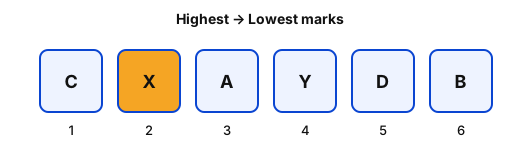
- Only two scored more than A → A is 3rd.
- Only B scored less than D → B is 6th, D is 5th.
- Left positions 1, 2, 4 for C, X, Y with C > X > Y → C 1st, X 2nd, Y 4th.
- Only C scored more than X → one person.
Trick: Place the 'only' clues first – they fix exact ranks.
Answer: (B) One
अवधारणा: पहले निश्चित स्थान तय करें, फिर बाकी शर्तों से भरें।
- केवल दो ने A से अधिक अंक पाए → A तीसरे स्थान पर।
- केवल B ने D से कम पाए → B छठे, D पाँचवें।
- शेष स्थान 1, 2, 4 पर C, X, Y; C > X > Y → C पहले, X दूसरे, Y चौथे।
- X से अधिक केवल C → एक व्यक्ति।
ट्रिक: 'केवल' वाले संकेत पहले लगाएँ – वे सटीक स्थान देते हैं।
उत्तर: (B) एक
RRB NTPC Graduate CBT 2General Intelligence and ReasoningRanking – comparisonRRB NTPC Graduate CBT 2 2024 · 13 Oct Shift 1
Q223.MPQO is related to UXYW in a certain way based on the English alphabetical order. In the same way, DGHF is related to LOPN. To which of the given options is KNOM related, following the same logic?
अंग्रेज़ी वर्णमाला क्रम के आधार पर MPQO एक निश्चित प्रकार से UXYW से संबंधित है। उसी प्रकार, DGHF, LOPN से संबंधित है। समान तर्क का अनुसरण करते हुए, KNOM दिए गए विकल्पों में से किससे संबंधित है?
- ASWUV
- BSVWU
- CSUWV
- DSWVU
Show answer
Concept: Each letter of the first cluster is shifted forward by the same number of places.
- M→U, P→X, Q→Y, O→W: each letter .
- D→L, G→O, H→P, F→N: again each .
- K+8 = S, N+8 = V, O+8 = W, M+8 = U → SVWU.
Trick: Check only the first letter of each option: all start with S, so test the second letter N+8 = V.
Answer: (B) SVWU
अवधारणा: पहले समूह के हर अक्षर को समान स्थान आगे बढ़ाया गया है।
- M→U, P→X, Q→Y, O→W: हर अक्षर ।
- D→L, G→O, H→P, F→N: फिर से हर अक्षर ।
- K+8 = S, N+8 = V, O+8 = W, M+8 = U → SVWU।
ट्रिक: सभी विकल्प S से शुरू हैं, तो दूसरा अक्षर जाँचें: N+8 = V, केवल (B) में।
उत्तर: (B) SVWU
RRB NTPC Graduate CBT 2General Intelligence and ReasoningLetter AnalogyRRB NTPC Graduate CBT 2 2024 · 13 Oct Shift 1
Q224.Each of P, Q, R, S, T, U and V has an exam on a different day of a week starting from Monday and ending on Sunday of the same week. Q has an exam on Thursday. Exactly four people have their exam between U and P, neither of whom has an exam on Sunday. R has an exam immediately before S. V does not have an exam on Friday. U does not have an exam after S. How many people have exams after P?
P, Q, R, S, T, U और V में से प्रत्येक की परीक्षा एक ही सप्ताह के सोमवार से शुरू होकर रविवार को समाप्त होने वाले सप्ताह के अलग-अलग दिन है। Q की परीक्षा गुरुवार को है। U और P के बीच ठीक चार व्यक्तियों की परीक्षा है, और इन दोनों (U और P) में से किसी की भी परीक्षा रविवार को नहीं है। R की परीक्षा S से ठीक पहले है। V की परीक्षा शुक्रवार को नहीं है। U की परीक्षा S के बाद नहीं है। P के बाद कितने व्यक्तियों की परीक्षा है?
- A4
- B3
- C1
- D2
Show answer
Concept: Use the fixed day (Q on Thursday) and the gap condition between U and P first.
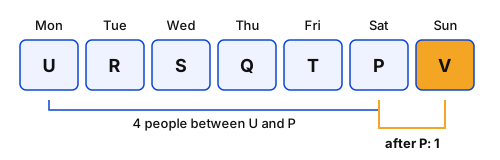
- Four people between U and P → they are on (Mon, Sat) or (Tue, Sun); Sunday is not allowed → U, P on Mon and Sat.
- If U were Saturday, S would have to be Sunday and R Saturday – clash. So U = Mon, P = Sat.
- R, S consecutive in the free days → R = Tue, S = Wed.
- T and V take Fri, Sun; V not Friday → T = Fri, V = Sun. After P (Sat) only V → 1.
Trick: With 7 days, "4 between" leaves only two pairs: (1, 6) or (2, 7).
Answer: (C) 1
अवधारणा: पहले निश्चित दिन (Q – गुरुवार) और U, P के बीच के अंतर वाली शर्त लगाएँ।
- U और P के बीच 4 लोग → (सोम, शनि) या (मंगल, रवि); रविवार नहीं हो सकता → U, P सोम और शनि पर।
- यदि U शनिवार हो तो S रविवार और R शनिवार होगा – टकराव। अतः U = सोम, P = शनि।
- R, S लगातार → R = मंगल, S = बुध।
- T, V के लिए शुक्र, रवि; V शुक्रवार नहीं → T = शुक्र, V = रवि। P (शनि) के बाद केवल V → 1।
ट्रिक: 7 दिनों में "बीच में 4" के केवल दो जोड़े: (1, 6) या (2, 7)।
उत्तर: (C) 1
RRB NTPC Graduate CBT 2General Intelligence and ReasoningScheduling PuzzleRRB NTPC Graduate CBT 2 2024 · 13 Oct Shift 1
Q225.Study the given Venn diagram carefully and answer the question that follows. The numbers in different sections indicate the number of persons.
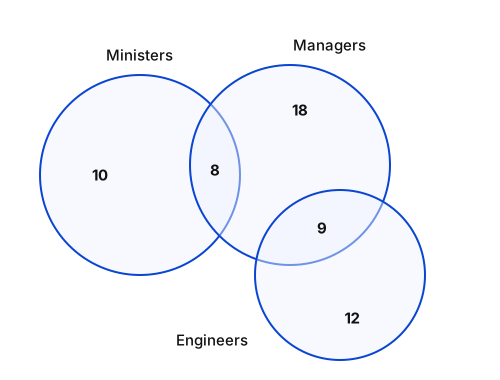
How many Ministers are there who are Managers but NOT Engineers?
दिए गए वेन आरेख का ध्यानपूर्वक अध्ययन कीजिए और उसके बाद दिए गए प्रश्न का उत्तर दीजिए। विभिन्न भागों में दी गई संख्याएँ व्यक्तियों की संख्या दर्शाती हैं।
ऐसे कितने मंत्री (Ministers) हैं जो प्रबंधक (Managers) हैं लेकिन इंजीनियर (Engineers) नहीं हैं?
- A10
- B8
- C9
- D18
Show answer
Concept: Ministers who are Managers but not Engineers = region common to Ministers and Managers only, outside the Engineers circle.
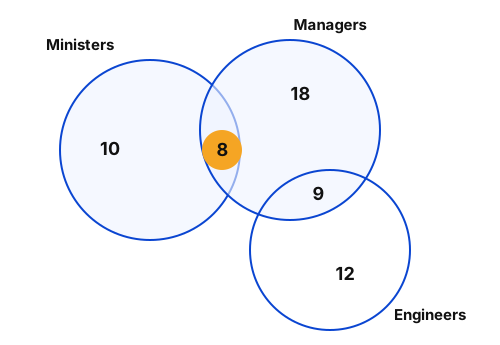
- Region only in Ministers = 10 (not Managers).
- Region in Managers and Engineers = 9 (not Ministers).
- Region common to Ministers and Managers only = 8.
Trick: Read the question as "inside A and B, outside C" and shade just that region.
Answer: (B) 8
अवधारणा: जो मंत्री (Ministers) प्रबंधक (Managers) हैं पर इंजीनियर नहीं = केवल Ministers और Managers का साझा भाग, Engineers वृत्त के बाहर।
- केवल Ministers वाला भाग = 10 (Managers नहीं)।
- Managers और Engineers का भाग = 9 (Ministers नहीं)।
- केवल Ministers और Managers का साझा भाग = 8।
ट्रिक: प्रश्न को "A और B के अंदर, C के बाहर" पढ़ें और केवल वही भाग छायांकित करें।
उत्तर: (B) 8
RRB NTPC Graduate CBT 2General Intelligence and ReasoningVenn DiagramRRB NTPC Graduate CBT 2 2024 · 13 Oct Shift 1
Q226.What should come in place of the question mark (?) in the given series?
12, 25, 51, 90, 142 , ?
दी गई शृंखला में प्रश्न चिह्न (?) के स्थान पर क्या आना चाहिए?
12, 25, 51, 90, 142 , ?
- A207
- B206
- C208
- D209
Show answer
Concept: Look at the differences between consecutive terms.
- Differences: , , , .
- They are multiples of 13: .
- Next difference → .
Trick: Differences in a table of a number (13, 26, 39…) → just add the next multiple.
Answer: (A) 207
अवधारणा: क्रमागत पदों के अंतर देखें।
- अंतर: , , , ।
- ये 13 के गुणज हैं: ।
- अगला अंतर → ।
ट्रिक: अंतर किसी संख्या का पहाड़ा (13, 26, 39…) हों तो अगला गुणज जोड़ दें।
उत्तर: (A) 207
RRB NTPC Graduate CBT 2General Intelligence and ReasoningNumber SeriesRRB NTPC Graduate CBT 2 2024 · 13 Oct Shift 1
Q227.In a certain code language,
A + B means ‘A is the mother of B’,
A – B means ‘A is the brother of B’,
A x B means ‘A is the wife of B’,
and A ÷ B means ‘A is the father of B’.
Which of the following means that R is the mother's brother of T ?
एक निश्चित कूट भाषा में,
A + B का अर्थ है ‘A, B की माता है’,
A – B का अर्थ है ‘A, B का भाई है’,
A x B का अर्थ है ‘A, B की पत्नी है’,
और A ÷ B का अर्थ है ‘A, B का पिता है’।
निम्नलिखित में से किसका अर्थ है कि R, T का मामा (माता का भाई) है?
- AP x Q ÷ R – S x T
- BP ÷ Q x R ÷ S + T
- CP ÷ Q x R – S + T
- DP ÷ Q – R x S – T
Show answer
Concept: Decode each option; R must be the brother of a woman who is T's mother.
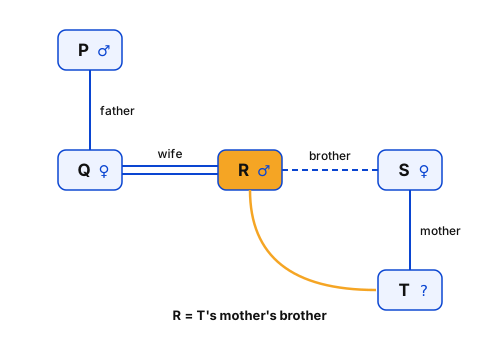
- Option (C): P ÷ Q → P is father of Q; Q × R → Q is wife of R.
- R – S → R is brother of S; S + T → S is mother of T.
- So S is T's mother and R is her brother → R is T's mother's brother (maternal uncle).
- In (B), R ÷ S makes R a father, and in (D), R × S makes R a wife – both wrong.
Trick: Look for the pattern "R – S + T" (R brother of S, S mother of T) in the options.
Answer: (C) P ÷ Q x R – S + T
अवधारणा: हर विकल्प को डिकोड करें; R उस महिला का भाई होना चाहिए जो T की माँ है।
- विकल्प (C): P ÷ Q → P, Q का पिता; Q × R → Q, R की पत्नी।
- R – S → R, S का भाई; S + T → S, T की माँ।
- अतः S, T की माँ है और R उसका भाई → R, T का मामा (mother's brother) है।
- (B) में R ÷ S से R पिता बनता है, (D) में R × S से R पत्नी – दोनों गलत।
ट्रिक: विकल्पों में "R – S + T" (R, S का भाई; S, T की माँ) ढूँढें।
उत्तर: (C) P ÷ Q x R – S + T
RRB NTPC Graduate CBT 2General Intelligence and ReasoningCoded Blood RelationsRRB NTPC Graduate CBT 2 2024 · 13 Oct Shift 1
Q228.In the following series, only one letter-cluster is incorrect. Select the INCORRECT letter- cluster.
JFB RNJ ZVR HDZ PLK XTP
निम्नलिखित शृंखला में केवल एक अक्षर-समूह गलत है। गलत अक्षर-समूह का चयन कीजिए।
JFB RNJ ZVR HDZ PLK XTP
- AHDZ
- BZVR
- CPLK
- DRNJ
Show answer
Concept: Each position of the clusters moves forward by the same step.
- First letters: J, R, Z, H, P, X – each (with wrap-around).
- Second letters: F, N, V, D, L, T – each .
- Third letters: B, J, R, Z, ?, P → after Z comes Z+8 = H, so the fifth cluster should be PLH.
- Given PLK breaks the pattern.
Trick: Check one position at a time; the odd letter shows the wrong cluster at once.
Answer: (C) PLK
अवधारणा: हर समूह का हर स्थान समान कदम से आगे बढ़ता है।
- पहले अक्षर: J, R, Z, H, P, X – हर बार (Z के बाद फिर A से)।
- दूसरे अक्षर: F, N, V, D, L, T – हर बार ।
- तीसरे अक्षर: B, J, R, Z, ?, P → Z+8 = H, अतः पाँचवाँ समूह PLH होना चाहिए।
- दिया गया PLK पैटर्न तोड़ता है।
ट्रिक: एक-एक स्थान अलग जाँचें; गलत अक्षर तुरंत गलत समूह दिखा देता है।
उत्तर: (C) PLK
RRB NTPC Graduate CBT 2General Intelligence and ReasoningLetter Cluster SeriesRRB NTPC Graduate CBT 2 2024 · 13 Oct Shift 1
Q229.Based on the English alphabetical order, three of the following four letter-cluster pairs are alike in a certain way and thus form a group. Which is the letter-cluster pair that DOES NOT belong to that group?
(Note: The odd one out is not based on the number of consonants/vowels or their position in the letter-cluster.)
अंग्रेज़ी वर्णमाला क्रम के आधार पर, निम्नलिखित चार अक्षर-समूह युग्मों में से तीन किसी निश्चित प्रकार से एक समान हैं और इस प्रकार एक समूह बनाते हैं। वह कौन-सा अक्षर-समूह युग्म है जो उस समूह से संबंधित नहीं है?
(नोट: असंगत को व्यंजनों/स्वरों की संख्या या अक्षर-समूह में उनके स्थान के आधार पर नहीं चुना गया है।)
- AKO−NR
- BMQ−PT
- CAE−DH
- DGK−IP
Show answer
Concept: Find the letter-gaps inside each pair: first cluster XY, second cluster PQ.
- KO−NR: K+4 = O, K+3 = N, N+4 = R.
- MQ−PT: M+4 = Q, M+3 = P, P+4 = T. AE−DH: A+4 = E, A+3 = D, D+4 = H.
- GK−IP: G+4 = K but G+2 = I and I+7 = P – pattern broken.
Trick: Pattern is (+4) in each cluster and (+3) between clusters; GK−IP fails at once.
Answer: (D) GK−IP
अवधारणा: हर युग्म के अंदर अक्षरों का अंतर देखें।
- KO−NR: K+4 = O, K+3 = N, N+4 = R।
- MQ−PT: M+4 = Q, M+3 = P, P+4 = T। AE−DH: A+4 = E, A+3 = D, D+4 = H।
- GK−IP: G+4 = K पर G+2 = I और I+7 = P – पैटर्न टूटा।
ट्रिक: हर समूह में (+4) और दोनों समूहों के बीच (+3); GK−IP तुरंत अलग।
उत्तर: (D) GK−IP
RRB NTPC Graduate CBT 2General Intelligence and ReasoningOdd One Out (Letter Pairs)RRB NTPC Graduate CBT 2 2024 · 13 Oct Shift 1
Q230.In the following triads, each group of letters is related to the subsequent one following a certain logic. Select from the given options, the one which follows the same logic. WASH - HSWA - WSAH
NEST - TSNE - NSET
निम्नलिखित त्रयी (triads) में, अक्षरों का प्रत्येक समूह एक निश्चित तर्क का अनुसरण करते हुए अगले समूह से संबंधित है। दिए गए विकल्पों में से उसका चयन कीजिए जो समान तर्क का अनुसरण करता है। WASH - HSWA - WSAH
NEST - TSNE - NSET
- AFOGS - SGFO - OGFS
- BPACE - PCAE - ECAP
- CTRAY - RATY - RAYT
- DOILS - SLOI - OLIS
Show answer
Concept: Number the letters 1 2 3 4 and find how positions move.
- WASH → HSWA: order 4 3 1 2. NEST → TSNE: same 4 3 1 2.
- HSWA → WSAH: order 3 2 4 1 of the second word (NSET from TSNE too).
- OILS → 4 3 1 2 = SLOI; SLOI → 3 2 4 1 = OLIS. Matches (D).
- FOGS → 4 3 1 2 would be SGFO ✓, but SGFO → 3 2 4 1 = FGOS, not OGFS.
Trick: Fix the rule on one triad, verify on the second, then test options only.
Answer: (D) OILS - SLOI - OLIS
अवधारणा: अक्षरों को 1 2 3 4 क्रमांक दें और स्थान परिवर्तन देखें।
- WASH → HSWA: क्रम 4 3 1 2। NEST → TSNE: वही 4 3 1 2।
- HSWA → WSAH: दूसरे शब्द का क्रम 3 2 4 1 (TSNE → NSET भी)।
- OILS → 4 3 1 2 = SLOI; SLOI → 3 2 4 1 = OLIS। (D) मेल खाता है।
- FOGS → SGFO ✓, पर SGFO → 3 2 4 1 = FGOS, OGFS नहीं।
ट्रिक: एक त्रिक से नियम निकालें, दूसरे पर जाँचें, फिर विकल्प परखें।
उत्तर: (D) OILS - SLOI - OLIS
RRB NTPC Graduate CBT 2General Intelligence and ReasoningLetter Triads (Position Rearrangement)RRB NTPC Graduate CBT 2 2024 · 13 Oct Shift 1
Q231.In the following number-pairs, the second number is obtained by applying certain mathematical operation(s) to the first number. Select the number-pair in which the numbers are related in the same way as are the numbers of the following pairs. (NOTE: Operations should be performed on the whole numbers, without breaking down the numbers into their constituent digits. E.g. 13 – Operations on 13 such as adding to/subtracting from/multiplying with 13 can be performed. Breaking down 13 into 1 and 3 and then performing mathematical operations on 1 and 3 is not allowed.)
11, 68
14, 86
निम्नलिखित संख्या-युग्मों में, पहली संख्या पर कुछ निश्चित गणितीय संक्रिया/संक्रियाएँ करके दूसरी संख्या प्राप्त की जाती है। उस संख्या-युग्म का चयन कीजिए जिसमें संख्याएँ उसी प्रकार संबंधित हैं जिस प्रकार निम्नलिखित युग्मों की संख्याएँ संबंधित हैं। (नोट: संक्रियाएँ संख्याओं को उनके घटक अंकों में तोड़े बिना, पूर्ण संख्याओं पर की जानी चाहिए। उदाहरण के लिए 13 – 13 पर संक्रियाएँ जैसे 13 में जोड़ना/13 में से घटाना/13 से गुणा करना आदि की जा सकती हैं। 13 को 1 और 3 में तोड़कर फिर 1 और 3 पर गणितीय संक्रियाएँ करने की अनुमति नहीं है।)
11, 68
14, 86
- A17, 103
- B17, 104
- C18, 103
- D18, 104
Show answer
Concept: Find one operation that converts the first number into the second in both pairs.
- .
- .
- Option (B): ✓. (A) gives 103, (C) and (D) would need .
Trick: Difference of second numbers for difference 3 in first numbers → multiplier .
Answer: (B) 17, 104
अवधारणा: एक ऐसी संक्रिया खोजें जो दोनों युग्मों में पहली संख्या को दूसरी में बदले।
- ।
- ।
- विकल्प (B): ✓। (A) में 103, (C), (D) के लिए चाहिए।
ट्रिक: दूसरी संख्याओं का अंतर , पहली का अंतर 3 → गुणक ।
उत्तर: (B) 17, 104
RRB NTPC Graduate CBT 2General Intelligence and ReasoningNumber Pair RelationRRB NTPC Graduate CBT 2 2024 · 13 Oct Shift 1
Q232.Namesh starts from point A and drives 4 km towards west. He then takes a left turn and drives 5 km. He takes a final left turn and drives 6 km and stops at point B. Rimit starts from point P, which is 16 km east of Point A, and drives 3 km towards east. He then takes a right turn and drives 5 km. He takes a final left turn and drives 3 km and stops at Point Q. What is the shortest distance between Point Q and Point B? (All turns are 90 degree turns only.)
नमेश बिंदु A से चलना शुरू करता है और पश्चिम की ओर 4 km गाड़ी चलाता है। फिर वह बाएँ मुड़ता है और 5 km गाड़ी चलाता है। वह अंतिम बार बाएँ मुड़ता है और 6 km गाड़ी चलाकर बिंदु B पर रुक जाता है। रिमित बिंदु P से, जो बिंदु A से 16 km पूर्व में है, चलना शुरू करता है और पूर्व की ओर 3 km गाड़ी चलाता है। फिर वह दाएँ मुड़ता है और 5 km गाड़ी चलाता है। वह अंतिम बार बाएँ मुड़ता है और 3 km गाड़ी चलाकर बिंदु Q पर रुक जाता है। बिंदु Q और बिंदु B के बीच की न्यूनतम दूरी क्या है? (सभी मोड़ केवल 90 डिग्री के मोड़ हैं।)
- A19 km
- B21 km
- C20 km
- D22 km
Show answer
Concept: Place A at the origin, east = +x, north = +y, and track both journeys.
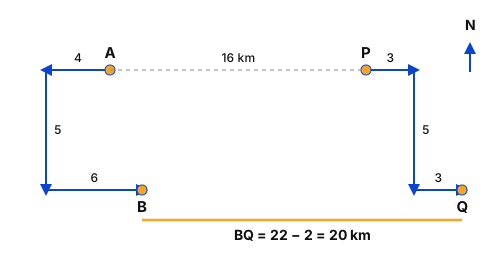
- Namesh: west 4 → ; left (south) 5 → ; left (east) 6 → B .
- P . Rimit: east 3 → ; right (south) 5 → ; left (east) 3 → Q .
- B and Q are on the same line : BQ .
Trick: Both end 5 km south, so only the east–west gap matters.
Answer: (C) 20 km
अवधारणा: A को मूल बिंदु लें, पूर्व = +x, उत्तर = +y, और दोनों यात्राएँ अंकित करें।
- नमेश: पश्चिम 4 → ; बाएँ (दक्षिण) 5 → ; बाएँ (पूर्व) 6 → B ।
- P । रिमित: पूर्व 3 → ; दाएँ (दक्षिण) 5 → ; बाएँ (पूर्व) 3 → Q ।
- B और Q एक ही रेखा पर: BQ ।
ट्रिक: दोनों 5 km दक्षिण में रुकते हैं, इसलिए केवल पूर्व–पश्चिम अंतर देखें।
उत्तर: (C) 20 km
RRB NTPC Graduate CBT 2General Intelligence and ReasoningDirection and DistanceRRB NTPC Graduate CBT 2 2024 · 13 Oct Shift 1
Q233.In this question, a statement is given followed by two courses of action, numbered I and II. You must assume everything in the statement to be true, and on the basis of the information given in the statement, decide which of the given courses of action logically follow(s) for pursuing.
Statement:
Reports indicate that fish populations in River Y have declined sharply due to excessive fishing and industrial pollution.
Courses of Action:
I. Fishing in River Y should be regulated for at least six months.
II. Industries should be ordered to treat waste before discharging into River Y.
इस प्रश्न में, एक कथन के बाद I और II क्रमांकित दो कार्यवाहियाँ दी गई हैं। आपको कथन में दी गई प्रत्येक बात को सत्य मानना है, और कथन में दी गई जानकारी के आधार पर निर्णय करना है कि दी गई कार्यवाहियों में से कौन-सी तार्किक रूप से अनुसरण करने योग्य है/हैं।
कथन:
रिपोर्टों से संकेत मिलता है कि अत्यधिक मछली पकड़ने और औद्योगिक प्रदूषण के कारण नदी Y में मछलियों की संख्या में तेज़ी से गिरावट आई है।
कार्यवाहियाँ:
I. नदी Y में मछली पकड़ने को कम से कम छह महीने के लिए विनियमित किया जाना चाहिए।
II. उद्योगों को नदी Y में छोड़ने से पहले अपशिष्ट का उपचार करने का आदेश दिया जाना चाहिए।
- AOnly II followsकेवल II अनुसरण करती है
- BNeither I nor II followsन तो I और न ही II अनुसरण करती है
- COnly I followsकेवल I अनुसरण करती है
- DBoth I and II followI और II दोनों अनुसरण करती हैं
Show answer
Concept: A course of action follows if it practically tackles a cause stated in the problem.
- Cause 1 – excessive fishing: regulating fishing for some months lets fish breed and recover → I follows.
- Cause 2 – industrial pollution: treating waste before discharge removes the pollution → II follows.
- Both actions address the two stated causes directly.
Trick: One action per cause mentioned in the statement → both follow.
Answer: (D) Both I and II follow
अवधारणा: कोई कार्यवाही तभी अनुसरण करती है जब वह समस्या के बताए गए कारण को व्यावहारिक रूप से दूर करे।
- कारण 1 – अत्यधिक मछली पकड़ना: कुछ महीने मछली पकड़ने पर नियंत्रण से मछलियाँ प्रजनन कर बढ़ेंगी → I अनुसरण करता है।
- कारण 2 – औद्योगिक प्रदूषण: छोड़ने से पहले अपशिष्ट का उपचार प्रदूषण घटाएगा → II अनुसरण करता है।
- दोनों कार्यवाहियाँ दोनों कारणों को सीधे हल करती हैं।
ट्रिक: कथन में हर कारण के लिए एक कार्यवाही → दोनों अनुसरण करती हैं।
उत्तर: (D) I और II दोनों अनुसरण करते हैं
RRB NTPC Graduate CBT 2General Intelligence and ReasoningStatement and Course of ActionRRB NTPC Graduate CBT 2 2024 · 13 Oct Shift 1
Q234.Eight people are sitting in two parallel rows containing 4 people each in such a way that there is equal distance between adjacent persons.
In row 1 – A, D, O and P are seated and all of them are facing south.
In row 2 – U,W, Y and F are seated and all of them are facing north.
Thus each person faces another person from the other row.
U sits third to the left of Y. The one facing P is an immediate neighbour of Y. A sits at some place to the right of P and is not facing W. D sits third to the right of O. Who amongst the following faces F?
आठ व्यक्ति 4-4 व्यक्तियों वाली दो समानांतर पंक्तियों में इस प्रकार बैठे हैं कि आसन्न व्यक्तियों के बीच समान दूरी है।
पंक्ति 1 में – A, D, O और P बैठे हैं और उन सभी का मुख दक्षिण की ओर है।
पंक्ति 2 में – U,W, Y और F बैठे हैं और उन सभी का मुख उत्तर की ओर है।
इस प्रकार प्रत्येक व्यक्ति दूसरी पंक्ति के किसी अन्य व्यक्ति की ओर मुख किए हुए है।
U, Y के बाईं ओर तीसरे स्थान पर बैठा है। P की ओर मुख किए हुए व्यक्ति, Y का निकटतम पड़ोसी है। A, P के दाईं ओर किसी स्थान पर बैठा है और W की ओर मुख किए हुए नहीं है। D, O के दाईं ओर तीसरे स्थान पर बैठा है। निम्नलिखित में से कौन F की ओर मुख किए हुए है?
- AU
- BD
- CA
- DW
Show answer
Concept: Row 2 faces north (its left = west); Row 1 faces south (its left = east). Number columns 1–4 from west to east.
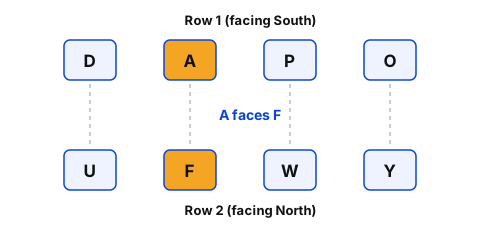
- U third to the left of Y → U at 1, Y at 4 (Row 2).
- Person facing P is Y's neighbour → column 3, so P is at 3 (Row 1).
- D third to the right of O (Row 1 faces south) → O at 4, D at 1; A right of P → A at 2.
- A is not facing W → column 2 of Row 2 is F, W at 3. So F faces A.
Trick: For south-facing people, "right" is your left on paper – flip directions for Row 1.
Answer: (C) A
अवधारणा: पंक्ति 2 उत्तर की ओर (बायाँ = पश्चिम); पंक्ति 1 दक्षिण की ओर (बायाँ = पूर्व)। स्तंभ 1–4 पश्चिम से पूर्व क्रमांकित करें।
- U, Y के बाएँ से तीसरा → U स्थान 1, Y स्थान 4 (पंक्ति 2)।
- P के सामने वाला Y का पड़ोसी → स्तंभ 3, अतः P स्थान 3 (पंक्ति 1)।
- D, O के दाएँ से तीसरा (दक्षिणमुखी) → O 4 पर, D 1 पर; A, P के दाएँ → A 2 पर।
- A, W के सामने नहीं → पंक्ति 2 का स्तंभ 2 = F, W = 3। अतः F के सामने A।
ट्रिक: दक्षिणमुखी व्यक्तियों के लिए "दायाँ" कागज़ पर आपका बायाँ होता है।
उत्तर: (C) A
RRB NTPC Graduate CBT 2General Intelligence and ReasoningSeating Arrangement (Two Rows)RRB NTPC Graduate CBT 2 2024 · 13 Oct Shift 1
Q235.6 is related to 34 following a certain logic. Following the same logic, 8 is related to 46. To which of the given options is 10 related, following the same logic?
(NOTE: Operations should be performed on the whole numbers, without breaking down the numbers into their constituent digits. E.g. 13 – Operations on 13 such as adding to/subtracting from/multiplying with 13 can be performed. Breaking down 13 into 1 and 3 and then performing mathematical operations on 1 and 3 is not allowed.)
एक निश्चित तर्क का अनुसरण करते हुए 6, 34 से संबंधित है। उसी तर्क का अनुसरण करते हुए, 8, 46 से संबंधित है। समान तर्क का अनुसरण करते हुए, 10 दिए गए विकल्पों में से किससे संबंधित है?
(नोट: संक्रियाएँ संख्याओं को उनके घटक अंकों में तोड़े बिना, पूर्ण संख्याओं पर की जानी चाहिए। उदाहरण के लिए 13 – 13 पर संक्रियाएँ जैसे 13 में जोड़ना/13 में से घटाना/13 से गुणा करना आदि की जा सकती हैं। 13 को 1 और 3 में तोड़कर फिर 1 और 3 पर गणितीय संक्रियाएँ करने की अनुमति नहीं है।)
- A57
- B55
- C56
- D58
Show answer
Concept: Find the common operation in both given pairs.
- .
- .
- .
Trick: Increase of 2 in the first number raised the second by 12 → multiplier 6.
Answer: (D) 58
अवधारणा: दोनों दिए गए युग्मों में समान संक्रिया खोजें।
- ।
- ।
- ।
ट्रिक: पहली संख्या में 2 बढ़ने पर दूसरी में 12 बढ़े → गुणक 6।
उत्तर: (D) 58
RRB NTPC Graduate CBT 2General Intelligence and ReasoningNumber AnalogyRRB NTPC Graduate CBT 2 2024 · 13 Oct Shift 1
Q236.A, B, C, D, E and F have different heights. C is shorter than exactly 1 person. D is shorter than A but taller than F. E is shorter than F, and C is shorter than B. How many people are taller than D?
A, B, C, D, E और F की ऊँचाइयाँ अलग-अलग हैं। C ठीक 1 व्यक्ति से छोटा है। D, A से छोटा लेकिन F से लंबा है। E, F से छोटा है, और C, B से छोटा है। कितने व्यक्ति D से लंबे हैं?
- A4
- B1
- C3
- D2
Show answer
Concept: Place people with the fixed rank first, then fit the chain of comparisons.
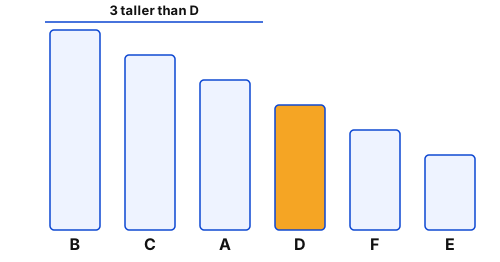
- C is shorter than exactly one person → C is 2nd tallest; C < B → B is tallest.
- Chain: A > D > F > E fills ranks 3 to 6.
- Order: B > C > A > D > F > E → taller than D: B, C, A = 3.
Trick: "Shorter than exactly one" means rank 2 from the top.
Answer: (C) 3
अवधारणा: पहले निश्चित स्थान वाले व्यक्ति को रखें, फिर तुलना की श्रृंखला जोड़ें।
- C ठीक एक व्यक्ति से छोटा → C दूसरा सबसे लंबा; C < B → B सबसे लंबा।
- श्रृंखला A > D > F > E स्थान 3 से 6 भरती है।
- क्रम: B > C > A > D > F > E → D से लंबे: B, C, A = 3।
ट्रिक: "ठीक एक से छोटा" = ऊपर से दूसरा स्थान।
उत्तर: (C) 3
RRB NTPC Graduate CBT 2General Intelligence and ReasoningRanking by HeightRRB NTPC Graduate CBT 2 2024 · 13 Oct Shift 1
Q237.Refer to the given letter, number, symbol series and answer the question that follows. (Left) D 4 & A $ Z G 7 R 5 % W 2 @ 3 # V 6 & F Y (Right)
If all the numbers are dropped from the series, which of the following will be seventh from the right?
दी गई अक्षर, संख्या, प्रतीक शृंखला को देखिए और उसके बाद दिए गए प्रश्न का उत्तर दीजिए। (बाएँ) D 4 & A $ Z G 7 R 5 % W 2 @ 3 # V 6 & F Y (दाएँ)
यदि शृंखला से सभी संख्याएँ हटा दी जाएँ, तो निम्नलिखित में से कौन दाएँ से सातवाँ होगा?
- AG
- B%
- C@
- DW
Show answer
Concept: Remove the numbers first, write the new series, then count from the right.
- Numbers removed: 4, 7, 5, 2, 3, 6.
- New series: D & A $ Z G R % W @ # V & F Y.
- From the right: Y(1), F(2), &(3), V(4), #(5), @(6), W(7).
Trick: Count from the right end directly, skipping digits as you go – no need to rewrite the whole series.
Answer: (D) W
अवधारणा: पहले संख्याएँ हटाएँ, नई श्रृंखला लिखें, फिर दाएँ से गिनें।
- हटाई गई संख्याएँ: 4, 7, 5, 2, 3, 6।
- नई श्रृंखला: D & A $ Z G R % W @ # V & F Y।
- दाएँ से: Y(1), F(2), &(3), V(4), #(5), @(6), W(7)।
ट्रिक: पूरी श्रृंखला दोबारा लिखे बिना दाएँ छोर से अंक छोड़ते हुए गिनें।
उत्तर: (D) W
RRB NTPC Graduate CBT 2General Intelligence and ReasoningAlpha-Numeric-Symbol SeriesRRB NTPC Graduate CBT 2 2024 · 13 Oct Shift 1
Q238.In a certain code, ‘books are knowledge’ is coded as ‘mk xp zj’, ‘knowledge is power’ is coded as ‘zk xp vr’, and ‘power brings success’ is coded as ‘vr mk gt’.
What is the code for ‘is’ in that code? (All codes are two-letter codes.)
एक निश्चित कूट में, ‘books are knowledge’ को ‘mk xp zj’ लिखा जाता है, ‘knowledge is power’ को ‘zk xp vr’ लिखा जाता है, और ‘power brings success’ को ‘vr mk gt’ लिखा जाता है।
उस कूट में ‘is’ के लिए कूट क्या है? (सभी कूट दो-अक्षरीय कूट हैं।)
- Axp
- Bvr
- Czk
- Dmk
Show answer
Concept: A word common to two sentences takes the code common to them.
- "knowledge" is in sentences 1 and 2 → common code xp.
- "power" is in sentences 2 and 3 → common code vr.
- Sentence 2: knowledge is power = zk xp vr → is = zk.
Trick: Remove the known codes from the sentence containing the target word.
Answer: (C) zk
अवधारणा: दो वाक्यों में समान शब्द का कोड भी दोनों में समान होता है।
- "knowledge" वाक्य 1 और 2 में → समान कोड xp।
- "power" वाक्य 2 और 3 में → समान कोड vr।
- वाक्य 2: knowledge is power = zk xp vr → is = zk।
ट्रिक: लक्ष्य शब्द वाले वाक्य से ज्ञात कोड हटा दें।
उत्तर: (C) zk
RRB NTPC Graduate CBT 2General Intelligence and ReasoningCoding–Decoding (Word Codes)RRB NTPC Graduate CBT 2 2024 · 13 Oct Shift 1
Q239.Each of P, Q, R, S, T, U and V has an exam on a different day of a week starting from Monday and ending on Sunday of the same week. S has an exam on Tuesday. Exactly two people have an exam between S and P. T has an exam immediately before U and R has an exam immediately after Q. Only 1 person has an exam between U and Q. How many people have exams after Q?
P, Q, R, S, T, U और V में से प्रत्येक की परीक्षा एक ही सप्ताह के सोमवार से शुरू होकर रविवार को समाप्त होने वाले सप्ताह के अलग-अलग दिन है। S की परीक्षा मंगलवार को है। S और P के बीच ठीक दो व्यक्तियों की परीक्षा है। T की परीक्षा U से ठीक पहले है और R की परीक्षा Q के ठीक बाद है। U और Q के बीच केवल 1 व्यक्ति की परीक्षा है। Q के बाद कितने व्यक्तियों की परीक्षा है?
- A4
- B2
- C3
- D1
Show answer
Concept: Start with S on Tuesday, then place the two consecutive pairs (T, U) and (Q, R).
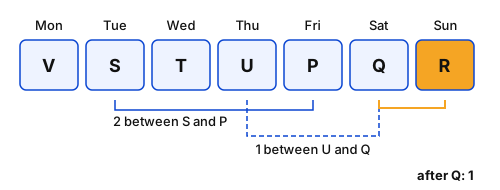
- Two people between S (Tue) and P → P = Fri (going back is impossible).
- Free days: Mon, Wed, Thu, Sat, Sun. Consecutive free pairs: (Wed, Thu) and (Sat, Sun).
- If T, U = Wed, Thu and Q, R = Sat, Sun: between U (Thu) and Q (Sat) only P → 1 ✓. The other way, U = Sun and Q = Wed have 3 between ✗.
- V = Mon. Q = Sat → after Q only R → 1.
Trick: Locate consecutive free slots first – they fix both pairs at once.
Answer: (D) 1
अवधारणा: S को मंगलवार पर रखें, फिर दो लगातार जोड़े (T, U) और (Q, R) लगाएँ।
- S (मंगल) और P के बीच दो लोग → P = शुक्र (पीछे जाना संभव नहीं)।
- खाली दिन: सोम, बुध, गुरु, शनि, रवि। लगातार खाली जोड़े: (बुध, गुरु) और (शनि, रवि)।
- T, U = बुध, गुरु और Q, R = शनि, रवि: U (गुरु) और Q (शनि) के बीच केवल P → 1 ✓। उल्टा करने पर U = रवि, Q = बुध, बीच में 3 ✗।
- V = सोम। Q = शनि → Q के बाद केवल R → 1।
ट्रिक: पहले लगातार खाली स्थान खोजें – दोनों जोड़े एक साथ तय हो जाते हैं।
उत्तर: (D) 1
RRB NTPC Graduate CBT 2General Intelligence and ReasoningScheduling PuzzleRRB NTPC Graduate CBT 2 2024 · 13 Oct Shift 1
Q240.In this question, a question is followed by two statements numbered (I) and (II). You have to decide whether the data provided in the statements are sufficient to answer the question. Read both the statements and select the most appropriate answer.
Question:
Among 5 students, F, A, K, E and D each having a different height, which student is the shortest?
Statements:
(I) A is shorter than E. K is shorter than F.
(II) K is taller than A.
इस प्रश्न में, एक प्रश्न के बाद (I) और (II) क्रमांकित दो कथन दिए गए हैं। आपको यह तय करना है कि कथनों में दिए गए आँकड़े प्रश्न का उत्तर देने के लिए पर्याप्त हैं या नहीं। दोनों कथनों को पढ़िए और सबसे उपयुक्त उत्तर का चयन कीजिए।
प्रश्न:
5 विद्यार्थियों F, A, K, E और D में से, जिनमें प्रत्येक की ऊँचाई अलग-अलग है, सबसे छोटा विद्यार्थी कौन है?
कथन:
(I) A, E से छोटा है। K, F से छोटा है।
(II) K, A से लंबा है।
- AData in statements I and II together are NOT sufficient to answer the questionकथन I और II दोनों के आँकड़े मिलकर भी प्रश्न का उत्तर देने के लिए पर्याप्त नहीं हैं
- BData in statement II alone is sufficient to answer the question while data in statement I is notप्रश्न का उत्तर देने के लिए अकेले कथन II के आँकड़े पर्याप्त हैं, जबकि कथन I के आँकड़े पर्याप्त नहीं हैं
- CData in statement I alone is sufficient to answer the question while data in statement II is notप्रश्न का उत्तर देने के लिए अकेले कथन I के आँकड़े पर्याप्त हैं, जबकि कथन II के आँकड़े पर्याप्त नहीं हैं
- DData in statements I and II together (and not statement I alone or statement II alone) are sufficient to answer the questionकथन I और II दोनों के आँकड़े मिलकर (न कि अकेले कथन I या अकेले कथन II) प्रश्न का उत्तर देने के लिए पर्याप्त हैं
Show answer
Concept: To name the shortest of 5 people, every person must be compared so that one is below all others.
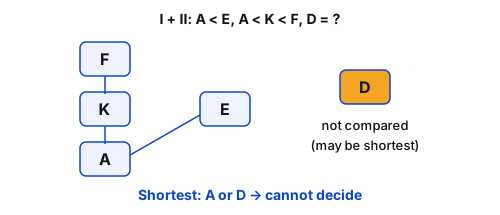
- I alone: A < E, K < F – two separate chains; D not mentioned → not enough.
- II alone: only K > A → not enough.
- I + II: A < K < F and A < E, so A is below F, K, E – but D is never compared, so A or D could be shortest.
Trick: Any person missing from all statements makes "shortest/tallest" impossible to decide.
Answer: (A) Data in statements I and II together are NOT sufficient to answer the question
अवधारणा: 5 में से सबसे छोटा बताने के लिए हर व्यक्ति की तुलना होनी चाहिए ताकि एक सबसे नीचे निश्चित हो।
- केवल I: A < E, K < F – दो अलग श्रृंखलाएँ; D का उल्लेख नहीं → पर्याप्त नहीं।
- केवल II: केवल K > A → पर्याप्त नहीं।
- I + II: A < K < F और A < E, अतः A, F, K, E से छोटा – पर D की तुलना कहीं नहीं, A या D कोई भी सबसे छोटा हो सकता है।
ट्रिक: जो व्यक्ति किसी कथन में नहीं है, उसके रहते "सबसे छोटा/लंबा" तय नहीं हो सकता।
उत्तर: (A) कथन I और II दोनों मिलकर भी पर्याप्त नहीं हैं
RRB NTPC Graduate CBT 2General Intelligence and ReasoningData SufficiencyRRB NTPC Graduate CBT 2 2024 · 13 Oct Shift 1

