Q4461.A company earns a profit (in ₹) that is distributed among the company's three partners in the ratio of 5 : 8 : 17. If the difference between the smallest and the largest shares is ₹78,106, the total profit (in ₹) of the company is:
एक कंपनी लाभ (₹ में) अर्जित करती है जिसे कंपनी के तीन साझेदारों के बीच 5 : 8 : 17 के अनुपात में वितरित किया जाता है। यदि सबसे छोटे और सबसे बड़े हिस्सों के बीच का अंतर ₹78,106 है, तो कंपनी का कुल लाभ (₹ में) है:
- A1,95,278
- B1,95,361
- C1,95,302
- D1,95,265
Show answer
Concept: The difference of ratio terms equals the given difference; scale up to the total.
- Ratio , total parts.
- Largest − smallest parts
- Total
Trick: – multiply the difference by 2.5 directly.
Answer: (D) ₹1,95,265
अवधारणा: अनुपात के पदों का अंतर दिए गए अंतर के बराबर रखकर कुल निकालें।
- अनुपात , कुल भाग
- सबसे बड़ा − सबसे छोटा भाग
- कुल
ट्रिक: – अंतर को सीधे 2.5 से गुणा करें।
उत्तर: (D) ₹1,95,265
RRB NTPC Undergraduate CBT 1MathematicsRatio – partnership sharesRRB NTPC Undergraduate CBT 1 2024 · 12 Aug Shift 3
Q4462.A man driving a car at a speed of 54 km/hr crosses a bridge in 1.7 minutes. Find the length of the bridge.
54 km/hr की चाल से कार चला रहा एक व्यक्ति 1.7 मिनट में एक पुल पार करता है। पुल की लंबाई ज्ञात कीजिए।
- A2.58 km
- B2.13 km
- C1.53 km
- D0.92 km
Show answer
Concept: Distance = Speed × Time (convert the units first).
- Length
Trick: , so .
Answer: (C) 1.53 km
अवधारणा: दूरी = चाल × समय (पहले इकाइयाँ बदलें)।
- पुल की लंबाई
ट्रिक: , अतः
उत्तर: (C) 1.53 km
RRB NTPC Undergraduate CBT 1MathematicsSpeed, time and distanceRRB NTPC Undergraduate CBT 1 2024 · 12 Aug Shift 3
Q4463.Two cubes of edge 5 cm are joined to form a cuboid. Find the total surface area of the cuboid.
5 cm किनारे वाले दो घनों को जोड़कर एक घनाभ बनाया जाता है। घनाभ का कुल पृष्ठीय क्षेत्रफल ज्ञात कीजिए।
- A25 cm2
- B250 cm2
- C100 cm2
- D125 cm2
Show answer
Concept: Two equal cubes joined face to face form a cuboid ; .
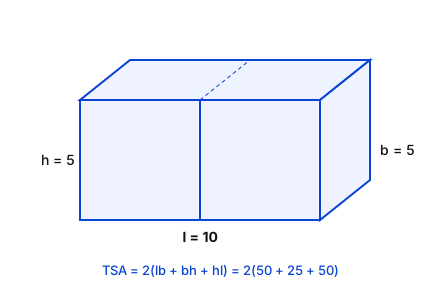
- , , (cm)
Trick: Two cubes have 12 faces; joining hides 2, so TSA .
Answer: (B)
अवधारणा: दो समान घनों को जोड़ने पर का घनाभ बनता है;
- , , (cm)
ट्रिक: दो घनों के 12 फलक; जोड़ने पर 2 छिप जाते हैं, अतः TSA
उत्तर: (B)
RRB NTPC Undergraduate CBT 1MathematicsSurface area of cuboidRRB NTPC Undergraduate CBT 1 2024 · 12 Aug Shift 3
Q4464.Pipe P can fill part of a tank in 24 hours, and pipe Q can fill part of the same tank in 16 hours. Both P and Q were kept open for 4 hours, then both were closed. Pipe R alone was then opened and it emptied the water in the tank in 5 hours. Pipes P, Q and R together can fill the empty tank in:
पाइप P किसी टंकी के भाग को 24 घंटे में भर सकता है, और पाइप Q उसी टंकी के भाग को 16 घंटे में भर सकता है। P और Q दोनों को 4 घंटे तक खुला रखा गया, फिर दोनों को बंद कर दिया गया। इसके बाद केवल पाइप R को खोला गया और उसने टंकी का पानी 5 घंटे में खाली कर दिया। पाइप P, Q और R एक साथ खाली टंकी को कितने समय में भर सकते हैं?
- A72 hours72 घंटे
- B62 hours62 घंटे
- C88 hours88 घंटे
- D79 hours79 घंटे
Show answer
Concept: Convert each pipe to "tank per hour"; filling pipes are +, emptying pipes are −.
- P fills in 24 h → full tank in ; Q: in 16 h → .
- In 4 h, P + Q fill of the tank.
- R empties in 5 h → R empties a full tank in .
- Together: →
Trick: LCM 72 as capacity: P = 2, Q = 3, R = −4 units/h; net unit/h → 72 h.
Answer: (A) 72 hours
अवधारणा: हर नल का "प्रति घंटा कार्य" निकालें; भरने वाला +, खाली करने वाला −।
- P, भाग 24 घंटे में → पूरी टंकी ; Q: भाग 16 घंटे में →
- 4 घंटे में P + Q: भाग
- R, भाग 5 घंटे में खाली करता है → पूरी टंकी में।
- तीनों साथ: →
ट्रिक: क्षमता = LCM 72 इकाई: P = 2, Q = 3, R = −4 इकाई/घंटा; कुल 1 इकाई/घंटा → 72 घंटे।
उत्तर: (A) 72 hours
RRB NTPC Undergraduate CBT 1MathematicsPipes and cisternsRRB NTPC Undergraduate CBT 1 2024 · 12 Aug Shift 3
Q4465.Find the mean proportional between 19 and 76.
19 और 76 का मध्यानुपाती ज्ञात कीजिए।
- A36
- B37
- C38
- D39
Show answer
Concept: Mean proportional of and .
Trick: , so the answer is without multiplying out.
Answer: (C) 38
अवधारणा: और का मध्यानुपाती
ट्रिक: , इसलिए उत्तर सीधे ।
उत्तर: (C) 38
RRB NTPC Undergraduate CBT 1MathematicsMean proportionalRRB NTPC Undergraduate CBT 1 2024 · 12 Aug Shift 3
Q4466.What smallest number should be added to 16809 so that the sum is completely divisible by 41?
16809 में कौन-सी सबसे छोटी संख्या जोड़ी जाए ताकि योगफल 41 से पूर्णतः विभाज्य हो?
- A3
- B2
- C1
- D4
Show answer
Concept: Number to add divisor − remainder.
- , so remainder .
- Number to add
Trick: Look for a round multiple near the number: is just 1 more.
Answer: (C) 1
अवधारणा: जोड़ी जाने वाली संख्या भाजक − शेषफल
- , अतः शेषफल
- जोड़ें
ट्रिक: पास का गोल गुणज देखें: , जो केवल 1 अधिक है।
उत्तर: (C) 1
RRB NTPC Undergraduate CBT 1MathematicsDivisibility – least number to addRRB NTPC Undergraduate CBT 1 2024 · 12 Aug Shift 3
Q4467.The selling price of 16 books is equal to the cost price of 8 books. Find the loss or gain percentage.
16 पुस्तकों का विक्रय मूल्य 8 पुस्तकों के क्रय मूल्य के बराबर है। हानि या लाभ प्रतिशत ज्ञात कीजिए।
- A gain लाभ
- B50% gain50% लाभ
- C50% loss50% हानि
- D loss हानि
Show answer
Concept: If SP of items = CP of items, then .
- SP < CP → loss.
Trick: (negative = loss).
Answer: (C) loss
अवधारणा: यदि वस्तुओं का SP = वस्तुओं का CP, तो
- SP < CP → हानि
ट्रिक: (ऋणात्मक = हानि)।
उत्तर: (C) हानि
RRB NTPC Undergraduate CBT 1MathematicsProfit and loss – SP of n vs CP of mRRB NTPC Undergraduate CBT 1 2024 · 12 Aug Shift 3
Q4468.Find the simple interest (in ₹) if a sum of ₹400 is borrowed for 5.5 years at 4% per annum rate of interest.
यदि ₹400 की राशि 4% वार्षिक ब्याज दर पर 5.5 वर्षों के लिए उधार ली जाती है, तो साधारण ब्याज (₹ में) ज्ञात कीजिए।
- A68
- B138
- C88
- D188
Show answer
Concept:
Trick: of 400 = 16 per year; .
Answer: (C) 88
अवधारणा:
ट्रिक: 400 का = 16 प्रति वर्ष;
उत्तर: (C) 88
RRB NTPC Undergraduate CBT 1MathematicsSimple interestRRB NTPC Undergraduate CBT 1 2024 · 12 Aug Shift 3
Q4469.What is the equivalent single discount for successive discounts of 20% and 10%?
20% और 10% की क्रमिक छूटों के समतुल्य एकल छूट कितनी है?
- A27%
- B25%
- C30%
- D28%
Show answer
Concept: Equivalent discount of and .
Trick: On ₹100: after → 80; after → 72; total discount .
Answer: (D)
अवधारणा: और की समतुल्य छूट
ट्रिक: ₹100 पर: के बाद 80; के बाद 72; कुल छूट ।
उत्तर: (D)
RRB NTPC Undergraduate CBT 1MathematicsSuccessive discountsRRB NTPC Undergraduate CBT 1 2024 · 12 Aug Shift 3
Q4470.A can lay railway track between two given stations in 17 days and B can do the same job in 16 days. With the help of C, they did the job in 4 days only. Then, C alone can do the job in
A दो दिए गए स्टेशनों के बीच रेलवे ट्रैक 17 दिनों में बिछा सकता है और B वही कार्य 16 दिनों में कर सकता है। C की सहायता से, उन्होंने वह कार्य केवल 4 दिनों में पूरा किया। तो, C अकेले वह कार्य कितने दिनों में कर सकता है?
- A days दिन
- B days दिन
- C days दिन
- D days दिन
Show answer
Concept: One day's work of C .
- LCM of 4, 17, 16 .
- C alone days
Trick: Total work 272 units: A = 16, B = 17, all = 68 units/day → C units/day.
Answer: (B) days
अवधारणा: C का एक दिन का कार्य
- 4, 17, 16 का LCM
- C अकेला दिन
ट्रिक: कुल कार्य 272 इकाई: A = 16, B = 17, तीनों = 68 इकाई/दिन → C = 35 इकाई/दिन।
उत्तर: (B) दिन
RRB NTPC Undergraduate CBT 1MathematicsTime and work – finding third workerRRB NTPC Undergraduate CBT 1 2024 · 12 Aug Shift 3
Q4471.Raghunandan walks 325 m towards the west to reach a cloth showroom. Then he turns to the right and walks 220 m straight to reach the fitness centre. Again, he turns to the right and walks for 200 m straight. Then, he turns to the right again and walks for 220 m. How far is he from the starting point?( All turns are 90-degree turns only, unless specified.)
रघुनंदन एक कपड़े के शोरूम तक पहुँचने के लिए पश्चिम की ओर 325 m चलता है। फिर वह दाएँ मुड़ता है और फिटनेस सेंटर तक पहुँचने के लिए 220 m सीधा चलता है। फिर से, वह दाएँ मुड़ता है और 200 m सीधा चलता है। फिर, वह पुनः दाएँ मुड़ता है और 220 m चलता है। वह प्रारंभिक बिंदु से कितनी दूरी पर है? (जब तक निर्दिष्ट न किया जाए, सभी मोड़ केवल 90-डिग्री के मोड़ हैं।)
- A125 m
- B120 m
- C105 m
- D150 m
Show answer
Concept: Trace each move on a grid; facing west, a right turn means north.
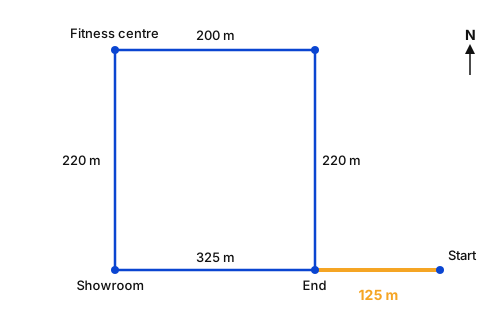
- 325 m west → showroom; right turn → north 220 m → fitness centre.
- Right → east 200 m; right → south 220 m: he is back on the starting line.
- Gap from start
Trick: The two 220 m legs cancel; only east–west matters: .
Answer: (A) 125 m
अवधारणा: हर चाल को ग्रिड पर बनाएँ; पश्चिम की ओर मुँह हो तो दाएँ मुड़ना = उत्तर।
- 325 m पश्चिम → शोरूम; दाएँ → उत्तर 220 m → फिटनेस सेंटर।
- दाएँ → पूर्व 200 m; दाएँ → दक्षिण 220 m: वह प्रारंभिक रेखा पर लौट आता है।
- प्रारंभ से दूरी
ट्रिक: दोनों 220 m कट जाते हैं; केवल पूर्व–पश्चिम:
उत्तर: (A) 125 m
RRB NTPC Undergraduate CBT 1General Intelligence and ReasoningDirection and distanceRRB NTPC Undergraduate CBT 1 2024 · 12 Aug Shift 3
Q4472.What will come in place of the question mark (?) in the following equation, if ‘+’ and ‘−’ are interchanged and ‘×’ and ‘÷’ are interchanged?
28 + 125 × 5 − 12 ÷ 3 = ?
यदि '+' और '−' को आपस में बदल दिया जाए तथा '×' और '÷' को आपस में बदल दिया जाए, तो निम्नलिखित समीकरण में प्रश्न-चिह्न (?) के स्थान पर क्या आएगा?
28 + 125 × 5 − 12 ÷ 3 = ?
- A28
- B46
- C39
- D21
Show answer
Concept: Swap the signs first, then apply BODMAS.
- becomes
Trick: Rewrite the whole expression with new signs before calculating – never swap mid-way.
Answer: (C) 39
अवधारणा: पहले चिह्न बदलें, फिर BODMAS लगाएँ।
- बनता है
ट्रिक: गणना से पहले पूरा व्यंजक नए चिह्नों के साथ दोबारा लिखें।
उत्तर: (C) 39
RRB NTPC Undergraduate CBT 1General Intelligence and ReasoningMathematical operations – interchange signsRRB NTPC Undergraduate CBT 1 2024 · 12 Aug Shift 3
Q4473.In the following number-pairs, the second number is obtained by applying certain mathematical operations to the first number. Select the set in which the numbers are related in the same way as are the numbers of the following sets.
(NOTE: Operations should be performed on the whole numbers, without breaking down the numbers into their constituent digits. E.g. 13 – Operations on 13 such as
adding/subtracting/multiplying to 13 can be performed. Breaking down 13 into 1 and 3 and then performing mathematical operations on 1 and 3 is not allowed.)
37, 62
52, 77
निम्नलिखित संख्या-युग्मों में, पहली संख्या पर कुछ गणितीय संक्रियाएँ करके दूसरी संख्या प्राप्त की जाती है। उस समुच्चय का चयन कीजिए जिसमें संख्याएँ उसी प्रकार संबंधित हैं जिस प्रकार निम्नलिखित समुच्चयों की संख्याएँ संबंधित हैं।
(नोट: संक्रियाएँ संख्याओं को उनके घटक अंकों में विभाजित किए बिना, पूर्ण संख्याओं पर की जानी चाहिए। उदाहरण 13 – 13 पर की जाने वाली संक्रियाएँ जैसे 13 में
जोड़ना/घटाना/गुणा करना आदि की जा सकती हैं। 13 को 1 और 3 में विभाजित करना और फिर 1 और 3 पर गणितीय संक्रियाएँ करना वर्जित है।)
37, 62
52, 77
- A81, 96
- B69, 88
- C64, 84
- D46, 71
Show answer
Concept: Find the single operation linking each pair.
- ; → rule: add 25.
- Check options: ✗, ✗, ✗, ✓
Trick: When both pairs show the same difference, just look for that difference in the options.
Answer: (D) 46, 71
अवधारणा: प्रत्येक युग्म को जोड़ने वाली संक्रिया खोजें।
- ; → नियम: 25 जोड़ें।
- विकल्प: ✗, ✗, ✗, ✓
ट्रिक: दोनों युग्मों में अंतर समान हो तो विकल्पों में वही अंतर ढूँढें।
उत्तर: (D) 46, 71
RRB NTPC Undergraduate CBT 1General Intelligence and ReasoningNumber pair analogyRRB NTPC Undergraduate CBT 1 2024 · 12 Aug Shift 3
Q4474.Which of the following letter-number clusters will replace the question mark (?) in the given series to make it logically complete?
NUB 63, JQX 54, FMT 45, BIP 36, XEL 27, ?
दी गई श्रृंखला को तार्किक रूप से पूर्ण करने के लिए निम्नलिखित में से कौन-सा अक्षर-संख्या समूह प्रश्न-चिह्न (?) का स्थान लेगा?
NUB 63, JQX 54, FMT 45, BIP 36, XEL 27, ?
- ATAI 17
- BUAH 20
- CTMH 15
- DTAH 18
Show answer
Concept: Track each letter position and the number separately.
- 1st letters: N, J, F, B, X, T (each −4).
- 2nd letters: U, Q, M, I, E, A (−4); 3rd letters: B, X, T, P, L, H (−4).
- Numbers: 63, 54, 45, 36, 27, 18 (−9).
Trick: After B, going back 4 wraps around: B → X; after E → A, after L → H.
Answer: (D) TAH 18
अवधारणा: हर अक्षर-स्थान और संख्या को अलग-अलग देखें।
- पहला अक्षर: N, J, F, B, X, T (हर बार −4)
- दूसरा: U, Q, M, I, E, A (−4); तीसरा: B, X, T, P, L, H (−4)
- संख्या: 63, 54, 45, 36, 27, 18 (−9)
ट्रिक: B से 4 पीछे जाने पर वर्णमाला घूमकर X आता है।
उत्तर: (D) TAH 18
RRB NTPC Undergraduate CBT 1General Intelligence and ReasoningLetter-number seriesRRB NTPC Undergraduate CBT 1 2024 · 12 Aug Shift 3
Q4475.Based on the English alphabetical order, three of the following four letter-clusters are alike in a certain way and thus form a group. Which letter-cluster DOES NOT belong to that group?
(Note: The odd one out is not based on the number of consonants/vowels or their position in the letter-cluster.)
अंग्रेज़ी वर्णमाला क्रम के आधार पर, निम्नलिखित चार अक्षर-समूहों में से तीन किसी निश्चित प्रकार से एकसमान हैं और इस प्रकार एक समूह बनाते हैं। कौन-सा अक्षर-समूह उस समूह से संबंधित नहीं है?
(नोट: असंगत अक्षर-समूह, व्यंजनों/स्वरों की संख्या या अक्षर-समूह में उनके स्थान पर आधारित नहीं है।)
- AORM
- BVYT
- CRUP
- DLOI
Show answer
Concept: Compare position gaps: 1st → 2nd and 2nd → 3rd letter.
- ORM: 15, 18, 13 → +3, −5; VYT: 22, 25, 20 → +3, −5; RUP: 18, 21, 16 → +3, −5.
- LOI: 12, 15, 9 → +3, −6 ✗
Yaad rakhein: EJOTY – E5, J10, O15, T20, Y25 helps convert letters fast.
Answer: (D) LOI
अवधारणा: अक्षरों के स्थानीय मान का अंतर देखें: पहले → दूसरा और दूसरा → तीसरा।
- ORM: 15, 18, 13 → +3, −5; VYT: 22, 25, 20 → +3, −5; RUP: 18, 21, 16 → +3, −5
- LOI: 12, 15, 9 → +3, −6 ✗
याद रखें: EJOTY – E5, J10, O15, T20, Y25 से अक्षर जल्दी बदलें।
उत्तर: (D) LOI
RRB NTPC Undergraduate CBT 1General Intelligence and ReasoningOdd one out – letter clustersRRB NTPC Undergraduate CBT 1 2024 · 12 Aug Shift 3
Q4476.What should come in place of the question (?) in the given series?
53 70 91 116 145 ?
दी गई श्रृंखला में प्रश्न-चिह्न (?) के स्थान पर क्या आना चाहिए?
53 70 91 116 145 ?
- A171
- B194
- C186
- D178
Show answer
Concept: Check the differences between consecutive terms.
- Differences: 17, 21, 25, 29, 33 (each +4).
- Next
Trick: Second differences constant (+4) → next difference is simply last + 4.
Answer: (D) 178
अवधारणा: क्रमागत पदों का अंतर देखें।
- अंतर: 17, 21, 25, 29, 33 (हर बार +4)
- अगला
ट्रिक: दूसरा अंतर स्थिर (+4) हो तो अगला अंतर = पिछला + 4।
उत्तर: (D) 178
RRB NTPC Undergraduate CBT 1General Intelligence and ReasoningNumber series – increasing differencesRRB NTPC Undergraduate CBT 1 2024 · 12 Aug Shift 3
Q4477.Based on the English alphabetical order, three of the following four letter-cluster pairs are alike in a certain way and thus form a group. Which letter-cluster pair DOES NOT belong to that group?
(Note: The odd one out is not based on the number of consonants/vowels or their position in the letter-cluster.)
अंग्रेज़ी वर्णमाला क्रम के आधार पर, निम्नलिखित चार अक्षर-समूह युग्मों में से तीन किसी निश्चित प्रकार से एकसमान हैं और इस प्रकार एक समूह बनाते हैं। कौन-सा अक्षर-समूह युग्म उस समूह से संबंधित नहीं है?
(नोट: असंगत अक्षर-समूह, व्यंजनों/स्वरों की संख्या या अक्षर-समूह में उनके स्थान पर आधारित नहीं है।)
- ASV-UX
- BDG-FI
- CBE-DG
- DEI-HK
Show answer
Concept: Check the gap inside each cluster and between the clusters.
- SV-UX: S+3 = V, S+2 = U, U+3 = X. DG-FI and BE-DG follow the same +3 / +2 / +3 pattern.
- EI-HK: E+4 = I ✗ (gap is 4, not 3).
Trick: Check the internal gap of the first cluster first – it exposes the odd one fastest.
Answer: (D) EI-HK
अवधारणा: हर समूह के अंदर का अंतर और दोनों समूहों के बीच का अंतर देखें।
- SV-UX: S+3 = V, S+2 = U, U+3 = X; DG-FI और BE-DG भी +3 / +2 / +3 पैटर्न पर।
- EI-HK: E+4 = I ✗ (अंतर 4 है, 3 नहीं)
ट्रिक: पहले समूह का आंतरिक अंतर पहले जाँचें – विषम तुरंत पकड़ में आता है।
उत्तर: (D) EI-HK
RRB NTPC Undergraduate CBT 1General Intelligence and ReasoningOdd one out – letter-cluster pairsRRB NTPC Undergraduate CBT 1 2024 · 12 Aug Shift 3
Q4478.Eight people, S, T, U, V, W, X, Y and Z, are sitting in a straight line. All are facing towards the north. S sits third from the extreme left end of the line. W is an immediate neighbour of V. Only U sits between S and W. Z is sitting at the extreme right end of the line. T is an immediate neighbour of both Y and S. How many people sit to the right of W?
आठ व्यक्ति, S, T, U, V, W, X, Y और Z, एक सीधी पंक्ति में बैठे हैं। सभी का मुख उत्तर की ओर है। S पंक्ति के बाएँ छोर से तीसरे स्थान पर बैठा है। W, V का निकटतम पड़ोसी है। S और W के बीच केवल U बैठा है। Z पंक्ति के दाएँ छोर पर बैठा है। T, Y और S दोनों का निकटतम पड़ोसी है। W के दाईं ओर कितने व्यक्ति बैठे हैं?
- AThreeतीन
- BFourचार
- COneएक
- DTwoदो
Show answer
Concept: Fix the definite positions first, then test the cases.
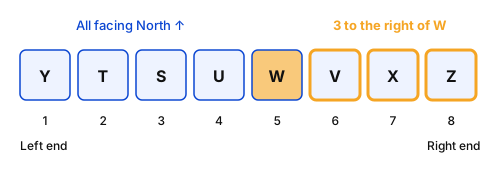
- S = 3rd from left, Z = 8th (right end).
- Only U between S and W: W at 5 (U at 4) or W at 1 (U at 2). If W = 1, V must be at 2, which is U – impossible. So U = 4, W = 5.
- T next to S and Y → T = 2, Y = 1; V next to W → V = 6; X = 7.
- Order: Y T S U W V X Z → right of W: V, X, Z = 3.
Trick: Use "only U sits between" to make two cases and kill one quickly.
Answer: (A) Three
अवधारणा: पहले निश्चित स्थान भरें, फिर स्थितियाँ जाँचें।
- S बाएँ से तीसरा, Z दाएँ छोर (8वाँ)।
- S और W के बीच केवल U: W = 5 (U = 4) या W = 1 (U = 2)। W = 1 पर V को 2 पर होना होगा, जहाँ U है – असंभव। अतः U = 4, W = 5।
- T, S और Y दोनों का पड़ोसी → T = 2, Y = 1; V, W का पड़ोसी → V = 6; X = 7
- क्रम: Y T S U W V X Z → W के दाएँ: V, X, Z = 3
ट्रिक: "केवल U बीच में" से दो स्थितियाँ बनाकर एक को जल्दी हटाएँ।
उत्तर: (A) तीन (Three)
RRB NTPC Undergraduate CBT 1General Intelligence and ReasoningLinear seating arrangementRRB NTPC Undergraduate CBT 1 2024 · 12 Aug Shift 3
Q4479.What should come in place of the question mark (?) in the given series?
442 530 626 730 842 ?
दी गई श्रृंखला में प्रश्न-चिह्न (?) के स्थान पर क्या आना चाहिए?
442 530 626 730 842 ?
- A901
- B1025
- C962
- D1090
Show answer
Concept: Check the differences between consecutive terms.
- Differences: 88, 96, 104, 112 (each +8).
- Next difference →
Trick: Differences rising by a fixed amount → keep adding that amount.
Answer: (C) 962
अवधारणा: क्रमागत पदों का अंतर देखें।
- अंतर: 88, 96, 104, 112 (हर बार +8)
- अगला अंतर →
ट्रिक: अंतर एक निश्चित मात्रा से बढ़े तो वही मात्रा जोड़ते रहें।
उत्तर: (C) 962
RRB NTPC Undergraduate CBT 1General Intelligence and ReasoningNumber series – increasing differencesRRB NTPC Undergraduate CBT 1 2024 · 12 Aug Shift 3
Q4480.Read the given statements and conclusions carefully. Assuming that the information given in the statements is true, even if it appears to be at variance with commonly known facts, decide which of the given conclusions logically follow(s) from the statements.
Statements:
All forests are hills.
Some hills are deserts.
Conclusions:
(I): All hills are forests.
(II): Some deserts are hills.
दिए गए कथनों और निष्कर्षों को ध्यानपूर्वक पढ़िए। यह मानते हुए कि कथनों में दी गई जानकारी सत्य है, भले ही वह सामान्य रूप से ज्ञात तथ्यों से भिन्न प्रतीत होती हो, निर्णय लीजिए कि दिए गए निष्कर्षों में से कौन-सा/कौन-से निष्कर्ष तार्किक रूप से कथनों का अनुसरण करता है/करते हैं।
कथन:
सभी जंगल, पहाड़ियाँ हैं।
कुछ पहाड़ियाँ, रेगिस्तान हैं।
निष्कर्ष:
(I): सभी पहाड़ियाँ, जंगल हैं।
(II): कुछ रेगिस्तान, पहाड़ियाँ हैं।
- AOnly Conclusion II followsकेवल निष्कर्ष II अनुसरण करता है
- BOnly Conclusion I followsकेवल निष्कर्ष I अनुसरण करता है
- CBoth Conclusions I and II followनिष्कर्ष I और II दोनों अनुसरण करते हैं
- DNeither Conclusion I nor II followsन तो निष्कर्ष I और न ही II अनुसरण करता है
Show answer
Concept: Draw the least-overlap Venn diagram; a conclusion follows only if it is true in every possible diagram.
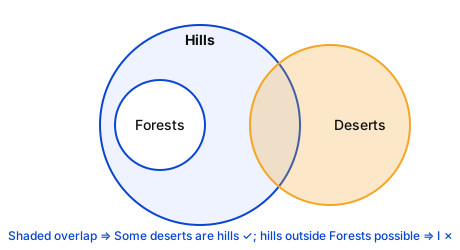
- Forests lie inside Hills; Deserts overlap Hills.
- I: "All hills are forests" – Hills can be bigger than Forests → not certain ✗.
- II: "Some deserts are hills" – conversion of "Some hills are deserts" ✓.
Yaad rakhein: "Some A are B" ⇔ "Some B are A" always; "All A are B" never gives "All B are A".
Answer: (A) Only Conclusion II follows
अवधारणा: न्यूनतम-ओवरलैप वेन आरेख बनाएँ; निष्कर्ष तभी निकलता है जब हर संभव आरेख में सही हो।
- Forests, Hills के अंदर; Deserts, Hills को काटता है।
- I: "सभी hills, forests हैं" – Hills बड़ा हो सकता है → निश्चित नहीं ✗
- II: "कुछ deserts, hills हैं" – "कुछ hills, deserts हैं" का विलोम ✓
याद रखें: "कुछ A, B हैं" ⇔ "कुछ B, A हैं"; पर "सभी A, B हैं" से "सभी B, A हैं" नहीं निकलता।
उत्तर: (A) केवल निष्कर्ष II अनुसरण करता है
RRB NTPC Undergraduate CBT 1General Intelligence and ReasoningSyllogismRRB NTPC Undergraduate CBT 1 2024 · 12 Aug Shift 3

