Q4541.The population of a district is 328000, out of which 164000 are males. 24% of the population is literate. If 34% males are literate, then what percentage of females are literate?
एक ज़िले की जनसंख्या 328000 है, जिसमें से 164000 पुरुष हैं। जनसंख्या का 24% साक्षर है। यदि 34% पुरुष साक्षर हैं, तो कितने प्रतिशत महिलाएँ साक्षर हैं?
- A13%
- B11%
- C17%
- D14%
Show answer
Concept: Total literates = male literates + female literates.
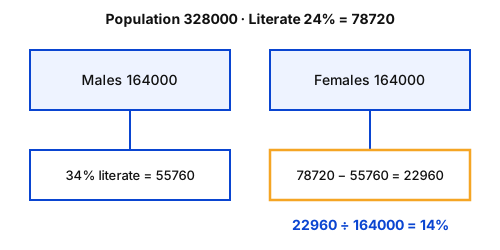
- Females .
- Total literates .
- Male literates .
- Female literates , so .
Trick: Males = females (half each), so average rule: .
Answer: (D)
अवधारणा: कुल साक्षर = साक्षर पुरुष + साक्षर महिलाएँ।
- महिलाएँ ।
- कुल साक्षर ।
- साक्षर पुरुष ।
- साक्षर महिलाएँ , अतः ।
ट्रिक: पुरुष = महिलाएँ (आधे-आधे), इसलिए औसत: ।
उत्तर: (D)
RRB NTPC Undergraduate CBT 1MathematicsPercentageRRB NTPC Undergraduate CBT 1 2024 · 12 Aug Shift 2
Q4542.If the 6-digit number N75M52 is divisible by 11, then which of the options below can give a possible correct relation between M and N?
यदि 6-अंकीय संख्या N75M52, 11 से विभाज्य है, तो नीचे दिए गए विकल्पों में से कौन-सा M और N के बीच संभावित सही संबंध दे सकता है?
- AM = N
- BM - N = 1
- CM + N = -1
- DM - N = 5
Show answer
Concept: A number is divisible by 11 if (sum of digits at odd places) − (sum of digits at even places) is or a multiple of .
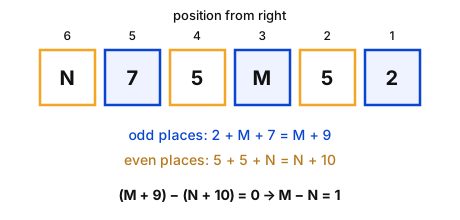
- N75M52 from the right: odd places ; even places .
- Odd sum , even sum .
- Difference .
- For divisibility, (e.g. : ).
Trick: Alternate signs from the right: .
Answer: (B)
अवधारणा: कोई संख्या 11 से विभाज्य है यदि (विषम स्थानों के अंकों का योग) − (सम स्थानों के अंकों का योग) या का गुणज हो।
- N75M52 में दाएँ से: विषम स्थान ; सम स्थान ।
- विषम योग , सम योग ।
- अंतर ।
- विभाज्यता के लिए (जैसे : )।
ट्रिक: दाएँ से बारी-बारी चिह्न: ।
उत्तर: (B)
RRB NTPC Undergraduate CBT 1MathematicsDivisibility rulesRRB NTPC Undergraduate CBT 1 2024 · 12 Aug Shift 2
Q4543.A number, when decreased by 6%, gives 3760. The number is:
एक संख्या को 6% घटाने पर 3760 प्राप्त होता है। वह संख्या है:
- A2000
- B4000
- C12000
- D8000
Show answer
Concept: Decreasing a number by leaves of it.
- .
- .
- .
Trick: , so the number is . Check: of , .
Answer: (B)
अवधारणा: किसी संख्या को घटाने पर उसका बचता है।
- ।
- ।
- ।
ट्रिक: , अतः संख्या । जाँच: का , ।
उत्तर: (B)
RRB NTPC Undergraduate CBT 1MathematicsPercentageRRB NTPC Undergraduate CBT 1 2024 · 12 Aug Shift 2
Q4544.If the third proportional of 9 and 60 be x, then what is the value of x?
यदि 9 और 60 का तृतीयानुपाती x है, तो x का मान क्या है?
- A398
- B400
- C402
- D401
Show answer
Concept: The third proportional of and satisfies , i.e. .
- .
- .
- .
Trick: Third proportional .
Answer: (B)
अवधारणा: और का तृतीयानुपाती हो तो , यानी ।
- ।
- ।
- ।
ट्रिक: ।
उत्तर: (B)
RRB NTPC Undergraduate CBT 1MathematicsRatio and proportionRRB NTPC Undergraduate CBT 1 2024 · 12 Aug Shift 2
Q4545.The product of two consecutive natural numbers is 552. The greater of the two numbers is:
दो क्रमागत प्राकृत संख्याओं का गुणनफल 552 है। दोनों में से बड़ी संख्या है:
- A24
- B18
- C15
- D27
Show answer
Concept: For consecutive numbers , is close to .
- , so try and .
- . ✓
- Greater number .
Trick: Unit digit 2 needs ends like or ; near only fits.
Answer: (A)
अवधारणा: क्रमागत संख्याओं के लिए , तो लगभग होता है।
- , अतः और जाँचें।
- ✓
- बड़ी संख्या ।
ट्रिक: इकाई अंक 2 के लिए या जैसे अंत; के पास केवल ।
उत्तर: (A)
RRB NTPC Undergraduate CBT 1MathematicsNumber systemRRB NTPC Undergraduate CBT 1 2024 · 12 Aug Shift 2
Q4546.Which of the following numbers divides 6,30,605?
निम्नलिखित में से कौन-सी संख्या 6,30,605 को विभाजित करती है?
- A3
- B5
- C7
- D14
Show answer
Concept: Use quick divisibility tests on .
- By 5: last digit is → divisible ✓.
- By 3: digit sum , not a multiple of → no.
- By 14: an odd number cannot be divisible by (even). By 7: → no.
Trick: Last digit 0 or 5 → divisible by 5 at a glance.
Answer: (B)
अवधारणा: पर विभाज्यता के नियम लगाएँ।
- 5 से: अंतिम अंक है → विभाज्य ✓।
- 3 से: अंकों का योग , का गुणज नहीं → नहीं।
- 14 से: विषम संख्या (सम) से विभाज्य नहीं। 7 से: → नहीं।
ट्रिक: अंतिम अंक 0 या 5 → तुरंत 5 से विभाज्य।
उत्तर: (B)
RRB NTPC Undergraduate CBT 1MathematicsDivisibility rulesRRB NTPC Undergraduate CBT 1 2024 · 12 Aug Shift 2
Q4547.What is the perimeter of an equilateral triangle with side 13 cm?
13 cm भुजा वाले एक समबाहु त्रिभुज का परिमाप क्या है?
- A52 cm
- B39 cm
- C40 cm
- D26 cm
Show answer
Concept: All three sides of an equilateral triangle are equal, so perimeter .
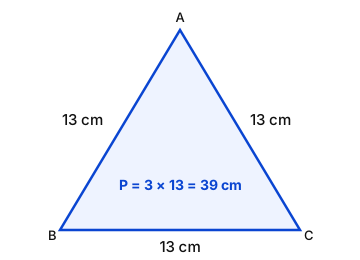
- Side .
- Perimeter .
Trick: Equilateral: ; square: .
Answer: (B)
अवधारणा: समबाहु त्रिभुज की तीनों भुजाएँ बराबर होती हैं, अतः परिमाप ।
- भुजा ।
- परिमाप ।
ट्रिक: समबाहु त्रिभुज: ; वर्ग: ।
उत्तर: (B)
RRB NTPC Undergraduate CBT 1MathematicsMensuration – triangleRRB NTPC Undergraduate CBT 1 2024 · 12 Aug Shift 2
Q4548.The LCM of 33 × 82 × 13, 32 × 132 × 16 and 83 × 132 × 162 is:
33 × 82 × 13, 32 × 132 × 16 और 83 × 132 × 162 का LCM है:
- A33 × 83 × 132 × 162
- B33 × 82 × 132 × 16
- C32 × 83 × 13 × 162
- D32 × 82 × 132 × 163
Show answer
Concept: LCM = product of each factor with its highest power appearing in the numbers.
- Highest power of : ; of : ; of : ; of : .
- So LCM .
- Check with primes: -powers are ; highest – same result.
Trick: LCM → highest powers; HCF → lowest powers.
Answer: (A)
अवधारणा: LCM = प्रत्येक गुणनखंड की संख्याओं में आने वाली सबसे बड़ी घात का गुणनफल।
- की सबसे बड़ी घात ; की ; की ; की ।
- अतः LCM ।
- अभाज्य रूप से जाँच: की घातें ; सबसे बड़ी – वही उत्तर।
ट्रिक: LCM → सबसे बड़ी घातें; HCF → सबसे छोटी घातें।
उत्तर: (A)
RRB NTPC Undergraduate CBT 1MathematicsLCMRRB NTPC Undergraduate CBT 1 2024 · 12 Aug Shift 2
Q4549.The number 253118139 is divisible by which of the following?
संख्या 253118139 निम्नलिखित में से किससे विभाज्य है?
- A3
- B12
- C5
- D8
Show answer
Concept: Apply divisibility tests to .
- By 3: digit sum , a multiple of → divisible ✓.
- By 5: last digit → no. By 8: last three digits not divisible by → no.
- By 12: needs divisibility by 4 and 3; the number is odd → no.
Trick: Odd number → straight away not divisible by 8 or 12.
Answer: (A)
अवधारणा: पर विभाज्यता के नियम लगाएँ।
- 3 से: अंकों का योग , का गुणज → विभाज्य ✓।
- 5 से: अंतिम अंक → नहीं। 8 से: अंतिम तीन अंक , से विभाज्य नहीं → नहीं।
- 12 से: 4 और 3 दोनों से विभाज्यता चाहिए; संख्या विषम है → नहीं।
ट्रिक: विषम संख्या → 8 या 12 से सीधे विभाज्य नहीं।
उत्तर: (A)
RRB NTPC Undergraduate CBT 1MathematicsDivisibility rulesRRB NTPC Undergraduate CBT 1 2024 · 12 Aug Shift 2
Q4550.The average of first 169 even numbers is
प्रथम 169 सम संख्याओं का औसत है
- A170
- B171
- C169.5
- D170.5
Show answer
Concept: Sum of first even numbers , so their average .
- First 169 even numbers: .
- Average .
- Also, average .
Trick: Average of first even numbers ; of first odd numbers .
Answer: (A)
अवधारणा: पहली सम संख्याओं का योग , अतः औसत ।
- पहली 169 सम संख्याएँ: ।
- औसत ।
- या, ।
ट्रिक: पहली सम संख्याओं का औसत ; पहली विषम संख्याओं का ।
उत्तर: (A)
RRB NTPC Undergraduate CBT 1MathematicsAverageRRB NTPC Undergraduate CBT 1 2024 · 12 Aug Shift 2
Q4551.A shopkeeper offers the following three schemes. Which scheme has the maximum discount percent?
I. Two successive discounts of 15% and 20%.
II. Buy 4 get 2 free.
III. Buy 6 get 4 free
एक दुकानदार निम्नलिखित तीन योजनाएँ प्रस्तुत करता है। किस योजना में अधिकतम छूट प्रतिशत है?
I. 15% और 20% की दो क्रमिक छूटें।
II. 4 खरीदें 2 मुफ़्त पाएँ।
III. 6 खरीदें 4 मुफ़्त पाएँ
- AIII onlyकेवल III
- BI onlyकेवल I
- CBoth I and III और II दोनों
- DII onlyकेवल II
Show answer
Concept: Compare the effective discount % of each scheme.
- I: .
- II: Buy 4 get 2 free → pay for 4, get 6: discount .
- III: Buy 6 get 4 free → get 10: discount .
- Maximum is (scheme III).
Trick: Free-item discount – divide by the TOTAL items, not the paid ones.
Answer: (A) III only
अवधारणा: हर योजना की प्रभावी छूट % की तुलना करें।
- I: .
- II: 4 खरीदें 2 मुफ्त → 6 वस्तुएँ, छूट .
- III: 6 खरीदें 4 मुफ्त → 10 वस्तुएँ, छूट .
- अधिकतम (योजना III)।
ट्रिक: मुफ्त वस्तु वाली छूट – कुल वस्तुओं से भाग दें।
उत्तर: (A) केवल III
RRB NTPC Undergraduate CBT 1MathematicsDiscountRRB NTPC Undergraduate CBT 1 2024 · 12 Aug Shift 2
Q4552.Daksh travels 200 km at 50 km/hr, the next 252 km at 42 km/hr and the next 204 km at 51 km/hr. What is his average speed (in km/hr) for the whole journey? (Round off your answer to two decimal places)
दक्ष 200 km की यात्रा 50 km/hr की चाल से, अगले 252 km की यात्रा 42 km/hr की चाल से और अगले 204 km की यात्रा 51 km/hr की चाल से करता है। पूरी यात्रा के लिए उसकी औसत चाल (km/hr में) क्या है? (अपने उत्तर को दो दशमलव स्थानों तक पूर्णांकित कीजिए)
- A53.31
- B38.25
- C46.86
- D53.45
Show answer
Concept: Average speed .
- Times: h, h, h → total h.
- Distance km.
- Average speed .
Trick: Never average the speeds directly ( is wrong); always use total distance ÷ total time.
Answer: (C)
अवधारणा: औसत चाल ।
- समय: घंटे, घंटे, घंटे → कुल घंटे।
- कुल दूरी km।
- औसत चाल ।
ट्रिक: चालों का सीधा औसत न लें; हमेशा कुल दूरी ÷ कुल समय।
उत्तर: (C)
RRB NTPC Undergraduate CBT 1MathematicsAverage SpeedRRB NTPC Undergraduate CBT 1 2024 · 12 Aug Shift 2
Q4553.Veer bought some sharpeners at the rate of ₹180/dozen. He sold them for ₹23 each. His profit percentage is ______% (rounded off to two decimal places).
वीर ने ₹180/दर्जन की दर से कुछ शार्पनर खरीदे। उसने उन्हें ₹23 प्रति शार्पनर की दर से बेच दिया। उसका लाभ प्रतिशत ______% है (दो दशमलव स्थानों तक पूर्णांकित)।
- A51.33
- B53.33
- C57.33
- D55.33
Show answer
Concept: .
- CP of one sharpener ₹15.
- SP ₹23, profit ₹8.
- .
Trick: Bring both prices to the same unit (per piece) first.
Answer: (B)
अवधारणा: ।
- एक शार्पनर का क्रय मूल्य ₹15।
- विक्रय मूल्य ₹23, लाभ ₹8।
- ।
ट्रिक: पहले दोनों मूल्यों को एक ही इकाई (प्रति नग) में बदलें।
उत्तर: (B)
RRB NTPC Undergraduate CBT 1MathematicsProfit and LossRRB NTPC Undergraduate CBT 1 2024 · 12 Aug Shift 2
Q4554.Pipe P can fill part of a tank in 16 hours, and pipe Q can fill part of the same tank in 20 hours. Both P and Q were kept open for 2 hours, then both were closed. Pipe R alone was then opened and it emptied the water in the tank in 8 hours. Pipes P, Q and R together can fill the empty tank in:
पाइप P किसी टंकी के भाग को 16 घंटे में भर सकता है, और पाइप Q उसी टंकी के भाग को 20 घंटे में भर सकता है। P और Q दोनों को 2 घंटे के लिए खुला रखा गया, फिर दोनों को बंद कर दिया गया। इसके बाद केवल पाइप R को खोला गया और उसने टंकी का पानी 8 घंटे में खाली कर दिया। पाइप P, Q और R एक साथ मिलकर खाली टंकी को कितने समय में भर सकते हैं?
- A8 hours8 घंटे
- B16 hours16 घंटे
- C29 hours29 घंटे
- D26 hours26 घंटे
Show answer
Concept: Find each pipe's full-tank time, then combine rates (filling +, emptying −).
- P fills in 16 h → full tank in h. Q fills in 20 h → full in h.
- In 2 h, P + Q fill of the tank.
- R empties in 8 h → R empties a full tank in h.
- Together: → hours.
Trick: Full time : , .
Answer: (B) 16 hours
अवधारणा: हर पाइप का पूरी टंकी का समय निकालें, फिर दरें जोड़ें (भरना +, खाली करना −)।
- P, भाग 16 घंटे में → पूरी टंकी घंटे। Q, भाग 20 घंटे में → पूरी घंटे।
- 2 घंटे में P + Q भरते हैं भाग।
- R यह भाग 8 घंटे में खाली करता है → पूरी टंकी घंटे में।
- तीनों साथ: → घंटे।
ट्रिक: पूरा समय : , ।
उत्तर: (B) 16 घंटे
RRB NTPC Undergraduate CBT 1MathematicsPipes and CisternsRRB NTPC Undergraduate CBT 1 2024 · 12 Aug Shift 2
Q4555.Simplify x(9x − 8) + 7(x2 − 3) + 18.
x(9x − 8) + 7(x2 − 3) + 18 को सरल कीजिए।
- A16x2 − 8x + 3
- B−16x2 − 8x + 3
- C−16x2 − 8x − 3
- D16x2 − 8x − 3
Show answer
Concept: Expand the brackets and combine like terms.
- .
- .
- Sum : .
Trick: Check with : and ✓.
Answer: (D)
अवधारणा: कोष्ठक खोलकर समान पद जोड़ें।
- ।
- ।
- जोड़ें : ।
ट्रिक: रखकर जाँचें: और ✓।
उत्तर: (D)
RRB NTPC Undergraduate CBT 1MathematicsAlgebraic SimplificationRRB NTPC Undergraduate CBT 1 2024 · 12 Aug Shift 2
Q4556.M and N start a business. M invests ₹68,000 more than N for 4 months and N invests for 7 months. M's share is ₹856 more than that of N, out of a total profit of ₹6,848. Find the capital contributed by M.
M और N एक व्यवसाय शुरू करते हैं। M, N से ₹68,000 अधिक राशि 4 महीने के लिए निवेश करता है और N, 7 महीने के लिए निवेश करता है। ₹6,848 के कुल लाभ में से M का हिस्सा N के हिस्से से ₹856 अधिक है। M द्वारा लगाई गई पूँजी ज्ञात कीजिए।
- A₹1,22,400
- B₹1,22,000
- C₹1,23,000
- D₹1,23,400
Show answer
Concept: Profit share ∝ capital × time.
- M's share , N's share ; ratio .
- Let N's capital , M's . Then .
- .
- M's capital ₹1,22,400.
Trick: Given sum and difference of shares: larger .
Answer: (A) ₹1,22,400
अवधारणा: लाभ का हिस्सा ∝ पूँजी × समय।
- M का हिस्सा , N का ; अनुपात ।
- N की पूँजी , M की ; ।
- ।
- M की पूँजी ₹1,22,400।
ट्रिक: योग और अंतर दिए हों तो बड़ा भाग ।
उत्तर: (A) ₹1,22,400
RRB NTPC Undergraduate CBT 1MathematicsPartnershipRRB NTPC Undergraduate CBT 1 2024 · 12 Aug Shift 2
Q4557.A bus travelling at 66 km/hr completes a journey in 15 hours. What should be its speed to cover the same distance in 5 hours?
66 km/hr की चाल से चल रही एक बस किसी यात्रा को 15 घंटे में पूरा करती है। समान दूरी 5 घंटे में तय करने के लिए उसकी चाल कितनी होनी चाहिए?
- A202 km/hr
- B203 km/hr
- C198 km/hr
- D193 km/hr
Show answer
Concept: Distance stays the same, so speed × time is constant.
- Distance km.
- New speed .
Trick: Time becomes → speed becomes 3 times: .
Answer: (C) 198 km/hr
अवधारणा: दूरी समान है, इसलिए चाल × समय स्थिर।
- दूरी km।
- नई चाल ।
ट्रिक: समय हुआ → चाल 3 गुना: ।
उत्तर: (C) 198 km/hr
RRB NTPC Undergraduate CBT 1MathematicsSpeed, Time and DistanceRRB NTPC Undergraduate CBT 1 2024 · 12 Aug Shift 2
Q4558.The perimeter of a square is 76 m. Its area (in m2) is:
एक वर्ग का परिमाप 76 m है। इसका क्षेत्रफल (m2 में) है:
- A372
- B360
- C361
- D336
Show answer
Concept: Square: perimeter , area .
- m.
- Area .
Trick: .
Answer: (C) 361
अवधारणा: वर्ग: परिमाप , क्षेत्रफल ।
- भुजा m।
- क्षेत्रफल ।
ट्रिक: ।
उत्तर: (C) 361
RRB NTPC Undergraduate CBT 1MathematicsMensuration – SquareRRB NTPC Undergraduate CBT 1 2024 · 12 Aug Shift 2
Q4559.Evaluate: −12 − {−8 × (6 − 12) + 30 ÷ (−6)}
मान ज्ञात कीजिए: −12 − {−8 × (6 − 12) + 30 ÷ (−6)}
- A−57
- B−52
- C−55
- D−58
Show answer
Concept: Solve innermost brackets first, then ×/÷, then +/−.
- ; .
- .
- Curly bracket: .
- .
Trick: Negative × negative = positive; keep track of signs before subtracting the bracket.
Answer: (C)
अवधारणा: पहले भीतरी कोष्ठक, फिर ×/÷, फिर +/−।
- ; ।
- ।
- मझला कोष्ठक: ।
- ।
ट्रिक: ऋण × ऋण = धन; कोष्ठक घटाने से पहले चिह्न ध्यान रखें।
उत्तर: (C)
RRB NTPC Undergraduate CBT 1MathematicsSimplification (BODMAS)RRB NTPC Undergraduate CBT 1 2024 · 12 Aug Shift 2
Q4560.Find the simple interest (in ₹) if a sum of ₹400 is borrowed for 5.5 years at 12% per annum rate of interest.
यदि ₹400 की राशि 12% वार्षिक ब्याज दर पर 5.5 वर्ष के लिए उधार ली जाती है, तो साधारण ब्याज (₹ में) ज्ञात कीजिए।
- A364
- B264
- C314
- D244
Show answer
Concept: .
- .
- .
Trick: for years of ₹400 ₹264.
Answer: (B) 264
अवधारणा: ।
- ।
- ।
ट्रिक: × वर्ष ; ₹400 का ₹264।
उत्तर: (B) 264
RRB NTPC Undergraduate CBT 1MathematicsSimple InterestRRB NTPC Undergraduate CBT 1 2024 · 12 Aug Shift 2

