Q4661.Which of the following numbers divides 81,42,42,541?
निम्नलिखित में से कौन-सी संख्या 81,42,42,541 को विभाजित करती है?
- A7
- B12
- C8
- D15
Show answer
Concept: Divisibility by 7 (also 11, 13): make 3-digit groups from the right and take the alternating sum.
- The number is odd and ends in 1 → not divisible by 8, 12 or 15
- Groups from the right: 814 | 242 | 541 →
- → divisible by 7; indeed
Trick: Last digit 1 kills every even option and 15 instantly; only 7 remains.
Answer: (A) 7
अवधारणा: 7 (और 11, 13) की विभाज्यता: दाएँ से 3-3 अंकों के समूह बनाकर एकांतर योग लें।
- संख्या विषम है और 1 पर समाप्त → 8, 12, 15 से विभाज्य नहीं
- समूह 814 | 242 | 541 →
- → 7 से विभाज्य;
ट्रिक: अंतिम अंक 1 से सभी सम विकल्प और 15 तुरंत बाहर; केवल 7 बचता है।
उत्तर: (A) 7
RRB NTPC Undergraduate CBT 1MathematicsDivisibilityRRB NTPC Undergraduate CBT 1 2024 · 12 Aug Shift 1
Q4662.In covering a distance of 30 km, Anmol takes 7 hours more than Nikhil. If Anmol doubles his speed, then he would take 8 hours less than Nikhil. Anmol's speed is:
30 km की दूरी तय करने में अनमोल, निखिल से 7 घंटे अधिक लेता है। यदि अनमोल अपनी चाल दोगुनी कर दे, तो वह निखिल से 8 घंटे कम लेगा। अनमोल की चाल है:
- A7 km/hr
- B1 km/hr
- C6 km/hr
- D3 km/hr
Show answer
Concept: Time ; doubling speed halves the time.
- Let Anmol's time be ; then = Nikhil's time
- With double speed Anmol takes
- h
- Speed
Trick: The gap h equals half of Anmol's time.
Answer: (B) 1 km/hr
अवधारणा: समय ; चाल दोगुनी करने पर समय आधा।
- अनमोल का समय ; निखिल का
- दोगुनी चाल पर
- घंटे
- चाल
ट्रिक: दोनों अंतर का योग घंटे = अनमोल के समय का आधा।
उत्तर: (B) 1 km/hr
RRB NTPC Undergraduate CBT 1MathematicsSpeed, Time and DistanceRRB NTPC Undergraduate CBT 1 2024 · 12 Aug Shift 1
Q4663.The current population of a town is 12,500. It increases by 52% and 30% in two successive years but decreases by 15% in the third year. What is the population of the town at the end of the third year?
एक कस्बे की वर्तमान जनसंख्या 12,500 है। यह दो क्रमिक वर्षों में 52% और 30% बढ़ती है, लेकिन तीसरे वर्ष में 15% घट जाती है। तीसरे वर्ष के अंत में कस्बे की जनसंख्या कितनी है?
- A20,995
- B20,991
- C20,990
- D20,998
Show answer
Concept: Successive % changes multiply: for each year.
Trick: Last digit check: only an answer ending in 5 can come from multiplying by 0.85 here.
Answer: (A) 20,995
अवधारणा: क्रमागत प्रतिशत परिवर्तन गुणा होते हैं: हर वर्ष ।
ट्रिक: इकाई अंक जाँच: यहाँ 0.85 से गुणा पर अंत में 5 ही आता है।
उत्तर: (A) 20,995
RRB NTPC Undergraduate CBT 1MathematicsPopulation GrowthRRB NTPC Undergraduate CBT 1 2024 · 12 Aug Shift 1
Q4664.The product of two consecutive natural numbers is 702. The greater of the two numbers is:
दो क्रमागत प्राकृत संख्याओं का गुणनफल 702 है। दोनों संख्याओं में से बड़ी संख्या है:
- A26
- B27
- C38
- D24
Show answer
Concept: Consecutive numbers lie close to .
- Greater number
Trick: Unit digit: ends in 2, matching 702.
Answer: (B) 27
अवधारणा: क्रमागत संख्याएँ के पास होंगी।
- बड़ी संख्या
ट्रिक: इकाई अंक: → 2, जो 702 से मेल खाता है।
उत्तर: (B) 27
RRB NTPC Undergraduate CBT 1MathematicsNumber SystemRRB NTPC Undergraduate CBT 1 2024 · 12 Aug Shift 1
Q4665.The LCM of the numbers 12.8 and 0.004 is:
संख्याओं 12.8 और 0.004 का LCM है:
- A128
- B0.128
- C1.28
- D12.8
Show answer
Concept: Make decimal places equal, take LCM of the whole numbers, then put the decimal back.
- and → 12800 and 4 (thousandths)
- LCM(12800, 4)
- Answer
Trick: 12.8 is itself a multiple of 0.004 (), so LCM = 12.8.
Answer: (D) 12.8
अवधारणा: दशमलव स्थान बराबर करें, पूर्ण संख्याओं का LCM लें, फिर दशमलव वापस लगाएँ।
- और → 12800 और 4
- LCM(12800, 4)
- उत्तर
ट्रिक: 12.8 स्वयं 0.004 का गुणज है (), अतः LCM = 12.8।
उत्तर: (D) 12.8
RRB NTPC Undergraduate CBT 1MathematicsLCM of DecimalsRRB NTPC Undergraduate CBT 1 2024 · 12 Aug Shift 1
Q4666.A retailer offers the following discount scheme to his customers for the purchase of articles.
'Buy 30 and get 10 free'
Find the discount percentage offered.
एक खुदरा विक्रेता अपने ग्राहकों को वस्तुओं की खरीद पर निम्नलिखित छूट योजना प्रदान करता है।
'30 खरीदें और 10 मुफ़्त पाएँ'
प्रदान की गई छूट का प्रतिशत ज्ञात कीजिए।
- A26%
- B25%
- C30%
- D28%
Show answer
Concept: Discount% .
- Customer gets articles, pays for 30
- Discount
Trick: Divide by items received (40), not items bought (30) – 33% is the trap.
Answer: (B) 25%
अवधारणा: छूट% ।
- ग्राहक को वस्तुएँ मिलती हैं, भुगतान 30 का
- छूट
ट्रिक: मिली वस्तुओं (40) से भाग दें, खरीदी (30) से नहीं।
उत्तर: (B) 25%
RRB NTPC Undergraduate CBT 1MathematicsDiscountRRB NTPC Undergraduate CBT 1 2024 · 12 Aug Shift 1
Q4667.Find the value of x satisfying: 5(2x2 − 7) − 2(5x2 + 8x − 2) = 12
x का वह मान ज्ञात कीजिए जो निम्नलिखित को संतुष्ट करता है: 5(2x2 − 7) − 2(5x2 + 8x − 2) = 12
- A
- B
- C
- D
Show answer
Concept: Expand; the terms cancel, leaving a linear equation.
Trick: Watch the sign: .
Answer: (A)
अवधारणा: विस्तार करें; वाले पद कट जाते हैं, रैखिक समीकरण बचता है।
ट्रिक: चिह्न ध्यान दें: ।
उत्तर: (A)
RRB NTPC Undergraduate CBT 1MathematicsLinear EquationsRRB NTPC Undergraduate CBT 1 2024 · 12 Aug Shift 1
Q4668.₹12,300 were divided among A, B and C such that 3 times the share of A = 6 times the share of B = 2 times the share of C. Find the share of A.
₹12,300 को A, B और C के बीच इस प्रकार विभाजित किया गया कि A के हिस्से का 3 गुना = B के हिस्से का 6 गुना = C के हिस्से का 2 गुना। A का हिस्सा ज्ञात कीजिए।
- A₹4,100
- B₹3,915
- C₹4,063
- D₹3,924
Show answer
Concept: If , then .
- Multiply by 6:
- Total parts
Trick: Shares are inversely proportional to the multipliers 3, 6, 2.
Answer: (A) ₹4,100
अवधारणा: यदि तो ।
- 6 से गुणा:
- कुल भाग
ट्रिक: हिस्से गुणकों 3, 6, 2 के व्युत्क्रमानुपाती होते हैं।
उत्तर: (A) ₹4,100
RRB NTPC Undergraduate CBT 1MathematicsRatio and ProportionRRB NTPC Undergraduate CBT 1 2024 · 12 Aug Shift 1
Q4669.Find the value of 50−6÷ 5018× 50−5.
50−6÷ 5018× 50−5 का मान ज्ञात कीजिए।
- A50−19
- B50−29
- C50−36
- D50−32
Show answer
Concept: and (left to right).
Trick: Exponent .
Answer: (B)
अवधारणा: , (बाएँ से दाएँ)।
ट्रिक: घात ।
उत्तर: (B)
RRB NTPC Undergraduate CBT 1MathematicsIndicesRRB NTPC Undergraduate CBT 1 2024 · 12 Aug Shift 1
Q4670.Find the median of 26, 13, 14, 15, 8, 36, 23, 35 and 50.
26, 13, 14, 15, 8, 36, 23, 35 और 50 की माध्यिका ज्ञात कीजिए।
- A35
- B23
- C26
- D50
Show answer
Concept: Median = middle value after arranging in order; for odd it is the th value.
- Order: 8, 13, 14, 15, 23, 26, 35, 36, 50
- → th value
- 5th value
Trick: Always sort first – 26 (the 5th value as printed) is the trap.
Answer: (B) 23
अवधारणा: माध्यिका = क्रम में लगाने के बाद बीच का मान; विषम हो तो वाँ पद।
- क्रम: 8, 13, 14, 15, 23, 26, 35, 36, 50
- → वाँ पद
- 5वाँ पद
ट्रिक: पहले क्रम में लगाएँ – दिए क्रम का 5वाँ पद 26 जाल है।
उत्तर: (B) 23
RRB NTPC Undergraduate CBT 1MathematicsMedianRRB NTPC Undergraduate CBT 1 2024 · 12 Aug Shift 1
Q4671.Town H is to the east of town R and to the north of town D. Town E is southeast of town H. In which direction is town D with respect to town R?
नगर H, नगर R के पूर्व में और नगर D के उत्तर में है। नगर E, नगर H के दक्षिण-पूर्व में है। नगर R के सापेक्ष नगर D किस दिशा में है?
- ASoutheastदक्षिण-पूर्व
- BSouthwestदक्षिण-पश्चिम
- CNorthउत्तर
- DWestपश्चिम
Show answer
Concept: Place the towns on a grid from the given relations.
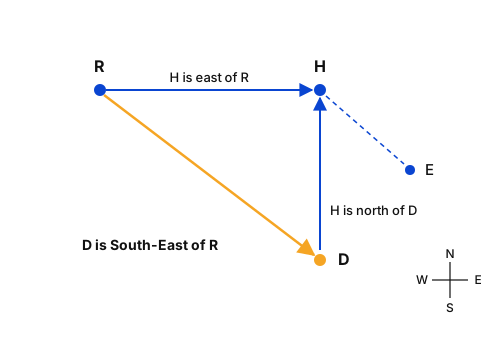
- H is east of R → H on R's right
- D is south of H → D is below H
- So D is to the east and to the south of R → South-East (E is not needed)
Trick: East + South together = South-East.
Answer: (A) Southeast
अवधारणा: दिए गए संबंधों से नगरों को ग्रिड पर रखें।
- H, R के पूर्व में
- D, H के दक्षिण में (H, D के उत्तर में)
- अतः D, R के पूर्व और दक्षिण दोनों में → दक्षिण-पूर्व (E की जरूरत नहीं)
ट्रिक: पूर्व + दक्षिण = दक्षिण-पूर्व।
उत्तर: (A) दक्षिण-पूर्व (Southeast)
RRB NTPC Undergraduate CBT 1General Intelligence and ReasoningDirection SenseRRB NTPC Undergraduate CBT 1 2024 · 12 Aug Shift 1
Q4672.Refer to the following number and symbol series and answer the question that follows. Counting to be done from left to right only.
(Left) > 5 * \ + 9 & 6 # 6 4 $ & / @ # $ & 8 3 < (Right)
How many such symbols are there that are immediately preceded by a number and also immediately followed by another symbol?
निम्नलिखित संख्या और प्रतीक श्रृंखला का संदर्भ लीजिए और उसके बाद दिए गए प्रश्न का उत्तर दीजिए। गिनती केवल बाएँ से दाएँ की जानी है।
(बाएँ) > 5 * \ + 9 & 6 # 6 4 $ & / @ # $ & 8 3 < (दाएँ)
ऐसे कितने प्रतीक हैं जिनके ठीक पहले एक संख्या है और ठीक बाद एक अन्य प्रतीक भी है?
- AFourचार
- BTwoदो
- COneएक
- DThreeतीन
Show answer
Concept: Check every symbol: the element just before must be a number and the one just after must be a symbol.
- 5 * \ → * qualifies
- 4 $ & → $ qualifies
- Others fail: 9 & 6, 6 # 6 (followed by numbers); 3 < has nothing after it
Trick: Scan for the pattern number-symbol-symbol only.
Answer: (B) Two
अवधारणा: हर प्रतीक जाँचें: ठीक पहले संख्या और ठीक बाद प्रतीक होना चाहिए।
- 5 * \ → * सही
- 4 $ & → $ सही
- बाकी नहीं: 9 & 6, 6 # 6 (बाद में संख्या); 3 < के बाद कुछ नहीं
ट्रिक: केवल संख्या-प्रतीक-प्रतीक पैटर्न खोजें।
उत्तर: (B) दो (Two)
RRB NTPC Undergraduate CBT 1General Intelligence and ReasoningSymbol-Number SeriesRRB NTPC Undergraduate CBT 1 2024 · 12 Aug Shift 1
Q4673.A, B, C, D, Q, R and S are sitting around a circular table, facing the centre of the table. Q sits to the immediate right of D. Only three people sit between Q and S, when counted from the left of Q. Only three people sit between D and C. A sits to the immediate right of R. How many people sit between D and R, when counted from the right of R?
A, B, C, D, Q, R और S एक वृत्ताकार मेज़ के चारों ओर मेज़ के केंद्र की ओर मुख करके बैठे हैं। Q, D के ठीक दाएँ बैठा है। Q के बाएँ से गिनने पर, Q और S के बीच केवल तीन व्यक्ति बैठे हैं। D और C के बीच केवल तीन व्यक्ति बैठे हैं। A, R के ठीक दाएँ बैठा है। R के दाएँ से गिनने पर, D और R के बीच कितने व्यक्ति बैठे हैं?
- AOneएक
- BFourचार
- CThreeतीन
- DTwoदो
Show answer
Concept: Facing the centre: right = anticlockwise, left = clockwise.
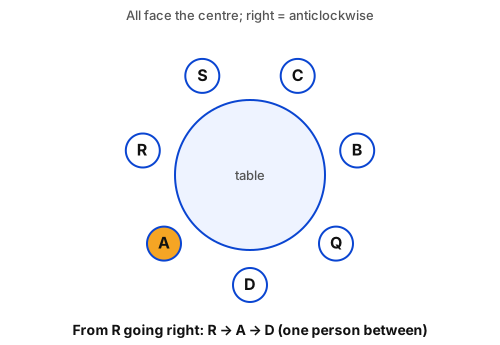
- Q is immediately right of D; going left (clockwise) from Q, three people sit before S
- Three people between D and C; one such seat is S's, so C sits next to S
- A is immediately right of R → R and A take the two seats left after D, i.e. order to the right: D, Q, B, C, S, R, A
- From R going right: R → A → D → one person (A) between
Trick: Always draw the circle and mark right/left as anticlockwise/clockwise first.
Answer: (A) One
अवधारणा: केंद्र की ओर मुख: दायाँ = वामावर्त (anticlockwise), बायाँ = दक्षिणावर्त।
- Q, D के ठीक दाएँ; Q के बाएँ गिनने पर तीन व्यक्तियों के बाद S
- D और C के बीच तीन व्यक्ति → C, S के बगल में
- A, R के ठीक दाएँ → दाएँ क्रम: D, Q, B, C, S, R, A
- R के दाएँ से: R → A → D → बीच में एक (A)
ट्रिक: पहले वृत्त बनाकर दायाँ/बायाँ दिशा तय करें।
उत्तर: (A) एक (One)
RRB NTPC Undergraduate CBT 1General Intelligence and ReasoningCircular Seating ArrangementRRB NTPC Undergraduate CBT 1 2024 · 12 Aug Shift 1
Q4674.In the following triads, each group of letters is related to the subsequent one following a certain logic. Select from the given options, the one which follows the same logic. JUNK - UJNK - KUJN
LACK - ALCK - KALC
निम्नलिखित त्रिकों में, अक्षरों का प्रत्येक समूह एक निश्चित तर्क का अनुसरण करते हुए अगले समूह से संबंधित है। दिए गए विकल्पों में से उस विकल्प का चयन कीजिए जो समान तर्क का अनुसरण करता है। JUNK - UJNK - KUJN
LACK - ALCK - KALC
- ABUNS - UBNS - SUNB
- BMOST - OMST - OSTM
- CFROM - RFOM - MRFO
- DMOCK - MCOK - KCOM
Show answer
Concept: Step 1: swap the first two letters. Step 2: move the last letter to the front.
- JUNK → UJNK → KUJN; LACK → ALCK → KALC
- FROM → RFOM → MRFO ✓
- BUNS → UBNS should give SUBN, not SUNB; MOST → OMST should give TOMS
Trick: Check both steps on every option; most options break at step 2.
Answer: (C) FROM - RFOM - MRFO
अवधारणा: चरण 1: पहले दो अक्षर अदला-बदली। चरण 2: अंतिम अक्षर आगे लाएँ।
- JUNK → UJNK → KUJN; LACK → ALCK → KALC
- FROM → RFOM → MRFO ✓
- BUNS → UBNS से SUBN बनना चाहिए, SUNB नहीं
ट्रिक: हर विकल्प पर दोनों चरण जाँचें।
उत्तर: (C) FROM - RFOM - MRFO
RRB NTPC Undergraduate CBT 1General Intelligence and ReasoningLetter Analogy (Triads)RRB NTPC Undergraduate CBT 1 2024 · 12 Aug Shift 1
Q4675.If + means −, − means ×, × means ÷ and ÷ means +, then what will come in place of the question mark (?) in the following equation?
51 + 8 − 8 ÷ 80 × 4 = ?
यदि + का अर्थ −, − का अर्थ ×, × का अर्थ ÷ और ÷ का अर्थ + है, तो निम्नलिखित समीकरण में प्रश्न चिह्न (?) के स्थान पर क्या आएगा?
51 + 8 − 8 ÷ 80 × 4 = ?
- A26
- B20
- C14
- D7
Show answer
Concept: Replace the symbols, then apply BODMAS.
- becomes
Trick: Do the symbol swap on paper first; never compute with the printed signs.
Answer: (D) 7
अवधारणा: चिह्न बदलें, फिर BODMAS लगाएँ।
ट्रिक: पहले चिह्न बदलकर लिखें, फिर गणना करें।
उत्तर: (D) 7
RRB NTPC Undergraduate CBT 1General Intelligence and ReasoningMathematical OperationsRRB NTPC Undergraduate CBT 1 2024 · 12 Aug Shift 1
Q4676.Based on the English alphabetical order, three of the following four letter-clusters are alike in a certain way and thus form a group. Which letter-cluster DOES NOT belong to that group? (Note: The odd one out is not based on the number of consonants/vowels or their position in the letter-cluster.)
अंग्रेज़ी वर्णमाला क्रम के आधार पर, निम्नलिखित चार अक्षर-समूहों में से तीन किसी निश्चित प्रकार से एकसमान हैं और इस प्रकार एक समूह बनाते हैं। कौन-सा अक्षर-समूह उस समूह से संबंधित नहीं है? (ध्यान दें: असंगत अक्षर-समूह, उस अक्षर-समूह में व्यंजनों/स्वरों की संख्या या उनके स्थान पर आधारित नहीं है।)
- AOJR
- BJEM
- CGBI
- DLGO
Show answer
Concept: Find the position gaps between consecutive letters.
- OJR: ; JEM: ; LGO:
- GBI: G → B is but B → I is
- So GBI is odd
Trick: Write letter positions (O = 15, J = 10, R = 18) to see gaps quickly.
Answer: (C) GBI
अवधारणा: क्रमागत अक्षरों के स्थानीय अंतर देखें।
- OJR: ; JEM: ; LGO:
- GBI: G → B , पर B → I
- अतः GBI भिन्न
ट्रिक: अक्षरों के स्थान (O = 15, J = 10, R = 18) लिखकर अंतर देखें।
उत्तर: (C) GBI
RRB NTPC Undergraduate CBT 1General Intelligence and ReasoningOdd One Out (Letters)RRB NTPC Undergraduate CBT 1 2024 · 12 Aug Shift 1
Q4677.What should come in place of the question mark (?) in the given series?
90 90 91 95 104 ?
दी गई श्रृंखला में प्रश्न चिह्न (?) के स्थान पर क्या आना चाहिए?
90 90 91 95 104 ?
- A122
- B120
- C121
- D119
Show answer
Concept: Differences are perfect squares.
- , , ,
Trick: Differences 0, 1, 4, 9, 16 → squares of 0, 1, 2, 3, 4.
Answer: (B) 120
अवधारणा: अंतर पूर्ण वर्ग हैं।
- , , ,
ट्रिक: अंतर 0, 1, 4, 9, 16 → 0 से 4 तक के वर्ग।
उत्तर: (B) 120
RRB NTPC Undergraduate CBT 1General Intelligence and ReasoningNumber SeriesRRB NTPC Undergraduate CBT 1 2024 · 12 Aug Shift 1
Q4678.In a certain code language, ‘EARS’ is coded as ‘4259’ and ‘SARI’ is coded as ‘9725’. What is the code for ‘I’ in the given code language?
एक निश्चित कूट भाषा में, ‘EARS’ को ‘4259’ और ‘SARI’ को ‘9725’ के रूप में कूटबद्ध किया जाता है। दी गई कूट भाषा में ‘I’ का कूट क्या है?
- A5
- B9
- C2
- D7
Show answer
Concept: Letters common to both words share the common digits.
- EARS = 4259, SARI = 9725
- Common letters S, A, R ↔ common digits 2, 5, 9
- Left: E = 4 and I = 7
Trick: Cancel common letters with common digits; what remains pairs up.
Answer: (D) 7
अवधारणा: दोनों शब्दों के समान अक्षरों के कोड भी समान अंक होंगे।
- EARS = 4259, SARI = 9725
- समान अक्षर S, A, R ↔ समान अंक 2, 5, 9
- बचे: E = 4 और I = 7
ट्रिक: समान अक्षर-अंक हटाएँ; जो बचे वही जोड़ी है।
उत्तर: (D) 7
RRB NTPC Undergraduate CBT 1General Intelligence and ReasoningCoding-DecodingRRB NTPC Undergraduate CBT 1 2024 · 12 Aug Shift 1
Q4679.Seven boxes A, B, C, D, E, F and G are kept one over the other but not necessarily in the same order. Only three boxes are kept below F. Only two boxes are kept between F and A. Only D is kept immediately above B. C is kept at some place below G and at some place above E. How many boxes are kept between B and F?
सात बक्से A, B, C, D, E, F और G एक के ऊपर एक रखे गए हैं, लेकिन आवश्यक नहीं कि इसी क्रम में हों। F के नीचे केवल तीन बक्से रखे गए हैं। F और A के बीच केवल दो बक्से रखे गए हैं। B के ठीक ऊपर केवल D रखा गया है। C, G के नीचे किसी स्थान पर और E के ऊपर किसी स्थान पर रखा गया है। B और F के बीच कितने बक्से रखे गए हैं?
- A4
- B1
- C2
- D3
Show answer
Concept: Number the positions 1 (bottom) to 7 (top), fix the certain boxes first, then check whether the clues give one unique stack.
- Three boxes below F F = 4. Two boxes between F and A A = 1 or 7.
- D is immediately above B, and E is below C which is below G.
- Several stacks satisfy every clue (bottom to top): A, B, D, F, E, C, G gives 1 box between B and F; B, D, E, F, C, G, A gives 2; A, E, C, F, B, D, G gives 0.
- Options 1 and 2 are both possible, so the answer is not unique as printed.
Note: In "how many" arrangement questions, try to build a second valid stack; if it gives a different count, the answer is not unique. In the exam, every candidate gets full marks (bonus) for such a question.
Answer: Bonus – no option is correct as printed; full marks to all.
अवधारणा: स्थानों को 1 (सबसे नीचे) से 7 (सबसे ऊपर) तक क्रमांकित करें, पहले निश्चित बॉक्स रखें, फिर देखें कि शर्तों से एक ही व्यवस्था बनती है या नहीं।
- F के नीचे तीन बॉक्स F = 4। F और A के बीच दो बॉक्स A = 1 या 7।
- D, B के ठीक ऊपर है; E, C के नीचे और C, G के नीचे है।
- कई व्यवस्थाएँ सभी शर्तें पूरी करती हैं (नीचे से ऊपर): A, B, D, F, E, C, G में B और F के बीच 1 बॉक्स; B, D, E, F, C, G, A में 2; A, E, C, F, B, D, G में 0।
- विकल्प 1 और 2 दोनों संभव हैं, इसलिए छपे प्रश्न का उत्तर अद्वितीय नहीं है।
नोट: "कितने" वाले व्यवस्था-प्रश्न में दूसरी मान्य व्यवस्था बनाकर देखें; अलग गिनती आए तो उत्तर अद्वितीय नहीं। परीक्षा में ऐसे प्रश्न पर सभी अभ्यर्थियों को पूरे अंक (बोनस) दिए जाते हैं।
उत्तर: बोनस – छपे प्रश्न के अनुसार कोई विकल्प सही नहीं; सभी को पूरे अंक।
RRB NTPC Undergraduate CBT 1General Intelligence and ReasoningBox ArrangementRRB NTPC Undergraduate CBT 1 2024 · 12 Aug Shift 1
Q4680.Based on the English alphabetical order, three of the following four letter-clusters are alike in a certain way and thus form a group. Which letter-cluster DOES NOT belong to that group?
(Note: The odd one out is not based on the number of consonants/vowels or their position in the letter-cluster.)
अंग्रेज़ी वर्णमाला क्रम के आधार पर, निम्नलिखित चार अक्षर-समूहों में से तीन किसी निश्चित प्रकार से एकसमान हैं और इस प्रकार एक समूह बनाते हैं। कौन-सा अक्षर-समूह उस समूह से संबंधित नहीं है?
(ध्यान दें: असंगत अक्षर-समूह, उस अक्षर-समूह में व्यंजनों/स्वरों की संख्या या उनके स्थान पर आधारित नहीं है।)
- ALNH
- BGIC
- CEGB
- DIKE
Show answer
Concept: Check the gaps between consecutive letters.
- LNH: ; GIC: ; IKE:
- EGB: E → G , G → B
- So EGB is odd
Trick: Use positions: E = 5, G = 7, B = 2.
Answer: (C) EGB
अवधारणा: क्रमागत अक्षरों के अंतर देखें।
- LNH: ; GIC: ; IKE:
- EGB: E → G , G → B
- अतः EGB भिन्न
ट्रिक: स्थान: E = 5, G = 7, B = 2।
उत्तर: (C) EGB
RRB NTPC Undergraduate CBT 1General Intelligence and ReasoningOdd One Out (Letters)RRB NTPC Undergraduate CBT 1 2024 · 12 Aug Shift 1

