Q1541.Nikhil, Nidhi and Tejas invested ₹1,200, ₹1,070 and ₹1,310, respectively to start a business. If the profit at the end of the year is ₹1,790, what is Tejas's share of the profit?
निखिल, निधि और तेजस ने एक व्यवसाय शुरू करने के लिए क्रमशः ₹1,200, ₹1,070 और ₹1,310 का निवेश किया। यदि वर्ष के अंत में लाभ ₹1,790 है, तो लाभ में तेजस का हिस्सा कितना है?
- A₹654
- B₹657
- C₹658
- D₹655
Show answer
Concept: When all invest for the same time, profit is shared in the ratio of investments.
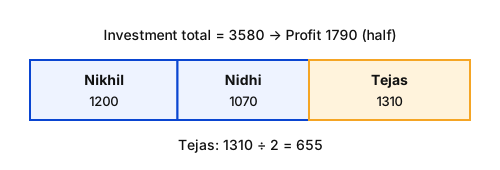
- Total investment .
- Profit , i.e. profit is exactly half of the investment.
- Tejas's share .
Trick: Spot that profit = half of total capital, so each share = half of own capital.
Answer: (D) ₹655
अवधारणा: समान अवधि के निवेश में लाभ निवेश के अनुपात में बँटता है।
- कुल निवेश ।
- लाभ , अर्थात लाभ कुल निवेश का ठीक आधा है।
- तेजस का हिस्सा ।
ट्रिक: लाभ = कुल पूँजी का आधा, तो हर हिस्सा = अपनी पूँजी का आधा।
उत्तर: (D) ₹655
RRB NTPC Undergraduate CBT 1MathematicsPartnershipRRB NTPC Undergraduate CBT 1 2024 · 1 Sep Shift 3
Q1542.If , then the value of is:
यदि है, तो का मान है:
- A
- B
- C
- D
Show answer
Concept: Use and .
- .
- .
- , so the value is .
Trick: Put : , value ; only matches.
Answer: (D)
अवधारणा: और का प्रयोग करें।
- ।
- ।
- , अतः मान ।
ट्रिक: रखें: , मान ; केवल मिलता है।
उत्तर: (D)
RRB NTPC Undergraduate CBT 1MathematicsTrigonometric identitiesRRB NTPC Undergraduate CBT 1 2024 · 1 Sep Shift 3
Q1543.A sum of money triples itself at a certain rate of compound interest in 17 years. In how many years will it amount to 81 times of itself?
कोई धनराशि चक्रवृद्धि ब्याज की एक निश्चित दर पर 17 वर्षों में स्वयं की तीन गुनी हो जाती है। कितने वर्षों में यह स्वयं की 81 गुनी हो जाएगी?
- A68 years68 वर्ष
- B59 years59 वर्ष
- C58 years58 वर्ष
- D64 years64 वर्ष
Show answer
Concept: Under compound interest, if a sum becomes times in years, it becomes times in years.
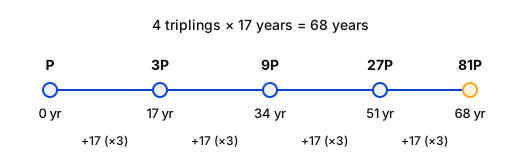
- 3 times in 17 years.
- , so the sum must triple 4 times.
- Time years.
Trick: Write the target as a power of the base multiple: .
Answer: (A) 68 years
अवधारणा: चक्रवृद्धि ब्याज में यदि राशि वर्ष में गुना होती है, तो वर्ष में गुना होती है।
- 17 वर्ष में 3 गुना।
- , अतः राशि को 4 बार तिगुना होना है।
- समय वर्ष।
ट्रिक: लक्ष्य को घात में लिखें: ।
उत्तर: (A) 68 वर्ष
RRB NTPC Undergraduate CBT 1MathematicsCompound interest – multiplesRRB NTPC Undergraduate CBT 1 2024 · 1 Sep Shift 3
Q1544.The value of is
का मान है
- A38
- B50
- C51
- D44
Show answer
Concept: Evaluate powers and roots first, then add/subtract (BODMAS).
- , , .
- .
Trick: for positive – no need to square and root again.
Answer: (D) 44
अवधारणा: पहले घात और मूल निकालें, फिर जोड़-घटाव करें (BODMAS)।
- , , ।
- ।
ट्रिक: धनात्मक के लिए ।
उत्तर: (D) 44
RRB NTPC Undergraduate CBT 1MathematicsSimplification – squares and rootsRRB NTPC Undergraduate CBT 1 2024 · 1 Sep Shift 3
Q1545.A shopkeeper offers the following discount scheme to his customers for the purchase of articles in his shop.
'Buy 20 and get 5 free'
Find the discount percentage offered.
एक दुकानदार अपनी दुकान में वस्तुओं की खरीद पर अपने ग्राहकों को निम्नलिखित छूट योजना प्रदान करता है।
'20 खरीदें और 5 मुफ़्त पाएँ'
प्रदान की गई छूट प्रतिशत ज्ञात कीजिए।
- A25%
- B30%
- C20%
- D32%
Show answer
Concept: In 'Buy get free', the customer pays for but receives articles.
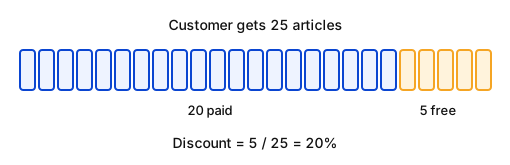
- Articles received ; articles free .
- .
Trick: – not (that gives the tempting 25%).
Answer: (C) 20%
अवधारणा: 'x खरीदें, y मुफ़्त' में ग्राहक का भुगतान करता है पर वस्तुएँ पाता है।
- प्राप्त वस्तुएँ ; मुफ़्त ।
- ।
ट्रिक: – नहीं (उससे भ्रामक 25% आता है)।
उत्तर: (C) 20%
RRB NTPC Undergraduate CBT 1MathematicsDiscount – buy x get y freeRRB NTPC Undergraduate CBT 1 2024 · 1 Sep Shift 3
Q1546.Find the value of x satisfying: 5(5x2 − 5) − 5(5x2 + 7x − 2) = 14
निम्नलिखित को संतुष्ट करने वाला x का मान ज्ञात कीजिए: 5(5x2 − 5) − 5(5x2 + 7x − 2) = 14
- A
- B
- C
- D
Show answer
Concept: Expand the brackets; the terms cancel, leaving a linear equation.
- and .
- Difference: .
- .
Trick: Take 5 common: .
Answer: (A)
अवधारणा: कोष्ठक खोलें; वाले पद कट जाते हैं और रैखिक समीकरण बचता है।
- तथा ।
- अंतर: ।
- ।
ट्रिक: 5 उभयनिष्ठ लें: ।
उत्तर: (A)
RRB NTPC Undergraduate CBT 1MathematicsLinear equationsRRB NTPC Undergraduate CBT 1 2024 · 1 Sep Shift 3
Q1547.The LCM of the numbers 2.8 and 0.217 is:
संख्याओं 2.8 और 0.217 का LCM (लघुत्तम समापवर्त्य) है:
- A0.868
- B8.68
- C868
- D86.8
Show answer
Concept: Make decimal places equal, find the LCM of the whole numbers, then put the decimal back.
- , .
- , .
- .
- LCM .
Trick: The LCM must be a multiple of 2.8: , and ✓.
Answer: (D) 86.8
अवधारणा: दशमलव स्थान बराबर करें, पूर्ण संख्याओं का LCM निकालें, फिर दशमलव वापस लगाएँ।
- , ।
- , ।
- ।
- LCM ।
ट्रिक: LCM, 2.8 का गुणज होगा: , तथा ✓।
उत्तर: (D) 86.8
RRB NTPC Undergraduate CBT 1MathematicsLCM of decimalsRRB NTPC Undergraduate CBT 1 2024 · 1 Sep Shift 3
Q1548.If 4 times a son's age is added to his father's age, the sum is 100 years. If 2.5 times the father's age is added to the son's age, the sum is 97 years. What is the father's age (in years)?
यदि पुत्र की आयु के 4 गुने को उसके पिता की आयु में जोड़ा जाए, तो योगफल 100 वर्ष होता है। यदि पिता की आयु के 2.5 गुने को पुत्र की आयु में जोड़ा जाए, तो योगफल 97 वर्ष होता है। पिता की आयु (वर्षों में) कितनी है?
- A31
- B32
- C36
- D30
Show answer
Concept: Form two linear equations with son's age and father's age .
- … (i); … (ii).
- From (ii): . Put in (i): .
- (and ).
Trick: Check options in (i): ; then ✓.
Answer: (B) 32
अवधारणा: पुत्र की आयु और पिता की आयु लेकर दो रैखिक समीकरण बनाएँ।
- … (i); … (ii)।
- (ii) से ; (i) में रखने पर ।
- (तथा )।
ट्रिक: विकल्प जाँचें: ; फिर ✓।
उत्तर: (B) 32
RRB NTPC Undergraduate CBT 1MathematicsProblems on agesRRB NTPC Undergraduate CBT 1 2024 · 1 Sep Shift 3
Q1549.4 men can complete a piece of work in 12 days, while 8 women can do it in 15 days. In how many days can 3 women and 2 men complete this work?
4 पुरुष किसी कार्य को 12 दिनों में पूरा कर सकते हैं, जबकि 8 महिलाएँ उसे 15 दिनों में पूरा कर सकती हैं। 3 महिलाएँ और 2 पुरुष मिलकर इस कार्य को कितने दिनों में पूरा कर सकते हैं?
- A19 days19 दिन
- B15 days15 दिन
- C11 days11 दिन
- D14 days14 दिन
Show answer
Concept: Convert everyone into one type of worker using total work (man-days = woman-days).
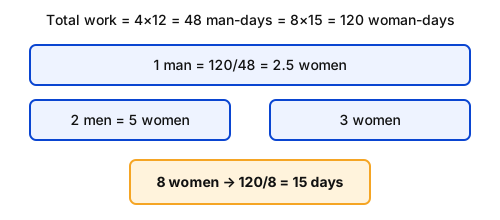
- Work man-days woman-days.
- So women; women.
- men women women; time days.
Trick: Equate 48 M = 120 W → M : W efficiency = 5 : 2.
Answer: (B) 15 days
अवधारणा: कुल कार्य (पुरुष-दिवस = महिला-दिवस) से सबको एक प्रकार के श्रमिक में बदलें।
- कार्य पुरुष-दिवस महिला-दिवस।
- अतः महिलाएँ; 2 पुरुष = 5 महिलाएँ।
- 2 पुरुष + 3 महिलाएँ = 8 महिलाएँ; समय दिन।
ट्रिक: 48 M = 120 W → पुरुष : महिला क्षमता = 5 : 2।
उत्तर: (B) 15 दिन
RRB NTPC Undergraduate CBT 1MathematicsTime and work – men and womenRRB NTPC Undergraduate CBT 1 2024 · 1 Sep Shift 3
Q1550.Find the number of sides of a regular polygon, each of whose interior angles measures 162°.
उस सम बहुभुज की भुजाओं की संख्या ज्ञात कीजिए, जिसका प्रत्येक आंतरिक कोण 162° का है।
- A18
- B16
- C20
- D22
Show answer
Concept: For a regular polygon, exterior angle and interior + exterior .
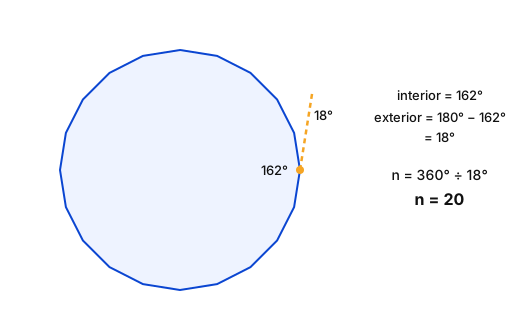
- Exterior angle .
- .
Trick: Always go via the exterior angle – it gives in one division.
Answer: (C) 20
अवधारणा: सम बहुभुज में बाह्य कोण तथा अंतः + बाह्य ।
- बाह्य कोण ।
- ।
ट्रिक: हमेशा बाह्य कोण से चलें – एक भाग में मिल जाता है।
उत्तर: (C) 20
RRB NTPC Undergraduate CBT 1MathematicsPolygons – anglesRRB NTPC Undergraduate CBT 1 2024 · 1 Sep Shift 3
Q1551.The income of Raman is ₹80,200. He saves 7.5% of his income. If his income increases by 34% and expenditure increases by 40%, then his savings will:
रमन की आय ₹80,200 है। वह अपनी आय का 7.5% बचाता है। यदि उसकी आय में 34% की वृद्धि होती है और व्यय में 40% की वृद्धि होती है, तो उसकी बचत:
- Aincrease by ₹2,403₹2,403 बढ़ जाएगी
- Bdecrease by ₹2,406₹2,406 घट जाएगी
- Cdecrease by ₹2,404₹2,404 घट जाएगी
- Dincrease by ₹2,404₹2,404 बढ़ जाएगी
Show answer
Concept: ; find old and new savings separately.
- Old saving ; expenditure .
- New income .
- New expenditure .
- New saving ; change .
Trick: Expenditure rose faster (40% vs 34%) on a much bigger base, so savings must fall — only the "decrease" options survive.
Answer: (B) decrease by ₹2,406
अवधारणा: ; पुरानी और नई बचत अलग-अलग निकालें।
- पुरानी बचत ; व्यय .
- नई आय .
- नया व्यय .
- नई बचत ; परिवर्तन .
ट्रिक: व्यय (40%) आय (34%) से तेज़ बढ़ा और उसका आधार भी बड़ा है, इसलिए बचत घटेगी — केवल "decrease" वाले विकल्प बचते हैं।
उत्तर: (B) ₹2,406 की कमी
RRB NTPC Undergraduate CBT 1MathematicsIncome, Expenditure & SavingsRRB NTPC Undergraduate CBT 1 2024 · 1 Sep Shift 3
Q1552.Volumes of three cubes made of solid metal are 789 cm3, 865 cm3 and 1721 cm3, respectively. After melting all the three, a solid cube was made of them. Find the length of the edge of the new cube.
ठोस धातु से बने तीन घनों के आयतन क्रमशः 789 cm3, 865 cm3 और 1721 cm3 हैं। तीनों को पिघलाकर उनसे एक ठोस घन बनाया गया। नए घन के किनारे की लंबाई ज्ञात कीजिए।
- A15 cm
- B25 cm
- C12 cm
- D14 cm
Show answer
Concept: On melting and recasting, total volume stays the same. Volume of cube .
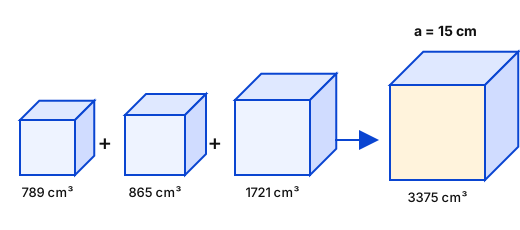
- Total volume .
- .
Trick: Cubes to remember: , , .
Answer: (A) 15 cm
अवधारणा: पिघलाकर नया ठोस बनाने पर कुल आयतन (volume) वही रहता है। घन का आयतन .
- कुल आयतन .
- .
ट्रिक: याद रखें: , , .
उत्तर: (A) 15 cm
RRB NTPC Undergraduate CBT 1MathematicsMensuration – Cube (Melting)RRB NTPC Undergraduate CBT 1 2024 · 1 Sep Shift 3
Q1553.Given that 810.65 = x, 810.26= y and xz = y7, then the value of z is close to:
दिया गया है कि 810.65 = x, 810.26= y और xz = y7 है, तो z का मान लगभग कितना है:
- A2.8
- B4.09
- C4.27
- D1.32
Show answer
Concept: Write both and as powers of the same base 81 and compare exponents.
- and .
- Equal bases ⇒ .
- .
Trick: — once bases match, just equate exponents.
Answer: (A) 2.8
अवधारणा: और को एक ही आधार 81 की घात में लिखकर घातांकों की तुलना करें।
- तथा .
- आधार बराबर ⇒ .
- .
ट्रिक: — आधार समान होते ही घातें बराबर कर दें।
उत्तर: (A) 2.8
RRB NTPC Undergraduate CBT 1MathematicsIndices / ExponentsRRB NTPC Undergraduate CBT 1 2024 · 1 Sep Shift 3
Q1554.A tradesman marks his goods at such a price that after allowing a discount of 30%, he still makes a profit of 10%. What is the marked price of an article (in ₹) whose cost price is ₹1,540?
एक व्यापारी अपने माल पर ऐसा मूल्य अंकित करता है कि 30% की छूट देने के बाद भी उसे 10% का लाभ होता है। उस वस्तु का अंकित मूल्य (₹ में) क्या है, जिसका क्रय मूल्य ₹1,540 है?
- A2,240
- B2,420
- C2,440
- D2,204
Show answer
Concept: .
- SP .
- MP .
Trick: , so MP .
Answer: (B) ₹2,420
अवधारणा: .
- विक्रय मूल्य .
- अंकित मूल्य .
ट्रिक: , अतः MP .
उत्तर: (B) ₹2,420
RRB NTPC Undergraduate CBT 1MathematicsDiscount and ProfitRRB NTPC Undergraduate CBT 1 2024 · 1 Sep Shift 3
Q1555.A man driving a car at a speed of 48 km/hr crosses a bridge in 3.8 minutes. Find the length of the bridge.
48 km/hr की चाल से कार चला रहा एक व्यक्ति 3.8 मिनट में एक पुल पार करता है। पुल की लंबाई ज्ञात कीजिए।
- A2.36 km
- B3.04 km
- C2.54 km
- D2.46 km
Show answer
Concept: (car length negligible, so distance = bridge length).
- Time .
- Length .
Trick: per minute — multiply by the minutes directly.
Answer: (B) 3.04 km
अवधारणा: (कार की लंबाई नगण्य, अतः दूरी = पुल की लंबाई)।
- समय .
- लंबाई .
ट्रिक: यानी हर मिनट — सीधे मिनटों से गुणा करें।
उत्तर: (B) 3.04 km
RRB NTPC Undergraduate CBT 1MathematicsSpeed, Distance and TimeRRB NTPC Undergraduate CBT 1 2024 · 1 Sep Shift 3
Q1556.I bought two shirts for ₹1,200. I sold the first one at a loss of 8% and the second at a gain of 24%. If, on the whole I made neither a loss nor a gain, find the cost price (in ₹) of the first shirt.
मैंने दो कमीज़ें ₹1,200 में खरीदीं। मैंने पहली कमीज़ 8% की हानि पर और दूसरी 24% के लाभ पर बेची। यदि कुल मिलाकर मुझे न तो हानि हुई और न ही लाभ, तो पहली कमीज़ का क्रय मूल्य (₹ में) ज्ञात कीजिए।
- A924
- B884
- C900
- D920
Show answer
Concept: No overall profit/loss ⇒ loss on first shirt = gain on second shirt (in ₹).
- Let first shirt cost , second .
- .
- .
Trick: Loss% : Gain% , so costs are in ratio ⇒ first .
Answer: (C) 900
अवधारणा: कुल न लाभ न हानि ⇒ पहली कमीज़ की हानि = दूसरी कमीज़ का लाभ (₹ में)।
- पहली का क्रय मूल्य , दूसरी का .
- .
- .
ट्रिक: हानि% : लाभ% , अतः क्रय मूल्य ⇒ पहली .
उत्तर: (C) 900
RRB NTPC Undergraduate CBT 1MathematicsProfit and LossRRB NTPC Undergraduate CBT 1 2024 · 1 Sep Shift 3
Q1557.Find the volume of a sphere with diameter 12 cm.
12 cm व्यास वाले एक गोले का आयतन ज्ञात कीजिए।
- A
- B
- C
- D
Show answer
Concept: Volume of sphere , with .
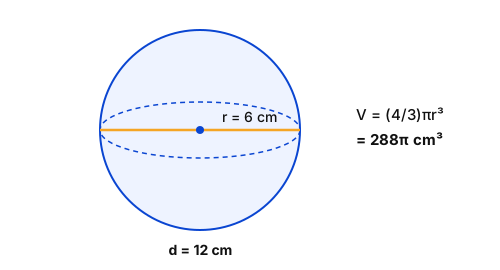
- .
- .
Trick: Do not use in place of — that gives times the volume ().
Answer: (B)
अवधारणा: गोले का आयतन , जहाँ .
- .
- .
ट्रिक: व्यास (diameter) को त्रिज्या मत मानें — वरना आयतन 8 गुना () आ जाएगा।
उत्तर: (B)
RRB NTPC Undergraduate CBT 1MathematicsMensuration – SphereRRB NTPC Undergraduate CBT 1 2024 · 1 Sep Shift 3
Q1558.The selling price of 20 books is equal to the cost price of 36 books. Find the loss or gain percentage.
20 पुस्तकों का विक्रय मूल्य 36 पुस्तकों के क्रय मूल्य के बराबर है। हानि या लाभ प्रतिशत ज्ञात कीजिए।
- A loss हानि
- B80% loss80% हानि
- C80% gain80% लाभ
- D gain लाभ
Show answer
Concept: If SP of articles = CP of articles, then .
- Let CP of 1 book = ₹1 ⇒ SP of 20 books = ₹36, CP of 20 books = ₹20.
- Gain ; gain% .
Trick: Divide by the number on the SP side (20), not the CP side (36).
Answer: (C) 80% gain
अवधारणा: यदि वस्तुओं का विक्रय मूल्य = वस्तुओं का क्रय मूल्य, तो .
- 1 किताब का क्रय मूल्य = ₹1 ⇒ 20 किताबों का विक्रय मूल्य = ₹36, क्रय मूल्य = ₹20.
- लाभ ; लाभ% .
ट्रिक: हमेशा विक्रय मूल्य वाली संख्या (20) से भाग दें, 36 से नहीं।
उत्तर: (C) 80% लाभ
RRB NTPC Undergraduate CBT 1MathematicsProfit and LossRRB NTPC Undergraduate CBT 1 2024 · 1 Sep Shift 3
Q1559.The sum of two numbers is 44 and their L.C.M. is 459. What are the two numbers?
दो संख्याओं का योग 44 है और उनका L.C.M. (लघुत्तम समापवर्त्य) 459 है। वे दो संख्याएँ कौन-सी हैं?
- A20, 24
- B25, 19
- C27, 17
- D32, 12
Show answer
Concept: Check options: sum must be 44 and LCM must be 459.
- and 27, 17 are co-prime, so LCM.
- ✓.
- Others fail: e.g. LCM, LCM.
Trick: Factorise the LCM: — the split adding to 44 jumps out.
Answer: (C) 27, 17
अवधारणा: विकल्प जाँचें: योग 44 और LCM 459 होना चाहिए।
- तथा 27, 17 सह-अभाज्य (co-prime) हैं, अतः LCM.
- ✓.
- बाकी गलत: जैसे LCM, LCM.
ट्रिक: LCM के गुणनखंड करें: — 27 और 17 का योग 44 तुरंत दिखता है।
उत्तर: (C) 27, 17
RRB NTPC Undergraduate CBT 1MathematicsLCM and HCFRRB NTPC Undergraduate CBT 1 2024 · 1 Sep Shift 3
Q1560.The average of first 147 odd natural numbers, is:
प्रथम 147 विषम प्राकृत संख्याओं का औसत है:
- A146.5
- B147
- C148
- D147.5
Show answer
Concept: Sum of first odd natural numbers , so their average .
- Here .
- Average .
Yaad rakhein: Average of first odd numbers ; of first even numbers .
Answer: (B) 147
अवधारणा: पहली विषम प्राकृत संख्याओं का योग , अतः औसत .
- यहाँ .
- औसत .
याद रखें: पहली विषम संख्याओं का औसत ; पहली सम संख्याओं का .
उत्तर: (B) 147
RRB NTPC Undergraduate CBT 1MathematicsAverageRRB NTPC Undergraduate CBT 1 2024 · 1 Sep Shift 3

