Q1941.A can do a work in 12 days and B can do the same work in 25 days. If they work on it together for 6 days, then what fraction of the work is left?
A किसी कार्य को 12 दिनों में और B उसी कार्य को 25 दिनों में कर सकता है। यदि वे 6 दिनों तक एक साथ कार्य करते हैं, तो कार्य का कितना भाग शेष रह जाता है?
- A
- B
- C
- D
Show answer
Concept: Take total work = LCM of the days; one-day work = total ÷ days.
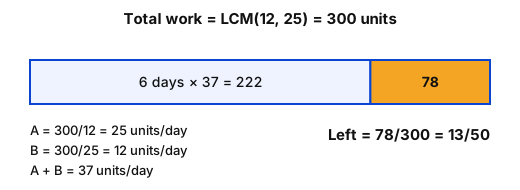
- Total work units; A , B units/day.
- Together units/day; in 6 days units.
- Left units .
Trick: Fraction done , so left .
Answer: (C)
अवधारणा: कुल कार्य = दिनों का LCM लें; एक दिन का कार्य = कुल ÷ दिन।
- कुल कार्य इकाई; A , B इकाई/दिन।
- दोनों मिलकर इकाई/दिन; 6 दिन में इकाई।
- शेष इकाई ।
ट्रिक: किया गया भाग , शेष ।
उत्तर: (C)
RRB NTPC Undergraduate CBT 1MathematicsTime and workRRB NTPC Undergraduate CBT 1 2024 · 29 Aug Shift 2
Q1942.Evaluate: (-9) - (-60) ÷ (-10) + (-3) × 9
मान ज्ञात कीजिए: (-9) - (-60) ÷ (-10) + (-3) × 9
- A-42
- B-44
- C-45
- D-41
Show answer
Concept: Follow BODMAS: division and multiplication before addition and subtraction; take care of signs.
- and .
- Expression .
- .
Trick: Minus a positive or plus a negative both move left on the number line: .
Answer: (A)
अवधारणा: BODMAS का पालन करें: पहले भाग और गुणा, फिर जोड़ और घटाना; चिह्नों का ध्यान रखें।
- और ।
- व्यंजक ।
- ।
ट्रिक: धनात्मक घटाना या ऋणात्मक जोड़ना – दोनों संख्या रेखा पर बाएँ: ।
उत्तर: (A)
RRB NTPC Undergraduate CBT 1MathematicsBODMAS with integersRRB NTPC Undergraduate CBT 1 2024 · 29 Aug Shift 2
Q1943.The HCF and the LCM of two numbers are 18 and 216, respectively. If one of the numbers is 72, find the other one.
दो संख्याओं का महत्तम समापवर्तक (HCF) और लघुत्तम समापवर्त्य (LCM) क्रमशः 18 और 216 हैं। यदि उनमें से एक संख्या 72 है, तो दूसरी संख्या ज्ञात कीजिए।
- A25
- B10
- C54
- D5
Show answer
Concept: For two numbers: .
- .
- .
- Check: , ✓.
Trick: , so .
Answer: (C)
अवधारणा: दो संख्याओं के लिए: ।
- ।
- ।
- जाँच: , ✓।
ट्रिक: , अतः ।
उत्तर: (C)
RRB NTPC Undergraduate CBT 1MathematicsHCF and LCMRRB NTPC Undergraduate CBT 1 2024 · 29 Aug Shift 2
Q1944.If the 6-digit number N36M77 is divisible by 11, then which of the options below can give a possible correct relation between M and N?
यदि 6-अंकीय संख्या N36M77, 11 से विभाज्य है, तो नीचे दिए गए विकल्पों में से कौन-सा M और N के बीच संभावित सही संबंध दर्शा सकता है?
- AM + N = -3
- BM - N = 3
- CM - N = 1
- DM = N
Show answer
Concept: A number is divisible by 11 if (sum of digits at odd places) − (sum of digits at even places) is or a multiple of 11.
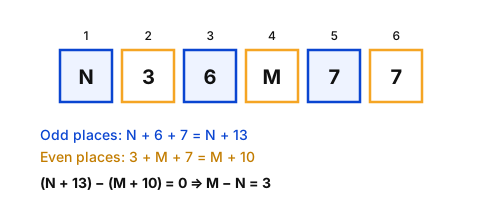
- Digits N, 3, 6, M, 7, 7: odd places ; even places .
- Difference .
- For : (e.g. gives 136477 ).
Trick: Alternate sum or ; digits are 0–9, so is the workable case here.
Answer: (B)
अवधारणा: कोई संख्या 11 से विभाज्य है यदि (विषम स्थानों के अंकों का योग) − (सम स्थानों के अंकों का योग) या 11 का गुणज हो।
- अंक N, 3, 6, M, 7, 7: विषम स्थान ; सम स्थान ।
- अंतर ।
- से (जैसे : 136477 )।
ट्रिक: एकांतर योग या ; अंक 0–9 हैं, अतः यहाँ उपयुक्त है।
उत्तर: (B)
RRB NTPC Undergraduate CBT 1MathematicsDivisibility by 11RRB NTPC Undergraduate CBT 1 2024 · 29 Aug Shift 2
Q1945.The product of two positive numbers is 245. If the first number is five times the second number, then the sum of the two numbers is:
दो धनात्मक संख्याओं का गुणनफल 245 है। यदि पहली संख्या दूसरी संख्या की पाँच गुनी है, तो दोनों संख्याओं का योग है:
- A38
- B51
- C40
- D42
Show answer
Concept: Let the second number be ; then the first is .
- .
- First number , second .
- Sum .
Trick: Sum ; gives directly, so sum .
Answer: (D)
अवधारणा: माना दूसरी संख्या है; तो पहली है।
- ।
- पहली संख्या , दूसरी ।
- योग ।
ट्रिक: योग ; से सीधे , योग ।
उत्तर: (D)
RRB NTPC Undergraduate CBT 1MathematicsNumbers – product and ratioRRB NTPC Undergraduate CBT 1 2024 · 29 Aug Shift 2
Q1946.Train A leaves station M at 8:35 AM and reaches station N at 3:35 PM on the same day. Train B leaves station N at 10:35 AM and reaches station M at 3:35 PM on the same day. Find the time when trains A and B meet.
ट्रेन A स्टेशन M से 8:35 AM पर चलती है और उसी दिन 3:35 PM पर स्टेशन N पर पहुँचती है। ट्रेन B स्टेशन N से 10:35 AM पर चलती है और उसी दिन 3:35 PM पर स्टेशन M पर पहुँचती है। वह समय ज्ञात कीजिए जब ट्रेन A और B एक-दूसरे से मिलती हैं।
- A11:50 AM
- B12:40 PM
- C12:10 PM
- D12:50 PM
Show answer
Concept: Take the distance MN as the LCM of the journey times; then the trains close the gap at the sum of their speeds.
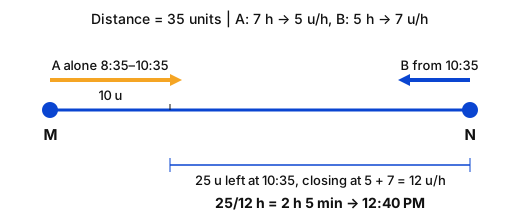
- A: 8:35 AM to 3:35 PM ; B: 10:35 AM to 3:35 PM . Let MN units: A , B units/h.
- By 10:35 A has run : units; gap units.
- Relative speed units/h; time .
- Meeting time 10:35 + 2 h 5 min 12:40 PM.
Trick: Always start both trains at the same clock time: move the early one ahead first.
Answer: (B) 12:40 PM
अवधारणा: दूरी MN को यात्रा-समयों का LCM मानें; फिर दोनों रेलगाड़ियाँ चालों के योग से अंतर घटाती हैं।
- A: 8:35 AM से 3:35 PM ; B: 10:35 AM से 3:35 PM । MN इकाई: A , B इकाई/घंटा।
- 10:35 तक A चली: इकाई; शेष दूरी इकाई।
- सापेक्ष चाल इकाई/घंटा; समय ।
- मिलने का समय 10:35 + 2 घंटे 5 मिनट 12:40 PM।
ट्रिक: पहले जल्दी चली गाड़ी को आगे बढ़ाएँ, फिर दोनों को एक ही समय से चलाएँ।
उत्तर: (B) 12:40 PM
RRB NTPC Undergraduate CBT 1MathematicsTrains – meeting timeRRB NTPC Undergraduate CBT 1 2024 · 29 Aug Shift 2
Q1947.If the third proportional of 8 and 16 be x, then what is the value of x?
यदि 8 और 16 का तृतीयानुपाती x हो, तो x का मान क्या है?
- A31
- B34
- C32
- D35
Show answer
Concept: If , then is the third proportional of and : .
- .
- .
Trick: Third proportional continues the ratio: (each ×2).
Answer: (C)
अवधारणा: यदि हो, तो , और का तृतीयानुपाती है: ।
- ।
- ।
ट्रिक: तृतीयानुपाती अनुपात को आगे बढ़ाता है: (हर बार ×2)।
उत्तर: (C)
RRB NTPC Undergraduate CBT 1MathematicsThird proportionalRRB NTPC Undergraduate CBT 1 2024 · 29 Aug Shift 2
Q1948.A bus travelling at 10 km/hr completes a journey in 16 hours. At what speed will it have to cover the same distance in 8 hours?
10 km/hr की चाल से चलने वाली एक बस एक यात्रा 16 घंटे में पूरी करती है। समान दूरी 8 घंटे में तय करने के लिए उसे किस चाल से चलना होगा?
- A14 km/hr
- B10 km/hr
- C20 km/hr
- D25 km/hr
Show answer
Concept: ; for a fixed distance, speed is inversely proportional to time.
- Distance .
- Required speed .
Trick: Time halves (16 → 8 h) ⇒ speed doubles: .
Answer: (C)
अवधारणा: ; दूरी स्थिर हो तो चाल समय के व्युत्क्रमानुपाती है।
- दूरी ।
- आवश्यक चाल ।
ट्रिक: समय आधा (16 → 8 घंटे) ⇒ चाल दोगुनी: ।
उत्तर: (C)
RRB NTPC Undergraduate CBT 1MathematicsSpeed, time and distanceRRB NTPC Undergraduate CBT 1 2024 · 29 Aug Shift 2
Q1949.Praveen and Hemant start a business. Praveen invests ₹78,000 more than Hemant for 5 months and Hemant invests for 6 months. Praveen's share is ₹1,360 more than that of Hemant, out of a total profit of ₹5,440. Find the capital contributed by Praveen.
प्रवीण और हेमंत एक व्यवसाय शुरू करते हैं। प्रवीण, हेमंत से ₹78,000 अधिक 5 महीने के लिए निवेश करता है और हेमंत 6 महीने के लिए निवेश करता है। ₹5,440 के कुल लाभ में से प्रवीण का हिस्सा हेमंत के हिस्से से ₹1,360 अधिक है। प्रवीण द्वारा लगाई गई पूँजी ज्ञात कीजिए।
- A₹1,56,000
- B₹1,55,955
- C₹1,55,875
- D₹1,56,185
Show answer
Concept: Profit is shared in the ratio of .
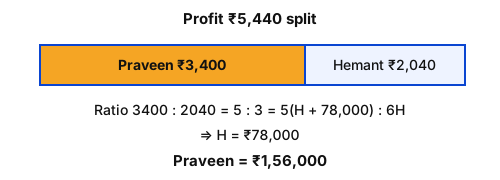
- Praveen's share ; Hemant's . Ratio .
- Let Hemant's capital : .
- .
- Praveen's capital ₹1,56,000.
Trick: Check option: ₹1,56,000 × 5 : ₹78,000 × 6 ✓.
Answer: (A) ₹1,56,000
अवधारणा: लाभ के अनुपात में बँटता है।
- प्रवीण का हिस्सा ; हेमंत का । अनुपात ।
- माना हेमंत की पूँजी : ।
- ।
- प्रवीण की पूँजी ₹1,56,000।
ट्रिक: विकल्प जाँचें: ₹1,56,000 × 5 : ₹78,000 × 6 ✓।
उत्तर: (A) ₹1,56,000
RRB NTPC Undergraduate CBT 1MathematicsPartnershipRRB NTPC Undergraduate CBT 1 2024 · 29 Aug Shift 2
Q1950.Sapna invested ₹22,800 on simple interest, partly at 5% per annum and partly at 11% per annum. If she earns equal interests from the two investments after 4 years, then find the sum invested at 5% per annum (in ₹).
सपना ने ₹22,800 साधारण ब्याज पर निवेश किए, कुछ भाग 5% वार्षिक दर पर और कुछ भाग 11% वार्षिक दर पर। यदि 4 वर्ष बाद उसे दोनों निवेशों से समान ब्याज प्राप्त होता है, तो 5% वार्षिक दर पर निवेश की गई राशि (₹ में) ज्ञात कीजिए।
- A15,676
- B15,675
- C15,678
- D15,677
Show answer
Concept: With the same time, equal SI means , so principals are in the inverse ratio of rates.
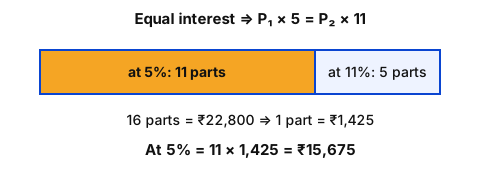
- .
- 16 parts 1 part .
- Sum at 5% .
Trick: Principal at lower rate gets the larger share: rates ⇒ sums .
Answer: (B) 15,675
अवधारणा: समय समान हो तो समान साधारण ब्याज का अर्थ , अतः मूलधन दरों के व्युत्क्रम अनुपात में होंगे।
- ।
- 16 भाग 1 भाग ।
- 5% पर राशि ।
ट्रिक: कम दर पर अधिक राशि: दरें ⇒ राशियाँ ।
उत्तर: (B) 15,675
RRB NTPC Undergraduate CBT 1MathematicsSimple interest – equal interestRRB NTPC Undergraduate CBT 1 2024 · 29 Aug Shift 2
Q1951.Simplify:
सरल कीजिए:
- A
- B
- C
- D
Show answer
Concept: Write everything in and ; use and .
- First term
- Total
Trick: Put : expression , and only .
Answer: (A)
अवधारणा: सब कुछ और में लिखें; और का प्रयोग करें।
- पहला पद
- कुल
ट्रिक: रखें: मान आता है, जो केवल से मिलता है।
उत्तर: (A)
RRB NTPC Undergraduate CBT 1MathematicsTrigonometric simplificationRRB NTPC Undergraduate CBT 1 2024 · 29 Aug Shift 2
Q1952.The value of is
का मान है
- A
- B
- C
- D
Show answer
Concept: Solve the inner bracket first (BODMAS), then add/subtract with a common denominator.
- , so
Trick: Group the like fractions first: is instantly .
Answer: (C)
अवधारणा: पहले भीतरी कोष्ठक हल करें (BODMAS), फिर समान हर लेकर जोड़ें/घटाएँ।
- , अतः
ट्रिक: समान हर वाली भिन्नें पहले मिलाएँ: ।
उत्तर: (C)
RRB NTPC Undergraduate CBT 1MathematicsSimplification of fractionsRRB NTPC Undergraduate CBT 1 2024 · 29 Aug Shift 2
Q1953.The average of first 159 even numbers is
प्रथम 159 सम संख्याओं का औसत है
- A161
- B160.5
- C159.5
- D160
Show answer
Concept: Sum of first even numbers , so their average .
- Here
- Average
Yaad rakhein: Average of first even numbers ; of first odd numbers .
Answer: (D)
अवधारणा: प्रथम सम संख्याओं का योग , अतः औसत ।
- यहाँ
- औसत
याद रखें: प्रथम सम संख्याओं का औसत ; प्रथम विषम संख्याओं का औसत ।
उत्तर: (D)
RRB NTPC Undergraduate CBT 1MathematicsAverage of even numbersRRB NTPC Undergraduate CBT 1 2024 · 29 Aug Shift 2
Q1954.Given that 1120.57 = x, 1120.8= y and xz = y6, then the value of z is close to:
दिया गया है कि 1120.57 = x, 1120.8= y और xz = y6 है, तो z का मान लगभग है:
- A10.14
- B9.12
- C8.45
- D8.42
Show answer
Concept: ; equal bases ⇒ equal powers.
Trick: Just compare exponents: .
Answer: (D)
अवधारणा: ; आधार समान हों तो घातें बराबर।
ट्रिक: सीधे घातें मिलाएँ: ।
उत्तर: (D)
RRB NTPC Undergraduate CBT 1MathematicsLaws of exponentsRRB NTPC Undergraduate CBT 1 2024 · 29 Aug Shift 2
Q1955.Find the effective discount for the scheme – Buy 12, get 8 free.
योजना – 12 खरीदें, 8 मुफ़्त पाएँ – के लिए प्रभावी छूट ज्ञात कीजिए।
- A10%
- B21%
- C40%
- D20%
Show answer
Concept: In "Buy get free", you pay for but receive items. .
- Items received ; items paid for
- Free items
- Discount
Trick: Divide free items by TOTAL items (not by bought items): , not .
Answer: (C)
अवधारणा: " खरीदें मुफ़्त" में भुगतान का होता है पर वस्तुएँ मिलती हैं। ।
- मिली वस्तुएँ ; भुगतान का
- मुफ़्त वस्तुएँ
- छूट
ट्रिक: मुफ़्त वस्तुओं को कुल वस्तुओं से भाग दें: , न कि ।
उत्तर: (C)
RRB NTPC Undergraduate CBT 1MathematicsEffective discount (Buy-Get offer)RRB NTPC Undergraduate CBT 1 2024 · 29 Aug Shift 2
Q1956.Pipe P can fill part of a tank in 30 hours, and pipe Q can fill part of the same tank in 16 hours. Both P and Q were kept open for 4 hours, then both were closed. Pipe R alone was then opened and it emptied the water in the tank in 8 hours. Pipes P, Q and R together can fill the empty tank in:
पाइप P किसी टंकी के भाग को 30 घंटे में भर सकता है, और पाइप Q उसी टंकी के भाग को 16 घंटे में भर सकता है। P और Q दोनों को 4 घंटे तक खुला रखा गया, फिर दोनों को बंद कर दिया गया। इसके बाद केवल पाइप R को खोला गया और उसने टंकी का पानी 8 घंटे में खाली कर दिया। पाइप P, Q और R एक साथ मिलकर खाली टंकी को कितने समय में भर सकते हैं?
- A35 hours35 घंटे
- B40 hours40 घंटे
- C21 hours21 घंटे
- D32 hours32 घंटे
Show answer
Concept: Find each pipe’s full-tank time, then add rates (filling , emptying ).
- P: tank in h ⇒ full tank in h; Q: in h ⇒ h
- In h, P and Q fill tank
- R empties tank in h ⇒ full tank in h
- Together: ⇒ h
Trick: Take LCM as tank capacity: P , Q , R units/h; net ⇒ h.
Answer: (D) hours
अवधारणा: हर पाइप का पूरी टंकी भरने/खाली करने का समय निकालें, फिर दरें जोड़ें (भरना , खाली करना )।
- P: टंकी घंटे में ⇒ पूरी घंटे; Q: टंकी घंटे में ⇒ पूरी घंटे
- घंटे में P और Q भरते हैं टंकी
- R टंकी घंटे में खाली करता है ⇒ पूरी घंटे
- तीनों साथ: ⇒ घंटे
ट्रिक: क्षमता इकाई लें: P , Q , R ; शुद्ध इकाई/घंटा ⇒ घंटे।
उत्तर: (D) घंटे
RRB NTPC Undergraduate CBT 1MathematicsPipes and cisternsRRB NTPC Undergraduate CBT 1 2024 · 29 Aug Shift 2
Q1957.If 4 times a son's age is added to his father's age, the sum is 46 years. If 2.8 times the father's age is added to the son's age, the sum is 88 years. What is the father's age (in years)?
यदि पुत्र की आयु के 4 गुने को उसके पिता की आयु में जोड़ा जाए, तो योग 46 वर्ष होता है। यदि पिता की आयु के 2.8 गुने को पुत्र की आयु में जोड़ा जाए, तो योग 88 वर्ष होता है। पिता की आयु (वर्षों में) क्या है?
- A35
- B25
- C28
- D30
Show answer
Concept: Let son , father and form two equations.
- ⇒
- ⇒
- ⇒ ⇒
Trick: Check options: ⇒ , and ✓.
Answer: (D)
अवधारणा: पुत्र , पिता मानकर दो समीकरण बनाएँ।
- ⇒
- ⇒
ट्रिक: विकल्प जाँचें: ⇒ , और ✓।
उत्तर: (D)
RRB NTPC Undergraduate CBT 1MathematicsProblems on ages (linear equations)RRB NTPC Undergraduate CBT 1 2024 · 29 Aug Shift 2
Q1958.If the radius of the base of a right circular cylinder is decreased by 46% and its height is increased by 261%, then what is the percentage increase (closest integer) in its volume?
यदि किसी लंब वृत्तीय बेलन के आधार की त्रिज्या में 46% की कमी की जाए और उसकी ऊँचाई में 261% की वृद्धि की जाए, तो उसके आयतन में प्रतिशत वृद्धि (निकटतम पूर्णांक) कितनी होगी?
- A5%
- B35%
- C17%
- D19%
Show answer
Concept: , so new = old .
- factor ; factor
- New/old
- Increase
Trick: Note , so factor .
Answer: (A)
अवधारणा: , अतः नया = पुराना ।
- गुणक ; गुणक
- नया/पुराना
- वृद्धि
ट्रिक: , अतः गुणक ।
उत्तर: (A)
RRB NTPC Undergraduate CBT 1MathematicsVolume of cylinder – percentage changeRRB NTPC Undergraduate CBT 1 2024 · 29 Aug Shift 2
Q1959.Vijay got an increase of 4% in his sales amount in the first year and 25% in the second year; also with this, his current sales are ₹1,50,800, what was his sales (in ₹) two years ago?
विजय की बिक्री राशि में पहले वर्ष 4% और दूसरे वर्ष 25% की वृद्धि हुई; इसके साथ उसकी वर्तमान बिक्री ₹1,50,800 है, तो दो वर्ष पहले उसकी बिक्री (₹ में) कितनी थी?
- A₹1,20,640
- B₹96,000
- C₹1,16,000
- D₹1,45,000
Show answer
Concept: Present value original ; reverse it to get the original.
- Combined factor
- Original
Trick: Combined % ⇒ divide by .
Answer: (C) ₹1,16,000
अवधारणा: वर्तमान मान मूल ; उल्टा करके मूल निकालें।
- संयुक्त गुणक
- मूल बिक्री
ट्रिक: संयुक्त % ⇒ से भाग दें।
उत्तर: (C) ₹1,16,000
RRB NTPC Undergraduate CBT 1MathematicsSuccessive percentage increaseRRB NTPC Undergraduate CBT 1 2024 · 29 Aug Shift 2
Q1960.The marks scored by 10 students are given below.
20, 16, 16, 19, 16, 12, 19, 10, 14, 18
The mode of the given data is:
10 विद्यार्थियों द्वारा प्राप्त अंक नीचे दिए गए हैं।
20, 16, 16, 19, 16, 12, 19, 10, 14, 18
दिए गए आँकड़ों का बहुलक है:
- A19
- B12
- C16
- D20
Show answer
Concept: Mode is the value that occurs most often.
- Counts: times, times, all others once
- Highest frequency is for
Yaad rakhein: Arrange data: – the longest run is the mode.
Answer: (C)
अवधारणा: बहुलक वह मान है जो सबसे अधिक बार आता है।
- गिनती: बार, बार, बाकी एक-एक बार
- सबसे अधिक बारंबारता की
याद रखें: आँकड़े क्रम में लिखें – सबसे लंबा दोहराव ही बहुलक है।
उत्तर: (C)
RRB NTPC Undergraduate CBT 1MathematicsModeRRB NTPC Undergraduate CBT 1 2024 · 29 Aug Shift 2

