Q921.Swarna runs at a speed of 10 km/h. How long will she take to cover 200 m?
स्वर्णा 10 km/h की चाल से दौड़ती है। 200 m की दूरी तय करने में उसे कितना समय लगेगा?
- A120 seconds120 सेकंड
- B54 seconds54 सेकंड
- C90 seconds90 सेकंड
- D72 seconds72 सेकंड
Show answer
Concept: ; .
- Time s
Trick: 10 km/h = 10,000 m per 3600 s → 200 m takes s.
Answer: (D) 72 seconds
अवधारणा: ; ।
- समय सेकंड
ट्रिक: 10 किमी/घं = 3600 सेकंड में 10,000 मी → 200 मी में सेकंड।
उत्तर: (D) 72 सेकंड
RRB Technician Grade IIIMathematicsSpeed – unit conversionRRB Technician Grade III 2024 · 30 Dec Shift 3
Q922.A retailer permits a trade discount of 25%, followed by a cash discount of 8%, on an article. The net percentage of discount is:
एक खुदरा विक्रेता किसी वस्तु पर 25% की व्यापारिक छूट और उसके बाद 8% की नकद छूट देता है। छूट का निवल प्रतिशत है:
- A33%
- B34%
- C32%
- D31%
Show answer
Concept: Net discount for and .
Trick: On ₹100: after 25% → 75; 8% of 75 = 6 → pays 69; discount 31%.
Answer: (D) 31%
अवधारणा: और की शुद्ध छूट ।
ट्रिक: ₹100 पर: 25% के बाद 75; 75 का 8% = 6 → भुगतान 69; छूट 31%।
उत्तर: (D) 31%
RRB Technician Grade IIIMathematicsSuccessive discounts – net discountRRB Technician Grade III 2024 · 30 Dec Shift 3
Q923.Lavanya got married 10 years ago. Now her age is times her age at the time of marriage. Her son’s present age is one-tenth of her present age. Find her son’s present age.
लावण्या का विवाह 10 वर्ष पहले हुआ था। अब उसकी आयु, विवाह के समय की उसकी आयु की गुनी है। उसके पुत्र की वर्तमान आयु, उसकी वर्तमान आयु का दसवाँ भाग है। उसके पुत्र की वर्तमान आयु ज्ञात कीजिए।
- A6 years6 वर्ष
- B5 years5 वर्ष
- C20 years20 वर्ष
- D12 years12 वर्ष
Show answer
Concept: Form an equation linking the present age and the age at marriage.
- Age at marriage ; present
- ; present age
- Son years
Trick: The extra part equals the 10 years → .
Answer: (A) 6 years
अवधारणा: वर्तमान आयु और विवाह के समय की आयु से समीकरण बनाएँ।
- विवाह के समय आयु ; अभी
- ; वर्तमान आयु
- पुत्र वर्ष
ट्रिक: अतिरिक्त भाग ही 10 वर्ष है → ।
उत्तर: (A) 6 वर्ष
RRB Technician Grade IIIMathematicsProblems on agesRRB Technician Grade III 2024 · 30 Dec Shift 3
Q924.Two numbers are less than a third number by 30% and 37%, respectively. By what percentage is the second number less than the first?
दो संख्याएँ एक तीसरी संख्या से क्रमशः 30% और 37% कम हैं। दूसरी संख्या, पहली संख्या से कितने प्रतिशत कम है?
- A15%
- B8%
- C12%
- D10%
Show answer
Concept: Percent less , base = the number compared with (first).
- Third : first , second
- Difference
Trick: Base is the first number (70), not 100 — so not 7%.
Answer: (D) 10%
अवधारणा: कम प्रतिशत , आधार = जिससे तुलना हो (पहली संख्या)।
- तीसरी : पहली , दूसरी
- अंतर
ट्रिक: आधार पहली संख्या (70) है, 100 नहीं — इसलिए 7% नहीं।
उत्तर: (D) 10%
RRB Technician Grade IIIMathematicsPercentage – percent less thanRRB Technician Grade III 2024 · 30 Dec Shift 3
Q925.Study the following chart and answer the question that follows.
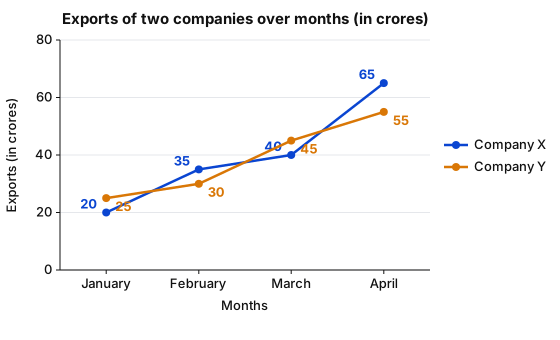
What is the absolute difference between the export by company X in February and export by company Y in April?
निम्नलिखित चार्ट का अध्ययन कीजिए और उसके बाद आने वाले प्रश्न का उत्तर दीजिए।
फरवरी में कंपनी X द्वारा किए गए निर्यात और अप्रैल में कंपनी Y द्वारा किए गए निर्यात के बीच निरपेक्ष अंतर कितना है?
- A10 crore10 करोड़
- B20 crore20 करोड़
- C5 crores5 करोड़
- D15 crore15 करोड़
Show answer
Concept: Read the data labels on the chart for each company and month.
- Company X, February crore
- Company Y, April crore
- Difference crore
Trick: Use the printed labels, not the axis height — the Y line sits above X on the scale.
Answer: (B) 20 crore
अवधारणा: चार्ट पर हर कंपनी और महीने के डेटा लेबल पढ़ें।
- कंपनी X, फरवरी करोड़
- कंपनी Y, अप्रैल करोड़
- अंतर करोड़
ट्रिक: अक्ष की ऊँचाई नहीं, छपे हुए लेबल पढ़ें — Y की रेखा पैमाने पर X के ऊपर रखी है।
उत्तर: (B) 20 करोड़
RRB Technician Grade IIIMathematicsData interpretation – line chartRRB Technician Grade III 2024 · 30 Dec Shift 3
Q926.Two pipes C and D can fill a tank in 6 hours and 9 hours, respectively. They are opened alternately for 1 hour each, starting with C first. In what duration, will the tank be filled?
दो पाइप C और D एक टंकी को क्रमशः 6 घंटे और 9 घंटे में भर सकते हैं। उन्हें C से शुरू करते हुए, बारी-बारी से 1-1 घंटे के लिए खोला जाता है। टंकी कितने समय में भर जाएगी?
- A5 hours5 घंटे
- B6 hours6 घंटे
- C8 hours8 घंटे
- D7 hours7 घंटे
Show answer
Concept: Find the work done in one 2-hour cycle, then finish the remainder.
- C: /h, D: /h; one cycle
- 3 cycles (6 h) ; left
- C (7th hour) fills exactly → total 7 h
Trick: LCM 18 units: C = 3, D = 2 per hour; 15 in 6 h, C adds the last 3 in hour 7.
Answer: (D) 7 hours
अवधारणा: एक 2 घंटे के चक्र का कार्य निकालें, फिर शेष पूरा करें।
- C: /घं, D: /घं; एक चक्र
- 3 चक्र (6 घं) ; शेष
- 7वें घंटे में C ठीक भरता है → कुल 7 घंटे
ट्रिक: LCM 18 इकाई: C = 3, D = 2 प्रति घंटा; 6 घंटे में 15, 7वें घंटे में C बाकी 3।
उत्तर: (D) 7 घंटे
RRB Technician Grade IIIMathematicsPipes – alternate fillingRRB Technician Grade III 2024 · 30 Dec Shift 3
Q927.In a certain code language, ‘ROAM’ is coded as ‘2835’ and ‘MORE’ is coded as ‘4538’. What is the code for ‘A’ in the given code language?
एक निश्चित कूट भाषा में, ‘ROAM’ को ‘2835’ के रूप में कूटबद्ध किया जाता है और ‘MORE’ को ‘4538’ के रूप में कूटबद्ध किया जाता है। उस कूट भाषा में ‘A’ के लिए कूट क्या है?
- A3
- B8
- C5
- D2
Show answer
Concept: Letters common to both words share the common digits; the leftover letter takes the leftover digit.
- ROAM = 2835, MORE = 4538
- Common letters R, O, M ↔ common digits 3, 5, 8
- ROAM leftover: A ↔ 2 (and E ↔ 4)
Trick: Strike out common letters and common digits — what remains pairs up directly.
Answer: (D) 2
अवधारणा: दोनों शब्दों के उभयनिष्ठ अक्षरों के कोड भी उभयनिष्ठ अंक होते हैं; बचा अक्षर बचे अंक से जुड़ता है।
- ROAM = 2835, MORE = 4538
- उभयनिष्ठ अक्षर R, O, M ↔ उभयनिष्ठ अंक 3, 5, 8
- ROAM में बचा: A ↔ 2 (और E ↔ 4)
ट्रिक: उभयनिष्ठ अक्षर और अंक काट दें — बचे हुए सीधे जुड़ जाते हैं।
उत्तर: (D) 2
RRB Technician Grade IIIGeneral Intelligence and ReasoningCoding – common lettersRRB Technician Grade III 2024 · 30 Dec Shift 3
Q928.If A means +, B means −, C means ×, D means ÷, then what will come in place of the question mark (?) in the following equation?
21 D 3 B 4 C 5 A 22 = ?
यदि A का अर्थ +, B का अर्थ −, C का अर्थ ×, D का अर्थ ÷ है, तो निम्नलिखित समीकरण में प्रश्न चिह्न (?) के स्थान पर क्या आएगा?
21 D 3 B 4 C 5 A 22 = ?
- A10
- B8
- C9
- D7
Show answer
Concept: Replace letters by signs (A = +, B = −, C = ×, D = ÷) and apply BODMAS.
Trick: Do ÷ and × first: 7 and 20, then .
Answer: (C) 9
अवधारणा: अक्षरों के स्थान पर चिह्न रखें (A = +, B = −, C = ×, D = ÷) और BODMAS लगाएँ।
ट्रिक: पहले ÷ और ×: 7 और 20, फिर ।
उत्तर: (C) 9
RRB Technician Grade IIIGeneral Intelligence and ReasoningMathematical operations – symbol substitutionRRB Technician Grade III 2024 · 30 Dec Shift 3
Q929.Based on the English alphabetical order, three of the following four letter-cluster pairs are alike in a certain way and thus form a group. Which pair does not belong to that group?
(Note: The odd one out is not based on the number of consonants/vowels or their position in the letter cluster.)
अंग्रेजी वर्णमाला क्रम के आधार पर, निम्नलिखित चार अक्षर-समूह युग्मों में से तीन किसी निश्चित प्रकार से समान हैं और इस प्रकार एक समूह बनाते हैं। कौन-सा युग्म उस समूह से संबंधित नहीं है?
(ध्यान दें: असंगत अक्षर-समूह, व्यंजनों/स्वरों की संख्या या अक्षर-समूह में उनके स्थान पर आधारित नहीं है।)
- AOJ-MP
- BSN-QU
- CQL-OR
- DUP-SV
Show answer
Concept: Check the position change of each letter (A = 1 … Z = 26).
- OJ-MP: O − 2 = M, J + 6 = P
- QL-OR: Q − 2 = O, L + 6 = R; UP-SV: U − 2 = S, P + 6 = V
- SN-QU: S − 2 = Q, but N + 7 = U
Trick: Find the rule from two options, then test the rest.
Answer: (B) SN-QU
अवधारणा: हर अक्षर की स्थिति में बदलाव देखें (A = 1 … Z = 26)।
- OJ-MP: O − 2 = M, J + 6 = P
- QL-OR: Q − 2 = O, L + 6 = R; UP-SV: U − 2 = S, P + 6 = V
- SN-QU: S − 2 = Q, पर N + 7 = U
ट्रिक: दो विकल्पों से नियम बनाएँ, फिर बाकी जाँचें।
उत्तर: (B) SN-QU
RRB Technician Grade IIIGeneral Intelligence and ReasoningOdd one out – letter pairsRRB Technician Grade III 2024 · 30 Dec Shift 3
Q930.Read the given statements and conclusions carefully. You have to take the given statements to be true even if they seem to be at variance from commonly known facts and decide which conclusion(s) logically follow(s) from the given statements.
Statements:
Some pulses are flours.
All biscuits are curds.
All biscuits are flours.
Conclusions:
(I) All flours are curds.
(II) Some biscuits are pulses.
दिए गए कथनों और निष्कर्षों को ध्यानपूर्वक पढ़िए। आपको दिए गए कथनों को सत्य मानना है, भले ही वे सामान्यतः ज्ञात तथ्यों से भिन्न प्रतीत होते हों, और निर्णय लीजिए कि कौन-सा/कौन-से निष्कर्ष दिए गए कथनों का तार्किक रूप से अनुसरण करता है/करते हैं।
कथन:
कुछ दालें, आटे हैं।
सभी बिस्कुट, दही हैं।
सभी बिस्कुट, आटे हैं।
निष्कर्ष:
(I) सभी आटे, दही हैं।
(II) कुछ बिस्कुट, दालें हैं।
- ANeither conclusion (I) nor (II) follows.न तो निष्कर्ष (I) और न ही (II) अनुसरण करता है।
- BOnly conclusion (I) follows.केवल निष्कर्ष (I) अनुसरण करता है।
- COnly conclusion (II) follows.केवल निष्कर्ष (II) अनुसरण करता है।
- DBoth conclusions (I) and (II) follow.दोनों निष्कर्ष (I) और (II) अनुसरण करते हैं।
Show answer
Concept: A conclusion follows only if it is true in every possible Venn diagram.
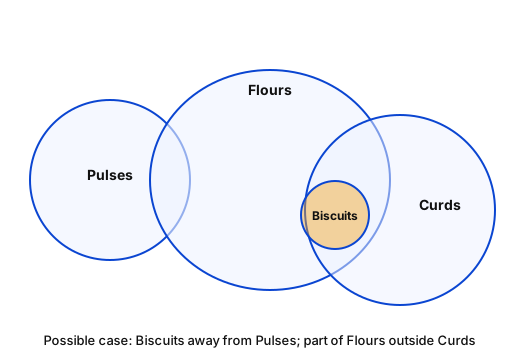
- All Biscuits are inside both Flours and Curds; Pulses only partly overlap Flours.
- (I) All flours are curds: part of Flours can lie outside Curds → does not follow.
- (II) Some biscuits are pulses: Biscuits can lie away from Pulses → does not follow.
Trick: 'Some' with 'All' in different circles gives no definite link — draw one case that breaks each conclusion.
Answer: (A) Neither conclusion (I) nor (II) follows.
अवधारणा: निष्कर्ष तभी सही है जब वह हर संभव वेन आरेख में सत्य हो।
- सभी बिस्कुट, आटा और दही दोनों के अंदर; दालें आटे से केवल आंशिक रूप से मिलती हैं।
- (I) सभी आटे दही हैं: आटे का कुछ भाग दही से बाहर हो सकता है → अनुसरण नहीं।
- (II) कुछ बिस्कुट दालें हैं: बिस्कुट दालों से अलग हो सकते हैं → अनुसरण नहीं।
ट्रिक: अलग-अलग वृत्तों में 'कुछ' और 'सभी' से निश्चित संबंध नहीं बनता — हर निष्कर्ष तोड़ने वाला एक आरेख बनाएँ।
उत्तर: (A) न तो निष्कर्ष (I) और न ही (II) अनुसरण करता है।
RRB Technician Grade IIIGeneral Intelligence and ReasoningSyllogismRRB Technician Grade III 2024 · 30 Dec Shift 3
Q931.Refer to the given series and answer the question that follows (all numbers are single-digit numbers only, and all counting is to be done from left to right).
(Left) 2 2 4 8 2 4 6 4 2 6 8 8 6 7 4 5 3 6 2 8 7 1 3 3 6 8 6 4 (Right)
How many such odd digits are there, each of which is immediately preceded by a perfect square and immediately followed by an even digit?
(Note: 1 will be considered as a perfect square.)
दी गई शृंखला को देखिए और उसके बाद आने वाले प्रश्न का उत्तर दीजिए (सभी संख्याएँ केवल एक अंक वाली संख्याएँ हैं, और सभी गणना बाएँ से दाएँ की जानी है)।
(बाएँ) 2 2 4 8 2 4 6 4 2 6 8 8 6 7 4 5 3 6 2 8 7 1 3 3 6 8 6 4 (दाएँ)
ऐसे कितने विषम अंक हैं, जिनमें से प्रत्येक के ठीक पहले एक पूर्ण वर्ग है और ठीक बाद एक सम अंक है?
(ध्यान दें: 1 को पूर्ण वर्ग माना जाएगा।)
- A1
- B0
- C4
- D2
Show answer
Concept: Check each odd digit: the one before must be a perfect square (1, 4, 9) and the one after must be even.
- Odd digits present: 7, 5, 3, 7, 1, 3, 3
- 5 has 4 before it but 3 (odd) after; 3 (after 1) has 3 (odd) after
- All other odd digits are preceded by 6, 5, 8, 7 or 3 (not squares) → count
Trick: Scan only the odd digits — there are just 7 of them here.
Answer: (B) 0
अवधारणा: हर विषम अंक जाँचें: उससे पहले पूर्ण वर्ग (1, 4, 9) और बाद में सम अंक होना चाहिए।
- विषम अंक: 7, 5, 3, 7, 1, 3, 3
- 5 से पहले 4 है पर बाद में 3 (विषम); 1 के बाद वाले 3 के बाद भी 3 (विषम)
- बाकी विषम अंकों से पहले 6, 5, 8, 7 या 3 (वर्ग नहीं) → संख्या
ट्रिक: केवल विषम अंक देखें — यहाँ सिर्फ 7 हैं।
उत्तर: (B) 0
RRB Technician Grade IIIGeneral Intelligence and ReasoningNumber series – digit conditionsRRB Technician Grade III 2024 · 30 Dec Shift 3
Q932.Select the triad which follows the same pattern as that followed by the two triads given below. Both triads follow the same pattern.
UQ-VR-WY
RN-SO-TV
उस त्रिक का चयन कीजिए जो उसी पैटर्न का अनुसरण करता है जिसका अनुसरण नीचे दिए गए दो त्रिक करते हैं। दोनों त्रिक समान पैटर्न का अनुसरण करते हैं।
UQ-VR-WY
RN-SO-TV
- ANK-PL-QR
- BOK-PL-QS
- CNK-PM-QS
- DOK-PM-QR
Show answer
Concept: Track first and second letters separately through the triad.
- UQ-VR-WY: first letters U, V, W (+1, +1); second Q, R, Y (+1, +7)
- RN-SO-TV: R, S, T (+1, +1); N, O, V (+1, +7)
- OK-PL-QS: O, P, Q (+1, +1); K, L, S (+1, +7) ✓
Trick: The +7 jump in the last second-letter decides it quickly: K → L → S.
Answer: (B) OK-PL-QS
अवधारणा: त्रिक में पहले और दूसरे अक्षरों को अलग-अलग देखें।
- UQ-VR-WY: पहले अक्षर U, V, W (+1, +1); दूसरे Q, R, Y (+1, +7)
- RN-SO-TV: R, S, T (+1, +1); N, O, V (+1, +7)
- OK-PL-QS: O, P, Q (+1, +1); K, L, S (+1, +7) ✓
ट्रिक: अंतिम दूसरे अक्षर का +7 उछाल जल्दी पहचान कराता है: K → L → S।
उत्तर: (B) OK-PL-QS
RRB Technician Grade IIIGeneral Intelligence and ReasoningLetter triads – patternRRB Technician Grade III 2024 · 30 Dec Shift 3
Q933.Select the set in which the numbers are related in the same way as are the numbers of the following sets.
(NOTE: Operations should be performed on the whole numbers, without breaking down the numbers into its constituent digits. E.g. 13 – Operations on 13 such as adding/subtracting/multiplying etc. to 13 can be performed. Breaking down 13 into 1 and 3 and then performing mathematical operations on 1 and 3 is not allowed.)
(12, 38, 26)
(50, 75, 25)
उस समुच्चय का चयन कीजिए जिसमें संख्याएँ उसी प्रकार संबंधित हैं जिस प्रकार निम्नलिखित समुच्चयों की संख्याएँ संबंधित हैं।
(ध्यान दें: संख्याओं को उनके घटक अंकों में तोड़े बिना, संक्रियाएँ पूर्ण संख्याओं पर की जानी चाहिए। उदाहरण के लिए 13 – 13 पर संक्रियाएँ जैसे 13 में जोड़ना/घटाना/गुणा करना आदि किया जा सकता है। 13 को 1 और 3 में तोड़ना और फिर 1 और 3 पर गणितीय संक्रियाएँ करना वर्जित है।)
(12, 38, 26)
(50, 75, 25)
- A(8, 32, 7)
- B(21, 40, 15)
- C(9, 28, 16)
- D(14, 42, 28)
Show answer
Concept: Find a single operation linking the three numbers in both given sets.
- and : second − first = third
- : ✓
- Others: , ,
Trick: Equivalently first + third = second: .
Answer: (D) (14, 42, 28)
अवधारणा: दोनों समूहों में तीनों संख्याओं को जोड़ने वाली एक संक्रिया खोजें।
- और : दूसरी − पहली = तीसरी
- : ✓
- अन्य: , ,
ट्रिक: यानी पहली + तीसरी = दूसरी: ।
उत्तर: (D) (14, 42, 28)
RRB Technician Grade IIIGeneral Intelligence and ReasoningNumber sets – relationRRB Technician Grade III 2024 · 30 Dec Shift 3
Q934.Select the set in which the numbers are related in the same way as are the numbers of the following sets.
(NOTE: Operations should be performed on the whole numbers, without breaking down the numbers into its constituent digits. E.g. 13 – Operations on 13 such as adding/subtracting/multiplying etc. to 13 can be performed. Breaking down 13 into 1 and 3 and then performing mathematical operations on 1 and 3 is not allowed.)
(25, 5, 20)
(40, 8, 32)
उस समुच्चय का चयन कीजिए जिसमें संख्याएँ उसी प्रकार संबंधित हैं जिस प्रकार निम्नलिखित समुच्चयों की संख्याएँ संबंधित हैं।
(ध्यान दें: संख्याओं को उनके घटक अंकों में तोड़े बिना, संक्रियाएँ पूर्ण संख्याओं पर की जानी चाहिए। उदाहरण के लिए 13 – 13 पर संक्रियाएँ जैसे 13 में जोड़ना/घटाना/गुणा करना आदि किया जा सकता है। 13 को 1 और 3 में तोड़ना और फिर 1 और 3 पर गणितीय संक्रियाएँ करना वर्जित है।)
(25, 5, 20)
(40, 8, 32)
- A(100, 16, 64)
- B(80, 16, 60)
- C(80, 16, 64)
- D(80, 14, 64)
Show answer
Concept: Find the operation common to both sets.
- : ,
- : ,
- : , ✓
Trick: Third of the first: .
Answer: (C) (80, 16, 64)
अवधारणा: दोनों समूहों में समान संक्रिया खोजें।
- : ,
- : ,
- : , ✓
ट्रिक: तीसरी पहली का : ।
उत्तर: (C) (80, 16, 64)
RRB Technician Grade IIIGeneral Intelligence and ReasoningNumber sets – relationRRB Technician Grade III 2024 · 30 Dec Shift 3
Q935.Refer to the given series and answer the question that follows (all numbers are single-digit numbers only, and all counting is to be done from left to right).
(Left) 2 1 6 8 3 9 5 2 7 6 3 2 9 9 7 3 9 6 4 6 3 2 6 2 2 0 3 4 7 2 (Right)
How many such even digits are there, each of which is immediately preceded by an odd digit and also immediately followed by an odd digit?
दी गई शृंखला को देखिए और उसके बाद आने वाले प्रश्न का उत्तर दीजिए (सभी संख्याएँ केवल एक अंक वाली संख्याएँ हैं, और सभी गणना बाएँ से दाएँ की जानी है)।
(बाएँ) 2 1 6 8 3 9 5 2 7 6 3 2 9 9 7 3 9 6 4 6 3 2 6 2 2 0 3 4 7 2 (दाएँ)
ऐसे कितने सम अंक हैं, जिनमें से प्रत्येक के ठीक पहले एक विषम अंक है और ठीक बाद भी एक विषम अंक है?
- A5
- B4
- C2
- D3
Show answer
Concept: Pick each even digit and check that both neighbours are odd.
- 5 2 7 ✓, 7 6 3 ✓, 3 2 9 ✓
- 3 4 7 ✓ (near the end)
- No other even digit has odd digits on both sides → count
Trick: Look for the pattern odd–even–odd in one left-to-right scan.
Answer: (B) 4
अवधारणा: हर सम अंक लें और जाँचें कि दोनों पड़ोसी विषम हों।
- 5 2 7 ✓, 7 6 3 ✓, 3 2 9 ✓
- 3 4 7 ✓ (अंत के पास)
- किसी अन्य सम अंक के दोनों ओर विषम अंक नहीं → संख्या
ट्रिक: एक बार बाएँ से दाएँ विषम–सम–विषम पैटर्न खोजें।
उत्तर: (B) 4
RRB Technician Grade IIIGeneral Intelligence and ReasoningNumber series – digit conditionsRRB Technician Grade III 2024 · 30 Dec Shift 3
Q936.In a certain code language, ‘BEAM’ is coded as ‘9483’ and ‘DAME’ is coded as ‘9683’. What is the code for ‘B’ in the given code language?
एक निश्चित कूट भाषा में, ‘BEAM’ को ‘9483’ के रूप में कूटबद्ध किया जाता है और ‘DAME’ को ‘9683’ के रूप में कूटबद्ध किया जाता है। उस कूट भाषा में ‘B’ के लिए कूट क्या है?
- A4
- B8
- C9
- D3
Show answer
Concept: Common letters of the two words get the common digits; the extra letter takes the extra digit.
- BEAM = 9483, DAME = 9683
- Common letters E, A, M ↔ common digits 9, 8, 3
- Leftover in BEAM: B ↔ 4 (and D ↔ 6)
Trick: Remove common letters/digits; the leftovers match directly.
Answer: (A) 4
अवधारणा: दोनों शब्दों के उभयनिष्ठ अक्षरों को उभयनिष्ठ अंक मिलते हैं; अतिरिक्त अक्षर को अतिरिक्त अंक।
- BEAM = 9483, DAME = 9683
- उभयनिष्ठ अक्षर E, A, M ↔ उभयनिष्ठ अंक 9, 8, 3
- BEAM में बचा: B ↔ 4 (और D ↔ 6)
ट्रिक: उभयनिष्ठ अक्षर/अंक हटा दें; बचे हुए सीधे मेल खाते हैं।
उत्तर: (A) 4
RRB Technician Grade IIIGeneral Intelligence and ReasoningCoding – common lettersRRB Technician Grade III 2024 · 30 Dec Shift 3
Q937.Based on the English alphabetical order, three of the following four letter-clusters are alike in a certain way and thus form a group. Which letter-cluster does not belong to that group?
(Note: The odd man out is not based on the number of consonants/vowels or their position in the letter cluster)
अंग्रेजी वर्णमाला क्रम के आधार पर, निम्नलिखित चार अक्षर-समूहों में से तीन किसी निश्चित प्रकार से समान हैं और इस प्रकार एक समूह बनाते हैं। कौन-सा अक्षर-समूह उस समूह से संबंधित नहीं है?
(ध्यान दें: असंगत अक्षर-समूह, व्यंजनों/स्वरों की संख्या या अक्षर-समूह में उनके स्थान पर आधारित नहीं है।)
- AEMS
- BAHO
- CHOV
- DVCJ
Show answer
Concept: Check the gaps between letters using positions (A = 1 … Z = 26).
- AHO: 1, 8, 15 (+7, +7); HOV: 8, 15, 22 (+7, +7)
- VCJ: 22 → 3 → 10 (+7, +7 cyclic)
- EMS: 5, 13, 19 (+8, +6) — odd one
Trick: Remember the cyclic count: after Z comes A again.
Answer: (A) EMS
अवधारणा: अक्षरों की स्थिति (A = 1 … Z = 26) से अंतर देखें।
- AHO: 1, 8, 15 (+7, +7); HOV: 8, 15, 22 (+7, +7)
- VCJ: 22 → 3 → 10 (+7, +7 चक्रीय)
- EMS: 5, 13, 19 (+8, +6) — विषम
ट्रिक: चक्रीय गिनती याद रखें: Z के बाद फिर A।
उत्तर: (A) EMS
RRB Technician Grade IIIGeneral Intelligence and ReasoningOdd one out – letter clustersRRB Technician Grade III 2024 · 30 Dec Shift 3
Q938.Which of the following options should come in place of the question mark (?) in the given series based on the English alphabetical order?
HLG, KOJ, NRM, QUP, ?
अंग्रेजी वर्णमाला क्रम के आधार पर दी गई श्रृंखला में प्रश्न चिह्न (?) के स्थान पर निम्नलिखित में से कौन-सा विकल्प आना चाहिए?
HLG, KOJ, NRM, QUP, ?
- ATXS
- BXST
- CXTS
- DTSX
Show answer
Concept: Each letter of the cluster moves forward by the same step.
- H → K → N → Q (+3)
- L → O → R → U (+3); G → J → M → P (+3)
- Next: Q + 3 = T, U + 3 = X, P + 3 = S → TXS
Trick: Only option starting with T and ending with S is TXS.
Answer: (A) TXS
अवधारणा: समूह का हर अक्षर समान अंतर से आगे बढ़ता है।
- H → K → N → Q (+3)
- L → O → R → U (+3); G → J → M → P (+3)
- अगला: Q + 3 = T, U + 3 = X, P + 3 = S → TXS
ट्रिक: T से शुरू और S पर खत्म होने वाला एकमात्र विकल्प TXS है।
उत्तर: (A) TXS
RRB Technician Grade IIIGeneral Intelligence and ReasoningAlphabet seriesRRB Technician Grade III 2024 · 30 Dec Shift 3
Q939.Seven people, A, B, E, G, P, Q and R, are sitting in a row, facing north. Only two people sit to the left of B. Only three people sit between B and R. P sits second to the right of B. Only two people sit between P and A. G sits at some place to the right of E but at some place to the left of Q. How many people sit to the right of G?
सात व्यक्ति, A, B, E, G, P, Q और R, उत्तर की ओर मुख करके एक पंक्ति में बैठे हैं। B के बाईं ओर केवल दो व्यक्ति बैठे हैं। B और R के बीच केवल तीन व्यक्ति बैठे हैं। P, B के दाईं ओर दूसरे स्थान पर बैठा है। P और A के बीच केवल दो व्यक्ति बैठे हैं। G, E के दाईं ओर किसी स्थान पर लेकिन Q के बाईं ओर किसी स्थान पर बैठा है। G के दाईं ओर कितने व्यक्ति बैठे हैं?
- AThreeतीन
- BFourचार
- COneएक
- DTwoदो
Show answer
Concept: Fix the definite positions first (positions 1–7 from the left, all facing north).
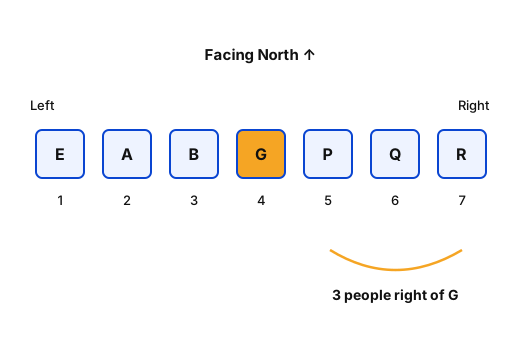
- Two to the left of B → B at 3; three between B and R → R at 7
- P second to the right of B → P at 5; two between P and A → A at 2
- E, G, Q fill 1, 4, 6 in that order (E left of G left of Q) → G at 4
- Right of G: P, Q, R = 3
Trick: Facing north, your right is the viewer's right — count positions directly.
Answer: (A) Three
अवधारणा: पहले निश्चित स्थान तय करें (बाएँ से स्थान 1–7, सभी उत्तर की ओर मुख)।
- B के बाएँ दो → B स्थान 3 पर; B और R के बीच तीन → R स्थान 7 पर
- P, B के दाएँ दूसरा → P स्थान 5 पर; P और A के बीच दो → A स्थान 2 पर
- E, G, Q क्रम से 1, 4, 6 पर (E, G के बाएँ; G, Q के बाएँ) → G स्थान 4 पर
- G के दाएँ: P, Q, R = 3
ट्रिक: उत्तर की ओर मुख हो तो दायाँ = देखने वाले का दायाँ — सीधे गिनें।
उत्तर: (A) तीन
RRB Technician Grade IIIGeneral Intelligence and ReasoningSeating arrangement – linearRRB Technician Grade III 2024 · 30 Dec Shift 3
Q940.D, E, F, G, L, M and N are sitting around a circular table facing the centre. F sits third to the left of L. N sits second to the left of E. L is an immediate neighbour of both D and N. G is not an immediate neighbour of F. How many people sit between M and N when counted from the right of M?
D, E, F, G, L, M और N एक वृत्ताकार मेज के चारों ओर केंद्र की ओर मुख करके बैठे हैं। F, L के बाईं ओर तीसरे स्थान पर बैठा है। N, E के बाईं ओर दूसरे स्थान पर बैठा है। L, D और N दोनों का निकटतम पड़ोसी है। G, F का निकटतम पड़ोसी नहीं है। M के दाईं ओर से गिनने पर M और N के बीच कितने व्यक्ति बैठे हैं?
- AFourचार
- BThreeतीन
- COneएक
- DTwoदो
Show answer
Concept: Facing the centre, left = clockwise and right = anticlockwise.
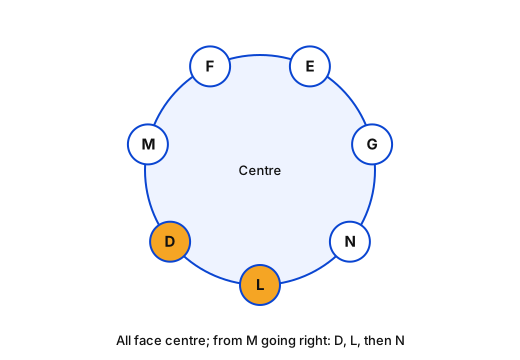
- Fix L; F is third to the left of L
- L's neighbours are D and N; N second to the left of E works only with N on L's right, D on L's left, E two seats right of N
- G not beside F → G between E and N, M between D and F
- From M going right: D, L, then N → 2 people between
Trick: Place the person linked to most clues (L) first.
Answer: (D) Two
अवधारणा: केंद्र की ओर मुख हो तो बायाँ = दक्षिणावर्त, दायाँ = वामावर्त।
- L को स्थिर करें; F, L के बाएँ तीसरा
- L के पड़ोसी D और N; N, E के बाएँ दूसरा तभी संभव जब N, L के दाएँ और D, L के बाएँ हो, E, N से दो स्थान दाएँ
- G, F के पास नहीं → G, E और N के बीच; M, D और F के बीच
- M से दाएँ: D, L, फिर N → बीच में 2 लोग
ट्रिक: सबसे अधिक शर्तों वाले व्यक्ति (L) को पहले बैठाएँ।
उत्तर: (D) दो
RRB Technician Grade IIIGeneral Intelligence and ReasoningSeating arrangement – circularRRB Technician Grade III 2024 · 30 Dec Shift 3

