Q941.Which of the following options should come in place of the question mark (?) in the given series based on the English alphabetical order?
MPL, ORN, QTP, SVR, ?
अंग्रेजी वर्णमाला क्रम के आधार पर दी गई श्रृंखला में प्रश्न चिह्न (?) के स्थान पर निम्नलिखित में से कौन-सा विकल्प आना चाहिए?
MPL, ORN, QTP, SVR, ?
- AUXT
- BXTU
- CUTX
- DXUT
Show answer
Concept: Each position of the cluster increases by the same number.
- M → O → Q → S (+2)
- P → R → T → V (+2); L → N → P → R (+2)
- Next: S + 2 = U, V + 2 = X, R + 2 = T → UXT
Trick: All three letters move +2 — just shift the last term.
Answer: (A) UXT
अवधारणा: समूह का हर स्थान समान संख्या से बढ़ता है।
- M → O → Q → S (+2)
- P → R → T → V (+2); L → N → P → R (+2)
- अगला: S + 2 = U, V + 2 = X, R + 2 = T → UXT
ट्रिक: तीनों अक्षर +2 बढ़ते हैं — बस अंतिम पद खिसकाएँ।
उत्तर: (A) UXT
RRB Technician Grade IIIGeneral Intelligence and ReasoningAlphabet seriesRRB Technician Grade III 2024 · 30 Dec Shift 3
Q942.Read the given statements and conclusions carefully. You have to take the given statements to be true even if they seem to be at variance from commonly known facts and decide which conclusion(s) logically follow(s) from the given statements.
Statements:
Some games are boards.
No board is a dice.
No remote is a game.
Conclusions:
(I) No game is a dice.
(II) Some remotes are boards.
दिए गए कथनों और निष्कर्षों को ध्यानपूर्वक पढ़िए। आपको दिए गए कथनों को सत्य मानना है, भले ही वे सामान्य रूप से ज्ञात तथ्यों से भिन्न प्रतीत होते हों, और निर्णय लेना है कि कौन-सा/से निष्कर्ष तार्किक रूप से दिए गए कथनों का अनुसरण करता/करते है/हैं।
कथन:
कुछ खेल, बोर्ड हैं।
कोई भी बोर्ड, पासा नहीं है।
कोई भी रिमोट, खेल नहीं है।
निष्कर्ष:
(I) कोई भी खेल, पासा नहीं है।
(II) कुछ रिमोट, बोर्ड हैं।
- AOnly conclusion (II) follows.केवल निष्कर्ष (II) अनुसरण करता है।
- BBoth conclusions (I) and (II) follow.निष्कर्ष (I) और (II) दोनों अनुसरण करते हैं।
- CNeither conclusion (I) nor (II) follows.न तो निष्कर्ष (I) और न ही (II) अनुसरण करता है।
- DOnly conclusion (I) follows.केवल निष्कर्ष (I) अनुसरण करता है।
Show answer
Concept: A conclusion is valid only if it holds in every possible diagram.
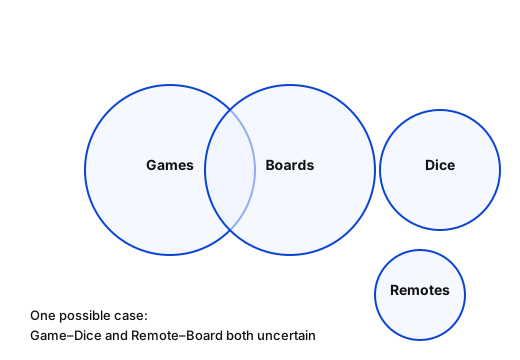
- Games overlap Boards; Dice are away from Boards; Remotes are away from Games.
- (I) No game is a dice: the part of Games outside Boards may touch Dice → not certain.
- (II) Some remotes are boards: Remotes may stay outside Boards → not certain.
Trick: Two negatives about different classes never give a definite 'No' or 'Some' between the third pair.
Answer: (C) Neither conclusion (I) nor (II) follows.
अवधारणा: निष्कर्ष तभी मान्य है जब वह हर संभव आरेख में सत्य हो।
- खेल और बोर्ड आंशिक रूप से मिलते हैं; पासे बोर्ड से अलग; रिमोट खेल से अलग।
- (I) कोई खेल पासा नहीं: खेल का बोर्ड से बाहर वाला भाग पासे से मिल सकता है → निश्चित नहीं।
- (II) कुछ रिमोट बोर्ड हैं: रिमोट बोर्ड से बाहर भी रह सकते हैं → निश्चित नहीं।
ट्रिक: अलग-अलग वर्गों के नकारात्मक कथनों से तीसरे युग्म में निश्चित 'कोई नहीं' या 'कुछ' नहीं बनता।
उत्तर: (C) न तो निष्कर्ष (I) और न ही (II) अनुसरण करता है।
RRB Technician Grade IIIGeneral Intelligence and ReasoningSyllogismRRB Technician Grade III 2024 · 30 Dec Shift 3
Q943.Refer to the given series and answer the question that follows (all numbers are single-digit numbers only, and all counting is to be done from left to right).
(Left) 3 5 5 7 1 6 1 8 8 7 6 2 2 5 9 8 1 1 5 3 3 2 8 1 7 9 2 (Right)
How many such even digits are there each of which is immediately preceded by a perfect square and immediately followed by an odd digit? (Note: 1 will be considered as a perfect square.)
दी गई श्रृंखला को देखिए और उसके बाद आने वाले प्रश्न का उत्तर दीजिए (सभी संख्याएँ केवल एक अंक वाली संख्याएँ हैं, और सभी गिनती बाएँ से दाएँ की जानी है)।
(बाएँ) 3 5 5 7 1 6 1 8 8 7 6 2 2 5 9 8 1 1 5 3 3 2 8 1 7 9 2 (दाएँ)
ऐसे कितने सम अंक हैं जिनमें से प्रत्येक के ठीक पहले एक पूर्ण वर्ग है और ठीक बाद एक विषम अंक है? (नोट: 1 को पूर्ण वर्ग माना जाएगा।)
- A0
- B2
- C3
- D4
Show answer
Concept: For every even digit, check: digit before is a perfect square (1, 4, 9) and digit after is odd.
- 1 6 1 → 1 is a square, 1 is odd ✓
- 9 8 1 → 9 is a square, 1 is odd ✓
- Other even digits fail (e.g. 8 8 7: 8 not a square; 2 8 1: 2 not a square) → count
Trick: Locate the squares 1, 4, 9 first, then look at the next two digits.
Answer: (B) 2
अवधारणा: हर सम अंक के लिए जाँचें: पहले पूर्ण वर्ग (1, 4, 9) और बाद में विषम अंक।
- 1 6 1 → 1 पूर्ण वर्ग, 1 विषम ✓
- 9 8 1 → 9 पूर्ण वर्ग, 1 विषम ✓
- बाकी सम अंक असफल (जैसे 8 8 7: 8 वर्ग नहीं; 2 8 1: 2 वर्ग नहीं) → संख्या
ट्रिक: पहले 1, 4, 9 खोजें, फिर अगले दो अंक देखें।
उत्तर: (B) 2
RRB Technician Grade IIIGeneral Intelligence and ReasoningNumber series – digit conditionsRRB Technician Grade III 2024 · 30 Dec Shift 3
Q944.In a certain code language,
‘A + B’ means ‘A is the mother of B’,
‘A – B’ means ‘A is the brother of B’,
‘A x B’ means ‘A is the wife of B’
and ‘A B’ means ‘A is the father of B’.
How is H related to L if 'H + J x K M – L'?
एक निश्चित कूट भाषा में,
‘A + B’ का अर्थ है ‘A, B की माता है’,
‘A – B’ का अर्थ है ‘A, B का भाई है’,
‘A x B’ का अर्थ है ‘A, B की पत्नी है’
और ‘A B’ का अर्थ है ‘A, B का पिता है’।
यदि 'H + J x K M – L' है, तो H का L से क्या संबंध है?
- AWife's motherपत्नी की माता
- BMother's sisterमाता की बहन
- CMother's motherमाता की माता
- DFather's motherपिता की माता
Show answer
Concept: Decode each symbol step by step and build a family tree.
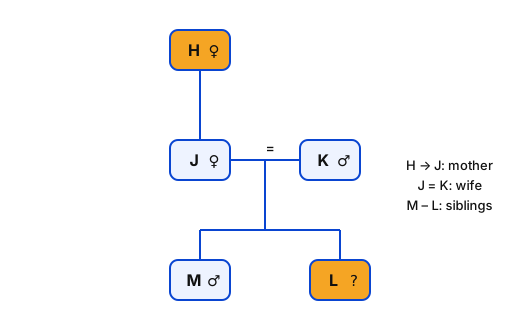
- H + J: H is the mother of J; J × K: J is the wife of K
- K ÷ M: K is the father of M; M – L: M is the brother of L
- So L is the child of J and K; H is J's mother
Trick: H is the mother of L's mother → maternal grandmother.
Answer: (C) Mother's mother
अवधारणा: हर चिह्न को क्रम से खोलें और वंश-वृक्ष बनाएँ।
- H + J: H, J की माँ है; J × K: J, K की पत्नी है
- K ÷ M: K, M का पिता है; M – L: M, L का भाई है
- अतः L, J और K की संतान है; H, J की माँ है
ट्रिक: H, L की माँ की माँ है → नानी।
उत्तर: (C) माता की माता
RRB Technician Grade IIIGeneral Intelligence and ReasoningBlood relations – codedRRB Technician Grade III 2024 · 30 Dec Shift 3
Q945.SDFG is related to YJKM in a certain way based on the English alphabetical order. In the same way, QBZE is related to WHEK. To which of the following options is ITOW related, following the same logic?
अंग्रेजी वर्णमाला क्रम के आधार पर SDFG एक निश्चित प्रकार से YJKM से संबंधित है। उसी प्रकार, QBZE, WHEK से संबंधित है। उसी तर्क का अनुसरण करते हुए, ITOW निम्नलिखित में से किस विकल्प से संबंधित है?
- AOZTC
- BHBCT
- CRYOM
- DMJVY
Show answer
Concept: Find the shift of each letter position-wise.
- SDFG → YJKM: +6, +6, +5, +6
- QBZE → WHEK: +6, +6, +5 (Z → E), +6
- ITOW: I + 6 = O, T + 6 = Z, O + 5 = T, W + 6 = C → OZTC
Trick: Use the cyclic alphabet: W(23) + 6 = 29 → 29 − 26 = 3 = C.
Answer: (A) OZTC
अवधारणा: हर स्थान के अक्षर का खिसकाव निकालें।
- SDFG → YJKM: +6, +6, +5, +6
- QBZE → WHEK: +6, +6, +5 (Z → E), +6
- ITOW: I + 6 = O, T + 6 = Z, O + 5 = T, W + 6 = C → OZTC
ट्रिक: चक्रीय वर्णमाला: W(23) + 6 = 29 → 29 − 26 = 3 = C।
उत्तर: (A) OZTC
RRB Technician Grade IIIGeneral Intelligence and ReasoningLetter analogyRRB Technician Grade III 2024 · 30 Dec Shift 3
Q946.Which of the following options should come in place of the question mark (?) in the given series to make it logically complete?
81, 108.6, 136.2, 163.8, ?
दी गई श्रृंखला को तार्किक रूप से पूर्ण करने के लिए प्रश्न चिह्न (?) के स्थान पर निम्नलिखित में से कौन-सा विकल्प आना चाहिए?
81, 108.6, 136.2, 163.8, ?
- A198.2
- B191.4
- C183.6
- D174.8
Show answer
Concept: Check the difference between consecutive terms.
- , ,
- Next
Trick: Constant difference → arithmetic progression; just add once more.
Answer: (B) 191.4
अवधारणा: क्रमागत पदों का अंतर देखें।
- , ,
- अगला
ट्रिक: स्थिर अंतर → समांतर श्रेढ़ी; बस एक बार और जोड़ें।
उत्तर: (B) 191.4
RRB Technician Grade IIIGeneral Intelligence and ReasoningNumber series – APRRB Technician Grade III 2024 · 30 Dec Shift 3
Q947.Gautam starts from Point A and drives 30 km towards South. He then takes a left turn, drives 15 km, turns left and drives 42 km. He then takes a left turn and drives 7 km. He takes a final left turn, drives 12 km and stops at Point P. How far (shortest distance) and towards which direction should he drive in order to reach Point A again?
(All turns are 90 degree turns only unless otherwise specified.)
गौतम बिंदु A से चलना शुरू करता है और दक्षिण की ओर 30 km ड्राइव करता है। फिर वह बाएँ मुड़ता है, 15 km ड्राइव करता है, बाएँ मुड़ता है और 42 km ड्राइव करता है। फिर वह बाएँ मुड़ता है और 7 km ड्राइव करता है। वह अंतिम बार बाएँ मुड़ता है, 12 km ड्राइव करता है और बिंदु P पर रुक जाता है। बिंदु A पर फिर से पहुँचने के लिए उसे कितनी दूरी (न्यूनतम दूरी) और किस दिशा में ड्राइव करना चाहिए?
(जब तक अन्यथा निर्दिष्ट न हो, सभी मोड़ केवल 90 डिग्री के मोड़ हैं।)
- A5 km towards Westपश्चिम की ओर 5 km
- B8 km towards Westपश्चिम की ओर 8 km
- C10 km towards Westपश्चिम की ओर 10 km
- D10 km towards Eastपूर्व की ओर 10 km
Show answer
Concept: Track the path on a grid; left turns while going south lead east, then north, then west, then south.
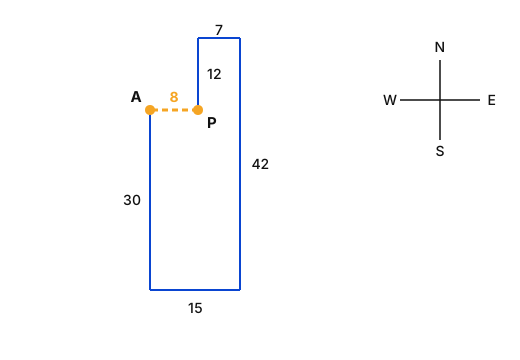
- A → 30 km South → 15 km East → 42 km North → 7 km West → 12 km South = P
- Net North–South: → P is level with A
- Net East: km → P is 8 km east of A
- So drive 8 km towards West
Trick: Four left turns in a row bring you back to the starting direction.
Answer: (B) 8 km towards West
अवधारणा: ग्रिड पर रास्ता बनाएँ; दक्षिण जाते हुए बाएँ मुड़ने पर पूर्व, फिर उत्तर, फिर पश्चिम, फिर दक्षिण।
- A → 30 किमी दक्षिण → 15 किमी पूर्व → 42 किमी उत्तर → 7 किमी पश्चिम → 12 किमी दक्षिण = P
- शुद्ध उत्तर–दक्षिण: → P, A के समान स्तर पर
- शुद्ध पूर्व: किमी → P, A से 8 किमी पूर्व
- अतः 8 किमी पश्चिम की ओर चलें
ट्रिक: लगातार चार बार बाएँ मुड़ने पर फिर मूल दिशा आ जाती है।
उत्तर: (B) पश्चिम की ओर 8 km
RRB Technician Grade IIIGeneral Intelligence and ReasoningDirection and distanceRRB Technician Grade III 2024 · 30 Dec Shift 3
Q948.What will come in the place of the question mark ‘?’ in the following equation, if ‘+’ and ‘’ are interchanged and ‘’ and ‘’ are interchanged?
यदि ‘+’ और ‘’ को आपस में बदल दिया जाए तथा ‘’ और ‘’ को आपस में बदल दिया जाए, तो निम्नलिखित समीकरण में प्रश्न चिह्न ‘?’ के स्थान पर क्या आएगा?
- A22
- B28
- C16
- D20
Show answer
Concept: Swap the signs first, then apply BODMAS.
- Swap + ↔ ÷ and × ↔ −:
- ,
Trick: Rewrite the full expression before calculating — never swap mid-way.
Answer: (D) 20
अवधारणा: पहले चिह्न बदलें, फिर BODMAS लगाएँ।
- + ↔ ÷ और × ↔ − बदलें:
- ,
ट्रिक: गणना से पहले पूरा व्यंजक दोबारा लिखें — बीच में न बदलें।
उत्तर: (D) 20
RRB Technician Grade IIIGeneral Intelligence and ReasoningMathematical operations – interchangeRRB Technician Grade III 2024 · 30 Dec Shift 3
Q949.B, C, D, E, F, K and L are sitting around a circular table, facing the centre. D sits to the immediate right of E. Only three people sit between E and L. B sits to the immediate right of C. Only three people sit between D and F when counted from the left of D. How many people sit between K and C when counted from the left of C?
B, C, D, E, F, K और L एक वृत्ताकार मेज के चारों ओर केंद्र की ओर मुख करके बैठे हैं। D, E के ठीक दाईं ओर बैठा है। E और L के बीच केवल तीन व्यक्ति बैठे हैं। B, C के ठीक दाईं ओर बैठा है। D के बाईं ओर से गिनने पर D और F के बीच केवल तीन व्यक्ति बैठे हैं। C के बाईं ओर से गिनने पर K और C के बीच कितने व्यक्ति बैठे हैं?
- AFourचार
- BOneएक
- CTwoदो
- DThreeतीन
Show answer
Concept: Facing the centre: left = clockwise, right = anticlockwise.
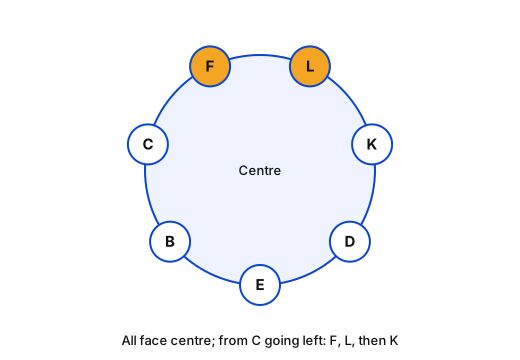
- Fix E; D sits to E's immediate right
- Counting from D's left, F is 4th (three between) → F; then three between E and L puts L next to F
- The 3 empty seats: C, then B to C's immediate right, then K
- From C to the left: F, L, then K → 2 people between
Trick: Seat the chain E–D–F–L first; B–C must take the only adjacent pair left.
Answer: (C) Two
अवधारणा: केंद्र की ओर मुख: बायाँ = दक्षिणावर्त, दायाँ = वामावर्त।
- E को स्थिर करें; D, E के ठीक दाएँ
- D के बाएँ से गिनने पर F चौथा (बीच में तीन); E और L के बीच तीन से L, F के पास
- बचे 3 स्थान: C, उसके ठीक दाएँ B, फिर K
- C से बाएँ: F, L, फिर K → बीच में 2 लोग
ट्रिक: पहले E–D–F–L शृंखला बैठाएँ; B–C को बचा एकमात्र सटा जोड़ा मिलेगा।
उत्तर: (C) दो
RRB Technician Grade IIIGeneral Intelligence and ReasoningSeating arrangement – circularRRB Technician Grade III 2024 · 30 Dec Shift 3
Q950.In this question, a statement is followed by two courses of actions, numbered I and II. You must assume everything in the statement to be true and on the basis of the information given in the statement, decide which of the course of action/s logically follow for pursuing.
Statement – In City X, the number of car accidents has spiked recently due to poor road conditions and lack of adequate signage.
I. The city should launch an awareness campaign to educate drivers on safe driving practices.
II. Immediate Road repair and installation of proper signage should be carried out.
इस प्रश्न में, एक कथन के बाद दो कार्यवाहियाँ I और II दी गई हैं। आपको कथन में दी गई हर बात को सत्य मानना है और कथन में दी गई जानकारी के आधार पर निर्णय लेना है कि कौन-सी कार्यवाही/कार्यवाहियाँ अनुसरण करने के लिए तार्किक रूप से उचित है/हैं।
कथन – शहर X में, खराब सड़क स्थितियों और पर्याप्त संकेतकों (signage) की कमी के कारण हाल ही में कार दुर्घटनाओं की संख्या में तेज़ी से वृद्धि हुई है।
I. शहर को चालकों को सुरक्षित ड्राइविंग प्रथाओं के बारे में शिक्षित करने के लिए एक जागरूकता अभियान शुरू करना चाहिए।
II. तत्काल सड़क की मरम्मत और उचित संकेतकों की स्थापना की जानी चाहिए।
- AOnly I followsकेवल I अनुसरण करता है
- BNeither I nor II followsन तो I और न ही II अनुसरण करता है
- CBoth I and II followI और II दोनों अनुसरण करते हैं
- DOnly II followsकेवल II अनुसरण करता है
Show answer
Concept: A valid course of action must directly address the stated cause and be practical.
- Cause given: poor road conditions and lack of signage
- II (repair roads, install signs) removes the cause → follows
- I (driver awareness) does not address road or signage faults → does not follow
Trick: Match the action to the cause stated in the statement, not to general good ideas.
Answer: (D) Only II follows
अवधारणा: मान्य कार्यवाही बताए गए कारण को सीधे दूर करे और व्यावहारिक हो।
- दिया गया कारण: खराब सड़कें और संकेतकों की कमी
- II (सड़क मरम्मत, संकेतक लगाना) कारण दूर करता है → अनुसरण करता है
- I (चालक जागरूकता) सड़क या संकेतक की कमी नहीं सुधारता → अनुसरण नहीं
ट्रिक: कार्यवाही को कथन में बताए कारण से मिलाएँ, सामान्य अच्छे विचारों से नहीं।
उत्तर: (D) केवल II अनुसरण करता है
RRB Technician Grade IIIGeneral Intelligence and ReasoningCourse of actionRRB Technician Grade III 2024 · 30 Dec Shift 3
Q951.1 kW power is equal to _______. (kW stands for kilowatt.)
1 kW शक्ति _______ के बराबर होती है। (kW का अर्थ किलोवाट है।)
- A1 J/s
- B1000 J/s
- C10 J/s
- D100 J/s
Show answer
Concept: Power is the rate of doing work: . Its SI unit is the watt, where .
- The prefix kilo means .
- So .
- Since , we get .
Trick: kilo = ; watt = joule per second.
Answer: (B) 1000 J/s
अवधारणा: शक्ति कार्य करने की दर है: । इसका SI मात्रक वाट है, जहाँ ।
- किलो का अर्थ है ।
- अतः ।
- चूँकि , इसलिए ।
ट्रिक: किलो = ; वाट = जूल प्रति सेकंड।
उत्तर: (B) 1000 J/s
RRB Technician Grade IIIGeneral SciencePower and its unitsRRB Technician Grade III 2024 · 30 Dec Shift 3
Q952.Which of the following is NOT an example of homogeneous mixture?
निम्नलिखित में से कौन-सा समांगी मिश्रण (homogeneous mixture) का उदाहरण नहीं है?
- AA mixture of copper sulphate in waterजल में कॉपर सल्फेट का मिश्रण
- BA mixture of sugar in waterजल में चीनी का मिश्रण
- CA mixture of salt in waterजल में नमक का मिश्रण
- DA mixture of iron nails in waterजल में लोहे की कीलों का मिश्रण
Show answer
Concept: A homogeneous mixture has a uniform composition throughout (a solution); a heterogeneous mixture has visibly separate parts.
- Copper sulphate, sugar and salt each dissolve completely in water, giving uniform solutions — homogeneous.
- Iron nails do not dissolve; they stay as separate solid pieces at the bottom.
- So iron nails in water is a heterogeneous mixture.
Trick: Dissolves completely → homogeneous; separate visible parts → heterogeneous.
Answer: (D) A mixture of iron nails in water
अवधारणा: समांगी मिश्रण का संघटन हर जगह एक-समान होता है (विलयन); विषमांगी मिश्रण में अलग-अलग भाग दिखाई देते हैं।
- कॉपर सल्फेट, चीनी और नमक पानी में पूरी तरह घुलकर एक-समान विलयन बनाते हैं — समांगी।
- लोहे की कीलें घुलती नहीं, अलग ठोस टुकड़ों के रूप में तली में रहती हैं।
- अतः पानी में लोहे की कीलें विषमांगी मिश्रण है।
ट्रिक: पूरा घुल जाए → समांगी; अलग भाग दिखें → विषमांगी।
उत्तर: (D) जल में लोहे की कीलों का मिश्रण
RRB Technician Grade IIIGeneral ScienceHomogeneous and heterogeneous mixturesRRB Technician Grade III 2024 · 30 Dec Shift 3
Q953.Consider a parallel combination of 3 resistors , and with currents , and , respectively. Which of the following is true? ( = total current, = equivalent resistance of the circuit)
क्रमशः , और धाराओं वाले 3 प्रतिरोधकों , और के एक पार्श्व (समांतर) संयोजन पर विचार कीजिए। निम्नलिखित में से कौन-सा सत्य है? ( = कुल धारा, = परिपथ का तुल्य प्रतिरोध)
- A
- B
- C
- D
Show answer
Concept: In a parallel combination, the voltage across each resistor is the same and the total current divides among the branches.
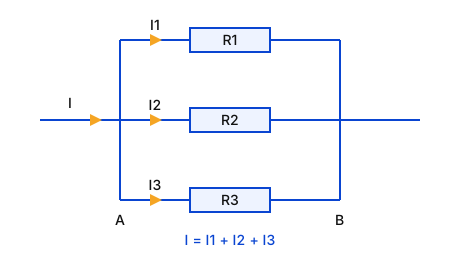
- Total current entering junction A splits into , , , so .
- Equivalent resistance: , so options (A) and (D) are wrong (they mix series and parallel).
- Currents add directly, not as reciprocals, so (C) is wrong.
Trick: Parallel: same , currents add. Series: same , voltages add.
Answer: (B)
अवधारणा: समानांतर संयोजन में प्रत्येक प्रतिरोध पर विभवांतर समान रहता है और कुल धारा शाखाओं में बँट जाती है।
- संधि A पर आने वाली कुल धारा , , में बँटती है, अतः ।
- तुल्य प्रतिरोध: , इसलिए (A) और (D) गलत हैं।
- धाराएँ सीधे जुड़ती हैं, व्युत्क्रम के रूप में नहीं, अतः (C) गलत है।
ट्रिक: समानांतर: समान, धाराएँ जुड़ती हैं। श्रेणी: समान, विभवांतर जुड़ते हैं।
उत्तर: (B)
RRB Technician Grade IIIGeneral ScienceResistors in parallelRRB Technician Grade III 2024 · 30 Dec Shift 3
Q954.The power input in a circuit P can be expressed in terms of voltage V and current I in the circuit as follows:
किसी परिपथ में निवेशी शक्ति P को परिपथ में वोल्टता V और धारा I के पदों में निम्न प्रकार व्यक्त किया जा सकता है:
- A
- B
- C
- D
Show answer
Concept: Electric power is the rate at which electrical energy is used: .
- Work done in moving charge through potential difference : .
- So , since .
- Using Ohm's law it can also be written .
Yaad rakhein: — the three forms of electric power.
Answer: (C)
अवधारणा: विद्युत शक्ति वह दर है जिससे विद्युत ऊर्जा व्यय होती है: ।
- आवेश को विभवांतर से ले जाने में किया गया कार्य: ।
- अतः , क्योंकि ।
- ओम के नियम से इसे भी लिख सकते हैं।
याद रखें: — विद्युत शक्ति के तीन रूप।
उत्तर: (C)
RRB Technician Grade IIIGeneral ScienceElectric powerRRB Technician Grade III 2024 · 30 Dec Shift 3
Q955.The danger signal lights are usually red in colour because red is:
खतरे के संकेत वाली बत्तियाँ आमतौर पर लाल रंग की होती हैं क्योंकि लाल रंग:
- Ahighest reflected by fog or smokeकोहरे या धुएँ द्वारा सर्वाधिक परावर्तित होता है
- Bleast scattered by fog or smokeकोहरे या धुएँ द्वारा सबसे कम प्रकीर्णित होता है
- Cnot scattered at all by fog or smokeकोहरे या धुएँ द्वारा बिल्कुल भी प्रकीर्णित नहीं होता है
- Dhighest scattered by fog or smokeकोहरे या धुएँ द्वारा सर्वाधिक प्रकीर्णित होता है
Show answer
Concept: Small particles scatter light of shorter wavelength more. Red light has the longest wavelength in the visible spectrum.
- Fog, smoke and dust particles scatter blue/violet light strongly.
- Red light, having the longest wavelength, is scattered the least.
- So red light passes through fog or smoke and is seen from far — ideal for danger signals.
Trick: Longer wavelength → less scattering → travels farther (red).
Answer: (B) least scattered by fog or smoke
अवधारणा: छोटे कण कम तरंगदैर्ध्य वाले प्रकाश को अधिक प्रकीर्णित करते हैं। दृश्य स्पेक्ट्रम में लाल प्रकाश की तरंगदैर्ध्य सबसे अधिक होती है।
- कोहरा, धुआँ और धूल के कण नीले/बैंगनी प्रकाश को अधिक प्रकीर्णित करते हैं।
- सबसे अधिक तरंगदैर्ध्य होने के कारण लाल प्रकाश सबसे कम प्रकीर्णित होता है।
- इसलिए लाल प्रकाश कोहरे या धुएँ को पार कर दूर तक दिखता है — खतरे के संकेत के लिए उपयुक्त।
ट्रिक: अधिक तरंगदैर्ध्य → कम प्रकीर्णन → दूर तक दिखे (लाल)।
उत्तर: (B) कोहरे या धुएँ द्वारा सबसे कम प्रकीर्णित होता है
RRB Technician Grade IIIGeneral ScienceScattering of lightRRB Technician Grade III 2024 · 30 Dec Shift 3
Q956.Which of the following can increase the work done by a force on an object?
निम्नलिखित में से कौन-सा किसी वस्तु पर बल द्वारा किए गए कार्य को बढ़ा सकता है?
- AIncreasing the displacement.विस्थापन को बढ़ाना।
- BReducing the displacement.विस्थापन को कम करना।
- CReducing the force.बल को कम करना।
- DReducing the mass.द्रव्यमान को कम करना।
Show answer
Concept: Work done by a constant force along the displacement is .
- is directly proportional to both force and displacement .
- Increasing the displacement (with the same force) increases .
- Reducing force or displacement decreases ; mass does not appear in the formula.
Trick: — increase either or to increase work.
Answer: (A) Increasing the displacement.
अवधारणा: किसी नियत बल द्वारा विस्थापन की दिशा में किया गया कार्य होता है।
- बल और विस्थापन दोनों के अनुक्रमानुपाती है।
- समान बल पर विस्थापन बढ़ाने से बढ़ता है।
- बल या विस्थापन घटाने से घटता है; सूत्र में द्रव्यमान नहीं है।
ट्रिक: — कार्य बढ़ाने के लिए या बढ़ाएँ।
उत्तर: (A) विस्थापन को बढ़ाना।
RRB Technician Grade IIIGeneral ScienceWork done by a forceRRB Technician Grade III 2024 · 30 Dec Shift 3
Q957.Identify the INCORRECT statement about muscle tissue.
पेशी ऊतक (muscle tissue) के बारे में गलत कथन की पहचान कीजिए।
- AMuscle tissues are made up of cuboidal cells.पेशी ऊतक घनाकार (cuboidal) कोशिकाओं से बने होते हैं।
- BSpecial contractile proteins are present in muscles.पेशियों में विशेष संकुचनशील प्रोटीन उपस्थित होते हैं।
- CMicroscopes reveal alternate light and dark bands in voluntary muscles.सूक्ष्मदर्शी से ऐच्छिक पेशियों में एकांतर हल्की और गहरी पट्टियाँ दिखाई देती हैं।
- DThe limbs have voluntary muscles.अंगों (हाथ-पैर) में ऐच्छिक पेशियाँ होती हैं।
Show answer
Concept: Muscle tissue consists of elongated cells called muscle fibres, which contain special contractile proteins that contract and relax to cause movement.
- Cuboidal cells form cuboidal epithelium (e.g. kidney tubules), not muscle — so statement (A) is incorrect.
- Contractile proteins are present in muscles — correct.
- Voluntary (striated) muscles show alternate light and dark bands and are found in limbs — correct.
Yaad rakhein: Muscle cells are long fibres; cuboidal cells belong to epithelial tissue.
Answer: (A) Muscle tissues are made up of cuboidal cells.
अवधारणा: पेशी ऊतक लंबी कोशिकाओं (पेशी रेशों) से बना होता है जिनमें विशेष संकुचनशील प्रोटीन होते हैं, जो संकुचन-शिथिलन से गति कराते हैं।
- घनाकार कोशिकाएँ घनाकार उपकला (जैसे वृक्क नलिकाएँ) बनाती हैं, पेशी नहीं — अतः कथन (A) गलत है।
- पेशियों में संकुचनशील प्रोटीन होते हैं — सही।
- ऐच्छिक (रेखित) पेशियों में हल्की-गहरी पट्टियाँ दिखती हैं और ये हाथ-पैरों में होती हैं — सही।
याद रखें: पेशी कोशिकाएँ लंबे रेशे हैं; घनाकार कोशिकाएँ उपकला ऊतक की होती हैं।
उत्तर: (A) पेशी ऊतक घनाकार (cuboidal) कोशिकाओं से बने होते हैं।
RRB Technician Grade IIIGeneral ScienceMuscle tissueRRB Technician Grade III 2024 · 30 Dec Shift 3
Q958.What is the SI unit of universal gravitational constant G?
सार्वत्रिक गुरुत्वाकर्षण नियतांक G का SI मात्रक क्या है?
- A
- B
- C
- D
Show answer
Concept: Newton's law of gravitation: .
- Rearrange: .
- Units: .
- So unit of = = (value ).
Trick: Make the subject of the formula and put units of each quantity.
Answer: (D)
अवधारणा: न्यूटन का गुरुत्वाकर्षण नियम: ।
- पुनर्व्यवस्थित करें: ।
- मात्रक: ।
- अतः का मात्रक = (मान )।
ट्रिक: सूत्र में को अलग करके प्रत्येक राशि का मात्रक रखें।
उत्तर: (D)
RRB Technician Grade IIIGeneral ScienceUniversal law of gravitationRRB Technician Grade III 2024 · 30 Dec Shift 3
Q959.Which of the following unicellular organism change their shape?
निम्नलिखित में से कौन-सा एककोशिकीय जीव अपना आकार बदलता है?
- AYeastयीस्ट
- BAmoebaअमीबा
- CParamoeciumपैरामीशियम
- DBacteriaजीवाणु (बैक्टीरिया)
Show answer
Concept: Amoeba has no rigid cell wall or fixed shape; it moves and feeds by forming finger-like projections called pseudopodia.
- Yeast and bacteria have a cell wall, so their shape is fixed.
- Paramoecium has a firm pellicle and a definite slipper shape.
- Amoeba keeps changing its shape as pseudopodia form and withdraw.
Yaad rakhein: Amoeba = shapeless, moves by pseudopodia (false feet).
Answer: (B) Amoeba
अवधारणा: अमीबा में कठोर कोशिका भित्ति या निश्चित आकार नहीं होता; यह कूटपाद (स्यूडोपोडिया) बनाकर चलता और भोजन ग्रहण करता है।
- यीस्ट और जीवाणु में कोशिका भित्ति होती है, इसलिए उनका आकार निश्चित है।
- पैरामीशियम का आकार चप्पल जैसा निश्चित होता है।
- कूटपाद बनने-सिमटने से अमीबा लगातार आकार बदलता है।
याद रखें: अमीबा = आकारहीन, कूटपाद से गति।
उत्तर: (B) अमीबा
RRB Technician Grade IIIGeneral ScienceUnicellular organismsRRB Technician Grade III 2024 · 30 Dec Shift 3
Q960.Which of the following is/are called biological catalysts?
निम्नलिखित में से किसे/किन्हें जैव उत्प्रेरक कहा जाता है?
- ADigestive juicesपाचक रस
- BEnzymesएंजाइम
- CHydrochloric acidहाइड्रोक्लोरिक अम्ल
- DMucusश्लेष्मा (म्यूकस)
Show answer
Concept: A catalyst speeds up a reaction without being used up. Enzymes are proteins that do this inside living organisms.
- Enzymes like amylase, pepsin and lipase speed up digestion and other body reactions.
- Digestive juices only contain enzymes; HCl provides an acidic medium; mucus protects the stomach lining.
- So enzymes are called biological catalysts.
Yaad rakhein: Enzymes = biocatalysts (mostly proteins).
Answer: (B) Enzymes
अवधारणा: उत्प्रेरक स्वयं खर्च हुए बिना अभिक्रिया की दर बढ़ाता है। जीवों के भीतर यह कार्य प्रोटीन रूपी एंजाइम करते हैं।
- एमाइलेज, पेप्सिन, लाइपेज जैसे एंजाइम पाचन व अन्य अभिक्रियाएँ तेज़ करते हैं।
- पाचक रसों में एंजाइम होते हैं; HCl अम्लीय माध्यम देता है; श्लेष्मा आमाशय की परत की रक्षा करता है।
- अतः एंजाइम को जैव उत्प्रेरक कहते हैं।
याद रखें: एंजाइम = जैव उत्प्रेरक (अधिकतर प्रोटीन)।
उत्तर: (B) एंजाइम
RRB Technician Grade IIIGeneral ScienceEnzymesRRB Technician Grade III 2024 · 30 Dec Shift 3

