Q81.Which of the following is the method used for refining metals such as copper, zinc and silver?
कॉपर, जिंक और सिल्वर जैसी धातुओं के परिष्करण के लिए निम्नलिखित में से कौन-सी विधि उपयोग की जाती है?
- ADistillationआसवन
- BExtractionनिष्कर्षण
- CElectrolytic refiningविद्युत अपघटनी परिष्करण
- DSmeltingप्रगलन
Show answer
Concept: Electrolytic refining is the most common method to purify metals like Cu, Zn, Ag, Sn, Ni, Au.
- Impure metal = anode, pure metal strip = cathode
- Pure metal deposits on cathode; impurities form anode mud
- Distillation suits low-boiling metals (Zn, Hg); smelting is extraction, not refining
Yaad rakhein: Anode mud from copper refining contains precious metals like gold and silver.
Answer: (C) Electrolytic refining
अवधारणा: Cu, Zn, Ag, Ni, Au जैसी धातुओं के शोधन की सबसे प्रचलित विधि विद्युत अपघटनी परिष्करण है।
- अशुद्ध धातु = एनोड, शुद्ध धातु की पट्टी = कैथोड
- शुद्ध धातु कैथोड पर जमती है; अशुद्धियाँ एनोड पंक
- आसवन कम क्वथनांक धातुओं (Zn, Hg) के लिए; प्रगलन निष्कर्षण है, परिष्करण नहीं
याद रखें: कॉपर परिष्करण के एनोड पंक में सोना, चाँदी जैसी कीमती धातुएँ होती हैं।
उत्तर: (C) विद्युत अपघटनी परिष्करण
RRB Technician Grade IIIGeneral ScienceRefining of metalsRRB Technician Grade III 2025 · 10 Mar Shift 3
Q82.According to Bohr’s model, where are electrons found in an atom?
बोर के मॉडल के अनुसार, किसी परमाणु में इलेक्ट्रॉन कहाँ पाए जाते हैं?
- AMoving in fixed circular orbits around the nucleusनाभिक के चारों ओर निश्चित वृत्ताकार कक्षाओं में घूमते हुए
- BFixed positions inside the nucleusनाभिक के अंदर निश्चित स्थितियों पर
- CRandomly scattered inside the atomपरमाणु के अंदर यादृच्छिक रूप से बिखरे हुए
- DResting outside the atom in free spaceपरमाणु के बाहर मुक्त आकाश में स्थिर अवस्था में
Show answer
Concept: Electrons revolve in fixed circular orbits (energy levels/shells) around the nucleus.
- Orbits K, L, M, N have fixed energy
- While in an orbit, an electron does not radiate energy
- The nucleus contains protons and neutrons, not electrons
Yaad rakhein: Maximum electrons in a shell = (K = 2, L = 8, M = 18).
Answer: (A) Moving in fixed circular orbits around the nucleus
अवधारणा: इलेक्ट्रॉन नाभिक के चारों ओर निश्चित वृत्ताकार कक्षाओं (ऊर्जा स्तर/कोश) में घूमते हैं।
- कक्षाएँ K, L, M, N — प्रत्येक की निश्चित ऊर्जा
- कक्षा में घूमते समय इलेक्ट्रॉन ऊर्जा नहीं छोड़ता
- नाभिक में प्रोटॉन व न्यूट्रॉन होते हैं, इलेक्ट्रॉन नहीं
याद रखें: किसी कोश में अधिकतम इलेक्ट्रॉन = (K = 2, L = 8, M = 18)।
उत्तर: (A) नाभिक के चारों ओर निश्चित वृत्ताकार कक्षाओं में घूमते हुए
RRB Technician Grade IIIGeneral ScienceBohr's atomic modelRRB Technician Grade III 2025 · 10 Mar Shift 3
Q83.The solubility of gases in liquids generally:
द्रवों में गैसों की विलेयता सामान्यतः:
- AIs unaffected by temperatureताप से अप्रभावित रहती है
- BIncreases with increase in temperatureताप में वृद्धि के साथ बढ़ती है
- CDecreases with increase in temperatureताप में वृद्धि के साथ घटती है
- DFirst increases then decreases with increase in temperatureताप में वृद्धि के साथ पहले बढ़ती है फिर घटती है
Show answer
Concept: Gas solubility in liquids decreases as temperature increases.
- Heating gives gas molecules energy to escape from the liquid
- Example: warm soda loses fizz faster; warm water holds less O₂ (fish suffer)
- Gas solubility increases with pressure (Henry's law)
Yaad rakhein: Gases: more soluble at low temperature and high pressure.
Answer: (C) Decreases with increase in temperature
अवधारणा: तापमान बढ़ने पर द्रव में गैसों की विलेयता घटती है।
- गर्म करने से गैस अणुओं को बाहर निकलने की ऊर्जा मिलती है
- उदाहरण: गर्म सोडा जल्दी फीका; गर्म पानी में कम O₂ (मछलियों को कठिनाई)
- दाब बढ़ने पर विलेयता बढ़ती है (हेनरी का नियम)
याद रखें: गैसें: कम ताप और उच्च दाब पर अधिक विलेय।
उत्तर: (C) ताप में वृद्धि के साथ घटती है
RRB Technician Grade IIIGeneral ScienceSolubility of gasesRRB Technician Grade III 2025 · 10 Mar Shift 3
Q84.A distance–time graph for uniform motion must pass through ________.
एकसमान गति के लिए दूरी-समय ग्राफ को अनिवार्य रूप से ________ से होकर गुजरना चाहिए।
- A(0, 1)
- B(1, 1) onlyकेवल (1, 1)
- CAny pointकोई भी बिंदु
- DThe originमूल बिंदु
Show answer
Concept: For uniform motion starting at t = 0, distance ∝ time → straight line through the origin.
- At t = 0, distance covered = 0 → point (0, 0)
- Equal distances in equal time → straight line of constant slope
- Points like (0, 1) or (1, 1) are not compulsory
Yaad rakhein: s = vt has no constant term, so the graph starts at the origin.
Answer: (D) The origin
अवधारणा: t = 0 से शुरू एकसमान गति में दूरी ∝ समय → मूल बिंदु से होकर सीधी रेखा।
- t = 0 पर तय दूरी = 0 → बिंदु (0, 0)
- बराबर समय में बराबर दूरी → स्थिर ढाल की सीधी रेखा
- (0, 1) या (1, 1) अनिवार्य नहीं
याद रखें: s = vt में कोई स्थिर पद नहीं, अतः ग्राफ मूल बिंदु से शुरू।
उत्तर: (D) मूल बिंदु
RRB Technician Grade IIIGeneral ScienceDistance–time graph for uniform motionRRB Technician Grade III 2025 · 10 Mar Shift 3
Q85.What is formed when the male germ-cell from the pollen grain fuses with the female gamete in flowering plants?
पुष्पी पादपों में जब परागकण से आने वाली नर जनन-कोशिका, मादा युग्मक से संलयित होती है, तो क्या बनता है?
- APollen grainपरागकण
- BZygoteयुग्मनज
- CStigmaवर्तिकाग्र
- DOvuleबीजांड
Show answer
Concept: Fusion of male and female gametes is fertilisation; its product is the zygote.
- Male germ cell (from pollen tube) fuses with egg in the ovule
- Zygote → develops into embryo; ovule → seed; ovary → fruit
- Stigma, pollen grain and ovule are structures, not products of fusion
Yaad rakhein: Zygote → embryo, ovule → seed, ovary → fruit.
Answer: (B) Zygote
अवधारणा: नर और मादा युग्मक का संलयन निषेचन है; इसका उत्पाद युग्मनज (zygote) है।
- पराग नलिका से आया नर युग्मक बीजांड में अंड से जुड़ता है
- युग्मनज → भ्रूण; बीजांड → बीज; अंडाशय → फल
- वर्तिकाग्र, परागकण और बीजांड संरचनाएँ हैं, संलयन के उत्पाद नहीं
याद रखें: युग्मनज → भ्रूण, बीजांड → बीज, अंडाशय → फल।
उत्तर: (B) युग्मनज
RRB Technician Grade IIIGeneral ScienceFertilisation in flowering plantsRRB Technician Grade III 2025 · 10 Mar Shift 3
Q86.The centre of curvature (C) of a concave mirror is located ____________.
अवतल दर्पण का वक्रता केंद्र (C) ____________ स्थित होता है।
- ABehind the mirrorदर्पण के पीछे
- BAt the pole (P)ध्रुव (P) पर
- CIn front of the mirrorदर्पण के सामने
- DAt infinityअनंत पर
Show answer
Concept: For a concave mirror, the reflecting surface faces the object, so C and F lie in front of the mirror.
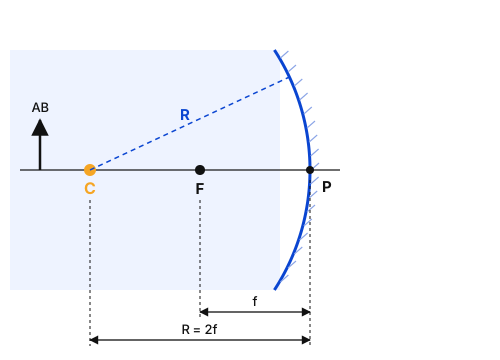
- C is the centre of the sphere of which the mirror is a part
- Concave: C in front (R = 2f, negative)
- Convex: C and F lie behind the mirror
Yaad rakhein: R = 2f — C is twice as far from the pole as F.
Answer: (C) In front of the mirror
अवधारणा: अवतल दर्पण की परावर्तक सतह वस्तु की ओर होती है, अतः C और F दर्पण के सामने होते हैं।
- C उस गोले का केंद्र है जिसका भाग दर्पण है
- अवतल: C सामने (R = 2f, ऋणात्मक)
- उत्तल: C और F दर्पण के पीछे
याद रखें: R = 2f — C, ध्रुव से F की दोगुनी दूरी पर।
उत्तर: (C) दर्पण के सामने
RRB Technician Grade IIIGeneral ScienceCentre of curvature – concave mirrorRRB Technician Grade III 2025 · 10 Mar Shift 3
Q87.What specialisation is commonly found in the epidermal cells of plant roots to aid in their primary function?
पादप जड़ों की बाह्यत्वचीय कोशिकाओं में उनके प्राथमिक कार्य में सहायता के लिए सामान्यतः कौन-सा विशिष्टीकरण पाया जाता है?
- AIrregularly thickened cornersअनियमित रूप से मोटे कोने
- BLarge air cavities (aerenchyma)बड़ी वायु गुहिकाएँ (वायूतक)
- CA thick, waxy coating of cutinक्यूटिन की एक मोटी, मोमी परत
- DLong, hair-like extensionsलंबे, बाल जैसे प्रवर्ध
Show answer
Concept: Epidermal cells of roots form long hair-like root hairs to absorb water and minerals.
- Root hairs greatly increase surface area for absorption
- Waxy cutin is on aerial parts (prevents water loss)
- Aerenchyma is in aquatic plants; thickened corners = collenchyma
Yaad rakhein: Cutin on leaves/stems reduces water loss; desert plants have a thick cuticle.
Answer: (D) Long, hair-like extensions
अवधारणा: जड़ की बाह्यत्वचा कोशिकाएँ लंबे बाल जैसे मूल रोम बनाती हैं जो जल व खनिज सोखते हैं।
- मूल रोम अवशोषण का सतही क्षेत्रफल बहुत बढ़ाते हैं
- मोमी क्यूटिन वायवीय भागों पर होता है (जल हानि रोकने हेतु)
- वायूतक (aerenchyma) जलीय पौधों में; कोनों पर मोटाई = स्थूलकोण ऊतक
याद रखें: पत्तियों/तनों पर क्यूटिन जल हानि घटाता है; मरुस्थलीय पौधों में मोटी क्यूटिकल।
उत्तर: (D) लंबे, बाल जैसे प्रवर्ध
RRB Technician Grade IIIGeneral ScienceRoot epidermis – root hairsRRB Technician Grade III 2025 · 10 Mar Shift 3
Q88.Even though action and reaction forces are equal in size, they may not cause equal accelerations. Why?
यद्यपि क्रिया और प्रतिक्रिया बल परिमाण में बराबर होते हैं, फिर भी वे समान त्वरण उत्पन्न नहीं कर सकते हैं। क्यों?
- ABecause the forces act on the same objectक्योंकि बल एक ही वस्तु पर कार्य करते हैं
- BBecause reaction forces are always weaker in effectक्योंकि प्रतिक्रिया बल सदैव प्रभाव में दुर्बल होते हैं
- CBecause each force acts on a different object, and the objects may have different massesक्योंकि प्रत्येक बल भिन्न वस्तु पर कार्य करता है, और वस्तुओं के द्रव्यमान भिन्न हो सकते हैं
- DBecause only the larger force causes accelerationक्योंकि केवल बड़ा बल ही त्वरण उत्पन्न करता है
Show answer
Concept: : equal forces on different masses give different accelerations.
- Action and reaction act on two different bodies
- Same F, bigger mass → smaller a (gun recoils slowly, bullet moves fast)
- Forces on the same body would cancel — not the case here
Yaad rakhein: Gun–bullet: equal and opposite forces, but the light bullet gets a huge acceleration.
Answer: (C) Because each force acts on a different object, and the objects may have different masses
अवधारणा: : बराबर बल अलग-अलग द्रव्यमानों पर अलग त्वरण देता है।
- क्रिया और प्रतिक्रिया दो अलग पिंडों पर लगते हैं
- समान F, अधिक द्रव्यमान → कम त्वरण (बंदूक धीरे पीछे हटती है, गोली तेज़)
- एक ही पिंड पर होते तो निरस्त हो जाते — ऐसा नहीं है
याद रखें: बंदूक–गोली: बल बराबर व विपरीत, पर हल्की गोली का त्वरण बहुत अधिक।
उत्तर: (C) क्योंकि प्रत्येक बल भिन्न वस्तु पर कार्य करता है, और वस्तुओं के द्रव्यमान भिन्न हो सकते हैं
RRB Technician Grade IIIGeneral ScienceThird law – unequal accelerationsRRB Technician Grade III 2025 · 10 Mar Shift 3
Q89.Addition reactions are characteristic of which type of hydrocarbons?
योगात्मक अभिक्रियाएँ (addition reactions) किस प्रकार के हाइड्रोकार्बनों की विशेषता हैं?
- ABoth alkynes and alkenesऐल्काइन और ऐल्कीन दोनों
- BOnly alkynesकेवल ऐल्काइन
- COnly alkenesकेवल ऐल्कीन
- DOnly alkanesकेवल ऐल्केन
Show answer
Concept: Addition reactions occur at double or triple bonds, i.e. in unsaturated hydrocarbons.
- Alkenes (C=C) and alkynes (C≡C) both undergo addition, e.g. hydrogenation
- Alkanes (only single bonds) give substitution reactions
Yaad rakhein: Hydrogenation of vegetable oils (Ni catalyst) is an addition reaction → vanaspati ghee.
Answer: (A) Both alkynes and alkenes
अवधारणा: योगात्मक अभिक्रिया द्वि- या त्रि-आबंध पर होती है, अर्थात असंतृप्त हाइड्रोकार्बन में।
- एल्कीन (C=C) और एल्काइन (C≡C) दोनों में योग, जैसे हाइड्रोजनीकरण
- एल्केन (केवल एकल आबंध) में प्रतिस्थापन अभिक्रिया
याद रखें: वनस्पति तेल का हाइड्रोजनीकरण (Ni उत्प्रेरक) योगात्मक अभिक्रिया है → वनस्पति घी।
उत्तर: (A) ऐल्काइन और ऐल्कीन दोनों
RRB Technician Grade IIIGeneral ScienceAddition reactions – unsaturated hydrocarbonsRRB Technician Grade III 2025 · 10 Mar Shift 3
Q90.Which of the following correctly explains why veins have valves but arteries do not?
निम्नलिखित में से कौन-सा सही रूप से स्पष्ट करता है कि शिराओं में वाल्व क्यों होते हैं परंतु धमनियों में नहीं?
- AVeins carry blood at low pressure and need valves to prevent backflowशिराएँ निम्न दाब पर रुधिर ले जाती हैं और रुधिर के पश्च प्रवाह को रोकने के लिए उन्हें वाल्व की आवश्यकता होती है
- BVeins carry blood under high pressure, so valves prevent it from burstingशिराएँ उच्च दाब पर रुधिर ले जाती हैं, इसलिए वाल्व उन्हें फटने से रोकते हैं
- CArteries carry oxygenated blood and do not need valvesधमनियाँ ऑक्सीजनित रुधिर ले जाती हैं और उन्हें वाल्व की आवश्यकता नहीं होती
- DArteries are located deep inside the body and are supported by musclesधमनियाँ शरीर के अंदर गहराई में स्थित होती हैं और पेशियों द्वारा सहारा पाती हैं
Show answer
Concept: Veins carry blood at low pressure back to the heart, so valves stop backflow.
- Arteries: thick elastic walls, blood at high pressure from heart → no valves needed
- Veins: thin walls, low pressure, blood often flows against gravity → valves keep it one-way
Yaad rakhein: Pulmonary vein carries oxygenated blood; pulmonary artery carries deoxygenated blood.
Answer: (A) Veins carry blood at low pressure and need valves to prevent backflow
अवधारणा: शिराएँ कम दाब पर रक्त हृदय तक लौटाती हैं, इसलिए वाल्व उल्टा प्रवाह रोकते हैं।
- धमनियाँ: मोटी लचीली भित्ति, हृदय से उच्च दाब पर रक्त → वाल्व की ज़रूरत नहीं
- शिराएँ: पतली भित्ति, कम दाब, रक्त अक्सर गुरुत्व के विरुद्ध → वाल्व एकदिशीय प्रवाह रखते हैं
याद रखें: फुफ्फुसीय शिरा ऑक्सीजनित रक्त और फुफ्फुसीय धमनी विऑक्सीजनित रक्त ले जाती है।
उत्तर: (A) शिराएँ निम्न दाब पर रुधिर ले जाती हैं और रुधिर के पश्च प्रवाह को रोकने के लिए उन्हें वाल्व की आवश्यकता होती है
RRB Technician Grade IIIGeneral ScienceVeins and valvesRRB Technician Grade III 2025 · 10 Mar Shift 3
Q91.Provincial autonomy in provinces in place of dyarchy was introduced by which of the following British Indian government legislations?
प्रांतों में द्वैध शासन के स्थान पर प्रांतीय स्वायत्तता निम्नलिखित में से किस ब्रिटिश भारत सरकार के अधिनियम द्वारा प्रारंभ की गई थी?
- AIndian Councils Act of 1909भारतीय परिषद अधिनियम, 1909
- BGovernment of India Act of 1935भारत सरकार अधिनियम, 1935
- CIndian Councils Act of 1892भारतीय परिषद अधिनियम, 1892
- DGovernment of India Act of 1919भारत सरकार अधिनियम, 1919
Show answer
Concept: The GoI Act 1935 abolished dyarchy in provinces and introduced provincial autonomy.
- Act of 1919 (Montagu–Chelmsford) introduced dyarchy in provinces
- Act of 1935 ended it in provinces and proposed dyarchy at the Centre instead
- 1909 (Morley–Minto) = separate electorates for Muslims
Yaad rakhein: 1935 Act also provided for an All-India Federation, a Federal Court (1937) and the RBI.
Answer: (B) Government of India Act of 1935
अवधारणा: भारत सरकार अधिनियम 1935 ने प्रांतों में द्वैध शासन समाप्त कर प्रांतीय स्वायत्तता दी।
- 1919 अधिनियम (मॉन्टेग्यू–चेम्सफोर्ड) ने प्रांतों में द्वैध शासन शुरू किया
- 1935 अधिनियम ने प्रांतों में इसे खत्म कर केंद्र में द्वैध शासन का प्रावधान किया
- 1909 (मॉर्ले–मिंटो) = मुसलमानों के लिए पृथक निर्वाचन
याद रखें: 1935 अधिनियम में अखिल भारतीय संघ, संघीय न्यायालय (1937) और RBI का प्रावधान भी था।
उत्तर: (B) भारत सरकार अधिनियम, 1935
RRB Technician Grade IIIGeneral AwarenessGovernment of India Act 1935 – provincial autonomyRRB Technician Grade III 2025 · 10 Mar Shift 3
Q92.According to the Ministry of Defence, what was India’s highest‑ever defence production in 2024–25?
रक्षा मंत्रालय के अनुसार, 2024–25 में भारत का अब तक का सर्वाधिक रक्षा उत्पादन कितना था?
- A₹1.54 Lakh Crore₹1.54 लाख करोड़
- B₹2.54 Lakh Crore₹2.54 लाख करोड़
- C₹2.94 Lakh Crore₹2.94 लाख करोड़
- D₹3.14 Lakh Crore₹3.14 लाख करोड़
Show answer
Concept: India's annual defence production hit a record of about ₹1.5 lakh crore in 2024–25 (keyed figure ₹1.54 lakh crore).
- Defence production has risen steadily (about ₹1.27 lakh crore in 2023–24)
- 2024–25 crossed the ₹1.5 lakh crore mark — the highest ever
- ₹2.54 / ₹2.94 / ₹3.14 lakh crore are far above actual levels → eliminate
Yaad rakhein: India's defence exports in 2024–25 were a record of about ₹23,600 crore.
Answer: (A) ₹1.54 Lakh Crore
अवधारणा: 2024–25 में भारत का वार्षिक रक्षा उत्पादन लगभग ₹1.5 लाख करोड़ के रिकॉर्ड स्तर पर पहुँचा (कुंजी के अनुसार ₹1.54 लाख करोड़)।
- रक्षा उत्पादन लगातार बढ़ा (2023–24 में लगभग ₹1.27 लाख करोड़)
- 2024–25 में ₹1.5 लाख करोड़ पार — अब तक का सर्वाधिक
- ₹2.54 / ₹2.94 / ₹3.14 लाख करोड़ वास्तविक स्तर से बहुत अधिक → हटाएँ
याद रखें: 2024–25 में भारत का रक्षा निर्यात रिकॉर्ड लगभग ₹23,600 करोड़ रहा।
उत्तर: (A) ₹1.54 लाख करोड़
RRB Technician Grade IIIGeneral AwarenessIndia's defence production 2024–25RRB Technician Grade III 2025 · 10 Mar Shift 3
Q93.Which Indian classical dance form originated in the southern state of Tamil Nadu and is traditionally performed in temples as a devotional offering?
कौन-सा भारतीय शास्त्रीय नृत्य रूप दक्षिणी राज्य तमिलनाडु में उत्पन्न हुआ और पारंपरिक रूप से मंदिरों में भक्तिपूर्ण अर्पण के रूप में प्रस्तुत किया जाता है?
- ABharatanatyamभरतनाट्यम
- BOdissiओडिसी
- CKathakकथक
- DMohiniyattamमोहिनीअट्टम
Show answer
Concept: Bharatanatyam is the classical dance of Tamil Nadu, originally performed in temples (Sadir / devadasi tradition).
- Odissi – Odisha; Kathak – North India (UP)
- Mohiniyattam – Kerala
- Bharatanatyam – Tamil Nadu, temple origin
Yaad rakhein: Sangeet Natak Akademi recognises 8 classical dances: Bharatanatyam, Kathak, Kathakali, Kuchipudi, Odissi, Manipuri, Mohiniyattam, Sattriya.
Answer: (A) Bharatanatyam
अवधारणा: भरतनाट्यम तमिलनाडु का शास्त्रीय नृत्य है, जो मूल रूप से मंदिरों में (सदिर/देवदासी परंपरा) किया जाता था।
- ओडिसी – ओडिशा; कथक – उत्तर भारत (UP)
- मोहिनीअट्टम – केरल
- भरतनाट्यम – तमिलनाडु, मंदिर से उत्पत्ति
याद रखें: संगीत नाटक अकादमी 8 शास्त्रीय नृत्य मानती है: भरतनाट्यम, कथक, कथकली, कुचिपुड़ी, ओडिसी, मणिपुरी, मोहिनीअट्टम, सत्रिया।
उत्तर: (A) भरतनाट्यम
RRB Technician Grade IIIGeneral AwarenessBharatanatyam – Tamil NaduRRB Technician Grade III 2025 · 10 Mar Shift 3
Q94.What is the focus of the 6G research project at IIIT-Naya Raipur funded under DST’s TTDF scheme?
DST की TTDF योजना के अंतर्गत वित्तपोषित IIIT-नया रायपुर की 6G अनुसंधान परियोजना का केंद्रबिंदु क्या है?
- AExpanding smartphone production facilitiesस्मार्टफोन उत्पादन सुविधाओं का विस्तार करना
- BCreating an AI-driven telecom cloud platformAI-संचालित दूरसंचार क्लाउड प्लेटफॉर्म बनाना
- CBuilding a 50-qubit quantum computer50-क्यूबिट क्वांटम कंप्यूटर का निर्माण करना
- DDeveloping a prototype for 6G cell-free communication6G सेल-फ्री संचार के लिए एक प्रोटोटाइप विकसित करना
Show answer
Concept: The IIIT-Naya Raipur project under the Telecom Technology Development Fund (TTDF) aims at a 6G cell-free communication prototype.
- Cell-free massive MIMO: many distributed access points serve users together, without fixed cell boundaries
- Smartphone factories, telecom cloud or a quantum computer are not 6G-communication research → eliminate
Yaad rakhein: India's 'Bharat 6G Vision' aims for India to be a leading 6G technology provider by 2030.
Answer: (D) Developing a prototype for 6G cell-free communication
अवधारणा: TTDF (दूरसंचार प्रौद्योगिकी विकास निधि) के अंतर्गत IIIT-नवा रायपुर की परियोजना 6G cell-free communication प्रोटोटाइप विकसित करने पर केंद्रित है।
- Cell-free massive MIMO: बिना निश्चित सेल सीमा के कई बिखरे access points मिलकर उपयोगकर्ता को सेवा देते हैं
- स्मार्टफोन उत्पादन, टेलीकॉम क्लाउड या क्वांटम कंप्यूटर 6G संचार अनुसंधान नहीं → हटाएँ
याद रखें: 'भारत 6G विज़न' का लक्ष्य 2030 तक भारत को अग्रणी 6G प्रौद्योगिकी प्रदाता बनाना है।
उत्तर: (D) 6G सेल-फ्री संचार के लिए एक प्रोटोटाइप विकसित करना
RRB Technician Grade IIIGeneral Awareness6G research – TTDF schemeRRB Technician Grade III 2025 · 10 Mar Shift 3
Q95.The Henley Passport Index 2025 ranks India at which rank globally?
हेनले पासपोर्ट इंडेक्स 2025 में भारत को वैश्विक स्तर पर कौन-सा स्थान दिया गया है?
- A86
- B85
- C84
- D83
Show answer
Concept: In the Henley Passport Index 2025 (January edition), India was ranked 85th.
- India slipped from 80th (2024) to 85th
- Singapore topped the index
- The index ranks passports by visa-free/visa-on-arrival access
Yaad rakhein: Henley Passport Index is published by Henley & Partners using IATA data; India's rank changes between editions, so note the edition asked.
Answer: (B) 85
अवधारणा: हेनली पासपोर्ट इंडेक्स 2025 (जनवरी संस्करण) में भारत 85वें स्थान पर रहा।
- भारत 2024 के 80वें से फिसलकर 85वें स्थान पर
- सिंगापुर शीर्ष पर रहा
- सूचकांक वीज़ा-मुक्त/वीज़ा-ऑन-अराइवल पहुँच के आधार पर बनता है
याद रखें: यह सूचकांक Henley & Partners IATA आँकड़ों से जारी करता है; संस्करण के अनुसार रैंक बदलती है।
उत्तर: (B) 85
RRB Technician Grade IIIGeneral AwarenessHenley Passport Index 2025RRB Technician Grade III 2025 · 10 Mar Shift 3
Q96.India shares a maritime boundary (sea boundary) with which one of the following countries across the Arabian Sea or the Indian Ocean?
भारत, अरब सागर या हिंद महासागर के पार निम्नलिखित में से किस देश के साथ समुद्री सीमा साझा करता है?
- AMaldivesमालदीव
- BMongoliaमंगोलिया
- CRussiaरूस
- DAfghanistanअफगानिस्तान
Show answer
Concept: India shares maritime boundaries with Sri Lanka, Maldives, Pakistan, Bangladesh, Myanmar, Thailand and Indonesia.
- Maldives lies in the Indian Ocean/Arabian Sea, south-west of Lakshadweep
- Mongolia and Afghanistan are landlocked
- Russia has no sea boundary with India
Yaad rakhein: Eight Degree Channel separates Minicoy (India) from the Maldives.
Answer: (A) Maldives
अवधारणा: भारत की समुद्री सीमा श्रीलंका, मालदीव, पाकिस्तान, बांग्लादेश, म्यांमार, थाईलैंड और इंडोनेशिया से लगती है।
- मालदीव हिंद महासागर/अरब सागर में, लक्षद्वीप के दक्षिण-पश्चिम में
- मंगोलिया और अफ़गानिस्तान स्थलरुद्ध देश हैं
- रूस की भारत से कोई समुद्री सीमा नहीं
याद रखें: आठ डिग्री चैनल मिनिकॉय (भारत) को मालदीव से अलग करता है।
उत्तर: (A) मालदीव
RRB Technician Grade IIIGeneral AwarenessIndia's maritime neighboursRRB Technician Grade III 2025 · 10 Mar Shift 3
Q97.PM Modi unveils how many Global Initiatives at the G20 Johannesburg Summit 2025?
प्रधानमंत्री मोदी ने G20 जोहान्सबर्ग शिखर सम्मेलन 2025 में कितनी वैश्विक पहलों का अनावरण किया?
- AFiveपाँच
- BSevenसात
- CSixछह
- DFourचार
Show answer
Concept: At the G20 Leaders' Summit in Johannesburg (November 2025), PM Modi proposed six global initiatives.
- Included: a G20 Global Traditional Knowledge Repository and a G20–Africa Skills Multiplier
- Also: a G20 initiative on countering the drug–terror nexus and a global healthcare response team, among others
- Total = six
Yaad rakhein: 2025 was the first G20 summit hosted on the African continent (South Africa's presidency).
Answer: (C) Six
अवधारणा: जोहान्सबर्ग G20 शिखर सम्मेलन (नवंबर 2025) में PM मोदी ने छह वैश्विक पहल प्रस्तावित कीं।
- इनमें G20 वैश्विक पारंपरिक ज्ञान भंडार और G20–अफ्रीका स्किल्स मल्टीप्लायर शामिल
- साथ ही ड्रग–आतंक गठजोड़ से निपटने की पहल व वैश्विक हेल्थकेयर रिस्पॉन्स टीम आदि
- कुल = छह
याद रखें: 2025 का G20 सम्मेलन अफ्रीकी महाद्वीप पर पहला G20 शिखर सम्मेलन था (दक्षिण अफ्रीका की अध्यक्षता)।
उत्तर: (C) छह
RRB Technician Grade IIIGeneral AwarenessG20 Johannesburg Summit 2025RRB Technician Grade III 2025 · 10 Mar Shift 3
Q98.In which year did India completely eliminate Quantitative Restrictions (QRs) on imports as part of trade liberalization?
व्यापार उदारीकरण के भाग के रूप में भारत ने किस वर्ष आयात पर मात्रात्मक प्रतिबंधों (QRs) को पूर्णतः समाप्त कर दिया?
- A1996
- B2005
- C1998
- D2001
Show answer
Concept: India removed all remaining Quantitative Restrictions on imports on 1 April 2001.
- QRs were phased out in line with WTO commitments after the 1991 reforms
- Last 715 items were freed in the EXIM Policy 2001–02 (from 1 April 2001)
Yaad rakhein: WTO was established on 1 January 1995; India is a founding member.
Answer: (D) 2001
अवधारणा: भारत ने 1 अप्रैल 2001 से आयात पर शेष सभी मात्रात्मक प्रतिबंध (QRs) हटा दिए।
- 1991 सुधारों के बाद WTO प्रतिबद्धताओं के अनुरूप QRs चरणबद्ध रूप से हटाए गए
- अंतिम 715 वस्तुएँ EXIM नीति 2001–02 में (1 अप्रैल 2001 से) मुक्त हुईं
याद रखें: WTO की स्थापना 1 जनवरी 1995 को हुई; भारत संस्थापक सदस्य है।
उत्तर: (D) 2001
RRB Technician Grade IIIGeneral AwarenessRemoval of quantitative restrictions on importsRRB Technician Grade III 2025 · 10 Mar Shift 3
Q99.Which among the following battles in 1757 marked the beginning of British political control in India?
1757 में हुए निम्नलिखित में से किस युद्ध ने भारत में ब्रिटिश राजनीतिक नियंत्रण की शुरुआत को चिह्नित किया?
- ABattle of Buxarबक्सर का युद्ध
- BBattle of Colachelकोलाचेल का युद्ध
- CBattle of Seringapatamसेरिंगापटम का युद्ध
- DBattle of Plasseyप्लासी का युद्ध
Show answer
Concept: The Battle of Plassey (23 June 1757) began British political control in India.
- Robert Clive defeated Siraj-ud-Daulah, Nawab of Bengal, helped by Mir Jafar's betrayal
- Buxar was 1764; Colachel 1741 (Travancore vs Dutch); Seringapatam 1799
Yaad rakhein: Plassey 1757 laid the foundation; Buxar 1764 confirmed British supremacy (Diwani of Bengal in 1765).
Answer: (D) Battle of Plassey
अवधारणा: प्लासी का युद्ध (23 जून 1757) भारत में ब्रिटिश राजनीतिक नियंत्रण की शुरुआत था।
- रॉबर्ट क्लाइव ने मीर जाफ़र के विश्वासघात की मदद से बंगाल के नवाब सिराजुद्दौला को हराया
- बक्सर 1764; कोलाचेल 1741 (त्रावणकोर बनाम डच); श्रीरंगपट्टनम 1799
याद रखें: प्लासी 1757 ने नींव रखी; बक्सर 1764 ने ब्रिटिश सर्वोच्चता पक्की की (1765 में बंगाल की दीवानी)।
उत्तर: (D) प्लासी का युद्ध
RRB Technician Grade IIIGeneral AwarenessBattle of Plassey 1757RRB Technician Grade III 2025 · 10 Mar Shift 3
Q100.Who among the following appoints the members of the State Public Service
Commission (SPSC) under Article 316 of the Constitution of India?
भारत के संविधान के अनुच्छेद 316 के अंतर्गत राज्य लोक सेवा
आयोग (SPSC) के सदस्यों की नियुक्ति निम्नलिखित में से कौन करता है?
- APresident of Indiaभारत का राष्ट्रपति
- BChief Justice of the High Courtउच्च न्यायालय का मुख्य न्यायाधीश
- CPrime Minister of Indiaभारत का प्रधानमंत्री
- DGovernor of the Stateराज्य का राज्यपाल
Show answer
Concept: Under Article 316, the Chairman and members of an SPSC are appointed by the Governor of the state.
- UPSC members → appointed by the President
- SPSC members → appointed by the Governor
- But SPSC members can be removed only by the President (Art. 317)
Yaad rakhein: Appointed by Governor, removed by President — a favourite exam twist.
Answer: (D) Governor of the State
अवधारणा: अनुच्छेद 316 के अंतर्गत राज्य लोक सेवा आयोग के अध्यक्ष और सदस्यों की नियुक्ति राज्यपाल करते हैं।
- UPSC सदस्य → राष्ट्रपति द्वारा नियुक्त
- SPSC सदस्य → राज्यपाल द्वारा नियुक्त
- पर SPSC सदस्यों को हटाने का अधिकार केवल राष्ट्रपति को (अनुच्छेद 317)
याद रखें: नियुक्ति राज्यपाल करते हैं, हटाते राष्ट्रपति हैं — परीक्षा का पसंदीदा प्रश्न।
उत्तर: (D) राज्य का राज्यपाल
RRB Technician Grade IIIGeneral AwarenessState Public Service Commission – appointmentRRB Technician Grade III 2025 · 10 Mar Shift 3

