Q1741.Refer to the given number and symbol series and answer the question that follows. Counting to be done from left to right only.
(Left) 3 @ 2 % 9 + 7 £ * 5 6 # Ω $ 1 & 8 4 (Right)
How many such symbols are there, each of which is immediately preceded by a symbol and also immediately followed by another symbol?
दी गई संख्या और प्रतीक श्रृंखला को देखिए और उसके बाद आने वाले प्रश्न का उत्तर दीजिए। गिनती केवल बाएँ से दाएँ की जानी है।
(बाएँ) 3 @ 2 % 9 + 7 £ * 5 6 # Ω $ 1 & 8 4 (दाएँ)
ऐसे कितने प्रतीक हैं, जिनमें से प्रत्येक के ठीक पहले एक प्रतीक है और ठीक बाद भी एक अन्य प्रतीक है?
- A1
- B2
- C0
- D3
Show answer
Concept: A symbol qualifies only if both its neighbours are symbols.
- Series: 3 @ 2 % 9 + 7 £ * 5 6 # Ω $ 1 & 8 4
- Only # Ω $ has a symbol on both sides of Ω
- £ * fails (7 before £, 5 after *)
- Count
Trick: Look only where three symbols come together.
Answer: (A) 1
अवधारणा: प्रतीक तभी गिना जाएगा जब उसके दोनों पड़ोसी प्रतीक हों।
- श्रृंखला: 3 @ 2 % 9 + 7 £ * 5 6 # Ω $ 1 & 8 4
- केवल # Ω $ में Ω के दोनों ओर प्रतीक हैं
- £ * असफल (£ से पहले 7, * के बाद 5)
- कुल
ट्रिक: केवल वहाँ देखें जहाँ तीन प्रतीक लगातार हों।
उत्तर: (A) 1
RRB Technician Grade IIIGeneral Intelligence and ReasoningNumber-Symbol SeriesRRB Technician Grade III 2024 · 28 Dec Shift 1
Q1742.Six boxes P, Q, R, S, T and U are kept one over the other but not necessarily in the same order. P is kept third from the bottom. Only two boxes are kept between P and Q. Only three boxes are kept between Q and R. S is kept immediately below R. T is kept immediately below Q.
Q. How many boxes are kept between U and S?
छह बक्से P, Q, R, S, T और U एक के ऊपर एक रखे गए हैं, लेकिन जरूरी नहीं कि इसी क्रम में हों। P को नीचे से तीसरे स्थान पर रखा गया है। P और Q के बीच केवल दो बक्से रखे गए हैं। Q और R के बीच केवल तीन बक्से रखे गए हैं। S को R के ठीक नीचे रखा गया है। T को Q के ठीक नीचे रखा गया है।
प्रश्न. U और S के बीच कितने बक्से रखे गए हैं?
- AOneएक
- BThreeतीन
- CZeroशून्य
- DTwoदो
Show answer
Concept: Number positions 1 (bottom) to 6 (top) and place boxes from fixed clues.
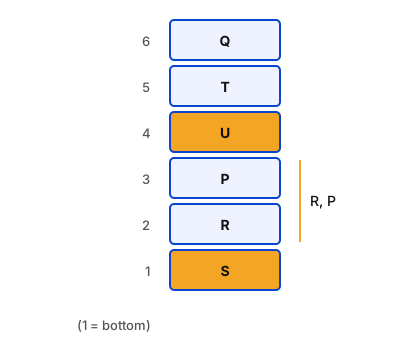
- P = 3; two boxes between P and Q, so Q = 6
- Three boxes between Q and R: R = 2; S just below R: S = 1
- T just below Q: T = 5; remaining U = 4
- Between U (4) and S (1): R and P → two boxes
Trick: Start with the box whose position is given exactly (P).
Answer: (D) Two
अवधारणा: स्थान 1 (नीचे) से 6 (ऊपर) तक मानें और निश्चित संकेत से शुरू करें।
- P = 3; P और Q के बीच दो, अतः Q = 6
- Q और R के बीच तीन: R = 2; S, R के ठीक नीचे: S = 1
- T, Q के ठीक नीचे: T = 5; शेष U = 4
- U (4) और S (1) के बीच: R और P → दो डिब्बे
ट्रिक: जिस डिब्बे का स्थान सीधे दिया हो (P), वहीं से शुरू करें।
उत्तर: (D) दो
RRB Technician Grade IIIGeneral Intelligence and ReasoningBox ArrangementRRB Technician Grade III 2024 · 28 Dec Shift 1
Q1743.Based on the English alphabetical order, three of the following four letter-clusters are alike in a certain way and thus form a group. Which letter-cluster does not belong to that group?
(Note: The odd one out is not based on the number of consonants/vowels or their position in the letter-cluster.)
अंग्रेजी वर्णमाला क्रम के आधार पर, निम्नलिखित चार अक्षर-समूहों में से तीन किसी निश्चित प्रकार से एकसमान हैं और इस प्रकार एक समूह बनाते हैं। कौन-सा अक्षर-समूह उस समूह से संबंधित नहीं है?
(ध्यान दें: असंगत अक्षर-समूह, उस अक्षर-समूह में व्यंजनों/स्वरों की संख्या या उनके स्थान पर आधारित नहीं है।)
- ABVP
- BPKI
- CKEY
- DUOI
Show answer
Concept: Find the gap between consecutive letters (positions, counting cyclically).
- UOI: , i.e.
- BVP: B → V (cyclic), V → P; KEY: K → E, E → Y (cyclic)
- PKI: , i.e. ✗
Trick: For backward cyclic moves, add 26: B = V.
Answer: (B) PKI
अवधारणा: क्रमागत अक्षरों का अंतर (स्थिति से, चक्रीय गिनती) देखें।
- UOI: , यानी
- BVP: B → V (चक्रीय), V → P; KEY: K → E, E → Y (चक्रीय)
- PKI: , यानी ✗
ट्रिक: पीछे की चक्रीय गिनती में 26 जोड़ें: B = V।
उत्तर: (B) PKI
RRB Technician Grade IIIGeneral Intelligence and ReasoningOdd One Out (Letters)RRB Technician Grade III 2024 · 28 Dec Shift 1
Q1744.Based on the English alphabetical order, three of the following four letter-cluster pairs are alike in a certain way and thus form a group. Which pair does not belong to that group?
(Note: The odd one out is not based on the number of consonants/vowels or their position in the letter cluster.)
अंग्रेजी वर्णमाला क्रम के आधार पर, निम्नलिखित चार अक्षर-समूह युग्मों में से तीन किसी निश्चित प्रकार से एकसमान हैं और इस प्रकार एक समूह बनाते हैं। कौन-सा युग्म उस समूह से संबंधित नहीं है?
(ध्यान दें: असंगत युग्म, उस अक्षर-समूह में व्यंजनों/स्वरों की संख्या या उनके स्थान पर आधारित नहीं है।)
- AOS-NR
- BIM-HK
- CLP-KN
- DFJ-EH
Show answer
Concept: Compare the gap inside each cluster and between the two clusters.
- Each pair: first letters drop by 1 (O→N, I→H, L→K, F→E)
- First cluster gap in all (OS, IM, LP, FJ)
- Second cluster gap: HK, KN, EH , but NR
- So OS-NR is different
Trick: Write the gaps as numbers — the one that breaks the pattern stands out.
Answer: (A) OS-NR
अवधारणा: हर समूह के भीतर और दोनों समूहों के बीच का अंतर देखें।
- हर जोड़े में पहला अक्षर 1 घटता है (O→N, I→H, L→K, F→E)
- पहले समूह का अंतर सभी में (OS, IM, LP, FJ)
- दूसरे समूह में: HK, KN, EH , पर NR
- अतः OS-NR अलग है
ट्रिक: अंतर संख्या में लिखें — पैटर्न तोड़ने वाला तुरंत दिखेगा।
उत्तर: (A) OS-NR
RRB Technician Grade IIIGeneral Intelligence and ReasoningOdd One Out (Letter Pairs)RRB Technician Grade III 2024 · 28 Dec Shift 1
Q1745.Read the given statements and conclusions carefully. You have to take the given statements to be true even if they seem to be at variance from commonly known facts and decide which conclusion(s) logically follow(s) from the given statements.
Statements:
All buds are flowers.
All insects are flowers.
Conclusions:
(I) All buds are insects.
(II) All flowers are buds.
दिए गए कथनों और निष्कर्षों को ध्यानपूर्वक पढ़िए। आपको दिए गए कथनों को सत्य मानना है, भले ही वे सामान्य रूप से ज्ञात तथ्यों से भिन्न प्रतीत होते हों, और निर्णय लेना है कि कौन-सा/से निष्कर्ष दिए गए कथनों का तार्किक रूप से अनुसरण करता है/करते हैं।
कथन:
सभी कलियाँ, फूल हैं।
सभी कीट, फूल हैं।
निष्कर्ष:
(I) सभी कलियाँ, कीट हैं।
(II) सभी फूल, कलियाँ हैं।
- AOnly conclusion (II) followsकेवल निष्कर्ष (II) अनुसरण करता है
- BNeither conclusion (I) nor (II) followsन तो निष्कर्ष (I) और न ही (II) अनुसरण करता है
- COnly conclusion (I) followsकेवल निष्कर्ष (I) अनुसरण करता है
- DBoth conclusions (I) and (II) followदोनों निष्कर्ष (I) और (II) अनुसरण करते हैं
Show answer
Concept: Draw the least-overlap Venn diagram; a conclusion follows only if it is true in every case.
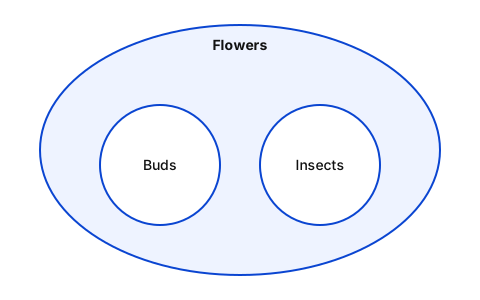
- Buds and Insects are both inside Flowers, but need not touch each other
- I: "All buds are insects" — not certain ✗
- II: "All flowers are buds" — reverse of "All buds are flowers"; not certain ✗
Yaad rakhein: "All A are B" never gives "All B are A".
Answer: (B) Neither conclusion (I) nor (II) follows
अवधारणा: न्यूनतम ओवरलैप वाला वेन आरेख बनाएँ; निष्कर्ष तभी सही जब हर स्थिति में सही हो।
- Buds और Insects दोनों Flowers के अंदर हैं, पर आपस में मिलें, यह ज़रूरी नहीं
- I: "सभी buds, insects हैं" — निश्चित नहीं ✗
- II: "सभी flowers, buds हैं" — "सभी buds, flowers" का उल्टा; निश्चित नहीं ✗
याद रखें: "सभी A, B हैं" से "सभी B, A हैं" कभी नहीं निकलता।
उत्तर: (B) न तो निष्कर्ष (I) और न ही (II) अनुसरण करता है
RRB Technician Grade IIIGeneral Intelligence and ReasoningSyllogismRRB Technician Grade III 2024 · 28 Dec Shift 1
Q1746.Which of the following options should come in place of the question mark (?) in the given series based on the English alphabetical order?
ABC, EDH, IFM, MHR, ?
अंग्रेजी वर्णमाला क्रम के आधार पर दी गई श्रृंखला में प्रश्न चिह्न (?) के स्थान पर निम्नलिखित में से कौन-सा विकल्प आना चाहिए?
ABC, EDH, IFM, MHR, ?
- ARSW
- BQJW
- CQNW
- DQIW
Show answer
Concept: Track each letter position separately.
- 1st letters: A, E, I, M → → Q
- 2nd letters: B, D, F, H → → J
- 3rd letters: C, H, M, R → → W
- Next term: QJW
Trick: Split the three positions into three mini-series.
Answer: (B) QJW
अवधारणा: हर स्थान के अक्षर को अलग-अलग देखें।
- पहला अक्षर: A, E, I, M → → Q
- दूसरा: B, D, F, H → → J
- तीसरा: C, H, M, R → → W
- अगला पद: QJW
ट्रिक: तीनों स्थानों को तीन छोटी श्रृंखलाओं में बाँटें।
उत्तर: (B) QJW
RRB Technician Grade IIIGeneral Intelligence and ReasoningLetter SeriesRRB Technician Grade III 2024 · 28 Dec Shift 1
Q1747.Read the given statements and conclusions carefully. You have to take the given statements to be true even if they seem to be at variance from commonly known facts and decide which conclusion(s) logically follow(s) from the given statements.
Statements:
Some pens are sketch pens.
All sketch pens are erasers.
Some erasers are rulers.
Conclusions:
(I) Some rulers are sketch pens.
(II) Some erasers are pens.
दिए गए कथनों और निष्कर्षों को ध्यानपूर्वक पढ़िए। आपको दिए गए कथनों को सत्य मानना है, भले ही वे सामान्य रूप से ज्ञात तथ्यों से भिन्न प्रतीत होते हों, और निर्णय लेना है कि कौन-सा/से निष्कर्ष दिए गए कथनों का तार्किक रूप से अनुसरण करता है/करते हैं।
कथन:
कुछ पेन, स्केच पेन हैं।
सभी स्केच पेन, इरेज़र हैं।
कुछ इरेज़र, रूलर हैं।
निष्कर्ष:
(I) कुछ रूलर, स्केच पेन हैं।
(II) कुछ इरेज़र, पेन हैं।
- AOnly conclusion (I) follows.केवल निष्कर्ष (I) अनुसरण करता है।
- BNeither conclusion (I) nor (II) follows.न तो निष्कर्ष (I) और न ही (II) अनुसरण करता है।
- CBoth conclusions (I) and (II) follow.दोनों निष्कर्ष (I) और (II) अनुसरण करते हैं।
- DOnly conclusion (II) follows.केवल निष्कर्ष (II) अनुसरण करता है।
Show answer
Concept: Draw a Venn diagram; check if a conclusion is true in every possible case.
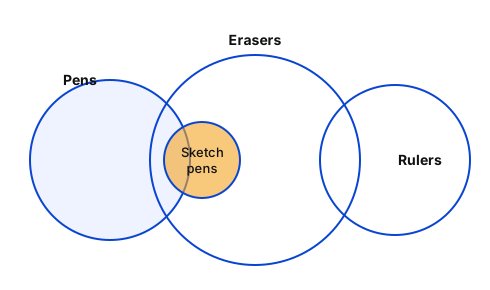
- Some pens are sketch pens, and all sketch pens lie inside erasers
- So those pens that are sketch pens are also erasers → II "Some erasers are pens" follows ✓
- Rulers meet erasers, but need not touch sketch pens → I is not certain ✗
Trick: Some + All = Some: "Some pens are sketch pens" + "All sketch pens are erasers" gives "Some pens are erasers".
Answer: (D) Only conclusion (II) follows.
अवधारणा: वेन आरेख बनाएँ; देखें कि निष्कर्ष हर संभव स्थिति में सही है या नहीं।
- कुछ pens, sketch pens हैं और सभी sketch pens, erasers के अंदर हैं
- अतः जो pens, sketch pens हैं वे erasers भी हैं → II "कुछ erasers, pens हैं" ✓
- Rulers, erasers से मिलते हैं, पर sketch pens से मिलना ज़रूरी नहीं → I निश्चित नहीं ✗
ट्रिक: कुछ + सभी = कुछ: "कुछ pens, sketch pens" + "सभी sketch pens, erasers" = "कुछ pens, erasers"।
उत्तर: (D) केवल निष्कर्ष (II) अनुसरण करता है।
RRB Technician Grade IIIGeneral Intelligence and ReasoningSyllogismRRB Technician Grade III 2024 · 28 Dec Shift 1
Q1748.Given below is a statement followed by two possible reasons numbered I and II. Read the statement carefully and decide which of the two explain(s) the event/observation/information given in the statement.
Statement - Even though sugar is added in most of the food items cooked, it is not good for health.
Reasons:
I. Sugar adds more taste into any food being cooked.
II. Sugar is the most consumed material in the country
नीचे एक कथन दिया गया है, जिसके बाद I और II क्रमांकित दो संभावित कारण दिए गए हैं। कथन को ध्यानपूर्वक पढ़िए और निर्णय लीजिए कि दोनों में से कौन-सा/से कथन में दी गई घटना/अवलोकन/जानकारी की व्याख्या करता है/करते हैं।
कथन - भले ही पकाए जाने वाले अधिकांश खाद्य पदार्थों में चीनी डाली जाती है, फिर भी यह स्वास्थ्य के लिए अच्छी नहीं है।
कारण:
I. चीनी पकाए जा रहे किसी भी भोजन में अधिक स्वाद जोड़ती है।
II. चीनी देश में सबसे अधिक उपभोग की जाने वाली सामग्री है
- ABoth I and II are possible reasons.I और II दोनों संभावित कारण हैं।
- BOnly I is a possible reason.केवल I एक संभावित कारण है।
- COnly II is a possible reason.केवल II एक संभावित कारण है।
- DNeither I nor II is a possible reason.न तो I और न ही II एक संभावित कारण है।
Show answer
Concept: A valid reason must explain the situation described in the statement.
- The statement says sugar is added to most food even though it is unhealthy
- I: sugar adds taste — this explains why people still add it ✓
- II: being the most consumed material does not explain why it is added despite being harmful ✗
Trick: Ask "why does this happen?" — only a reason that answers that "why" is valid.
Answer: (B) Only I is a possible reason.
अवधारणा: मान्य कारण वही है जो कथन में बताई स्थिति को स्पष्ट करे।
- कथन: चीनी स्वास्थ्य के लिए अच्छी नहीं, फिर भी अधिकतर भोजन में डाली जाती है
- I: चीनी स्वाद बढ़ाती है — इससे स्पष्ट है कि लोग फिर भी क्यों डालते हैं ✓
- II: सबसे अधिक उपभोग होना इस "क्यों" का उत्तर नहीं देता ✗
ट्रिक: पूछें "ऐसा क्यों होता है?" — जो कारण इसका उत्तर दे वही मान्य।
उत्तर: (B) केवल I एक संभावित कारण है।
RRB Technician Grade IIIGeneral Intelligence and ReasoningStatement and ReasonsRRB Technician Grade III 2024 · 28 Dec Shift 1
Q1749.In a certain code language, ‘I Drink Juice’ is written as ‘Hu Pu Nu’ and ‘We Drink Water’ is written as ‘Tu Su Hu’ and 'Juice and Water' is written as 'Pu Du Tu'. How is ‘We’ written in the given language?
एक निश्चित कूट भाषा में, ‘I Drink Juice’ को ‘Hu Pu Nu’ लिखा जाता है और ‘We Drink Water’ को ‘Tu Su Hu’ लिखा जाता है तथा 'Juice and Water' को 'Pu Du Tu' लिखा जाता है। उसी भाषा में ‘We’ को कैसे लिखा जाएगा?
- AHu
- BPu
- CTu
- DSu
Show answer
Concept: A word common to two sentences takes the code common to both.
- Drink (1st and 2nd) = Hu; Juice (1st and 3rd) = Pu
- Water (2nd and 3rd) = Tu
- 2nd sentence: We Drink Water = Tu Su Hu, so We = Su
Trick: Remove the known codes from the sentence containing the target word.
Answer: (D) Su
अवधारणा: दो वाक्यों में समान शब्द का कोड भी दोनों में समान होता है।
- Drink (पहला और दूसरा) = Hu; Juice (पहला और तीसरा) = Pu
- Water (दूसरा और तीसरा) = Tu
- दूसरा वाक्य: We Drink Water = Tu Su Hu, अतः We = Su
ट्रिक: लक्ष्य शब्द वाले वाक्य से ज्ञात कोड हटा दें।
उत्तर: (D) Su
RRB Technician Grade IIIGeneral Intelligence and ReasoningCoding-DecodingRRB Technician Grade III 2024 · 28 Dec Shift 1
Q1750.In a certain code language, ‘He Loves Cricket’ is written as ‘Ki Mi Gi’, ‘She Loves To Play’ is written as ‘Si Di Ci Ki’, and 'He Play Chess' is written as 'Ti Gi Di'. How is ‘Chess’ written in the given language?
एक निश्चित कूट भाषा में, ‘He Loves Cricket’ को ‘Ki Mi Gi’ लिखा जाता है, ‘She Loves To Play’ को ‘Si Di Ci Ki’ लिखा जाता है, और 'He Play Chess' को 'Ti Gi Di' लिखा जाता है। उसी भाषा में ‘Chess’ को कैसे लिखा जाएगा?
- AGi
- BTi
- CDi
- DKi
Show answer
Concept: A word common to two sentences takes the code common to both.
- Loves (1st and 2nd) = Ki; He (1st and 3rd) = Gi
- Play (2nd and 3rd) = Di
- He Play Chess = Ti Gi Di, so Chess = Ti
Trick: Remove the known codes from the sentence containing the target word.
Answer: (B) Ti
अवधारणा: दो वाक्यों में समान शब्द का कोड भी दोनों में समान होता है।
- Loves (पहला और दूसरा) = Ki; He (पहला और तीसरा) = Gi
- Play (दूसरा और तीसरा) = Di
- He Play Chess = Ti Gi Di, अतः Chess = Ti
ट्रिक: लक्ष्य शब्द वाले वाक्य से ज्ञात कोड हटा दें।
उत्तर: (B) Ti
RRB Technician Grade IIIGeneral Intelligence and ReasoningCoding-DecodingRRB Technician Grade III 2024 · 28 Dec Shift 1
Q1751.Which of the following are cells of phloem?
निम्नलिखित में से कौन-सी फ्लोएम (phloem) की कोशिकाएँ हैं?
- ATracheids and companion cellsवाहिनिकाएँ (Tracheids) और सहचर कोशिकाएँ (companion cells)
- BTracheids and vesselsवाहिनिकाएँ (Tracheids) और वाहिकाएँ (vessels)
- CSieve tubes and companion cellsचालनी नलिकाएँ (Sieve tubes) और सहचर कोशिकाएँ (companion cells)
- DSieve cells and vesselsचालनी कोशिकाएँ (Sieve cells) और वाहिकाएँ (vessels)
Show answer
Concept: Phloem conducts food (sugars) in plants. It is made of sieve tubes, companion cells, phloem parenchyma and phloem fibres.
- Sieve tubes carry food; companion cells keep the sieve tubes alive and working.
- Tracheids and vessels are elements of xylem (water-conducting), not phloem.
- So options with tracheids or vessels are wrong.
Yaad rakhein: Xylem = Tracheids + Vessels (water); Phloem = Sieve tubes + Companion cells (food).
Answer: (C) Sieve tubes and companion cells
अवधारणा: फ्लोएम पौधों में भोजन (शर्करा) का संवहन करता है। इसमें चालनी नलिकाएँ, सहचर कोशिकाएँ, फ्लोएम मृदूतक और फ्लोएम रेशे होते हैं।
- चालनी नलिकाएँ भोजन ले जाती हैं; सहचर कोशिकाएँ उन्हें सक्रिय रखती हैं।
- वाहिनिकाएँ (tracheids) और वाहिकाएँ (vessels) जाइलम के घटक हैं, फ्लोएम के नहीं।
- इसलिए इन्हें शामिल करने वाले विकल्प ग़लत हैं।
याद रखें: जाइलम = वाहिनिकाएँ + वाहिकाएँ (पानी); फ्लोएम = चालनी नलिकाएँ + सहचर कोशिकाएँ (भोजन)।
उत्तर: (C) चालनी नलिकाएँ (Sieve tubes) और सहचर कोशिकाएँ (companion cells)
RRB Technician Grade IIIGeneral SciencePhloem – componentsRRB Technician Grade III 2024 · 28 Dec Shift 1
Q1752.Which of the following seeds are dispersed by animals, especially spiny seeds with hooks, that get attached to their bodies and are carried to distant places?
निम्नलिखित में से कौन-से बीज जंतुओं द्वारा प्रकीर्णित होते हैं, विशेष रूप से हुक युक्त काँटेदार बीज, जो उनके शरीर से चिपक जाते हैं और दूर-दूर के स्थानों तक ले जाए जाते हैं?
- AXanthium and Urenaज़ैन्थियम (Xanthium) और यूरेना (Urena)
- BCastor and Balsamअरंड (Castor) और गुलमेंहदी (Balsam)
- CDrumstick and Mapleसहजन (Drumstick) और मेपल (Maple)
- DSunflower and Madarसूरजमुखी (Sunflower) और मदार (Madar)
Show answer
Concept: Seeds with spines or hooks stick to the fur of animals and get carried to far-off places.
- Xanthium and Urena have hooked/spiny fruits – dispersed by animals.
- Castor and balsam burst open – dispersal by explosion.
- Drumstick and maple have winged seeds; sunflower and madar have hairy/light seeds – dispersal by wind.
Yaad rakhein: Hooks/spines = animals; wings/hairs = wind; bursting pods = explosion.
Answer: (A) Xanthium and Urena
अवधारणा: काँटेदार या हुक वाले बीज जंतुओं के बालों से चिपककर दूर-दूर तक पहुँच जाते हैं।
- ज़ैंथियम और यूरेना के फल काँटेदार/हुकदार होते हैं – जंतुओं द्वारा प्रकीर्णन।
- अरंडी और बालसम की फलियाँ फटती हैं – विस्फोट द्वारा प्रकीर्णन।
- सहजन और मेपल के बीज पंखयुक्त; सूरजमुखी और मदार के बीज हल्के/रोमयुक्त – पवन द्वारा प्रकीर्णन।
याद रखें: हुक/काँटे = जंतु; पंख/रोम = पवन; फटने वाली फली = विस्फोट।
उत्तर: (A) ज़ैन्थियम (Xanthium) और यूरेना (Urena)
RRB Technician Grade IIIGeneral ScienceSeed dispersal by animalsRRB Technician Grade III 2024 · 28 Dec Shift 1
Q1753.Every cell has a ________ around it to keep its own contents separate from the external environment.
प्रत्येक कोशिका के चारों ओर एक ________ होती है, जो उसकी अपनी सामग्री को बाहरी वातावरण से अलग रखती है।
- Amitochondriaमाइटोकॉन्ड्रिया (mitochondria)
- Bnucleusकेंद्रक (nucleus)
- Ccell wallकोशिका भित्ति (cell wall)
- Dmembraneझिल्ली (membrane)
Show answer
Concept: Every cell – plant, animal or bacterial – is bounded by a plasma (cell) membrane that separates its contents from the surroundings.
- The membrane is selectively permeable and controls entry and exit of substances.
- Cell wall is present only in plants, fungi and bacteria – not in every cell.
- Nucleus and mitochondria are inside the cell, not around it.
Yaad rakhein: Membrane = in ALL cells; cell wall = only in some (plants, fungi, bacteria).
Answer: (D) membrane
अवधारणा: हर कोशिका – पादप, जंतु या जीवाणु – प्लाज़्मा (कोशिका) झिल्ली से घिरी होती है, जो उसकी सामग्री को बाहरी वातावरण से अलग रखती है।
- यह झिल्ली वरणात्मक पारगम्य होती है और पदार्थों के आने-जाने को नियंत्रित करती है।
- कोशिका भित्ति केवल पौधों, कवकों और जीवाणुओं में होती है – हर कोशिका में नहीं।
- केन्द्रक और माइटोकॉन्ड्रिया कोशिका के अंदर होते हैं, चारों ओर नहीं।
याद रखें: झिल्ली = सभी कोशिकाओं में; भित्ति = केवल कुछ में (पौधे, कवक, जीवाणु)।
उत्तर: (D) झिल्ली (membrane)
RRB Technician Grade IIIGeneral ScienceCell membraneRRB Technician Grade III 2024 · 28 Dec Shift 1
Q1754.What is the equivalent resistance of a series combination of resistors?
प्रतिरोधकों के श्रेणीक्रम संयोजन (series combination) का तुल्य प्रतिरोध (equivalent resistance) क्या होता है?
- AThe reciprocal of the sum of the individual resistances.अलग-अलग प्रतिरोधों के योग का व्युत्क्रम।
- BThe sum of the individual resistances.अलग-अलग प्रतिरोधों का योग।
- CThe product of the individual resistances.अलग-अलग प्रतिरोधों का गुणनफल।
- DThe difference between the individual resistances.अलग-अलग प्रतिरोधों के बीच का अंतर।
Show answer
Concept: In series, the same current flows through every resistor, and the total voltage is the sum of the individual voltages.
- Dividing by :
- The reciprocal-sum rule is for parallel.
Yaad rakhein: Series → simply add; parallel → add reciprocals. Series value is always greater than the largest resistor.
Answer: (B) The sum of the individual resistances.
अवधारणा: श्रेणी क्रम में हर प्रतिरोध से एक ही धारा बहती है और कुल विभवांतर अलग-अलग विभवांतरों का योग होता है।
- से भाग देने पर:
- व्युत्क्रमों का योग समांतर क्रम के लिए है।
याद रखें: श्रेणी → सीधे जोड़ें; समांतर → व्युत्क्रम जोड़ें। श्रेणी का मान सबसे बड़े प्रतिरोध से भी अधिक होता है।
उत्तर: (B) अलग-अलग प्रतिरोधों का योग।
RRB Technician Grade IIIGeneral ScienceResistors in seriesRRB Technician Grade III 2024 · 28 Dec Shift 1
Q1755.Which of the following gases present in the atmosphere is used by terrestrial organisms for respiration?
वायुमंडल में उपस्थित निम्नलिखित में से किस गैस का उपयोग स्थलीय जीवों द्वारा श्वसन के लिए किया जाता है?
- ANitrogenनाइट्रोजन
- BOxygenऑक्सीजन
- CNeonनियॉन
- DHydrogenहाइड्रोजन
Show answer
Concept: Aerobic respiration in land organisms uses oxygen from the atmosphere to break down glucose and release energy.
- + energy
- Nitrogen (about 78% of air) is inert for respiration; neon is a noble gas; free hydrogen is negligible in air.
- Oxygen forms about 21% of air.
Yaad rakhein: Respiration takes in and gives out ; photosynthesis does the reverse.
Answer: (B) Oxygen
अवधारणा: स्थलीय जीवों में वायवीय श्वसन वायुमंडल की ऑक्सीजन से ग्लूकोज़ को तोड़कर ऊर्जा मुक्त करता है।
- + ऊर्जा
- नाइट्रोजन (वायु का लगभग 78%) श्वसन में प्रयुक्त नहीं होती; नियॉन अक्रिय गैस है; वायु में मुक्त हाइड्रोजन नगण्य है।
- वायु में ऑक्सीजन लगभग 21% है।
याद रखें: श्वसन में ली जाती है और निकलती है; प्रकाश-संश्लेषण इसका उल्टा है।
उत्तर: (B) ऑक्सीजन
RRB Technician Grade IIIGeneral ScienceGases for respirationRRB Technician Grade III 2024 · 28 Dec Shift 1
Q1756.Among the following cases, which kind of magnetic field production is found similar to the magnetic-field of a bar magnet?
निम्नलिखित स्थितियों में से, किस प्रकार से उत्पन्न चुंबकीय क्षेत्र एक छड़ चुंबक (bar magnet) के चुंबकीय क्षेत्र के समान पाया जाता है?
- AA circular loop carrying current.धारावाही वृत्ताकार लूप।
- BA rectangular loop carrying current.धारावाही आयताकार लूप।
- CAn infinitely long wire carrying current.धारावाही अनंत लंबा तार।
- DA solenoid of finite length carrying current.सीमित लंबाई की धारावाही परिनालिका (solenoid)।
Show answer
Concept: A solenoid is a long coil of many circular turns of insulated wire. When current flows, its field pattern is just like that of a bar magnet.
- Field lines emerge from one end (N) and enter the other end (S).
- Inside the solenoid the lines are parallel and straight – the field is nearly uniform.
- A single loop or a straight wire gives circular/concentric field lines, not a bar-magnet pattern.
Yaad rakhein: Current-carrying solenoid = bar magnet; with a soft-iron core it becomes an electromagnet.
Answer: (D) A solenoid of finite length carrying current.
अवधारणा: परिनालिका विद्युतरोधी तार के अनेक वृत्ताकार फेरों वाली लंबी कुंडली है। धारा प्रवाहित होने पर इसका क्षेत्र-पैटर्न छड़ चुंबक जैसा होता है।
- क्षेत्र रेखाएँ एक सिरे (N) से निकलकर दूसरे सिरे (S) में प्रवेश करती हैं।
- परिनालिका के अंदर रेखाएँ सीधी व समांतर होती हैं – क्षेत्र लगभग एकसमान।
- एक लूप या सीधा तार वृत्ताकार/संकेंद्री रेखाएँ बनाता है, छड़ चुंबक जैसा पैटर्न नहीं।
याद रखें: धारावाही परिनालिका = छड़ चुंबक; नर्म लोहे की कोर डालने पर विद्युत-चुंबक बन जाती है।
उत्तर: (D) सीमित लंबाई की धारावाही परिनालिका (solenoid)।
RRB Technician Grade IIIGeneral ScienceMagnetic field of a solenoidRRB Technician Grade III 2024 · 28 Dec Shift 1
Q1757.Which of the following examples is NOT an example of combination reaction?
निम्नलिखित में से कौन-सा उदाहरण संयोजन अभिक्रिया (combination reaction) का उदाहरण नहीं है?
- ABurning of coalकोयले का दहन
- BFormation of slaked lime from quick limeबिना बुझे चूने (quick lime) से बुझे हुए चूने (slaked lime) का बनना
- CFormation of waterजल का बनना
- DFormation of iron sulphate from copper sulphate and ironकॉपर सल्फेट और आयरन से आयरन सल्फेट का बनना
Show answer
Concept: In a combination reaction two or more reactants join to form a single product.
- Burning of coal: – combination.
- Slaked lime: – combination.
- Water: – combination.
- – iron displaces copper, so it is a displacement reaction.
Trick: Single product → combination; a more reactive metal pushing out another → displacement.
Answer: (D) Formation of iron sulphate from copper sulphate and iron
अवधारणा: संयोजन अभिक्रिया में दो या अधिक अभिकारक मिलकर एक ही उत्पाद बनाते हैं।
- कोयले का जलना: – संयोजन।
- बुझा चूना: – संयोजन।
- जल बनना: – संयोजन।
- – लोहा ताँबे को हटाता है, अतः यह विस्थापन अभिक्रिया है।
ट्रिक: एक ही उत्पाद → संयोजन; अधिक क्रियाशील धातु दूसरी को हटाए → विस्थापन।
उत्तर: (D) कॉपर सल्फेट और आयरन से आयरन सल्फेट का बनना
RRB Technician Grade IIIGeneral ScienceCombination vs displacement reactionRRB Technician Grade III 2024 · 28 Dec Shift 1
Q1758.Which of the following reproduces by budding?
निम्नलिखित में से कौन मुकुलन (budding) द्वारा प्रजनन करता है?
- AMosquitoमच्छर
- BLiver flukeलिवर फ्लूक (Liver fluke)
- CAlgaeशैवाल (Algae)
- DHydraहाइड्रा
Show answer
Concept: In budding, a small outgrowth (bud) forms on the parent due to repeated cell division, grows, and detaches as a new individual.
- Hydra reproduces by budding (also regenerates).
- Mosquito and liver fluke reproduce sexually; algae like Spirogyra mostly reproduce by fragmentation.
- Yeast is another common example of budding.
Yaad rakhein: Budding = Hydra & Yeast; Fragmentation = Spirogyra; Regeneration = Planaria.
Answer: (D) Hydra
अवधारणा: मुकुलन में बार-बार कोशिका विभाजन से जनक पर एक छोटा उभार (मुकुल) बनता है, जो बढ़कर अलग होकर नया जीव बन जाता है।
- हाइड्रा मुकुलन से जनन करता है (पुनर्जनन भी करता है)।
- मच्छर और लिवर फ्लूक लैंगिक जनन करते हैं; स्पाइरोगाइरा जैसे शैवाल मुख्यतः खंडन से।
- यीस्ट भी मुकुलन का एक सामान्य उदाहरण है।
याद रखें: मुकुलन = हाइड्रा व यीस्ट; खंडन = स्पाइरोगाइरा; पुनर्जनन = प्लेनेरिया।
उत्तर: (D) हाइड्रा
RRB Technician Grade IIIGeneral ScienceBuddingRRB Technician Grade III 2024 · 28 Dec Shift 1
Q1759.Which of the following organisms show a parasitic nutritive strategy?
निम्नलिखित में से कौन-से जीव परजीवी पोषण रणनीति (parasitic nutritive strategy) प्रदर्शित करते हैं?
- ACuscutaअमरबेल (Cuscuta)
- BAcaciaबबूल (Acacia)
- CMossesमॉस (Mosses)
- DOrchidsऑर्किड (Orchids)
Show answer
Concept: A parasite takes food from a living host and harms it.
- Cuscuta (amarbel) is leafless and yellow; it winds around a host and absorbs food through special roots called haustoria.
- Acacia and mosses make their own food (autotrophs).
- Orchids are epiphytes – they only use trees for support, not food.
Yaad rakhein: Cuscuta = total stem parasite (amarbel); orchids = epiphytes, not parasites.
Answer: (A) Cuscuta
अवधारणा: परजीवी जीवित परपोषी से भोजन लेता है और उसे हानि पहुँचाता है।
- कस्कुटा (अमरबेल) पत्ती-रहित और पीला होता है; यह परपोषी पर लिपटकर चूषकांगों (हॉस्टोरिया) से भोजन सोखता है।
- बबूल और मॉस अपना भोजन स्वयं बनाते हैं (स्वपोषी)।
- ऑर्किड अधिपादप हैं – पेड़ से केवल सहारा लेते हैं, भोजन नहीं।
याद रखें: कस्कुटा = पूर्ण स्तंभ परजीवी (अमरबेल); ऑर्किड = अधिपादप, परजीवी नहीं।
उत्तर: (A) अमरबेल (Cuscuta)
RRB Technician Grade IIIGeneral ScienceParasitic nutrition in plantsRRB Technician Grade III 2024 · 28 Dec Shift 1
Q1760.Which of the following is NOT a characteristic of a gas?
निम्नलिखित में से कौन-सा गैस का अभिलक्षण नहीं है?
- AIt is highly compressible.यह अत्यधिक संपीड्य (compressible) होती है।
- BThe particles are very loosely packed.इसके कण बहुत ढीले-ढाले संकुलित होते हैं।
- CThe rate of diffusion is very high.इसकी विसरण (diffusion) की दर बहुत अधिक होती है।
- DIt has a fixed shape.इसकी एक निश्चित आकृति होती है।
Show answer
Concept: Gas particles are very far apart and move freely in all directions.
- Large gaps → gases are highly compressible.
- Particles loosely packed with weak attraction → very fast diffusion.
- Because particles are free, a gas takes the shape (and volume) of its container – it has no fixed shape.
Yaad rakhein: Solid: fixed shape & volume; Liquid: fixed volume only; Gas: neither.
Answer: (D) It has a fixed shape.
अवधारणा: गैस के कण एक-दूसरे से बहुत दूर होते हैं और सभी दिशाओं में स्वतंत्र रूप से गति करते हैं।
- अधिक रिक्त स्थान → गैसें अत्यधिक संपीड्य होती हैं।
- कण ढीले और आकर्षण कम → विसरण बहुत तेज़।
- कण स्वतंत्र हैं, इसलिए गैस बर्तन का आकार (और आयतन) ले लेती है – इसका कोई निश्चित आकार नहीं होता।
याद रखें: ठोस: निश्चित आकार व आयतन; द्रव: केवल निश्चित आयतन; गैस: दोनों नहीं।
उत्तर: (D) इसकी एक निश्चित आकृति होती है।
RRB Technician Grade IIIGeneral ScienceProperties of gasesRRB Technician Grade III 2024 · 28 Dec Shift 1

