Q1761.Select the parasitic plant from the given options.
दिए गए विकल्पों में से परजीवी पौधे का चयन कीजिए।
- ACucumberखीरा (Cucumber)
- BCuscutaअमरबेल (Cuscuta)
- CCabbageपत्तागोभी (Cabbage)
- DCactusनागफनी (Cactus)
Show answer
Concept: A parasitic plant depends on another living plant (host) for its food.
- Cuscuta (amarbel) has no chlorophyll and grows on host plants, sucking nutrients through haustoria.
- Cucumber, cabbage and cactus are green plants that photosynthesise – autotrophs.
- Cactus is only adapted to deserts, not parasitic.
Yaad rakhein: Yellow, leafless, thread-like climber on trees = Cuscuta (amarbel).
Answer: (B) Cuscuta
अवधारणा: परजीवी पौधा अपने भोजन के लिए किसी अन्य जीवित पौधे (परपोषी) पर निर्भर रहता है।
- कस्कुटा (अमरबेल) में क्लोरोफिल नहीं होता; यह परपोषी पर उगकर चूषकांगों से पोषक तत्व खींचता है।
- खीरा, पत्तागोभी और नागफनी हरे पौधे हैं जो प्रकाश-संश्लेषण करते हैं – स्वपोषी।
- नागफनी केवल मरुस्थल के अनुकूल है, परजीवी नहीं।
याद रखें: पेड़ों पर पीली, पत्ती-रहित धागे जैसी बेल = कस्कुटा (अमरबेल)।
उत्तर: (B) अमरबेल (Cuscuta)
RRB Technician Grade IIIGeneral ScienceParasitic plantRRB Technician Grade III 2024 · 28 Dec Shift 1
Q1762.Which of the following does NOT correctly match a change in the state of matter with its corresponding process?
निम्नलिखित में से कौन-सा, पदार्थ की अवस्था में परिवर्तन का उसकी संगत प्रक्रिया के साथ सही मिलान नहीं करता है?
- AGas to Solid: Depositionगैस से ठोस: निक्षेपण (Deposition)
- BGas to Liquid: Sublimationगैस से द्रव: ऊर्ध्वपातन (Sublimation)
- CSolid to Gas: Sublimationठोस से गैस: ऊर्ध्वपातन (Sublimation)
- DLiquid to Gas: Evaporationद्रव से गैस: वाष्पीकरण (Evaporation)
Show answer
Concept: Each change of state has a specific name.
- Gas → solid directly: deposition (correct).
- Solid → gas directly: sublimation (correct).
- Liquid → gas below boiling point: evaporation (correct).
- Gas → liquid is condensation, not sublimation – so this pair is wrong.
Yaad rakhein: Melting (S→L), Freezing (L→S), Evaporation (L→G), Condensation (G→L), Sublimation (S→G), Deposition (G→S).
Answer: (B) Gas to Liquid: Sublimation
अवधारणा: हर अवस्था परिवर्तन का एक विशेष नाम होता है।
- गैस → ठोस सीधे: निक्षेपण (सही)।
- ठोस → गैस सीधे: ऊर्ध्वपातन (सही)।
- क्वथनांक से नीचे द्रव → गैस: वाष्पीकरण (सही)।
- गैस → द्रव संघनन है, ऊर्ध्वपातन नहीं – अतः यह युग्म ग़लत है।
याद रखें: गलन (ठोस→द्रव), हिमीकरण (द्रव→ठोस), वाष्पीकरण (द्रव→गैस), संघनन (गैस→द्रव), ऊर्ध्वपातन (ठोस→गैस), निक्षेपण (गैस→ठोस)।
उत्तर: (B) गैस से द्रव: ऊर्ध्वपातन (Sublimation)
RRB Technician Grade IIIGeneral ScienceChanges of stateRRB Technician Grade III 2024 · 28 Dec Shift 1
Q1763.Which of the following statements is/are correct related to respiration?
(i) Pyruvate is converted into ethanol and carbon dioxide in yeast during fermentation.
(ii) The break-down of pyruvate using oxygen takes place in chloroplast.
(iii) In muscle cells, pyruvate is converted into lactic acid.
श्वसन से संबंधित निम्नलिखित में से कौन-सा/से कथन सही है/हैं?
(i) किण्वन के दौरान यीस्ट में पायरुवेट, एथेनॉल और कार्बन डाइऑक्साइड में परिवर्तित हो जाता है।
(ii) ऑक्सीजन का उपयोग करके पायरुवेट का विखंडन हरितलवक (chloroplast) में होता है।
(iii) पेशी कोशिकाओं में, पायरुवेट लैक्टिक अम्ल में परिवर्तित हो जाता है।
- AOnly (i) and (ii)केवल (i) और (ii)
- BOnly (i)केवल (i)
- COnly (i) and (iii)केवल (i) और (iii)
- D(i), (ii) and (iii)(i), (ii) और (iii)
Show answer
Concept: Glucose first breaks into pyruvate in the cytoplasm; pyruvate then follows different pathways.
- (i) Yeast (anaerobic): pyruvate → ethanol + + energy. Correct.
- (ii) Aerobic breakdown of pyruvate with oxygen occurs in the mitochondria, not chloroplast. Incorrect.
- (iii) Muscles (lack of oxygen): pyruvate → lactic acid (causes cramps). Correct.
Yaad rakhein: Chloroplast = photosynthesis; mitochondria = aerobic respiration (powerhouse).
Answer: (C) Only (i) and (iii)
अवधारणा: ग्लूकोज़ पहले कोशिकाद्रव्य में पाइरुवेट में टूटता है; फिर पाइरुवेट अलग-अलग मार्ग अपनाता है।
- (i) यीस्ट (अवायवीय): पाइरुवेट → एथेनॉल + + ऊर्जा। सही।
- (ii) ऑक्सीजन से पाइरुवेट का विखंडन माइटोकॉन्ड्रिया में होता है, हरितलवक में नहीं। ग़लत।
- (iii) पेशियों में (ऑक्सीजन की कमी): पाइरुवेट → लैक्टिक अम्ल (ऐंठन)। सही।
याद रखें: हरितलवक = प्रकाश-संश्लेषण; माइटोकॉन्ड्रिया = वायवीय श्वसन (ऊर्जा घर)।
उत्तर: (C) केवल (i) और (iii)
RRB Technician Grade IIIGeneral ScienceBreakdown of pyruvateRRB Technician Grade III 2024 · 28 Dec Shift 1
Q1764.Which of the following organisms has NO genetically predetermined sex?
निम्नलिखित में से किस जीव का लिंग आनुवंशिक रूप से पूर्वनिर्धारित नहीं होता है?
- ADogsकुत्ते
- BPigeonकबूतर
- CHumanमानव
- DSnailघोंघा (Snail)
Show answer
Concept: In many animals sex is fixed by genes/chromosomes, but in some it is not genetically predetermined.
- Humans, dogs and pigeons – sex is decided by sex chromosomes.
- In snails, individuals can change sex, so sex is not genetically fixed.
- In some reptiles, egg incubation temperature decides the sex.
Yaad rakhein: NCERT: snail – sex can change; turtle/crocodile – temperature decides sex.
Answer: (D) Snail
अवधारणा: अनेक जंतुओं में लिंग जीन/गुणसूत्रों से तय होता है, पर कुछ में यह आनुवंशिक रूप से पूर्वनिर्धारित नहीं होता।
- मनुष्य, कुत्ते और कबूतर – लिंग गुणसूत्रों से तय होता है।
- घोंघे में जीव अपना लिंग बदल सकते हैं, अतः लिंग आनुवंशिक रूप से निश्चित नहीं।
- कुछ सरीसृपों में अंडे के ऊष्मायन का ताप लिंग तय करता है।
याद रखें: NCERT: घोंघा – लिंग बदल सकता है; कछुआ/मगरमच्छ – ताप से लिंग तय।
उत्तर: (D) घोंघा (Snail)
RRB Technician Grade IIIGeneral ScienceSex determinationRRB Technician Grade III 2024 · 28 Dec Shift 1
Q1765.The potential energy possessed by an object of mass 8 kg when it is at a height of 5 m above the ground will be (g is acceleration due to gravity in SI unit):
8 kg द्रव्यमान की किसी वस्तु की स्थितिज ऊर्जा (potential energy) कितनी होगी, जब वह भूमि से 5 m की ऊँचाई पर है (g, SI मात्रक में गुरुत्वीय त्वरण है)?
- A100g J
- B200g J
- C40g J
- D20g J
Show answer
Concept: Potential energy of a body at height : .
- ,
Trick: Just multiply mass × height and keep as it is: .
Answer: (C) 40g J
अवधारणा: ऊँचाई पर स्थित वस्तु की स्थितिज ऊर्जा: ।
- ,
ट्रिक: केवल द्रव्यमान × ऊँचाई करें और को वैसा ही रखें: ।
उत्तर: (C) 40g J
RRB Technician Grade IIIGeneral SciencePotential energyRRB Technician Grade III 2024 · 28 Dec Shift 1
Q1766.Which of the following is an example of a heterogeneous solution?
निम्नलिखित में से कौन-सा विषमांगी विलयन (heterogeneous solution) का एक उदाहरण है?
- AMixture of ethanol in waterजल में एथेनॉल का मिश्रण
- BMixture of oil in waterजल में तेल का मिश्रण
- CLemonadeनींबू पानी (Lemonade)
- DTincture of iodineआयोडीन का टिंचर
Show answer
Concept: A heterogeneous mixture has non-uniform composition; its components can be seen as separate layers or particles.
- Oil does not dissolve in water – it forms a separate layer → heterogeneous.
- Ethanol in water, lemonade and tincture of iodine (iodine in alcohol) are uniform → homogeneous solutions.
Yaad rakhein: Oil + water = immiscible = heterogeneous; separated using a separating funnel.
Answer: (B) Mixture of oil in water
अवधारणा: विषमांगी मिश्रण का संघटन एकसमान नहीं होता; इसके घटक अलग परत या कणों के रूप में दिखते हैं।
- तेल पानी में नहीं घुलता – अलग परत बनाता है → विषमांगी।
- पानी में एथेनॉल, नींबू पानी और टिंचर आयोडीन (एल्कोहॉल में आयोडीन) एकसमान हैं → समांगी विलयन।
याद रखें: तेल + पानी = अमिश्रणीय = विषमांगी; पृथक्कारी कीप से अलग करते हैं।
उत्तर: (B) जल में तेल का मिश्रण
RRB Technician Grade IIIGeneral ScienceHeterogeneous mixturesRRB Technician Grade III 2024 · 28 Dec Shift 1
Q1767.The relation between power (), voltage () and resistance () is given by ____.
शक्ति (), वोल्टता () और प्रतिरोध () के बीच संबंध ____ द्वारा दिया जाता है।
- A
- B
- C
- D
Show answer
Concept: Electric power ; combine it with Ohm's law .
- Put in .
- Also .
Yaad rakhein: Three forms: .
Answer: (A)
अवधारणा: विद्युत शक्ति ; इसे ओम के नियम से जोड़ें।
- में रखें।
- साथ ही ।
याद रखें: तीन रूप: ।
उत्तर: (A)
RRB Technician Grade IIIGeneral ScienceElectric power formulasRRB Technician Grade III 2024 · 28 Dec Shift 1
Q1768.What causes the wavy appearance of objects seen through a turbulent stream of hot air?
गर्म वायु की विक्षुब्ध धारा में से देखी गई वस्तुओं के लहराते हुए दिखाई देने का कारण क्या है?
- ARefraction of lightप्रकाश का अपवर्तन
- BDiffraction of lightप्रकाश का विवर्तन
- CAbsorption of lightप्रकाश का अवशोषण
- DInterference of lightप्रकाश का व्यतिकरण
Show answer
Concept: Hot air is less dense (optically rarer) than cooler air above it, so its refractive index differs from place to place.
- Above a fire or hot road, the refractive index keeps changing as the air moves.
- Light from objects bends (refracts) by varying amounts.
- So the apparent position of the object keeps fluctuating – it looks wavy.
Yaad rakhein: Wavy objects over fire, twinkling of stars, advance sunrise – all due to atmospheric refraction.
Answer: (A) Refraction of light
अवधारणा: गर्म वायु अपने ऊपर की ठंडी वायु से कम सघन (प्रकाशतः विरल) होती है, इसलिए अपवर्तनांक जगह-जगह बदलता है।
- आग या गर्म सड़क के ऊपर वायु के हिलने से अपवर्तनांक लगातार बदलता रहता है।
- वस्तु से आने वाला प्रकाश अलग-अलग मात्रा में मुड़ता (अपवर्तित होता) है।
- इसलिए वस्तु की आभासी स्थिति बदलती रहती है – वह लहराती दिखती है।
याद रखें: आग के ऊपर लहराती वस्तुएँ, तारों का टिमटिमाना, जल्दी सूर्योदय – सब वायुमंडलीय अपवर्तन से।
उत्तर: (A) प्रकाश का अपवर्तन
RRB Technician Grade IIIGeneral ScienceAtmospheric refraction – hot airRRB Technician Grade III 2024 · 28 Dec Shift 1
Q1769.Which of the following statements is INCORRECT for colloid?
कोलॉइड के लिए निम्नलिखित में से कौन-सा कथन गलत है?
- AColloid is a homogeneous mixture.कोलॉइड एक समांगी मिश्रण है।
- BThey do not settle down when left undisturbed.अबाधित छोड़ने पर वे नीचे नहीं बैठते हैं।
- CColloid is a heterogeneous mixture.कोलॉइड एक विषमांगी मिश्रण है।
- DColloidal particles scatter a beam of light passing through it.कोलॉइडी कण उनसे होकर गुजरने वाले प्रकाश के किरण-पुंज को प्रकीर्णित कर देते हैं।
Show answer
Concept: A colloid has particles of size about 1–1000 nm – between a true solution and a suspension.
- It appears homogeneous but is actually a heterogeneous mixture.
- Particles are too small to settle down when left undisturbed.
- Particles scatter a beam of light – Tyndall effect.
- So the statement 'colloid is a homogeneous mixture' is incorrect.
Yaad rakhein: Colloid: looks homogeneous, is heterogeneous, shows Tyndall effect, does not settle.
Answer: (A) Colloid is a homogeneous mixture.
अवधारणा: कोलॉइड के कणों का आकार लगभग 1–1000 nm होता है – वास्तविक विलयन और निलंबन के बीच।
- यह देखने में समांगी लगता है पर वास्तव में विषमांगी मिश्रण है।
- कण इतने छोटे होते हैं कि स्थिर छोड़ने पर नीचे नहीं बैठते।
- कण प्रकाश पुंज को प्रकीर्णित करते हैं – टिंडल प्रभाव।
- अतः 'कोलॉइड समांगी मिश्रण है' कथन ग़लत है।
याद रखें: कोलॉइड: समांगी दिखता है, विषमांगी होता है, टिंडल प्रभाव दिखाता है, नीचे नहीं बैठता।
उत्तर: (A) कोलॉइड एक समांगी मिश्रण है।
RRB Technician Grade IIIGeneral ScienceColloidsRRB Technician Grade III 2024 · 28 Dec Shift 1
Q1770.In which plant do the buds produced in the notches along the leaf margin, fall on the soil and develop into a new plant?
किस पौधे में पत्ती के किनारे के खाँचों में उत्पन्न कलिकाएँ मिट्टी पर गिरकर एक नए पौधे के रूप में विकसित हो जाती हैं?
- AGrapesअंगूर
- BBryophyllumब्रायोफिलम (पत्थरचट्टा)
- CRoseगुलाब
- DJasmineचमेली
Show answer
Concept: Some plants reproduce vegetatively through their leaves.
- In Bryophyllum, buds form in the notches along the leaf margin.
- When the leaf falls on moist soil, these buds grow into new plants.
- Grapes, rose and jasmine are usually propagated by stem cuttings or layering.
Yaad rakhein: Leaf buds in notches = Bryophyllum (patharchatta).
Answer: (B) Bryophyllum
अवधारणा: कुछ पौधे पत्तियों द्वारा कायिक जनन करते हैं।
- ब्रायोफिलम में पत्ती के किनारे के खाँचों में कलिकाएँ बनती हैं।
- पत्ती नम मिट्टी पर गिरने पर ये कलिकाएँ नए पौधों में विकसित होती हैं।
- अंगूर, गुलाब और चमेली प्रायः तने की कलम या दाब-कलम से उगाए जाते हैं।
याद रखें: पत्ती के खाँचों में कलिकाएँ = ब्रायोफिलम (पत्थरचट्टा)।
उत्तर: (B) ब्रायोफिलम (पत्थरचट्टा)
RRB Technician Grade IIIGeneral ScienceVegetative propagation – leavesRRB Technician Grade III 2024 · 28 Dec Shift 1
Q1771.Which phenomenon is responsible for the blue colour of the sky?
आकाश के नीले रंग के लिए कौन-सी परिघटना उत्तरदायी है?
- AScattering of lightप्रकाश का प्रकीर्णन
- BTotal internal reflectionपूर्ण आंतरिक परावर्तन
- CReflectionपरावर्तन
- DAtmospheric refractionवायुमंडलीय अपवर्तन
Show answer
Concept: Tiny air molecules scatter light of shorter wavelength much more than longer wavelength.
- Blue light has a shorter wavelength than red, so it is scattered the most.
- This scattered blue light reaches our eyes from all directions.
- Hence the sky appears blue. Without atmosphere (e.g. in space) the sky looks dark.
Yaad rakhein: Blue sky, red sunrise/sunset, Tyndall effect – all due to scattering.
Answer: (A) Scattering of light
अवधारणा: वायु के अति सूक्ष्म अणु छोटी तरंगदैर्घ्य वाले प्रकाश को लंबी तरंगदैर्घ्य की तुलना में अधिक प्रकीर्णित करते हैं।
- नीले प्रकाश की तरंगदैर्घ्य लाल से कम होती है, इसलिए वह सबसे अधिक प्रकीर्णित होता है।
- यह प्रकीर्णित नीला प्रकाश हर दिशा से हमारी आँखों तक पहुँचता है।
- इसलिए आकाश नीला दिखता है। वायुमंडल न हो (जैसे अंतरिक्ष में) तो आकाश काला दिखता है।
याद रखें: नीला आकाश, लाल सूर्योदय/सूर्यास्त, टिंडल प्रभाव – सब प्रकीर्णन से।
उत्तर: (A) प्रकाश का प्रकीर्णन
RRB Technician Grade IIIGeneral ScienceBlue colour of the skyRRB Technician Grade III 2024 · 28 Dec Shift 1
Q1772.At which of the following temperatures does a liquid change into a solid upon cooling?
निम्नलिखित में से किस तापमान पर कोई द्रव ठंडा करने पर ठोस में परिवर्तित हो जाता है?
- ACondensation pointसंघनन बिंदु
- BFreezing pointहिमांक (Freezing point)
- CBoiling pointक्वथनांक
- DMelting pointगलनांक
Show answer
Concept: The fixed temperature at which a liquid turns into a solid on cooling is its freezing point.
- For pure water, the freezing point is .
- Melting point is for solid → liquid (on heating); for a pure substance both have the same value.
- Boiling point is liquid → gas; condensation is gas → liquid.
Yaad rakhein: Cooling a liquid → freezing point; heating a solid → melting point.
Answer: (B) Freezing point
अवधारणा: जिस निश्चित ताप पर द्रव ठंडा होकर ठोस बनता है, वह उसका हिमांक है।
- शुद्ध जल का हिमांक है।
- गलनांक ठोस → द्रव (गर्म करने पर) के लिए है; शुद्ध पदार्थ के लिए दोनों का मान समान होता है।
- क्वथनांक द्रव → गैस; संघनन गैस → द्रव।
याद रखें: द्रव ठंडा करें → हिमांक; ठोस गर्म करें → गलनांक।
उत्तर: (B) हिमांक (Freezing point)
RRB Technician Grade IIIGeneral ScienceFreezing pointRRB Technician Grade III 2024 · 28 Dec Shift 1
Q1773.The problem of myopia in human eye can be corrected by using:
मानव नेत्र में निकट-दृष्टि दोष (मायोपिया) की समस्या को किसका उपयोग करके ठीक किया जा सकता है?
- Aa convex lens of suitable powerउपयुक्त क्षमता के उत्तल लेंस
- Ba convex mirror of suitable focal lengthउपयुक्त फोकस दूरी के उत्तल दर्पण
- Ca concave lens of suitable powerउपयुक्त क्षमता के अवतल लेंस
- Da plain glass plateएक समतल काँच की प्लेट
Show answer
Concept: In myopia (near-sightedness) a person sees near objects clearly but not distant ones, because the image forms in front of the retina.
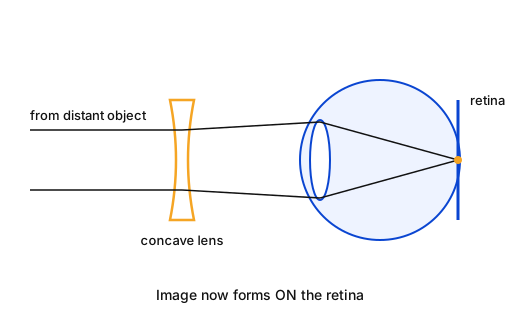
- Cause: eye lens too converging (excessive curvature) or eyeball too long.
- A concave (diverging) lens spreads the rays slightly before they enter the eye.
- The image then forms exactly on the retina.
Trick: Myopia → Minus (concave) lens; Hypermetropia → convex (plus) lens.
Answer: (C) a concave lens of suitable power
अवधारणा: निकट दृष्टि दोष में व्यक्ति पास की वस्तुएँ साफ़ देखता है पर दूर की नहीं, क्योंकि प्रतिबिंब रेटिना के आगे बनता है।
- कारण: नेत्र लेंस की अधिक वक्रता या नेत्र गोलक का लंबा होना।
- अवतल (अपसारी) लेंस किरणों को आँख में जाने से पहले थोड़ा फैला देता है।
- तब प्रतिबिंब ठीक रेटिना पर बनता है।
ट्रिक: निकट दृष्टि → माइनस (अवतल) लेंस; दूर दृष्टि → उत्तल (प्लस) लेंस।
उत्तर: (C) उपयुक्त क्षमता के अवतल लेंस
RRB Technician Grade IIIGeneral ScienceMyopia and its correctionRRB Technician Grade III 2024 · 28 Dec Shift 1
Q1774.Which of the following statements is true about suspension?
निलंबन (suspension) के बारे में निम्नलिखित में से कौन-सा कथन सत्य है?
- AThe particles of a suspension can be seen by the naked eye.निलंबन के कणों को नग्न आँखों से देखा जा सकता है।
- BIt is a homogeneous mixture.यह एक समांगी मिश्रण है।
- CThe solute particles don’t settle down when a suspension is left undisturbed.निलंबन को अबाधित छोड़ने पर विलेय के कण नीचे नहीं बैठते हैं।
- DThe solute particles cannot be separated from the mixture.विलेय के कणों को मिश्रण से पृथक नहीं किया जा सकता है।
Show answer
Concept: A suspension is a heterogeneous mixture whose solid particles are large (above about 1000 nm).
- Particles are big enough to be seen with the naked eye – statement true.
- It is heterogeneous, not homogeneous.
- Particles settle down when left undisturbed and can be separated by filtration.
Yaad rakhein: Suspension: visible particles, settles, filterable, scatters light (e.g. muddy water, chalk in water).
Answer: (A) The particles of a suspension can be seen by the naked eye.
अवधारणा: निलंबन एक विषमांगी मिश्रण है जिसके ठोस कण बड़े (लगभग 1000 nm से अधिक) होते हैं।
- कण इतने बड़े होते हैं कि नंगी आँखों से दिखते हैं – कथन सही।
- यह विषमांगी है, समांगी नहीं।
- स्थिर छोड़ने पर कण नीचे बैठ जाते हैं और छानकर अलग किए जा सकते हैं।
याद रखें: निलंबन: कण दिखते हैं, नीचे बैठते हैं, छन जाते हैं (जैसे मटमैला पानी, पानी में चॉक)।
उत्तर: (A) निलंबन के कणों को नग्न आँखों से देखा जा सकता है।
RRB Technician Grade IIIGeneral ScienceSuspensionsRRB Technician Grade III 2024 · 28 Dec Shift 1
Q1775.Which unicellular organism has a whip-like structure at one end of the cell and binary fission occurs in a definite orientation in relation to these structures?
किस एककोशिकीय जीव में कोशिका के एक सिरे पर कोड़े जैसी संरचना होती है और द्विविभाजन इन संरचनाओं के संबंध में एक निश्चित दिशा में होता है?
- AAmoebaअमीबा
- BYeastयीस्ट
- CPlasmodiumप्लाज्मोडियम
- DLeishmaniaलेस्मानिया (Leishmania)
Show answer
Concept: Unicellular organisms reproduce by binary fission; the plane of division may be random or definite.
- Leishmania (causes kala-azar) has a whip-like flagellum at one end.
- Its binary fission occurs in a definite plane relative to the flagellum.
- In Amoeba, fission can happen in any plane; Plasmodium shows multiple fission; yeast shows budding.
Yaad rakhein: Amoeba – any plane; Leishmania – definite plane; Plasmodium – multiple fission.
Answer: (D) Leishmania
अवधारणा: एककोशिकीय जीव द्विखंडन द्वारा जनन करते हैं; विभाजन का तल अनियमित या निश्चित हो सकता है।
- लीश्मानिया (काला-अज़ार का कारक) के एक सिरे पर चाबुक जैसा कशाभ होता है।
- इसका द्विखंडन कशाभ के सापेक्ष एक निश्चित तल में होता है।
- अमीबा में किसी भी तल में विभाजन; प्लाज़्मोडियम में बहुखंडन; यीस्ट में मुकुलन।
याद रखें: अमीबा – किसी भी तल में; लीश्मानिया – निश्चित तल में; प्लाज़्मोडियम – बहुखंडन।
उत्तर: (D) लेस्मानिया (Leishmania)
RRB Technician Grade IIIGeneral ScienceBinary fission in LeishmaniaRRB Technician Grade III 2024 · 28 Dec Shift 1
Q1776.In a parallel combination of two different resistors, which of the following is/are correct?
(A) The potential difference across each resistor has the same value.
(B) The current flowing through each resistor has the same value.
दो भिन्न प्रतिरोधकों के पार्श्व (समांतर) संयोजन में, निम्नलिखित में से कौन-सा/से सही है/हैं?
(A) प्रत्येक प्रतिरोधक के सिरों पर विभवांतर का मान समान होता है।
(B) प्रत्येक प्रतिरोधक से प्रवाहित होने वाली धारा का मान समान होता है।
- ABoth ‘A’ and ‘B’ are incorrect.‘A’ और ‘B’ दोनों गलत हैं।
- B‘A’ is incorrect and ‘B’ is correct.‘A’ गलत है और ‘B’ सही है।
- C‘A’ is correct and ‘B’ is incorrect.‘A’ सही है और ‘B’ गलत है।
- DBoth ‘A’ and ‘B’ are correct.‘A’ और ‘B’ दोनों सही हैं।
Show answer
Concept: In a parallel combination, every resistor is connected directly between the same two points P and Q.
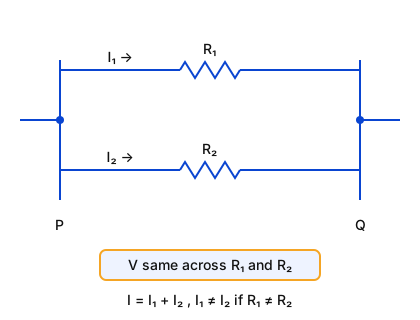
- So the potential difference across each resistor is the same → (A) correct.
- Current divides: , .
- If , then → (B) incorrect. Total .
Yaad rakhein: Series: same current; Parallel: same voltage.
Answer: (C) ‘A’ is correct and ‘B’ is incorrect.
अवधारणा: समांतर क्रम में हर प्रतिरोध सीधे उन्हीं दो बिंदुओं P और Q के बीच जुड़ा होता है।
- इसलिए हर प्रतिरोध पर विभवांतर समान होता है → (A) सही।
- धारा बँटती है: , ।
- यदि तो → (B) ग़लत। कुल ।
याद रखें: श्रेणी: धारा समान; समांतर: विभवांतर समान।
उत्तर: (C) ‘A’ सही है और ‘B’ गलत है।
RRB Technician Grade IIIGeneral ScienceResistors in parallelRRB Technician Grade III 2024 · 28 Dec Shift 1
Q1777.The phenomenon of change of liquid into vapours at any temperature below its boiling point is known as ______.
किसी द्रव का उसके क्वथनांक से कम किसी भी तापमान पर वाष्प में परिवर्तित होने की परिघटना ______ कहलाती है।
- Afusionसंगलन (fusion)
- Bsublimationऊर्ध्वपातन (sublimation)
- Cevaporationवाष्पीकरण (evaporation)
- Ddepositionनिक्षेपण (deposition)
Show answer
Concept: Change of a liquid into vapour at any temperature below its boiling point is evaporation.
- It is a surface phenomenon – only surface particles with enough energy escape.
- Fusion = solid → liquid (melting); sublimation = solid → gas; deposition = gas → solid.
- Evaporation increases with temperature, surface area and wind speed, and decreases with humidity.
Yaad rakhein: Evaporation causes cooling – e.g. sweating, earthen pot (matka) keeps water cool.
Answer: (C) evaporation
अवधारणा: द्रव का अपने क्वथनांक से नीचे किसी भी ताप पर वाष्प में बदलना वाष्पीकरण कहलाता है।
- यह सतही प्रक्रिया है – केवल पर्याप्त ऊर्जा वाले सतह के कण बाहर निकलते हैं।
- संगलन = ठोस → द्रव; ऊर्ध्वपातन = ठोस → गैस; निक्षेपण = गैस → ठोस।
- ताप, सतह क्षेत्रफल और हवा की गति बढ़ने पर वाष्पीकरण बढ़ता है; आर्द्रता बढ़ने पर घटता है।
याद रखें: वाष्पीकरण से ठंडक होती है – जैसे पसीना, मटके का ठंडा पानी।
उत्तर: (C) वाष्पीकरण (evaporation)
RRB Technician Grade IIIGeneral ScienceEvaporationRRB Technician Grade III 2024 · 28 Dec Shift 1
Q1778.‘When a sailor jumps out of a rowing boat, the boat moves backwards’ is an example of which law of motion?
‘जब कोई नाविक नाव से बाहर कूदता है, तो नाव पीछे की ओर चलती है’ यह गति के किस नियम का उदाहरण है?
- ANewton’s third law of motionन्यूटन का गति का तीसरा नियम
- BNewton’s first law of motionन्यूटन का गति का पहला नियम
- CNewton’s second law of motionन्यूटन का गति का दूसरा नियम
- DLaw of inertiaजड़त्व का नियम
Show answer
Concept: Newton's third law: to every action there is an equal and opposite reaction, acting on different bodies.
- When the sailor jumps forward, he pushes the boat backward (action).
- The boat pushes the sailor forward (reaction).
- So the boat moves backward – a direct example of the third law (also momentum conservation).
Yaad rakhein: Recoil of gun, rocket launch, swimming, jumping from a boat – third law.
Answer: (A) Newton’s third law of motion
अवधारणा: न्यूटन का तीसरा नियम: प्रत्येक क्रिया की बराबर और विपरीत प्रतिक्रिया होती है, जो अलग-अलग वस्तुओं पर लगती है।
- नाविक आगे कूदते समय नाव को पीछे धकेलता है (क्रिया)।
- नाव नाविक को आगे धकेलती है (प्रतिक्रिया)।
- इसलिए नाव पीछे जाती है – तीसरे नियम का सीधा उदाहरण (संवेग संरक्षण भी)।
याद रखें: बंदूक का पीछे हटना, रॉकेट, तैरना, नाव से कूदना – तीसरा नियम।
उत्तर: (A) न्यूटन का गति का तीसरा नियम
RRB Technician Grade IIIGeneral ScienceNewton's third lawRRB Technician Grade III 2024 · 28 Dec Shift 1
Q1779.Which of the following phenomena is responsible for Tyndall effect?
टिंडल प्रभाव के लिए निम्नलिखित में से कौन-सी परिघटना उत्तरदायी है?
- AScattering of lightप्रकाश का प्रकीर्णन
- BDispersion of lightप्रकाश का विक्षेपण
- CRefraction of lightप्रकाश का अपवर्तन
- DReflection of lightप्रकाश का परावर्तन
Show answer
Concept: The Tyndall effect is the visible path of a light beam through a colloid, caused by scattering of light by its particles.
- Colloidal particles are large enough to scatter light sideways.
- The scattered light makes the beam's path visible.
- Examples: sunlight beams through a dense forest canopy, light beam in a dusty room.
Yaad rakhein: True solution – no Tyndall effect; colloid & suspension – show it (scattering).
Answer: (A) Scattering of light
अवधारणा: टिंडल प्रभाव कोलॉइड से गुज़रते प्रकाश पुंज का पथ दिखाई देना है, जो कणों द्वारा प्रकाश के प्रकीर्णन से होता है।
- कोलॉइडी कण इतने बड़े होते हैं कि प्रकाश को इधर-उधर बिखेर देते हैं।
- प्रकीर्णित प्रकाश से पुंज का मार्ग दिखाई देता है।
- उदाहरण: घने जंगल में छनकर आती धूप, धूल भरे कमरे में प्रकाश की किरण।
याद रखें: वास्तविक विलयन – टिंडल प्रभाव नहीं; कोलॉइड व निलंबन – दिखाते हैं (प्रकीर्णन)।
उत्तर: (A) प्रकाश का प्रकीर्णन
RRB Technician Grade IIIGeneral ScienceTyndall effectRRB Technician Grade III 2024 · 28 Dec Shift 1
Q1780.Ramu has been given a tub of water with a refractive index of 1.33, a mug of oil with a refractive index of 1.46, a bottle of glycerine with a refractive index of 1.5 and a glass-slab with a refractive index of 1.65. Light will travel fastest in:
रामू को 1.33 अपवर्तनांक वाले पानी का एक टब, 1.46 अपवर्तनांक वाले तेल का एक मग, 1.5 अपवर्तनांक वाली ग्लिसरीन की एक बोतल और 1.65 अपवर्तनांक वाला एक काँच का स्लैब दिया गया है। प्रकाश सबसे तेज़ किसमें चलेगा?
- Aglycerineग्लिसरीन
- Boilतेल
- Cwaterपानी
- Dglass-slabकाँच का स्लैब
Show answer
Concept: Refractive index , so speed of light – lower means higher speed.
- Values: water , oil , glycerine , glass slab .
- Smallest (water).
- So light travels fastest in water: .
Trick: Speed is inversely proportional to refractive index – pick the smallest .
Answer: (C) water
अवधारणा: अपवर्तनांक , अतः प्रकाश की चाल – कम यानी अधिक चाल।
- मान: जल , तेल , ग्लिसरीन , काँच की पट्टी ।
- सबसे कम (जल)।
- इसलिए प्रकाश जल में सबसे तेज़ चलता है: ।
ट्रिक: चाल अपवर्तनांक के व्युत्क्रमानुपाती है – सबसे छोटा चुनें।
उत्तर: (C) पानी
RRB Technician Grade IIIGeneral ScienceRefractive index and speed of lightRRB Technician Grade III 2024 · 28 Dec Shift 1

