Q6341.If house tax is paid before the due date, one gets a reduction of 12% on the amount of the bill. By paying the tax before the due date, a person got a reduction of ₹2,100. The amount (in ₹) of house tax was:
यदि गृह कर नियत तिथि से पहले चुकाया जाता है, तो बिल की राशि पर 12% की छूट मिलती है। नियत तिथि से पहले कर चुकाकर, एक व्यक्ति को ₹2,100 की छूट मिली। गृह कर की राशि (₹ में) कितनी थी?
- A21,000
- B17,500
- C25,000
- D18,000
Show answer
Concept: If of the bill ₹2100, the bill .
- Bill
Trick: , so .
Answer: (B) ₹
अवधारणा: यदि बिल का ₹2100, तो बिल ।
- बिल
ट्रिक: → ।
उत्तर: (B) ₹
SSC CPO Paper IQuantitative AptitudePercentageSSC CPO Paper I 2020 · 23 Nov Shift 3
Q6342.The least number which is exactly divisible by 5, 6, 8, 10 and 12 is:
वह छोटी से छोटी संख्या, जो 5, 6, 8, 10 और 12 से पूर्णतः विभाज्य है, कौन-सी है?
- A180
- B240
- C120
- D150
Show answer
Concept: Least number divisible by all LCM of the numbers.
- , , , ,
- LCM
Trick: Check options from smallest: is divisible by 5, 6, 8, 10, 12.
Answer: (C)
अवधारणा: सबसे छोटी संख्या जो सबसे विभाज्य हो LCM।
- , ,
- LCM
ट्रिक: सबसे छोटे विकल्प से जाँचें: सभी से विभाज्य।
उत्तर: (C)
SSC CPO Paper IQuantitative AptitudeLCMSSC CPO Paper I 2020 · 23 Nov Shift 3
Q6343.The value of is:
का मान क्या है?
- A
- B
- C
- D
Show answer
Concept: Let , . Check: ; ; .
- Expression
Trick: When numbers look odd, test if they are , , of the visible numbers.
Answer: (B)
अवधारणा: माना , । जाँच: ; ; ।
- व्यंजक
ट्रिक: अजीब संख्याएँ दिखें तो जाँचें कि वे , , तो नहीं।
उत्तर: (B)
SSC CPO Paper IQuantitative AptitudeSimplification – Algebraic IdentitiesSSC CPO Paper I 2020 · 23 Nov Shift 3
Q6344.The given bar graph represents the number of boys and girls in five different schools. Study the graph and answer the question that follows.
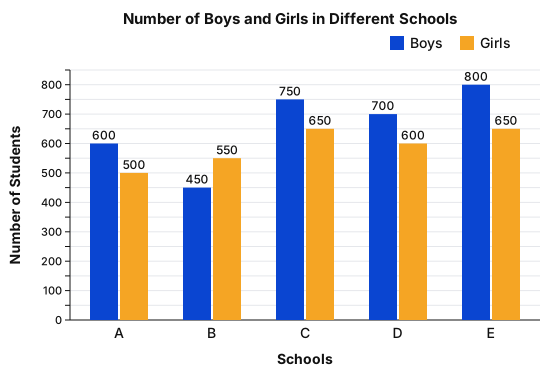
What is the average number of boys in schools A, B, C, D and E?
दिया गया दंड आलेख पाँच विभिन्न विद्यालयों में लड़कों और लड़कियों की संख्या को दर्शाता है। आलेख का अध्ययन कीजिए और उसके बाद दिए गए प्रश्न का उत्तर दीजिए।
विद्यालयों A, B, C, D और E में लड़कों की औसत संख्या कितनी है?
- A660
- B616
- C596
- D569
Show answer
Concept: Average .
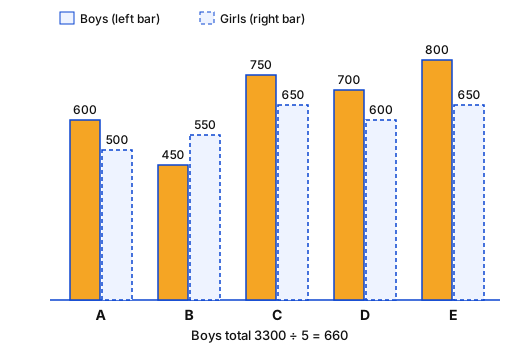
- Boys
- Average
Trick: Deviation from 600: ; .
Answer: (A)
अवधारणा: औसत ।
- लड़के
- औसत
ट्रिक: 600 से विचलन का योग ; ।
उत्तर: (A)
SSC CPO Paper IQuantitative AptitudeData Interpretation – Bar GraphSSC CPO Paper I 2020 · 23 Nov Shift 3
Q6345.If , where is an acute angle, then x is equal to:
यदि है, जहाँ एक न्यून कोण है, तो x किसके बराबर है?
- A
- B
- C
- D
Show answer
Concept: If (both acute), then .
Yaad rakhein: .
Answer: (B)
अवधारणा: यदि (दोनों न्यूनकोण), तो ।
याद रखें: ।
उत्तर: (B)
SSC CPO Paper IQuantitative AptitudeTrigonometry – Complementary AnglesSSC CPO Paper I 2020 · 23 Nov Shift 3
Q6346.The given histogram shows the frequency distribution of the speed of cars passing though at a particular spot on a highway. Study the graph and answer the question that follows.
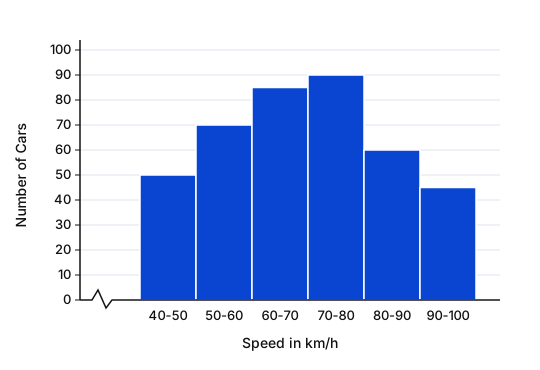
What is the ratio of the number of cars with speed less than 60 km/h to the number of cars with speed more than 80 km/h?
दिया गया आयतचित्र (histogram) किसी राजमार्ग पर एक विशेष स्थान से गुज़रने वाली कारों की गति के बारंबारता बंटन को दर्शाता है। आलेख का अध्ययन कीजिए और उसके बाद दिए गए प्रश्न का उत्तर दीजिए।
60 km/h से कम गति वाली कारों की संख्या का 80 km/h से अधिक गति वाली कारों की संख्या से अनुपात क्या है?
- A8 : 7
- B4 : 5
- C5 : 4
- D7 : 8
Show answer
Concept: Add the class frequencies on each side and simplify the ratio.
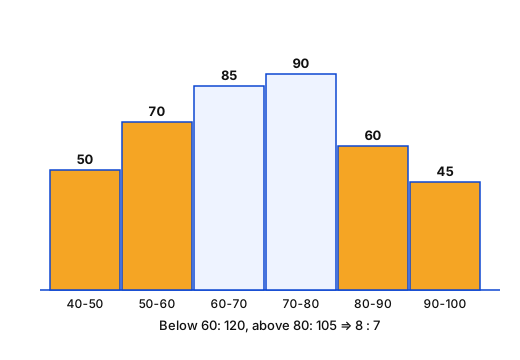
- Below 60 :
- Above 80 :
Trick: Divide both by 15.
Answer: (A)
अवधारणा: दोनों ओर की आवृत्तियाँ जोड़कर अनुपात सरल करें।
- 60 से कम:
- 80 से अधिक:
ट्रिक: दोनों को 15 से भाग दें।
उत्तर: (A)
SSC CPO Paper IQuantitative AptitudeData Interpretation – HistogramSSC CPO Paper I 2020 · 23 Nov Shift 3
Q6347.When operated separately, pipe A takes 5 hours less than pipe B to fill a cistern, and when both pipes are operated together, the cistern gets filled in 6 hours. In how much time (in hours) will pipe B fill the cistern, if operated separately?
अलग-अलग चलाए जाने पर, पाइप A किसी टंकी को भरने में पाइप B से 5 घंटे कम समय लेता है, और जब दोनों पाइप एक साथ चलाए जाते हैं, तो टंकी 6 घंटे में भर जाती है। अलग से चलाए जाने पर पाइप B टंकी को कितने समय (घंटों में) में भरेगा?
- A15
- B18
- C10
- D9
Show answer
Concept: If B takes hours, A takes ; combined rate .
- ; is impossible (), so
Trick: Test options: → A ; ✓.
Answer: (A)
अवधारणा: B को घंटे लगें तो A को ; मिलकर दर ।
- ( असंभव)
ट्रिक: विकल्प जाँचें: ✓।
उत्तर: (A)
SSC CPO Paper IQuantitative AptitudePipes and Cisterns – QuadraticSSC CPO Paper I 2020 · 23 Nov Shift 3
Q6348.The average weight of a group of 3 people A, B and C is 70 kg. When D joins this group, the average becomes 60 kg. One man E, whose weight is 5 kg more than that of D, replaces A and the average weight of B, C, D, and E now becomes 59 kg. A's weight (in kg) is:
3 व्यक्तियों A, B और C के एक समूह का औसत भार 70 kg है। जब D इस समूह में शामिल होता है, तो औसत 60 kg हो जाता है। एक व्यक्ति E, जिसका भार D के भार से 5 kg अधिक है, A का स्थान लेता है और अब B, C, D और E का औसत भार 59 kg हो जाता है। A का भार (kg में) कितना है?
- A50
- B40
- C39
- D59
Show answer
Concept: Convert every average into a total.
- ; with D:
Yaad rakhein: Total average count, at every stage.
Answer: (C)
अवधारणा: हर औसत को योग में बदलें।
- ;
याद रखें: योग औसत संख्या।
उत्तर: (C)
SSC CPO Paper IQuantitative AptitudeAverage – ReplacementSSC CPO Paper I 2020 · 23 Nov Shift 3
Q6349.If the annual rate of simple interest increases from 11% to , a person's yearly income increases by ₹1,071.20. The principal amount invested (in ₹) is:
यदि साधारण ब्याज की वार्षिक दर 11% से बढ़कर हो जाती है, तो एक व्यक्ति की वार्षिक आय में ₹1,071.20 की वृद्धि हो जाती है। निवेश की गई मूलधन राशि (₹ में) कितनी है?
- A19,120
- B16,480
- C17,250
- D10,710
Show answer
Concept: Change in yearly SI .
- Rate change
Trick: → .
Answer: (B) ₹
अवधारणा: वार्षिक ब्याज में परिवर्तन ।
- दर परिवर्तन
ट्रिक: → ।
उत्तर: (B) ₹
SSC CPO Paper IQuantitative AptitudeSimple InterestSSC CPO Paper I 2020 · 23 Nov Shift 3
Q6350.A person travels a distance of 300 km and then returns to the starting point. The time taken by him for the outward journey is 5 hours more than the time taken for the return journey. If he returns at a speed of 10 km/h more than the speed of going, what is the average speed (in km/h) for the entire journey?
एक व्यक्ति 300 km की दूरी तय करता है और फिर प्रारंभिक बिंदु पर लौट आता है। जाने की यात्रा में उसके द्वारा लिया गया समय, वापसी की यात्रा में लिए गए समय से 5 घंटे अधिक है। यदि वह जाने की चाल से 10 km/h अधिक चाल से लौटता है, तो पूरी यात्रा के लिए औसत चाल (km/h में) कितनी है?
- A20
- B15
- C24
- D30
Show answer
Concept: Average speed .
- Let outward speed :
- Times: h and h
- Average
Trick: Check: .
Answer: (C)
अवधारणा: औसत चाल ।
- जाने की चाल :
- समय: घंटे और घंटे
- औसत
ट्रिक: ।
उत्तर: (C)
SSC CPO Paper IQuantitative AptitudeSpeed – Average SpeedSSC CPO Paper I 2020 · 23 Nov Shift 3
Q6351.Identify the segment in the sentence which contains a grammatical error.
Do you earn so much to make both ends meet?
- Amake both
- BDo you earn
- Cends meet
- Dso much to
Show answer
Concept: To show that something is sufficient for a purpose we use adjective/adverb + enough + to-infinitive, not 'so much to'.
- 'So much' needs a result clause with that (so much that …) or 'as to'; 'so much to make' is incorrect.
- The idea is sufficiency: earning sufficient money to meet expenses.
- Correct sentence: Do you earn enough to make both ends meet?
- 'Do you earn', 'make both', 'ends meet' are correct (idiom: make both ends meet = manage expenses).
Trick: Sufficient for a purpose → enough to; result → so … that.
Answer: (D) so much to
अवधारणा: किसी काम के लिए 'पर्याप्त' बताने हेतु enough + to-infinitive आता है, 'so much to' नहीं।
- 'So much' के साथ परिणाम बताने के लिए that (so much that …) या 'as to' चाहिए; 'so much to make' गलत है।
- यहाँ भाव 'पर्याप्त कमाई' का है।
- सही वाक्य: Do you earn enough to make both ends meet?
- 'make both ends meet' = खर्च चला पाना – यह मुहावरा सही है।
ट्रिक: उद्देश्य के लिए पर्याप्त → enough to; परिणाम → so … that।
उत्तर: (D) so much to
SSC CPO Paper IEnglish ComprehensionError Spotting – 'enough to'SSC CPO Paper I 2020 · 23 Nov Shift 3
Q6352.Select the most appropriate synonym of the given word.
CATASTROPHE
- Arestraint
- Bprosperity
- Cexpansion
- Dcalamity
Show answer
Concept: Catastrophe means a sudden event causing great damage or suffering; a disaster.
- Calamity = a great misfortune or disaster – same meaning.
- Restraint = self-control; prosperity = wealth/success (nearly opposite); expansion = growth.
Yaad rakhein: Catastrophe ≈ calamity ≈ disaster ≈ tragedy.
Answer: (D) calamity
अवधारणा: Catastrophe का अर्थ है – महाविपत्ति, आपदा (भारी नुकसान वाली घटना)।
- Calamity = विपत्ति, आपदा – समान अर्थ।
- Restraint = संयम; prosperity = समृद्धि (लगभग विपरीत); expansion = विस्तार।
याद रखें: Catastrophe ≈ calamity ≈ disaster (आपदा)।
उत्तर: (D) calamity
SSC CPO Paper IEnglish ComprehensionSynonymsSSC CPO Paper I 2020 · 23 Nov Shift 3
Q6353.Identify the segment in the sentence which contains a grammatical error.
Nobody has ever listened to me so attentive.
- Ato me
- BNobody has
- Cever listened
- Dso attentive
Show answer
Concept: A verb is modified by an adverb, not an adjective.
- The word describes how somebody 'listened' (a verb).
- 'Attentive' is an adjective; the adverb is 'attentively'.
- Correct: Nobody has ever listened to me so attentively.
- Other parts ('Nobody has', 'ever listened', 'to me') are correct.
Trick: Ask 'how?' about the verb → answer must be an -ly adverb.
Answer: (D) so attentive
अवधारणा: Verb (क्रिया) को विशेषित करने के लिए adverb चाहिए, adjective नहीं।
- शब्द यह बता रहा है कि 'listened' कैसे किया – यानी verb की विशेषता।
- 'Attentive' adjective है; adverb रूप 'attentively' है।
- सही वाक्य: Nobody has ever listened to me so attentively.
- बाकी हिस्से सही हैं।
ट्रिक: Verb से 'कैसे?' पूछें → उत्तर -ly वाला adverb होगा।
उत्तर: (D) so attentive
SSC CPO Paper IEnglish ComprehensionError Spotting – Adjective vs AdverbSSC CPO Paper I 2020 · 23 Nov Shift 3
Q6354.Select the most appropriate ANTONYM of the given word.
IMPUDENT
- Aarrant
- Bbrazen
- Cblatant
- Dmodest
Show answer
Concept: Impudent means rude and disrespectful; shamelessly bold.
- Arrant, brazen and blatant all suggest shameless or open boldness – close to impudent, not opposite.
- Modest = humble, polite, not boastful – the opposite of impudent.
Yaad rakhein: Impudent ↔ modest / respectful / courteous.
Answer: (D) modest
अवधारणा: Impudent का अर्थ है – ढीठ, बेअदब, निर्लज्ज।
- Arrant, brazen, blatant – सभी निर्लज्जता/खुलेपन का भाव देते हैं; ये समानार्थी जैसे हैं।
- Modest = विनम्र, शालीन – impudent का विपरीत।
याद रखें: Impudent (ढीठ) ↔ modest (विनम्र)।
उत्तर: (D) modest
SSC CPO Paper IEnglish ComprehensionAntonymsSSC CPO Paper I 2020 · 23 Nov Shift 3
Q6355.Select the most appropriate meaning of the given idiom.
Speak one’s mind
- Ato speak without thinking
- Bto speak in an assembly
- Cto voice one’s thoughts plainly
- Dto put one’s thoughts in writing
Show answer
Concept: The idiom speak one's mind means to say openly and honestly what one thinks.
- It is about frankness, not carelessness, so 'to speak without thinking' is wrong.
- It has nothing to do with an assembly or with writing.
- Example: She always speaks her mind, even before her seniors.
Yaad rakhein: Speak one's mind = be frank and outspoken.
Answer: (C) to voice one’s thoughts plainly
अवधारणा: Speak one's mind = अपने विचार साफ़-साफ़ और खुलकर कहना।
- यह स्पष्टवादिता है, बिना सोचे बोलना नहीं।
- इसका सभा या लिखने से कोई संबंध नहीं।
- उदाहरण: She always speaks her mind, even before her seniors.
याद रखें: Speak one's mind = मन की बात खुलकर कहना।
उत्तर: (C) to voice one’s thoughts plainly
SSC CPO Paper IEnglish ComprehensionIdioms and PhrasesSSC CPO Paper I 2020 · 23 Nov Shift 3
Q6356.Select the most appropriate one-word substitution for the given group of words.
One who is easily deceived
- Aplausible
- Bagreeable
- Ccredible
- Dgullible
Show answer
Concept: A person who is easily deceived or tricked is gullible.
- Plausible = seeming reasonable or believable (used for statements).
- Credible = trustworthy, believable; agreeable = pleasant.
- Gullible fits: A gullible buyer trusted the fake offer.
Trick: Gullible → think 'gull' = to fool someone; a gullible person is easily fooled.
Answer: (D) gullible
अवधारणा: जो आसानी से धोखा खा जाए, उसे gullible (भोला, जल्दी ठगा जाने वाला) कहते हैं।
- Plausible = विश्वसनीय लगने वाला (बात के लिए)।
- Credible = भरोसेमंद; agreeable = सुखद, सहमत।
- अतः gullible सही है।
ट्रिक: 'gull' = मूर्ख बनाना; gullible = जो आसानी से मूर्ख बने।
उत्तर: (D) gullible
SSC CPO Paper IEnglish ComprehensionOne Word SubstitutionSSC CPO Paper I 2020 · 23 Nov Shift 3
Q6357.Fill in the blank with the most appropriate word.
______! What have you done to your hair? You are looking so odd.
- AHurrah
- BBother
- CBravo
- DGoodness gracious
Show answer
Concept: An interjection must match the emotion of the sentence – here surprise/shock at an odd hairstyle.
- 'Goodness gracious!' expresses surprise or shock – fits 'What have you done to your hair?'
- Hurrah and Bravo express joy or praise – unsuitable for 'looking so odd'.
- Bother expresses annoyance at one's own trouble, not surprise at someone's look.
Trick: Match the interjection with the feeling: surprise → Goodness gracious / Oh my God; joy → Hurrah; praise → Bravo.
Answer: (D) Goodness gracious
अवधारणा: Interjection वाक्य की भावना से मेल खाना चाहिए – यहाँ अजीब बाल देखकर आश्चर्य/हैरानी है।
- 'Goodness gracious!' आश्चर्य/हैरानी दिखाता है – सही।
- Hurrah (खुशी) और Bravo (शाबाश) – 'looking so odd' के साथ नहीं जमते।
- Bother झुंझलाहट दिखाता है, आश्चर्य नहीं।
ट्रिक: आश्चर्य → Goodness gracious; खुशी → Hurrah; प्रशंसा → Bravo।
उत्तर: (D) Goodness gracious
SSC CPO Paper IEnglish ComprehensionFill in the Blank – InterjectionSSC CPO Paper I 2020 · 23 Nov Shift 3
Q6358.Select the most appropriate one-word substitution for the given group of words.
A person with the same name as another
- Aalias
- Bimposter
- Cnamesake
- Dancestor
Show answer
Concept: A person having the same name as another is a namesake.
- Alias = a false or assumed name.
- Imposter = one who pretends to be someone else; ancestor = forefather.
- Example: My namesake in the class often gets my marks.
Yaad rakhein: Name + sake → same name.
Answer: (C) namesake
अवधारणा: किसी दूसरे के समान नाम वाला व्यक्ति namesake (हमनाम) कहलाता है।
- Alias = उपनाम/झूठा नाम।
- Imposter = धोखे से किसी और का रूप धरने वाला; ancestor = पूर्वज।
- अतः namesake सही है।
याद रखें: Namesake = हमनाम।
उत्तर: (C) namesake
SSC CPO Paper IEnglish ComprehensionOne Word SubstitutionSSC CPO Paper I 2020 · 23 Nov Shift 3
Q6359.Fill in the blank with the most appropriate word.
She has inherited her fondness ______ tennis from her parents.
- Ato
- Bat
- Cfor
- Dby
Show answer
Concept: The noun fondness (like the adjective fond) takes the preposition for.
- Fixed usage: fondness for something; but fond of something.
- Correct: She has inherited her fondness for tennis from her parents.
- 'to', 'at', 'by' are not used with fondness.
Yaad rakhein: fond of but fondness for (love for, liking for, passion for).
Answer: (C) for
अवधारणा: संज्ञा fondness के साथ preposition for आता है।
- निश्चित प्रयोग: fondness for; परन्तु fond of।
- सही वाक्य: She has inherited her fondness for tennis from her parents.
- 'to', 'at', 'by' इसके साथ नहीं आते।
याद रखें: fond of लेकिन fondness for (love for, liking for जैसे)।
उत्तर: (C) for
SSC CPO Paper IEnglish ComprehensionPrepositionsSSC CPO Paper I 2020 · 23 Nov Shift 3
Q6360.Fill in the blank with the most appropriate word.
The doctor often made his patients ______ for long.
- Awaited
- Bwaiting
- Cto wait
- Dwait
Show answer
Concept: Causative make + object + bare infinitive (verb without 'to').
- Pattern: made + his patients + wait.
- 'To wait' is used only in the passive: patients were made to wait.
- 'Waited' and 'waiting' do not fit this pattern.
- Correct: The doctor often made his patients wait for long.
Trick: make / let / have + object + V1 (no 'to') in active voice.
Answer: (D) wait
अवधारणा: Causative make + object + bare infinitive (बिना 'to' वाला V1)।
- संरचना: made + his patients + wait।
- 'to wait' केवल passive में आता है: patients were made to wait।
- 'waited', 'waiting' यहाँ गलत हैं।
- सही वाक्य: The doctor often made his patients wait for long.
ट्रिक: Active में make / let / have + object + V1 (बिना 'to')।
उत्तर: (D) wait
SSC CPO Paper IEnglish ComprehensionCausative Verb 'make'SSC CPO Paper I 2020 · 23 Nov Shift 3

