Q6501.Two successive discounts, each of on the marked price of an article, are equal to a single discount of ₹331.20. If the marked price of the article is ₹920, then the value of is:
किसी वस्तु के अंकित मूल्य पर प्रत्येक की दो क्रमिक छूटें, ₹331.20 की एकल छूट के बराबर हैं। यदि वस्तु का अंकित मूल्य ₹920 है, तो का मान है:
- A20
- B15
- C25
- D18
Show answer
Concept: After two equal discounts of , SP .
- SP = ₹ ₹.
- .
- .
Trick: Check: twice , and of ✓.
Answer: (A)
अवधारणा: दो बराबर छूट के बाद विक्रय मूल्य ।
- विक्रय मूल्य = ₹ ₹।
- ।
- ।
ट्रिक: जाँच: दो बार और का ✓।
उत्तर: (A)
SSC CPO Paper IQuantitative AptitudeSuccessive DiscountsSSC CPO Paper I 2020 · 23 Nov Shift 1
Q6502.If , then is:
यदि है, तो है:
- A8
- B3
- C6
- D4
Show answer
Concept: Shift everything to one side and complete squares; a sum of squares only when each square .
- .
- (since ).
- .
- .
Trick: Constant splits as — half of each coefficient gives the value.
Answer: (C)
अवधारणा: सभी पदों को एक ओर ले जाकर पूर्ण वर्ग बनाइए; वर्गों का योग तभी होगा जब हर वर्ग हो।
- ।
- (क्योंकि )।
- ।
- ।
ट्रिक: — गुणांक का आधा ही चर का मान है।
उत्तर: (C)
SSC CPO Paper IQuantitative AptitudeAlgebraic IdentitiesSSC CPO Paper I 2020 · 23 Nov Shift 1
Q6503.A is twice as good a workman as B and together they finish a piece of work in 13 days. In how many days will B alone finish the work?
A, B से दोगुना कुशल कारीगर है और वे मिलकर एक कार्य को 13 दिनों में पूरा करते हैं। B अकेले उस कार्य को कितने दिनों में पूरा करेगा?
- A39
- B42
- C21
- D18.5
Show answer
Concept: Efficiency ratio A : B ; total work combined efficiency days.
- Let B unit/day, A units/day; together units/day.
- Total work units.
- B alone days.
Trick: B alone days.
Answer: (A) days
अवधारणा: दक्षता अनुपात A : B ; कुल कार्य संयुक्त दक्षता दिन।
- B इकाई/दिन, A इकाई/दिन; मिलकर इकाई/दिन।
- कुल कार्य इकाई।
- B अकेला दिन।
ट्रिक: B अकेला दिन।
उत्तर: (A) दिन
SSC CPO Paper IQuantitative AptitudeTime and WorkSSC CPO Paper I 2020 · 23 Nov Shift 1
Q6504.Two pipes A and B can fill a tank in 15 hours and 18 hours, respectively. Both pipes are opened simultaneously to fill the tank. In how many hours will the empty tank be filled?
दो पाइप A और B एक टंकी को क्रमशः 15 घंटे और 18 घंटे में भर सकते हैं। टंकी को भरने के लिए दोनों पाइप एक साथ खोले जाते हैं। खाली टंकी कितने घंटे में भर जाएगी?
- A
- B
- C
- D
Show answer
Concept: Two pipes together fill in hours.
- Time .
- hours.
Trick: Product ÷ sum works for any two filling pipes.
Answer: (A)
अवधारणा: दो पाइप मिलकर घंटे में टंकी भरते हैं।
- समय ।
- घंटे।
ट्रिक: गुणनफल ÷ योग — किन्हीं दो भरने वाले पाइपों के लिए।
उत्तर: (A)
SSC CPO Paper IQuantitative AptitudePipes and CisternsSSC CPO Paper I 2020 · 23 Nov Shift 1
Q6505.The given histogram shows the height of the students.
| Height of the students (cm) | Number of students |
|---|
| 150-155 | 15 |
| 155-160 | 13 |
| 160-165 | 10 |
| 165-170 | 14 |
| 170-175 | 12 |
| 175-180 | 6 |
The number of students whose height is in the class interval 170-175 is what per cent less than the number of students whose height is in the interval 165-170?
(correct to one decimal place)
दिया गया आयतचित्र (histogram) विद्यार्थियों की ऊँचाई दर्शाता है।
| विद्यार्थियों की ऊँचाई (cm) | विद्यार्थियों की संख्या |
|---|
| 150-155 | 15 |
| 155-160 | 13 |
| 160-165 | 10 |
| 165-170 | 14 |
| 170-175 | 12 |
| 175-180 | 6 |
वर्ग अंतराल 170-175 में ऊँचाई वाले विद्यार्थियों की संख्या, अंतराल 165-170 में ऊँचाई वाले विद्यार्थियों की संख्या से कितने प्रतिशत कम है?
(एक दशमलव स्थान तक सही)
- A
- B
- C
- D
Show answer
Concept: "X is what % less than Y" (base is the second quantity).
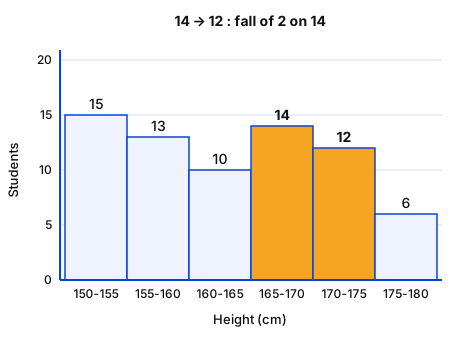
- 165-170: students; 170-175: students.
- Less by .
- .
Trick: — a fall of on is .
Answer: (A)
अवधारणा: "X, Y से कितने % कम है" (आधार दूसरी राशि)।
- 165-170: छात्र; 170-175: छात्र।
- कमी ।
- ।
ट्रिक: — पर की कमी ।
उत्तर: (A)
SSC CPO Paper IQuantitative AptitudeData Interpretation – HistogramSSC CPO Paper I 2020 · 23 Nov Shift 1
Q6506.Pipes A and B can fill a tank in 16 hours and 24 hours, respectively, whereas pipe C can empty the full tank in 40 hours. All three pipes are opened together, but pipe A is closed after 10 hours. After how many hours will the remaining part of the tank be filled?
पाइप A और B एक टंकी को क्रमशः 16 घंटे और 24 घंटे में भर सकते हैं, जबकि पाइप C भरी हुई टंकी को 40 घंटे में खाली कर सकता है। तीनों पाइप एक साथ खोले जाते हैं, परंतु पाइप A को 10 घंटे बाद बंद कर दिया जाता है। टंकी का शेष भाग कितने घंटे बाद भरेगा?
- A
- B10
- C20
- D
Show answer
Concept: Take tank LCM of times; emptying pipe has negative efficiency.
- Tank units; A , B , C units/h.
- In h all three fill units.
- Remaining units by B and C: units/h.
- Time hours.
Trick: Always make the leak negative before adding efficiencies.
Answer: (A)
अवधारणा: टंकी समयों का LCM; खाली करने वाले पाइप की दक्षता ऋणात्मक।
- टंकी इकाई; A , B , C इकाई/घंटा।
- घंटे में तीनों इकाई भरते हैं।
- शेष इकाई B और C से: इकाई/घंटा।
- समय घंटे।
ट्रिक: दक्षताएँ जोड़ने से पहले खाली करने वाले पाइप को ऋणात्मक लें।
उत्तर: (A)
SSC CPO Paper IQuantitative AptitudePipes and CisternsSSC CPO Paper I 2020 · 23 Nov Shift 1
Q6507.If decreasing 110 by gives the same result as increasing 50 by , then of 650 is what percentage more than of 180?
(correct to nearest integer)
यदि 110 में की कमी करने पर वही परिणाम प्राप्त होता है जो 50 में की वृद्धि करने पर प्राप्त होता है, तो 650 का , 180 के से कितने प्रतिशत अधिक है?
(निकटतम पूर्णांक तक सही)
- A
- B
- C
- D
Show answer
Concept: Form the equation for , then use .
- .
- of ; of .
- .
- Nearest integer .
Trick: "Decrease A by = increase B by " gives .
Answer: (A)
अवधारणा: का समीकरण बनाएँ, फिर ।
- ।
- का ; का ।
- ।
- निकटतम पूर्णांक ।
ट्रिक: "A को घटाना = B को बढ़ाना" से ।
उत्तर: (A)
SSC CPO Paper IQuantitative AptitudePercentageSSC CPO Paper I 2020 · 23 Nov Shift 1
Q6508.In a , the bisectors of and meet at O. If , then the measure of is:
में, और के समद्विभाजक O पर मिलते हैं। यदि है, तो का माप है:
- A
- B
- C
- D
Show answer
Concept: When the internal bisectors of and meet at O (incentre), .
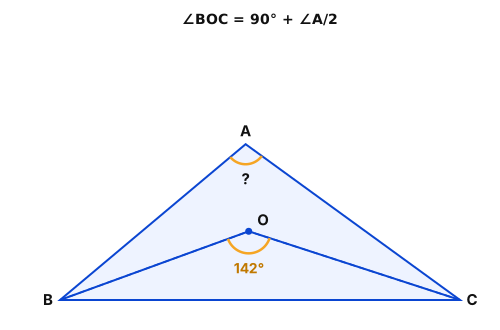
- .
- .
Trick: Internal–internal: ; external–external: ; internal–external: .
Answer: (C)
अवधारणा: और के आंतरिक समद्विभाजक O (अंतःकेंद्र) पर मिलें तो ।
- ।
- ।
ट्रिक: आंतरिक–आंतरिक: ; बाह्य–बाह्य: ; आंतरिक–बाह्य: ।
उत्तर: (C)
SSC CPO Paper IQuantitative AptitudeTriangles – Angle BisectorsSSC CPO Paper I 2020 · 23 Nov Shift 1
Q6509.A person was standing on a road near a mall. He was 1425 m away from the mall and able to see the top of the mall from the road in such a way that the top of a tree, which is in between him and the mall, was exactly in line of sight with the top of the mall. The tree height is 10 m and it is 30 m away from him. How tall (in m) is the mall?
एक व्यक्ति एक मॉल के पास सड़क पर खड़ा था। वह मॉल से 1425 m दूर था और सड़क से मॉल का शीर्ष इस प्रकार देख पा रहा था कि उसके और मॉल के बीच स्थित एक पेड़ का शीर्ष, मॉल के शीर्ष के साथ ठीक दृष्टि-रेखा में था। पेड़ की ऊँचाई 10 m है और वह उससे 30 m दूर है। मॉल की ऊँचाई (m में) कितनी है?
- A475
- B300
- C425
- D525
Show answer
Concept: The tree and the mall make similar right triangles with the same angle of elevation from the observer.
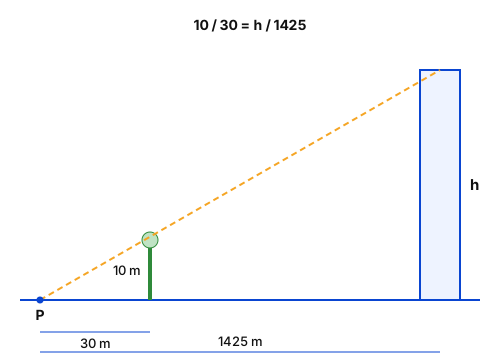
- .
- m.
Trick: Same line of sight ⇒ height : distance ratio is constant ( here).
Answer: (A)
अवधारणा: पेड़ और मॉल प्रेक्षक से एक ही उन्नयन कोण वाले समरूप समकोण त्रिभुज बनाते हैं।
- ।
- मीटर।
ट्रिक: एक ही दृष्टि रेखा ⇒ ऊँचाई : दूरी का अनुपात स्थिर ()।
उत्तर: (A)
SSC CPO Paper IQuantitative AptitudeHeights and DistancesSSC CPO Paper I 2020 · 23 Nov Shift 1
Q6510.Seven years ago, the ratio of the ages of A and B was 4 : 5. Eight years hence, the ratio of the ages of A and B will be 9 : 10. What is the sum of their present ages in years?
सात वर्ष पहले, A और B की आयु का अनुपात 4 : 5 था। आठ वर्ष बाद, A और B की आयु का अनुपात 9 : 10 होगा। उनकी वर्तमान आयु का योग (वर्षों में) क्या है?
- A32
- B82
- C41
- D56
Show answer
Concept: Take past ages as ; the gap between the two times is years.
- .
- Seven years ago: ; present: .
- Sum .
Trick: Difference of ages is constant: part. In also part ⇒ future ages ⇒ present .
Answer: (C)
अवधारणा: पहले की आयु लें; दोनों समयों का अंतर वर्ष।
- ।
- सात वर्ष पहले: ; वर्तमान: ।
- योग ।
ट्रिक: आयु का अंतर स्थिर रहता है: दोनों अनुपातों में अंतर भाग ⇒ भविष्य ⇒ वर्तमान ।
उत्तर: (C)
SSC CPO Paper IQuantitative AptitudeProblems on AgesSSC CPO Paper I 2020 · 23 Nov Shift 1
Q6511.A person sold an article at a loss of 16%. Had he sold it for ₹660 more, he would have gained 8%. What should be the selling price (in ₹) to gain a profit of 12%?
एक व्यक्ति ने एक वस्तु 16% की हानि पर बेची। यदि वह इसे ₹660 अधिक में बेचता, तो उसे 8% का लाभ होता। 12% का लाभ प्राप्त करने के लिए विक्रय मूल्य (₹ में) क्या होना चाहिए?
- A2,970
- B3,200
- C2,750
- D3,080
Show answer
Concept: The gap between loss% and gain% equals the extra money as a percent of CP.
- From to is of CP ₹.
- CP ₹.
- SP for profit ₹.
Trick: , so directly.
Answer: (D) ₹3,080
अवधारणा: हानि% और लाभ% का अंतर, अतिरिक्त राशि का CP पर प्रतिशत है।
- से तक CP ₹।
- CP ₹।
- लाभ के लिए SP ₹।
ट्रिक: , अतः ।
उत्तर: (D) ₹3,080
SSC CPO Paper IQuantitative AptitudeProfit and LossSSC CPO Paper I 2020 · 23 Nov Shift 1
Q6512.The value of is:
का मान है:
- A
- B1
- C
- D0
Show answer
Concept: BODMAS: Brackets, then "of", then division/multiplication, then addition/subtraction.
- Numerator: .
- Denominator: .
- Value .
Trick: "of" is done right after brackets, before plain subtraction.
Answer: (B)
अवधारणा: BODMAS: पहले कोष्ठक, फिर "of", फिर भाग/गुणा, फिर जोड़/घटाव।
- अंश: ।
- हर: ।
- मान ।
ट्रिक: "of" कोष्ठक के तुरंत बाद हल होता है, घटाव से पहले।
उत्तर: (B)
SSC CPO Paper IQuantitative AptitudeSimplification (BODMAS)SSC CPO Paper I 2020 · 23 Nov Shift 1
Q6513.If a nine-digit number is divisible by 72, then the value of is:
यदि नौ अंकों की एक संख्या , 72 से विभाज्य है, तो का मान है:
- A
- B0
- C2
- D
Show answer
Concept: : last three digits divisible by and digit sum divisible by .
- Last three digits : , so .
- Digit sum ; nearest multiple of is , so .
- .
Trick: For always fix the last digit first using , then the free digit using .
Answer: (C)
अवधारणा: : अंतिम तीन अंक से और अंकों का योग से विभाज्य हो।
- अंतिम तीन अंक : , अतः ।
- अंकों का योग ; का निकटतम गुणज , अतः ।
- ।
ट्रिक: के लिए पहले से अंतिम अंक, फिर से दूसरा अंक निकालें।
उत्तर: (C)
SSC CPO Paper IQuantitative AptitudeDivisibility RulesSSC CPO Paper I 2020 · 23 Nov Shift 1
Q6514.A takes 2 hours 30 minutes more than B to walk 40 km. If A doubles his speed, then he can make it in 1 hour less than B. How much time (in hours) does A require for walking a 40 km distance?
A को 40 km पैदल चलने में B से 2 घंटे 30 मिनट अधिक लगते हैं। यदि A अपनी चाल दोगुनी कर ले, तो वह यह दूरी B से 1 घंटा कम समय में तय कर सकता है। A को 40 km की दूरी पैदल तय करने में कितना समय (घंटों में) लगता है?
- A6
- B7
- C9
- D5
Show answer
Concept: Doubling the speed halves the time for the same distance.
- Let A take h; B takes h.
- With double speed A takes .
- hours.
Trick: Halving A’s time saves h, which is ⇒ .
Answer: (B)
अवधारणा: समान दूरी के लिए चाल दोगुनी करने पर समय आधा हो जाता है।
- A को घंटे; B को घंटे।
- दोगुनी चाल पर A: ।
- घंटे।
ट्रिक: समय आधा करने से A के घंटे बचे ⇒ ।
उत्तर: (B)
SSC CPO Paper IQuantitative AptitudeTime, Speed and DistanceSSC CPO Paper I 2020 · 23 Nov Shift 1
Q6515.The radius of the base of a cylinder is 14 cm and its curved surface area is 880 cm2. Its volume (in cm3) is:
(Take )
एक बेलन के आधार की त्रिज्या 14 cm है और उसका वक्र पृष्ठीय क्षेत्रफल 880 cm2 है। इसका आयतन (cm3 में) है:
( लीजिए)
- A3080
- B1078
- C6160
- D9240
Show answer
Concept: CSA , Volume .
- cm.
- cm.
Trick: .
Answer: (C)
अवधारणा: वक्र पृष्ठ , आयतन ।
- सेमी।
- सेमी।
ट्रिक: ।
उत्तर: (C)
SSC CPO Paper IQuantitative AptitudeMensuration – CylinderSSC CPO Paper I 2020 · 23 Nov Shift 1
Q6516.A, B and C started a business by investing ₹13,750, ₹16,250 and ₹18,750, respectively. If B's share in the profit earned by them is ₹5,200, what is the total profit (in ₹) earned by them together?
A, B और C ने क्रमशः ₹13,750, ₹16,250 और ₹18,750 का निवेश करके एक व्यवसाय आरंभ किया। यदि उनके द्वारा अर्जित लाभ में B का हिस्सा ₹5,200 है, तो उनके द्वारा मिलकर अर्जित कुल लाभ (₹ में) कितना है?
- A18,200
- B17,500
- C15,600
- D16,600
Show answer
Concept: For the same period, profit is shared in the ratio of investments.
- ; total parts.
- B’s parts ₹ part ₹.
- Total profit ₹.
Trick: Total .
Answer: (C) ₹15,600
अवधारणा: समान अवधि में लाभ निवेश के अनुपात में बँटता है।
- ; कुल भाग।
- B के भाग ₹ भाग ₹।
- कुल लाभ ₹।
ट्रिक: कुल ।
उत्तर: (C) ₹15,600
SSC CPO Paper IQuantitative AptitudePartnershipSSC CPO Paper I 2020 · 23 Nov Shift 1
Q6517.Three successive discounts 22%, 17% and 11% are equivalent to a single discount of:
तीन क्रमिक छूटें 22%, 17% और 11% किस एकल छूट के समतुल्य हैं?
- Aapproximately लगभग
- Bapproximately लगभग
- Capproximately लगभग
- Dapproximately लगभग
Show answer
Concept: Net price factor .
- .
- .
- Single discount .
Trick: Successive discounts are always less than their sum (), so and above are ruled out at once.
Answer: (A) approximately
अवधारणा: शुद्ध मूल्य गुणक ।
- ।
- ।
- एकल छूट ।
ट्रिक: क्रमिक छूट हमेशा उनके योग () से कम होती है, अतः तुरंत हट जाता है।
उत्तर: (A) लगभग
SSC CPO Paper IQuantitative AptitudeSuccessive DiscountsSSC CPO Paper I 2020 · 23 Nov Shift 1
Q6518.Two numbers are in the ratio 7 : 11. If their HCF is 28, then the difference between the two numbers is:
दो संख्याएँ 7 : 11 के अनुपात में हैं। यदि उनका महत्तम समापवर्तक (HCF) 28 है, तो दोनों संख्याओं के बीच का अंतर है:
- A28
- B308
- C112
- D196
Show answer
Concept: If numbers are in ratio (co-prime) and HCF is , the numbers are and .
- Numbers and .
- Difference .
Trick: Difference .
Answer: (C)
अवधारणा: संख्याएँ (सह-अभाज्य) में हों और HCF हो तो संख्याएँ और होती हैं।
- संख्याएँ और ।
- अंतर ।
ट्रिक: अंतर ।
उत्तर: (C)
SSC CPO Paper IQuantitative AptitudeHCF and LCMSSC CPO Paper I 2020 · 23 Nov Shift 1
Q6519.A and B can do a job in 10 days and 5 days, respectively. They worked together for two days, after which B was replaced by C and the work was finished in the next three days. How long will C alone take to finish 60% of the job?
A और B एक कार्य को क्रमशः 10 दिन और 5 दिन में कर सकते हैं। उन्होंने दो दिनों तक एक साथ कार्य किया, जिसके बाद B के स्थान पर C आया और कार्य अगले तीन दिनों में पूरा हो गया। C अकेले कार्य का 60% भाग पूरा करने में कितना समय लेगा?
- A18 days18 दिन
- B30 days30 दिन
- C25 days25 दिन
- D24 days24 दिन
Show answer
Concept: Work done rate time; find C’s rate from the work left after A’s share.
- A + B in days: ; left .
- A in next days: , so C did in days.
- C alone: whole job in days; in days.
Trick: Total units: A , B ; days , A adds , C adds in days ⇒ units need days.
Answer: (A) days
अवधारणा: किया गया कार्य दर समय; A का हिस्सा घटाकर C की दर निकालें।
- A + B ने दिन में: ; शेष ।
- अगले दिन A ने किया, अतः C ने दिन में ।
- C अकेला पूरा कार्य दिन में; में दिन।
ट्रिक: कुल इकाई: A , B ; C ने दिन में इकाई ⇒ इकाई में दिन।
उत्तर: (A) दिन
SSC CPO Paper IQuantitative AptitudeTime and WorkSSC CPO Paper I 2020 · 23 Nov Shift 1
Q6520.A ladder leaning against a wall makes an angle with the horizontal ground such that . If the height of the top of the ladder from the wall is 18 m, then what is the distance (in m) of the foot of the ladder from the wall?
दीवार के सहारे टिकी एक सीढ़ी क्षैतिज भूमि के साथ कोण इस प्रकार बनाती है कि है। यदि दीवार से सीढ़ी के शीर्ष की ऊँचाई 18 m है, तो दीवार से सीढ़ी के पाद की दूरी (m में) कितनी है?
- A18
- B7.5
- C13
- D19.5
Show answer
Concept: Wall, ground and ladder form a right triangle; .
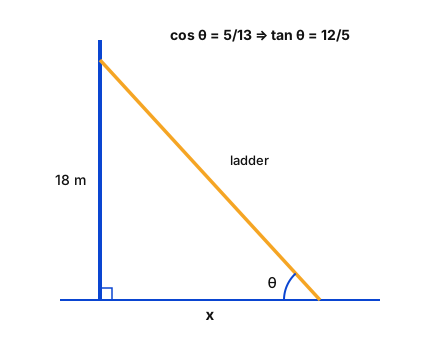
- .
- m.
Trick: Triplet --: height , base .
Answer: (B)
अवधारणा: दीवार, ज़मीन और सीढ़ी समकोण त्रिभुज बनाते हैं; ।
- ।
- मीटर।
ट्रिक: त्रिक --: ऊँचाई , आधार ।
उत्तर: (B)
SSC CPO Paper IQuantitative AptitudeHeights and DistancesSSC CPO Paper I 2020 · 23 Nov Shift 1

