Q6561.Select the most appropriate word to fill in the blank.
We respect you but we don’t agree ______ your ideas.
- Afor
- Bto
- Cby
- Dwith
Show answer
Concept: The verb ‘agree’ takes ‘with’ for a person or an idea/opinion, ‘to’ for a proposal/terms, and ‘on’ for a topic.
- Ideas = opinions → agree with your ideas.
- ‘agree for’ and ‘agree by’ are incorrect; ‘agree to’ is used for a plan or proposal one accepts.
Yaad rakhein: agree with (person/opinion), agree to (proposal), agree on (topic).
Answer: (D) with
अवधारणा: Verb ‘agree’ के साथ व्यक्ति या विचार के लिए ‘with’, प्रस्ताव के लिए ‘to’, विषय के लिए ‘on’ आता है।
- Ideas = विचार → agree with your ideas।
- ‘agree for’ और ‘agree by’ गलत हैं; ‘agree to’ प्रस्ताव/योजना स्वीकारने के लिए है।
याद रखें: agree with (व्यक्ति/विचार), agree to (प्रस्ताव), agree on (विषय)।
उत्तर: (D) with
SSC CPO Paper IEnglish ComprehensionFill in the BlanksSSC CPO Paper I 2020 · 23 Nov Shift 1
Q6562.Identify the segment in the sentence which contains a grammatical error. If there is no error, then select the option 'No error'.
When he goes on a business trip, he is usually taking his wife.
- ANo error
- Bhe is usually taking his wife
- Con a business trip
- DWhen he goes
Show answer
Concept: Habitual actions (with ‘usually’, ‘always’, ‘whenever’) take the Simple Present, not the Present Continuous.
- ‘When he goes on a business trip’ describes a regular habit.
- So the main clause must be: he usually takes his wife.
- ‘is usually taking’ is the error.
Trick: usually / often / every time → Simple Present.
Answer: (B) he is usually taking his wife
अवधारणा: आदत (usually, always, whenever) दर्शाने वाले वाक्यों में Simple Present आता है, Present Continuous नहीं।
- ‘When he goes on a business trip’ एक नियमित आदत है।
- इसलिए main clause होगा: he usually takes his wife।
- ‘is usually taking’ में त्रुटि है।
ट्रिक: usually / often / every time → Simple Present।
उत्तर: (B) he is usually taking his wife
SSC CPO Paper IEnglish ComprehensionError SpottingSSC CPO Paper I 2020 · 23 Nov Shift 1
Q6563.Select the most appropriate word which means the same as the group of words given. A place where games are played for money
- Achurch
- Bcasino
- Cuniversity
- Dgymnasium
Show answer
Concept: A ‘casino’ is a building where people play gambling games for money.
- Church – place of worship; university – place of higher study; gymnasium – place for physical exercise.
- Only ‘casino’ fits ‘games played for money’.
Yaad rakhein: Casino = gambling house.
Answer: (B) casino
अवधारणा: ‘Casino’ वह स्थान है जहाँ पैसों के लिए जुआ (gambling) खेला जाता है।
- Church – पूजा स्थल; university – उच्च शिक्षा का स्थान; gymnasium – व्यायामशाला।
- ‘पैसों के लिए खेले जाने वाले खेल’ के लिए केवल ‘casino’ सही है।
याद रखें: Casino = जुआघर।
उत्तर: (B) casino
SSC CPO Paper IEnglish ComprehensionOne Word SubstitutionSSC CPO Paper I 2020 · 23 Nov Shift 1
Q6564.Select the most appropriate word which means the same as the group of words given. Be more successful than someone
- Awin
- Bsucceed
- Coutdo
- Dbeat
Show answer
Concept: ‘Outdo’ means to do better than someone else; to surpass or be more successful than them.
- Example: She outdid all her classmates in the exam.
- ‘win’ and ‘succeed’ do not compare with another person; ‘beat’ means defeat in a contest, while the definition asks for doing better generally.
Trick: Prefix ‘out-’ = more than: outdo, outrun, outshine.
Answer: (C) outdo
अवधारणा: ‘Outdo’ का अर्थ है किसी से बेहतर करना या उससे अधिक सफल होना।
- उदाहरण: She outdid all her classmates in the exam.
- ‘win’ और ‘succeed’ में किसी से तुलना नहीं; ‘beat’ = मुकाबले में हराना, जबकि परिभाषा ‘किसी से अधिक सफल होना’ है।
ट्रिक: Prefix ‘out-’ = से अधिक: outdo, outrun, outshine।
उत्तर: (C) outdo
SSC CPO Paper IEnglish ComprehensionOne Word SubstitutionSSC CPO Paper I 2020 · 23 Nov Shift 1
Q6565.Select the most appropriate option to substitute the underlined segment in the given sentence. If there is no need to substitute it, select ‘No substitution required’.
When I left my house this morning, it was raining.
- Arained
- Bis raining
- Crains
- DNo substitution required
Show answer
Concept: An action in progress at a past moment, interrupted or set against another past action, takes the Past Continuous.
- ‘When I left my house this morning’ – a past point of time.
- At that time the rain was in progress → it was raining is correct.
- ‘is raining / rains’ are present tense; ‘rained’ loses the sense of continuing action.
Trick: When + Simple Past, … Past Continuous (background action).
Answer: (D) No substitution required
अवधारणा: भूतकाल के किसी क्षण पर चल रही क्रिया के लिए Past Continuous आता है।
- ‘When I left my house this morning’ – भूतकाल का एक क्षण।
- उस समय बारिश हो रही थी → it was raining सही है।
- ‘is raining / rains’ वर्तमान काल हैं; ‘rained’ से चल रही क्रिया का भाव नहीं आता।
ट्रिक: When + Simple Past, … Past Continuous (पृष्ठभूमि क्रिया)।
उत्तर: (D) No substitution required
SSC CPO Paper IEnglish ComprehensionSentence ImprovementSSC CPO Paper I 2020 · 23 Nov Shift 1
In the following passage, some words have been deleted. Fill in the blanks with the help of the alternatives given. Select the most appropriate option for each blank.
Let us take a brief look at the planet (1)______ which we live. As the earth hurtles through space at a (2)______ of 70, 000 miles per hour, it spins, as we all know, on its axis, (3)______ causes it to be flattened at the Poles. Thus, if you (4)______ to stand at the North or South Pole you would be 13 miles nearer the centre of the earth (5)______ if you stood on the
Equator.
Q6566.Select the most appropriate option to fill in blank no.1.
- Afor
- Bon
- Cby
- Dfrom
Show answer
Concept: ‘Live on’ a planet/island is the fixed usage; ‘on which’ = relative pronoun with preposition.
- We live on the earth (surface), so: the planet on which we live.
- ‘for, by, from which we live’ give no sense of location.
Trick: Turn it round: we live ___ the planet → on.
Answer: (B) on
अवधारणा: ग्रह/द्वीप पर रहने के लिए ‘live on’ प्रयोग होता है; ‘on which’ = preposition + relative pronoun।
- हम पृथ्वी की सतह पर रहते हैं: the planet on which we live।
- ‘for, by, from which we live’ से स्थान का अर्थ नहीं बनता।
ट्रिक: उलट कर देखें: we live ___ the planet → on।
उत्तर: (B) on
SSC CPO Paper IEnglish ComprehensionCloze TestSSC CPO Paper I 2020 · 23 Nov Shift 1
In the following passage, some words have been deleted. Fill in the blanks with the help of the alternatives given. Select the most appropriate option for each blank.
Let us take a brief look at the planet (1)______ which we live. As the earth hurtles through space at a (2)______ of 70, 000 miles per hour, it spins, as we all know, on its axis, (3)______ causes it to be flattened at the Poles. Thus, if you (4)______ to stand at the North or South Pole you would be 13 miles nearer the centre of the earth (5)______ if you stood on the
Equator.
Q6567.Select the most appropriate option to fill in blank no.2.
- Aforce
- Bdistance
- Cspeed
- Dmass
Show answer
Concept: ‘Miles per hour’ is a unit of speed, so the blank needs ‘speed’.
- at a speed of 70,000 miles per hour – standard collocation.
- force, distance and mass are not measured in miles per hour.
Trick: per hour / per second → speed.
Answer: (C) speed
अवधारणा: ‘Miles per hour’ गति (speed) की इकाई है, इसलिए ‘speed’ चाहिए।
- at a speed of 70,000 miles per hour – सही collocation।
- force, distance और mass ‘miles per hour’ में नहीं मापे जाते।
ट्रिक: per hour / per second → speed।
उत्तर: (C) speed
SSC CPO Paper IEnglish ComprehensionCloze TestSSC CPO Paper I 2020 · 23 Nov Shift 1
In the following passage, some words have been deleted. Fill in the blanks with the help of the alternatives given. Select the most appropriate option for each blank.
Let us take a brief look at the planet (1)______ which we live. As the earth hurtles through space at a (2)______ of 70, 000 miles per hour, it spins, as we all know, on its axis, (3)______ causes it to be flattened at the Poles. Thus, if you (4)______ to stand at the North or South Pole you would be 13 miles nearer the centre of the earth (5)______ if you stood on the
Equator.
Q6568.Select the most appropriate option to fill in blank no.3.
- Awhich
- Bwhere
- Cthat
- Dwho
Show answer
Concept: After a comma, a relative pronoun referring to the whole previous idea (the spinning) is ‘which’ (non-defining clause).
- ‘it spins on its axis, which causes it to be flattened’ – ‘which’ = the fact that it spins.
- ‘that’ cannot follow a comma in a non-defining clause; ‘who’ is for persons; ‘where’ is for place.
Trick: comma + relative pronoun for a thing/idea → which.
Answer: (A) which
अवधारणा: Comma के बाद पिछले पूरे विचार (घूमना) की ओर संकेत करने वाला relative pronoun ‘which’ होता है।
- ‘it spins on its axis, which causes it to be flattened’ – ‘which’ = घूमने की क्रिया।
- Non-defining clause में comma के बाद ‘that’ नहीं आता; ‘who’ व्यक्ति के लिए, ‘where’ स्थान के लिए।
ट्रिक: comma + वस्तु/विचार → which।
उत्तर: (A) which
SSC CPO Paper IEnglish ComprehensionCloze TestSSC CPO Paper I 2020 · 23 Nov Shift 1
In the following passage, some words have been deleted. Fill in the blanks with the help of the alternatives given. Select the most appropriate option for each blank.
Let us take a brief look at the planet (1)______ which we live. As the earth hurtles through space at a (2)______ of 70, 000 miles per hour, it spins, as we all know, on its axis, (3)______ causes it to be flattened at the Poles. Thus, if you (4)______ to stand at the North or South Pole you would be 13 miles nearer the centre of the earth (5)______ if you stood on the
Equator.
Q6569.Select the most appropriate option to fill in blank no.4.
- Aare
- Bwas
- Cwere
- Dhave
Show answer
Concept: An imaginary condition is expressed with ‘were to + V1’ for all subjects (subjunctive), followed by ‘would’ in the main clause.
- ‘you would be 13 miles nearer’ shows a hypothetical situation.
- So: if you were to stand at the North Pole.
- ‘was’ is not used with ‘you’; ‘are/have’ do not form the hypothetical.
Trick: If + subject + were to + V1, … would + V1.
Answer: (C) were
अवधारणा: काल्पनिक शर्त में सभी subjects के साथ ‘were to + V1’ (subjunctive) आता है और main clause में ‘would’।
- ‘you would be 13 miles nearer’ – काल्पनिक स्थिति।
- इसलिए: if you were to stand at the North Pole।
- ‘you’ के साथ ‘was’ नहीं; ‘are/have’ से काल्पनिक शर्त नहीं बनती।
ट्रिक: If + subject + were to + V1, … would + V1।
उत्तर: (C) were
SSC CPO Paper IEnglish ComprehensionCloze TestSSC CPO Paper I 2020 · 23 Nov Shift 1
In the following passage, some words have been deleted. Fill in the blanks with the help of the alternatives given. Select the most appropriate option for each blank.
Let us take a brief look at the planet (1)______ which we live. As the earth hurtles through space at a (2)______ of 70, 000 miles per hour, it spins, as we all know, on its axis, (3)______ causes it to be flattened at the Poles. Thus, if you (4)______ to stand at the North or South Pole you would be 13 miles nearer the centre of the earth (5)______ if you stood on the
Equator.
Q6570.Select the most appropriate option to fill in blank no.5.
- Athan
- Bfrom
- Cwhere
- Dwhen
Show answer
Concept: A comparative form (‘nearer’) is always followed by ‘than’.
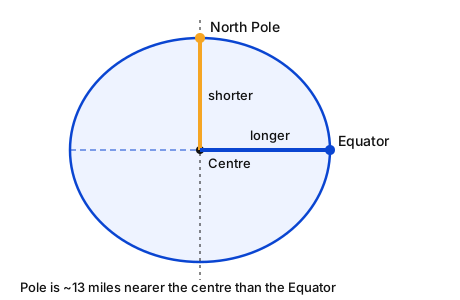
- 13 miles nearer the centre of the earth than if you stood on the Equator.
- Because the earth is flattened at the poles, the polar radius is shorter than the equatorial radius (see figure).
- ‘from, where, when’ cannot complete a comparison.
Trick: -er / more … → than.
Answer: (A) than
अवधारणा: Comparative (‘nearer’) के बाद हमेशा ‘than’ आता है।
- 13 miles nearer the centre of the earth than if you stood on the Equator।
- पृथ्वी ध्रुवों पर चपटी है, इसलिए ध्रुवीय त्रिज्या भूमध्यरेखीय त्रिज्या से छोटी है (चित्र देखें)।
- ‘from, where, when’ से तुलना पूरी नहीं होती।
ट्रिक: -er / more … → than।
उत्तर: (A) than
SSC CPO Paper IEnglish ComprehensionCloze TestSSC CPO Paper I 2020 · 23 Nov Shift 1
Q6571.Identify the segment in the sentence which contains a grammatical error. If there is no error, then select the option 'No error'.
The sun rises at 6.35 yesterday morning.
- AThe sun
- Brises at 6.35
- CNo error
- Dyesterday morning
Show answer
Concept: A completed action at a definite past time (‘yesterday morning’) needs the Simple Past.
- ‘yesterday morning’ is past, but ‘rises’ is Simple Present.
- Correct: The sun rose at 6.35 yesterday morning.
- Universal truths use the present tense only when no specific past time is mentioned.
Trick: Past time marker → V2 (rise → rose).
Answer: (B) rises at 6.35
अवधारणा: निश्चित भूतकाल (‘yesterday morning’) की पूरी हुई क्रिया के लिए Simple Past चाहिए।
- ‘yesterday morning’ भूतकाल है, पर ‘rises’ Simple Present है।
- सही: The sun rose at 6.35 yesterday morning.
- सार्वभौमिक सत्य में present tense तभी आता है जब कोई विशेष भूतकाल न हो।
ट्रिक: भूतकाल संकेत → V2 (rise → rose)।
उत्तर: (B) rises at 6.35
SSC CPO Paper IEnglish ComprehensionError SpottingSSC CPO Paper I 2020 · 23 Nov Shift 1
Q6572.Select the most appropriate word which means the same as the group of words given. An exact or a very close copy (of something)
- Aartificial
- Bforgery
- Creplica
- Dsubstitute
Show answer
Concept: A ‘replica’ is an exact or very close copy of something, especially a model of an object.
- Example: a replica of the Taj Mahal.
- ‘forgery’ is a copy made to deceive (illegal); ‘artificial’ = man-made; ‘substitute’ = a replacement, not a copy.
Yaad rakhein: Replica = exact copy; forgery = fraudulent copy.
Answer: (C) replica
अवधारणा: ‘Replica’ किसी वस्तु की हूबहू या बहुत मिलती-जुलती प्रतिकृति होती है।
- उदाहरण: a replica of the Taj Mahal।
- ‘forgery’ = धोखे के लिए बनी नकल (जालसाज़ी); ‘artificial’ = कृत्रिम; ‘substitute’ = विकल्प, प्रतिकृति नहीं।
याद रखें: Replica = प्रतिकृति; forgery = जालसाज़ी।
उत्तर: (C) replica
SSC CPO Paper IEnglish ComprehensionOne Word SubstitutionSSC CPO Paper I 2020 · 23 Nov Shift 1
Q6573.Select the most appropriate synonym of the given word.
FICTION
- Aliterature
- Bfact
- Cfantasy
- Dtruth
Show answer
Concept: FICTION means something imagined or invented, not real; its synonym is ‘fantasy’.
- ‘fantasy’ = imagination/unreal story – same idea.
- ‘fact’ and ‘truth’ are antonyms; ‘literature’ is a broader category that includes non-fiction too.
Yaad rakhein: Fiction = fantasy, invention, myth; opposite: fact.
Answer: (C) fantasy
अवधारणा: FICTION का अर्थ है कल्पित या गढ़ी हुई बात, जो वास्तविक न हो; पर्यायवाची ‘fantasy’ है।
- ‘fantasy’ = कल्पना – समान अर्थ।
- ‘fact’ और ‘truth’ विलोम हैं; ‘literature’ व्यापक श्रेणी है जिसमें non-fiction भी आता है।
याद रखें: Fiction = fantasy, invention; विलोम: fact।
उत्तर: (C) fantasy
SSC CPO Paper IEnglish ComprehensionSynonymsSSC CPO Paper I 2020 · 23 Nov Shift 1
Q6574.Select the most appropriate option to substitute the underlined segment in the given sentence. If there is no need to substitute it, select ‘No substitution required’.
The secretary talks over the phone right now.
- Atalked
- Bwas talking
- CNo substitution required
- Dis talking
Show answer
Concept: An action happening at the moment of speaking (‘right now’) takes the Present Continuous: is/am/are + V-ing.
- ‘right now’ is a time marker for the present moment.
- Correct: The secretary is talking over the phone right now.
- ‘talks’ (habit), ‘talked’ and ‘was talking’ (past) do not fit.
Trick: now / right now / at present → is/am/are + V-ing.
Answer: (D) is talking
अवधारणा: बोलने के समय चल रही क्रिया (‘right now’) के लिए Present Continuous: is/am/are + V-ing।
- ‘right now’ वर्तमान क्षण का संकेत है।
- सही: The secretary is talking over the phone right now.
- ‘talks’ (आदत), ‘talked’ और ‘was talking’ (भूतकाल) उपयुक्त नहीं।
ट्रिक: now / right now → is/am/are + V-ing।
उत्तर: (D) is talking
SSC CPO Paper IEnglish ComprehensionSentence ImprovementSSC CPO Paper I 2020 · 23 Nov Shift 1
Q6575.Select the most appropriate meaning of the given idiom.
Give a hand
- Adonate an organ
- Bassist
- Cencourage
- Dclap hands
Show answer
Concept: ‘Give (someone) a hand’ means to help or assist someone.
- Example: Can you give me a hand with these boxes?
- ‘clap hands’ is ‘give a big hand’ (applause) – different idiom; donating an organ is a literal reading.
Yaad rakhein: Give a hand = help; give a big hand = applaud.
Answer: (B) assist
अवधारणा: ‘Give (someone) a hand’ का अर्थ है किसी की मदद करना।
- उदाहरण: Can you give me a hand with these boxes?
- ‘clap hands’ के लिए ‘give a big hand’ आता है – अलग मुहावरा; अंग दान शाब्दिक अर्थ है।
याद रखें: Give a hand = मदद करना; give a big hand = तालियाँ बजाना।
उत्तर: (B) assist
SSC CPO Paper IEnglish ComprehensionIdioms and PhrasesSSC CPO Paper I 2020 · 23 Nov Shift 1
Q6576.Select the most appropriate word which means the same as the group of words given. Something done because one wants to, not by force
- Acoerced
- Bvoluntary
- Cthreatened
- Dsubjected
Show answer
Concept: ‘Voluntary’ means done of one’s own free will, without being forced.
- Example: He took voluntary retirement.
- ‘coerced’, ‘threatened’ and ‘subjected’ all suggest force or pressure – the opposite.
Yaad rakhein: Voluntary = by choice; compulsory/coerced = by force.
Answer: (B) voluntary
अवधारणा: ‘Voluntary’ का अर्थ है अपनी इच्छा से किया गया, बिना दबाव के (स्वैच्छिक)।
- उदाहरण: He took voluntary retirement.
- ‘coerced’, ‘threatened’ और ‘subjected’ – सभी में दबाव/ज़बरदस्ती का भाव है।
याद रखें: Voluntary = स्वैच्छिक; coerced = ज़बरदस्ती।
उत्तर: (B) voluntary
SSC CPO Paper IEnglish ComprehensionOne Word SubstitutionSSC CPO Paper I 2020 · 23 Nov Shift 1
Q6577.Select the most appropriate option to substitute the underlined segment in the given sentence. If there is no need to substitute it, select ‘No substitution required’.
She is taking all kinds of medicine wherever she goes.
- Awas taking
- Btook
- CNo substitution required
- Dtakes
Show answer
Concept: A habitual or repeated action (‘wherever she goes’) is expressed with the Simple Present.
- ‘wherever she goes’ (present) shows a regular habit.
- Correct: She takes all kinds of medicine wherever she goes.
- ‘is taking’ shows a temporary action now; ‘was taking/took’ are past and clash with ‘goes’.
Trick: whenever / wherever + present → Simple Present in main clause.
Answer: (D) takes
अवधारणा: आदत या बार-बार होने वाली क्रिया (‘wherever she goes’) के लिए Simple Present आता है।
- ‘wherever she goes’ नियमित आदत बताता है।
- सही: She takes all kinds of medicine wherever she goes.
- ‘is taking’ अस्थायी क्रिया है; ‘was taking/took’ भूतकाल हैं और ‘goes’ से मेल नहीं खाते।
ट्रिक: whenever / wherever + present → main clause में Simple Present।
उत्तर: (D) takes
SSC CPO Paper IEnglish ComprehensionSentence ImprovementSSC CPO Paper I 2020 · 23 Nov Shift 1
Q6578.Select the most appropriate synonym of the given word.
ACCURATE
- Asincere
- Bcorrect
- Ccomplete
- Dappropriate
Show answer
Concept: ACCURATE means free from error; exact. Its synonym is ‘correct’.
- ‘correct’ = right, without mistakes – same meaning.
- ‘sincere’ = honest; ‘complete’ = whole; ‘appropriate’ = suitable – different meanings.
Yaad rakhein: Accurate = correct, exact, precise.
Answer: (B) correct
अवधारणा: ACCURATE का अर्थ है त्रुटिरहित, सटीक; पर्यायवाची ‘correct’ है।
- ‘correct’ = सही, बिना गलती – समान अर्थ।
- ‘sincere’ = ईमानदार; ‘complete’ = पूरा; ‘appropriate’ = उचित – भिन्न अर्थ।
याद रखें: Accurate = correct, exact, precise (सटीक)।
उत्तर: (B) correct
SSC CPO Paper IEnglish ComprehensionSynonymsSSC CPO Paper I 2020 · 23 Nov Shift 1
Q6579.Identify the segment in the sentence which contains a grammatical error. If there is no error, then select the option 'No error'.
I am hearing a strange noise now.
- Aa strange
- BNo error
- CI am hearing
- Dnoise now
Show answer
Concept: Verbs of perception used involuntarily (hear, see, smell) are stative and are not used in the continuous tense.
- ‘I am hearing’ is wrong; it should be I hear a strange noise now (or I can hear).
- The rest of the sentence is correct.
Trick: hear, see, smell, know, like, own → no -ing form for state.
Answer: (C) I am hearing
अवधारणा: अनैच्छिक इंद्रिय-बोध वाली क्रियाएँ (hear, see, smell) stative हैं; ये continuous tense में नहीं आतीं।
- ‘I am hearing’ गलत है; सही: I hear a strange noise now (या I can hear)।
- वाक्य का बाकी भाग सही है।
ट्रिक: hear, see, smell, know, like, own → -ing नहीं लगता।
उत्तर: (C) I am hearing
SSC CPO Paper IEnglish ComprehensionError SpottingSSC CPO Paper I 2020 · 23 Nov Shift 1
Q6580.Identify the segment in the sentence which contains a grammatical error. If there is no error, then select the option 'No error'.
All of us were a little nervous when we came into this room today.
- Awhen we came into this room today
- Ba little nervous when
- CAll of us were
- DNo error
Show answer
Concept: Check subject–verb agreement and tense consistency in each part.
- ‘All of us’ is plural → ‘were’ is correct.
- ‘were … when we came’ – both past, consistent; ‘a little nervous’ is correct usage.
- ‘came into this room today’ is fine for a completed action earlier today. So there is no error.
Trick: If every segment agrees in number and tense, choose ‘No error’.
Answer: (D) No error
अवधारणा: हर भाग में subject–verb agreement और tense की एकरूपता जाँचिए।
- ‘All of us’ बहुवचन है → ‘were’ सही।
- ‘were … when we came’ – दोनों भूतकाल; ‘a little nervous’ सही प्रयोग है।
- ‘came into this room today’ आज पहले हो चुकी क्रिया के लिए सही है। अतः कोई त्रुटि नहीं।
ट्रिक: यदि हर भाग number और tense में सही है, तो ‘No error’।
उत्तर: (D) No error
SSC CPO Paper IEnglish ComprehensionError SpottingSSC CPO Paper I 2020 · 23 Nov Shift 1

