Q41. is related to which one of the following nomenclatures ?
(A = central atom, X = singly bounded ligand and E = an unshared electron pair).
निम्न में किस नामकरण से संबंधित है ?
(A = केन्द्रीय परमाणु, X = एकल आबंध लिगैण्ड एवं E = असहभाजित इलेक्ट्रान युग्म) ।
- A
- B
- C
- D
Show answer
Concept: Lone pairs E = (valence electrons of A − charge − electrons used in bonds)/2.
- Xe has 8 valence electrons; +1 charge leaves 7.
- 3 Xe–F bonds use 3 → 4 electrons left = 2 lone pairs.
- → trigonal-bipyramidal arrangement, T-shaped ion (like ).
Short trick: XeF3+ is isoelectronic (valence) with IF3/ClF3 → T-shape.
अवधारणा: एकाकी युग्म E = (A के संयोजी इलेक्ट्रॉन − आवेश − बंध में प्रयुक्त इलेक्ट्रॉन)/2।
- Xe के 8 संयोजी इलेक्ट्रॉन; +1 आवेश से 7 बचे।
- 3 Xe–F बंधों में 3 प्रयुक्त → 4 इलेक्ट्रॉन = 2 एकाकी युग्म।
- → त्रिकोणीय द्विपिरामिडी व्यवस्था, T-आकार (जैसे )।
याद रखें: XeF3+ ≈ ClF3 → T-आकार।
UPHESC Assistant Professor ChemistryChemistryVSEPR – xenon fluoride cationsUPHESC Assistant Professor Chemistry 2025 · 16 Apr Shift 2
Q42.Which of the following is an example of nido-carborane ?
निम्न में से कौन-सा निडो-कार्बोरेन का उदाहरण है ?
- A
- B
- C
- D
Show answer
Concept: SEP: BH = 1 pair, CH = 3/2 pairs, each extra H = 1/2 pair. closo = n+1, nido = n+2, arachno = n+3 (n = vertices).
- : 4 CH (6) + 2 BH (2) = 8 pairs, n = 6 → n+2 → nido (pentagonal pyramid).
- : 3 + 8 = 11, n = 10 → closo; : 13, n = 12 → closo.
- : 3 + 7 + 4 extra H (2) = 12, n = 9 → n+3 → arachno.
Short trick: Carborane formula C2BnHn+2 = closo; C4B2H6 ≡ B6H10 type → nido.
अवधारणा: SEP: BH = 1 युग्म, CH = 3/2 युग्म, प्रत्येक अतिरिक्त H = 1/2 युग्म। क्लोसो = n+1, निडो = n+2, अरैक्नो = n+3 (n = शीर्ष)।
- : 4 CH (6) + 2 BH (2) = 8 युग्म, n = 6 → n+2 → निडो (पंचकोणीय पिरामिड)।
- : 3 + 8 = 11, n = 10 → क्लोसो; : 13, n = 12 → क्लोसो।
- : 3 + 7 + 4 अतिरिक्त H (2) = 12, n = 9 → n+3 → अरैक्नो।
याद रखें: C2BnHn+2 = क्लोसो; C4B2H6 ≡ B6H10 प्रकार → निडो।
UPHESC Assistant Professor ChemistryChemistryWade's rules – carboranesUPHESC Assistant Professor Chemistry 2025 · 16 Apr Shift 2
Q43.Given the matrices for and below
, the trace of matrix representing is
एवं मैट्रीक्स नीचे दी गई है
, मैट्रिक्स के लिए ट्रेस है
- A0
- B−2
- C1
- D−1
Show answer
Concept: , so .
- Rotation by has trace (the z-element is +1).
- : → .
- (Check: trace of itself = −½ − ½ + 1 = 0 as well.)
Short trick: Snk with k even = Cnk → trace 2cos θ + 1.
अवधारणा: , अतः ।
- कोण के घूर्णन का ट्रेस होता है (z-अवयव +1)।
- : → ।
- (जाँच: का ट्रेस भी −½ − ½ + 1 = 0)।
याद रखें: Snk (k सम) = Cnk → ट्रेस 2cos θ + 1।
UPHESC Assistant Professor ChemistryChemistrySymmetry operations – matrix representationUPHESC Assistant Professor Chemistry 2025 · 16 Apr Shift 2
Q44.Given below are two statements, one is labelled as Assertion (A) and other is labelled as Reason (R).
Assertion (A) : and are intensely coloured compounds.
Reason (R) : Transition metal compounds having electrons in d-orbitals are coloured due to d-d transition.
In the light of the above statements choose the correct answer from the options given below.
नीचे दो कथन दिए गए हैं, एक को अभिकथन (A) और दूसरे को तर्क (R) कहा गया है ।
अभिकथन (A) : तथा तीव्र रंगीन यौगिक है ।
तर्क (R) : संक्रमण धातु यौगिक जिनके d-कक्षक में इलेक्ट्रान होते हैं, वे d-d संक्रमण के कारण रंगीन होते हैं ।
उपर्युक्त कथनों के आलोक में निम्नांकित विकल्पों में से सर्वाधिक उपयुक्त उत्तर चुनें ।
- ABoth (A) and (R) are correct and (R) is the correct explanation of (A)(A) और (R) दोनों सही है और (R), (A) की सही व्याख्या है
- BBoth (A) and (R) are correct but (R) is not the correct explanation of (A)(A) और (R) दोनों सही है परन्तु (R), (A) की सही व्याख्या नहीं है
- C(A) is correct but (R) is not correct(A) सही है, परन्तु (R) गलत है
- D(A) is not correct but (R) is correct(A) सही नहीं है परन्तु (R) सही है
Show answer
Concept: Colour of – ions comes from d–d transitions, but (Mn VII) and (Cr VI) are .
- Both are intensely coloured (purple, orange) – A is true.
- R is true as a general statement for (n = 1–9) compounds.
- But ions have no d electrons; their colour is due to ligand-to-metal charge transfer (O → M), which is Laporte-allowed and therefore intense. So R does not explain A.
Short trick: d0 yet coloured → charge transfer (KMnO4, K2Cr2O7, CrO42−).
अवधारणा: – आयनों का रंग d–d संक्रमण से होता है, किन्तु (Mn VII) एवं (Cr VI) हैं।
- दोनों तीव्र रंगीन हैं (बैंगनी, नारंगी) – A सत्य।
- (n = 1–9) यौगिकों के लिए सामान्य कथन के रूप में R सत्य है।
- परन्तु आयनों में d इलेक्ट्रॉन नहीं; इनका रंग लिगैंड से धातु आवेश स्थानांतरण (O → M) के कारण है जो लापोर्ट-अनुमत होने से तीव्र होता है। अतः R, A की व्याख्या नहीं।
याद रखें: d0 फिर भी रंगीन → आवेश स्थानांतरण।
UPHESC Assistant Professor ChemistryChemistryColour of transition metal compounds – LMCTUPHESC Assistant Professor Chemistry 2025 · 16 Apr Shift 2
Q45.For the Michaelis and Menten mechanism of enzyme catalyzed reaction
a. Michaelis constant
b. The order of reaction with respect to substrate is one, when [s] > >
c. is called the turnover number
d. Unit of in
Choose the correct answer from the options given below.
एन्जाइम उत्प्रेरित अभिक्रिया के माइकेलिस एवं मेन्टेन क्रियाविधि के लिए
a. माइकेलिस स्थिरांक
b. क्रियाधार के सापेक्ष में अभिक्रिया की कोटि एक है, यदि [s] > >
c. टर्नओवर संख्या कहलाती है
d. की इकाई होती है
नीचे दिए गए विकल्पों में से सही उत्तर चुनिए ।
- AOnly a, b, cकेवल a, b, c
- BOnly a, c, dकेवल a, c, d
- COnly b, c, dकेवल b, c, d
- DOnly a, b, dकेवल a, b, d
Show answer
Concept: ; rate with .
- a correct (steady-state result).
- b wrong: when [S] ≫ , rate = = → zero order in S (first order only when [S] ≪ ).
- c correct: = turnover number. d correct: is a concentration, mol dm−3.
Short trick: High [S] → enzyme saturated → zero order.
अवधारणा: ; दर , जहाँ ।
- a सही (स्थायी-अवस्था सन्निकटन)।
- b गलत: [S] ≫ पर दर = = → S के सापेक्ष शून्य कोटि (प्रथम कोटि केवल [S] ≪ पर)।
- c सही: = टर्नओवर संख्या। d सही: सांद्रता है, mol dm−3।
याद रखें: अधिक [S] → एन्जाइम संतृप्त → शून्य कोटि।
UPHESC Assistant Professor ChemistryChemistryMichaelis–Menten kineticsUPHESC Assistant Professor Chemistry 2025 · 16 Apr Shift 2
Q46.Match the Column – I and Column – II and choose the correct option.
| Column – I | Column – II |
|---|
| a. Wilkinson's catalyst | 1. Trans |
| b. Speier's catalyst | 2. Hydrosilyation |
| c. Water gas shift catalyst | 3. |
| d. Zeolite ZSM-5 catalyst | 4. Synthetic gasoline |
| 5. Zinc-copper oxide |
कालम – I और कालम – II का मिलान कर सही विकल्प चुने ।
| कालम – I | कालम – II |
|---|
| a. विल्किंसन उत्प्रेरक | 1. ट्रांस |
| b. स्पीयर्स उत्प्रेरक | 2. हाइड्रोसिलाइलेशन |
| c. जल गैस शिफ्ट उत्प्रेरक | 3. |
| d. जियोलाइट ZSM-5 उत्प्रेरक | 4. सिंथेटिक गैसोलिन |
| 5. जिंक-कापर आक्साइड |
- Aa – 3, b – 2, c – 5, d – 4
- Ba – 3, b – 4, c – 1, d – 2
- Ca – 5, b – 1, c – 3, d – 4
- Da – 2, b – 3, c – 4, d – 5
Show answer
Concept: Recall each named catalyst.
- Wilkinson's catalyst = (hydrogenation) → 3.
- Speier's catalyst = in isopropanol, used for hydrosilylation → 2.
- Low-temperature water-gas shift () uses Cu–ZnO → 5; ZSM-5 converts methanol to synthetic gasoline (MTG) → 4.
- trans- is Vaska's complex – a distractor.
Short trick: Wilkinson-Rh, Vaska-Ir, Speier-Pt (Si–H), ZSM-5 – MTG.
अवधारणा: प्रत्येक नामित उत्प्रेरक याद करें।
- विल्किंसन उत्प्रेरक = (हाइड्रोजनीकरण) → 3।
- स्पीयर उत्प्रेरक = आइसोप्रोपेनॉल में , हाइड्रोसिलिलीकरण हेतु → 2।
- निम्न-ताप जल-गैस शिफ्ट () में Cu–ZnO → 5; ZSM-5 मेथेनॉल से संश्लेषित पेट्रोल (MTG) → 4।
- ट्रांस- वास्का संकुल है – भ्रामक विकल्प।
याद रखें: विल्किंसन-Rh, वास्का-Ir, स्पीयर-Pt (Si–H), ZSM-5 – MTG।
UPHESC Assistant Professor ChemistryChemistryIndustrial / homogeneous catalystsUPHESC Assistant Professor Chemistry 2025 · 16 Apr Shift 2
Q47.Simmons-Smith reaction uses which reaction intermediate ?
साइमन्स-स्मिथ अभिक्रिया में कौन-सा मध्यवर्ती प्रयोग होता है ?
- ACarbanionकार्बेनियन
- BFree radicalsमुक्त मूलक
- CCarbeneकार्बीन
- DCarbocationकार्बोकेटायन
Show answer
Concept: , a zinc carbenoid that transfers a (carbene equivalent) to an alkene.
- The addition is concerted and stereospecific (cis-alkene → cis-cyclopropane).
- No free ions or radicals are involved; the reagent behaves as a methylene carbene.
Short trick: Simmons–Smith = CH2I2/Zn-Cu = carbenoid → cyclopropane.
अवधारणा: – एक जिंक कार्बीनॉयड जो ऐल्कीन को (कार्बीन तुल्य) देता है।
- योग समन्वित एवं त्रिविम-विशिष्ट है (सिस-ऐल्कीन → सिस-साइक्लोप्रोपेन)।
- कोई मुक्त आयन या मूलक नहीं बनते; अभिकर्मक मेथिलीन कार्बीन जैसा व्यवहार करता है।
याद रखें: सिमन्स–स्मिथ = CH2I2/Zn-Cu = कार्बीनॉयड → साइक्लोप्रोपेन।
UPHESC Assistant Professor ChemistryChemistrySimmons–Smith cyclopropanationUPHESC Assistant Professor Chemistry 2025 · 16 Apr Shift 2
Q48.Which of the following orbital is represented by the wave function ?
निम्नलिखित में से कौन-सा कक्षक तरंग फलन द्वारा निरूपित किया जाता है ?
- A1s
- B2p
- C3d
- D4f
Show answer
Concept: Read n and l from the radial and angular parts.
- Angular part is the harmonic → l = 1 (p orbital). (The last exponent is the azimuthal angle φ.)
- Radial part with no radial node → n − l − 1 = 0 → n = 2 (k = Z/2a0).
- So the function is .
Short trick: Power of r = l; exponent Zr/na0; sinθ e±iφ → p±1.
अवधारणा: त्रिज्य एवं कोणीय भाग से n तथा l पढ़ें।
- कोणीय भाग , है → l = 1 (p कक्षक)। (अंतिम घातांक का कोण दिगंशीय कोण φ है।)
- त्रिज्य भाग में कोई त्रिज्य नोड नहीं → n − l − 1 = 0 → n = 2 (k = Z/2a0)।
- अतः यह कक्षक है।
याद रखें: r की घात = l; sinθ e±iφ → p±1।
UPHESC Assistant Professor ChemistryChemistryHydrogen-like wave functionsUPHESC Assistant Professor Chemistry 2025 · 16 Apr Shift 2
Q49.The asymmetry in the electron absorption spectrum in the visible region of is caused by
के दृश्य क्षेत्र में इलेक्ट्रान अवशोषण स्पेक्ट्रम में असममिति का कारण है
- ACharge-transferआवेश स्थानांतरण
- B
- C
- DJahn-Teller effectजॉन-टेलर प्रभाव
Show answer
Concept: is ; the single band at ~20 300 cm−1 is ().
- The excited state is orbitally degenerate and undergoes a strong Jahn–Teller distortion, splitting .
- Hence the band appears broad and asymmetric with a shoulder (~17 400 cm−1).
- The transition itself (t2 → e) causes the band, not its asymmetry.
Short trick: Ti3+ band shoulder = excited-state Jahn–Teller.
अवधारणा: है; ~20 300 cm−1 का एकल बैंड () है।
- उत्तेजित अवस्था कक्षीय रूप से अपभ्रष्ट है, अतः इसमें प्रबल जॉन–टेलर विकृति होकर विभाजित होता है।
- इसलिए बैंड चौड़ा, असममित एवं स्कंध (~17 400 cm−1) युक्त होता है।
- t2 → e संक्रमण बैंड का कारण है, उसकी असममिति का नहीं।
याद रखें: Ti3+ बैंड का स्कंध = उत्तेजित अवस्था जॉन–टेलर।
UPHESC Assistant Professor ChemistryChemistryJahn–Teller distortion in electronic spectraUPHESC Assistant Professor Chemistry 2025 · 16 Apr Shift 2
Q50.Which of the following pairs have identical bond orders ?
a. and
b. and
c. and
d. and
Choose the correct answer from the options given below.
निम्नलिखित में से किस जोड़े में समान बंध क्रम है ?
a. एवं
b. एवं
c. एवं
d. एवं
नीचे दिए गए विकल्पों में से सही उत्तर चुनिए ।
- AOnly aकेवल a
- BOnly b, dकेवल b, d
- COnly cकेवल c
- DOnly a, cकेवल a, c
Show answer
Concept: Bond order = ½(bonding − antibonding electrons).
- a: (13 e) = 2.5; (15 e) = 2.5 → same.
- b: = 1, = 0 → different.
- c: (18 e) = 1, (10 e) = 1 → same.
- d: = 2, = 3 → different.
Short trick: Total e 10→1, 12→2, 14→3, 16→2, 18→1, 20→0 (13 & 15 → 2.5).
अवधारणा: बंध कोटि = ½(आबंधी − प्रतिआबंधी इलेक्ट्रॉन)।
- a: (13 e) = 2.5; (15 e) = 2.5 → समान।
- b: = 1, = 0 → भिन्न।
- c: (18 e) = 1, (10 e) = 1 → समान।
- d: = 2, = 3 → भिन्न।
याद रखें: कुल e 10→1, 12→2, 14→3, 16→2, 18→1, 20→0 (13 व 15 → 2.5)।
UPHESC Assistant Professor ChemistryChemistryMO theory – bond orderUPHESC Assistant Professor Chemistry 2025 · 16 Apr Shift 2
Q51.How many symmetry operations are generated by ?
के द्वारा कितने सिमेट्री आपरेशन उत्पन्न होंगे ?
- A6
- B3
- C2
- D5
Show answer
Concept: For odd n, generates 2n operations before returning to E.
- , , , , , .
- Six distinct operations (this set is the group ).
Short trick: Sn: n even → n operations; n odd → 2n operations.
अवधारणा: विषम n के लिए , E पर लौटने से पहले 2n संक्रियाएँ उत्पन्न करता है।
- , , , , , ।
- छह भिन्न संक्रियाएँ (यह समूह है)।
याद रखें: Sn: n सम → n संक्रियाएँ; n विषम → 2n।
UPHESC Assistant Professor ChemistryChemistryImproper rotation axisUPHESC Assistant Professor Chemistry 2025 · 16 Apr Shift 2
Q52.What is inorganic benzene ?
अकार्बनिक बेन्जीन क्या है ?
- ABoronबोरोन
- BBoraxबोरेक्स
- CBorolineबोरोलीन
- DBorazineबोराजिन
Show answer
Concept: Borazine is isoelectronic and isostructural with benzene.
- Planar six-membered ring of alternating B and N with delocalised π electrons (N lone pair → B empty p).
- Prepared from on heating, or then .
- Being polar (Bδ+–Nδ−), it is more reactive than benzene (adds HCl readily).
Short trick: B–N unit ≡ C=C unit (12 electrons each) → borazine ≈ benzene.
अवधारणा: बोराज़ीन बेन्ज़ीन का समइलेक्ट्रॉनी एवं समसंरचनात्मक है।
- एकान्तर B तथा N का समतलीय षट्सदस्यीय वलय, जिसमें π इलेक्ट्रॉन विस्थानित हैं (N का एकाकी युग्म → B का रिक्त p)।
- को गर्म करके बनाया जाता है।
- ध्रुवीय (Bδ+–Nδ−) होने से यह बेन्ज़ीन से अधिक क्रियाशील है (HCl का योग करता है)।
याद रखें: B–N इकाई ≡ C=C इकाई → बोराज़ीन ≈ बेन्ज़ीन।
UPHESC Assistant Professor ChemistryChemistryBorazineUPHESC Assistant Professor Chemistry 2025 · 16 Apr Shift 2
Q53.Match List – I (stretching) with List – II (approximately
) and select the answer using the codes given below the lists.
| List – I | List – II |
|---|
| a. >N – H | 1. 2250 |
| b. – C ≡ N | 2. 3300 |
| c. – SH | 3. 2270 |
| d. – COOR | 4. 1735 |
सूची – I (तनन) को सूची – II (लगभग
) से मिलाइए तथा सूचियों के नीचे दिए गए कोड का प्रयोग करते हुए उत्तर चुनिए ।
| सूची – I | सूची – II |
|---|
| a. >N – H | 1. 2250 |
| b. – C ≡ N | 2. 3300 |
| c. – SH | 3. 2270 |
| d. – COOR | 4. 1735 |
- Aa – 1, b – 2, c – 3, d – 4
- Ba – 2, b – 1, c – 3, d – 4
- Ca – 2, b – 3, c – 1, d – 4
- Da – 3, b – 1, c – 2, d – 4
Show answer
Concept: Recall characteristic IR group frequencies.
- N–H stretch ≈ 3300–3500 cm−1 → a–2; ester C=O ≈ 1735–1750 cm−1 → d–4.
- Nitrile C≡N ≈ 2210–2260 cm−1 (typically quoted 2250) → b–1.
- S–H is a weak band in the ~2550–2600 cm−1 region; of the values left, 2270 is assigned to it → c–3. Only code (B) fits.
Short trick: X–H > 3000 (except S–H ~2550), triple bonds ~2100–2260, C=O ~1700.
अवधारणा: विशिष्ट IR समूह आवृत्तियाँ याद रखें।
- N–H तनन ≈ 3300–3500 cm−1 → a–2; एस्टर C=O ≈ 1735–1750 cm−1 → d–4।
- नाइट्राइल C≡N ≈ 2210–2260 cm−1 (प्रायः 2250) → b–1।
- S–H लगभग 2550–2600 cm−1 पर दुर्बल बैंड देता है; शेष मान 2270 इसे दिया गया → c–3। केवल कोड (B) मेल खाता है।
याद रखें: X–H > 3000 (S–H ~2550 अपवाद), त्रिबंध ~2100–2260, C=O ~1700।
UPHESC Assistant Professor ChemistryChemistryIR stretching frequenciesUPHESC Assistant Professor Chemistry 2025 · 16 Apr Shift 2
Q54.Which one of the following will be most reactive for
reaction ?

निम्न में से कौन-सा
अभिक्रिया के लिए अधिकतम क्रियाशील होगा ?
- AChloroethaneक्लोरोएथेन
- BChlorocyclohexaneक्लोरोसाइक्लोहेक्सेन
- C2-Chloro-1,1-dimethylcyclohexane2-क्लोरो-1,1-डाइमेथिलसाइक्लोहेक्सेन
- D1-Chloro-2,2-dimethylpropane (neopentyl chloride)1-क्लोरो-2,2-डाइमेथिलप्रोपेन (नियोपेन्टिल क्लोराइड)
Show answer
Concept: needs backside attack; rate falls sharply with crowding at the α- and β-carbons.
- (A) Chloroethane is primary and unhindered → fastest.
- (B) Secondary ring carbon – slower; (C) secondary with a quaternary β-carbon (gem-dimethyl) – much slower.
- (D) Neopentyl chloride is primary but the bulky t-butyl β-group blocks the backside – about 105 times slower than ethyl.
Short trick: SN2: Me > 1° > 2° ≫ 3°; neopentyl ≈ practically inert.
अवधारणा: में पीछे से आक्रमण होता है; α- तथा β-कार्बन पर भीड़ बढ़ने से दर तेजी से घटती है।
- (A) क्लोरोएथेन प्राथमिक एवं बाधारहित है → सर्वाधिक तीव्र।
- (B) द्वितीयक वलय कार्बन – धीमा; (C) द्वितीयक तथा β-कार्बन चतुष्क (जेम-डाइमेथिल) – और भी धीमा।
- (D) नियोपेन्टिल क्लोराइड प्राथमिक है, पर भारी t-ब्यूटिल β-समूह पीछे का मार्ग रोकता है – एथिल से लगभग 105 गुना धीमा।
याद रखें: SN2: Me > 1° > 2° ≫ 3°; नियोपेन्टिल लगभग निष्क्रिय।
UPHESC Assistant Professor ChemistryChemistrySN2 reactivity and steric hindranceUPHESC Assistant Professor Chemistry 2025 · 16 Apr Shift 2
Q55.The elimination of water from 2-butanol in presence of , the major product formed is
की उपस्थिति में 2-ब्युटेनोल से जल का विलोपन करके कौन-सा प्रमुख उत्पाद बनता है ?
- A
- B
- C
- D
Show answer
Concept: Acid dehydration of a 2° alcohol goes by E1 via a carbocation; the more substituted (Saytzeff) alkene predominates.
- .
- Loss of H from C-3 gives but-2-ene (disubstituted, mainly trans) – major; loss from C-1 gives but-1-ene – minor.
- Butadiene would need two eliminations; isobutylene needs a skeletal rearrangement (not favoured).
Short trick: Saytzeff: H goes from the carbon having fewer H → more substituted alkene.
अवधारणा: द्वितीयक ऐल्कोहॉल का अम्लीय निर्जलीकरण E1 द्वारा कार्बधनायन से होता है; अधिक प्रतिस्थापित (सेत्ज़ेफ़) ऐल्कीन मुख्य बनती है।
- ।
- C-3 से H हटने पर ब्यूट-2-ईन (द्विप्रतिस्थापित, मुख्यतः ट्रांस) – मुख्य; C-1 से हटने पर ब्यूट-1-ईन – गौण।
- ब्यूटाडाईन हेतु दो विलोपन तथा आइसोब्यूटिलीन हेतु कंकाल पुनर्विन्यास चाहिए।
याद रखें: सेत्ज़ेफ़: कम H वाले कार्बन से H निकलता है → अधिक प्रतिस्थापित ऐल्कीन।
UPHESC Assistant Professor ChemistryChemistryAcid-catalysed dehydration – Saytzeff ruleUPHESC Assistant Professor Chemistry 2025 · 16 Apr Shift 2
Q56.Pyridine reacts with a mixture of and at 300°C to give
पिरीडीन 300°C पर और के मिश्रण के साथ अभिक्रिया करने पर देता है
- A1-nitropyridine1-नाइट्रोपिरीडीन
- B2-nitropyridine2-नाइट्रोपिरीडीन
- C3-nitropyridine3-नाइट्रोपिरीडीन
- D4-nitropyridine4-नाइट्रोपिरीडीन
Show answer
Concept: Pyridine is π-deficient; electrophilic substitution is sluggish and occurs at C-3.
- Attack at C-2 or C-4 gives a σ-complex with a resonance form bearing + charge on electronegative N – very unfavourable.
- Attack at C-3 keeps the + charge on carbon only, so 3-substitution is preferred (nitration needs ~300 °C, low yield).
- N-nitration (1-nitropyridinium) is not the substitution product.
Short trick: Pyridine behaves like nitrobenzene → meta (C-3) substitution.
अवधारणा: पिरीडीन π-न्यून है; इलेक्ट्रॉनस्नेही प्रतिस्थापन कठिन है और C-3 पर होता है।
- C-2 या C-4 पर आक्रमण से बने σ-संकुल की एक अनुनादी संरचना में विद्युतऋणी N पर धनावेश आता है – अत्यंत अस्थिर।
- C-3 पर आक्रमण में धनावेश केवल कार्बन पर रहता है, अतः 3-प्रतिस्थापन (नाइट्रीकरण ~300 °C पर, अल्प लब्धि)।
- N-नाइट्रीकरण (1-नाइट्रोपिरीडिनियम) प्रतिस्थापन उत्पाद नहीं है।
याद रखें: पिरीडीन ≈ नाइट्रोबेन्ज़ीन → मेटा (C-3) प्रतिस्थापन।
UPHESC Assistant Professor ChemistryChemistryElectrophilic substitution in pyridineUPHESC Assistant Professor Chemistry 2025 · 16 Apr Shift 2
Q57.Give the major product X of the following reaction.
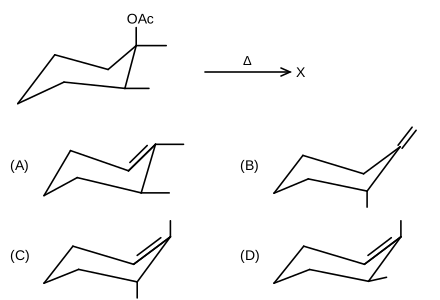
निम्नलिखित अभिक्रिया में प्रमुख उत्पाद X क्या होगा ?
- AStructure (A)संरचना (A)
- BStructure (B)संरचना (B)
- CStructure (C)संरचना (C)
- DStructure (D)संरचना (D)
Show answer
Concept: Acetate pyrolysis is a concerted cyclic (6-membered) Ei elimination: the β-H removed must be cis (syn) to the OAc group.
- OAc is axial (up) on C-1. On C-2 the methyl is equatorial (cis to OAc) and the H is axial-down (trans) – so no syn H on C-2; no double bond can form towards C-2.
- On the other ring neighbour (CH2) the equatorial H is cis to OAc → elimination gives the endocyclic, trisubstituted alkene with the old C-1 methyl on the double bond; (B), the exocyclic alkene, is the minor path.
- The C-2 stereocentre is untouched, so its methyl keeps its original orientation. (C) shows that methyl on the opposite face (axial-down) – wrong.
- (A) and (D) both show this same product: they differ only in the direction in which the methyl on the sp2 carbon is drawn, and an sp2 carbon has no stereochemistry. So (A) and (D) are the same compound, two options are correct, and the question is treated as a bonus. The product is 1,6-dimethylcyclohexene with the ring methyl in its original position.
Short trick: Ei (acetate, xanthate, Cope) = syn elimination; E2 = anti elimination.
अवधारणा: ऐसीटेट तापअपघटन एक समन्वित चक्रीय (षट्सदस्यीय) Ei विलोपन है: हटने वाला β-H, OAc के समपक्ष (सिन) होना चाहिए।
- C-1 पर OAc अक्षीय (ऊपर) है। C-2 पर मेथिल विषुवतीय (OAc के समपक्ष) तथा H अक्षीय-नीचे (विपक्ष) है – अतः C-2 पर सिन H नहीं; उस ओर द्विबंध नहीं बनेगा।
- दूसरे पड़ोसी CH2 का विषुवतीय H, OAc के समपक्ष है → वलय के भीतर त्रिप्रतिस्थापित द्विबंध बनता है जिस पर C-1 का मेथिल है; (B) बाह्यचक्रीय ऐल्कीन गौण मार्ग है।
- C-2 त्रिविम केन्द्र अप्रभावित रहता है, अतः उसका मेथिल मूल दिशा में रहता है। (C) में यह मेथिल विपरीत फलक (अक्षीय-नीचे) पर है – गलत।
- (A) और (D) दोनों यही उत्पाद दिखाते हैं: अंतर केवल sp2 कार्बन पर लगे मेथिल को खींचने की दिशा का है, और sp2 कार्बन पर कोई त्रिविम रसायन नहीं होता। अतः (A) और (D) एक ही यौगिक हैं, दो विकल्प सही हैं, इसलिए प्रश्न बोनस माना गया है। उत्पाद 1,6-डाइमेथिलसाइक्लोहेक्सीन है जिसमें वलय-मेथिल अपनी मूल स्थिति में है।
याद रखें: Ei (ऐसीटेट, ज़ैन्थेट, कोप) = सिन विलोपन; E2 = एन्टी विलोपन।
UPHESC Assistant Professor ChemistryChemistryEster pyrolysis – syn (Ei) eliminationUPHESC Assistant Professor Chemistry 2025 · 16 Apr Shift 2
Q58.In the following reaction, product X is
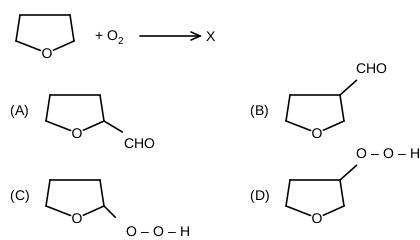
निम्नलिखित अभिक्रिया में उत्पाद X है
- ATetrahydrofuran-2-carbaldehydeटेट्राहाइड्रोफ्यूरान-2-कार्बैल्डिहाइड
- BTetrahydrofuran-3-carbaldehydeटेट्राहाइड्रोफ्यूरान-3-कार्बैल्डिहाइड
- C2-Hydroperoxytetrahydrofuran2-हाइड्रोपरॉक्सीटेट्राहाइड्रोफ्यूरान
- D3-Hydroperoxytetrahydrofuran3-हाइड्रोपरॉक्सीटेट्राहाइड्रोफ्यूरान
Show answer
Concept: Ethers react slowly with air (O2) by a free-radical chain at the C–H next to oxygen.
- The α-C–H of THF is weakest because the radical formed is stabilised by the adjacent O lone pair.
- R• + O2 → ROO•; ROO• + THF–H → ROOH + R• (chain).
- Product: 2-hydroperoxy-THF – the explosive peroxide found in old THF/ether bottles.
Short trick: Old ether + air → α-hydroperoxide → distil only after peroxide test.
अवधारणा: ईथर वायु (O2) से धीरे-धीरे ऑक्सीजन से सटे C–H पर मुक्त-मूलक श्रृंखला द्वारा अभिक्रिया करते हैं।
- THF का α-C–H सबसे दुर्बल है, क्योंकि बना मूलक सटे O के एकाकी युग्म से स्थिर होता है।
- R• + O2 → ROO•; ROO• + THF–H → ROOH + R• (श्रृंखला)।
- उत्पाद: 2-हाइड्रोपरॉक्सी-THF – पुरानी THF/ईथर बोतलों में मिलने वाला विस्फोटक परॉक्साइड।
याद रखें: पुराना ईथर + वायु → α-हाइड्रोपरॉक्साइड।
UPHESC Assistant Professor ChemistryChemistryAutoxidation of ethers – peroxide formationUPHESC Assistant Professor Chemistry 2025 · 16 Apr Shift 2
Q59.In the following reaction, the main product is
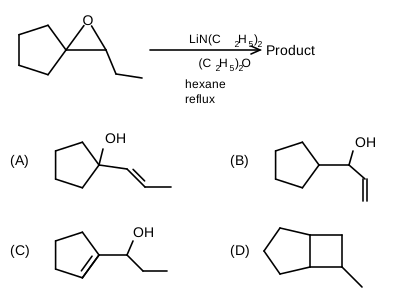
निम्नलिखित अभिक्रिया में प्रमुख उत्पाद है
- A(E)-1-(Prop-1-en-1-yl)cyclopentan-1-ol(E)-1-(प्रोप-1-ईन-1-इल)साइक्लोपेन्टेन-1-ऑल
- B1-Cyclopentylprop-2-en-1-ol1-साइक्लोपेन्टिलप्रोप-2-ईन-1-ऑल
- C1-(Cyclopent-1-en-1-yl)propan-1-ol1-(साइक्लोपेन्ट-1-ईन-1-इल)प्रोपेन-1-ऑल
- D6-Methylbicyclo[3.2.0]heptane6-मेथिलबाइसाइक्लो[3.2.0]हेप्टेन
Show answer
Concept: Lithium dialkylamides (LiNEt2, ether/hexane, reflux) isomerise epoxides to allylic alcohols by a syn β-elimination (as in α-pinene oxide → trans-pinocarveol).
- The base removes a β-H that is syn to the epoxide oxygen; the C–O bond next to it breaks and O− stays on the other carbon.
- The freely rotating CH2 of the ethyl side-chain supplies such an H much more easily than the ring CH2 groups.
- So the CH–O bond breaks, O stays on the spiro (ring) carbon and a C=C forms in the side chain: 1-(prop-1-enyl)cyclopentanol (E-alkene).
Short trick: Epoxide + LiNR2 → allylic alcohol; H is taken from the most accessible (acyclic) β-CH.
अवधारणा: लीथियम डाइऐल्किलऐमाइड (LiNEt2, ईथर/हेक्सेन, रिफ्लक्स) इपॉक्साइड को सिन β-विलोपन द्वारा ऐलिलिक ऐल्कोहॉल में बदलते हैं (जैसे α-पाइनीन ऑक्साइड → ट्रांस-पाइनोकार्वियोल)।
- क्षार इपॉक्साइड ऑक्सीजन के समपक्ष β-H को हटाता है; सटा C–O बंध टूटता है और O− दूसरे कार्बन पर रहता है।
- एथिल पार्श्व-श्रृंखला का स्वतंत्र घूर्णन करने वाला CH2 ऐसा H वलय CH2 की अपेक्षा कहीं सरलता से देता है।
- अतः CH–O बंध टूटता है, O स्पाइरो (वलय) कार्बन पर रहता है और पार्श्व-श्रृंखला में C=C बनता है: 1-(प्रोप-1-इनिल)साइक्लोपेन्टेनॉल (E-ऐल्कीन)।
याद रखें: इपॉक्साइड + LiNR2 → ऐलिलिक ऐल्कोहॉल; H सबसे सुलभ (अचक्रीय) β-CH से।
UPHESC Assistant Professor ChemistryChemistryBase-induced epoxide → allylic alcohol rearrangementUPHESC Assistant Professor Chemistry 2025 · 16 Apr Shift 2
Q60.In the following reaction, product B is
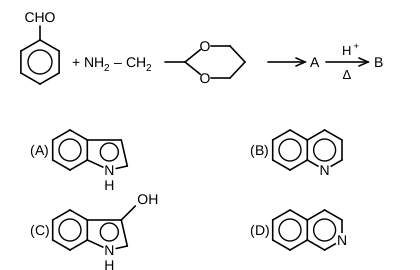
निम्नलिखित अभिक्रिया में उत्पाद B है
- AIndoleइण्डोल
- BQuinolineक्विनोलीन
- C3-Hydroxyindole (indoxyl)3-हाइड्रॉक्सीइण्डोल (इण्डॉक्सिल)
- DIsoquinolineआइसोक्विनोलीन
Show answer
Concept: Benzaldehyde + an aminoacetaldehyde acetal is the Pomeranz–Fritsch route to isoquinoline.
- Step 1: condensation gives the imine (Schiff base) A: .
- Step 2: acid (H+, Δ) ionises the acetal; the oxocarbenium ion attacks the benzene ring ortho to the imine carbon, then loss of ROH aromatises.
- The new ring is C1(from CHO)–N2–C3–C4, fused to benzene → isoquinoline (N at position 2).
Short trick: Benzaldehyde + H2NCH2CH(OR)2 / H+ → isoquinoline (Pomeranz–Fritsch).
अवधारणा: बेन्ज़ैल्डिहाइड + ऐमीनोऐसीटैल्डिहाइड ऐसीटल – आइसोक्विनोलीन का पोमेरान्ज़–फ्रिट्श संश्लेषण।
- चरण 1: संघनन से इमीन (शिफ क्षार) A बनता है: ।
- चरण 2: अम्ल (H+, Δ) ऐसीटल को आयनित करता है; ऑक्सोकार्बेनियम आयन इमीन कार्बन के ऑर्थो पर बेन्ज़ीन वलय पर आक्रमण करता है, फिर ROH निकलकर ऐरोमैटिक वलय बनता है।
- नया वलय C1(CHO से)–N2–C3–C4, बेन्ज़ीन से संलग्न → आइसोक्विनोलीन (N स्थिति 2 पर)।
याद रखें: बेन्ज़ैल्डिहाइड + H2NCH2CH(OR)2 / H+ → आइसोक्विनोलीन।
UPHESC Assistant Professor ChemistryChemistryPomeranz–Fritsch isoquinoline synthesisUPHESC Assistant Professor Chemistry 2025 · 16 Apr Shift 2

