Q81.Equivalent conductance of an electrolyte and equivalent ionic conductances for cations and anions forming electrolyte are , and at infinite dilution respectively. What is the correct relationship between these ?
विद्युत अपघट्य की अनन्त तनुता पर तुल्यांक चालकता, विद्युत अपघट्य को बनाने वाले धनायन और ऋणायन की तुल्यांक आयनी चालकता क्रमश: , और है । इनके बीच सही सम्बन्ध क्या है ?
- A
- B
- C
- D
Show answer
Concept: Kohlrausch's law of independent migration: at infinite dilution each ion contributes independently.
- (equivalent conductances).
- Dividing: .
Short trick: Λ°(salt) = λ°(+) + λ°(−).
अवधारणा: कोलराउश का स्वतंत्र आयन अभिगमन नियम: अनन्त तनुता पर प्रत्येक आयन स्वतंत्र रूप से योगदान देता है।
- (तुल्यांक चालकताएँ)।
- भाग देने पर: ।
याद रखें: Λ°(लवण) = λ°(+) + λ°(−)।
UPHESC Assistant Professor ChemistryChemistryKohlrausch's lawUPHESC Assistant Professor Chemistry 2025 · 16 Apr Shift 2
Q82.In the following Robinson annulation, the major product (P) is
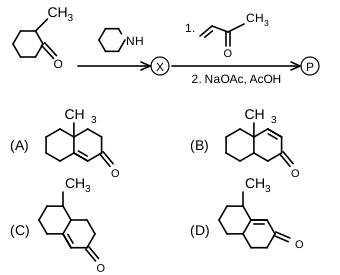
निम्न रोबिन्सन एनूलेशन में मुख्य उत्पाद (P) है
- AStructure (A)संरचना (A)
- BStructure (B)संरचना (B)
- CStructure (C)संरचना (C)
- DStructure (D)संरचना (D)
Show answer
Concept: With a secondary amine, 2-methylcyclohexanone forms the less substituted enamine (double bond towards C-6), because the more substituted enamine suffers A1,3-strain between CH3 and the N-ring.
- X = enamine at C-6; Michael addition to methyl vinyl ketone occurs at C-6 (the CH2 side), not at the methyl-bearing C-2.
- Hydrolysis and intramolecular aldol (NaOAc/AcOH) – the CH3CO of the side chain attacks the ring C=O – then dehydration gives the conjugated octalone.
- The CH3 ends up on the carbon next to the ring-fusion alkene carbon (not angular) → structure (D). Base-catalysed Robinson annulation (via the thermodynamic enolate) would give the angular-methyl product (A).
Short trick: Enamine → less substituted α-C; enolate (thermodynamic) → more substituted α-C.
अवधारणा: द्वितीयक ऐमीन के साथ 2-मेथिलसाइक्लोहेक्सेनोन कम प्रतिस्थापित इनैमीन (C-6 की ओर द्विबंध) बनाता है, क्योंकि अधिक प्रतिस्थापित इनैमीन में CH3 व N-वलय के बीच A1,3-विकृति होती है।
- X = C-6 पर इनैमीन; मेथिल विनाइल कीटोन पर माइकेल योग C-6 (CH2 पक्ष) पर होता है, CH3 वाले C-2 पर नहीं।
- जलअपघटन तथा अंतराअणुक ऐल्डॉल (NaOAc/AcOH) – पार्श्व श्रृंखला का CH3CO वलय C=O पर आक्रमण करता है – फिर निर्जलीकरण से संयुग्मी ऑक्टालोन बनता है।
- CH3 वलय-संधि ऐल्कीन कार्बन के पड़ोसी कार्बन पर रहता है (कोणीय नहीं) → संरचना (D)। क्षार-उत्प्रेरित रॉबिन्सन वलयन (ऊष्मागतिक ईनोलेट) से कोणीय मेथिल उत्पाद (A) बनता।
याद रखें: इनैमीन → कम प्रतिस्थापित α-C; ईनोलेट (ऊष्मागतिक) → अधिक प्रतिस्थापित α-C।
UPHESC Assistant Professor ChemistryChemistryStork enamine – Robinson annulationUPHESC Assistant Professor Chemistry 2025 · 16 Apr Shift 2
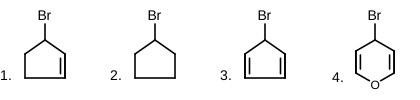
Q83.Arrange the following compounds in decreasing order of their
reaction.
निम्नलिखित यौगिकों को उनके
अभिक्रिया के घटते क्रम में व्यवस्थित कीजिए ।
- A3 > 1 > 2 > 4
- B1 > 3 > 2 > 4
- C4 > 1 > 2 > 3
- D3 > 1 > 4 > 2
Show answer
Concept: rate follows the stability of the carbocation formed on loss of Br−.
- 4 → pyrylium ion: planar, 6π electrons, aromatic → most stable → fastest.
- 1 → cyclopentenyl (allylic) cation, resonance-stabilised → next.
- 2 → plain secondary cyclopentyl cation.
- 3 → cyclopentadienyl cation: 4π electrons, antiaromatic → very unstable → slowest. Order 4 > 1 > 2 > 3.
Short trick: Aromatic cation > allylic > simple 2° > antiaromatic.
अवधारणा: की दर Br− निकलने पर बने कार्बधनायन के स्थायित्व पर निर्भर है।
- 4 → पाइरिलियम आयन: समतल, 6π इलेक्ट्रॉन, ऐरोमैटिक → सर्वाधिक स्थायी → सबसे तीव्र।
- 1 → साइक्लोपेन्टेनिल (ऐलिलिक) धनायन, अनुनाद-स्थिर → इसके बाद।
- 2 → साधारण द्वितीयक साइक्लोपेन्टिल धनायन।
- 3 → साइक्लोपेन्टाडाइनिल धनायन: 4π इलेक्ट्रॉन, प्रतिऐरोमैटिक → अत्यंत अस्थायी → सबसे धीमा। क्रम 4 > 1 > 2 > 3।
याद रखें: ऐरोमैटिक धनायन > ऐलिलिक > साधारण 2° > प्रतिऐरोमैटिक।
UPHESC Assistant Professor ChemistryChemistrySN1 reactivity – carbocation stability and aromaticityUPHESC Assistant Professor Chemistry 2025 · 16 Apr Shift 2
Q84.Which of the following ions are aromatic ?
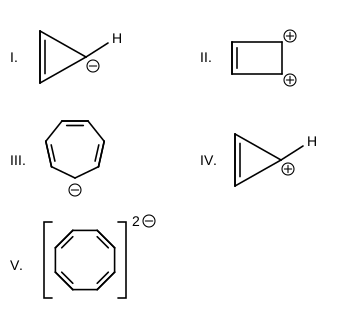
निम्न में से कौन-से आयन एरोमैटिक है ?
- AI, II, III
- BII, IV, V
- CI, II, IV, V
- DII, III, IV, V
Show answer
Concept: Aromatic: cyclic, planar, fully conjugated with (4n + 2) π electrons; 4n π → antiaromatic.
- I cyclopropenyl anion: 4π → antiaromatic. IV cyclopropenyl cation: 2π → aromatic.
- II cyclobutadiene dication: 2π → aromatic.
- III cycloheptatrienyl anion: 8π → antiaromatic.
- V cyclooctatetraene dianion: 10π, planar → aromatic. So II, IV, V.
Short trick: Count π e: 2, 6, 10, 14 → aromatic; 4, 8, 12 → antiaromatic.
अवधारणा: ऐरोमैटिक: चक्रीय, समतल, पूर्ण संयुग्मित तथा (4n + 2) π इलेक्ट्रॉन; 4n π → प्रतिऐरोमैटिक।
- I साइक्लोप्रोपेनिल ऋणायन: 4π → प्रतिऐरोमैटिक। IV साइक्लोप्रोपेनिल धनायन: 2π → ऐरोमैटिक।
- II साइक्लोब्यूटाडाईन द्विधनायन: 2π → ऐरोमैटिक।
- III साइक्लोहेप्टाट्राइनिल ऋणायन: 8π → प्रतिऐरोमैटिक।
- V साइक्लोऑक्टाटेट्राईन द्विऋणायन: 10π, समतल → ऐरोमैटिक। अतः II, IV, V।
याद रखें: π e गिनें: 2, 6, 10, 14 → ऐरोमैटिक; 4, 8, 12 → प्रतिऐरोमैटिक।
UPHESC Assistant Professor ChemistryChemistryHückel's rule for ionsUPHESC Assistant Professor Chemistry 2025 · 16 Apr Shift 2
Q85.The property measured in TGA is
TGA में मापित गुण होता है
- AChange in temperatureतापमान में परिवर्तन
- BChange in heat evolved or absorbedउत्सर्जित या अवशोषित उष्मा में परिवर्तन
- CRate of change in weightभार में परिवर्तन की दर
- DChange in weightभार में परिवर्तन
Show answer
Concept: Thermogravimetric analysis (TGA) records the mass (weight) of a sample as it is heated at a controlled rate.
- DTA measures the temperature difference (ΔT) between sample and reference.
- DSC measures heat flow (heat evolved/absorbed).
- DTG (derivative TGA) plots the rate of change of weight, dm/dt.
Short trick: TGA – mass; DTA – ΔT; DSC – heat; DTG – dm/dt.
अवधारणा: तापभारमितीय विश्लेषण (TGA) नियंत्रित दर से गर्म करते समय नमूने का द्रव्यमान (भार) अंकित करता है।
- DTA नमूने व संदर्भ के बीच ताप अंतर (ΔT) मापता है।
- DSC ऊष्मा प्रवाह (उत्सर्जित/अवशोषित ऊष्मा) मापता है।
- DTG (अवकलज TGA) भार परिवर्तन की दर dm/dt दर्शाता है।
याद रखें: TGA – द्रव्यमान; DTA – ΔT; DSC – ऊष्मा; DTG – dm/dt।
UPHESC Assistant Professor ChemistryChemistryThermal methods of analysisUPHESC Assistant Professor Chemistry 2025 · 16 Apr Shift 2
Q86.Why gelatin is added during polarographic measurements ?
पोलेरोग्राफीक माप के समय जिलेटिन क्यों मिलाया जाता है ?
- ATo reduce streaming motion of falling mercury dropगिरती हुई मरकरी की बूँद की प्रवाह गति कम करने के लिए
- BTo decrease viscosity of solutionश्यानता में कमी करने के लिए
- CTo eliminate residual currentअवशेष प्रवाह खत्म करने के लिए
- DTo prevent oxidation of HgHg का आक्सीकरण रोकने के लिए
Show answer
Concept: Polarograms often show sharp 'maxima' caused by streaming (convective) motion of the solution around the growing mercury drop.
- A trace of surface-active substance such as gelatin or Triton X-100 adsorbs on the drop and damps this streaming → maxima suppressed.
- Gelatin raises (not lowers) viscosity slightly; residual current is due to impurities/charging current and is not removed; dissolved O2 is removed by N2 purging.
Short trick: Gelatin = maximum suppressor; N2 = O2 remover; KCl = supporting electrolyte.
अवधारणा: पोलेरोग्रामों में प्रायः तीक्ष्ण 'उच्चिष्ठ' (मैक्सिमा) आते हैं, जो बढ़ती पारद बूँद के चारों ओर विलयन की प्रवाह (संवहन) गति से होते हैं।
- जिलेटिन या ट्राइटॉन X-100 जैसा पृष्ठ-सक्रिय पदार्थ बूँद पर अधिशोषित होकर यह प्रवाह गति कम करता है → उच्चिष्ठ दब जाते हैं।
- जिलेटिन श्यानता घटाता नहीं; अवशिष्ट धारा नहीं हटती; घुली O2, N2 प्रवाहित कर हटाई जाती है।
याद रखें: जिलेटिन = उच्चिष्ठ दमनकारी; N2 = O2 निष्कासक; KCl = सहायक विद्युत-अपघट्य।
UPHESC Assistant Professor ChemistryChemistryPolarography – maximum suppressorsUPHESC Assistant Professor Chemistry 2025 · 16 Apr Shift 2
Q87.Increasing order of electronegativity of the elements is
तत्वों की विद्युत ऋणात्मकता का बढ़ता हुआ अनुक्रम है
- AC, N, Si, P
- BN, Si, C, P
- CSi, P, C, N
- DP, Si, C, N
Show answer
Concept: Pauling values: Si 1.90, P 2.19, C 2.55, N 3.04.
- Electronegativity increases across a period (Si < P; C < N) and decreases down a group (C > Si; N > P).
- Period-2 elements C and N exceed both period-3 elements here → Si < P < C < N.
Short trick: Up and right → more electronegative.
अवधारणा: पॉलिंग मान: Si 1.90, P 2.19, C 2.55, N 3.04।
- आवर्त में बाएँ से दाएँ विद्युतऋणता बढ़ती है (Si < P; C < N) तथा वर्ग में नीचे घटती है (C > Si; N > P)।
- द्वितीय आवर्त के C व N यहाँ तृतीय आवर्त वालों से अधिक हैं → Si < P < C < N।
याद रखें: ऊपर व दाएँ → अधिक विद्युतऋणी।
UPHESC Assistant Professor ChemistryChemistryElectronegativity trendsUPHESC Assistant Professor Chemistry 2025 · 16 Apr Shift 2
Q88.The radius of the first orbit for hydrogen atom is
हाइड्रोजन परमाणु के प्रथम कक्षा की त्रिज्या है
- A cm
- B cm
- C cm
- D0.53 cm
Show answer
Concept: Bohr radius Å.
- 1 Å = cm = m.
- So cm (= m = 52.9 pm).
Short trick: rn = 0.529 n2/Z Å.
अवधारणा: बोर त्रिज्या Å।
- 1 Å = cm = m।
- अतः cm (= m = 52.9 pm)।
याद रखें: rn = 0.529 n2/Z Å।
UPHESC Assistant Professor ChemistryChemistryBohr radiusUPHESC Assistant Professor Chemistry 2025 · 16 Apr Shift 2
Q89.The value of for a system containing equal number of particles with molecular weight 10000 and 20000 will be
10000 एवं 20000 आणविक भार वाले समान संख्या में कणों वाले सिस्टम के लिए का मान होगा
- A18182
- B16667
- C15667
- D16182
Show answer
Concept: .
- With : numerator = .
- Denominator = 10000 + 20000 = 30000.
- (while = 15000).
Short trick: Mw ≥ Mn; PDI = Mw/Mn.
अवधारणा: ।
- लेने पर अंश = ।
- हर = 10000 + 20000 = 30000।
- (जबकि = 15000)।
याद रखें: Mw ≥ Mn; PDI = Mw/Mn।
UPHESC Assistant Professor ChemistryChemistryPolymer molar masses – weight averageUPHESC Assistant Professor Chemistry 2025 · 16 Apr Shift 2
Q90.Carbon atom in graphite is hybridised
ग्रेफाइट में कार्बन परमाणु संकरित होता है
- Asp
- B
- C
- D
Show answer
Concept: In graphite each C is bonded to three others in a planar hexagonal sheet.
- Three σ bonds (120°) → ; the fourth electron in the unhybridised p orbital is delocalised over the sheet → electrical conductivity.
- Diamond is ; carbyne/acetylene-type carbon is sp.
Short trick: Graphite, graphene, fullerene – sp2; diamond – sp3.
अवधारणा: ग्रेफाइट में प्रत्येक C समतल षट्कोणीय परत में तीन अन्य C से जुड़ा होता है।
- तीन σ बंध (120°) → ; चौथा इलेक्ट्रॉन असंकरित p कक्षक में परत पर विस्थानित → विद्युत चालकता।
- हीरा ; कार्बाइन sp।
याद रखें: ग्रेफाइट, ग्रैफीन, फुलरीन – sp2; हीरा – sp3।
UPHESC Assistant Professor ChemistryChemistryAllotropes of carbonUPHESC Assistant Professor Chemistry 2025 · 16 Apr Shift 2
Q91.Which of the following species is paramagnetic ?
निम्नलिखित स्पीशीज में कौन-सा पराचुम्बकीय है ?
- A
- B
- CCO
- D
Show answer
Concept: Paramagnetism needs unpaired electrons.
- (16 e): → 2 unpaired → paramagnetic.
- , CO and are isoelectronic (14 e) with all electrons paired → diamagnetic.
Short trick: 14-electron diatomics (N2, CO, NO+, CN−) – diamagnetic.
अवधारणा: अनुचुम्बकत्व के लिए अयुग्मित इलेक्ट्रॉन आवश्यक हैं।
- (16 e): → 2 अयुग्मित → अनुचुम्बकीय।
- , CO तथा समइलेक्ट्रॉनी (14 e) हैं, सभी इलेक्ट्रॉन युग्मित → प्रतिचुम्बकीय।
याद रखें: 14-इलेक्ट्रॉन द्विपरमाणुक (N2, CO, NO+, CN−) – प्रतिचुम्बकीय।
UPHESC Assistant Professor ChemistryChemistryMO theory – magnetic behaviourUPHESC Assistant Professor Chemistry 2025 · 16 Apr Shift 2
Q92.X-ray diffraction does not give any structural information for
एक्स-रे विवर्तन निम्न में से किसके लिए संरचनात्मक जानकारी नहीं दे सकता ?
- AMetallic solidsधात्विक ठोस के बारे में
- BIonic solidsआयनिक ठोस के बारे में
- CMolecular solidsआणविक ठोस के बारे में
- DAmorphous solidsअनाकार ठोस के बारे में
Show answer
Concept: Bragg diffraction () needs a regular, periodic arrangement of atoms (lattice planes).
- Metallic, ionic and molecular solids are crystalline → sharp diffraction patterns → unit cell and structure.
- Amorphous solids (glass, rubber) lack long-range order → only broad diffuse halos, no lattice/structure determination.
Short trick: No long-range order → no Bragg peaks.
अवधारणा: ब्रैग विवर्तन () के लिए परमाणुओं की नियमित आवर्ती व्यवस्था (जालक तल) आवश्यक है।
- धात्विक, आयनिक व आणविक ठोस क्रिस्टलीय हैं → तीक्ष्ण विवर्तन प्रतिरूप → एकक कोष्ठिका व संरचना।
- अनाकार ठोस (काँच, रबर) में दीर्घ-परास क्रम नहीं → केवल चौड़े विसरित वलय, संरचना निर्धारण नहीं।
याद रखें: दीर्घ-परास क्रम नहीं → ब्रैग शिखर नहीं।
UPHESC Assistant Professor ChemistryChemistryX-ray diffractionUPHESC Assistant Professor Chemistry 2025 · 16 Apr Shift 2
Q93.Among the following those can act as Mössbauer nuclei are
a. b.
c. d.
निम्नलिखित में से कौन-सा मोसबाउर नाभिक के रूप में कार्य कर सकते हैं ?
a. b.
c. d.
- Aa, b, c, d
- Bb, c and d onlyकेवल b, c और d
- Ca, b and d onlyकेवल a, b और d
- Da, c and d onlyकेवल a, c और d
Show answer
Concept: A Mössbauer nucleus has a low-lying excited state that gives recoil-free γ-resonance absorption.
- Common Mössbauer nuclei: 57Fe (14.4 keV), 119Sn, 121Sb, 129I, 127I, 197Au, 99Ru.
- 57Co is only the source: it decays by electron capture to excited 57Fe, which emits the 14.4 keV γ-ray absorbed by 57Fe in the sample.
- So a, c, d.
Short trick: 57Co (source) → 57Fe (absorber/Mössbauer nucleus).
अवधारणा: मॉसबाउर नाभिक में निम्न ऊर्जा की उत्तेजित अवस्था होती है जो प्रतिक्षेप-रहित γ-अनुनाद अवशोषण देती है।
- सामान्य मॉसबाउर नाभिक: 57Fe (14.4 keV), 119Sn, 121Sb, 129I, 197Au।
- 57Co केवल स्रोत है: यह इलेक्ट्रॉन प्रग्रहण द्वारा उत्तेजित 57Fe बनाता है, जो 14.4 keV γ-किरण देता है।
- अतः a, c, d।
याद रखें: 57Co (स्रोत) → 57Fe (मॉसबाउर नाभिक)।
UPHESC Assistant Professor ChemistryChemistryMössbauer spectroscopyUPHESC Assistant Professor Chemistry 2025 · 16 Apr Shift 2
Q94.Amongst Li, Na, K and Rb, the metal which do not form peroxide and superoxide respectively are
Li, Na, K एवं Rb धातुओं में से कौन-सा क्रमश: परऑक्साइड और सुपरऑक्साइड नहीं बनाता ?
- ALi and KLi और K
- BLi and NaLi और Na
- CNa and KNa और K
- DK and RbK और Rb
Show answer
Concept: On burning in air: Li → (normal oxide), Na → (peroxide), K, Rb, Cs → (superoxide).
- Small, highly polarising Li+ cannot stabilise the large ion → Li does not form a peroxide.
- Na+ stabilises but not the larger under normal conditions → Na does not form a superoxide.
- Larger cations stabilise larger anions (lattice-energy matching).
Short trick: Li – oxide, Na – peroxide, K/Rb/Cs – superoxide.
अवधारणा: वायु में जलाने पर: Li → (सामान्य ऑक्साइड), Na → (परऑक्साइड), K, Rb, Cs → (सुपरऑक्साइड)।
- छोटा, अत्यधिक ध्रुवणकारी Li+ बड़े को स्थिर नहीं कर पाता → Li परऑक्साइड नहीं बनाता।
- Na+, को स्थिर करता है पर सामान्य परिस्थिति में बड़े को नहीं → Na सुपरऑक्साइड नहीं बनाता।
- बड़े धनायन बड़े ऋणायनों को स्थिर करते हैं (जालक ऊर्जा मेल)।
याद रखें: Li – ऑक्साइड, Na – परऑक्साइड, K/Rb/Cs – सुपरऑक्साइड।
UPHESC Assistant Professor ChemistryChemistryOxides of alkali metalsUPHESC Assistant Professor Chemistry 2025 · 16 Apr Shift 2
Q95.Which of the following statements about the inert pair effect in group 13 elements is correct ?
निम्नलिखित कथनों में से कौन-सा समूह 13 तत्वों के अक्रिय युग्म प्रभाव के बारे में सही है ?
- AIt leads to the stability of (+3) oxidation stateयह (+3) आक्सीकरण अवस्था के स्थायित्व को इंगित करता है
- BIt leads to the stability of (+1) oxidation stateयह (+1) आक्सीकरण के स्थायित्व की ओर ले जाता है
- CIt has no effect on oxidation stateइसका आक्सीकरण अवस्था पर कोई प्रभाव नहीं
- DIt leads to the stability of (+2) of oxidation stateयह (+2) आक्सीकरण अवस्था के स्थायित्व की ओर इंगित करता है
Show answer
Concept: Down group 13 the pair becomes reluctant to take part in bonding (poor shielding by d and f electrons, relativistic contraction of 6s).
- Only the np1 electron is used → +1 state is stabilised down the group: B, Al (+3) … Ga, In (+3, +1) … Tl (+1 more stable).
- Hence Tl(III) compounds are oxidising, Tl(I) is the stable state.
Short trick: Group 13: Tl+; group 14: Pb2+; group 15: Bi3+ – all inert-pair states.
अवधारणा: वर्ग 13 में नीचे जाने पर युग्म आबंधन में भाग लेने से हिचकता है (d तथा f इलेक्ट्रॉनों का दुर्बल परिरक्षण, 6s का आपेक्षिकीय संकुचन)।
- केवल np1 इलेक्ट्रॉन प्रयुक्त → वर्ग में नीचे +1 अवस्था स्थायी होती है: B, Al (+3) … Ga, In (+3, +1) … Tl (+1 अधिक स्थायी)।
- अतः Tl(III) यौगिक ऑक्सीकारक हैं, Tl(I) स्थायी अवस्था है।
याद रखें: वर्ग 13: Tl+; वर्ग 14: Pb2+; वर्ग 15: Bi3+।
UPHESC Assistant Professor ChemistryChemistryInert pair effectUPHESC Assistant Professor Chemistry 2025 · 16 Apr Shift 2
Q96.Consider the following reaction
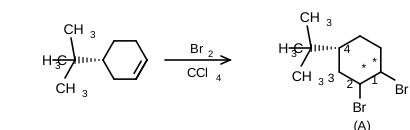
The stereochemistry at
,
and
centres in the major product (A) will be respectively
निम्नलिखित अभिक्रिया पर विचार कीजिए
मुख्य उत्पाद (A) में
,
और
केन्द्रों पर त्रिविम रसायन क्रमश: होगी
- A(1S, 2S, 4R)
- B(1R, 2S, 2S)
- C(1S, 2R, 4S)
- D(1R, 2S, 4R)
Show answer
Concept: Br2 adds anti via a bromonium ion; in a conformationally locked ring (t-Bu equatorial) opening is trans-diaxial (Fürst–Plattner), giving the diaxial trans-1,2-dibromide as the major product.
- C-4 is not touched: t-Bu (hashed) > C-3 (leads to CHBr) > C-5 > H (towards viewer) → 4R.
- With t-Bu equatorial and down, diaxial Br's are: Br on C-1 down (cis to t-Bu, 1,4-ax/eq) and Br on C-2 up (trans to t-Bu, 1,3-ax/eq).
- CIP: C-1 [Br > C-2 > C-6 > H] → S; C-2 [Br > C-1 > C-3 > H] → S.
- So (1S, 2S, 4R). (The diequatorial isomer would be 1R, 2R, 4R – not offered.)
Short trick: Locked cyclohexene + Br2 → trans-diaxial dibromide.
अवधारणा: Br2 ब्रोमोनियम आयन द्वारा एन्टी योग करता है; t-Bu द्वारा बंधे (विषुवतीय) वलय में खुलना ट्रांस-द्विअक्षीय होता है (फ़र्स्ट–प्लैटनर), अतः द्विअक्षीय ट्रांस-1,2-डाइब्रोमाइड मुख्य उत्पाद है।
- C-4 अपरिवर्तित: t-Bu (हैश्ड) > C-3 (CHBr की ओर) > C-5 > H (दर्शक की ओर) → 4R।
- t-Bu विषुवतीय व नीचे होने पर द्विअक्षीय Br: C-1 का Br नीचे (t-Bu के सिस), C-2 का Br ऊपर (t-Bu के ट्रांस)।
- CIP: C-1 [Br > C-2 > C-6 > H] → S; C-2 [Br > C-1 > C-3 > H] → S।
- अतः (1S, 2S, 4R)। (द्विविषुवतीय समावयवी 1R, 2R, 4R होता – विकल्प में नहीं।)
याद रखें: बंधा साइक्लोहेक्सीन + Br2 → ट्रांस-द्विअक्षीय डाइब्रोमाइड।
UPHESC Assistant Professor ChemistryChemistryStereochemistry of bromine addition – Fürst–Plattner ruleUPHESC Assistant Professor Chemistry 2025 · 16 Apr Shift 2
Q97.The major product formed when (E) – 4 – Bromo – Oct – 4 – Ene is treated with
is
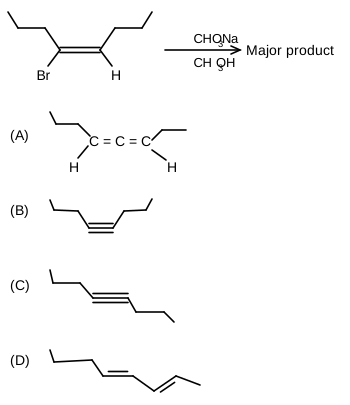
(E) – 4 – ब्रोमो – आक्ट – 4 – ईन का
से अभिक्रिया के पश्चात बनने वाला मुख्य उत्पाद है
- AStructure (A)संरचना (A)
- BStructure (B)संरचना (B)
- CStructure (C)संरचना (C)
- DStructure (D)संरचना (D)
Show answer
Concept: E2 needs an H anti-periplanar to the C–Br bond.
- In (E)-4-bromooct-4-ene the vinylic H on C-5 is cis to Br (both drawn below the double bond); the group anti to Br is the propyl chain. So anti-elimination to the alkyne is not possible (syn elimination is very slow).
- The allylic CH2 (C-3) next to C–Br can rotate an H into the anti position; E2 removes it, forming C3=C4 alongside C4=C5.
- Product: the allene (octa-3,4-diene). Options (B) and (C) both depict oct-4-yne.
Short trick: Vinyl halide: anti H → alkyne; only cis H → allene via allylic H.
अवधारणा: E2 के लिए C–Br बंध के एन्टी-पेरिप्लैनर H चाहिए।
- (E)-4-ब्रोमोऑक्ट-4-ईन में C-5 का वाइनिलिक H, Br के सिस है (दोनों द्विबंध के नीचे); Br के एन्टी प्रोपिल समूह है। अतः ऐल्काइन बनाने वाला एन्टी विलोपन संभव नहीं (सिन विलोपन अत्यंत धीमा)।
- C–Br के पड़ोसी ऐलिलिक CH2 (C-3) का H घूर्णन से एन्टी स्थिति में आ सकता है; E2 द्वारा यह हटकर C4=C5 के साथ C3=C4 बनता है।
- उत्पाद: ऐलीन (ऑक्टा-3,4-डाईन)। विकल्प (B) व (C) दोनों ऑक्ट-4-आइन दर्शाते हैं।
याद रखें: वाइनिल हैलाइड: एन्टी H → ऐल्काइन; केवल सिस H → ऐलिलिक H से ऐलीन।
UPHESC Assistant Professor ChemistryChemistryElimination from vinyl halides – geometry requirementUPHESC Assistant Professor Chemistry 2025 · 16 Apr Shift 2
Q98.The number of possible products in the following reaction is/are
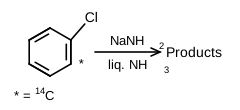
निम्नलिखित अभिक्रिया में संभावित उत्पादों की संख्या है/हैं
- A4
- B2
- C5
- D3
Show answer
Concept: /liq. NH3 converts ArCl to aniline through benzyne; the label (*14C) is on C-2, ortho to C–Cl.
- Path 1: H removed from unlabelled C-6 → benzyne C1≡C6. NH2 at C-1 → label ortho (2-14C-aniline); NH2 at C-6 → label meta (3-14C-aniline).
- Path 2: H removed from labelled C-2 → benzyne C1≡C2*. NH2 at C-1 → label ortho (same as above); NH2 at C-2* → label ipso (1-14C-aniline).
- Distinct products: 1-, 2- and 3-14C-aniline = 3.
Short trick: Label at C-1 → 2 products; label at C-2 (ortho) → 3 products.
अवधारणा: /द्रव NH3, ArCl को बेन्ज़ाइन द्वारा ऐनिलीन में बदलता है; अंकित कार्बन (*14C) C-2 पर, C–Cl के ऑर्थो है।
- मार्ग 1: अनंकित C-6 से H हटे → बेन्ज़ाइन C1≡C6। NH2 C-1 पर → अंक ऑर्थो (2-14C-ऐनिलीन); NH2 C-6 पर → अंक मेटा (3-14C-ऐनिलीन)।
- मार्ग 2: अंकित C-2 से H हटे → बेन्ज़ाइन C1≡C2*। NH2 C-1 पर → अंक ऑर्थो (वही); NH2 C-2* पर → अंक इप्सो (1-14C-ऐनिलीन)।
- भिन्न उत्पाद: 1-, 2- तथा 3-14C-ऐनिलीन = 3।
याद रखें: अंक C-1 पर → 2 उत्पाद; अंक C-2 (ऑर्थो) पर → 3 उत्पाद।
UPHESC Assistant Professor ChemistryChemistryBenzyne mechanism – isotopic labellingUPHESC Assistant Professor Chemistry 2025 · 16 Apr Shift 2
Q99.Substitution of for one CO in results in a product, the symmetry of new complex will be
संकुल में एक CO समूह का विस्थापन द्वारा होने पर प्राप्त उत्पाद संकुल की सममिति क्या होगी ?
- A
- B
- C
- D
Show answer
Concept: is ; replacing one ligand gives an octahedron.
- The only axis left is the through P–Cr–CO(trans); no ⊥ and no .
- Four vertical mirror planes (2σv + 2σd) remain → (treating PR3 as a point ligand).
- trans-ML4L'2 → ; cis-ML4L'2 → .
Short trick: MA5B = C4v; trans-MA4B2 = D4h; cis = C2v.
अवधारणा: का समूह है; एक लिगैंड बदलने से अष्टफलक बनता है।
- केवल P–Cr–CO(ट्रांस) से होकर अक्ष बचता है; लम्बवत तथा नहीं।
- चार ऊर्ध्वाधर दर्पण तल (2σv + 2σd) → (PR3 को बिन्दु लिगैंड मानकर)।
- ट्रांस-ML4L'2 → ; सिस → ।
याद रखें: MA5B = C4v; ट्रांस-MA4B2 = D4h; सिस = C2v।
UPHESC Assistant Professor ChemistryChemistryPoint groups of substituted octahedraUPHESC Assistant Professor Chemistry 2025 · 16 Apr Shift 2
Q100.Which of the following organo metallic compound is present in human being ?
निम्नलिखित में से कौन-सा कार्ब-धात्विक यौगिक मानव शरीर में पाया जाता है ?
- AMethyl Lithiumमिथाइल लिथियम
- BMethyl Cobalamineमिथाइल कोबालामाइन
- CCyano Cobalamineसायनो कोबालामाइन
- DMethyl Sodiumमिथाइल सोडियम
Show answer
Concept: Methylcobalamin, a coenzyme form of vitamin B12, contains a genuine Co–CH3 σ-bond – a natural organometallic compound.
- It is the cofactor of methionine synthase (methyl transfer to homocysteine); 5'-deoxyadenosylcobalamin (Co–CH2R) is the other active form.
- Cyanocobalamin is the commercial, isolated form (CN− picked up during purification) and must be converted in the body.
- MeLi and MeNa are reactive laboratory reagents destroyed instantly by water.
Short trick: B12 coenzyme = the only natural Co–C bond (methyl / adenosyl cobalamin).
अवधारणा: मेथिलकोबालामिन (विटामिन B12 का सहएन्ज़ाइम रूप) में वास्तविक Co–CH3 σ-बंध होता है – एक प्राकृतिक कार्बधात्विक यौगिक।
- यह मेथिओनीन सिन्थेज़ का सहकारक है (होमोसिस्टीन को मेथिल स्थानांतरण); 5'-डीऑक्सीऐडिनोसिलकोबालामिन दूसरा सक्रिय रूप है।
- सायनोकोबालामिन व्यापारिक/पृथक्कृत रूप है (शुद्धिकरण में CN− जुड़ता है), शरीर में रूपांतरित होता है।
- MeLi व MeNa अत्यधिक क्रियाशील प्रयोगशाला अभिकर्मक हैं, जल से तुरंत नष्ट।
याद रखें: B12 सहएन्ज़ाइम = प्राकृतिक Co–C बंध।
UPHESC Assistant Professor ChemistryChemistryBioorganometallic chemistry – vitamin B12UPHESC Assistant Professor Chemistry 2025 · 16 Apr Shift 2

