Question bank

Q&A: practice questions with answers

Search questions on any topic. Filter by exam category, exam, subject and topic, try the question, then open the answer and explanation.

Courses – airGurukul

7,077 questions found.

Q5861.
In a certain code language,
A + B means ‘A is the sister of B’
A - B means ‘A is the husband of B’
A × B means ‘A is the son of B’
A ÷ B means ‘A is the daughter of B’.
Based on the above, how is T related to S if ‘T + P × M - V ÷ S’?
एक निश्चित कूट भाषा में,
A + B का अर्थ है ‘A, B की बहन है’
A - B का अर्थ है ‘A, B का पति है’
A × B का अर्थ है ‘A, B का पुत्र है’
A ÷ B का अर्थ है ‘A, B की पुत्री है’।
उपर्युक्त के आधार पर, यदि ‘T + P × M - V ÷ S’ है, तो T, S से किस प्रकार संबंधित है?
  1. ABrother’s daughterभाई की पुत्री
  2. BSon’s daughterपुत्र की पुत्री
  3. CDaughter’s daughterपुत्री की पुत्री
  4. DSister’s daughterबहन की पुत्री
Show answer

Concept: Decode the chain from left to right and build the family tree.
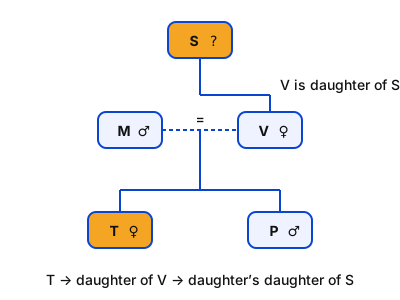
  1. T + P: T is the sister of P. P × M: P is the son of M → T is the daughter of M.
  2. M − V: M is the husband of V → V is the mother of T.
  3. V ÷ S: V is the daughter of S.
  4. So T is the daughter of V, and V is the daughter of S → T is S's daughter's daughter (granddaughter).

Trick: T's gender is fixed by "sister" (female), so options with "son" or "brother" as the link are eliminated at once.

Answer: (C) Daughter’s daughter

अवधारणा: श्रृंखला को बाएँ से दाएँ डिकोड करें और वंश-वृक्ष बनाएँ।

  1. T + P: T, P की बहन। P × M: P, M का बेटा → T, M की बेटी।
  2. M − V: M, V का पति → V, T की माँ।
  3. V ÷ S: V, S की बेटी।
  4. अतः T, V की बेटी और V, S की बेटी → T, S की बेटी की बेटी (नातिन)।

ट्रिक: "sister" से T का लिंग स्त्री तय है, अतः "son" या "brother" की कड़ी वाले विकल्प तुरंत कट जाते हैं।

उत्तर: (C) Daughter’s daughter
RRB NTPC Graduate CBT 1General Intelligence and ReasoningBlood Relations (Coded)RRB NTPC Graduate CBT 1 2025 · 22 Mar Shift 1 →
Q5862.
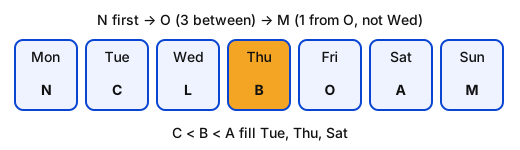
Each of L, M, N, O, A, B and C has an exam on a different day of a week starting from Monday and ending on Sunday of the same week. No one has exam before N. Only three people have exams between N and O. Only one person has exam between O and M. L has exam on Wednesday. B has exam on one of the days after C but on one of the days before A. On which day of the week does B have exam?
L, M, N, O, A, B और C में से प्रत्येक की परीक्षा एक ही सप्ताह के सोमवार से रविवार तक के अलग-अलग दिनों में है। N से पहले किसी की परीक्षा नहीं है। N और O के बीच केवल तीन व्यक्तियों की परीक्षा है। O और M के बीच केवल एक व्यक्ति की परीक्षा है। L की परीक्षा बुधवार को है। B की परीक्षा C के बाद के किसी दिन परंतु A से पहले के किसी दिन है। B की परीक्षा सप्ताह के किस दिन है?
  1. ASaturdayशनिवार
  2. BMondayसोमवार
  3. CThursdayगुरुवार
  4. DTuesdayमंगलवार
Show answer

Concept: Fix the definite days first, then fit the ordered group into the gaps.

  1. No one before N → N on Monday. Three between N and O → O on Friday.
  2. One person between O and M → M on Wednesday or Sunday; Wednesday is L's → M on Sunday.
  3. Tuesday, Thursday, Saturday remain for C, B, A in the order C → B → A.
  4. B gets Thursday.

Trick: "No one has exam before N" = N is on the first day; such absolute clues anchor the whole schedule.

Answer: (C) Thursday

अवधारणा: पहले निश्चित दिन तय करें, फिर क्रम वाले समूह को खाली दिनों में बिठाएँ।

  1. N से पहले कोई नहीं → N सोमवार। N और O के बीच तीन → O शुक्रवार।
  2. O और M के बीच एक → M बुधवार या रविवार; बुधवार L का है → M रविवार।
  3. मंगल, गुरु, शनि बचे C, B, A के लिए, क्रम C → B → A।
  4. B को गुरुवार मिला।

ट्रिक: "N से पहले किसी की परीक्षा नहीं" = N पहले दिन; ऐसे निरपेक्ष सुराग पूरी सारणी को जमा देते हैं।

उत्तर: (C) Thursday

RRB NTPC Graduate CBT 1General Intelligence and ReasoningScheduling (Days of the Week)RRB NTPC Graduate CBT 1 2025 · 22 Mar Shift 1 →
Q5863.
Based on the English alphabetical order, three of the following four letter-cluster pairs are alike in a certain way and thus form a group. Which is the one that does not belong to that group?
(Note: The odd man out is not based on the number of consonants/vowels or their position in the letter-cluster.)
अंग्रेज़ी वर्णमाला क्रम के आधार पर, निम्नलिखित चार अक्षर-समूह युग्मों में से तीन एक निश्चित प्रकार से समान हैं और इस प्रकार एक समूह बनाते हैं। वह कौन-सा है जो उस समूह से संबंधित नहीं है?
(नोट: असंगत युग्म व्यंजनों/स्वरों की संख्या या अक्षर-समूह में उनकी स्थिति पर आधारित नहीं है।)
  1. AAB - DE
  2. BXY - YZ
  3. CTU - WX
  4. DKL - NO
Show answer

Concept: Check the alphabetical gap from the first cluster to the second.

  1. AB → DE: A(+3)D, B(+3)E.
  2. TU → WX: T(+3)W, U(+3)X.
  3. KL → NO: K(+3)N, L(+3)O.
  4. XY → YZ: X(+1)Y, Y(+1)Z – gap is +1, not +3.

Trick: Write the place numbers (A=1 … Z=26) and subtract – the pair with a different gap is the odd one.

Answer: (B) XY - YZ

अवधारणा: पहले समूह से दूसरे समूह तक वर्णमाला का अंतर (gap) देखें।

  1. AB → DE: A(+3)D, B(+3)E.
  2. TU → WX: T(+3)W, U(+3)X.
  3. KL → NO: K(+3)N, L(+3)O.
  4. XY → YZ: X(+1)Y, Y(+1)Z – यहाँ अंतर +1 है, +3 नहीं।

ट्रिक: अक्षरों के स्थान-मान (A=1 … Z=26) लिखकर घटाएँ – जिस युग्म का अंतर अलग हो, वही विषम है।

उत्तर: (B) XY - YZ

RRB NTPC Graduate CBT 1General Intelligence and ReasoningOdd one out (letter pairs)RRB NTPC Graduate CBT 1 2025 · 22 Mar Shift 1 →
Q5864.
Refer to the following number, symbol series and answer the question.
(Left) 5 # % 8 * $ % @ 1 3 @ $ 4 6 9 7 # $ 2 % 5 4 (Right)
If all the numbers are dropped from the series, which of the following will be fourth from the left?
निम्नलिखित संख्या, प्रतीक शृंखला को देखिए और प्रश्न का उत्तर दीजिए।
(बाएँ) 5 # % 8 * $ % @ 1 3 @ $ 4 6 9 7 # $ 2 % 5 4 (दाएँ)
यदि शृंखला से सभी संख्याएँ हटा दी जाएँ, तो निम्नलिखित में से कौन-सा बाएँ से चौथा होगा?
  1. A$
  2. B#
  3. C%
  4. D*
Show answer

Concept: Remove every digit and then count from the left in the remaining series.

  1. Series: 5 # % 8 * $ % @ 1 3 @ $ 4 6 9 7 # $ 2 % 5 4.
  2. After dropping numbers: # % * $ % @ @ $ # $ %.
  3. Fourth from the left = $.

Trick: Strike the digits with a pencil first; never try to count and skip at the same time.

Answer: (A) $

अवधारणा: सभी अंक हटाकर बची हुई श्रृंखला में बाएँ से गिनें।

  1. श्रृंखला: 5 # % 8 * $ % @ 1 3 @ $ 4 6 9 7 # $ 2 % 5 4.
  2. अंक हटाने पर: # % * $ % @ @ $ # $ %.
  3. बाएँ से चौथा = $.

ट्रिक: पहले अंकों को पेंसिल से काट दें; गिनते समय छोड़ने की कोशिश न करें।

उत्तर: (A) $

RRB NTPC Graduate CBT 1General Intelligence and ReasoningNumber–symbol seriesRRB NTPC Graduate CBT 1 2025 · 22 Mar Shift 1 →
Q5865.
If ‘+’ means ‘−’, ‘−’ means ‘×’, ‘×’ means ‘÷’, ‘÷’ means ‘+’, then what will come in place of the question mark (?) in the following equation?
79 − 8 ÷ 55 + 423 × 3 = ?
यदि ‘+’ का अर्थ ‘−’, ‘−’ का अर्थ ‘×’, ‘×’ का अर्थ ‘÷’, ‘÷’ का अर्थ ‘+’ है, तो निम्नलिखित समीकरण में प्रश्नचिह्न (?) के स्थान पर क्या आएगा?
79 − 8 ÷ 55 + 423 × 3 = ?
  1. A546
  2. B519
  3. C525
  4. D584
Show answer

Concept: Replace each symbol by its given meaning and then apply BODMAS.

  1. 79 − 8 ÷ 55 + 423 × 3 becomes 79×8+55−423÷3.
  2. 423÷3=141, 79×8=632.
  3. 632+55−141=546.

Trick: Rewrite the whole expression with new symbols first, then solve – do not substitute and calculate in the same step.

Answer: (A) 546

अवधारणा: हर प्रतीक को उसके दिए गए अर्थ से बदलें, फिर BODMAS लगाएँ।

  1. 79 − 8 ÷ 55 + 423 × 3 बन जाता है 79×8+55−423÷3.
  2. 423÷3=141, 79×8=632.
  3. 632+55−141=546.

ट्रिक: पहले पूरा व्यंजक नए प्रतीकों में लिखें, फिर हल करें – बदलना और गणना एक साथ न करें।

उत्तर: (A) 546

RRB NTPC Graduate CBT 1General Intelligence and ReasoningMathematical operations (symbol substitution)RRB NTPC Graduate CBT 1 2025 · 22 Mar Shift 1 →
Q5866.
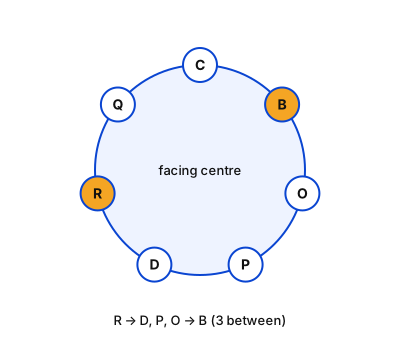
Seven people B, C, D, O, P, Q and R are sitting around a circular table facing the center of the table. Only one person sits between P and B when counted from the right of P. O sits third to the left of Q. C sits third to the left of D. Q sits to the immediate right of C. R is not an immediate neighbor of C. How many people sit between R and B when counted from the right of R?
सात व्यक्ति B, C, D, O, P, Q और R एक वृत्ताकार मेज़ के चारों ओर मेज़ के केंद्र की ओर मुख करके बैठे हैं। P के दाईं ओर से गिनने पर P और B के बीच केवल एक व्यक्ति बैठा है। O, Q के बाईं ओर तीसरे स्थान पर बैठा है। C, D के बाईं ओर तीसरे स्थान पर बैठा है। Q, C के ठीक दाईं ओर बैठा है। R, C का निकटतम पड़ोसी नहीं है। R के दाईं ओर से गिनने पर R और B के बीच कितने व्यक्ति बैठे हैं?
  1. ATwoदो
  2. BOneएक
  3. CFourचार
  4. DThreeतीन
Show answer

Concept: Facing the centre, ‘right’ means anticlockwise and ‘left’ means clockwise. Start from the definite clue.

  1. Q is immediate right of C; O is 3rd left of Q; D is such that C is 3rd left of D → going anticlockwise: C, Q, _, D, _, O, _.
  2. R is not next to C, so R takes the seat after Q. Only one person between P and B (from P’s right) → P takes the seat after D and B the last seat, with O between them.
  3. Order anticlockwise: C, Q, R, D, P, O, B. From R’s right: D, P, O, then B → three people.

Trick: Fix the pair with an ‘immediate’ relation first (C–Q), then place the ‘third-left’ clues; the negative clue (R not near C) settles the rest.

Answer: (D) Three

अवधारणा: केंद्र की ओर मुख होने पर ‘दाएँ’ = वामावर्त (anticlockwise) और ‘बाएँ’ = दक्षिणावर्त। निश्चित सूत्र से शुरू करें।

  1. Q, C के ठीक दाएँ; O, Q के बाएँ तीसरा; C, D के बाएँ तीसरा → वामावर्त क्रम: C, Q, _, D, _, O, _.
  2. R, C का पड़ोसी नहीं, अतः R को Q के बाद की सीट मिलती है। P और B के बीच (P के दाएँ से) केवल एक व्यक्ति → P, D के बाद और B अंतिम सीट पर (बीच में O)।
  3. वामावर्त क्रम: C, Q, R, D, P, O, B. R के दाएँ से: D, P, O, फिर B → तीन व्यक्ति।

ट्रिक: पहले ‘ठीक दाएँ/बाएँ’ वाला जोड़ा (C–Q) रखें, फिर ‘तीसरा बाएँ’ वाले सूत्र; नकारात्मक सूत्र (R, C के पास नहीं) बाकी तय कर देता है।

उत्तर: (D) Three

RRB NTPC Graduate CBT 1General Intelligence and ReasoningCircular seating arrangementRRB NTPC Graduate CBT 1 2025 · 22 Mar Shift 1 →
Q5867.
In a certain code language,
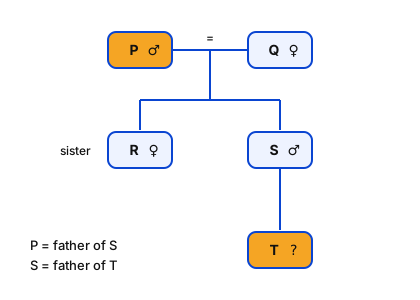
X + Y means ‘X is the husband of Y’,
X – Y means ‘X is the mother of Y’,
X × Y means ‘X is the sister of Y’ and
X ÷ Y means ‘X is the father of Y’.
Based on the above, how is P related to T if ‘P + Q – R × S ÷ T’?
एक निश्चित कूट भाषा में,
X + Y का अर्थ है ‘X, Y का पति है’,
X – Y का अर्थ है ‘X, Y की माता है’,
X × Y का अर्थ है ‘X, Y की बहन है’ और
X ÷ Y का अर्थ है ‘X, Y का पिता है’।
उपर्युक्त के आधार पर, यदि ‘P + Q – R × S ÷ T’ है, तो P, T से किस प्रकार संबंधित है?
  1. A​Mother's brotherमाता का भाई
  2. BFather's brotherपिता का भाई
  3. CFather's fatherपिता का पिता
  4. DMother's fatherमाता का पिता
Show answer

Concept: Decode the expression pair by pair and draw the family tree.

  1. P + Q: P is husband of Q. Q – R: Q is mother of R → P is father of R.
  2. R × S: R is sister of S → S is also P’s child (son).
  3. S ÷ T: S is father of T.
  4. So P is the father of T’s father → father’s father (paternal grandfather).

Trick: ‘Husband of the mother’ = father; then one more generation down gives grandfather.

Answer: (C) Father’s father

अवधारणा: व्यंजक को जोड़े-जोड़े में खोलें और वंश-वृक्ष बनाएँ।

  1. P + Q: P, Q का पति। Q – R: Q, R की माता → P, R का पिता।
  2. R × S: R, S की बहन → S भी P की संतान (पुत्र)।
  3. S ÷ T: S, T का पिता।
  4. अतः P, T के पिता का पिता → दादा (Father’s father)।

ट्रिक: ‘माता का पति’ = पिता; फिर एक पीढ़ी नीचे जाने पर दादा।

उत्तर: (C) Father’s father

RRB NTPC Graduate CBT 1General Intelligence and ReasoningBlood relations (coded)RRB NTPC Graduate CBT 1 2025 · 22 Mar Shift 1 →
Q5868.
In a certain code language, ‘BELL’ is coded as ‘1582’ and ‘SELL’ is coded as ‘2568’. What is the code for ‘S’ in that language?
एक निश्चित कूट भाषा में, ‘BELL’ को ‘1582’ के रूप में कूटबद्ध किया जाता है और ‘SELL’ को ‘2568’ के रूप में कूटबद्ध किया जाता है। उस भाषा में ‘S’ का कूट क्या है?
  1. A6
  2. B1
  3. C2
  4. D5
Show answer

Concept: Letters common to both words get the common digits; the leftover letter gets the leftover digit.

  1. BELL → 1582, SELL → 2568.
  2. Common letters E, L, L ↔ common digits 2, 5, 8.
  3. Leftover in BELL: B ↔ 1; leftover in SELL: S ↔ 6.

Trick: In such questions, only the uncommon letter–digit pair is asked; compare the two codes and pick the digit present in one but not the other.

Answer: (A) 6

अवधारणा: दोनों शब्दों के समान अक्षरों को समान अंक मिलते हैं; बचा हुआ अक्षर = बचा हुआ अंक।

  1. BELL → 1582, SELL → 2568.
  2. समान अक्षर E, L, L ↔ समान अंक 2, 5, 8.
  3. BELL में बचा B ↔ 1; SELL में बचा S ↔ 6.

ट्रिक: ऐसे प्रश्नों में केवल असमान अक्षर–अंक पूछा जाता है; दोनों कोड मिलाकर वह अंक चुनें जो एक में है, दूसरे में नहीं।

उत्तर: (A) 6

RRB NTPC Graduate CBT 1General Intelligence and ReasoningCoding–decoding (common letters)RRB NTPC Graduate CBT 1 2025 · 22 Mar Shift 1 →
Q5869.
In a certain code language, ‘TOUR’ is coded as ‘4791’ and ‘FORT’ is coded as ‘1279’. What is the code for ‘F’ in the given code language?
एक निश्चित कूट भाषा में, ‘TOUR’ को ‘4791’ के रूप में कूटबद्ध किया जाता है और ‘FORT’ को ‘1279’ के रूप में कूटबद्ध किया जाता है। दी गई कूट भाषा में ‘F’ का कूट क्या है?
  1. A1
  2. B2
  3. C9
  4. D7
Show answer

Concept: Match the common letters of the two words with the common digits of the two codes.

  1. TOUR → 4791, FORT → 1279.
  2. Common letters T, O, R ↔ common digits 7, 9, 1.
  3. Leftover: U ↔ 4 (in TOUR), F ↔ 2 (in FORT).

Trick: The digit that appears in FORT’s code but not in TOUR’s code is the code of the letter unique to FORT.

Answer: (B) 2

अवधारणा: दोनों शब्दों के समान अक्षरों को दोनों कोड के समान अंकों से मिलाएँ।

  1. TOUR → 4791, FORT → 1279.
  2. समान अक्षर T, O, R ↔ समान अंक 7, 9, 1.
  3. बचे: U ↔ 4 (TOUR में), F ↔ 2 (FORT में)।

ट्रिक: जो अंक FORT के कोड में है पर TOUR के कोड में नहीं, वही FORT के अनोखे अक्षर का कोड है।

उत्तर: (B) 2

RRB NTPC Graduate CBT 1General Intelligence and ReasoningCoding–decoding (common letters)RRB NTPC Graduate CBT 1 2025 · 22 Mar Shift 1 →
Q5870.
Which of the following letter-clusters should replace # and % so that the pattern and relationship followed between the letter-cluster pair on the left side of :: is the same as that on the right side of :: ?
# : LKP :: TSX : %
निम्नलिखित में से कौन-से अक्षर-समूह # और % के स्थान पर आने चाहिए ताकि :: के बाईं ओर के अक्षर-समूह युग्म के बीच का पैटर्न और संबंध :: के दाईं ओर के युग्म के समान हो?
# : LKP :: TSX : %
  1. A# = QIV % = OLL
  2. B# = ISU % = ONM
  3. C# = QPU % = ONS
  4. D# = QNU % = OIB
Show answer

Concept: Find the rule from the complete side and apply it to both blanks.

  1. Try the options for %: TSX → each letter −5 gives O, N, S → ONS (option C).
  2. Apply the same rule to #: # −5 = LKP ⇒ # = L+5, K+5, P+5 = Q, P, U → QPU.
  3. Option C gives exactly # = QPU and % = ONS.

Trick: When both sides have blanks, test the simplest rule (same shift for all letters) on the option values.

Answer: (C) # = QPU, % = ONS

अवधारणा: पूरे पक्ष से नियम निकालें और दोनों रिक्त स्थानों पर लागू करें।

  1. % के लिए विकल्प जाँचें: TSX → हर अक्षर −5 करने पर O, N, S → ONS (विकल्प C)।
  2. यही नियम # पर: # −5 = LKP ⇒ # = L+5, K+5, P+5 = Q, P, U → QPU.
  3. विकल्प C में ठीक # = QPU और % = ONS है।

ट्रिक: जब दोनों ओर रिक्त स्थान हों, सबसे सरल नियम (सभी अक्षरों में समान shift) को विकल्पों पर परखें।

उत्तर: (C) # = QPU, % = ONS

RRB NTPC Graduate CBT 1General Intelligence and ReasoningLetter analogyRRB NTPC Graduate CBT 1 2025 · 22 Mar Shift 1 →
Q5871.
Refer to the following number, symbol series and answer the question. Counting to be done from left to right only. All numbers are single digit numbers only.
(Left) 2 < 8 5 8 7 4 9 $ % % % & @ ? & @ 5 9 6 ? (Right)
How many such numbers are there, each of which is immediately preceded by a number and also immediately followed by a symbol?
निम्नलिखित संख्या, प्रतीक शृंखला को देखिए और प्रश्न का उत्तर दीजिए। गिनती केवल बाएँ से दाएँ की जानी है। सभी संख्याएँ केवल एक-अंकीय संख्याएँ हैं।
(बाएँ) 2 < 8 5 8 7 4 9 $ % % % & @ ? & @ 5 9 6 ? (दाएँ)
ऐसी कितनी संख्याएँ हैं, जिनमें से प्रत्येक के ठीक पहले एक संख्या है और ठीक बाद एक प्रतीक है?
  1. AThreeतीन
  2. BTwoदो
  3. CNoneकोई नहीं
  4. DOneएक
Show answer

Concept: Look for the pattern ‘number – number – symbol’ and count the middle number.

  1. Series: 2 < 8 5 8 7 4 9 $ % % % & @ ? & @ 5 9 6 ?
  2. 4 9 $ → 9 qualifies (preceded by 4, followed by $).
  3. 9 6 ? → 6 qualifies (preceded by 9, followed by ?).
  4. No other number has a number before it and a symbol after it → two.

Trick: Such numbers can only sit at the end of a run of numbers just before a symbol – check only those spots.

Answer: (B) Two

अवधारणा: ‘संख्या – संख्या – प्रतीक’ पैटर्न ढूँढ़ें और बीच वाली संख्या गिनें।

  1. श्रृंखला: 2 < 8 5 8 7 4 9 $ % % % & @ ? & @ 5 9 6 ?
  2. 4 9 $ → 9 मान्य (पहले 4, बाद में $)।
  3. 9 6 ? → 6 मान्य (पहले 9, बाद में ?)।
  4. और कोई संख्या ऐसी नहीं → दो।

ट्रिक: ऐसी संख्याएँ केवल संख्याओं की कतार के अंत में, प्रतीक से ठीक पहले हो सकती हैं – बस वही स्थान जाँचें।

उत्तर: (B) Two

RRB NTPC Graduate CBT 1General Intelligence and ReasoningNumber–symbol seriesRRB NTPC Graduate CBT 1 2025 · 22 Mar Shift 1 →
Q5872.
Read the given statements and conclusions carefully. Assuming that the information given in the statements is true, even if it appears to be at variance with commonly known facts, decide which of the given conclusions logically follow(s) from the statements.
Statements:
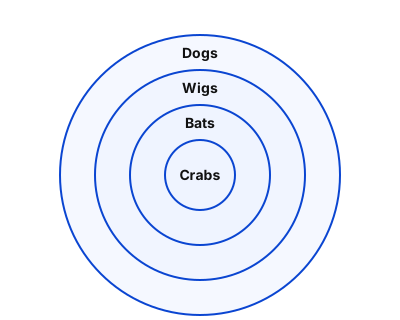
All crabs are bats. All bats are wigs. All wigs are dogs.
Conclusions:
(I) All crabs are dogs.
(II) Some dogs are bats.
दिए गए कथनों और निष्कर्षों को ध्यानपूर्वक पढ़िए। कथनों में दी गई जानकारी को सत्य मानते हुए, भले ही वह सामान्यतः ज्ञात तथ्यों से भिन्न प्रतीत होती हो, निर्णय कीजिए कि दिए गए निष्कर्षों में से कौन-सा/कौन-से निष्कर्ष कथनों का तार्किक रूप से अनुसरण करता है/करते हैं।
कथन:
सभी केकड़े, चमगादड़ हैं। सभी चमगादड़, विग हैं। सभी विग, कुत्ते हैं।
निष्कर्ष:
(I) सभी केकड़े, कुत्ते हैं।
(II) कुछ कुत्ते, चमगादड़ हैं।
  1. AOnly conclusion (II) followsकेवल निष्कर्ष (II) अनुसरण करता है
  2. BNeither conclusion (I) nor (II) followsन तो निष्कर्ष (I) और न ही (II) अनुसरण करता है
  3. COnly conclusion (I) followsकेवल निष्कर्ष (I) अनुसरण करता है
  4. DBoth conclusions (I) and (II) followनिष्कर्ष (I) और (II) दोनों अनुसरण करते हैं
Show answer

Concept: A chain of ‘All A are B’ statements can be drawn as nested circles.

  1. Crabs ⊂ Bats ⊂ Wigs ⊂ Dogs.
  2. (I) All crabs are dogs – the innermost circle lies inside the outermost → follows.
  3. (II) Some dogs are bats – the bats circle lies inside dogs, so some dogs are certainly bats → follows.

Trick: ‘All A are B’ always gives ‘Some B are A’ (conversion) – so conclusion II is a direct conversion of ‘All bats are dogs’.

Answer: (D) Both conclusions (I) and (II) follow

अवधारणा: ‘सभी A, B हैं’ की श्रृंखला को एक-दूसरे के अंदर बने वृत्तों से दिखाया जा सकता है।

  1. Crabs ⊂ Bats ⊂ Wigs ⊂ Dogs.
  2. (I) सभी crabs, dogs हैं – सबसे भीतरी वृत्त सबसे बाहरी के अंदर है → अनुसरण करता है।
  3. (II) कुछ dogs, bats हैं – bats का वृत्त dogs के अंदर है, अतः कुछ dogs निश्चित रूप से bats हैं → अनुसरण करता है।

ट्रिक: ‘सभी A, B हैं’ से हमेशा ‘कुछ B, A हैं’ निकलता है (conversion) – निष्कर्ष II ‘सभी bats, dogs हैं’ का सीधा conversion है।

उत्तर: (D) Both conclusions (I) and (II) follow

RRB NTPC Graduate CBT 1General Intelligence and ReasoningSyllogismRRB NTPC Graduate CBT 1 2025 · 22 Mar Shift 1 →
Q5873.
Below are given two sets of numbers. In each set of numbers, a certain mathematical operation on the first number results in the second number. Similarly, certain
mathematical operation on the second number results in the third number and so on. Which of the given operations follows the same set of operations as in question? (NOTE – A two/three-digit number cannot be broken into individual digits for operations e.g. if 37 is followed by 10, the operation cannot be 3+7 as a two-digit number cannot be broken into individual digits.)
17 - 7 - 21 - 33 ;
21 - 11 - 33 - 45
नीचे संख्याओं के दो समुच्चय दिए गए हैं। संख्याओं के प्रत्येक समुच्चय में, पहली संख्या पर एक निश्चित गणितीय संक्रिया करने से दूसरी संख्या प्राप्त होती है। इसी प्रकार, दूसरी संख्या पर एक निश्चित
गणितीय संक्रिया करने से तीसरी संख्या प्राप्त होती है, और इसी तरह आगे भी। दी गई संक्रियाओं में से कौन-सी प्रश्न में दी गई संक्रियाओं के समान समुच्चय का अनुसरण करती है? (नोट – संक्रियाओं के लिए दो/तीन-अंकीय संख्या को अलग-अलग अंकों में नहीं तोड़ा जा सकता, उदाहरण के लिए यदि 37 के बाद 10 आता है, तो संक्रिया 3+7 नहीं हो सकती क्योंकि दो-अंकीय संख्या को अलग-अलग अंकों में नहीं तोड़ा जा सकता।)
17 - 7 - 21 - 33 ;
21 - 11 - 33 - 45
  1. A16-8-24-48
  2. B23-13-26-52
  3. C14-4-12-24
  4. D21-11-33-72
Show answer

Concept: Find the three operations in the given sets and test them on the options.

  1. 17 → 7 (−10), 7 → 21 (×3), 21 → 33 (+12). Check: 21 → 11 (−10), 11 → 33 (×3), 33 → 45 (+12). ✓
  2. Option C: 14 → 4 (−10), 4 → 12 (×3), 12 → 24 (+12). ✓
  3. A: 16−8 is −8; B: 13×3 ≠ 26; D: 33+12 ≠ 72.

Trick: Check the first operation (−10) on all options first – it eliminates A at once; then verify the rest.

Answer: (C) 14-4-12-24

अवधारणा: दिए गए सेटों में तीनों संक्रियाएँ निकालें और विकल्पों पर परखें।

  1. 17 → 7 (−10), 7 → 21 (×3), 21 → 33 (+12). जाँच: 21 → 11 (−10), 11 → 33 (×3), 33 → 45 (+12). ✓
  2. विकल्प C: 14 → 4 (−10), 4 → 12 (×3), 12 → 24 (+12). ✓
  3. A: 16−8 में −8; B: 13×3 ≠ 26; D: 33+12 ≠ 72.

ट्रिक: पहले सभी विकल्पों पर पहली संक्रिया (−10) जाँचें – A तुरंत कट जाता है; फिर बाकी सत्यापित करें।

उत्तर: (C) 14-4-12-24

RRB NTPC Graduate CBT 1General Intelligence and ReasoningNumber operations seriesRRB NTPC Graduate CBT 1 2025 · 22 Mar Shift 1 →
Q5874.
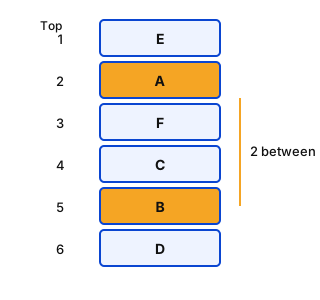
Six boxes, A, B, C, D, E and F are kept one over the other but not necessarily in the same order. F is placed third from the top. Only two boxes are kept between F and D. A is kept above F but somewhere below E. C is not kept at the second place from the bottom. How many boxes are kept between A and B?
छह बक्से, A, B, C, D, E और F एक के ऊपर एक रखे गए हैं, परंतु आवश्यक नहीं कि इसी क्रम में हों। F ऊपर से तीसरे स्थान पर रखा है। F और D के बीच केवल दो बक्से रखे हैं। A, F के ऊपर परंतु E के नीचे कहीं रखा है। C नीचे से दूसरे स्थान पर नहीं रखा है। A और B के बीच कितने बक्से रखे हैं?
  1. ATwoदो
  2. BThreeतीन
  3. CFourचार
  4. DOneएक
Show answer

Concept: Number positions 1 (top) to 6 (bottom) and fill from the definite clue.

  1. F at position 3. Two boxes between F and D → D at 6 (position 0 does not exist).
  2. A above F but below E → E = 1, A = 2.
  3. C is not at position 5 → C = 4, so B = 5.
  4. Order: E, A, F, C, B, D. Between A (2) and B (5): F and C → two boxes.

Trick: ‘Only one position possible’ clues (like F third from top + D two away) should be placed before the relative ones.

Answer: (A) Two

अवधारणा: स्थान 1 (ऊपर) से 6 (नीचे) तक अंकित करें और निश्चित सूत्र से भरें।

  1. F स्थान 3 पर। F और D के बीच दो बॉक्स → D = 6 (स्थान 0 संभव नहीं)।
  2. A, F के ऊपर पर E के नीचे → E = 1, A = 2.
  3. C स्थान 5 पर नहीं → C = 4, अतः B = 5.
  4. क्रम: E, A, F, C, B, D. A (2) और B (5) के बीच: F और C → दो बॉक्स।

ट्रिक: जिन सूत्रों से केवल एक स्थान संभव हो (F ऊपर से तीसरा + D दो दूर), उन्हें सापेक्ष सूत्रों से पहले रखें।

उत्तर: (A) Two

RRB NTPC Graduate CBT 1General Intelligence and ReasoningBox arrangement (stack)RRB NTPC Graduate CBT 1 2025 · 22 Mar Shift 1 →
Q5875.
In this question, a question is followed by two statements numbered (I) and (II). You have to decide whether the data provided in the statements are sufficient to answer the question. Read both the statements and decide the appropriate answer.
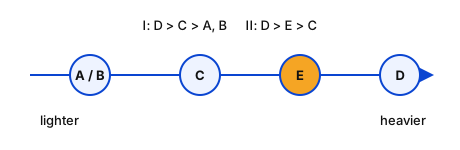
Q. Five boxes – Box-A, Box-B, Box-C, Box-D, and Box-E – have different weights. Which box is the second heaviest?
(I) Box-C is heavier than Box-A and Box-B but lighter than Box-D.
(II) Box-E is heavier than Box-C but lighter than Box-D.
इस प्रश्न में, एक प्रश्न के बाद (I) और (II) क्रमांकित दो कथन दिए गए हैं। आपको यह निर्णय करना है कि कथनों में दिए गए आँकड़े प्रश्न का उत्तर देने के लिए पर्याप्त हैं या नहीं। दोनों कथनों को पढ़िए और उचित उत्तर का चयन कीजिए।
प्रश्न: पाँच बक्सों – बक्सा-A, बक्सा-B, बक्सा-C, बक्सा-D और बक्सा-E – के भार अलग-अलग हैं। कौन-सा बक्सा दूसरा सबसे भारी है?
(I) बक्सा-C, बक्सा-A और बक्सा-B से भारी है परंतु बक्सा-D से हल्का है।
(II) बक्सा-E, बक्सा-C से भारी है परंतु बक्सा-D से हल्का है।
  1. ABoth statements I and II together are NOT sufficient to answer the questionकथन I और II दोनों मिलकर भी प्रश्न का उत्तर देने के लिए पर्याप्त नहीं हैं
  2. BData in Statement I alone is sufficient to answer the question while data in Statement II is notकथन I के आँकड़े अकेले प्रश्न का उत्तर देने के लिए पर्याप्त हैं, जबकि कथन II के आँकड़े पर्याप्त नहीं हैं
  3. CBoth statements I and II together (and not statement I alone or statement II alone) are sufficient to answer the questionकथन I और II दोनों मिलकर (और न कि केवल कथन I या केवल कथन II) प्रश्न का उत्तर देने के लिए पर्याप्त हैं
  4. DData in Statement II alone is sufficient to answer the question while data in Statement I is notकथन II के आँकड़े अकेले प्रश्न का उत्तर देने के लिए पर्याप्त हैं, जबकि कथन I के आँकड़े पर्याप्त नहीं हैं
Show answer

Concept: Check each statement alone, then both together.

  1. I alone: D > C > A, B – but E is unknown; E could be anywhere → not sufficient.
  2. II alone: D > E > C – A and B unknown; they could be above E → not sufficient.
  3. Together: D > E > C > A, B → second heaviest is E.

Trick: For ‘second heaviest’, every box must be placed below someone except the top two – a statement missing any box is insufficient.

Answer: (C) Both statements I and II together are sufficient

अवधारणा: पहले हर कथन अकेले, फिर दोनों साथ जाँचें।

  1. I अकेले: D > C > A, B – पर E अज्ञात; E कहीं भी हो सकता है → अपर्याप्त।
  2. II अकेले: D > E > C – A और B अज्ञात; वे E से ऊपर हो सकते हैं → अपर्याप्त।
  3. दोनों साथ: D > E > C > A, B → दूसरा सबसे भारी E.

ट्रिक: ‘दूसरा सबसे भारी’ जानने के लिए हर बॉक्स की स्थिति चाहिए – जिस कथन में कोई बॉक्स छूटे, वह अपर्याप्त है।

उत्तर: (C) Both statements I and II together are sufficient

RRB NTPC Graduate CBT 1General Intelligence and ReasoningData sufficiency – orderingRRB NTPC Graduate CBT 1 2025 · 22 Mar Shift 1 →
Q5876.
What should come in place of ‘?’ in the given series?
30 28 25 20 13 ?
दी गई शृंखला में ‘?’ के स्थान पर क्या आना चाहिए?
30 28 25 20 13 ?
  1. A4
  2. B1
  3. C2
  4. D3
Show answer

Concept: Look at the successive differences.

  1. 30→28→25→20→13: differences 2,3,5,7 – consecutive primes.
  2. Next prime is 11: 13−11=2.

Trick: Differences 2, 3, 5, 7, 11, 13 … (primes) is a favourite pattern – check it whenever gaps grow irregularly.

Answer: (C) 2

अवधारणा: क्रमागत अंतर देखें।

  1. 30→28→25→20→13: अंतर 2,3,5,7 – क्रमागत अभाज्य संख्याएँ।
  2. अगली अभाज्य 11: 13−11=2.

ट्रिक: अंतर 2, 3, 5, 7, 11, 13 … (अभाज्य) एक प्रिय पैटर्न है – जब अंतर अनियमित बढ़ें तो इसे ज़रूर जाँचें।

उत्तर: (C) 2

RRB NTPC Graduate CBT 1General Intelligence and ReasoningNumber seriesRRB NTPC Graduate CBT 1 2025 · 22 Mar Shift 1 →
Q5877.
LFGK is related to RKKN in a certain way based on the English alphabetical order. In the same way, GMOP is related to MRSS. To which of the following is COLU related, following the same logic?
अंग्रेज़ी वर्णमाला क्रम के आधार पर LFGK एक निश्चित प्रकार से RKKN से संबंधित है। उसी प्रकार, GMOP, MRSS से संबंधित है। उसी तर्क के अनुसार, COLU निम्नलिखित में से किससे संबंधित है?
  1. AITPX
  2. BJUQZ
  3. CHSOX
  4. DGWNZ
Show answer

Concept: Find the position-wise shift from the first cluster to the second.

  1. LFGK → RKKN: L+6=R, F+5=K, G+4=K, K+3=N (shifts +6, +5, +4, +3).
  2. Check GMOP → MRSS: G+6=M, M+5=R, O+4=S, P+3=S ✓.
  3. COLU: C+6=I, O+5=T, L+4=P, U+3=X → ITPX.

Trick: Decreasing shifts (+6, +5, +4, +3) are common; verify with the second pair before applying.

Answer: (A) ITPX

अवधारणा: पहले समूह से दूसरे तक स्थान-वार shift निकालें।

  1. LFGK → RKKN: L+6=R, F+5=K, G+4=K, K+3=N (shift +6, +5, +4, +3)।
  2. जाँच GMOP → MRSS: G+6=M, M+5=R, O+4=S, P+3=S ✓.
  3. COLU: C+6=I, O+5=T, L+4=P, U+3=X → ITPX.

ट्रिक: घटते shift (+6, +5, +4, +3) आम हैं; लागू करने से पहले दूसरे जोड़े से सत्यापित करें।

उत्तर: (A) ITPX

RRB NTPC Graduate CBT 1General Intelligence and ReasoningLetter-cluster analogyRRB NTPC Graduate CBT 1 2025 · 22 Mar Shift 1 →
Q5878.
When a spring is compressed from its equilibrium position, its potential energy will ___________________.
जब किसी स्प्रिंग को उसकी साम्यावस्था से संपीडित किया जाता है, तो उसकी स्थितिज ऊर्जा ___________________।
  1. Aremain unchangedअपरिवर्तित रहेगी
  2. Bfirst decrease then increaseपहले घटेगी फिर बढ़ेगी
  3. Cincreaseबढ़ेगी
  4. Ddecreaseघटेगी
Show answer

Concept: Elastic potential energy of a spring U=12kx2, where x is the compression or extension from equilibrium.

  1. At equilibrium x=0, so U=0 (minimum).
  2. Compressing increases x, and since x2 is always positive, U increases – work done against the spring force is stored in it.

Trick: Stretch or compress – both store energy; U depends on x2, not on direction.

Answer: (C) increase

अवधारणा: स्प्रिंग की प्रत्यास्थ स्थितिज ऊर्जा U=12kx2, जहाँ x साम्य स्थिति से संपीडन या खिंचाव है।

  1. साम्य पर x=0, अतः U=0 (न्यूनतम)।
  2. दबाने पर x बढ़ता है और x2 सदैव धनात्मक है, अतः U बढ़ती है – स्प्रिंग बल के विरुद्ध किया गया कार्य उसमें संचित होता है।

ट्रिक: खींचो या दबाओ – दोनों में ऊर्जा संचित होती है; U, x2 पर निर्भर है, दिशा पर नहीं।

उत्तर: (C) बढ़ेगी (increase)

RRB NTPC Graduate CBT 1General AwarenessElastic Potential EnergyRRB NTPC Graduate CBT 1 2025 · 19 Mar Shift 3 →
Q5879.
Items such as the operating system and device drivers fall under which category of software?
ऑपरेटिंग सिस्टम और डिवाइस ड्राइवर जैसी वस्तुएँ सॉफ्टवेयर की किस श्रेणी में आती हैं?
  1. ASystem softwareसिस्टम सॉफ्टवेयर
  2. BUtility software onlyकेवल यूटिलिटी सॉफ्टवेयर
  3. CEntertainment softwareमनोरंजन सॉफ्टवेयर
  4. DTemporary programsअस्थायी प्रोग्राम
Show answer

Concept: Software is broadly system software (runs/manages the hardware) and application software (does user tasks).

  1. Operating system (Windows, Linux) and device drivers control hardware and provide a platform for other programs – that is system software.
  2. Utility software (antivirus, disk cleanup) is a sub-type of system software, so "utility software only" is too narrow.

Trick: OS + drivers + utilities + language translators = System software.

Answer: (A) System software

अवधारणा: सॉफ्टवेयर मुख्यतः system software (हार्डवेयर चलाता/प्रबंधित करता है) और application software (उपयोगकर्ता के कार्य) होता है।

  1. ऑपरेटिंग सिस्टम (Windows, Linux) और डिवाइस ड्राइवर हार्डवेयर को नियंत्रित कर अन्य प्रोग्रामों को platform देते हैं – यही system software है।
  2. Utility software (antivirus, disk cleanup) system software का उप-प्रकार है, अतः "utility software only" संकीर्ण है।

ट्रिक: OS + drivers + utilities + language translators = System software।

उत्तर: (A) System software

RRB NTPC Graduate CBT 1General AwarenessTypes of SoftwareRRB NTPC Graduate CBT 1 2025 · 19 Mar Shift 3 →
Q5880.
Which among the following Articles of the Indian Constitution provides Municipalities with financial powers?
भारतीय संविधान के निम्नलिखित में से कौन-सा अनुच्छेद नगरपालिकाओं को वित्तीय शक्तियाँ प्रदान करता है?
  1. AArticle 243Pअनुच्छेद 243P
  2. BArticle 243ZBअनुच्छेद 243ZB
  3. CArticle 243Uअनुच्छेद 243U
  4. DArticle 243 Xअनुच्छेद 243X
Show answer

Concept: Part IXA (Articles 243P–243ZG, added by the 74th Amendment, 1992) deals with Municipalities.

  1. Article 243X – power to impose taxes by, and funds of, the Municipalities: the State Legislature may authorise a municipality to levy taxes, duties, tolls and fees and assign grants.
  2. Article 243P – definitions; 243U – duration of municipalities; 243ZB – application to Union Territories. 243Y is the Finance Commission for municipalities.

Trick: Panchayat finance = 243H; Municipality finance = 243X (both "money" articles end in H/X).

Answer: (D) Article 243 X

अवधारणा: भाग IXA (अनुच्छेद 243P–243ZG, 74वें संशोधन 1992 से जोड़ा गया) नगरपालिकाओं से संबंधित है।

  1. अनुच्छेद 243X – नगरपालिकाओं द्वारा कर लगाने की शक्ति तथा उनकी निधियाँ: राज्य विधानमंडल नगरपालिका को कर, शुल्क, पथकर, फीस लगाने का अधिकार और अनुदान दे सकता है।
  2. अनुच्छेद 243P – परिभाषाएँ; 243U – नगरपालिकाओं की अवधि; 243ZB – संघ राज्यक्षेत्रों पर लागू होना। 243Y नगरपालिका वित्त आयोग है।

ट्रिक: पंचायत वित्त = 243H; नगरपालिका वित्त = 243X।

उत्तर: (D) अनुच्छेद 243 X

RRB NTPC Graduate CBT 1General AwarenessMunicipalities – Part IXARRB NTPC Graduate CBT 1 2025 · 19 Mar Shift 3 →