Question bank

Q&A: practice questions with answers

Search questions on any topic. Filter by exam category, exam, subject and topic, try the question, then open the answer and explanation.

Courses – airGurukul

53,050 questions in the question bank.

Q2441.
Spraying of which of the following phytohormone on juvenile conifers helps in hastening the maturity period, that leads to early seed production?
किशोर शंकुधारी (conifers) पौधों पर निम्नलिखित में से किस पादप हार्मोन का छिड़काव परिपक्वता अवधि को शीघ्र करने में सहायक होता है, जिससे बीज उत्पादन जल्दी होता है?
  1. AIndole-3-butyric Acidइंडोल-3-ब्यूटिरिक अम्ल
  2. BGibberellic Acidजिबरेलिक अम्ल
  3. CZeatinज़ियाटिन
  4. DAbscisic Acidएब्सिसिक अम्ल
Show answer

Concept: NCERT (gibberellins): "Gibberellins also promote bolting… Spraying juvenile conifers with GAs hastens the maturity period, thus leading to early seed production."

  1. GA → early maturity in conifers, also increases length of grape stalks, sugarcane yield, malting in brewing → correct.
  2. IBA – auxin, used for rooting of stem cuttings.
  3. Zeatin – natural cytokinin (cell division, delays senescence).
  4. ABA – growth inhibitor, induces dormancy and stomatal closure.

Short trick: GA = "Grow up fast" – bolting, early maturity in conifers, longer grape stalks.

Answer: (B) Gibberellic Acid

अवधारणा: NCERT (जिबरेलिन): "जिबरेलिन बोल्टिंग को भी बढ़ाते हैं… किशोर शंकुधारी पौधों पर GA का छिड़काव परिपक्वता अवधि को शीघ्र करता है, जिससे बीज उत्पादन जल्दी होता है।"

  1. GA → शंकुधारियों में शीघ्र परिपक्वता; अंगूर के डंठल की लंबाई, गन्ने की उपज और मद्य निर्माण में माल्टिंग भी बढ़ाता है → सही।
  2. IBA – ऑक्सिन, तने की कलमों में जड़ निकालने हेतु।
  3. ज़ियाटिन – प्राकृतिक साइटोकाइनिन (कोशिका विभाजन, जीर्णता में देरी)।
  4. ABA – वृद्धि निरोधक, प्रसुप्ति और रंध्र बंद करना।

शॉर्ट ट्रिक: GA = "जल्दी बड़ा करो" – बोल्टिंग, शंकुधारियों में शीघ्र परिपक्वता, अंगूर के लंबे डंठल।

उत्तर: (B) जिबरेलिक अम्ल
NEET UGBotanyPlant growth regulators – gibberellinsNEET UG 2023 · 7 May Shift 1 →
Q2442.
In the equation
GPP − R = NPP
GPP is Gross Primary Productivity
NPP is Net Primary Productivity
R here is ______.
समीकरण
GPP − R = NPP
में GPP सकल प्राथमिक उत्पादकता है
NPP नेट (शुद्ध) प्राथमिक उत्पादकता है
यहाँ R ______ है।
  1. APhotosynthetically active radiationप्रकाश-संश्लेषणीय सक्रिय विकिरण (PAR)
  2. BRespiratory quotientश्वसन गुणांक (RQ)
  3. CRespiratory lossश्वसन हानि
  4. DReproductive allocationजनन आवंटन
Show answer

Concept: NCERT: "A considerable amount of GPP is utilised by plants in respiration. Gross primary productivity minus respiration losses (R) is the net primary productivity (NPP)."

  1. GPP = rate of production of organic matter during photosynthesis.
  2. Part of it is burnt in the plant's own respiration = R (respiratory loss).
  3. NPP = GPP − R is the biomass available to heterotrophs.
  4. PAR, RQ and reproductive allocation are unrelated terms.

Short trick: Gross salary − tax = net salary; here the "tax" a plant pays is its own respiration.

Answer: (C) Respiratory loss

अवधारणा: NCERT: "GPP का काफी भाग पौधे श्वसन में उपयोग कर लेते हैं। सकल प्राथमिक उत्पादकता में से श्वसन हानि (R) घटाने पर नेट प्राथमिक उत्पादकता (NPP) प्राप्त होती है।"

  1. GPP = प्रकाश-संश्लेषण के दौरान कार्बनिक पदार्थ बनने की दर।
  2. इसका कुछ भाग पौधे के अपने श्वसन में जल जाता है = R (श्वसन हानि)।
  3. NPP = GPP − R, विषमपोषियों को उपलब्ध जैवभार है।
  4. PAR, RQ और जनन आवंटन असंबंधित पद हैं।

शॉर्ट ट्रिक: सकल वेतन − कर = शुद्ध वेतन; यहाँ पौधे का "कर" उसका अपना श्वसन है।

उत्तर: (C) श्वसन हानि

NEET UGBotanyEcosystem – productivityNEET UG 2023 · 7 May Shift 1 →
Q2443.
Family Fabaceae differs from Solanaceae and Liliaceae. With respect to the stamens, pick out the characteristics specific to family Fabaceae but not found in Solanaceae or Liliaceae.
कुल फैबेसी, सोलैनेसी और लिलिएसी से भिन्न है। पुंकेसरों के संदर्भ में, वे लक्षण चुनिए जो कुल फैबेसी के विशिष्ट हैं परंतु सोलैनेसी या लिलिएसी में नहीं पाए जाते।
  1. ADiadelphous and Dithecous anthersद्विसंघी (diadelphous) तथा द्विकोष्ठी (dithecous) परागकोश
  2. BPolyadelphous and epipetalous stamensबहुसंघी (polyadelphous) तथा दललग्न (epipetalous) पुंकेसर
  3. CMonoadelphous and Monothecous anthersएकसंघी (monoadelphous) तथा एककोष्ठी (monothecous) परागकोश
  4. DEpiphyllous and Dithecous anthersपरिदललग्न (epiphyllous) तथा द्विकोष्ठी परागकोश
Show answer

Concept: NCERT floral features – Fabaceae: stamens ten, diadelphous (9+1), anthers dithecous. Solanaceae: five, epipetalous, free. Liliaceae: six, epiphyllous (attached to tepals), free.

  1. Diadelphous condition occurs only in Fabaceae among the three → (A) correct (anthers dithecous).
  2. (B) Polyadelphous – citrus; epipetalous – Solanaceae.
  3. (C) Monoadelphous + monothecous – Malvaceae (china rose), not Fabaceae.
  4. (D) Epiphyllous – Liliaceae.

Short trick: Pea flower: (9)+1 stamens = diadelphous – the "odd one out" stamen is the Fabaceae signature.

Answer: (A) Diadelphous and Dithecous anthers

अवधारणा: NCERT पुष्पी लक्षण – फैबेसी: पुंकेसर दस, द्विसंघी (9+1), परागकोश द्विकोष्ठी। सोलैनेसी: पाँच, दललग्न, स्वतंत्र। लिलिएसी: छह, परिदललग्न (टेपल से जुड़े), स्वतंत्र।

  1. तीनों में द्विसंघी अवस्था केवल फैबेसी में है → (A) सही (परागकोश द्विकोष्ठी)।
  2. (B) बहुसंघी – सिट्रस; दललग्न – सोलैनेसी।
  3. (C) एकसंघी + एककोष्ठी – मालवेसी (गुड़हल), फैबेसी नहीं।
  4. (D) परिदललग्न – लिलिएसी।

शॉर्ट ट्रिक: मटर का पुष्प: (9)+1 पुंकेसर = द्विसंघी – यही "एक अलग" पुंकेसर फैबेसी की पहचान है।

उत्तर: (A) द्विसंघी तथा द्विकोष्ठी परागकोश

NEET UGBotanyMorphology – families (Fabaceae androecium)NEET UG 2023 · 7 May Shift 1 →
Q2444.
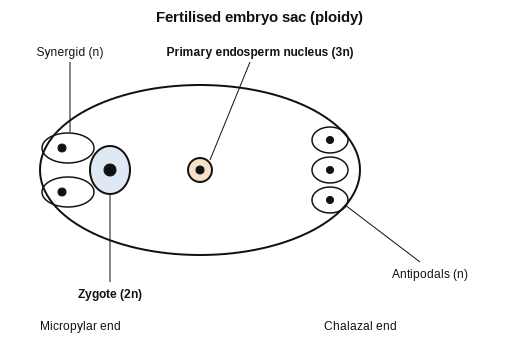
In angiosperm, the haploid, diploid and triploid structures of a fertilized embryo sac sequentially are:
आवृतबीजी में, निषेचित भ्रूणकोष की अगुणित, द्विगुणित और त्रिगुणित संरचनाएँ क्रमशः हैं:
  1. ASynergids, Primary endosperm nucleus and zygoteसहायक कोशिकाएँ, प्राथमिक भ्रूणपोष केंद्रक और युग्मनज
  2. BAntipodals, synergids, and primary endosperm nucleusप्रतिव्यासांत कोशिकाएँ, सहायक कोशिकाएँ और प्राथमिक भ्रूणपोष केंद्रक
  3. CSynergids, Zygote and Primary endosperm nucleusसहायक कोशिकाएँ, युग्मनज और प्राथमिक भ्रूणपोष केंद्रक
  4. DSynergids, antipodals and Polar nucleiसहायक कोशिकाएँ, प्रतिव्यासांत कोशिकाएँ और ध्रुवीय केंद्रक
Show answer

Concept: Double fertilisation: male gamete (n) + egg (n) = zygote (2n) – syngamy; male gamete (n) + two polar nuclei (n + n) = PEN (3n) – triple fusion. Synergids and antipodals stay haploid.

  1. Haploid: synergids (and antipodals).
  2. Diploid: zygote.
  3. Triploid: primary endosperm nucleus.
  4. Order haploid → diploid → triploid = synergids, zygote, PEN → (C).
  5. (A) puts PEN as diploid and zygote as triploid; (B) synergids are not diploid; (D) antipodals and polar nuclei are not 2n/3n.

Short trick: Count gametes fused: zygote = 2 sets, PEN = 3 sets (1 male + 2 polar); everything unfused = n.

Answer: (C) Synergids, Zygote and Primary endosperm nucleus

अवधारणा: द्विनिषेचन: नर युग्मक (n) + अंड (n) = युग्मनज (2n) – युग्मक संलयन; नर युग्मक (n) + दो ध्रुवीय केंद्रक (n + n) = PEN (3n) – त्रिसंलयन। सहायक व प्रतिव्यासांत कोशिकाएँ अगुणित रहती हैं।

  1. अगुणित: सहायक कोशिकाएँ (और प्रतिव्यासांत कोशिकाएँ)।
  2. द्विगुणित: युग्मनज।
  3. त्रिगुणित: प्राथमिक भ्रूणपोष केंद्रक।
  4. क्रम अगुणित → द्विगुणित → त्रिगुणित = सहायक कोशिकाएँ, युग्मनज, PEN → (C)।
  5. (A) में PEN को द्विगुणित व युग्मनज को त्रिगुणित बताया है; (B) सहायक कोशिकाएँ द्विगुणित नहीं; (D) प्रतिव्यासांत व ध्रुवीय केंद्रक 2n/3n नहीं हैं।

शॉर्ट ट्रिक: संलयित समुच्चय गिनें: युग्मनज = 2 समुच्चय, PEN = 3 समुच्चय (1 नर + 2 ध्रुवीय); बाकी सब = n।

उत्तर: (C) सहायक कोशिकाएँ, युग्मनज और प्राथमिक भ्रूणपोष केंद्रक

NEET UGBotanySexual reproduction in flowering plants – ploidy of embryo sacNEET UG 2023 · 7 May Shift 1 →
Q2445.
Which hormone promotes internode/petiole elongation in deep water rice?
गहरे जल वाले धान (deep water rice) में पर्व/पर्णवृंत के दीर्घीकरण को कौन-सा हार्मोन बढ़ावा देता है?
  1. AGA3
  2. BKinetinकाइनेटिन
  3. CEthyleneएथिलीन
  4. D2, 4-D
Show answer

Concept: NCERT (ethylene): "Ethylene promotes rapid internode/petiole elongation in deep water rice plants. It helps leaves/upper parts of the shoot to remain above water."

  1. Ethylene (gaseous PGR) → correct; it also causes horizontal growth of seedlings, swelling of axis, apical hook in dicots, fruit ripening.
  2. GA3 – stem elongation/bolting in general, not the deep-water-rice example.
  3. Kinetin – cytokinin (cell division).
  4. 2,4-D – synthetic auxin, weedicide.

Short trick: Deep water rice "snorkels" out of water with ethylene – flooding traps ethylene in submerged tissue.

Answer: (C) Ethylene

अवधारणा: NCERT (एथिलीन): "एथिलीन गहरे जल वाले धान के पौधों में पर्व/पर्णवृंत के तीव्र दीर्घीकरण को बढ़ाता है, जिससे पत्तियाँ/प्ररोह के ऊपरी भाग जल के ऊपर बने रहते हैं।"

  1. एथिलीन (गैसीय PGR) → सही; यह नवोद्भिदों की क्षैतिज वृद्धि, अक्ष का फूलना, द्विबीजपत्रियों में शीर्षस्थ हुक और फल पकना भी कराता है।
  2. GA3 – सामान्य तना दीर्घीकरण/बोल्टिंग, गहरे जल वाले धान का उदाहरण नहीं।
  3. काइनेटिन – साइटोकाइनिन (कोशिका विभाजन)।
  4. 2,4-D – संश्लेषित ऑक्सिन, खरपतवारनाशी।

शॉर्ट ट्रिक: गहरे जल वाला धान एथिलीन से पानी के ऊपर "स्नॉर्कल" करता है – बाढ़ में डूबे ऊतक में एथिलीन फँस जाती है।

उत्तर: (C) एथिलीन

NEET UGBotanyPlant growth regulators – ethyleneNEET UG 2023 · 7 May Shift 1 →
Q2446.
Given below are two statements: One is labelled as Assertion A and the other is labelled as Reason R:
Assertion A: Late wood has fewer xylary elements with narrow vessels.
Reason R: Cambium is less active in winters.
In the light of the above statements, choose the correct answer from the options given below:
नीचे दो कथन दिए गए हैं: एक को अभिकथन (Assertion) A और दूसरे को कारण (Reason) R के रूप में अंकित किया गया है:
अभिकथन A: पश्च काष्ठ (late wood) में कम जाइलम तत्त्व तथा संकरी वाहिकाएँ होती हैं।
कारण R: शीत ऋतु में एधा (cambium) कम सक्रिय होती है।
उपर्युक्त कथनों के आलोक में, नीचे दिए गए विकल्पों में से सही उत्तर चुनिए:
  1. ABoth A and R are true and R is the correct explanation of A.A और R दोनों सत्य हैं तथा R, A की सही व्याख्या है।
  2. BBoth A and R are true but R is NOT the correct explanation of A.A और R दोनों सत्य हैं परंतु R, A की सही व्याख्या नहीं है।
  3. CA is true but R is false.A सत्य है परंतु R असत्य है।
  4. DA is false but R is true.A असत्य है परंतु R सत्य है।
Show answer

Concept: NCERT: "In winter, the cambium is less active and forms fewer xylary elements that have narrow vessels, and this wood is called autumn wood or late wood." In spring it is very active (early/spring wood – many elements, wide vessels).

  1. A is true – late (autumn) wood is dense, darker, with fewer elements and narrow vessels.
  2. R is true – cambial activity falls in winter.
  3. Low cambial activity is exactly why late wood has fewer, narrower elements → R explains A.

Short trick: Spring = spacious vessels, light colour; Autumn/late = narrow, dark, dense. One spring + one autumn ring = one annual ring.

Answer: (A) Both A and R are true and R is the correct explanation of A.

अवधारणा: NCERT: "शीत ऋतु में एधा कम सक्रिय होती है और कम जाइलम तत्त्व बनाती है जिनकी वाहिकाएँ संकरी होती हैं; यह काष्ठ शरद काष्ठ या पश्च काष्ठ कहलाता है।" वसंत में यह अत्यधिक सक्रिय होती है (वसंत/पूर्व काष्ठ – अधिक तत्त्व, चौड़ी वाहिकाएँ)।

  1. A सत्य – पश्च (शरद) काष्ठ सघन, गहरा तथा कम तत्त्वों व संकरी वाहिकाओं वाला होता है।
  2. R सत्य – शीत ऋतु में एधा की सक्रियता घटती है।
  3. एधा की कम सक्रियता ही पश्च काष्ठ में कम व संकरे तत्त्वों का कारण है → R, A की व्याख्या करता है।

शॉर्ट ट्रिक: वसंत = चौड़ी वाहिकाएँ, हल्का रंग; शरद/पश्च = संकरी, गहरी, सघन। एक वसंत + एक शरद वलय = एक वार्षिक वलय।

उत्तर: (A) A और R दोनों सत्य हैं तथा R, A की सही व्याख्या है।

NEET UGBotanyAnatomy – secondary growth (spring and autumn wood)NEET UG 2023 · 7 May Shift 1 →
Q2447.
Given below are two statements: One is labelled as Assertion A and the other is labelled as Reason R:
Assertion A: ATP is used at two steps in glycolysis.
Reason R: First ATP is used in converting glucose into glucose-6-phosphate and second ATP is used in conversion of fructose-6-phosphate into fructose-1,6-diphosphate.
In the light of the above statements, choose the correct answer from the options given below:
नीचे दो कथन दिए गए हैं: एक को अभिकथन (Assertion) A और दूसरे को कारण (Reason) R के रूप में अंकित किया गया है:
अभिकथन A: ग्लाइकोलिसिस में ATP का उपयोग दो चरणों में होता है।
कारण R: प्रथम ATP ग्लूकोस को ग्लूकोस-6-फॉस्फेट में बदलने में तथा द्वितीय ATP फ्रक्टोस-6-फॉस्फेट को फ्रक्टोस-1,6-डाइफॉस्फेट में बदलने में प्रयुक्त होता है।
उपर्युक्त कथनों के आलोक में, नीचे दिए गए विकल्पों में से सही उत्तर चुनिए:
  1. ABoth A and R are true and R is the correct explanation of A.A और R दोनों सत्य हैं तथा R, A की सही व्याख्या है।
  2. BBoth A and R are true but R is NOT the correct explanation of A.A और R दोनों सत्य हैं परंतु R, A की सही व्याख्या नहीं है।
  3. CA is true but R is false.A सत्य है परंतु R असत्य है।
  4. DA is false but R is true.A असत्य है परंतु R सत्य है।
Show answer

Concept: Glycolysis (EMP pathway) has an investment phase that uses 2 ATP and a pay-off phase that gives 4 ATP (net 2 ATP).

  1. Step 1: glucose + ATP → glucose-6-phosphate (hexokinase).
  2. Step 3: fructose-6-phosphate + ATP → fructose-1,6-bisphosphate (phosphofructokinase).
  3. So A is true, R is true, and R names exactly those two ATP-consuming steps → R explains A.

Short trick: Glycolysis ATP account: −2 (steps 1 & 3) +4 (substrate-level) = net +2.

Answer: (A) Both A and R are true and R is the correct explanation of A.

अवधारणा: ग्लाइकोलिसिस (EMP पथ) में एक निवेश चरण है जिसमें 2 ATP खर्च होते हैं और एक लाभ चरण जिसमें 4 ATP बनते हैं (शुद्ध 2 ATP)।

  1. चरण 1: ग्लूकोस + ATP → ग्लूकोस-6-फॉस्फेट (हेक्सोकाइनेज़)।
  2. चरण 3: फ्रक्टोस-6-फॉस्फेट + ATP → फ्रक्टोस-1,6-बिसफॉस्फेट (फॉस्फोफ्रक्टोकाइनेज़)।
  3. अतः A सत्य, R सत्य, और R ठीक वही दो ATP-उपभोगी चरण बताता है → R, A की व्याख्या करता है।

शॉर्ट ट्रिक: ग्लाइकोलिसिस का ATP हिसाब: −2 (चरण 1 व 3) +4 (सब्सट्रेट-स्तरीय) = शुद्ध +2।

उत्तर: (A) A और R दोनों सत्य हैं तथा R, A की सही व्याख्या है।

NEET UGBotanyRespiration in plants – glycolysisNEET UG 2023 · 7 May Shift 1 →
Q2448.
Identify the correct statements:
A. Detrivores perform fragmentation.
B. The humus is further degraded by some microbes during mineralization.
C. Water soluble inorganic nutrients go down into the soil and get precipitated by a process called leaching.
D. The detritus food chain begins with living organisms.
E. Earthworms break down detritus into smaller particles by a process called catabolism.
Choose the correct answer from the options given below :
सही कथनों को पहचानिए:
A. अपरदाहारी (detritivores) खंडन (fragmentation) करते हैं।
B. खनिजीकरण के दौरान कुछ सूक्ष्मजीवों द्वारा ह्यूमस का और अधिक निम्नीकरण होता है।
C. जल में घुलनशील अकार्बनिक पोषक मृदा में नीचे चले जाते हैं और निक्षालन (leaching) नामक प्रक्रिया द्वारा अवक्षेपित हो जाते हैं।
D. अपरद खाद्य शृंखला सजीवों से आरंभ होती है।
E. केंचुए अपचय (catabolism) नामक प्रक्रिया द्वारा अपरद को छोटे कणों में तोड़ते हैं।
नीचे दिए गए विकल्पों में से सही उत्तर चुनिए:
  1. AA, B, C onlyकेवल A, B, C
  2. BB, C, D onlyकेवल B, C, D
  3. CC, D, E onlyकेवल C, D, E
  4. DD, E, A onlyकेवल D, E, A
Show answer

Concept: Decomposition steps (NCERT): fragmentation → leaching → catabolism → humification → mineralisation.

  1. A – true: detritivores (e.g. earthworm) break detritus into smaller particles = fragmentation.
  2. B – true: "the humus is further degraded by some microbes and release of inorganic nutrients occur by the process known as mineralisation".
  3. C – true: "by the process of leaching, water-soluble inorganic nutrients go down into the soil horizon and get precipitated as unavailable salts".
  4. D – false: the detritus food chain begins with dead organic matter, not living organisms (that is the grazing food chain).
  5. E – false: breaking detritus into smaller particles is fragmentation; catabolism is enzymatic degradation by bacteria and fungi.
  6. Correct set = A, B, C → option (A).

Short trick: Earthworm = Fragmentation (physical); bacteria/fungi = Catabolism (chemical). Any statement swapping them is false.

Answer: (A) A, B, C only

अवधारणा: अपघटन के चरण (NCERT): खंडन → निक्षालन → अपचय → ह्यूमस निर्माण → खनिजीकरण।

  1. A – सत्य: अपरदाहारी (उदा. केंचुआ) अपरद को छोटे कणों में तोड़ते हैं = खंडन।
  2. B – सत्य: "ह्यूमस का कुछ सूक्ष्मजीवों द्वारा और निम्नीकरण होता है तथा खनिजीकरण द्वारा अकार्बनिक पोषक मुक्त होते हैं"।
  3. C – सत्य: "निक्षालन द्वारा जल में घुलनशील अकार्बनिक पोषक मृदा संस्तर में नीचे जाकर अनुपलब्ध लवणों के रूप में अवक्षेपित हो जाते हैं"।
  4. D – असत्य: अपरद खाद्य शृंखला मृत कार्बनिक पदार्थ से आरंभ होती है, सजीवों से नहीं (वह चारण खाद्य शृंखला है)।
  5. E – असत्य: अपरद को छोटे कणों में तोड़ना खंडन है; अपचय जीवाणुओं व कवकों द्वारा एंज़ाइमी निम्नीकरण है।
  6. सही समुच्चय = A, B, C → विकल्प (A)।

शॉर्ट ट्रिक: केंचुआ = खंडन (भौतिक); जीवाणु/कवक = अपचय (रासायनिक)। जो कथन इन्हें उलट दे, वह असत्य है।

उत्तर: (A) केवल A, B, C

NEET UGBotanyEcosystem – decompositionNEET UG 2023 · 7 May Shift 1 →
Q2449.
The process of appearance of recombination nodules occurs at which sub stage of prophase I in meiosis?
अर्धसूत्री विभाजन में प्रोफेज़ I की किस उप-अवस्था में पुनर्योजन ग्रंथिकाएँ (recombination nodules) प्रकट होती हैं?
  1. AZygoteneयुग्मपट्ट (Zygotene)
  2. BPachyteneस्थूलपट्ट (Pachytene)
  3. CDiploteneद्विपट्ट (Diplotene)
  4. DDiakinesisपारगतिक्रम (Diakinesis)
Show answer

Concept: NCERT: "Pachytene is characterised by the appearance of recombination nodules, the sites at which crossing over occurs between non-sister chromatids of the homologous chromosomes."

  1. Leptotene – chromosomes condense.
  2. Zygotene – synapsis, synaptonemal complex, bivalents form.
  3. Pachytene – tetrads clear, recombination nodules, crossing over (recombinase) → correct.
  4. Diplotene – synaptonemal complex dissolves, chiasmata visible; diakinesis – terminalisation of chiasmata.

Short trick: "Little Zebras Play During Day" = Leptotene, Zygotene, Pachytene, Diplotene, Diakinesis; Pachytene = Point of crossing over.

Answer: (B) Pachytene

अवधारणा: NCERT: "स्थूलपट्ट की पहचान पुनर्योजन ग्रंथिकाओं के प्रकट होने से होती है – ये वे स्थल हैं जहाँ समजात गुणसूत्रों के असंतति अर्धगुणसूत्रों के बीच जीन विनिमय (crossing over) होता है।"

  1. तनुपट्ट (Leptotene) – गुणसूत्रों का संघनन।
  2. युग्मपट्ट – सूत्रयुग्मन, सिनैप्टोनीमल सम्मिश्र, युगली बनना।
  3. स्थूलपट्ट – चतुष्क स्पष्ट, पुनर्योजन ग्रंथिकाएँ, जीन विनिमय (रिकॉम्बिनेज़) → सही।
  4. द्विपट्ट – सिनैप्टोनीमल सम्मिश्र का विघटन, काएज़्मेटा दिखना; पारगतिक्रम – काएज़्मेटा का उपांतीभवन।

शॉर्ट ट्रिक: "Little Zebras Play During Day" = लेप्टोटीन, ज़ाइगोटीन, पैकीटीन, डिप्लोटीन, डायकाइनेसिस; Pachytene = जीन विनिमय का Point।

उत्तर: (B) स्थूलपट्ट (Pachytene)

NEET UGBotanyCell cycle – prophase INEET UG 2023 · 7 May Shift 1 →
Q2450.
How many ATP and NADPH2 are required for the synthesis of one molecule of Glucose during Calvin cycle?
केल्विन चक्र के दौरान ग्लूकोस के एक अणु के संश्लेषण के लिए कितने ATP और NADPH2 आवश्यक होते हैं?
  1. A12 ATP and 12 NADPH212 ATP और 12 NADPH2
  2. B18 ATP and 12 NADPH218 ATP और 12 NADPH2
  3. C12 ATP and 16 NADPH212 ATP और 16 NADPH2
  4. D18 ATP and 16 NADPH218 ATP और 16 NADPH2
Show answer

Concept: Per CO2 fixed, the Calvin cycle uses 3 ATP and 2 NADPH (2 ATP + 2 NADPH in reduction, 1 ATP in regeneration of RuBP).

  1. One glucose (C6) needs 6 turns, i.e. 6 CO2 fixed.
  2. ATP = 6 × 3 = 18.
  3. NADPH = 6 × 2 = 12.
  4. Hence 18 ATP and 12 NADPH2.

Short trick: Ratio 3 : 2 per CO2; multiply by 6 → 18 : 12. (NCERT table: In 6 CO2 + 18 ATP + 12 NADPH → Out glucose + 18 ADP + 12 NADP.)

Answer: (B) 18 ATP and 12 NADPH2

अवधारणा: प्रति CO2 स्थिरीकरण पर केल्विन चक्र 3 ATP और 2 NADPH उपयोग करता है (अपचयन में 2 ATP + 2 NADPH, RuBP के पुनर्जनन में 1 ATP)।

  1. एक ग्लूकोस (C6) के लिए 6 चक्र, अर्थात 6 CO2 का स्थिरीकरण।
  2. ATP = 6 × 3 = 18।
  3. NADPH = 6 × 2 = 12।
  4. अतः 18 ATP और 12 NADPH2।

शॉर्ट ट्रिक: प्रति CO2 अनुपात 3 : 2; 6 से गुणा → 18 : 12। (NCERT तालिका: अंदर 6 CO2 + 18 ATP + 12 NADPH → बाहर ग्लूकोस + 18 ADP + 12 NADP)।

उत्तर: (B) 18 ATP और 12 NADPH2

NEET UGBotanyPhotosynthesis – Calvin cycleNEET UG 2023 · 7 May Shift 1 →
Q2451.
The phenomenon of pleiotropism refers to
बहुप्रभाविता (pleiotropism) की परिघटना से तात्पर्य है
  1. Apresence of several alleles of a single gene controlling a single crossover.एक ही जीन के कई युग्मविकल्पियों की उपस्थिति जो एक ही विनिमय (crossover) को नियंत्रित करते हैं।
  2. Bpresence of two alleles, each of the two genes controlling a single trait.दो युग्मविकल्पियों की उपस्थिति, दो जीनों में से प्रत्येक एक ही लक्षण को नियंत्रित करता है।
  3. Ca single gene affecting multiple phenotypic expression.एक ही जीन का अनेक लक्षणप्ररूपी अभिव्यक्तियों को प्रभावित करना।
  4. Dmore than two genes affecting a single character.दो से अधिक जीनों का एक ही लक्षण को प्रभावित करना।
Show answer

Concept: NCERT: "a single gene can exhibit multiple phenotypic expression. Such a gene is called a pleiotropic gene" – e.g. phenylketonuria, starch synthesis gene in pea (seed shape + starch grain size).

  1. (C) one gene → many effects = pleiotropy → correct.
  2. (A) several alleles of one gene = multiple allelism (e.g. ABO), not pleiotropy.
  3. (B) and (D) many genes → one trait = polygenic inheritance (e.g. skin colour).

Short trick: Pleio = many (effects) from one gene; Polygenic = many genes for one trait – the exact reverse.

Answer: (C) a single gene affecting multiple phenotypic expression.

अवधारणा: NCERT: "एक ही जीन अनेक लक्षणप्ररूपी अभिव्यक्तियाँ दिखा सकता है। ऐसा जीन बहुप्रभावी जीन कहलाता है" – उदा. फेनिलकीटोनूरिया, मटर में मंड संश्लेषण जीन (बीज आकृति + मंड कण आकार)।

  1. (C) एक जीन → अनेक प्रभाव = बहुप्रभाविता → सही।
  2. (A) एक जीन के अनेक युग्मविकल्पी = बहुविकल्पता (उदा. ABO), बहुप्रभाविता नहीं।
  3. (B) और (D) अनेक जीन → एक लक्षण = बहुजीनी वंशागति (उदा. त्वचा का रंग)।

शॉर्ट ट्रिक: Pleio = एक जीन से अनेक प्रभाव; Polygenic = एक लक्षण के लिए अनेक जीन – ठीक उल्टा।

उत्तर: (C) एक ही जीन का अनेक लक्षणप्ररूपी अभिव्यक्तियों को प्रभावित करना।

NEET UGBotanyPrinciples of inheritance – pleiotropyNEET UG 2023 · 7 May Shift 1 →
Q2452.
Upon exposure to UV radiation, DNA stained with ethidium bromide will show
पराबैंगनी (UV) विकिरण के संपर्क में आने पर, एथिडियम ब्रोमाइड से अभिरंजित DNA दिखाएगा
  1. ABright red colourचमकीला लाल रंग
  2. BBright blue colourचमकीला नीला रंग
  3. CBright yellow colourचमकीला पीला रंग
  4. DBright orange colourचमकीला नारंगी रंग
Show answer

Concept: NCERT: "The separated DNA fragments can be visualised only after staining the DNA with a compound known as ethidium bromide followed by exposure to UV radiation. You can see bright orange coloured bands of DNA."

  1. EtBr intercalates between DNA bases and fluoresces orange under UV → (D).
  2. Red, blue and yellow are not the colour of EtBr–DNA fluorescence.

Short trick: EtBr + UV = "Orange bands" – think "Ethidium Orange".

Answer: (D) Bright orange colour

अवधारणा: NCERT: "पृथक DNA खंडों को केवल एथिडियम ब्रोमाइड नामक यौगिक से अभिरंजित करके UV विकिरण में रखने पर ही देखा जा सकता है। DNA की चमकीली नारंगी रंग की पट्टियाँ दिखाई देती हैं।"

  1. EtBr, DNA के क्षारकों के बीच अंतर्निविष्ट होकर UV में नारंगी प्रतिदीप्ति देता है → (D)।
  2. लाल, नीला और पीला EtBr–DNA प्रतिदीप्ति के रंग नहीं हैं।

शॉर्ट ट्रिक: EtBr + UV = "नारंगी पट्टियाँ" – याद रखें "एथिडियम ऑरेंज"।

उत्तर: (D) चमकीला नारंगी रंग

NEET UGBotanyBiotechnology – gel electrophoresisNEET UG 2023 · 7 May Shift 1 →
Q2453.
The reaction centre in PS II has an absorption maxima at
PS II के अभिक्रिया केंद्र का अवशोषण उच्चिष्ठ (absorption maxima) किस पर होता है?
  1. A680 nm
  2. B700 nm
  3. C660 nm
  4. D780 nm
Show answer

Concept: NCERT: "In PS I the reaction centre chlorophyll a has an absorption peak at 700 nm, hence is called P700, while in PS II it has absorption maxima at 680 nm, and is called P680."

  1. PS II reaction centre = P680 → (A).
  2. 700 nm is PS I (P700).
  3. 660 nm and 780 nm are not reaction-centre maxima.

Short trick: Higher number (II) ↔ lower wavelength (680); PS I = P700. "Two is less."

Answer: (A) 680 nm

अवधारणा: NCERT: "PS I में अभिक्रिया केंद्र क्लोरोफिल a का अवशोषण शिखर 700 nm पर होता है, इसलिए यह P700 कहलाता है, जबकि PS II में अवशोषण उच्चिष्ठ 680 nm पर होता है और यह P680 कहलाता है।"

  1. PS II अभिक्रिया केंद्र = P680 → (A)।
  2. 700 nm PS I (P700) का है।
  3. 660 nm और 780 nm अभिक्रिया केंद्र के उच्चिष्ठ नहीं हैं।

शॉर्ट ट्रिक: बड़ी संख्या (II) ↔ छोटी तरंगदैर्ध्य (680); PS I = P700। "दो वाला कम।"

उत्तर: (A) 680 nm

NEET UGBotanyPhotosynthesis – photosystemsNEET UG 2023 · 7 May Shift 1 →
Q2454.
During the purification process for recombinant DNA technology, addition of chilled ethanol precipitates out
पुनर्योगज DNA प्रौद्योगिकी हेतु शुद्धिकरण प्रक्रिया के दौरान, ठंडा एथेनॉल मिलाने पर कौन अवक्षेपित होता है?
  1. ARNA
  2. BDNA
  3. CHistonesहिस्टोन
  4. DPolysaccharidesपॉलीसैकेराइड
Show answer

Concept: NCERT: cell is lysed (lysozyme/cellulase/chitinase), RNA removed by ribonuclease, proteins by protease; "Purified DNA ultimately precipitates out after the addition of chilled ethanol" – seen as fine threads (spooling).

  1. DNA is insoluble in cold ethanol → precipitates → (B).
  2. RNA is already removed by ribonuclease.
  3. Histones (proteins) are removed by protease.
  4. Polysaccharides are removed during cell-wall breakdown/other treatments.

Short trick: Chilled ethanol → white DNA threads that can be spooled out – classic NCERT figure.

Answer: (B) DNA

अवधारणा: NCERT: कोशिका को लाइसोज़ाइम/सेल्युलेज़/काइटिनेज़ से तोड़ा जाता है, RNA को राइबोन्यूक्लिएज़ से और प्रोटीन को प्रोटिएज़ से हटाया जाता है; "ठंडा एथेनॉल मिलाने पर अंततः शुद्ध DNA अवक्षेपित हो जाता है" – बारीक धागों के रूप में (स्पूलिंग)।

  1. DNA ठंडे एथेनॉल में अघुलनशील → अवक्षेपित → (B)।
  2. RNA पहले ही राइबोन्यूक्लिएज़ से हटा दिया जाता है।
  3. हिस्टोन (प्रोटीन) प्रोटिएज़ से हटाए जाते हैं।
  4. पॉलीसैकेराइड कोशिका भित्ति तोड़ने/अन्य उपचारों में हटते हैं।

शॉर्ट ट्रिक: ठंडा एथेनॉल → DNA के सफेद धागे जिन्हें लपेटकर निकाला जा सकता है – NCERT का प्रसिद्ध चित्र।

उत्तर: (B) DNA

NEET UGBotanyBiotechnology – isolation of DNANEET UG 2023 · 7 May Shift 1 →
Q2455.
Which micronutrient is required for splitting of water molecule during photosynthesis?
प्रकाश-संश्लेषण के दौरान जल के अणु के विखंडन के लिए कौन-सा सूक्ष्म पोषक आवश्यक है?
  1. Amanganeseमैंगनीज़
  2. Bmolybdenumमॉलिब्डेनम
  3. Cmagnesiumमैग्नीशियम
  4. Dcopperताँबा
Show answer

Concept: NCERT: "The best defined function of manganese is in the splitting of water to liberate oxygen during photosynthesis." The water-splitting complex of PS II also needs Ca2+ and Cl−.

  1. Mn – micronutrient, photolysis of water → correct.
  2. Mo – nitrogenase and nitrate reductase.
  3. Mg – a macronutrient (centre of chlorophyll), not a micronutrient.
  4. Cu – plastocyanin, redox reactions.

Short trick: Water splitting = Mn, Ca, Cl ("Man Can Clean water").

Answer: (A) manganese

अवधारणा: NCERT: "मैंगनीज़ का सबसे स्पष्ट कार्य प्रकाश-संश्लेषण के दौरान ऑक्सीजन मुक्त करने हेतु जल के विखंडन में है।" PS II के जल-विखंडन सम्मिश्र में Ca2+ और Cl− भी आवश्यक हैं।

  1. Mn – सूक्ष्म पोषक, जल का प्रकाश-अपघटन → सही।
  2. Mo – नाइट्रोजिनेज़ और नाइट्रेट रिडक्टेज़।
  3. Mg – वृहत् पोषक (क्लोरोफिल का केंद्र), सूक्ष्म पोषक नहीं।
  4. Cu – प्लास्टोसायनिन, ऑक्सीकरण-अपचयन अभिक्रियाएँ।

शॉर्ट ट्रिक: जल विखंडन = Mn, Ca, Cl ("Man Can Clean water")।

उत्तर: (A) मैंगनीज़

NEET UGBotanyMineral nutrition – manganeseNEET UG 2023 · 7 May Shift 1 →
Q2456.
Movement and accumulation of ions across a membrane against their concentration gradient can be explained by
झिल्ली के आर-पार आयनों का उनकी सांद्रता प्रवणता के विरुद्ध गमन और संचय किसके द्वारा समझाया जा सकता है?
  1. AOsmosisपरासरण
  2. BFacilitated Diffusionसुसाध्य विसरण
  3. CPassive Transportनिष्क्रिय परिवहन
  4. DActive transportसक्रिय परिवहन
Show answer

Concept: Moving solutes uphill (low → high concentration) needs energy (ATP) and carrier pumps – this is active transport.

  1. Active transport – against gradient, uses ATP, carrier proteins (pumps) → correct.
  2. Osmosis – movement of water, along its potential gradient.
  3. Facilitated diffusion – carrier-mediated but only down the gradient, no energy.
  4. Passive transport – always down the gradient.

Short trick: "Against the gradient" in any question = active (energy + pump).

Answer: (D) Active transport

अवधारणा: विलेय को ऊपर की ओर (कम → अधिक सांद्रता) ले जाने में ऊर्जा (ATP) और वाहक पंप चाहिए – यही सक्रिय परिवहन है।

  1. सक्रिय परिवहन – प्रवणता के विरुद्ध, ATP उपयोग, वाहक प्रोटीन (पंप) → सही।
  2. परासरण – जल का गमन, उसके विभव प्रवणता के अनुदिश।
  3. सुसाध्य विसरण – वाहक-आधारित पर केवल प्रवणता के अनुदिश, ऊर्जा नहीं।
  4. निष्क्रिय परिवहन – सदैव प्रवणता के अनुदिश।

शॉर्ट ट्रिक: प्रश्न में "प्रवणता के विरुद्ध" = सक्रिय (ऊर्जा + पंप)।

उत्तर: (D) सक्रिय परिवहन

NEET UGBotanyTransport in plants – active transportNEET UG 2023 · 7 May Shift 1 →
Q2457.
Among eukaryotes, replication of DNA takes place in
यूकैरियोट में DNA प्रतिकृतियन किस प्रावस्था में होता है?
  1. AM phaseM प्रावस्था
  2. BS phaseS प्रावस्था
  3. CG1 phaseG1 प्रावस्था
  4. DG2 phaseG2 प्रावस्था
Show answer

Concept: S (synthesis) phase of interphase is the period of DNA synthesis/replication; DNA content doubles (2C → 4C) while chromosome number stays the same.

  1. S phase – DNA replication → correct.
  2. M phase – division (karyokinesis + cytokinesis).
  3. G1 – cell growth, metabolically active, no DNA replication.
  4. G2 – proteins synthesised in preparation for mitosis.

Short trick: S = Synthesis of DNA. 2C → 4C, but 2n stays 2n.

Answer: (B) S phase

अवधारणा: अंतरावस्था की S (संश्लेषण) प्रावस्था DNA संश्लेषण/प्रतिकृतियन की अवधि है; DNA मात्रा दुगुनी (2C → 4C) होती है जबकि गुणसूत्र संख्या वही रहती है।

  1. S प्रावस्था – DNA प्रतिकृतियन → सही।
  2. M प्रावस्था – विभाजन (केंद्रक विभाजन + कोशिकाद्रव्य विभाजन)।
  3. G1 – कोशिका वृद्धि, उपापचयी रूप से सक्रिय, DNA प्रतिकृतियन नहीं।
  4. G2 – समसूत्रण की तैयारी हेतु प्रोटीन संश्लेषण।

शॉर्ट ट्रिक: S = DNA का Synthesis। 2C → 4C, पर 2n वही 2n रहता है।

उत्तर: (B) S प्रावस्था

NEET UGBotanyCell cycle – S phaseNEET UG 2023 · 7 May Shift 1 →
Q2458.
Cellulose does not form blue colour with Iodine because
सेल्यूलोस आयोडीन के साथ नीला रंग नहीं बनाता, क्योंकि
  1. AIt is a disaccharide.यह एक डाइसैकेराइड है।
  2. BIt is a helical molecule.यह एक कुंडलित (helical) अणु है।
  3. CIt does not contain complex helices and hence cannot hold iodine molecules.इसमें जटिल कुंडलियाँ नहीं होतीं, अतः यह आयोडीन अणुओं को धारण नहीं कर सकता।
  4. DIt breaks down when iodine reacts with it.आयोडीन से अभिक्रिया करने पर यह टूट जाता है।
Show answer

Concept: NCERT: "Starch forms helical secondary structures. In fact, starch can hold I2 molecules in the helical portion. The starch-I2 is blue in colour. Cellulose does not contain complex helices and hence cannot hold I2."

  1. (C) – no helices → no place to trap I2 → no blue colour → correct.
  2. (A) wrong – cellulose is a polysaccharide (homopolymer of glucose).
  3. (B) wrong – it is starch that is helical; cellulose chains are straight.
  4. (D) wrong – iodine does not break cellulose.

Short trick: Blue colour needs a helix to trap iodine: starch (helix) = blue; cellulose (straight chain) = no colour.

Answer: (C) It does not contain complex helices and hence cannot hold iodine molecules.

अवधारणा: NCERT: "मंड कुंडलित द्वितीयक संरचना बनाता है। वस्तुतः मंड अपने कुंडलित भाग में I2 अणुओं को धारण कर सकता है। मंड-I2 नीले रंग का होता है। सेल्यूलोस में जटिल कुंडलियाँ नहीं होतीं, अतः यह I2 धारण नहीं कर सकता।"

  1. (C) – कुंडलियाँ नहीं → I2 फँसाने का स्थान नहीं → नीला रंग नहीं → सही।
  2. (A) गलत – सेल्यूलोस पॉलीसैकेराइड है (ग्लूकोस का समबहुलक)।
  3. (B) गलत – कुंडलित तो मंड है; सेल्यूलोस की शृंखलाएँ सीधी होती हैं।
  4. (D) गलत – आयोडीन सेल्यूलोस को नहीं तोड़ता।

शॉर्ट ट्रिक: नीले रंग के लिए आयोडीन फँसाने वाली कुंडली चाहिए: मंड (कुंडली) = नीला; सेल्यूलोस (सीधी शृंखला) = रंग नहीं।

उत्तर: (C) इसमें जटिल कुंडलियाँ नहीं होतीं, अतः यह आयोडीन अणुओं को धारण नहीं कर सकता।

NEET UGBotanyBiomolecules – polysaccharidesNEET UG 2023 · 7 May Shift 1 →
Q2459.
The historic Convention on Biological Diversity, ‘The Earth Summit’ was held in Rio de Janeiro in the year:
जैव विविधता पर ऐतिहासिक सम्मेलन, ‘पृथ्वी सम्मेलन (The Earth Summit)’, रियो डी जेनेरो में किस वर्ष आयोजित हुआ था?
  1. A1985
  2. B1992
  3. C1986
  4. D2002
Show answer

Concept: NCERT: "In the historic Convention on Biological Diversity ('The Earth Summit') held in Rio de Janeiro in 1992, all nations were called upon to take appropriate measures for conservation of biodiversity."

  1. Rio Earth Summit – 1992 → (B).
  2. World Summit on Sustainable Development – Johannesburg, South Africa, 2002 (190 countries pledged to reduce biodiversity loss by 2010).
  3. 1985 and 1986 – not biodiversity summit years (1985 is the Vienna Convention on ozone).

Short trick: Rio 92, Jo'burg 2002 – exactly ten years apart.

Answer: (B) 1992

अवधारणा: NCERT: "1992 में रियो डी जेनेरो में आयोजित जैव विविधता पर ऐतिहासिक सम्मेलन ('पृथ्वी सम्मेलन') में सभी राष्ट्रों से जैव विविधता संरक्षण हेतु उचित उपाय करने का आह्वान किया गया।"

  1. रियो पृथ्वी सम्मेलन – 1992 → (B)।
  2. सतत विकास पर विश्व शिखर सम्मेलन – जोहान्सबर्ग, दक्षिण अफ्रीका, 2002 (190 देशों ने 2010 तक जैव विविधता ह्रास घटाने का संकल्प लिया)।
  3. 1985 और 1986 – जैव विविधता सम्मेलन के वर्ष नहीं (1985 ओज़ोन पर वियना कन्वेंशन)।

शॉर्ट ट्रिक: रियो 92, जोहान्सबर्ग 2002 – ठीक दस वर्ष का अंतर।

उत्तर: (B) 1992

NEET UGBotanyBiodiversity – conservation (Earth Summit)NEET UG 2023 · 7 May Shift 1 →
Q2460.
Identify the pair of heterosporous pteridophytes among the following:
निम्नलिखित में से विषमबीजाणुक (heterosporous) टेरिडोफाइट के युग्म को पहचानिए:
  1. ALycopodium and Selaginellaलाइकोपोडियम और सिलैजिनेला
  2. BSelaginella and Salviniaसिलैजिनेला और साल्विनिया
  3. CPsilotum and Salviniaसाइलोटम और साल्विनिया
  4. DEquisetum and Salviniaइक्विसीटम और साल्विनिया
Show answer

Concept: NCERT: "Genera like Selaginella and Salvinia which produce two kinds of spores, macro (large) and micro (small) spores, are known as heterosporous."

  1. Selaginella and Salvinia – both heterosporous → (B).
  2. Lycopodium, Psilotum and Equisetum are homosporous, so (A), (C) and (D) each contain one homosporous genus.

Short trick: Heterosporous pteridophytes: "Self Same Mix" – Selaginella, Salvinia, Marsilea (also Azolla, Isoetes).

Answer: (B) Selaginella and Salvinia

अवधारणा: NCERT: "सिलैजिनेला और साल्विनिया जैसे वंश, जो दो प्रकार के बीजाणु – गुरु (बड़े) और लघु (छोटे) बीजाणु – बनाते हैं, विषमबीजाणुक कहलाते हैं।"

  1. सिलैजिनेला और साल्विनिया – दोनों विषमबीजाणुक → (B)।
  2. लाइकोपोडियम, साइलोटम और इक्विसीटम समबीजाणुक हैं, अतः (A), (C) और (D) प्रत्येक में एक समबीजाणुक वंश है।

शॉर्ट ट्रिक: विषमबीजाणुक टेरिडोफाइट: Selaginella, Salvinia, Marsilea (तथा एज़ोला, आइसोइटीज़) – "S-S-M"।

उत्तर: (B) सिलैजिनेला और साल्विनिया

NEET UGBotanyPlant kingdom – heterosporous pteridophytesNEET UG 2023 · 7 May Shift 1 →