Question bank

Q&A: practice questions with answers

Search questions on any topic. Filter by exam category, exam, subject and topic, try the question, then open the answer and explanation.

Courses – airGurukul

53,050 questions in the question bank.

Q2921.
The ratio of escape velocity at earth (υe) to the escape velocity at a planet (υp) whose radius and mean density are twice as that of earth is:
पृथ्वी पर पलायन वेग (υe) तथा उस ग्रह पर पलायन वेग (υp) का अनुपात, जिसकी त्रिज्या तथा माध्य घनत्व पृथ्वी के दोगुने हैं, है:
  1. A1 : 2
  2. B1 : 22
  3. C1 : 4
  4. D1 : 2
Show answer

Concept: υ=2GMR=R8πGρ3 → υ∝Rρ.

  1. υeυp=R2Rρ2ρ=12×12=122.

Short trick: υ∝Rρ: doubling R ×2, doubling ρ ×√2 → planet is 22 times.

Answer: (B) 1 : 22

अवधारणा: υ=2GMR=R8πGρ3 → υ∝Rρ।

  1. υeυp=R2Rρ2ρ=12×12=122।

शॉर्ट ट्रिक: υ∝Rρ: R दोगुना → ×2, ρ दोगुना → ×√2 → ग्रह पर 22 गुना।

उत्तर: (B) 1 : 22

NEET UGPhysicsGravitation – escape velocityNEET UG 2016 · 1 May Shift 1 →
Q2922.
If the magnitude of sum of two vectors is equal to the magnitude of difference of the two vectors, the angle between these vectors is:
यदि दो सदिशों के योग का परिमाण उन दोनों सदिशों के अंतर के परिमाण के बराबर है, तो इन सदिशों के बीच का कोण है:
  1. A0∘
  2. B90∘
  3. C45∘
  4. D180∘
Show answer

Concept: |A→±B→|2=A2+B2±2ABcos⁡θ.

  1. Equal magnitudes → A2+B2+2ABcos⁡θ=A2+B2−2ABcos⁡θ.
  2. 4ABcos⁡θ=0 → cos⁡θ=0 → θ=90∘.

Short trick: Sum and difference are the two diagonals of the parallelogram; equal diagonals → rectangle → 90°.

Answer: (B) 90∘

अवधारणा: |A→±B→|2=A2+B2±2ABcos⁡θ।

  1. परिमाण बराबर → A2+B2+2ABcos⁡θ=A2+B2−2ABcos⁡θ।
  2. 4ABcos⁡θ=0 → cos⁡θ=0 → θ=90∘।

शॉर्ट ट्रिक: योग तथा अंतर समांतर चतुर्भुज के दो विकर्ण हैं; बराबर विकर्ण → आयत → 90°।

उत्तर: (B) 90∘

NEET UGPhysicsVectors – sum and differenceNEET UG 2016 · 1 May Shift 1 →
Q2923.
Given the value of Rydberg constant is 107 m−1, the wave number of the last line of the Balmer series in hydrogen spectrum will be:
रिडबर्ग नियतांक का मान 107 m−1 दिया गया है, तो हाइड्रोजन स्पेक्ट्रम में बामर श्रेणी की अंतिम रेखा की तरंग संख्या होगी:
  1. A0.025×104 m−1
  2. B0.5×107 m−1
  3. C0.25×107 m−1
  4. D2.5×107 m−1
Show answer

Concept: ν¯=1λ=R(1n12−1n22); Balmer: n1=2; last line (series limit): n2→∞.

  1. ν¯=R(14−0)=1074.
  2. ν¯=0.25×10⁷ m−1.

Short trick: Series limit wave number = R/n12 → R/4 for Balmer.

Answer: (C) 0.25×10⁷ m−1

अवधारणा: ν¯=1λ=R(1n12−1n22); बामर: n1=2; अंतिम रेखा (श्रेणी सीमा): n2→∞।

  1. ν¯=R(14−0)=1074।
  2. ν¯=0.25×10⁷ m−1।

शॉर्ट ट्रिक: श्रेणी सीमा की तरंग संख्या = R/n12 → बामर के लिए R/4।

उत्तर: (C) 0.25×10⁷ m−1

NEET UGPhysicsAtoms – Balmer series limitNEET UG 2016 · 1 May Shift 1 →
Q2924.
A body of mass 1 kg begins to move under the action of a time dependent force F→=(2ti^+3t2j^) N, where i^ and j^ are unit vectors along x and y axis. What power will be developed by the force at the time t?
1 kg द्रव्यमान की एक वस्तु एक समय-निर्भर बल F→=(2ti^+3t2j^) N के प्रभाव में गति करना प्रारंभ करती है, जहाँ i^ तथा j^ क्रमशः x तथा y अक्षों के अनुदिश एकांक सदिश हैं। समय t पर बल द्वारा विकसित शक्ति कितनी होगी?
  1. A(2t2+3t3) W
  2. B(2t2+4t4) W
  3. C(2t3+3t4) W
  4. D(2t3+3t5) W
Show answer

Concept: P=F→⋅v→; starting from rest, v→=∫a→dt with a→=F→/m.

  1. a→=2ti^+3t2j^ (m = 1 kg).
  2. v→=t2i^+t3j^.
  3. P=(2t)(t2)+(3t2)(t3)=2t3+3t5 W.

Short trick: Each term: F∝tn → v∝tn+1 → P∝t2n+1: n = 1 → t3, n = 2 → t5.

Answer: (D) (2t3+3t5) W

अवधारणा: P=F→⋅v→; विरामावस्था से प्रारंभ, v→=∫a→dt, जहाँ a→=F→/m।

  1. a→=2ti^+3t2j^ (m = 1 kg)।
  2. v→=t2i^+t3j^।
  3. P=(2t)(t2)+(3t2)(t3)=2t3+3t5 W।

शॉर्ट ट्रिक: प्रत्येक पद: F∝tn → v∝tn+1 → P∝t2n+1: n = 1 → t3, n = 2 → t5।

उत्तर: (D) (2t3+3t5) W

NEET UGPhysicsWork, energy and power – power of a time-dependent forceNEET UG 2016 · 1 May Shift 1 →
Q2925.
An inductor 20 mH, a capacitor 50 μF and a resistor 40 Ω are connected in series across a source of emf V=10sin⁡340t. The power loss in A.C. circuit is :
20 mH का एक प्रेरक, 50 μF का एक संधारित्र तथा 40 Ω का एक प्रतिरोधक, emf V=10sin⁡340t के स्रोत से श्रेणी में जुड़े हैं। A.C. परिपथ में शक्ति हानि है :
  1. A0.51 W
  2. B0.67 W
  3. C0.76 W
  4. D0.89 W
Show answer

Concept: Average power P=Irms2R=Vrms2RZ2, with Z=R2+(XL−XC)2.

  1. XL=340×0.02=6.8 Ω; XC=1340×50×10−6=58.8 Ω.
  2. Z2=402+(58.8−6.8)2=1600+2706=4306 → Z≈65.6 Ω.
  3. Vrms2=1022=50 → P=50×404306≈0.46 W.
  4. The value closest to this among the choices is 0.51 W; the others (0.67, 0.76, 0.89 W) are much farther away.

Short trick: P=V02R2Z2=20004306≈0.46 W – pick the nearest option.

Answer: (A) 0.51 W

अवधारणा: औसत शक्ति P=Irms2R=Vrms2RZ2, जहाँ Z=R2+(XL−XC)2।

  1. XL=340×0.02=6.8 Ω; XC=1340×50×10−6=58.8 Ω।
  2. Z2=402+(58.8−6.8)2=1600+2706=4306 → Z≈65.6 Ω।
  3. Vrms2=1022=50 → P=50×404306≈0.46 W।
  4. दिए गए विकल्पों में इसके सबसे निकट 0.51 W है; अन्य (0.67, 0.76, 0.89 W) बहुत दूर हैं।

शॉर्ट ट्रिक: P=V02R2Z2=20004306≈0.46 W – निकटतम विकल्प चुनें।

उत्तर: (A) 0.51 W

NEET UGPhysicsAlternating current – power in series LCR circuitNEET UG 2016 · 1 May Shift 1 →
Q2926.
If the velocity of a particle is υ=At+Bt2, where A and B are constants, then the distance travelled by it between 1s and 2s is:
यदि किसी कण का वेग υ=At+Bt2 है, जहाँ A तथा B नियतांक हैं, तो 1 s तथा 2 s के बीच इसके द्वारा चली गई दूरी है:
  1. A32A+4B
  2. B3A+7B
  3. C32A+73B
  4. DA2+B3
Show answer

Concept: Distance = ∫υdt (velocity does not change sign in the interval for positive A, B).

  1. s=∫12(At+Bt2)dt=[At22+Bt33]12
  2. s=A2(4−1)+B3(8−1)=32A+73B.

Short trick: t2 difference = 3, t3 difference = 7 → 3A2+7B3.

Answer: (C) 32A+73B

अवधारणा: दूरी = ∫υdt (धनात्मक A, B के लिए अंतराल में वेग का चिह्न नहीं बदलता)।

  1. s=∫12(At+Bt2)dt=[At22+Bt33]12
  2. s=A2(4−1)+B3(8−1)=32A+73B।

शॉर्ट ट्रिक: t2 का अंतर = 3, t3 का अंतर = 7 → 3A2+7B3।

उत्तर: (C) 32A+73B

NEET UGPhysicsKinematics – distance from velocity–time relationNEET UG 2016 · 1 May Shift 1 →
Q2927.
A long solenoid has 1000 turns. When a current of 4A flows through it the magnetic flux linked with each turn of the solenoid is 4×10⁻³ Wb. The self-inductance of the solenoid is:
एक लंबी परिनालिका में 1000 फेरे हैं। जब इसमें 4 A धारा प्रवाहित होती है, तो परिनालिका के प्रत्येक फेरे से संबद्ध चुंबकीय फ्लक्स 4×10⁻³ Wb है। परिनालिका का स्वप्रेरकत्व है:
  1. A4 H
  2. B3 H
  3. C2 H
  4. D1 H
Show answer

Concept: Total flux linkage Nϕ=LI.

  1. L=NϕI=1000×4×10−34.
  2. L=1 H.

Short trick: Do not forget N: flux per turn × turns ÷ current.

Answer: (D) 1 H

अवधारणा: कुल फ्लक्स बंधता Nϕ=LI।

  1. L=NϕI=1000×4×10−34।
  2. L=1 H।

शॉर्ट ट्रिक: N को न भूलें: प्रति फेरा फ्लक्स × फेरे ÷ धारा।

उत्तर: (D) 1 H

NEET UGPhysicsElectromagnetic induction – self-inductance of solenoidNEET UG 2016 · 1 May Shift 1 →
Q2928.
A small signal voltage V(t)=V0sin⁡ωt is applied across an ideal capacitor C:
एक आदर्श संधारित्र C के सिरों पर एक लघु सिग्नल वोल्टता V(t)=V0sin⁡ωt आरोपित की जाती है:
  1. ACurrent I(t), lags voltage V(t) by 90∘धारा I(t), वोल्टता V(t) से 90∘ पीछे रहती है
  2. BOver a full cycle the capacitor C does not consume any energy from the voltage sourceएक पूर्ण चक्र में संधारित्र C वोल्टता स्रोत से कोई ऊर्जा उपभुक्त नहीं करता
  3. CCurrent I(t) is in phase with voltage V(t).धारा I(t), वोल्टता V(t) के साथ समान कला में है।
  4. DCurrent I(t) leads voltage V(t) by 180∘धारा I(t), वोल्टता V(t) से 180∘ आगे रहती है
Show answer

Concept: In an ideal capacitor current leads voltage by 90∘, so power factor cos⁡90∘=0.

  1. I=CdVdt=ωCV0cos⁡ωt → leads V by 90∘ → (A), (C), (D) wrong.
  2. Pavg=VrmsIrmscos⁡90∘=0 → energy stored in one quarter-cycle is returned in the next → (B) correct.

Short trick: Pure L or pure C: wattless current, zero average power. Capacitor: "ICE" – current leads.

Answer: (B) No energy consumed over a full cycle

अवधारणा: आदर्श संधारित्र में धारा वोल्टता से 90∘ आगे रहती है, अतः शक्ति गुणांक cos⁡90∘=0।

  1. I=CdVdt=ωCV0cos⁡ωt → V से 90∘ आगे → (A), (C), (D) गलत।
  2. Pavg=VrmsIrmscos⁡90∘=0 → एक चौथाई चक्र में संचित ऊर्जा अगले चौथाई चक्र में लौटा दी जाती है → (B) सही।

शॉर्ट ट्रिक: शुद्ध L या शुद्ध C: वाटहीन धारा, औसत शक्ति शून्य। संधारित्र: "ICE" – धारा आगे।

उत्तर: (B) पूर्ण चक्र में कोई ऊर्जा उपभुक्त नहीं

NEET UGPhysicsAlternating current – purely capacitive circuitNEET UG 2016 · 1 May Shift 1 →
Q2929.
Match the corresponding entries of column 1 with column 2. [Where m is the magnification produced by the mirror]
Column 1Column 2
(A)m=−2(a)Convex mirror
(B)m=−12(b)Concave mirror
(C)m=+2(c)Real image
(D)m=+12(d)Virtual image
स्तंभ 1 की प्रविष्टियों का स्तंभ 2 की संगत प्रविष्टियों से मिलान कीजिए। [जहाँ m दर्पण द्वारा उत्पन्न आवर्धन है]
स्तंभ 1स्तंभ 2
(A)m=−2(a)उत्तल दर्पण
(B)m=−12(b)अवतल दर्पण
(C)m=+2(c)वास्तविक प्रतिबिंब
(D)m=+12(d)आभासी प्रतिबिंब
  1. AA → b and c; B → b and c; C → b and d; D → a and dA → b तथा c; B → b तथा c; C → b तथा d; D → a तथा d
  2. BA → a and c; B → a and d; C → a and b; D → c and dA → a तथा c; B → a तथा d; C → a तथा b; D → c तथा d
  3. CA → a and d; B → b and c; C → b and d; D → b and cA → a तथा d; B → b तथा c; C → b तथा d; D → b तथा c
  4. DA → c and d; B → b and d; C → b and c; D → a and dA → c तथा d; B → b तथा d; C → b तथा c; D → a तथा d
Show answer

Concept: Negative m → inverted → real image (only a concave mirror). Positive m → erect → virtual; |m| > 1 erect needs a concave mirror, |m| < 1 erect can be a convex mirror.

  1. A: m = −2 → real, magnified → concave → b, c.
  2. B: m = −1/2 → real, diminished → concave → b, c.
  3. C: m = +2 → virtual, magnified → only a concave mirror (object within F) → b, d.
  4. D: m = +1/2 → virtual, diminished → convex mirror → a, d.
  5. Only option (A) matches all four; (B) gives a convex mirror a real image, (C) and (D) pair negative m with virtual images.

Short trick: Convex mirror always gives virtual, erect, diminished (0 < m < 1); every negative m is real and from a concave mirror.

Answer: (A) A → b, c; B → b, c; C → b, d; D → a, d

अवधारणा: ऋणात्मक m → उल्टा → वास्तविक प्रतिबिंब (केवल अवतल दर्पण)। धनात्मक m → सीधा → आभासी; |m| > 1 वाला सीधा प्रतिबिंब अवतल दर्पण से, |m| < 1 वाला सीधा प्रतिबिंब उत्तल दर्पण से संभव।

  1. A: m = −2 → वास्तविक, आवर्धित → अवतल → b, c।
  2. B: m = −1/2 → वास्तविक, छोटा → अवतल → b, c।
  3. C: m = +2 → आभासी, आवर्धित → केवल अवतल दर्पण (वस्तु F के भीतर) → b, d।
  4. D: m = +1/2 → आभासी, छोटा → उत्तल दर्पण → a, d।
  5. केवल विकल्प (A) चारों से मेल खाता है; (B) उत्तल दर्पण को वास्तविक प्रतिबिंब देता है, (C) तथा (D) ऋणात्मक m को आभासी प्रतिबिंब से जोड़ते हैं।

शॉर्ट ट्रिक: उत्तल दर्पण सदैव आभासी, सीधा, छोटा प्रतिबिंब देता है (0 < m < 1); प्रत्येक ऋणात्मक m वास्तविक तथा अवतल दर्पण से होता है।

उत्तर: (A) A → b, c; B → b, c; C → b, d; D → a, d

NEET UGPhysicsRay optics – magnification by mirrorsNEET UG 2016 · 1 May Shift 1 →
Q2930.
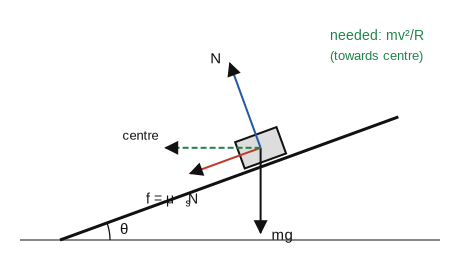
A car is negotiating a curved road of radius R. The road is banked at an angle θ. The coefficient of friction between the tyres of the car and the road is μs. The maximum safe velocity on this road is:
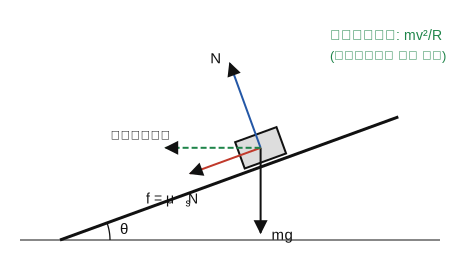
एक कार त्रिज्या R की एक वक्रित सड़क पर मुड़ रही है। सड़क θ कोण पर ढालू (banked) है। कार के टायरों तथा सड़क के बीच घर्षण गुणांक μs है। इस सड़क पर अधिकतम सुरक्षित वेग है:
  1. AgR2μs+tan⁡θ1−μstan⁡θ
  2. BgRμs+tan⁡θ1−μstan⁡θ
  3. CgRμs+tan⁡θ1−μstan⁡θ
  4. DgR2μs+tan⁡θ1−μstan⁡θ
Show answer

Concept: At maximum speed the car tends to slide outward, so friction (μsN) acts down the slope; horizontal net force = mv2R.

  1. Vertical: Ncos⁡θ=mg+μsNsin⁡θ.
  2. Horizontal: Nsin⁡θ+μsNcos⁡θ=mv2R.
  3. Divide: v2Rg=sin⁡θ+μscos⁡θcos⁡θ−μssin⁡θ=μs+tan⁡θ1−μstan⁡θ.
  4. vmax=gRμs+tan⁡θ1−μstan⁡θ.

Short trick: Dimension check: v2 must be g × length → only gR works → (B).

Answer: (B) gRμs+tan⁡θ1−μstan⁡θ

अवधारणा: अधिकतम चाल पर कार बाहर की ओर फिसलने की प्रवृत्ति रखती है, अतः घर्षण (μsN) ढाल के नीचे की ओर लगता है; क्षैतिज नेट बल = mv2R।

  1. ऊर्ध्वाधर: Ncos⁡θ=mg+μsNsin⁡θ।
  2. क्षैतिज: Nsin⁡θ+μsNcos⁡θ=mv2R।
  3. भाग देने पर: v2Rg=sin⁡θ+μscos⁡θcos⁡θ−μssin⁡θ=μs+tan⁡θ1−μstan⁡θ।
  4. vmax=gRμs+tan⁡θ1−μstan⁡θ।

शॉर्ट ट्रिक: विमीय जाँच: v2 = g × लंबाई होना चाहिए → केवल gR सही → (B)।

उत्तर: (B) gRμs+tan⁡θ1−μstan⁡θ

NEET UGPhysicsCircular motion – banked road with frictionNEET UG 2016 · 1 May Shift 1 →
Q2931.
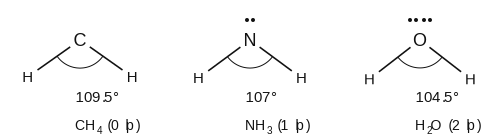
Consider the molecules CH4, NH3 and H2O. Which of the given statements is false?
अणुओं CH4, NH3 तथा H2O पर विचार कीजिए। दिए गए कथनों में से कौन-सा असत्य है?
  1. AThe H – C – H bond angle in CH4, the H – N – H bond angle in NH3, and the H – O – H bond angle in H2O are all greater than 90°.CH4 में H – C – H आबंध कोण, NH3 में H – N – H आबंध कोण तथा H2O में H – O – H आबंध कोण, सभी 90° से अधिक हैं।
  2. BThe H – O – H bond angle in H2O is larger than the H – C – H bond angle in CH4.H2O में H – O – H आबंध कोण, CH4 में H – C – H आबंध कोण से बड़ा है।
  3. CThe H – O – H bond angle in H2O is smaller than the H – N – H bond angle in NH3.H2O में H – O – H आबंध कोण, NH3 में H – N – H आबंध कोण से छोटा है।
  4. DThe H – C – H bond angle in CH4 is larger than the H – N – H bond angle in NH3.CH4 में H – C – H आबंध कोण, NH3 में H – N – H आबंध कोण से बड़ा है।
Show answer

Concept: All three central atoms are sp3 hybridised. Lone pairs repel more than bond pairs, so each extra lone pair squeezes the H–X–H angle.

  1. CH4 (0 lone pair) = 109.5°; NH3 (1 lone pair) = 107°; H2O (2 lone pairs) = 104.5°.
  2. (A) All three angles are > 90° – true.
  3. (B) Says 104.5° > 109.5° – false.
  4. (C) 104.5° < 107° – true. (D) 109.5° > 107° – true.

Short trick: More lone pairs on the central atom → smaller angle: CH4 > NH3 > H2O (109.5 > 107 > 104.5).

Answer: (B) H2O angle is NOT larger than CH4 angle – this statement is false.

अवधारणा: तीनों केंद्रीय परमाणु sp3 संकरित हैं। एकाकी युग्म (lone pair) आबंधी युग्म से अधिक प्रतिकर्षण करते हैं, अतः प्रत्येक अतिरिक्त एकाकी युग्म H–X–H कोण को घटा देता है।

  1. CH4 (0 एकाकी युग्म) = 109.5°; NH3 (1 एकाकी युग्म) = 107°; H2O (2 एकाकी युग्म) = 104.5°।
  2. (A) तीनों कोण 90° से अधिक हैं – सत्य।
  3. (B) कहता है 104.5° > 109.5° – असत्य।
  4. (C) 104.5° < 107° – सत्य। (D) 109.5° > 107° – सत्य।

शॉर्ट ट्रिक: केंद्रीय परमाणु पर जितने अधिक एकाकी युग्म, कोण उतना छोटा: CH4 > NH3 > H2O (109.5 > 107 > 104.5)।

उत्तर: (B) H2O का कोण CH4 के कोण से बड़ा नहीं है – यह कथन असत्य है।

NEET UGChemistryChemical bonding – VSEPR and bond anglesNEET UG 2016 · 1 May Shift 1 →
Q2932.
In the reaction
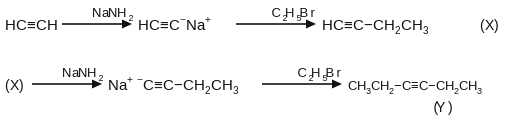
H−C≡CH (1) NaNH2/liq. NH3(2) CH3CH2Br X (1) NaNH2/liq. NH3(2) CH3CH2Br Y
X and Y are:
अभिक्रिया
H−C≡CH (1) NaNH2/liq. NH3(2) CH3CH2Br X (1) NaNH2/liq. NH3(2) CH3CH2Br Y
में X तथा Y हैं:
  1. AX = 1 – Butyne ; Y = 3 – HexyneX = 1 – ब्यूटाइन ; Y = 3 – हेक्साइन
  2. BX = 2 – Butyne ; Y = 3 – HexyneX = 2 – ब्यूटाइन ; Y = 3 – हेक्साइन
  3. CX = 2 – Butyne ; Y = 2 – HexyneX = 2 – ब्यूटाइन ; Y = 2 – हेक्साइन
  4. DX = 1 – Butyne ; Y = 2 – HexyneX = 1 – ब्यूटाइन ; Y = 2 – हेक्साइन
Show answer

Concept: Terminal alkyne C–H is acidic: NaNH2 makes the acetylide ion, which attacks a primary alkyl halide (SN2) and adds an alkyl group to that carbon.

  1. HC≡CH + NaNH2 → HC≡C−Na+; + CH3CH2Br → HC≡C–CH2CH3 = 1-butyne (X).
  2. X still has one acidic ≡C–H: NaNH2 → Na+ −C≡C–CH2CH3; + CH3CH2Br → CH3CH2–C≡C–CH2CH3.
  3. Numbering C1–C6, the triple bond starts at C3 → 3-hexyne (Y).
  4. 2-Butyne / 2-hexyne would need a methyl group on the triple bond – no CH3Br is used, so (B), (C), (D) are out.

Short trick: One ethyl on each end of C≡C: first ethyl → 1-butyne, second ethyl on the other end → symmetrical Et–C≡C–Et = 3-hexyne.

Answer: (A) X = 1-butyne; Y = 3-hexyne

अवधारणा: सीमांत ऐल्काइन का C–H अम्लीय होता है: NaNH2 ऐसीटिलाइड आयन बनाता है, जो प्राथमिक ऐल्किल हैलाइड पर आक्रमण (SN2) कर उस कार्बन पर ऐल्किल समूह जोड़ देता है।

  1. HC≡CH + NaNH2 → HC≡C−Na+; + CH3CH2Br → HC≡C–CH2CH3 = 1-ब्यूटाइन (X)।
  2. X में अभी भी एक अम्लीय ≡C–H है: NaNH2 → Na+ −C≡C–CH2CH3; + CH3CH2Br → CH3CH2–C≡C–CH2CH3।
  3. C1–C6 क्रमांकन में त्रिआबंध C3 से आरंभ होता है → 3-हेक्साइन (Y)।
  4. 2-ब्यूटाइन / 2-हेक्साइन के लिए त्रिआबंध पर मेथिल समूह चाहिए – CH3Br प्रयुक्त नहीं हुआ, अतः (B), (C), (D) गलत हैं।

शॉर्ट ट्रिक: C≡C के प्रत्येक सिरे पर एक एथिल: पहला एथिल → 1-ब्यूटाइन, दूसरे सिरे पर दूसरा एथिल → सममित Et–C≡C–Et = 3-हेक्साइन।

उत्तर: (A) X = 1-ब्यूटाइन; Y = 3-हेक्साइन

NEET UGChemistryHydrocarbons – alkynes (acidity and alkylation)NEET UG 2016 · 1 May Shift 1 →
Q2933.
Among the following, the correct order of acidity is:
निम्नलिखित में से अम्लता का सही क्रम है:
  1. AHClO3 < HClO4 < HClO2 < HClO
  2. BHClO < HClO2 < HClO3 < HClO4
  3. CHClO2 < HClO < HClO3 < HClO4
  4. DHClO4 < HClO2 < HClO < HClO3
Show answer

Concept: For oxoacids of the same element, acidity rises with the oxidation state of the central atom (more O atoms → the conjugate anion is more resonance-stabilised).

  1. Oxidation state of Cl: HClO (+1), HClO2 (+3), HClO3 (+5), HClO4 (+7).
  2. ClO4− spreads the negative charge over 4 O atoms – the most stable anion, so HClO4 is the strongest acid.
  3. Order: HClO < HClO2 < HClO3 < HClO4; the other three orders break this trend.

Short trick: Count the oxygens – more O, stronger acid (HClO4 is one of the strongest acids known).

Answer: (B) HClO < HClO2 < HClO3 < HClO4

अवधारणा: एक ही तत्व के ऑक्सोअम्लों में केंद्रीय परमाणु की ऑक्सीकरण अवस्था बढ़ने पर अम्लता बढ़ती है (अधिक O परमाणु → संयुग्मी ऋणायन अनुनाद द्वारा अधिक स्थायी)।

  1. Cl की ऑक्सीकरण अवस्था: HClO (+1), HClO2 (+3), HClO3 (+5), HClO4 (+7)।
  2. ClO4− में ऋण आवेश 4 O परमाणुओं पर फैला है – सबसे स्थायी ऋणायन, अतः HClO4 सबसे प्रबल अम्ल है।
  3. क्रम: HClO < HClO2 < HClO3 < HClO4; शेष तीनों क्रम इस प्रवृत्ति के विपरीत हैं।

शॉर्ट ट्रिक: ऑक्सीजन गिनिए – जितने अधिक O, उतना प्रबल अम्ल (HClO4 ज्ञात प्रबलतम अम्लों में से एक है)।

उत्तर: (B) HClO < HClO2 < HClO3 < HClO4

NEET UGChemistryp-Block – oxoacids of chlorine (acidic strength)NEET UG 2016 · 1 May Shift 1 →
Q2934.
The rate of a first-order reaction is 0.04 mol l−1 s−1 at 10 second and 0.03 mol l−1 s−1 at 20 seconds after initiation of the reaction. The half-life period of the reaction is:
एक प्रथम कोटि की अभिक्रिया का वेग, अभिक्रिया आरंभ होने के 10 सेकंड पर 0.04 mol l−1 s−1 तथा 20 सेकंड पर 0.03 mol l−1 s−1 है। अभिक्रिया की अर्धायु अवधि है:
  1. A24.1 s
  2. B34.1 s
  3. C44.1 s
  4. D54.1 s
Show answer

Concept: For a first-order reaction rate = k[A], so the ratio of rates equals the ratio of concentrations; k=2.303t2−t1log⁡[A]1[A]2 and t1/2=0.693k.

  1. [A]1[A]2=r1r2=0.040.03=43
  2. k=2.30320−10log⁡43=0.2303×0.1249=0.02877 s−1
  3. t1/2=0.6930.02877=24.1 s

Short trick: In Δt = 10 s the rate falls to 3/4. Since (3/4) is more than (1/2), t1/2 must be well above 10 s; ln 2/ln(4/3) = 0.693/0.2877 ≈ 2.41 → t1/2 = 2.41 × 10 s.

Answer: (A) 24.1 s

अवधारणा: प्रथम कोटि अभिक्रिया में वेग = k[A], अतः वेगों का अनुपात सांद्रताओं के अनुपात के बराबर होता है; k=2.303t2−t1log⁡[A]1[A]2 तथा t1/2=0.693k।

  1. [A]1[A]2=r1r2=0.040.03=43
  2. k=2.30320−10log⁡43=0.2303×0.1249=0.02877 s−1
  3. t1/2=0.6930.02877=24.1 s

शॉर्ट ट्रिक: Δt = 10 s में वेग घटकर 3/4 रह जाता है। चूँकि 3/4, 1/2 से अधिक है, t1/2 10 s से काफी अधिक होगा; ln 2/ln(4/3) = 0.693/0.2877 ≈ 2.41 → t1/2 = 2.41 × 10 s।

उत्तर: (A) 24.1 s

NEET UGChemistryChemical kinetics – first-order reaction, half-lifeNEET UG 2016 · 1 May Shift 1 →
Q2935.
Which one of the following characteristics is associated with adsorption?
निम्नलिखित में से कौन-सा अभिलक्षण अधिशोषण (adsorption) से संबद्ध है?
  1. AΔG is negative but ΔH and ΔS are positiveΔG ऋणात्मक है परंतु ΔH तथा ΔS धनात्मक हैं
  2. BΔG, ΔH and ΔS all are negativeΔG, ΔH तथा ΔS सभी ऋणात्मक हैं
  3. CΔG and ΔH are negative but ΔS is positiveΔG तथा ΔH ऋणात्मक हैं परंतु ΔS धनात्मक है
  4. DΔG and ΔS are negative but ΔH is positiveΔG तथा ΔS ऋणात्मक हैं परंतु ΔH धनात्मक है
Show answer

Concept: Adsorption is spontaneous (ΔG < 0); gas molecules lose freedom when they stick to the surface (ΔS < 0); hence, from ΔG = ΔH − TΔS, ΔH must be negative (exothermic).

  1. Free gas molecules → bound to surface: randomness decreases, ΔS < 0, so −TΔS is positive.
  2. For ΔG to be negative, ΔH must be negative and larger in magnitude than TΔS → adsorption is always exothermic.
  3. (A), (C) need ΔS > 0 – wrong; (D) needs ΔH > 0 with ΔS < 0, which can never give ΔG < 0 – wrong.

Short trick: NCERT line: "adsorption is always exothermic" + entropy decreases → all three negative.

Answer: (B) ΔG, ΔH and ΔS all are negative

अवधारणा: अधिशोषण स्वतः प्रवर्तित (ΔG < 0) होता है; पृष्ठ पर चिपकने से गैस अणुओं की स्वतंत्रता घटती है (ΔS < 0); अतः ΔG = ΔH − TΔS से ΔH ऋणात्मक (ऊष्माक्षेपी) होना चाहिए।

  1. मुक्त गैस अणु → पृष्ठ से बंधे: यादृच्छिकता घटती है, ΔS < 0, अतः −TΔS धनात्मक है।
  2. ΔG ऋणात्मक होने के लिए ΔH ऋणात्मक तथा परिमाण में TΔS से बड़ा होना चाहिए → अधिशोषण सदैव ऊष्माक्षेपी है।
  3. (A), (C) में ΔS > 0 चाहिए – गलत; (D) में ΔS < 0 के साथ ΔH > 0 है, जिससे ΔG कभी ऋणात्मक नहीं हो सकता – गलत।

शॉर्ट ट्रिक: NCERT पंक्ति: "अधिशोषण सदैव ऊष्माक्षेपी होता है" + एन्ट्रॉपी घटती है → तीनों ऋणात्मक।

उत्तर: (B) ΔG, ΔH तथा ΔS सभी ऋणात्मक हैं

NEET UGChemistrySurface chemistry – thermodynamics of adsorptionNEET UG 2016 · 1 May Shift 1 →
Q2936.
In which of the following options the order of arrangement does not agree with the variation of property indicated against it?
निम्नलिखित में से किस विकल्प में व्यवस्था का क्रम उसके सामने दर्शाए गए गुण के परिवर्तन से मेल नहीं खाता?
  1. AAl3+ < Mg2+ < Na+ < F− (increasing ionic size)Al3+ < Mg2+ < Na+ < F− (बढ़ता आयनिक आकार)
  2. BB < C < N < O (increasing first ionization enthalpy)B < C < N < O (बढ़ती प्रथम आयनन एन्थैल्पी)
  3. CI < Br < Cl < F (increasing electron gain enthalpy)I < Br < Cl < F (बढ़ती इलेक्ट्रॉन लब्धि एन्थैल्पी)
  4. DLi < Na < K < Rb (increasing metallic radius)Li < Na < K < Rb (बढ़ती धात्विक त्रिज्या)
Show answer

Concept: Check each order against the real trend; the question wants the order that does NOT agree.

  1. (A) Isoelectronic ions (10 e−): more nuclear charge → smaller; Al3+ < Mg2+ < Na+ < F− – correct order.
  2. (B) N (2p3, half-filled, extra stable) has higher IE than O (2p4); real order B < C < O < N – does NOT agree.
  3. (C) Electron gain enthalpy (magnitude): F is less negative than Cl because the small 2p shell of F repels the incoming electron; real order I < Br < F < Cl – does NOT agree.
  4. (D) Metallic radius increases down the group: Li < Na < K < Rb – correct order.
  5. So both (B) and (C) fit the question – two correct answers.

Short trick: Two classic exceptions of period 2: IE N > O and |ΔegH| Cl > F.

Answer: Bonus – both (B) and (C) are orders that do not agree with the property, so no single answer exists.

अवधारणा: प्रत्येक क्रम को वास्तविक प्रवृत्ति से मिलाइए; प्रश्न वह क्रम पूछता है जो मेल नहीं खाता।

  1. (A) सम-इलेक्ट्रॉनिक आयन (10 e−): अधिक नाभिकीय आवेश → छोटा आकार; Al3+ < Mg2+ < Na+ < F− – सही क्रम।
  2. (B) N (2p3, अर्धपूरित, अतिरिक्त स्थायी) की आयनन एन्थैल्पी O (2p4) से अधिक है; वास्तविक क्रम B < C < O < N – मेल नहीं खाता।
  3. (C) इलेक्ट्रॉन लब्धि एन्थैल्पी (परिमाण): F का मान Cl से कम ऋणात्मक है क्योंकि F का छोटा 2p कोश आने वाले इलेक्ट्रॉन को प्रतिकर्षित करता है; वास्तविक क्रम I < Br < F < Cl – मेल नहीं खाता।
  4. (D) धात्विक त्रिज्या वर्ग में नीचे जाने पर बढ़ती है: Li < Na < K < Rb – सही क्रम।
  5. अतः (B) तथा (C) दोनों प्रश्न के अनुरूप हैं – दो सही उत्तर।

शॉर्ट ट्रिक: आवर्त 2 के दो प्रसिद्ध अपवाद: आयनन एन्थैल्पी N > O तथा |ΔegH| Cl > F।

उत्तर: बोनस – (B) तथा (C) दोनों ऐसे क्रम हैं जो गुण से मेल नहीं खाते, अतः कोई एक उत्तर नहीं है।

NEET UGChemistryPeriodic properties – ionic size, ionisation and electron gain enthalpyNEET UG 2016 · 1 May Shift 1 →
Q2937.
Which of the following statements is false?
निम्नलिखित में से कौन-सा कथन असत्य है?
  1. AMg2+ ions form a complex with ATP.Mg2+ आयन ATP के साथ संकुल बनाते हैं।
  2. BCa2+ ions are important in blood clotting.Ca2+ आयन रक्त के थक्का बनने (blood clotting) में महत्त्वपूर्ण हैं।
  3. CCa2+ ions are not important in maintaining the regular beating of the heart.Ca2+ आयन हृदय की नियमित धड़कन बनाए रखने में महत्त्वपूर्ण नहीं हैं।
  4. DMg2+ ions are important in the green parts of plants.Mg2+ आयन पौधों के हरे भागों में महत्त्वपूर्ण हैं।
Show answer

Concept: NCERT (s-block, biological importance of Na, K, Mg, Ca): Ca2+ is needed for blood clotting and for maintaining the regular beating of the heart.

  1. (A) All ATP-using enzymes need Mg2+, which binds ATP as a Mg–ATP complex – true.
  2. (B) Ca2+ is a clotting factor – true.
  3. (C) Ca2+ controls muscle contraction, including the heart beat – so saying it is "not important" is false.
  4. (D) Mg2+ is the central ion of chlorophyll in green parts – true.

Short trick: Ca → clotting + heart beat + bones; Mg → chlorophyll + ATP.

Answer: (C) The statement denying the role of Ca2+ in heart beat is false.

अवधारणा: NCERT (s-ब्लॉक, Na, K, Mg, Ca का जैविक महत्त्व): Ca2+ रक्त का थक्का बनने तथा हृदय की नियमित धड़कन बनाए रखने के लिए आवश्यक है।

  1. (A) ATP का उपयोग करने वाले सभी एन्ज़ाइमों को Mg2+ चाहिए, जो ATP से Mg–ATP संकुल बनाता है – सत्य।
  2. (B) Ca2+ थक्का बनाने वाला कारक है – सत्य।
  3. (C) Ca2+ हृदय की धड़कन सहित पेशी संकुचन को नियंत्रित करता है – अतः इसे "महत्त्वपूर्ण नहीं" कहना असत्य है।
  4. (D) Mg2+ हरे भागों में क्लोरोफिल का केंद्रीय आयन है – सत्य।

शॉर्ट ट्रिक: Ca → थक्का + हृदय धड़कन + हड्डियाँ; Mg → क्लोरोफिल + ATP।

उत्तर: (C) हृदय धड़कन में Ca2+ की भूमिका नकारने वाला कथन असत्य है।

NEET UGChemistrys-Block – biological importance of Mg and CaNEET UG 2016 · 1 May Shift 1 →
Q2938.
Which of the following statements about hydrogen is incorrect?
हाइड्रोजन के विषय में निम्नलिखित में से कौन-सा कथन गलत है?
  1. AHydrogen has three isotopes of which tritium is the most common.हाइड्रोजन के तीन समस्थानिक हैं जिनमें ट्रिटियम सबसे सामान्य है।
  2. BHydrogen never acts as cation in ionic salts.हाइड्रोजन आयनिक लवणों में कभी धनायन के रूप में कार्य नहीं करता।
  3. CHydronium ion, H3O+ exists freely in solution.हाइड्रोनियम आयन, H3O+ विलयन में स्वतंत्र रूप से विद्यमान रहता है।
  4. DDihydrogen does not act as a reducing agent.डाइहाइड्रोजन अपचायक (reducing agent) के रूप में कार्य नहीं करता।
Show answer

Concept: Recall NCERT facts on hydrogen and test each statement.

  1. (A) Isotopes: protium (99.985 %), deuterium (0.015 %), tritium (radioactive, ~1 in 1018 atoms). Protium is the most common, not tritium – incorrect.
  2. (B) H+ (a bare proton) cannot exist on its own in a crystal; in ionic hydrides H is the anion H− – statement is correct.
  3. (C) In water H+ is always hydrated and exists as H3O+ – correct.
  4. (D) H2 reduces metal oxides (CuO + H2 → Cu + H2O) – it IS a reducing agent, so this statement is incorrect.
  5. Two statements, (A) and (D), are incorrect.

Short trick: Tritium = rarest and radioactive; H2 = classic reducing agent.

Answer: Bonus – statements (A) and (D) are both incorrect, so two options fit the question.

अवधारणा: हाइड्रोजन से संबंधित NCERT तथ्यों को याद कर प्रत्येक कथन जाँचिए।

  1. (A) समस्थानिक: प्रोटियम (99.985 %), ड्यूटीरियम (0.015 %), ट्रिटियम (रेडियोऐक्टिव, लगभग 1018 में 1 परमाणु)। सबसे सामान्य प्रोटियम है, ट्रिटियम नहीं – गलत।
  2. (B) H+ (केवल प्रोटॉन) क्रिस्टल में अकेला नहीं रह सकता; आयनिक हाइड्राइडों में H ऋणायन H− होता है – कथन सही है।
  3. (C) जल में H+ सदैव जलयोजित होकर H3O+ के रूप में रहता है – सही।
  4. (D) H2 धातु ऑक्साइडों का अपचयन करता है (CuO + H2 → Cu + H2O) – यह अपचायक है, अतः यह कथन गलत है।
  5. दो कथन, (A) तथा (D), गलत हैं।

शॉर्ट ट्रिक: ट्रिटियम = सबसे दुर्लभ एवं रेडियोऐक्टिव; H2 = प्रसिद्ध अपचायक।

उत्तर: बोनस – कथन (A) तथा (D) दोनों गलत हैं, अतः दो विकल्प प्रश्न के अनुरूप हैं।

NEET UGChemistryHydrogen – isotopes and propertiesNEET UG 2016 · 1 May Shift 1 →
Q2939.
The correct statement regarding a carbonyl compound with a hydrogen atom on its alpha carbon, is:
ऐल्फा कार्बन पर हाइड्रोजन परमाणु वाले कार्बोनिल यौगिक के संबंध में सही कथन है:
  1. AA carbonyl compound with a hydrogen atom on its alpha-carbon never equilibrates with its corresponding enol.ऐल्फा-कार्बन पर हाइड्रोजन परमाणु वाला कार्बोनिल यौगिक अपने संगत ईनॉल के साथ कभी साम्य स्थापित नहीं करता।
  2. BA carbonyl compound with a hydrogen atom on its alpha-carbon rapidly equilibrates with its corresponding enol and this process is known as aldehyde-ketone equilibration.ऐल्फा-कार्बन पर हाइड्रोजन परमाणु वाला कार्बोनिल यौगिक अपने संगत ईनॉल के साथ तीव्रता से साम्य स्थापित करता है और यह प्रक्रम ऐल्डिहाइड-कीटोन साम्यन कहलाता है।
  3. CA carbonyl compound with a hydrogen atom on its alpha-carbon rapidly equilibrates with its corresponding enol and this process is known as carbonylation.ऐल्फा-कार्बन पर हाइड्रोजन परमाणु वाला कार्बोनिल यौगिक अपने संगत ईनॉल के साथ तीव्रता से साम्य स्थापित करता है और यह प्रक्रम कार्बोनिलन (carbonylation) कहलाता है।
  4. DA carbonyl compound with a hydrogen atom on its alpha-carbon rapidly equilibrates with its corresponding enol and this process is known as keto-enol tautomerism.ऐल्फा-कार्बन पर हाइड्रोजन परमाणु वाला कार्बोनिल यौगिक अपने संगत ईनॉल के साथ तीव्रता से साम्य स्थापित करता है और यह प्रक्रम कीटो-ईनॉल चलावयवता (tautomerism) कहलाता है।
Show answer

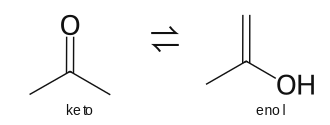
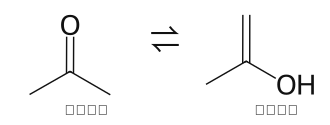
Concept: An α-H can shift to the carbonyl O, giving an enol (C=C–OH). The keto and enol forms are tautomers in rapid equilibrium.

  1. Example: CH3COCH3 (keto) ⇌ CH2=C(OH)CH3 (enol); the keto form dominates at equilibrium.
  2. (A) "never equilibrates" – wrong, the equilibrium is fast (acid/base catalysed).
  3. (B) "aldehyde-ketone equilibration" and (C) "carbonylation" (adding a CO group) are wrong names.
  4. The correct name is keto-enol tautomerism – (D).

Short trick: α-H present ⇒ enolisable ⇒ keto ⇌ enol tautomerism (same reason α-H is needed for aldol condensation).

Answer: (D) keto-enol tautomerism

अवधारणा: α-H, कार्बोनिल O पर स्थानांतरित होकर ईनॉल (C=C–OH) बना सकता है। कीटो तथा ईनॉल रूप चलावयवी (tautomers) हैं जो तीव्र साम्य में रहते हैं।

  1. उदाहरण: CH3COCH3 (कीटो) ⇌ CH2=C(OH)CH3 (ईनॉल); साम्य पर कीटो रूप प्रधान होता है।
  2. (A) "कभी साम्य नहीं" – गलत, साम्य तीव्र होता है (अम्ल/क्षार उत्प्रेरित)।
  3. (B) "ऐल्डिहाइड-कीटोन साम्यन" तथा (C) "कार्बोनिलन" (CO समूह जोड़ना) गलत नाम हैं।
  4. सही नाम कीटो-ईनॉल चलावयवता है – (D)।

शॉर्ट ट्रिक: α-H उपस्थित ⇒ ईनॉलीकरण संभव ⇒ कीटो ⇌ ईनॉल चलावयवता (इसी कारण ऐल्डोल संघनन के लिए भी α-H आवश्यक है)।

उत्तर: (D) कीटो-ईनॉल चलावयवता

NEET UGChemistryAldehydes and ketones – keto-enol tautomerismNEET UG 2016 · 1 May Shift 1 →
Q2940.
MY and NY3, two nearly insoluble salts, have the same Ksp values of 6.2 × 10⁻¹³ at room temperature. Which statement would be true in regard to MY and NY3?
MY तथा NY3, दो लगभग अविलेय लवणों के Ksp मान कमरे के ताप पर समान, 6.2 × 10⁻¹³ हैं। MY तथा NY3 के संबंध में कौन-सा कथन सत्य होगा?
  1. AThe molar solubilities of MY and NY3 in water are identical.जल में MY तथा NY3 की मोलर विलेयताएँ समान हैं।
  2. BThe molar solubility of MY in water is less than that of NY3.जल में MY की मोलर विलेयता NY3 की तुलना में कम है।
  3. CThe salts MY and NY3 are more soluble in 0.5 M KY than in pure water.लवण MY तथा NY3 शुद्ध जल की तुलना में 0.5 M KY में अधिक विलेय हैं।
  4. DThe addition of the salt of KY to solution of MY and NY3 will have no effect on their solubilities.MY तथा NY3 के विलयन में KY लवण मिलाने से उनकी विलेयताओं पर कोई प्रभाव नहीं पड़ेगा।
Show answer

Concept: For AB: Ksp = s2; for AB3: Ksp = s(3s)3 = 27s4. A common ion lowers solubility.

  1. MY: s=6.2×10−13=7.9×10⁻⁷ M.
  2. NY3 ⇌ N3+ + 3Y−: 27s4=6.2×10⁻¹³⇒s=(6.2×10−1327)1/4=3.9×10−4 M.
  3. So s(MY) < s(NY3) → (B) true, (A) false.
  4. KY supplies the common ion Y− → both salts become LESS soluble; (C) and (D) are false.

Short trick: Same Ksp but more ions per formula ⇒ larger s (the root is of a higher order). Whatever the exact formula, AB3 wins.

Answer: (B) Molar solubility of MY is less than that of NY3.

अवधारणा: AB के लिए: Ksp = s2; AB3 के लिए: Ksp = s(3s)3 = 27s4। सम-आयन विलेयता घटाता है।

  1. MY: s=6.2×10−13=7.9×10⁻⁷ M।
  2. NY3 ⇌ N3+ + 3Y−: 27s4=6.2×10⁻¹³⇒s=(6.2×10−1327)1/4=3.9×10−4 M।
  3. अतः s(MY) < s(NY3) → (B) सत्य, (A) असत्य।
  4. KY सम-आयन Y− देता है → दोनों लवण कम विलेय हो जाते हैं; (C) तथा (D) असत्य हैं।

शॉर्ट ट्रिक: Ksp समान, परंतु प्रति सूत्र अधिक आयन ⇒ s अधिक (उच्च कोटि का मूल लेना पड़ता है)। सूत्र कुछ भी हो, AB3 की विलेयता अधिक।

उत्तर: (B) MY की मोलर विलेयता NY3 से कम है।

NEET UGChemistryIonic equilibrium – solubility productNEET UG 2016 · 1 May Shift 1 →