Question bank

Q&A: practice questions with answers

Search questions on any topic. Filter by exam category, exam, subject and topic, try the question, then open the answer and explanation.

Courses – airGurukul

53,050 questions in the question bank.

Q2881.
Which of the following in sewage treatment removes suspended solids?
वाहितमल उपचार में निम्नलिखित में से कौन-सा निलंबित ठोसों को हटाता है?
  1. ATertiary treatmentतृतीयक उपचार
  2. BSecondary treatmentद्वितीयक उपचार
  3. CPrimary treatmentप्राथमिक उपचार
  4. DSludge treatmentआपंक उपचार
Show answer

Concept: Primary treatment is a physical process: floating debris is removed by sequential filtration, then grit (soil, pebbles) by sedimentation; settled solids form primary sludge and the supernatant is primary effluent.

  1. (C) ✔ Primary (physical) treatment removes particles – large and small – i.e. suspended solids.
  2. (A) ✘ Tertiary treatment removes remaining nutrients/chemicals and disinfects.
  3. (B) ✘ Secondary (biological) treatment reduces BOD using aerobic flocs, then anaerobic digestion of sludge.
  4. (D) ✘ Sludge treatment (anaerobic digesters) handles the activated sludge, producing biogas.

Short trick: Primary = Physical (filter + settle); Secondary = biological (microbes).

Answer: (C) Primary treatment

अवधारणा: प्राथमिक उपचार एक भौतिक प्रक्रिया है: तैरता कचरा क्रमिक निस्यंदन से, फिर ग्रिट (मिट्टी, कंकड़) अवसादन से हटाया जाता है; नीचे बैठे ठोस प्राथमिक आपंक बनाते हैं और ऊपरी तरल प्राथमिक बहिःस्राव होता है।

  1. (C) ✔ प्राथमिक (भौतिक) उपचार कणों – बड़े और छोटे – अर्थात् निलंबित ठोसों को हटाता है।
  2. (A) ✘ तृतीयक उपचार शेष पोषकों/रसायनों को हटाता और विसंक्रमण करता है।
  3. (B) ✘ द्वितीयक (जैविक) उपचार वायवीय फ्लॉक द्वारा BOD घटाता है, फिर आपंक का अवायवीय पाचन।
  4. (D) ✘ आपंक उपचार (अवायवीय पाचक) सक्रियित आपंक को संसाधित कर बायोगैस बनाता है।

शॉर्ट ट्रिक: प्राथमिक = भौतिक (छानना + बैठाना); द्वितीयक = जैविक (सूक्ष्मजीव)।

उत्तर: (C) प्राथमिक उपचार
NEET UGBiologyMicrobes in human welfare – sewage treatmentNEET UG 2017 · 7 May Shift 1 →
Q2882.
The water potential of pure water is
शुद्ध जल का जल विभव होता है
  1. AZeroशून्य
  2. BLess than zeroशून्य से कम
  3. CMore than zero but less than oneशून्य से अधिक परंतु एक से कम
  4. DMore than oneएक से अधिक
Show answer

Concept: Water potential (Ψw) = Ψs + Ψp. By convention, the water potential of pure water at standard temperature and atmospheric pressure is taken as zero.

  1. (A) ✔ Pure water: Ψw = 0 (maximum possible at atmospheric pressure).
  2. (B) ✘ Adding solute lowers Ψ – solutions have negative values, not pure water.
  3. (C), (D) ✘ Pure water cannot have positive Ψ unless pressure is applied.

Short trick: Pure water is the “zero reference”; every solution is “minus”.

Answer: (A) Zero

अवधारणा: जल विभव (Ψw) = Ψs + Ψp। परिपाटी के अनुसार, मानक ताप और वायुमंडलीय दाब पर शुद्ध जल का जल विभव शून्य माना जाता है।

  1. (A) ✔ शुद्ध जल: Ψw = 0 (वायुमंडलीय दाब पर अधिकतम संभव)।
  2. (B) ✘ विलेय मिलाने से Ψ घटता है – ऋणात्मक मान विलयनों के होते हैं, शुद्ध जल के नहीं।
  3. (C), (D) ✘ दाब लगाए बिना शुद्ध जल का Ψ धनात्मक नहीं हो सकता।

शॉर्ट ट्रिक: शुद्ध जल “शून्य संदर्भ” है; हर विलयन “ऋणात्मक” है।

उत्तर: (A) शून्य

NEET UGBiologyTransport in plants – water potentialNEET UG 2017 · 7 May Shift 1 →
Q2883.
Identify the wrong statement in context of heartwood.
अंतःकाष्ठ (heartwood) के संदर्भ में गलत कथन पहचानिए।
  1. AOrganic compounds are deposited in itइसमें कार्बनिक यौगिक जमा होते हैं
  2. BIt is highly durableयह अत्यधिक टिकाऊ होती है
  3. CIt conducts water and minerals efficientlyयह जल और खनिजों का कुशलतापूर्वक संचालन करती है
  4. DIt comprises dead elements with highly lignified wallsयह अत्यधिक लिग्निनयुक्त भित्तियों वाले मृत तत्वों से बनी होती है
Show answer

Concept: Heartwood (duramen) is the dark central secondary xylem filled with tannins, resins, oils, gums and aromatic substances; its cells are dead and highly lignified. It does not conduct water but gives mechanical support.

  1. (A) ✔ True – organic compounds deposited.
  2. (B) ✔ True – resistant to microbes and insects, hence durable.
  3. (C) ✘ Wrong – conduction is done by the outer sapwood (alburnum); heartwood vessels are blocked by tyloses.
  4. (D) ✔ True – dead, highly lignified elements.

Short trick: Heart-wood = “dead heart, strong back” (support only); Sap-wood = “sap flows” (conduction).

Answer: (C) It conducts water and minerals efficiently

अवधारणा: अंतःकाष्ठ (ड्यूरामेन) गहरे रंग का केन्द्रीय द्वितीयक जाइलम है जिसमें टैनिन, रेज़िन, तेल, गोंद और सुगंधित पदार्थ भरे होते हैं; इसकी कोशिकाएँ मृत और अत्यधिक लिग्निनयुक्त होती हैं। यह जल का संचालन नहीं करती बल्कि यांत्रिक सहारा देती है।

  1. (A) ✔ सत्य – कार्बनिक यौगिक जमा होते हैं।
  2. (B) ✔ सत्य – सूक्ष्मजीवों और कीटों के प्रति प्रतिरोधी, अतः टिकाऊ।
  3. (C) ✘ गलत – संचालन बाहरी रसदारु (sapwood, ऐल्बर्नम) करती है; अंतःकाष्ठ की वाहिकाएँ टाइलोसिस से अवरुद्ध होती हैं।
  4. (D) ✔ सत्य – मृत, अत्यधिक लिग्निनयुक्त तत्व।

शॉर्ट ट्रिक: अंतःकाष्ठ = “मृत हृदय, मज़बूत सहारा” (केवल सहारा); रसदारु = “रस बहता है” (संचालन)।

उत्तर: (C) यह जल और खनिजों का कुशलतापूर्वक संचालन करती है

NEET UGBiologyAnatomy of flowering plants – heartwoodNEET UG 2017 · 7 May Shift 1 →
Q2884.
Thalassemia and sickle cell anemia are caused due to a problem in globin molecule synthesis. Select the correct statement.
थैलेसीमिया और सिकल सेल अरक्तता ग्लोबिन अणु संश्लेषण में समस्या के कारण होते हैं। सही कथन चुनिए।
  1. ABoth are due to a qualitative defect in globin chain synthesisदोनों ग्लोबिन शृंखला संश्लेषण में गुणात्मक दोष के कारण होते हैं
  2. BBoth are due to a quantitative defect in globin chain synthesisदोनों ग्लोबिन शृंखला संश्लेषण में मात्रात्मक दोष के कारण होते हैं
  3. CThalassemia is due to less synthesis of globin moleculesथैलेसीमिया ग्लोबिन अणुओं के कम संश्लेषण के कारण होता है
  4. DSickle cell anemia is due to a quantitative problem of globin moleculesसिकल सेल अरक्तता ग्लोबिन अणुओं की मात्रात्मक समस्या के कारण होती है
Show answer

Concept: NCERT: thalassemia differs from sickle-cell anaemia in that the former is a quantitative problem of synthesising too few globin molecules, while the latter is a qualitative problem of synthesising an incorrectly functioning globin (Glu → Val at 6th position of β-chain).

  1. (C) ✔ Thalassemia – reduced synthesis (α or β chain).
  2. (A) ✘ Thalassemia is not qualitative.
  3. (B) ✘ Sickle-cell is not quantitative.
  4. (D) ✘ Sickle-cell anaemia is qualitative.

Short trick: Thala-ssemia = “Too Little” (quantity); Sickle = “Wrong Shape” (quality).

Answer: (C) Thalassemia is due to less synthesis of globin molecules

अवधारणा: NCERT: थैलेसीमिया सिकल-सेल अरक्तता से इस प्रकार भिन्न है कि पहला बहुत कम ग्लोबिन अणु बनने की मात्रात्मक समस्या है, जबकि दूसरा गलत कार्य करने वाले ग्लोबिन के संश्लेषण की गुणात्मक समस्या है (β-शृंखला के 6वें स्थान पर Glu → Val)।

  1. (C) ✔ थैलेसीमिया – (α या β शृंखला का) कम संश्लेषण।
  2. (A) ✘ थैलेसीमिया गुणात्मक नहीं है।
  3. (B) ✘ सिकल-सेल मात्रात्मक नहीं है।
  4. (D) ✘ सिकल-सेल अरक्तता गुणात्मक है।

शॉर्ट ट्रिक: थैलेसीमिया = “बहुत कम” (मात्रा); सिकल = “गलत आकार” (गुण)।

उत्तर: (C) थैलेसीमिया ग्लोबिन अणुओं के कम संश्लेषण के कारण होता है

NEET UGBiologyPrinciples of inheritance – Mendelian disordersNEET UG 2017 · 7 May Shift 1 →
Q2885.
Flowers which have single ovule in the ovary and are packed into inflorescence are usually pollinated by
वे पुष्प जिनके अंडाशय में एक ही बीजांड होता है और जो पुष्पक्रम में सघन रूप से व्यवस्थित होते हैं, प्रायः किसके द्वारा परागित होते हैं?
  1. AWaterजल
  2. BBeeमधुमक्खी
  3. CWindवायु
  4. DBatचमगादड़
Show answer

Concept: NCERT: wind-pollinated flowers often have a single ovule in each ovary and numerous flowers packed into an inflorescence (e.g. corn cob tassels); pollen is light, non-sticky, stamens well exposed and stigmas large and feathery.

  1. (C) ✔ Wind (anemophily).
  2. (A) ✘ Water pollination – rare, ~30 genera mostly monocots (Vallisneria, Hydrilla, Zostera).
  3. (B) ✘ Bee-pollinated flowers are large, colourful, fragrant, nectar-rich.
  4. (D) ✘ Bat-pollinated flowers are large, open at night, strongly scented.

Short trick: Wind is non-directional – so many flowers each with just one ovule maximise the chance of a pollen grain landing. Picture a maize cob/grass.

Answer: (C) Wind

अवधारणा: NCERT: वायु-परागित पुष्पों में प्रायः प्रत्येक अंडाशय में एक बीजांड होता है और अनेक पुष्प एक पुष्पक्रम में सघन होते हैं (जैसे मक्के के भुट्टे के गुच्छे); परागकण हल्के, अचिपचिपे, पुंकेसर भली-भाँति अनावृत और वर्तिकाग्र बड़े व पिच्छाकार होते हैं।

  1. (C) ✔ वायु (वायुपरागण)।
  2. (A) ✘ जल-परागण – दुर्लभ, लगभग 30 वंश, अधिकतर एकबीजपत्री (Vallisneria, Hydrilla, Zostera)।
  3. (B) ✘ मधुमक्खी-परागित पुष्प बड़े, रंगीन, सुगंधित और मकरंद-युक्त होते हैं।
  4. (D) ✘ चमगादड़-परागित पुष्प बड़े, रात्रि में खिलने वाले और तीव्र गंध वाले होते हैं।

शॉर्ट ट्रिक: वायु दिशाहीन है – इसलिए अनेक पुष्प, प्रत्येक में केवल एक बीजांड, परागकण गिरने की संभावना बढ़ाते हैं। मक्का/घास को याद करें।

उत्तर: (C) वायु

NEET UGBiologySexual reproduction in flowering plants – wind pollinationNEET UG 2017 · 7 May Shift 1 →
Q2886.
From a disc of radius R and mass M, a circular hole of diameter R, whose rim passes through the centre is cut. What is the moment of inertia of the remaining part of the disc about a perpendicular axis, passing through the centre?
त्रिज्या R तथा द्रव्यमान M की एक चकती में से R व्यास का एक वृत्ताकार छिद्र काटा जाता है, जिसकी परिधि (रिम) चकती के केंद्र से होकर गुजरती है। केंद्र से गुजरने वाले लंबवत अक्ष के परितः चकती के शेष भाग का जड़त्व आघूर्ण क्या है?
  1. A15MR2/32
  2. B13MR2/32
  3. C11MR2/32
  4. D9MR2/32
Show answer

Concept: Remaining I = I(full disc) − I(removed disc) about the same axis; use the parallel-axis theorem for the removed part.

  1. Mass per area σ=MπR2; removed disc radius R2 → mass m=σπR24=M4.
  2. Its centre is R2 from O: Irem=12m(R2)2+m(R2)2=32⋅M4⋅R24=3MR232.
  3. I=MR22−3MR232=16MR2−3MR232=13MR232.

Short trick: Hole of radius R/2 touching the centre always removes 332MR2 → 16−332=1332.

Answer: (B) 13MR2/32

अवधारणा: शेष I = पूरी चकती का I − हटाई गई चकती का I (उसी अक्ष के परितः); हटाए गए भाग के लिए समांतर अक्ष प्रमेय लगाएँ।

  1. प्रति क्षेत्रफल द्रव्यमान σ=MπR2; हटाई गई चकती की त्रिज्या R2 → द्रव्यमान m=σπR24=M4।
  2. इसका केंद्र O से R2 दूर है: Irem=12m(R2)2+m(R2)2=32⋅M4⋅R24=3MR232।
  3. I=MR22−3MR232=16MR2−3MR232=13MR232।

शॉर्ट ट्रिक: केंद्र को छूने वाला R/2 त्रिज्या का छिद्र सदैव 332MR2 घटाता है → 16−332=1332।

उत्तर: (B) 13MR2/32

NEET UGPhysicsRotational motion – moment of inertia (cut disc)NEET UG 2016 · 1 May Shift 1 →
Q2887.
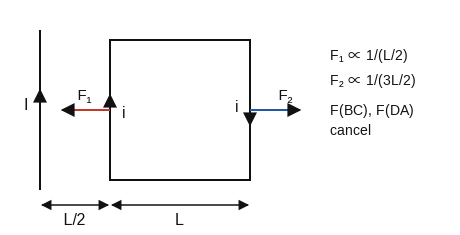
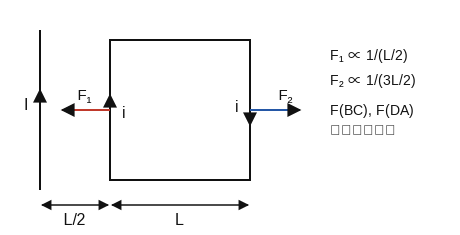
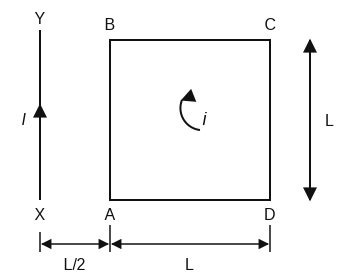
A square loop ABCD carrying a current i, is placed near and coplanar with a long straight conductor XY carrying a current I, the net force on the loop will be:
धारा i वाहित एक वर्गाकार लूप ABCD को धारा I वाहित एक लंबे सीधे चालक XY के निकट तथा उसी तल में रखा गया है। लूप पर नेट बल होगा:
  1. A2μ0Ii3π
  2. Bμ0Ii2π
  3. C2μ0IiL3π
  4. Dμ0IiL2π
Show answer

Concept: Force on a length L of wire parallel to a long wire: F=μ0IiL2πr (like currents attract). Forces on BC and DA are equal and opposite.

  1. AB at r=L2, current along I → attraction: F1=μ0IiL2π(L/2)=μ0Iiπ (towards XY).
  2. CD at r=3L2, current opposite → repulsion: F2=μ0IiL2π(3L/2)=μ0Ii3π (away).
  3. Fnet=F1−F2=μ0Iiπ(1−13)=2μ0Ii3π, towards the wire.

Short trick: L cancels (force ∝ L/r), so options (C), (D) with extra L are dimensionally wrong; then 1−13=23 → (A).

Answer: (A) 2μ0Ii3π

अवधारणा: लंबे तार के समांतर L लंबाई के तार पर बल: F=μ0IiL2πr (समान दिशा की धाराएँ आकर्षित करती हैं)। BC तथा DA पर बल बराबर व विपरीत होते हैं।

  1. AB दूरी r=L2 पर, धारा I की दिशा में → आकर्षण: F1=μ0IiL2π(L/2)=μ0Iiπ (XY की ओर)।
  2. CD दूरी r=3L2 पर, विपरीत धारा → प्रतिकर्षण: F2=μ0IiL2π(3L/2)=μ0Ii3π (दूर की ओर)।
  3. Fnet=F1−F2=μ0Iiπ(1−13)=2μ0Ii3π, तार की ओर।

शॉर्ट ट्रिक: L कट जाता है (बल ∝ L/r), इसलिए अतिरिक्त L वाले विकल्प (C), (D) विमीय रूप से गलत हैं; फिर 1−13=23 → (A)।

उत्तर: (A) 2μ0Ii3π

NEET UGPhysicsMoving charges – force between current-carrying conductorsNEET UG 2016 · 1 May Shift 1 →
Q2888.
The magnetic susceptibility is negative for:
चुंबकीय प्रवृत्ति (susceptibility) ऋणात्मक होती है:
  1. Adiamagnetic material onlyकेवल प्रतिचुंबकीय पदार्थ के लिए
  2. Bparamagnetic material onlyकेवल अनुचुंबकीय पदार्थ के लिए
  3. Cferromagnetic material onlyकेवल लौहचुंबकीय पदार्थ के लिए
  4. Dparamagnetic and ferromagnetic materialsअनुचुंबकीय तथा लौहचुंबकीय पदार्थों के लिए
Show answer

Concept: χm=MH. Diamagnets get magnetised opposite to the field, so χm is small and negative.

  1. Diamagnetic: −1≤χm<0 (e.g. Bi, Cu, water) → negative.
  2. Paramagnetic: small positive χm → (B) wrong.
  3. Ferromagnetic: large positive χm → (C), (D) wrong.

Short trick: Dia = "against" → only diamagnets have negative susceptibility (and μr < 1).

Answer: (A) diamagnetic material only

अवधारणा: χm=MH। प्रतिचुंबकीय पदार्थ क्षेत्र के विपरीत चुंबकित होते हैं, अतः χm छोटा व ऋणात्मक होता है।

  1. प्रतिचुंबकीय: −1≤χm<0 (जैसे Bi, Cu, जल) → ऋणात्मक।
  2. अनुचुंबकीय: छोटा धनात्मक χm → (B) गलत।
  3. लौहचुंबकीय: बड़ा धनात्मक χm → (C), (D) गलत।

शॉर्ट ट्रिक: Dia = "विरुद्ध" → केवल प्रतिचुंबकीय पदार्थों की प्रवृत्ति ऋणात्मक होती है (और μr < 1)।

उत्तर: (A) केवल प्रतिचुंबकीय पदार्थ के लिए

NEET UGPhysicsMagnetism and matter – magnetic susceptibilityNEET UG 2016 · 1 May Shift 1 →
Q2889.
A siren emitting a sound of frequency 800 Hz moves away from an observer towards a cliff at a speed of 15 m s−1. Then, the frequency of sound that the observer hears in the echo reflected from the cliff is : (Take velocity of sound in air = 330 m s−1)
800 Hz आवृत्ति की ध्वनि उत्सर्जित करने वाला एक सायरन एक प्रेक्षक से दूर, एक चट्टान की ओर 15 m s−1 की चाल से गतिमान है। चट्टान से परावर्तित प्रतिध्वनि में प्रेक्षक द्वारा सुनी गई ध्वनि की आवृत्ति है : (वायु में ध्वनि का वेग = 330 m s−1 लीजिए)
  1. A765 Hz
  2. B800 Hz
  3. C838 Hz
  4. D885 Hz
Show answer

Concept: The cliff receives sound from a source approaching it: f′=fvv−vs. The cliff (at rest) reflects this same frequency to the stationary observer.

  1. Source moves towards the cliff with vs=15 m/s.
  2. f′=800×330330−15=800×330315
  3. f′=838.1≈838 Hz (observer and cliff are at rest, so the echo keeps this frequency).

Short trick: Echo comes from the side the source approaches → frequency must be above 800 Hz; ratio 330/315 ≈ 1.048 → 838 Hz.

Answer: (C) 838 Hz

अवधारणा: चट्टान को निकट आते स्रोत से ध्वनि मिलती है: f′=fvv−vs। स्थिर चट्टान यही आवृत्ति स्थिर प्रेक्षक की ओर परावर्तित करती है।

  1. स्रोत चट्टान की ओर vs=15 m/s से गतिमान है।
  2. f′=800×330330−15=800×330315
  3. f′=838.1≈838 Hz (प्रेक्षक व चट्टान स्थिर हैं, अतः प्रतिध्वनि की आवृत्ति यही रहती है)।

शॉर्ट ट्रिक: प्रतिध्वनि उस ओर से आती है जिधर स्रोत बढ़ रहा है → आवृत्ति 800 Hz से अधिक; अनुपात 330/315 ≈ 1.048 → 838 Hz।

उत्तर: (C) 838 Hz

NEET UGPhysicsWaves – Doppler effect (echo from cliff)NEET UG 2016 · 1 May Shift 1 →
Q2890.

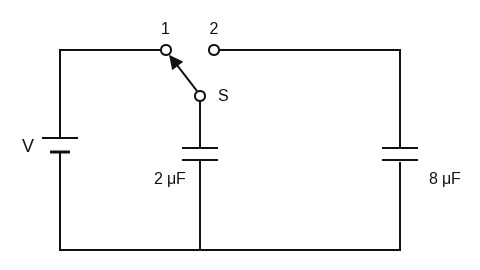
A capacitor of 2 μF is charged as shown in the diagram. When the switch S is turned to position 2, the percentage of its stored energy dissipated is:

आरेख में दर्शाए अनुसार 2 μF के एक संधारित्र को आवेशित किया गया है। जब स्विच S को स्थिति 2 पर घुमाया जाता है, तो इसकी संचित ऊर्जा का कितना प्रतिशत क्षयित होता है?
  1. A0%
  2. B20%
  3. C75%
  4. D80%
Show answer

Concept: When a charged capacitor is joined to an uncharged one, charge is shared (common potential) and energy lost =C1C22(C1+C2)V2.

  1. Initially (position 1): Q=2V μC, Ui=12(2)V2=V2.
  2. Position 2: 2 μF and 8 μF in parallel, common potential Vc=2V2+8=V5.
  3. Uf=12(10)(V5)2=V25.
  4. Dissipated =V2−V25=4V25 → 4/51×100=80%.

Short trick: Fraction lost =C2C1+C2=810=80%.

Answer: (D) 80%

अवधारणा: जब आवेशित संधारित्र को अनावेशित संधारित्र से जोड़ते हैं, तो आवेश बँटता है (उभयनिष्ठ विभव) तथा ऊर्जा हानि =C1C22(C1+C2)V2।

  1. प्रारंभ में (स्थिति 1): Q=2V μC, Ui=12(2)V2=V2।
  2. स्थिति 2: 2 μF तथा 8 μF समांतर में, उभयनिष्ठ विभव Vc=2V2+8=V5।
  3. Uf=12(10)(V5)2=V25।
  4. क्षयित ऊर्जा =V2−V25=4V25 → 4/51×100=80%।

शॉर्ट ट्रिक: हानि का अंश =C2C1+C2=810=80%।

उत्तर: (D) 80%

NEET UGPhysicsCapacitance – energy loss in charge sharingNEET UG 2016 · 1 May Shift 1 →
Q2891.
In a diffraction pattern due to a single slit of width ‘a’, the first minimum is observed at an angle 30∘ when light of wavelength 5000 Å is incident on the slit. The first secondary maximum is observed at an angle of:
चौड़ाई ‘a’ की एकल झिरी के कारण बने विवर्तन पैटर्न में, जब झिरी पर 5000 Å तरंगदैर्ध्य का प्रकाश आपतित होता है, तो प्रथम निम्निष्ठ 30∘ कोण पर प्राप्त होता है। प्रथम द्वितीयक उच्चिष्ठ किस कोण पर प्राप्त होगा?
  1. Asin−1⁡(14)
  2. Bsin−1⁡(23)
  3. Csin−1⁡(12)
  4. Dsin−1⁡(34)
Show answer

Concept: Single slit: minima at asin⁡θ=nλ; secondary maxima approximately at asin⁡θ=(n+12)λ.

  1. First minimum: asin⁡30∘=λ → λa=12.
  2. First secondary maximum: asin⁡θ=3λ2.
  3. sin⁡θ=32⋅λa=32×12=34 → θ=sin−1⁡(34).

Short trick: sin⁡θmax1=1.5×sin⁡θmin1=1.5×0.5=0.75.

Answer: (D) sin−1⁡(34)

अवधारणा: एकल झिरी: निम्निष्ठ asin⁡θ=nλ पर; द्वितीयक उच्चिष्ठ लगभग asin⁡θ=(n+12)λ पर।

  1. प्रथम निम्निष्ठ: asin⁡30∘=λ → λa=12।
  2. प्रथम द्वितीयक उच्चिष्ठ: asin⁡θ=3λ2।
  3. sin⁡θ=32⋅λa=32×12=34 → θ=sin−1⁡(34)।

शॉर्ट ट्रिक: sin⁡θmax1=1.5×sin⁡θmin1=1.5×0.5=0.75।

उत्तर: (D) sin−1⁡(34)

NEET UGPhysicsWave optics – single slit diffractionNEET UG 2016 · 1 May Shift 1 →
Q2892.
At what height from the surface of earth the gravitation potential and the value of g are −5.4×10⁷ J kg−2 and 6.0 m s−2 respectively? Take the radius of earth as 6400 km:
पृथ्वी की सतह से किस ऊँचाई पर गुरुत्वीय विभव तथा g के मान क्रमशः −5.4×10⁷ J kg−2 तथा 6.0 m s−2 हैं? पृथ्वी की त्रिज्या 6400 km लीजिए:
  1. A2600 km
  2. B1600 km
  3. C1400 km
  4. D2000 km
Show answer

Concept: At distance r=R+h from the centre: V=−GMr and g=GMr2, so |V|g=r.

  1. r=|V|g=5.4×1076.0=9×10⁶ m = 9000 km.
  2. h=r−R=9000−6400=2600 km.

Short trick: Divide |V| by g directly → distance from centre; subtract R.

Answer: (A) 2600 km

अवधारणा: केंद्र से दूरी r=R+h पर: V=−GMr तथा g=GMr2, अतः |V|g=r।

  1. r=|V|g=5.4×1076.0=9×10⁶ m = 9000 km।
  2. h=r−R=9000−6400=2600 km।

शॉर्ट ट्रिक: |V| को g से सीधे भाग दें → केंद्र से दूरी; उसमें से R घटाएँ।

उत्तर: (A) 2600 km

NEET UGPhysicsGravitation – potential and g at heightNEET UG 2016 · 1 May Shift 1 →
Q2893.
Out of the following options which one can be used to produce a propagating electromagnetic wave?
निम्नलिखित विकल्पों में से किसका उपयोग संचरित होने वाली विद्युत-चुंबकीय तरंग उत्पन्न करने के लिए किया जा सकता है?
  1. AA charge moving at constant velocityनियत वेग से गतिमान आवेश
  2. BA stationary chargeएक स्थिर आवेश
  3. CA chargeless particleएक आवेशरहित कण
  4. DAn accelerating chargeएक त्वरित आवेश
Show answer

Concept: A changing (time-varying) electric and magnetic field that radiates away needs an accelerated charge.

  1. Stationary charge → only static electric field (B wrong).
  2. Uniform velocity → steady current-like fields, no radiation (A wrong).
  3. Chargeless particle → no field at all (C wrong).
  4. Accelerating / oscillating charge → radiates EM waves.

Short trick: NCERT line: "An accelerated charge produces electromagnetic waves" (e.g. oscillating charges in an antenna).

Answer: (D) An accelerating charge

अवधारणा: दूर तक विकिरित होने वाले परिवर्ती विद्युत तथा चुंबकीय क्षेत्र के लिए त्वरित आवेश आवश्यक है।

  1. स्थिर आवेश → केवल स्थिर विद्युत क्षेत्र (B गलत)।
  2. नियत वेग → स्थायी क्षेत्र, विकिरण नहीं (A गलत)।
  3. आवेशरहित कण → कोई क्षेत्र नहीं (C गलत)।
  4. त्वरित / दोलनशील आवेश → EM तरंगें विकिरित करता है।

शॉर्ट ट्रिक: NCERT पंक्ति: "त्वरित आवेश विद्युत-चुंबकीय तरंगें उत्पन्न करता है" (जैसे ऐंटेना में दोलन करते आवेश)।

उत्तर: (D) एक त्वरित आवेश

NEET UGPhysicsElectromagnetic waves – source of EM wavesNEET UG 2016 · 1 May Shift 1 →
Q2894.
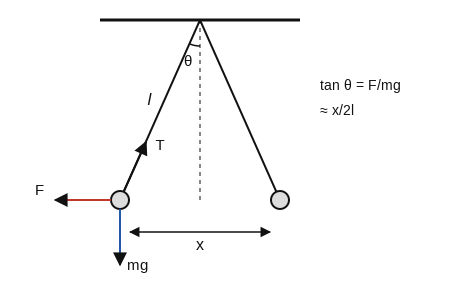
Two identical charged spheres suspended from a common point by two massless strings of lengths l, are initially at a distance d (d<<l) apart because of their mutual repulsion. The charges begin to leak from both the spheres at a constant rate. As a result, the spheres approach each other with a velocity υ. Then υ varies as a function of the distance x between the spheres, as
दो सर्वसम आवेशित गोले एक उभयनिष्ठ बिंदु से l लंबाई की दो द्रव्यमानरहित डोरियों द्वारा लटके हैं तथा परस्पर प्रतिकर्षण के कारण प्रारंभ में d (d<<l) दूरी पर हैं। दोनों गोलों से आवेश एक नियत दर से क्षरित होने लगता है। परिणामस्वरूप गोले वेग υ से एक-दूसरे की ओर आते हैं। तब गोलों के बीच की दूरी x के फलन के रूप में υ किस प्रकार परिवर्तित होता है?
  1. Aυ∝x12
  2. Bυ∝x
  3. Cυ∝x−12
  4. Dυ∝x−1
Show answer

Concept: Equilibrium of each sphere: tan⁡θ=Fmg, and for small angle tan⁡θ≈x/2l. Leak rate dqdt = constant.

  1. kq2x2=mgx2l → q2=mg2lkx3 → q∝x3/2.
  2. Differentiate: dqdt∝32x1/2dxdt=32x1/2υ.
  3. dqdt constant → x1/2υ = constant → υ∝x−1/2.

Short trick: q∝x3/2; constant q˙ means υ∝x1−3/2=x−1/2.

Answer: (C) υ∝x−12

अवधारणा: प्रत्येक गोले का संतुलन: tan⁡θ=Fmg, तथा छोटे कोण के लिए tan⁡θ≈x/2l। क्षरण दर dqdt = नियत।

  1. kq2x2=mgx2l → q2=mg2lkx3 → q∝x3/2।
  2. अवकलन करने पर: dqdt∝32x1/2dxdt=32x1/2υ।
  3. dqdt नियत → x1/2υ = नियत → υ∝x−1/2।

शॉर्ट ट्रिक: q∝x3/2; नियत q˙ का अर्थ υ∝x1−3/2=x−1/2।

उत्तर: (C) υ∝x−12

NEET UGPhysicsElectrostatics – leaking charges on suspended spheresNEET UG 2016 · 1 May Shift 1 →
Q2895.
A uniform rope of length L and mass m1, hangs vertically from a rigid support. A block of mass m2 is attached to the free end of the rope. A transverse pulse of wavelength λ1 is produced at the lower end of the rope. The wavelength of the pulse when it reaches the top of the rope is λ2. The ratio λ2/λ1 is:
लंबाई L तथा द्रव्यमान m1 की एक एकसमान रस्सी एक दृढ़ आधार से ऊर्ध्वाधर लटकी है। रस्सी के मुक्त सिरे से द्रव्यमान m2 का एक गुटका बँधा है। रस्सी के निचले सिरे पर तरंगदैर्ध्य λ1 का एक अनुप्रस्थ स्पंद उत्पन्न किया जाता है। रस्सी के ऊपरी सिरे पर पहुँचने पर स्पंद की तरंगदैर्ध्य λ2 है। अनुपात λ2/λ1 है:
  1. Am1m2
  2. Bm1+m2m2
  3. Cm2m1
  4. Dm1+m2m1
Show answer

Concept: v=Tμ; frequency stays the same along the rope, so λ∝v∝T.

  1. Bottom: tension T1=m2g.
  2. Top: tension T2=(m1+m2)g.
  3. λ2λ1=T2T1=m1+m2m2.

Short trick: Top supports everything → ratio must be > 1 with m2 in the denominator → (B).

Answer: (B) m1+m2m2

अवधारणा: v=Tμ; रस्सी में आवृत्ति समान रहती है, अतः λ∝v∝T।

  1. नीचे: तनाव T1=m2g।
  2. ऊपर: तनाव T2=(m1+m2)g।
  3. λ2λ1=T2T1=m1+m2m2।

शॉर्ट ट्रिक: ऊपरी सिरा सब कुछ सँभालता है → अनुपात > 1 तथा हर में m2 → (B)।

उत्तर: (B) m1+m2m2

NEET UGPhysicsWaves – speed of transverse wave in hanging ropeNEET UG 2016 · 1 May Shift 1 →
Q2896.
A refrigerator works between 4∘C and 30∘C. It is required to remove 600 calories of heat every second in order to keep the temperature of the refrigerated space constant. The power required is: (Take 1 cal = 4.2 Joules)
एक प्रशीतित्र 4∘C तथा 30∘C के बीच कार्य करता है। प्रशीतित स्थान का ताप नियत बनाए रखने के लिए प्रति सेकंड 600 कैलोरी ऊष्मा निकालना आवश्यक है। आवश्यक शक्ति है: (1 cal = 4.2 जूल लीजिए)
  1. A2.365 W
  2. B23.65 W
  3. C236.5 W
  4. D2365 W
Show answer

Concept: Ideal (Carnot) refrigerator: β=Q2W=T2T1−T2.

  1. T2=277 K, T1=303 K → β=27726=10.65.
  2. Q2 per second =600×4.2=2520 J/s.
  3. P=Q2β=2520×26277=236.5 W.

Short trick: P=Q⋅ΔTTcold=2520×26277≈236 W.

Answer: (C) 236.5 W

अवधारणा: आदर्श (कार्नो) प्रशीतित्र: β=Q2W=T2T1−T2।

  1. T2=277 K, T1=303 K → β=27726=10.65।
  2. प्रति सेकंड Q2=600×4.2=2520 J/s।
  3. P=Q2β=2520×26277=236.5 W।

शॉर्ट ट्रिक: P=Q⋅ΔTTcold=2520×26277≈236 W।

उत्तर: (C) 236.5 W

NEET UGPhysicsThermodynamics – refrigerator (coefficient of performance)NEET UG 2016 · 1 May Shift 1 →
Q2897.
An air column, closed at one end and open at the other, resonates with a tuning fork when the smallest length of the column is 50 cm. The next larger length of the column resonating with the same tuning fork is:
एक सिरे पर बंद तथा दूसरे सिरे पर खुला एक वायु स्तंभ, स्तंभ की न्यूनतम लंबाई 50 cm होने पर एक स्वरित्र के साथ अनुनाद करता है। उसी स्वरित्र के साथ अनुनाद करने वाली स्तंभ की अगली बड़ी लंबाई है:
  1. A66.7 cm
  2. B100 cm
  3. C150 cm
  4. D200 cm
Show answer

Concept: Closed pipe resonance lengths: λ4,3λ4,5λ4,… (odd multiples).

  1. λ4=50 cm → λ=200 cm.
  2. Next: 3λ4=150 cm.

Short trick: Closed pipe → lengths in ratio 1 : 3 : 5 → 50 × 3 = 150 cm.

Answer: (C) 150 cm

अवधारणा: बंद नली की अनुनाद लंबाइयाँ: λ4,3λ4,5λ4,… (विषम गुणज)।

  1. λ4=50 cm → λ=200 cm।
  2. अगली: 3λ4=150 cm।

शॉर्ट ट्रिक: बंद नली → लंबाइयाँ 1 : 3 : 5 के अनुपात में → 50 × 3 = 150 cm।

उत्तर: (C) 150 cm

NEET UGPhysicsWaves – resonance in closed pipeNEET UG 2016 · 1 May Shift 1 →
Q2898.
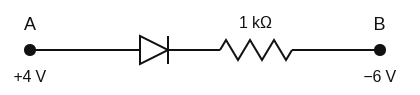
Consider the junction diode as ideal. The value of current flowing through AB is:
संधि डायोड को आदर्श मानिए। AB से प्रवाहित धारा का मान है:
  1. A0 A
  2. B10−2 A
  3. C10−1 A
  4. D10−3 A
Show answer

Concept: An ideal diode has zero resistance when forward biased (p-side at higher potential).

  1. Diode arrow points from A (+4 V) towards B (−6 V) → p-side at higher potential → forward biased, acts as a plain wire.
  2. VA−VB=4−(−6)=10 V across 1 kΩ.
  3. i=101000=10−2 A.

Short trick: Arrow of the diode points "downhill" in potential → conducts; I = ΔV/R = 10 V / 1 kΩ = 10 mA.

Answer: (B) 10−2 A

अवधारणा: अग्र अभिनत (p-सिरा उच्च विभव पर) होने पर आदर्श डायोड का प्रतिरोध शून्य होता है।

  1. डायोड का तीर A (+4 V) से B (−6 V) की ओर है → p-सिरा उच्च विभव पर → अग्र अभिनत, साधारण तार की तरह कार्य करता है।
  2. 1 kΩ के सिरों पर VA−VB=4−(−6)=10 V।
  3. i=101000=10−2 A।

शॉर्ट ट्रिक: डायोड का तीर विभव के "ढलान" की ओर → चालन; I = ΔV/R = 10 V / 1 kΩ = 10 mA।

उत्तर: (B) 10−2 A

NEET UGPhysicsSemiconductors – ideal diode in a circuitNEET UG 2016 · 1 May Shift 1 →
Q2899.
The charge flowing through a resistance R varies with time t as Q=at−bt2 where a and b are positive constants. The total heat produced in R is :
एक प्रतिरोध R से प्रवाहित आवेश समय t के साथ Q=at−bt2 के अनुसार परिवर्तित होता है, जहाँ a तथा b धनात्मक नियतांक हैं। R में उत्पन्न कुल ऊष्मा है :
  1. Aa3R6b
  2. Ba3R3b
  3. Ca3R2b
  4. Da3Rb
Show answer

Concept: i=dQdt and heat H=∫i2Rdt. Charge flows only while Q keeps increasing, i.e. until i=0.

  1. i=a−2bt; current becomes zero at t=a2b (Q is then maximum and the flow stops).
  2. H=∫0a/2b(a−2bt)2Rdt=R[(a−2bt)3−6b]0a/2b
  3. H=R(0+a36b)=a3R6b.

Short trick: i falls linearly from a to 0 in time a2b: ∫i2dt of a straight line = 13i02t=13a2⋅a2b → a3R6b.

Answer: (A) a3R6b

अवधारणा: i=dQdt तथा ऊष्मा H=∫i2Rdt। आवेश तभी तक प्रवाहित होता है जब तक Q बढ़ता रहता है, अर्थात् i=0 होने तक।

  1. i=a−2bt; t=a2b पर धारा शून्य हो जाती है (तब Q अधिकतम होता है और प्रवाह रुक जाता है)।
  2. H=∫0a/2b(a−2bt)2Rdt=R[(a−2bt)3−6b]0a/2b
  3. H=R(0+a36b)=a3R6b।

शॉर्ट ट्रिक: i, समय a2b में a से 0 तक रैखिक घटती है: सरल रेखा का ∫i2dt=13i02t=13a2⋅a2b → a3R6b।

उत्तर: (A) a3R6b

NEET UGPhysicsCurrent electricity – Joule heating with time-varying chargeNEET UG 2016 · 1 May Shift 1 →
Q2900.
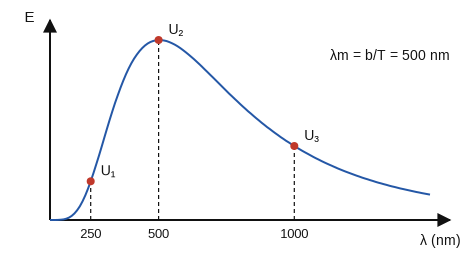
A black body is at a temperature of 5760 K. The energy of radiation emitted by the body at wavelength 250 nm is U1, at wavelength 500 nm is U2 and that at 1000 nm is U3. Wien’s constant, b=2.88×10⁶ nmK. Which of the following is correct?
एक कृष्णिका 5760 K ताप पर है। कृष्णिका द्वारा 250 nm तरंगदैर्ध्य पर उत्सर्जित विकिरण की ऊर्जा U1, 500 nm पर U2 तथा 1000 nm पर U3 है। वीन नियतांक b=2.88×10⁶ nmK है। निम्नलिखित में से कौन-सा सही है?
  1. AU1=0
  2. BU3=0
  3. CU1>U2
  4. DU2>U1
Show answer

Concept: Wien's law: λmT=b; emitted energy is maximum at λm and smaller on both sides (never zero).

  1. λm=2.88×1065760=500 nm → U2 is the peak.
  2. 250 nm and 1000 nm lie on either side of the peak → U1<U2 and U3<U2 → (D) correct, (C) wrong.
  3. A black body emits at all wavelengths, so U1, U3≠0 → (A), (B) wrong.

Short trick: Compute λm first: it equals one of the given wavelengths (500 nm) → that U is the largest.

Answer: (D) U2>U1

अवधारणा: वीन नियम: λmT=b; उत्सर्जित ऊर्जा λm पर अधिकतम तथा दोनों ओर कम होती है (कभी शून्य नहीं)।

  1. λm=2.88×1065760=500 nm → U2 शिखर है।
  2. 250 nm तथा 1000 nm शिखर के दोनों ओर हैं → U1<U2 तथा U3<U2 → (D) सही, (C) गलत।
  3. कृष्णिका सभी तरंगदैर्ध्यों पर उत्सर्जन करती है, अतः U1, U3≠0 → (A), (B) गलत।

शॉर्ट ट्रिक: पहले λm निकालें: यह दी गई तरंगदैर्ध्यों में से एक (500 nm) है → वही U सबसे बड़ा।

उत्तर: (D) U2>U1

NEET UGPhysicsThermal radiation – Wien's displacement lawNEET UG 2016 · 1 May Shift 1 →