Question bank

Q&A: practice questions with answers

Search questions on any topic. Filter by exam category, exam, subject and topic, try the question, then open the answer and explanation.

Courses – airGurukul

53,050 questions in the question bank.

Q3241.
Which of the following is not an autoimmune disease?
निम्नलिखित में से कौन-सा एक स्व-प्रतिरक्षा (autoimmune) रोग नहीं है?
  1. AAlzheimer's diseaseऐल्ज़ाइमर रोग
  2. BRheumatoid arthritisआमवाती संधिशोथ (Rheumatoid arthritis)
  3. CPsoriasisसोरायसिस
  4. DVitiligoविटिलिगो (श्वित्र)
Show answer

Concept: Autoimmunity = immune system attacks self cells. Rheumatoid arthritis (NCERT example), psoriasis and vitiligo are autoimmune.

  1. Alzheimer's disease is a neurodegenerative disorder associated with deficiency of the neurotransmitter acetylcholine – not autoimmune → (A).
  2. Rheumatoid arthritis – antibodies against synovial membrane/cartilage.
  3. Psoriasis – T-cell–mediated attack causing thick red scaly skin patches.
  4. Vitiligo – immune destruction of melanocytes → white patches.

Short trick: Three skin/joint diseases are autoimmune; the brain-degeneration one (Alzheimer's – low acetylcholine) is the odd one out.

Answer: (A) Alzheimer's disease

अवधारणा: स्व-प्रतिरक्षा = प्रतिरक्षा तंत्र का अपनी ही कोशिकाओं पर आक्रमण। आमवाती संधिशोथ (NCERT उदाहरण), सोरायसिस और विटिलिगो स्व-प्रतिरक्षा रोग हैं।

  1. ऐल्ज़ाइमर रोग तंत्रिका-अपह्रासी विकार है जो तंत्रिकाप्रेषी ऐसीटिलकोलीन की कमी से जुड़ा है – स्व-प्रतिरक्षा नहीं → (A)।
  2. आमवाती संधिशोथ – साइनोवियल झिल्ली/उपास्थि के विरुद्ध प्रतिरक्षी।
  3. सोरायसिस – T-कोशिका मध्यस्थ आक्रमण से त्वचा पर मोटे लाल शल्की धब्बे।
  4. विटिलिगो – मेलेनोसाइटों का प्रतिरक्षी विनाश → सफेद धब्बे।

शॉर्ट ट्रिक: तीन त्वचा/जोड़ रोग स्व-प्रतिरक्षी हैं; मस्तिष्क-अपह्रास वाला (ऐल्ज़ाइमर – कम ऐसीटिलकोलीन) अलग है।

उत्तर: (A) ऐल्ज़ाइमर रोग
NEET UGBiologyHuman health and disease – autoimmunityNEET UG 2018 · 6 May Shift 1 →
Q3242.
Among the following sets of examples for divergent evolution, select the incorrect option :
अपसारी विकास के उदाहरणों के निम्नलिखित समूहों में से गलत विकल्प चुनिए:
  1. ABrain of bat, man and cheetahचमगादड़, मनुष्य और चीता का मस्तिष्क
  2. BHeart of bat, man and cheetahचमगादड़, मनुष्य और चीता का हृदय
  3. CForelimbs of man, bat and cheetahमनुष्य, चमगादड़ और चीता के अग्रपाद
  4. DEye of octopus, bat and manऑक्टोपस, चमगादड़ और मनुष्य की आँख
Show answer

Concept: Divergent evolution → homologous organs (same origin, different functions), e.g. vertebrate hearts, brains, forelimbs. Convergent evolution → analogous organs (different origin, similar function).

  1. (A), (B), (C) – structures of vertebrates (mammals) with common ancestry → homologous → divergent: correct examples.
  2. (D) Eye of octopus (mollusc) and of mammals have different origins but similar function → analogous → convergent evolution → incorrect as a divergent example.

Short trick: If an invertebrate (octopus) is mixed with vertebrates → analogy/convergent.

Answer: (D) Eye of octopus, bat and man

अवधारणा: अपसारी विकास → समजात अंग (समान उत्पत्ति, भिन्न कार्य), जैसे कशेरुकियों के हृदय, मस्तिष्क, अग्रपाद। अभिसारी विकास → समरूप अंग (भिन्न उत्पत्ति, समान कार्य)।

  1. (A), (B), (C) – समान पूर्वज वाले कशेरुकियों (स्तनधारियों) की संरचनाएँ → समजात → अपसारी: सही उदाहरण।
  2. (D) ऑक्टोपस (मोलस्क) और स्तनधारियों की आँख की उत्पत्ति भिन्न पर कार्य समान → समरूप → अभिसारी विकास → अपसारी के उदाहरण के रूप में गलत।

शॉर्ट ट्रिक: यदि अकशेरुकी (ऑक्टोपस) कशेरुकियों के साथ मिला हो → समरूपता/अभिसारी।

उत्तर: (D) ऑक्टोपस, चमगादड़ और मनुष्य की आँख

NEET UGBiologyEvolution – divergent and convergent evolutionNEET UG 2018 · 6 May Shift 1 →
Q3243.
Conversion of milk to curd improves its nutritional value by increasing the amount of
दूध के दही में परिवर्तन से उसका पोषण मान किसकी मात्रा बढ़ने से सुधरता है?
  1. AVitamin B12विटामिन B12
  2. BVitamin Aविटामिन A
  3. CVitamin Dविटामिन D
  4. DVitamin Eविटामिन E
Show answer

Concept: NCERT: Lactic acid bacteria (LAB, e.g. Lactobacillus) convert milk to curd and also improve its nutritional quality by increasing vitamin B12.

  1. LAB produce acids that coagulate and partially digest milk proteins → curd.
  2. They synthesise vitamin B12 → (A); A, D, E are fat-soluble vitamins not increased by LAB. LAB in the stomach also check disease-causing microbes.

Short trick: LAB → "Lactobacillus Adds B12".

Answer: (A) Vitamin B12

अवधारणा: NCERT: लैक्टिक अम्ल जीवाणु (LAB, जैसे Lactobacillus) दूध को दही में बदलते हैं और विटामिन B12 बढ़ाकर इसकी पोषण गुणवत्ता भी सुधारते हैं।

  1. LAB अम्ल बनाते हैं जो दूध प्रोटीनों को स्कंदित व आंशिक पचित करते हैं → दही।
  2. ये विटामिन B12 संश्लेषित करते हैं → (A); A, D, E वसा-विलेय विटामिन हैं जिन्हें LAB नहीं बढ़ाते। आमाशय में LAB रोगकारक सूक्ष्मजीवों को भी नियंत्रित करते हैं।

शॉर्ट ट्रिक: LAB → "Lactobacillus B12 बढ़ाता है"।

उत्तर: (A) विटामिन B12

NEET UGBiologyMicrobes in human welfare – household productsNEET UG 2018 · 6 May Shift 1 →
Q3244.
The similarity of bone structure in the forelimbs of many vertebrates is an example of
अनेक कशेरुकियों के अग्रपादों की अस्थि संरचना में समानता किसका उदाहरण है?
  1. AConvergent evolutionअभिसारी विकास
  2. BAnalogyसमरूपता (Analogy)
  3. CHomologyसमजातता (Homology)
  4. DAdaptive radiationअनुकूली विकिरण
Show answer

Concept: NCERT: forelimbs of whales, bats, cheetah and human share the same pattern of bones (humerus, radius-ulna, carpals, metacarpals, phalanges) though they perform different functions → homology.

  1. Same anatomical plan + common ancestry = homologous organs → homology → (C).
  2. Analogy/convergent evolution = different structures doing similar function (e.g. wings of butterfly and bird) – opposite case.
  3. Adaptive radiation is a process (e.g. Darwin's finches) leading to many forms; the question asks what the bone similarity itself represents.

Short trick: HOMology = "same HOMe (origin)"; ANAlogy = "ANother origin, same job".

Answer: (C) Homology

अवधारणा: NCERT: व्हेल, चमगादड़, चीता और मनुष्य के अग्रपादों में अस्थियों का समान प्रतिरूप (ह्यूमरस, रेडियस-अल्ना, कार्पल, मेटाकार्पल, फैलेंजेज़) होता है, यद्यपि कार्य भिन्न हैं → समजातता।

  1. समान शारीरिक योजना + समान पूर्वज = समजात अंग → समजातता → (C)।
  2. समरूपता/अभिसारी विकास = भिन्न संरचनाएँ समान कार्य करती हैं (जैसे तितली और पक्षी के पंख) – विपरीत स्थिति।
  3. अनुकूली विकिरण एक प्रक्रिया है (जैसे डार्विन की फिंच) जिससे अनेक रूप बनते हैं; प्रश्न पूछता है कि अस्थि समानता स्वयं क्या दर्शाती है।

शॉर्ट ट्रिक: समजात = "समान जन्म (उत्पत्ति)"; समरूप = "भिन्न उत्पत्ति, समान कार्य"।

उत्तर: (C) समजातता (Homology)

NEET UGBiologyEvolution – homologous organsNEET UG 2018 · 6 May Shift 1 →
Q3245.
Which of the following characteristics represent ‘Inheritance of blood groups’ in humans?
a. Dominance
b. Co-dominance
c. Multiple allele
d. Incomplete dominance
e. Polygenic inheritance
निम्नलिखित में से कौन-से लक्षण मनुष्यों में ‘रुधिर वर्गों की वंशागति’ को दर्शाते हैं?
a. प्रभाविता
b. सहप्रभाविता
c. बहु-युग्मविकल्पी (Multiple allele)
d. अपूर्ण प्रभाविता
e. बहुजीनी वंशागति
  1. Ab, d and eb, d और e
  2. Ba, b and ca, b और c
  3. Cb, c and eb, c और e
  4. Da, c and ea, c और e
Show answer

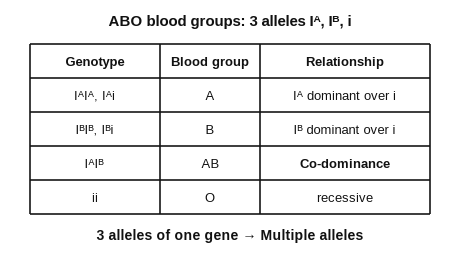
Concept: ABO blood group is controlled by one gene I with three alleles IA, IB, i (NCERT).

  1. a. Dominance: IA and IB are dominant over i (IAi → A, IBi → B). ✔
  2. b. Co-dominance: IAIB expresses both A and B antigens → AB. ✔
  3. c. Multiple alleles: three alleles of the same gene in the population. ✔
  4. d. Incomplete dominance (blended intermediate, e.g. snapdragon) – not seen. ✘
  5. e. Polygenic inheritance needs several genes (e.g. skin colour) – ABO is a single gene. ✘
  6. Hence a, b and c → (B).

Short trick: ABO shows "all three Ds except the blended one": Dominance, co-Dominance, Diverse (multiple) alleles.

Answer: (B) a, b and c

अवधारणा: ABO रुधिर वर्ग एक जीन I द्वारा नियंत्रित होता है जिसके तीन युग्मविकल्पी IA, IB, i हैं (NCERT)।

  1. a. प्रभाविता: IA और IB, i पर प्रभावी हैं (IAi → A, IBi → B)। ✔
  2. b. सहप्रभाविता: IAIB में A और B दोनों प्रतिजन व्यक्त → AB। ✔
  3. c. बहुविकल्पता: समष्टि में एक ही जीन के तीन युग्मविकल्पी। ✔
  4. d. अपूर्ण प्रभाविता (मिश्रित मध्यवर्ती, जैसे स्नैपड्रैगन) – नहीं दिखती। ✘
  5. e. बहुजीनी वंशागति में अनेक जीन चाहिए (जैसे त्वचा का रंग) – ABO एक जीन है। ✘
  6. अतः a, b और c → (B)।

शॉर्ट ट्रिक: ABO में: प्रभाविता, सहप्रभाविता, बहुविकल्पता – पर मिश्रण (अपूर्ण प्रभाविता) नहीं।

उत्तर: (B) a, b और c

NEET UGBiologyPrinciples of inheritance – ABO blood groupsNEET UG 2018 · 6 May Shift 1 →
Q3246.
A radioactive nucleus ZAX undergoes spontaneous decay in the sequence ZAX→Z−1B→Z−3C→Z−2D, where Z is the atomic number of element X. The possible decay particles in the sequence are:
एक रेडियोऐक्टिव नाभिक ZAX स्वतः क्षय के अनुक्रम ZAX→Z−1B→Z−3C→Z−2D से गुजरता है, जहाँ Z तत्व X का परमाणु क्रमांक है। इस अनुक्रम में संभावित क्षय कण हैं:
  1. Aβ+,α,β−
  2. Bβ−,α,β+
  3. Cα,β−,β+
  4. Dα,β+,β−
Show answer

Concept: In decay, the change in atomic number tells the particle: β+ → Z decreases by 1, β− → Z increases by 1, α → Z decreases by 2 (A by 4).

  1. X (Z) → B (Z − 1): Z falls by 1 ⇒ β+ emission (a proton turns into a neutron).
  2. B (Z − 1) → C (Z − 3): Z falls by 2 ⇒ α emission.
  3. C (Z − 3) → D (Z − 2): Z rises by 1 ⇒ β− emission (a neutron turns into a proton).
  4. Sequence = β+,α,β−.

Short trick: Track only ΔZ: −1, −2, +1 ↔ β⁺, α, β⁻. Only option (A) starts with β⁺ and ends with β⁻ with α in between.

Answer: (A) β+,α,β−

अवधारणा: क्षय में परमाणु क्रमांक का परिवर्तन कण बताता है: β+ → Z में 1 की कमी, β− → Z में 1 की वृद्धि, α → Z में 2 की कमी (A में 4 की कमी)।

  1. X (Z) → B (Z − 1): Z में 1 की कमी ⇒ β+ उत्सर्जन (एक प्रोटॉन न्यूट्रॉन में बदलता है)।
  2. B (Z − 1) → C (Z − 3): Z में 2 की कमी ⇒ α उत्सर्जन।
  3. C (Z − 3) → D (Z − 2): Z में 1 की वृद्धि ⇒ β− उत्सर्जन (एक न्यूट्रॉन प्रोटॉन में बदलता है)।
  4. अनुक्रम = β+,α,β−।

शॉर्ट ट्रिक: केवल ΔZ देखिए: −1, −2, +1 ↔ β⁺, α, β⁻। केवल विकल्प (A) β⁺ से शुरू होकर β⁻ पर समाप्त होता है और बीच में α है।

उत्तर: (A) β+,α,β−

NEET UGPhysicsNuclei – radioactive decayNEET UG 2021 · 12 Sep Shift 1 →
Q3247.
Polar molecules are the molecules:
ध्रुवीय अणु वे अणु हैं जो:
  1. AAcquire a dipole moment only when magnetic field is absent.केवल चुंबकीय क्षेत्र की अनुपस्थिति में द्विध्रुव आघूर्ण प्राप्त करते हैं।
  2. BHaving a permanent electric dipole moment.स्थायी वैद्युत द्विध्रुव आघूर्ण रखते हैं।
  3. CHaving zero dipole moment.शून्य द्विध्रुव आघूर्ण रखते हैं।
  4. Dpresence of electric field due to displacement of charges.आवेशों के विस्थापन के कारण वैद्युत क्षेत्र की उपस्थिति।
Show answer

Concept: In a polar molecule (e.g. H2O, HCl) the centres of positive and negative charge do not coincide even without any external field, so it has a permanent dipole moment.

  1. (A) Wrong – a magnetic field has nothing to do with the electric dipole moment of a molecule.
  2. (B) Correct – permanent dipole moment is the definition of a polar molecule.
  3. (C) Wrong – zero dipole moment (in the absence of field) describes a non-polar molecule (O2, CO2).
  4. (D) Wrong – a dipole moment produced only by displacement of charges in an applied field is an induced dipole, typical of non-polar molecules.

Short trick: Polar = Permanent; Non-polar = only iNduced (in a field).

Answer: (B) Having a permanent electric dipole moment

अवधारणा: ध्रुवीय अणु (जैसे H2O, HCl) में बाह्य क्षेत्र के बिना भी धन और ऋण आवेशों के केंद्र संपाती नहीं होते, इसलिए इनका स्थायी द्विध्रुव आघूर्ण होता है।

  1. (A) गलत – चुंबकीय क्षेत्र का अणु के वैद्युत द्विध्रुव आघूर्ण से कोई संबंध नहीं है।
  2. (B) सही – स्थायी द्विध्रुव आघूर्ण ही ध्रुवीय अणु की परिभाषा है।
  3. (C) गलत – (क्षेत्र की अनुपस्थिति में) शून्य द्विध्रुव आघूर्ण अध्रुवीय अणु (O2, CO2) का लक्षण है।
  4. (D) गलत – केवल लगाए गए क्षेत्र में आवेशों के विस्थापन से उत्पन्न द्विध्रुव आघूर्ण प्रेरित द्विध्रुव है, जो अध्रुवीय अणुओं में होता है।

शॉर्ट ट्रिक: ध्रुवीय = स्थायी (Permanent); अध्रुवीय = केवल प्रेरित (क्षेत्र में)।

उत्तर: (B) स्थायी वैद्युत द्विध्रुव आघूर्ण रखते हैं

NEET UGPhysicsElectric charges and fields – electric dipoleNEET UG 2021 · 12 Sep Shift 1 →
Q3248.
The effective resistance of a parallel connection that consists of four wires of equal length, equal area of cross-section and same material is 0.25 Ω. What will be the effective resistance if they are connected in series?
समान लंबाई, समान अनुप्रस्थ-काट क्षेत्रफल और समान पदार्थ के चार तारों से बने समांतर संयोजन का प्रभावी प्रतिरोध 0.25 Ω है। यदि इन्हें श्रेणीक्रम में जोड़ा जाए तो प्रभावी प्रतिरोध क्या होगा?
  1. A1 Ω
  2. B4 Ω
  3. C0.25 Ω
  4. D0.5 Ω
Show answer

Concept: Identical wires have the same resistance R; n identical resistors give R/n in parallel and nR in series.

  1. Parallel: R/4 = 0.25 Ω ⇒ R = 1 Ω.
  2. Series: Rs=4R=4×1=4 Ω.

Short trick: For n equal resistors, Rs/Rp=n2 ⇒ Rs=16×0.25=4 Ω.

Answer: (B) 4 Ω

अवधारणा: समान तारों का प्रतिरोध R समान होता है; n समान प्रतिरोध समांतर में R/n और श्रेणी में nR देते हैं।

  1. समांतर: R/4 = 0.25 Ω ⇒ R = 1 Ω।
  2. श्रेणी: Rs=4R=4×1=4 Ω।

शॉर्ट ट्रिक: n समान प्रतिरोधों के लिए Rs/Rp=n2 ⇒ Rs=16×0.25=4 Ω।

उत्तर: (B) 4 Ω

NEET UGPhysicsCurrent electricity – combination of resistorsNEET UG 2021 · 12 Sep Shift 1 →
Q3249.
Column-I gives certain physical terms associated with flow of current through a metallic conductor. Column-II gives some mathematical relations involving electrical quantities. Match Column-I and Column-II with appropriate relations.
Column IColumn II
(A) Drift Velocity(P) mne2ρ
(B) Electrical Resistivity(Q) nevd
(C) Relaxation Period(R) eEmτ
(D) Current Density(S) EJ
स्तंभ-I में धात्विक चालक से धारा प्रवाह से संबंधित कुछ भौतिक पद दिए गए हैं। स्तंभ-II में वैद्युत राशियों से संबंधित कुछ गणितीय संबंध दिए गए हैं। स्तंभ-I का स्तंभ-II से उपयुक्त संबंधों के साथ मिलान कीजिए।
स्तंभ-Iस्तंभ-II
(A) अपवाह वेग (Drift Velocity)(P) mne2ρ
(B) वैद्युत प्रतिरोधकता (Electrical Resistivity)(Q) nevd
(C) विश्रांति काल (Relaxation Period)(R) eEmτ
(D) धारा घनत्व (Current Density)(S) EJ
  1. AA-R, B-P, C-S, D-Q
  2. BA-R, B-Q, C-S, D-P
  3. CA-R, B-S, C-P, D-Q
  4. DA-R, B-S, C-Q, D-P
Show answer

Concept: Free-electron model: vd=eEmτ, J=nevd, ρ=mne2τ and Ohm’s law E=ρJ.

  1. Drift velocity vd=eEmτ ⇒ A-R.
  2. Resistivity from E=ρJ ⇒ ρ=EJ ⇒ B-S.
  3. From ρ=mne2τ ⇒ τ=mne2ρ ⇒ C-P.
  4. Current density J=I/A=nevd ⇒ D-Q.

Short trick: All options have A-R; just check D: J=nevd (Q) → only (C) has D-Q.

Answer: (C) A-R, B-S, C-P, D-Q

अवधारणा: मुक्त-इलेक्ट्रॉन मॉडल: vd=eEmτ, J=nevd, ρ=mne2τ तथा ओम का नियम E=ρJ।

  1. अपवाह वेग vd=eEmτ ⇒ A-R।
  2. E=ρJ से प्रतिरोधकता ρ=EJ ⇒ B-S।
  3. ρ=mne2τ से τ=mne2ρ ⇒ C-P।
  4. धारा घनत्व J=I/A=nevd ⇒ D-Q।

शॉर्ट ट्रिक: सभी विकल्पों में A-R है; केवल D जाँचिए: J=nevd (Q) → केवल (C) में D-Q है।

उत्तर: (C) A-R, B-S, C-P, D-Q

NEET UGPhysicsCurrent electricity – drift velocity, resistivityNEET UG 2021 · 12 Sep Shift 1 →
Q3250.
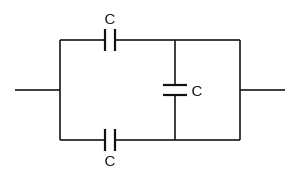
The equivalent capacitance of the combination shown in the figure is:
चित्र में दर्शाए गए संयोजन की तुल्य धारिता है:
  1. AC/2
  2. B3C/2
  3. C3C
  4. D2C
Show answer

Concept: A capacitor whose both plates are connected to the same node (same potential) stores no charge – it is short-circuited and drops out.

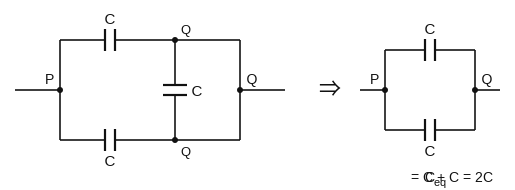
  1. Name the left junction P and the right junction Q. The top and bottom wires to the right of the two outer capacitors are both joined to Q.
  2. So both plates of the middle capacitor are at the potential of Q ⇒ it is shorted (no charge).
  3. The remaining top C and bottom C are each connected between P and Q ⇒ parallel.
  4. Ceq=C+C=2C.

Short trick: Whenever a capacitor sits between two points joined by a plain wire, delete it first.

Answer: (D) 2C

अवधारणा: जिस संधारित्र की दोनों प्लेटें एक ही संधि (समान विभव) से जुड़ी हों, उसमें कोई आवेश संचित नहीं होता – वह लघुपथित (short-circuited) होकर हट जाता है।

  1. बाएँ संधि-बिंदु को P और दाएँ संधि-बिंदु को Q कहें। दोनों बाहरी संधारित्रों के दाईं ओर के ऊपरी और निचले तार, दोनों Q से जुड़े हैं।
  2. अतः बीच वाले संधारित्र की दोनों प्लेटें Q के विभव पर हैं ⇒ वह लघुपथित है (आवेश शून्य)।
  3. शेष ऊपरी C और निचला C दोनों P और Q के बीच जुड़े हैं ⇒ समांतर क्रम।
  4. Ceq=C+C=2C।

शॉर्ट ट्रिक: जब भी कोई संधारित्र किसी सीधे तार से जुड़े दो बिंदुओं के बीच हो, पहले उसे हटा दीजिए।

उत्तर: (D) 2C

NEET UGPhysicsCapacitance – combination of capacitorsNEET UG 2021 · 12 Sep Shift 1 →
Q3251.
In a potentiometer circuit a cell of EMF 1.5 V gives balance point at 36 cm length of wire. If another cell of EMF 2.5 V replaces the first cell, then at what length of the wire, the balance point occurs?
एक विभवमापी परिपथ में 1.5 V विद्युत वाहक बल (EMF) का सेल तार की 36 cm लंबाई पर संतुलन बिंदु देता है। यदि पहले सेल के स्थान पर 2.5 V EMF का दूसरा सेल लगा दिया जाए, तो संतुलन बिंदु तार की किस लंबाई पर प्राप्त होगा?
  1. A64 cm
  2. B62 cm
  3. C60 cm
  4. D21.6 cm
Show answer

Concept: With the same driving current, the potential gradient k is constant, so balancing length ∝ EMF: E=kℓ.

  1. E1E2=ℓ1ℓ2 ⇒ 1.52.5=36ℓ2.
  2. ℓ2=36×2.51.5=36×53=60 cm.

Short trick: Larger EMF ⇒ longer balancing length; 21.6 cm is the trap (inverse ratio).

Answer: (C) 60 cm

अवधारणा: समान मुख्य धारा पर विभव प्रवणता k नियत रहती है, अतः संतुलन लंबाई ∝ EMF: E=kℓ।

  1. E1E2=ℓ1ℓ2 ⇒ 1.52.5=36ℓ2।
  2. ℓ2=36×2.51.5=36×53=60 cm।

शॉर्ट ट्रिक: अधिक EMF ⇒ अधिक संतुलन लंबाई; 21.6 cm उल्टे अनुपात वाला जाल है।

उत्तर: (C) 60 cm

NEET UGPhysicsCurrent electricity – potentiometerNEET UG 2021 · 12 Sep Shift 1 →
Q3252.
The escape velocity from the Earth’s surface is v. The escape velocity from the surface of another planet having a radius, four times that of Earth and same mass density is:
पृथ्वी के पृष्ठ से पलायन वेग v है। किसी अन्य ग्रह, जिसकी त्रिज्या पृथ्वी की चार गुनी है और द्रव्यमान घनत्व समान है, के पृष्ठ से पलायन वेग है:
  1. A3v
  2. B4v
  3. Cv
  4. D2v
Show answer

Concept: ve=2GMR with M=43πR3ρ.

  1. ve=2GR⋅43πR3ρ=R8πGρ3.
  2. Same ρ ⇒ ve∝R.
  3. R becomes 4R ⇒ ve becomes 4v.

Short trick: Same density: ve∝R (and g∝R). Same mass: ve∝1/R – don’t mix them.

Answer: (B) 4v

अवधारणा: ve=2GMR तथा M=43πR3ρ।

  1. ve=2GR⋅43πR3ρ=R8πGρ3।
  2. समान ρ ⇒ ve∝R।
  3. R के 4R होने पर ve = 4v।

शॉर्ट ट्रिक: समान घनत्व: ve∝R (और g∝R)। समान द्रव्यमान: ve∝1/R – दोनों को न मिलाएँ।

उत्तर: (B) 4v

NEET UGPhysicsGravitation – escape velocityNEET UG 2021 · 12 Sep Shift 1 →
Q3253.
A cup of coffee cools from 90°C to 80°C in t minutes, when the room temperature is 20°C. The time taken by a similar cup of coffee to cool from 80°C to 60°C at a room temperature same at 20°C is
कमरे का ताप 20°C होने पर कॉफ़ी का एक कप t मिनट में 90°C से 80°C तक ठंडा होता है। कमरे का ताप 20°C ही रहने पर, इसी प्रकार के कॉफ़ी के कप को 80°C से 60°C तक ठंडा होने में लगा समय है
  1. A1013t
  2. B513t
  3. C1310t
  4. D135t
Show answer

Concept: Newton’s law of cooling (average form): ΔTΔt=k(Tavg−T0).

  1. Case 1: 10t=k(85−20)=65k.
  2. Case 2: 20t′=k(70−20)=50k.
  3. Divide: 20t′⋅t10=5065 ⇒ 2tt′=1013.
  4. t′=26t10=135t.

Short trick: Twice the drop at a smaller excess temperature must take MORE than 2t ⇒ only 13t/5 = 2.6t fits.

Answer: (D) 135t

अवधारणा: न्यूटन का शीतलन नियम (औसत रूप): ΔTΔt=k(Tavg−T0)।

  1. स्थिति 1: 10t=k(85−20)=65k।
  2. स्थिति 2: 20t′=k(70−20)=50k।
  3. भाग देने पर: 20t′⋅t10=5065 ⇒ 2tt′=1013।
  4. t′=26t10=135t।

शॉर्ट ट्रिक: कम आधिक्य ताप पर दोगुनी गिरावट में 2t से अधिक समय लगेगा ⇒ केवल 13t/5 = 2.6t उपयुक्त है।

उत्तर: (D) 135t

NEET UGPhysicsThermal properties of matter – Newton’s law of coolingNEET UG 2021 · 12 Sep Shift 1 →
Q3254.
A capacitor of capacitance ‘C’, is connected across an ac source of voltage V, given by V=V0sin⁡ωt. The displacement current between the plates of the capacitor, would then be given by:
धारिता ‘C’ का एक संधारित्र V=V0sin⁡ωt द्वारा दी गई वोल्टता V के ac स्रोत से जुड़ा है। संधारित्र की प्लेटों के बीच विस्थापन धारा होगी:
  1. AId=V0ωCsin⁡ωt
  2. BId=V0ωCsin⁡ωt
  3. CId=V0ωCcos⁡ωt
  4. DId=V0ωCcos⁡ωt
Show answer

Concept: Displacement current between the plates equals the conduction current in the leads: Id=ε0dϕEdt=dqdt.

  1. q=CV=CV0sin⁡ωt.
  2. Id=dqdt=V0ωCcos⁡ωt.

Short trick: Dimension check: current amplitude = V0/XC=V0ωC (removes A, D); differentiating sin gives cos (removes B).

Answer: (C) Id=V0ωCcos⁡ωt

अवधारणा: प्लेटों के बीच विस्थापन धारा, संयोजी तारों में चालन धारा के बराबर होती है: Id=ε0dϕEdt=dqdt।

  1. q=CV=CV0sin⁡ωt।
  2. Id=dqdt=V0ωCcos⁡ωt।

शॉर्ट ट्रिक: धारा आयाम = V0/XC=V0ωC (A, D हटे); sin का अवकलन cos देता है (B हटा)।

उत्तर: (C) Id=V0ωCcos⁡ωt

NEET UGPhysicsElectromagnetic waves – displacement currentNEET UG 2021 · 12 Sep Shift 1 →
Q3255.
A small block slides down on a smooth inclined plane, starting from rest at time t = 0. Let Sn be the distance travelled by the block in the interval t = n – 1 to t = n. Then, the ratio SnSn+1 is:
एक छोटा गुटका समय t = 0 पर विराम से प्रारंभ होकर एक चिकने आनत तल पर नीचे की ओर फिसलता है। माना Sn, t = n – 1 से t = n के अंतराल में गुटके द्वारा तय की गई दूरी है। तब अनुपात SnSn+1 है:
  1. A2n+12n−1
  2. B2n2n−1
  3. C2n−12n
  4. D2n−12n+1
Show answer

Concept: Distance in the nth second: Sn=u+a2(2n−1); on a smooth incline a=gsin⁡θ (constant), u = 0.

  1. Sn=gsin⁡θ2(2n−1).
  2. Sn+1=gsin⁡θ2(2n+1).
  3. SnSn+1=2n−12n+1.

Short trick: Galileo’s odd-number rule: from rest, successive equal intervals cover 1 : 3 : 5 : … ⇒ consecutive ratio (2n−1):(2n+1). Check n = 1 → 1/3.

Answer: (D) 2n−12n+1

अवधारणा: n वें सेकंड में दूरी: Sn=u+a2(2n−1); चिकने आनत तल पर a=gsin⁡θ (नियत), u = 0।

  1. Sn=gsin⁡θ2(2n−1)।
  2. Sn+1=gsin⁡θ2(2n+1)।
  3. SnSn+1=2n−12n+1।

शॉर्ट ट्रिक: गैलीलियो का विषम संख्या नियम: विराम से समान क्रमागत अंतरालों में दूरियाँ 1 : 3 : 5 : … ⇒ क्रमागत अनुपात (2n−1):(2n+1)। n = 1 रखें → 1/3।

उत्तर: (D) 2n−12n+1

NEET UGPhysicsMotion in a straight line – distance in nth secondNEET UG 2021 · 12 Sep Shift 1 →
Q3256.
If force [F], acceleration [A] and time [T] are chosen as the fundamental physical quantities. Find the dimensions of energy.
यदि बल [F], त्वरण [A] और समय [T] को मूल भौतिक राशियाँ चुना जाए, तो ऊर्जा की विमाएँ ज्ञात कीजिए।
  1. A[F][A][T−1]
  2. B[F][A−1][T]
  3. C[F][A][T]
  4. D[F][A][T2]
Show answer

Concept: Write E=FaAbTc and equate powers of M, L, T.

  1. [ML2T−2]=[MLT−2]a[LT−2]b[T]c.
  2. M: a = 1; L: a + b = 2 ⇒ b = 1.
  3. T: −2a − 2b + c = −2 ⇒ −4 + c = −2 ⇒ c = 2.
  4. E=[F][A][T2].

Short trick: Energy = force × distance and distance = acceleration × time² ⇒ E = F·A·T² directly.

Answer: (D) [F][A][T2]

अवधारणा: E=FaAbTc लिखकर M, L, T की घातें बराबर कीजिए।

  1. [ML2T−2]=[MLT−2]a[LT−2]b[T]c।
  2. M: a = 1; L: a + b = 2 ⇒ b = 1।
  3. T: −2a − 2b + c = −2 ⇒ −4 + c = −2 ⇒ c = 2।
  4. E=[F][A][T2]।

शॉर्ट ट्रिक: ऊर्जा = बल × दूरी तथा दूरी = त्वरण × समय² ⇒ सीधे E = F·A·T²।

उत्तर: (D) [F][A][T2]

NEET UGPhysicsUnits and measurements – dimensional analysisNEET UG 2021 · 12 Sep Shift 1 →
Q3257.
For a plane electromagnetic wave propagating in x-direction, which one of the following combination gives the correct possible directions for electric field (E) and magnetic field (B) respectively?
x-दिशा में संचरित एक समतल विद्युतचुंबकीय तरंग के लिए, निम्नलिखित में से कौन-सा संयोजन क्रमशः वैद्युत क्षेत्र (E) और चुंबकीय क्षेत्र (B) की सही संभावित दिशाएँ देता है?
  1. Aj^+k^, −j^−k^
  2. B−j^+k^, −j^+k^
  3. Cj^+k^, j^+k^
  4. D−j^+k^, −j^−k^
Show answer

Concept: In an EM wave E→⊥B→ and E→×B→ points along the direction of propagation (+x here).

  1. (A) (j^+k^)×(−j^−k^)=0 (antiparallel) ✗.
  2. (B) and (C): E and B parallel ⇒ cross product 0 ✗.
  3. (D) (−j^+k^)×(−j^−k^)=j^×k^+k^×(−j^)=i^+i^=2i^ ✓ (and E→⋅B→=1−1=0).

Short trick: First reject parallel/antiparallel pairs (A, B, C); the only remaining pair must be the answer.

Answer: (D) −j^+k^, −j^−k^

अवधारणा: विद्युतचुंबकीय तरंग में E→⊥B→ तथा E→×B→ संचरण की दिशा (यहाँ +x) में होता है।

  1. (A) (j^+k^)×(−j^−k^)=0 (प्रतिसमांतर) ✗।
  2. (B) और (C): E और B समांतर ⇒ सदिश गुणनफल 0 ✗।
  3. (D) (−j^+k^)×(−j^−k^)=j^×k^+k^×(−j^)=i^+i^=2i^ ✓ (और E→⋅B→=1−1=0)।

शॉर्ट ट्रिक: पहले समांतर/प्रतिसमांतर युग्म (A, B, C) हटाइए; बचा हुआ एकमात्र युग्म ही उत्तर है।

उत्तर: (D) −j^+k^, −j^−k^

NEET UGPhysicsElectromagnetic waves – direction of E and BNEET UG 2021 · 12 Sep Shift 1 →
Q3258.
A spring is stretched by 5 cm by a force 10 N. The time period of the oscillations when a mass of 2 kg is suspended by it is:
एक स्प्रिंग 10 N बल द्वारा 5 cm खींची जाती है। जब इससे 2 kg का द्रव्यमान लटकाया जाता है, तो दोलनों का आवर्तकाल है:
  1. A3.14 s
  2. B0.628 s
  3. C0.0628 s
  4. D6.28 s
Show answer

Concept: Hooke’s law F = kx gives k; then T=2πm/k.

  1. k=Fx=100.05=200 N m−1.
  2. T=2π2200=2π×110=0.628 s.

Short trick: Direct: T=2πmxF=2π2×0.0510=2π10=0.628 s.

Answer: (B) 0.628 s

अवधारणा: हुक के नियम F = kx से k ज्ञात करें; फिर T=2πm/k।

  1. k=Fx=100.05=200 N m−1।
  2. T=2π2200=2π×110=0.628 s।

शॉर्ट ट्रिक: सीधे: T=2πmxF=2π2×0.0510=2π10=0.628 s।

उत्तर: (B) 0.628 s

NEET UGPhysicsOscillations – spring-mass systemNEET UG 2021 · 12 Sep Shift 1 →
Q3259.
A particle is released from height S from the surface of the Earth. At a certain height its kinetic energy is three times its potential energy. The height from the surface of earth and the speed of the particle at that instant are respectively
एक कण को पृथ्वी के पृष्ठ से S ऊँचाई से छोड़ा जाता है। किसी ऊँचाई पर इसकी गतिज ऊर्जा इसकी स्थितिज ऊर्जा की तीन गुनी है। उस क्षण पृथ्वी के पृष्ठ से ऊँचाई और कण की चाल क्रमशः हैं
  1. AS2,3gS2
  2. BS4,3gS2
  3. CS4,3gS2
  4. DS4,3gS2
Show answer

Concept: Total mechanical energy mgS is conserved; PE measured from the ground.

  1. KE = 3 PE ⇒ KE + PE = 4 mgh = mgS ⇒ h=S4.
  2. 12mv2=mg(S−S4)=34mgS ⇒ v2=3gS2.
  3. v=3gS2.

Short trick: KE : PE = 3 : 1 ⇒ PE is 1/4 of total ⇒ h = S/4; speed must have units of √(gS) – (C) is not even a speed.

Answer: (B) S4,3gS2

अवधारणा: कुल यांत्रिक ऊर्जा mgS संरक्षित रहती है; स्थितिज ऊर्जा धरातल से मापी जाती है।

  1. KE = 3 PE ⇒ KE + PE = 4 mgh = mgS ⇒ h=S4।
  2. 12mv2=mg(S−S4)=34mgS ⇒ v2=3gS2।
  3. v=3gS2।

शॉर्ट ट्रिक: KE : PE = 3 : 1 ⇒ PE कुल का 1/4 ⇒ h = S/4; चाल का मात्रक √(gS) होना चाहिए – (C) तो चाल ही नहीं है।

उत्तर: (B) S4,3gS2

NEET UGPhysicsWork, energy and power – conservation of energyNEET UG 2021 · 12 Sep Shift 1 →
Q3260.
A lens of large focal length and large aperture is best suited as an objective of an astronomical telescope since:
बड़ी फोकस दूरी और बड़े द्वारक (aperture) वाला लेंस खगोलीय दूरदर्शक के अभिदृश्यक (objective) के रूप में सर्वोत्तम है, क्योंकि:
  1. AA large aperture contributes to the quality and visibility of the imagesबड़ा द्वारक प्रतिबिंबों की गुणवत्ता और दृश्यता में योगदान देता है
  2. BA large area of the objective ensures better light gathering powerअभिदृश्यक का बड़ा क्षेत्रफल बेहतर प्रकाश संग्रहण क्षमता सुनिश्चित करता है
  3. CA large aperture provides a better resolutionबड़ा द्वारक बेहतर विभेदन (resolution) प्रदान करता है
  4. DAll of the aboveउपर्युक्त सभी
Show answer

Concept: Large fo gives high magnification (m=fo/fe); large aperture D gives more light (∝D2) and better resolving power (∝D/λ).

  1. (A) True – more light and less diffraction make faint objects visible and images sharper.
  2. (B) True – light gathering power ∝ area ∝ D², so faint stars become visible.
  3. (C) True – limiting angle θ=1.22λ/D decreases as D increases ⇒ better resolution.
  4. All three statements are correct ⇒ (D).

Short trick: Big D ⇒ Brighter + Better resolution; big fo ⇒ Bigger magnification.

Answer: (D) All of the above

अवधारणा: बड़ी fo से अधिक आवर्धन (m=fo/fe); बड़े द्वारक D से अधिक प्रकाश (∝D2) और बेहतर विभेदन क्षमता (∝D/λ) मिलती है।

  1. (A) सत्य – अधिक प्रकाश और कम विवर्तन से धुंधले पिंड दिखते हैं और प्रतिबिंब स्पष्ट होते हैं।
  2. (B) सत्य – प्रकाश संग्रहण क्षमता ∝ क्षेत्रफल ∝ D², अतः धुंधले तारे भी दिखते हैं।
  3. (C) सत्य – सीमांत कोण θ=1.22λ/D, D बढ़ने पर घटता है ⇒ बेहतर विभेदन।
  4. तीनों कथन सही हैं ⇒ (D)।

शॉर्ट ट्रिक: बड़ा D ⇒ अधिक चमक + बेहतर विभेदन; बड़ी fo ⇒ अधिक आवर्धन।

उत्तर: (D) उपर्युक्त सभी

NEET UGPhysicsRay optics – astronomical telescopeNEET UG 2021 · 12 Sep Shift 1 →