Question bank

Q&A: practice questions with answers

Search questions on any topic. Filter by exam category, exam, subject and topic, try the question, then open the answer and explanation.

Courses – airGurukul

53,050 questions in the question bank.

Q3281.
From a circular ring of mass ‘M’ and radius ‘R’ an arc corresponding to a 90° sector is removed. The moment of inertia of the remaining part of the ring about an axis passing through the centre of the ring and perpendicular to the plane of the ring is ‘K’ times ‘MR2’. Then the value of ‘K’ is:
द्रव्यमान ‘M’ और त्रिज्या ‘R’ के एक वृत्ताकार वलय से 90° त्रिज्यखंड के संगत एक चाप हटा दिया जाता है। वलय के केंद्र से गुजरने वाली और वलय के तल के लंबवत अक्ष के परितः वलय के शेष भाग का जड़त्व आघूर्ण ‘MR2’ का ‘K’ गुना है। तब ‘K’ का मान है:
  1. A14
  2. B18
  3. C34
  4. D78
Show answer

Concept: Every element of a ring (or arc) lies at distance R from the central perpendicular axis, so I=mR2 for any arc of mass m.

  1. Removed 90° = 1/4 of the ring ⇒ remaining mass = 3M4.
  2. I=3M4R2 ⇒ K = 3/4.

Short trick: For an arc about the axis through its centre of curvature, I = (mass) × R² – shape of the arc does not matter.

Answer: (C) 34

अवधारणा: वलय (या चाप) का प्रत्येक अवयव केंद्रीय लंबवत अक्ष से R दूरी पर है, अतः m द्रव्यमान के किसी भी चाप के लिए I=mR2।

  1. हटाया गया 90° = वलय का 1/4 ⇒ शेष द्रव्यमान = 3M4।
  2. I=3M4R2 ⇒ K = 3/4।

शॉर्ट ट्रिक: चाप के वक्रता केंद्र से गुजरने वाले अक्ष के परितः I = (द्रव्यमान) × R² – चाप का आकार मायने नहीं रखता।

उत्तर: (C) 34
NEET UGPhysicsSystem of particles – moment of inertia of ringNEET UG 2021 · 12 Sep Shift 1 →
Q3282.
A series LCR circuit containing 5.0 H inductor, 80 μF capacitor and 40 Ω resistor is connected to 230 V variable frequency ac source. The angular frequencies of the source at which power transferred to the circuit is half the power at the resonant angular frequency are likely to be:
5.0 H प्रेरक, 80 μF संधारित्र और 40 Ω प्रतिरोधक वाला एक श्रेणी LCR परिपथ 230 V के परिवर्ती आवृत्ति ac स्रोत से जुड़ा है। स्रोत की वे कोणीय आवृत्तियाँ, जिन पर परिपथ को स्थानांतरित शक्ति, अनुनादी कोणीय आवृत्ति पर शक्ति की आधी है, संभवतः हैं:
  1. A46 rad/s and 54 rad/s46 rad/s और 54 rad/s
  2. B42 rad/s and 58 rad/s42 rad/s और 58 rad/s
  3. C25 rad/s and 75 rad/s25 rad/s और 75 rad/s
  4. D50 rad/s and 25 rad/s50 rad/s और 25 rad/s
Show answer

Concept: Half-power points lie at ω0±Δω2 with bandwidth Δω=R/L and ω0=1/LC.

  1. ω0=15×80×10−6=14×10−4=50 rad/s.
  2. Δω=RL=405=8 rad/s.
  3. ω1,2=50∓4=46 rad/s and 54 rad/s.

Short trick: The pair must be centred on ω0 = 50 with a gap R/L = 8 ⇒ 46 & 54.

Answer: (A) 46 rad/s and 54 rad/s

अवधारणा: अर्ध-शक्ति बिंदु ω0±Δω2 पर होते हैं, जहाँ बैंड-चौड़ाई Δω=R/L तथा ω0=1/LC।

  1. ω0=15×80×10−6=14×10−4=50 rad/s।
  2. Δω=RL=405=8 rad/s।
  3. ω1,2=50∓4=46 rad/s और 54 rad/s।

शॉर्ट ट्रिक: युग्म ω0 = 50 पर केंद्रित और R/L = 8 के अंतर वाला होना चाहिए ⇒ 46 और 54।

उत्तर: (A) 46 rad/s और 54 rad/s

NEET UGPhysicsAlternating current – half-power frequenciesNEET UG 2021 · 12 Sep Shift 1 →
Q3283.
A uniform conducting wire of length 12a and resistance ‘R’ is wound up as a current carrying coil in the shape of,
(i) an equilateral triangle of side ‘a’.
(ii) a square of side ‘a’.
The magnetic dipole moments of the coil in each case respectively are:
लंबाई 12a और प्रतिरोध ‘R’ के एक एकसमान चालक तार को धारावाही कुंडली के रूप में लपेटा जाता है, जिसका आकार है
(i) भुजा ‘a’ का एक समबाहु त्रिभुज।
(ii) भुजा ‘a’ का एक वर्ग।
प्रत्येक स्थिति में कुंडली के चुंबकीय द्विध्रुव आघूर्ण क्रमशः हैं:
  1. A3 Ia2 and 4 Ia23 Ia2 और 4 Ia2
  2. B4 Ia2 and 3 Ia24 Ia2 और 3 Ia2
  3. C3 Ia2 and 3 Ia23 Ia2 और 3 Ia2
  4. D3 Ia2 and Ia23 Ia2 और Ia2
Show answer

Concept: Magnetic moment of a coil m = NIA; the number of turns N = total length / perimeter of one turn.

  1. Triangle: perimeter 3a ⇒ N = 12a/3a = 4; area = 34a2 ⇒ m=4I34a2=3Ia2.
  2. Square: perimeter 4a ⇒ N = 3; area = a² ⇒ m = 3Ia².

Short trick: Same wire length: compare N × (area per turn) – the square always gives more moment than the triangle.

Answer: (C) 3 Ia2 and 3 Ia2

अवधारणा: कुंडली का चुंबकीय आघूर्ण m = NIA; फेरों की संख्या N = कुल लंबाई / एक फेरे का परिमाप।

  1. त्रिभुज: परिमाप 3a ⇒ N = 12a/3a = 4; क्षेत्रफल = 34a2 ⇒ m=4I34a2=3Ia2।
  2. वर्ग: परिमाप 4a ⇒ N = 3; क्षेत्रफल = a² ⇒ m = 3Ia²।

शॉर्ट ट्रिक: समान तार लंबाई: N × (प्रति फेरा क्षेत्रफल) की तुलना करें – वर्ग सदैव त्रिभुज से अधिक आघूर्ण देता है।

उत्तर: (C) 3 Ia2 और 3 Ia2

NEET UGPhysicsMoving charges and magnetism – magnetic dipole moment of coilNEET UG 2021 · 12 Sep Shift 1 →
Q3284.
A step down transformer connected to an ac mains supply of 220 V is made to operate at 11 V, 44 W lamp. Ignoring power losses in the transformer, what is the current in the primary circuit?
220 V के ac मुख्य आपूर्ति से जुड़े एक अपचायी (step down) ट्रांसफ़ॉर्मर से 11 V, 44 W का लैंप चलाया जाता है। ट्रांसफ़ॉर्मर में शक्ति हानियों की उपेक्षा करते हुए, प्राथमिक परिपथ में धारा क्या है?
  1. A2 A
  2. B4 A
  3. C0.2 A
  4. D0.4 A
Show answer

Concept: Ideal transformer: input power = output power, VpIp=VsIs.

  1. Output power = 44 W.
  2. 220×Ip=44 ⇒ Ip=0.2 A.

Short trick: Secondary current = 44/11 = 4 A (trap); step-down by 20 ⇒ primary current = 4/20 = 0.2 A.

Answer: (C) 0.2 A

अवधारणा: आदर्श ट्रांसफ़ॉर्मर: निवेशी शक्ति = निर्गत शक्ति, VpIp=VsIs।

  1. निर्गत शक्ति = 44 W।
  2. 220×Ip=44 ⇒ Ip=0.2 A।

शॉर्ट ट्रिक: द्वितीयक धारा = 44/11 = 4 A (जाल); 20 गुना अपचयन ⇒ प्राथमिक धारा = 4/20 = 0.2 A।

उत्तर: (C) 0.2 A

NEET UGPhysicsAlternating current – transformerNEET UG 2021 · 12 Sep Shift 1 →
Q3285.
Twenty seven drops of same size are charged at 220 V each. They combine to form a bigger drop. Calculate the potential of the bigger drop.
समान आकार की सत्ताईस बूँदें प्रत्येक 220 V पर आवेशित हैं। ये मिलकर एक बड़ी बूँद बनाती हैं। बड़ी बूँद का विभव ज्ञात कीजिए।
  1. A1520 V
  2. B1980 V
  3. C660 V
  4. D1320 V
Show answer

Concept: Volume conservation: R=n1/3r; charge adds: Q = nq ⇒ V=n2/3v.

  1. n = 27 ⇒ R = 3r, Q = 27q.
  2. V=kQR=27kq3r=9kqr=9×220=1980 V.

Short trick: Big-drop rules: V × n2/3, charge × n, capacitance × n1/3, energy × n5/3.

Answer: (B) 1980 V

अवधारणा: आयतन संरक्षण: R=n1/3r; आवेश जुड़ते हैं: Q = nq ⇒ V=n2/3v।

  1. n = 27 ⇒ R = 3r, Q = 27q।
  2. V=kQR=27kq3r=9kqr=9×220=1980 V।

शॉर्ट ट्रिक: बड़ी बूँद के नियम: V × n2/3, आवेश × n, धारिता × n1/3, ऊर्जा × n5/3।

उत्तर: (B) 1980 V

NEET UGPhysicsElectrostatic potential – combining dropsNEET UG 2021 · 12 Sep Shift 1 →
Q3286.
Two conducting circular loops of radii R1 and R2 are placed in the same plane with their centres coinciding. If R1>>R2, the mutual inductance M between them will be directly proportional to:
त्रिज्याओं R1 और R2 के दो चालक वृत्ताकार लूप एक ही तल में इस प्रकार रखे हैं कि उनके केंद्र संपाती हैं। यदि R1>>R2, तो उनके बीच अन्योन्य प्रेरकत्व M किसके अनुक्रमानुपाती होगा:
  1. AR12R2
  2. BR22R1
  3. CR1R2
  4. DR2R1
Show answer

Concept: Pass current I1 in the big loop; its field at the centre is nearly uniform over the small loop. M=ϕ2/I1.

  1. B1=μ0I12R1 at the centre.
  2. ϕ2=B1πR22=μ0πR222R1I1.
  3. M=μ0πR222R1 ⇒ M∝R22R1.

Short trick: M = (field of big loop per unit current) × (area of small loop) ⇒ (1/R1) × R2².

Answer: (B) R22R1

अवधारणा: बड़े लूप में धारा I1 प्रवाहित करें; इसका केंद्र पर क्षेत्र छोटे लूप पर लगभग एकसमान है। M=ϕ2/I1।

  1. केंद्र पर B1=μ0I12R1।
  2. ϕ2=B1πR22=μ0πR222R1I1।
  3. M=μ0πR222R1 ⇒ M∝R22R1।

शॉर्ट ट्रिक: M = (प्रति एकांक धारा बड़े लूप का क्षेत्र) × (छोटे लूप का क्षेत्रफल) ⇒ (1/R1) × R2²।

उत्तर: (B) R22R1

NEET UGPhysicsElectromagnetic induction – mutual inductanceNEET UG 2021 · 12 Sep Shift 1 →
Q3287.
A particle of mass ‘m’ is projected with a velocity u=kVe (k < 1) from the surface of the earth. (Ve = escape velocity)
The maximum height above the surface reached by the particle is:
द्रव्यमान ‘m’ का एक कण पृथ्वी के पृष्ठ से वेग u=kVe (k < 1) से प्रक्षेपित किया जाता है। (Ve = पलायन वेग)
कण द्वारा पृष्ठ से ऊपर प्राप्त अधिकतम ऊँचाई है:
  1. AR2k1+k
  2. BRk21−k2
  3. CR(k1−k)2
  4. DR(k1+k)2
Show answer

Concept: Energy conservation with U=−GMmr and Ve2=2GMR.

  1. 12mk22GMR−GMmR=−GMmR+H.
  2. k2−1R=−1R+H ⇒ R+H=R1−k2.
  3. H=R1−k2−R=Rk21−k2.

Short trick: Checks: k → 1 ⇒ H → ∞ (escape) and small k ⇒ H ≈ Rk² = u²/2g. Only (B) satisfies both.

Answer: (B) Rk21−k2

अवधारणा: U=−GMmr और Ve2=2GMR के साथ ऊर्जा संरक्षण।

  1. 12mk22GMR−GMmR=−GMmR+H।
  2. k2−1R=−1R+H ⇒ R+H=R1−k2।
  3. H=R1−k2−R=Rk21−k2।

शॉर्ट ट्रिक: जाँच: k → 1 ⇒ H → ∞ (पलायन) तथा छोटे k पर H ≈ Rk² = u²/2g। केवल (B) दोनों को संतुष्ट करता है।

उत्तर: (B) Rk21−k2

NEET UGPhysicsGravitation – maximum height of projectileNEET UG 2021 · 12 Sep Shift 1 →
Q3288.
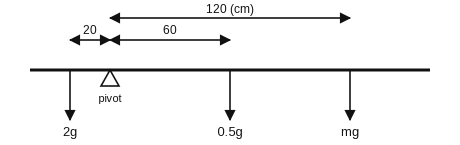
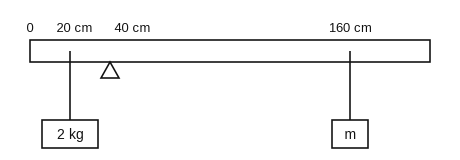
A uniform rod of length 200 cm and mass 500 g is balanced on a wedge placed at 40 cm mark. A mass of 2 kg is suspended from the rod at 20 cm and another unknown mass ‘m’ is suspended from the rod at 160 cm mark as shown in the figure. Find the value of ‘m’ such that the rod is in equilibrium. (g = 10 m/s2)
लंबाई 200 cm और द्रव्यमान 500 g की एक एकसमान छड़ 40 cm चिह्न पर रखी एक फन्नी (wedge) पर संतुलित है। चित्रानुसार छड़ से 20 cm पर 2 kg का द्रव्यमान और 160 cm चिह्न पर एक अज्ञात द्रव्यमान ‘m’ लटकाया गया है। ‘m’ का वह मान ज्ञात कीजिए जिससे छड़ साम्यावस्था में रहे। (g = 10 m/s2)
  1. A1/6 kg
  2. B1/12 kg
  3. C1/2 kg
  4. D1/3 kg
Show answer

Concept: Take torques about the wedge (40 cm mark); the rod’s weight acts at its centre (100 cm mark).

  1. Anticlockwise: 2 kg at 20 cm from the pivot ⇒ 2g × 20.
  2. Clockwise: rod 0.5 kg at 60 cm ⇒ 0.5g × 60; mass m at 120 cm ⇒ mg × 120.
  3. 2 × 20 = 0.5 × 60 + 120m ⇒ 40 = 30 + 120m ⇒ m = 10/120 = 1/12 kg.

Short trick: Don’t forget the rod’s own weight – ignoring it gives m = 1/3 kg (a trap option).

Answer: (B) 1/12 kg

अवधारणा: फन्नी (40 cm चिह्न) के परितः बल-आघूर्ण लें; छड़ का भार इसके केंद्र (100 cm चिह्न) पर कार्य करता है।

  1. वामावर्त: धुरी से 20 cm पर 2 kg ⇒ 2g × 20।
  2. दक्षिणावर्त: 60 cm पर छड़ 0.5 kg ⇒ 0.5g × 60; 120 cm पर द्रव्यमान m ⇒ mg × 120।
  3. 2 × 20 = 0.5 × 60 + 120m ⇒ 40 = 30 + 120m ⇒ m = 10/120 = 1/12 kg।

शॉर्ट ट्रिक: छड़ का अपना भार न भूलें – इसे छोड़ने पर m = 1/3 kg (जाल विकल्प) आता है।

उत्तर: (B) 1/12 kg

NEET UGPhysicsSystem of particles – rotational equilibriumNEET UG 2021 · 12 Sep Shift 1 →
Q3289.
A ball of mass 0.15 kg is dropped from a height 10 m, strikes the ground and rebounds to the same height. The magnitude of impulse imparted to the ball is (g = 10 m/s2) nearly:
0.15 kg द्रव्यमान की एक गेंद 10 m की ऊँचाई से गिराई जाती है, धरातल से टकराती है और उसी ऊँचाई तक वापस उछलती है। गेंद को दिए गए आवेग का परिमाण (g = 10 m/s2) लगभग है:
  1. A21 kg m/s
  2. B1.4 kg m/s
  3. C0 kg m/s
  4. D4.2 kg m/s
Show answer

Concept: Impulse = change in momentum; the velocity reverses with the same magnitude.

  1. Speed at impact u=2gh=200≈14.14 m/s; rebound speed is the same (same height).
  2. Impulse = m[u − (−u)] = 2mu = 2 × 0.15 × 14.14 ≈ 4.2 kg m/s.

Short trick: Rebound to same height ⇒ impulse = 2m√(2gh); 0 is the trap (momentum reverses, it does not cancel).

Answer: (D) 4.2 kg m/s

अवधारणा: आवेग = संवेग में परिवर्तन; वेग समान परिमाण के साथ उलट जाता है।

  1. टकराने पर चाल u=2gh=200≈14.14 m/s; उछलने की चाल भी समान (समान ऊँचाई)।
  2. आवेग = m[u − (−u)] = 2mu = 2 × 0.15 × 14.14 ≈ 4.2 kg m/s।

शॉर्ट ट्रिक: समान ऊँचाई तक उछाल ⇒ आवेग = 2m√(2gh); 0 जाल है (संवेग उलटता है, निरस्त नहीं होता)।

उत्तर: (D) 4.2 kg m/s

NEET UGPhysicsLaws of motion – impulseNEET UG 2021 · 12 Sep Shift 1 →
Q3290.
A particle moving in a circle of radius R with a uniform speed takes a time T to complete one revolution. If this particle were projected with the same speed at an angle ‘θ’ to the horizontal, the maximum height attained by it equals 4R. The angle of projection, θ, is then given by:
त्रिज्या R के वृत्त में एकसमान चाल से गतिमान एक कण एक परिक्रमा पूरी करने में समय T लेता है। यदि इस कण को उसी चाल से क्षैतिज से ‘θ’ कोण पर प्रक्षेपित किया जाए, तो इसके द्वारा प्राप्त अधिकतम ऊँचाई 4R के बराबर है। तब प्रक्षेपण कोण θ है:
  1. Aθ=sin−1⁡(π2RgT2)1/2
  2. Bθ=sin−1⁡(2gT2π2R)1/2
  3. Cθ=cos−1⁡(gT2π2R)1/2
  4. Dθ=cos−1⁡(π2RgT2)1/2
Show answer

Concept: Uniform circular motion gives v=2πRT; projectile maximum height H=v2sin2⁡θ2g.

  1. 4R=4π2R2T2⋅sin2⁡θ2g.
  2. sin2⁡θ=8gRT24π2R2=2gT2π2R.
  3. θ=sin−1⁡(2gT2π2R)1/2.

Short trick: H involves sin²θ ⇒ answer is a sin⁻¹ form; and H ∝ v² ∝ 1/T² ⇒ sinθ ∝ T, so T² must be in the numerator ⇒ (B).

Answer: (B) θ=sin−1⁡(2gT2π2R)1/2

अवधारणा: एकसमान वृत्तीय गति से v=2πRT; प्रक्षेप्य की अधिकतम ऊँचाई H=v2sin2⁡θ2g।

  1. 4R=4π2R2T2⋅sin2⁡θ2g।
  2. sin2⁡θ=8gRT24π2R2=2gT2π2R।
  3. θ=sin−1⁡(2gT2π2R)1/2।

शॉर्ट ट्रिक: H में sin²θ है ⇒ उत्तर sin⁻¹ रूप में; और H ∝ v² ∝ 1/T² ⇒ sinθ ∝ T, अतः T² अंश में होना चाहिए ⇒ (B)।

उत्तर: (B) θ=sin−1⁡(2gT2π2R)1/2

NEET UGPhysicsMotion in a plane – projectile and circular motionNEET UG 2021 · 12 Sep Shift 1 →
Q3291.
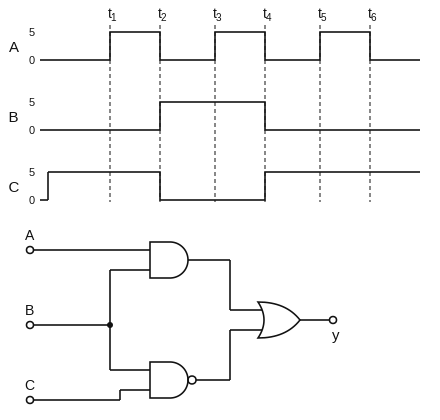
For the given circuit, the input digital signals are applied at the terminals A, B and C. What would be the output at the terminal y?
दिए गए परिपथ के लिए, निवेशी अंकीय सिग्नल टर्मिनलों A, B और C पर लगाए गए हैं। टर्मिनल y पर निर्गत क्या होगा?
  1. A
  2. B
  3. C
  4. D
Show answer

Concept: Read the circuit: AND(A, B) and NAND(B, C) feed an OR gate ⇒ Y=A⋅B+B⋅C―.

IntervalABCA·BB⋅C―Y
0 – t1001011
t1 – t2101011
t2 – t3010011
t3 – t4110111
t4 – t5001011
t5 – t6101011
after t6001011
  1. From the waveforms, B = 1 only between t2 and t4, and exactly in that interval C = 0.
  2. So B·C = 0 at all times ⇒ B⋅C―=1 at all times.
  3. An OR gate with one input permanently 1 gives Y = 1 always ⇒ a constant 5 V output.

Short trick: Look for a gate whose output never changes (here the NAND); if it feeds an OR with a constant 1, the output is constant HIGH – no full truth table needed.

Answer: (C) constant 5 V output

अवधारणा: परिपथ पढ़ें: AND(A, B) और NAND(B, C) एक OR गेट को निवेश देते हैं ⇒ Y=A⋅B+B⋅C―।

अंतरालABCA·BB⋅C―Y
0 – t1001011
t1 – t2101011
t2 – t3010011
t3 – t4110111
t4 – t5001011
t5 – t6101011
t6 के बाद001011
  1. तरंग-रूपों से, B = 1 केवल t2 और t4 के बीच है, और ठीक उसी अंतराल में C = 0 है।
  2. अतः B·C सदैव 0 ⇒ B⋅C― सदैव 1।
  3. जिस OR गेट का एक निवेश स्थायी रूप से 1 हो, उसका निर्गत Y सदैव 1 ⇒ नियत 5 V निर्गत।

शॉर्ट ट्रिक: ऐसा गेट खोजें जिसका निर्गत कभी नहीं बदलता (यहाँ NAND); यदि वह OR को नियत 1 देता है, तो निर्गत नियत उच्च (HIGH) – पूरी सत्यमान सारणी की आवश्यकता नहीं।

उत्तर: (C) नियत 5 V निर्गत

NEET UGPhysicsSemiconductor electronics – logic gatesNEET UG 2021 · 12 Sep Shift 1 →
Q3292.
In the product F→=q(v→×B→)=qv→×(Bi^+Bj^+B0k^)
For q = 1 and v→=2i^+4j^+6k^ and F→=4i^−20j^+12k^
What will be the complete expression for B→?
गुणनफल F→=q(v→×B→)=qv→×(Bi^+Bj^+B0k^) में
q = 1 तथा v→=2i^+4j^+6k^ और F→=4i^−20j^+12k^ के लिए
B→ का पूर्ण व्यंजक क्या होगा?
  1. A8i^+8j^−6k^
  2. B6i^+6j^−8k^
  3. C−8i^−8j^−6k^
  4. D−6i^−6j^−8k^
Show answer

Concept: Expand the cross product with the determinant and compare components.

  1. v→×B→=i^(4B0−6B)−j^(2B0−6B)+k^(2B−4B).
  2. k^: −2B = 12 ⇒ B = −6.
  3. j^: −(2B0 − 6B) = −20 ⇒ 2B0 + 36 = 20 ⇒ B0 = −8.
  4. Check i^: 4(−8) − 6(−6) = −32 + 36 = 4 ✓ ⇒ B→=−6i^−6j^−8k^.

Short trick: Only the k̂-component (2B − 4B = −2B) needs B alone ⇒ B = −6 immediately; only (D) has −6 for both î and ĵ. Also F→⋅v→=8−80+72=0 ✓.

Answer: (D) −6i^−6j^−8k^

अवधारणा: सारणिक (determinant) से सदिश गुणनफल का विस्तार करें और घटकों की तुलना करें।

  1. v→×B→=i^(4B0−6B)−j^(2B0−6B)+k^(2B−4B)।
  2. k^: −2B = 12 ⇒ B = −6।
  3. j^: −(2B0 − 6B) = −20 ⇒ 2B0 + 36 = 20 ⇒ B0 = −8।
  4. i^ जाँच: 4(−8) − 6(−6) = −32 + 36 = 4 ✓ ⇒ B→=−6i^−6j^−8k^।

शॉर्ट ट्रिक: केवल k̂-घटक (2B − 4B = −2B) में केवल B है ⇒ तुरंत B = −6; केवल (D) में î और ĵ दोनों के लिए −6 है। साथ ही F→⋅v→=8−80+72=0 ✓।

उत्तर: (D) −6i^−6j^−8k^

NEET UGPhysicsMoving charges and magnetism – Lorentz force (vector)NEET UG 2021 · 12 Sep Shift 1 →
Q3293.
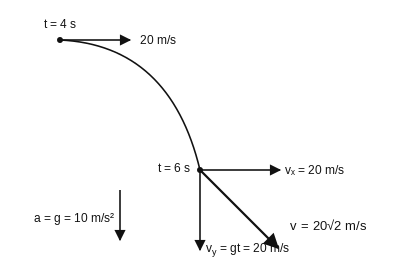
A car starts from rest and accelerates at 5 m/s2. At t = 4 s, a ball is dropped out of a window by a person sitting in the car. What is the velocity and acceleration of the ball at t = 6 s? (Take g = 10 m/s2)
एक कार विराम से प्रारंभ होकर 5 m/s2 से त्वरित होती है। t = 4 s पर कार में बैठा एक व्यक्ति खिड़की से एक गेंद गिराता है। t = 6 s पर गेंद का वेग और त्वरण क्या है? (g = 10 m/s2 लें)
  1. A202 m/s, 0
  2. B202 m/s, 10 m/s2
  3. C20 m/s, 5 m/s2
  4. D20 m/s, 0
Show answer

Concept: Once released, the ball keeps the car’s horizontal velocity at that instant and has only the acceleration g (air resistance neglected).

  1. At t = 4 s: car speed = 0 + 5 × 4 = 20 m/s ⇒ vx=20 m/s (constant afterwards).
  2. Free fall for 2 s: vy=10×2=20 m/s.
  3. v=202+202=202 m/s; acceleration = g = 10 m/s² (vertically down).

Short trick: After release the car’s 5 m/s² no longer acts on the ball ⇒ a = g only.

Answer: (B) 202 m/s, 10 m/s2

अवधारणा: छोड़े जाने के बाद गेंद उस क्षण कार का क्षैतिज वेग बनाए रखती है और इस पर केवल त्वरण g होता है (वायु प्रतिरोध नगण्य)।

  1. t = 4 s पर: कार की चाल = 0 + 5 × 4 = 20 m/s ⇒ vx=20 m/s (इसके बाद नियत)।
  2. 2 s का मुक्त पतन: vy=10×2=20 m/s।
  3. v=202+202=202 m/s; त्वरण = g = 10 m/s² (ऊर्ध्वाधर नीचे)।

शॉर्ट ट्रिक: छोड़ने के बाद कार का 5 m/s² गेंद पर कार्य नहीं करता ⇒ केवल a = g।

उत्तर: (B) 202 m/s, 10 m/s2

NEET UGPhysicsMotion in a plane – relative motion and free fallNEET UG 2021 · 12 Sep Shift 1 →
Q3294.
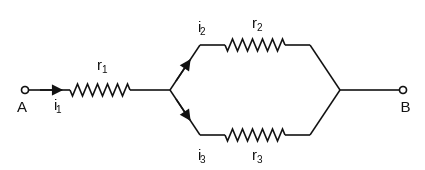
Three resistors having resistance r1, r2 and r3 are connected as shown in the given circuit. The ratio i3/i1 of currents in terms of resistances used in the circuit is:
प्रतिरोध r1, r2 और r3 वाले तीन प्रतिरोधक दिए गए परिपथ में दर्शाए अनुसार जुड़े हैं। परिपथ में प्रयुक्त प्रतिरोधों के पदों में धाराओं का अनुपात i3/i1 है:
  1. Ar1r1+r2
  2. Br2r1+r3
  3. Cr1r2+r3
  4. Dr2r2+r3
Show answer

Concept: In two parallel branches the current divides in the inverse ratio of resistances: i3=i1r2r2+r3.

  1. i1 through r1 splits into i2 (through r2) and i3 (through r3); same voltage: i2r2=i3r3.
  2. i1=i2+i3=i3(r3r2+1) ⇒ i3i1=r2r2+r3.

Short trick: Current in one branch = total × (OTHER branch resistance)/(sum); r1 (series) cannot appear ⇒ (A), (B), (C) out.

Answer: (D) r2r2+r3

अवधारणा: दो समांतर शाखाओं में धारा प्रतिरोधों के व्युत्क्रम अनुपात में बँटती है: i3=i1r2r2+r3।

  1. r1 से होकर i1, i2 (r2 से) और i3 (r3 से) में बँटती है; समान वोल्टता: i2r2=i3r3।
  2. i1=i2+i3=i3(r3r2+1) ⇒ i3i1=r2r2+r3।

शॉर्ट ट्रिक: एक शाखा में धारा = कुल × (दूसरी शाखा का प्रतिरोध)/(योग); r1 (श्रेणी) नहीं आ सकता ⇒ (A), (B), (C) हटें।

उत्तर: (D) r2r2+r3

NEET UGPhysicsCurrent electricity – current divisionNEET UG 2021 · 12 Sep Shift 1 →
Q3295.
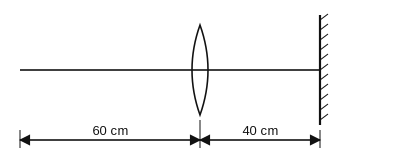
A point object is placed at a distance of 60 cm from a convex lens of focal length 30 cm. If a plane mirror were put perpendicular to the principal axis of the lens and at a distance of 40 cm from it, the final image would be formed at a distance of:
30 cm फोकस दूरी के एक उत्तल लेंस से 60 cm की दूरी पर एक बिंदु बिंब रखा है। यदि लेंस के मुख्य अक्ष के लंबवत और इससे 40 cm की दूरी पर एक समतल दर्पण रख दिया जाए, तो अंतिम प्रतिबिंब किस दूरी पर बनेगा:
  1. A30 cm from the plane mirror, it would be a virtual image.समतल दर्पण से 30 cm पर, यह आभासी प्रतिबिंब होगा।
  2. B20 cm from the plane mirror, it would be a virtual image.समतल दर्पण से 20 cm पर, यह आभासी प्रतिबिंब होगा।
  3. C20 cm from the lens, it would be a real image.लेंस से 20 cm पर, यह वास्तविक प्रतिबिंब होगा।
  4. D30 cm from the lens, it would be a real image.लेंस से 30 cm पर, यह वास्तविक प्रतिबिंब होगा।
Show answer

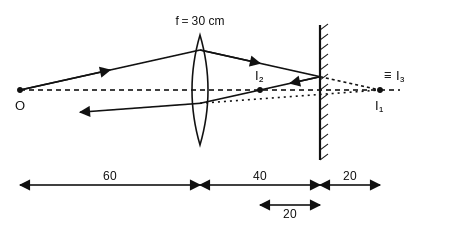
Concept: Treat it step by step: lens → mirror → lens again, using 1v−1u=1f each time with the light’s direction as positive.

  1. Lens (1st pass): u = −60, f = +30 ⇒ 1v1=130−160=160 ⇒ v1 = +60 cm, i.e. 20 cm behind the mirror (I1).
  2. Mirror: I1 is a virtual object 20 cm behind it ⇒ real image I2 20 cm in front of the mirror, i.e. 20 cm from the lens.
  3. Lens (2nd pass, light now travelling left): object I2 at u = −20 cm, f = +30 ⇒ 1v2=130−120=−160 ⇒ v2 = −60 cm.
  4. Final image is virtual, 60 cm from the lens on the mirror side ⇒ 60 − 40 = 20 cm behind the plane mirror.

Short trick: Object inside f on the return trip (20 < 30) ⇒ the lens acts as a magnifier ⇒ final image is VIRTUAL: only (A) or (B); |v| = 60 ⇒ 20 cm beyond the mirror.

Answer: (B) 20 cm from the plane mirror, it would be a virtual image.

अवधारणा: क्रमशः हल करें: लेंस → दर्पण → पुनः लेंस, प्रत्येक बार प्रकाश की दिशा को धनात्मक मानकर 1v−1u=1f लगाएँ।

  1. लेंस (पहली बार): u = −60, f = +30 ⇒ 1v1=130−160=160 ⇒ v1 = +60 cm, अर्थात् दर्पण के 20 cm पीछे (I1)।
  2. दर्पण: I1 इसके 20 cm पीछे एक आभासी बिंब है ⇒ दर्पण के 20 cm सामने वास्तविक प्रतिबिंब I2, अर्थात् लेंस से 20 cm पर।
  3. लेंस (दूसरी बार, प्रकाश अब बाईं ओर): बिंब I2, u = −20 cm, f = +30 ⇒ 1v2=130−120=−160 ⇒ v2 = −60 cm।
  4. अंतिम प्रतिबिंब आभासी है, लेंस से 60 cm पर दर्पण की ओर ⇒ समतल दर्पण के 60 − 40 = 20 cm पीछे।

शॉर्ट ट्रिक: वापसी में बिंब f के अंदर (20 < 30) ⇒ लेंस आवर्धक की तरह ⇒ अंतिम प्रतिबिंब आभासी: केवल (A) या (B); |v| = 60 ⇒ दर्पण के 20 cm पीछे।

उत्तर: (B) समतल दर्पण से 20 cm पर, यह आभासी प्रतिबिंब होगा।

NEET UGPhysicsRay optics – lens and plane mirror combinationNEET UG 2021 · 12 Sep Shift 1 →
Q3296.
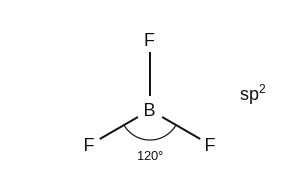
BF3 is planar and electron deficient compound. Hybridization and number of electrons around the central atom, respectively are
BF3 एक समतलीय तथा इलेक्ट्रॉन-न्यून यौगिक है। केन्द्रीय परमाणु का संकरण तथा उसके चारों ओर इलेक्ट्रॉनों की संख्या क्रमशः हैं
  1. Asp2 and 6sp2 और 6
  2. Bsp2 and 8sp2 और 8
  3. Csp3 and 4sp3 और 4
  4. Dsp3 and 6sp3 और 6
Show answer

Concept: Steric number = bond pairs + lone pairs decides hybridisation; electrons around the central atom = 2 × (bond pairs + lone pairs).

  1. B (2s22p1) has 3 valence electrons; each forms one B–F bond → 3 bond pairs, 0 lone pair.
  2. Steric number 3 → sp2, trigonal planar, F–B–F = 120°.
  3. Electrons around B = 3 × 2 = 6 (incomplete octet – that is why BF3 is electron deficient, a Lewis acid).
  4. sp3 would need 4 electron pairs (8 electrons) – not the case here.

Short trick: Electron deficient + planar → sp2 with only a sextet (6 e−). Same for BCl3, AlCl3 (monomer).

Answer: (A) sp2 and 6

अवधारणा: स्टेरिक संख्या = आबंधी युग्म + एकाकी युग्म, इसी से संकरण तय होता है; केन्द्रीय परमाणु के चारों ओर इलेक्ट्रॉन = 2 × (आबंधी युग्म + एकाकी युग्म)।

  1. B (2s22p1) में 3 संयोजी इलेक्ट्रॉन हैं; प्रत्येक एक B–F आबंध बनाता है → 3 आबंधी युग्म, 0 एकाकी युग्म।
  2. स्टेरिक संख्या 3 → sp2, त्रिकोणीय समतलीय, F–B–F = 120°।
  3. B के चारों ओर इलेक्ट्रॉन = 3 × 2 = 6 (अपूर्ण अष्टक – इसी कारण BF3 इलेक्ट्रॉन-न्यून है, एक लुईस अम्ल)।
  4. sp3 के लिए 4 इलेक्ट्रॉन युग्म (8 इलेक्ट्रॉन) चाहिए – यहाँ ऐसा नहीं है।

शॉर्ट ट्रिक: इलेक्ट्रॉन-न्यून + समतलीय → केवल षष्टक (6 e−) वाला sp2। BCl3, AlCl3 (एकलक) में भी यही।

उत्तर: (A) sp2 और 6

NEET UGChemistryChemical bonding – hybridisationNEET UG 2021 · 12 Sep Shift 1 →
Q3297.
Which of the following reactions is the metal displacement reaction? Choose the right option.
निम्नलिखित में से कौन-सी अभिक्रिया धातु विस्थापन अभिक्रिया है? सही विकल्प चुनिए।
  1. AFe + 2HCl ⟶ FeCl2 + H2↑
  2. B2Pb(NO3)2 ⟶ 2PbO + 4NO2 + O2↑
  3. C2KClO3 Δ​ 2KCl + 3O2
  4. DCr2O3 + 2Al Δ​ Al2O3 + 2Cr
Show answer

Concept: In a metal displacement reaction a more reactive metal pushes a less reactive metal out of its compound.

  1. (A) Fe displaces hydrogen from HCl → hydrogen displacement, not metal displacement.
  2. (B) Lead nitrate breaks into PbO, NO2, O2 → thermal decomposition.
  3. (C) KClO3 → KCl + O2 → decomposition.
  4. (D) Al (more reactive) takes oxygen from Cr2O3 and sets Cr free → metal displacement (aluminothermy, like the thermite process).

Short trick: Look for “metal + compound of another metal → new compound + free metal”. Al + metal oxide is the classic example.

Answer: (D) Cr2O3 + 2Al → Al2O3 + 2Cr

अवधारणा: धातु विस्थापन अभिक्रिया में अधिक क्रियाशील धातु, कम क्रियाशील धातु को उसके यौगिक से बाहर निकाल देती है।

  1. (A) Fe, HCl से हाइड्रोजन को विस्थापित करता है → हाइड्रोजन विस्थापन, धातु विस्थापन नहीं।
  2. (B) लेड नाइट्रेट PbO, NO2, O2 में टूटता है → तापीय वियोजन।
  3. (C) KClO3 → KCl + O2 → वियोजन अभिक्रिया।
  4. (D) Al (अधिक क्रियाशील) Cr2O3 से ऑक्सीजन लेकर Cr को मुक्त करता है → धातु विस्थापन (ऐलुमिनोथर्मी, थर्माइट प्रक्रम की तरह)।

शॉर्ट ट्रिक: “धातु + दूसरी धातु का यौगिक → नया यौगिक + मुक्त धातु” खोजिए। Al + धातु ऑक्साइड इसका क्लासिक उदाहरण है।

उत्तर: (D) Cr2O3 + 2Al → Al2O3 + 2Cr

NEET UGChemistryRedox reactions – types of redox reactionsNEET UG 2021 · 12 Sep Shift 1 →
Q3298.
The compound which shows metamerism is
मध्यावयवता (metamerism) प्रदर्शित करने वाला यौगिक है
  1. AC3H6O
  2. BC4H10O
  3. CC5H12
  4. DC3H8O
Show answer

Concept: Metamers have the same functional group (–O–, –CO–, –NH–) but different alkyl groups on its two sides.

  1. C4H10O ethers: CH3–O–CH2CH2CH3 and C2H5–O–C2H5 → metamers. ✔
  2. C3H8O: only one ether, CH3–O–C2H5 → no second arrangement.
  3. C3H6O: only one ketone (acetone), CH3COCH3 – no metamer.
  4. C5H12: alkane, no polyvalent functional group → only chain isomers.

Short trick: Ether needs at least 4 C to split carbons two ways (1+3, 2+2) – so the smallest ether metamers are C4H10O.

Answer: (B) C4H10O

अवधारणा: मध्यावयवों में एक ही क्रियात्मक समूह (–O–, –CO–, –NH–) होता है, पर उसके दोनों ओर भिन्न ऐल्किल समूह होते हैं।

  1. C4H10O ईथर: CH3–O–CH2CH2CH3 तथा C2H5–O–C2H5 → मध्यावयव। ✔
  2. C3H8O: केवल एक ईथर, CH3–O–C2H5 → दूसरी व्यवस्था सम्भव नहीं।
  3. C3H6O: केवल एक कीटोन (ऐसीटोन), CH3COCH3 – कोई मध्यावयव नहीं।
  4. C5H12: ऐल्केन, कोई बहुसंयोजी क्रियात्मक समूह नहीं → केवल शृंखला समावयव।

शॉर्ट ट्रिक: ईथर में कार्बन को दो प्रकार से बाँटने (1+3, 2+2) के लिए कम-से-कम 4 C चाहिए – अतः सबसे छोटे ईथर मध्यावयव C4H10O हैं।

उत्तर: (B) C4H10O

NEET UGChemistryOrganic chemistry – isomerism (metamerism)NEET UG 2021 · 12 Sep Shift 1 →
Q3299.
The pKb of dimethylamine and pKa of acetic acid are 3.27 and 4.77 respectively at T(K). The correct option for the pH of dimethyl ammonium acetate solution is:
T(K) पर डाइमेथिलऐमीन का pKb तथा ऐसीटिक अम्ल का pKa क्रमशः 3.27 तथा 4.77 हैं। डाइमेथिल अमोनियम ऐसीटेट विलयन के pH के लिए सही विकल्प है:
  1. A7.75
  2. B6.25
  3. C8.50
  4. D5.50
Show answer

Concept: Salt of a weak acid and a weak base: pH=7+12(pKa−pKb) (independent of concentration).

  1. pKa − pKb = 4.77 − 3.27 = 1.50
  2. pH = 7 + ½ (1.50) = 7 + 0.75 = 7.75

Short trick: pKb < pKa means the base is stronger → solution is basic, pH > 7. Only (A) and (C) are > 7, and the shift from 7 is half the difference = 0.75.

Answer: (A) 7.75

अवधारणा: दुर्बल अम्ल और दुर्बल क्षार का लवण: pH=7+12(pKa−pKb) (सान्द्रता पर निर्भर नहीं)।

  1. pKa − pKb = 4.77 − 3.27 = 1.50
  2. pH = 7 + ½ (1.50) = 7 + 0.75 = 7.75

शॉर्ट ट्रिक: pKb < pKa यानी क्षार अधिक प्रबल → विलयन क्षारीय, pH > 7। केवल (A) व (C) 7 से अधिक हैं, और 7 से विचलन अन्तर का आधा = 0.75।

उत्तर: (A) 7.75

NEET UGChemistryIonic equilibrium – hydrolysis of saltsNEET UG 2021 · 12 Sep Shift 1 →
Q3300.
The structure of beryllium chloride in solid state and vapour phase, are:
ठोस अवस्था और वाष्प प्रावस्था में बेरिलियम क्लोराइड की संरचनाएँ हैं:
  1. ADimer and Linear, respectivelyक्रमशः द्वितय (डाइमर) और रैखिक
  2. BChain in bothदोनों में शृंखला
  3. CChain and dimer, respectivelyक्रमशः शृंखला और द्वितय (डाइमर)
  4. DLinear in bothदोनों में रैखिक
Show answer

Concept: BeCl2 is electron deficient (only 4 e− on Be), so it uses Cl bridges to complete its valence shell.

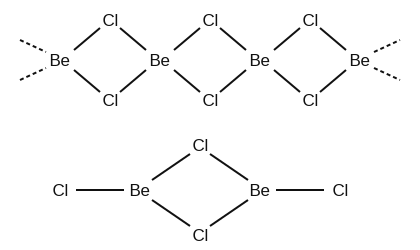
  1. Solid state: each Be is bonded to four bridging Cl atoms → polymeric chain (upper figure).
  2. Vapour (below ~1200 K): Cl-bridged dimer Be2Cl4 (lower figure); only above ~1200 K does it become linear monomer.
  3. Hence chain (solid) and dimer (vapour).

Short trick: NCERT line: “BeCl2 has a chain structure in the solid state … in the vapour phase it tends to form a chloro-bridged dimer which dissociates into the linear monomer at high temperatures of the order of 1200 K.”

Answer: (C) Chain and dimer, respectively

अवधारणा: BeCl2 इलेक्ट्रॉन-न्यून है (Be पर केवल 4 e−), इसलिए यह संयोजकता कोश पूर्ण करने हेतु Cl सेतु (ब्रिज) बनाता है।

  1. ठोस अवस्था: प्रत्येक Be चार सेतु Cl परमाणुओं से जुड़ा → बहुलकी शृंखला (ऊपर का चित्र)।
  2. वाष्प (लगभग 1200 K से नीचे): Cl-सेतु वाला द्वितय Be2Cl4 (नीचे का चित्र); लगभग 1200 K से ऊपर ही यह रैखिक एकलक बनता है।
  3. अतः शृंखला (ठोस) और द्वितय (वाष्प)।

शॉर्ट ट्रिक: NCERT पंक्ति: “ठोस अवस्था में BeCl2 की शृंखला संरचना होती है … वाष्प प्रावस्था में यह क्लोरो-सेतु द्वितय बनाता है जो लगभग 1200 K के उच्च ताप पर रैखिक एकलक में वियोजित हो जाता है।”

उत्तर: (C) क्रमशः शृंखला और द्वितय (डाइमर)

NEET UGChemistrys-Block elements – beryllium chlorideNEET UG 2021 · 12 Sep Shift 1 →