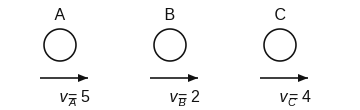
Assertion (A) : Three identical spheres of same mass undergo one dimensional motion as shown in figure with initial velocities m/s, m/s, m/s. If we wait sufficiently long for elastic collision to happen, then m/s, m/s, m/s will be the final velocities.
Reason (R) : In an elastic collision between identical masses, two objects exchange their velocities.
In the light of the above statements, choose the correct answer from the options given below :
अभिकथन (A) : समान द्रव्यमान के तीन सर्वसम गोले चित्रानुसार प्रारंभिक वेगों m/s, m/s, m/s के साथ एकविमीय गति करते हैं। यदि प्रत्यास्थ संघट्ट (elastic collision) होने के लिए हम पर्याप्त लंबे समय तक प्रतीक्षा करें, तो अंतिम वेग m/s, m/s, m/s होंगे।
तर्क (R) : सर्वसम द्रव्यमानों के बीच प्रत्यास्थ संघट्ट में दोनों वस्तुएँ अपने वेगों का विनिमय कर लेती हैं।
उपर्युक्त कथनों के आलोक में, नीचे दिए गए विकल्पों में से सही उत्तर चुनिए :
- A(A) is false but (R) is true(A) असत्य है परन्तु (R) सत्य है
- BBoth (A) and (R) are true but (R) is NOT the correct explanation of (A)(A) और (R) दोनों सत्य हैं परन्तु (R), (A) की सही व्याख्या नहीं है
- CBoth (A) and (R) are true and (R) is the correct explanation of (A)(A) और (R) दोनों सत्य हैं तथा (R), (A) की सही व्याख्या है
- D(A) is true but (R) is false(A) सत्य है परन्तु (R) असत्य है
Show answer
Concept: In a 1-D elastic collision between equal masses the two bodies simply exchange velocities. Keep applying this until the velocities, read from left to right, are non-decreasing (then no further collision occurs).
- A (5 m/s) catches up with B (2 m/s): exchange → , m/s.
- B (5 m/s) now catches up with C (4 m/s): exchange → , m/s.
- Final set: , , m/s — increasing to the right, so no more collisions.
- Assertion claims , , m/s, which is wrong; the Reason is a correct standard result.
Short trick: With equal-mass elastic chase collisions the final velocities are just the initial set {5, 2, 4} rearranged in increasing order left to right: 2, 4, 5.
Answer: (A)
अवधारणा: समान द्रव्यमानों के एकविमीय प्रत्यास्थ संघट्ट में दोनों पिंड केवल अपने वेगों का विनिमय करते हैं। यह तब तक दोहराएँ जब तक बाएँ से दाएँ पढ़ने पर वेग अह्रासमान (non-decreasing) न हो जाएँ (तब कोई और संघट्ट नहीं होगा)।
- A (5 m/s), B (2 m/s) को पकड़ता है: विनिमय → , m/s।
- अब B (5 m/s), C (4 m/s) को पकड़ता है: विनिमय → , m/s।
- अंतिम वेग: , , m/s — दाईं ओर बढ़ते क्रम में, अतः अब कोई संघट्ट नहीं।
- अभिकथन में , , m/s कहा गया है, जो गलत है; तर्क एक सही मानक परिणाम है।
शॉर्ट ट्रिक: समान द्रव्यमान वाले प्रत्यास्थ पीछा-संघट्टों में अंतिम वेग, प्रारंभिक वेगों {5, 2, 4} को बाएँ से दाएँ बढ़ते क्रम में सजाने से मिलते हैं: 2, 4, 5।
उत्तर: (A)