Question bank

Q&A: practice questions with answers

Search questions on any topic. Filter by exam category, exam, subject and topic, try the question, then open the answer and explanation.

Courses – airGurukul

53,050 questions in the question bank.

Q1661.
Let A=[aij]=[log5⁡128log4⁡5log5⁡8log4⁡25]. If Aij is the cofactor of aij, Cij=∑k=12aikAjk, 1≤i,j≤2, and C=[Cij], then 8|C| is equal to :
माना A=[aij]=[log5⁡128log4⁡5log5⁡8log4⁡25] है। यदि Aij, aij का सहखंड (cofactor) है, Cij=∑k=12aikAjk, 1≤i,j≤2 तथा C=[Cij] है, तो 8|C| बराबर है :
  1. A288
  2. B222
  3. C242
  4. D262
Show answer

Concept: ∑kaikAjk=|A|δij (expansion by alien cofactors is zero), so C=|A|I.

  1. |A|=log5⁡128⋅log4⁡25−log4⁡5⋅log5⁡8.
  2. log5⁡128⋅log4⁡25=7ln⁡2ln⁡5⋅ln⁡5ln⁡2=7; log4⁡5⋅log5⁡8=ln⁡52ln⁡2⋅3ln⁡2ln⁡5=32.
  3. |A|=7−32=112.
  4. C=112I2⇒|C|=(112)2=1214, so 8|C|=242.

Short trick: For an n×n matrix this C is always |A|In, so |C|=|A|n – no cofactor needs computing.

Answer: (C) 242

अवधारणा: ∑kaikAjk=|A|δij (भिन्न पंक्ति के सहखंडों से प्रसार शून्य होता है), अतः C=|A|I.

  1. |A|=log5⁡128⋅log4⁡25−log4⁡5⋅log5⁡8.
  2. log5⁡128⋅log4⁡25=7ln⁡2ln⁡5⋅ln⁡5ln⁡2=7; log4⁡5⋅log5⁡8=ln⁡52ln⁡2⋅3ln⁡2ln⁡5=32.
  3. |A|=7−32=112.
  4. C=112I2⇒|C|=(112)2=1214, अतः 8|C|=242.

शॉर्ट ट्रिक: n×n आव्यूह के लिए यह C सदैव |A|In होता है, अतः |C|=|A|n – कोई सहखंड निकालने की आवश्यकता नहीं।

उत्तर: (C) 242
JEE Main 2025 (January) – Paper 1 (B.E./B.Tech)MathematicsMatrices and determinants – cofactorsJEE Main 2025 (January) – Paper 1 (B.E./B.Tech) 2025 · 29 Jan Shift 1 →
Q1662.
Let |z1−8−2i|≤1 and |z2−2+6i|≤2, z1,z2∈C. Then the minimum value of |z1−z2| is :
माना |z1−8−2i|≤1 तथा |z2−2+6i|≤2, z1,z2∈C हैं। तो |z1−z2| का न्यूनतम मान है :
  1. A13
  2. B10
  3. C3
  4. D7
Show answer

Concept: z1,z2 lie in two closed discs; minimum distance between points of non-overlapping discs = distance between centres − sum of radii.

  1. Disc 1: centre 8+2i, radius 1. Disc 2: centre 2−6i, radius 2.
  2. Distance between centres =|(8+2i)−(2−6i)|=|6+8i|=36+64=10.
  3. Since 10>1+2, the discs are separate: min|z1−z2|=10−(1+2)=7.

Short trick: 6-8-10 Pythagorean triple gives the centre distance instantly.

Answer: (D) 7

अवधारणा: z1,z2 दो संवृत चक्रिकाओं (discs) में हैं; अलग-अलग चक्रिकाओं के बिंदुओं के बीच न्यूनतम दूरी = केंद्रों की दूरी − त्रिज्याओं का योग।

  1. चक्रिका 1: केंद्र 8+2i, त्रिज्या 1। चक्रिका 2: केंद्र 2−6i, त्रिज्या 2।
  2. केंद्रों की दूरी =|(8+2i)−(2−6i)|=|6+8i|=36+64=10.
  3. चूँकि 10>1+2, चक्रिकाएँ पृथक् हैं: min|z1−z2|=10−(1+2)=7.

शॉर्ट ट्रिक: 6-8-10 पाइथागोरस त्रिक से केंद्रों की दूरी तुरंत मिल जाती है।

उत्तर: (D) 7

JEE Main 2025 (January) – Paper 1 (B.E./B.Tech)MathematicsComplex numbers – geometryJEE Main 2025 (January) – Paper 1 (B.E./B.Tech) 2025 · 29 Jan Shift 1 →
Q1663.
Let L1:x−11=y−2−1=z−12 and L2:x+1−1=y−22=z1 be two lines. Let L3 be a line passing through the point (α,β,γ) and be perpendicular to both L1 and L2. If L3 intersects L1, then |5α−11β−8γ| equals :
माना L1:x−11=y−2−1=z−12 तथा L2:x+1−1=y−22=z1 दो रेखाएँ हैं। माना L3 एक रेखा है, जो बिंदु (α,β,γ) से होकर जाती है तथा L1 और L2 दोनों के लंबवत है। यदि L3, रेखा L1 को प्रतिच्छेद करती है, तो |5α−11β−8γ| बराबर है :
  1. A20
  2. B18
  3. C25
  4. D16
Show answer

Concept: L3 has direction d→1×d→2; the point (α,β,γ) lies somewhere on a line that meets L1 with that direction.

  1. d→=(1,−1,2)×(−1,2,1)=(−5,−3,1).
  2. L3 meets L1 at (1+t, 2−t, 1+2t), so (α,β,γ)=(1+t−5s, 2−t−3s, 1+2t+s) for some t,s.
  3. 5α−11β−8γ=5(1+t−5s)−11(2−t−3s)−8(1+2t+s) =(5−22−8)+(5+11−16)t+(−25+33−8)s=−25: both parameters cancel.
  4. |5α−11β−8γ|=25.

Short trick: The combination 5x−11y−8z is constant along both d→1=(1,−1,2) and d→=(−5,−3,1) (both dot products are zero), so just evaluate it at (1,2,1): 5−22−8=−25.

Answer: (C) 25

अवधारणा: L3 की दिशा d→1×d→2 है; बिंदु (α,β,γ) ऐसी रेखा पर है जो इसी दिशा में L1 से मिलती है।

  1. d→=(1,−1,2)×(−1,2,1)=(−5,−3,1).
  2. L3, L1 से (1+t, 2−t, 1+2t) पर मिलती है, अतः किसी t,s के लिए (α,β,γ)=(1+t−5s, 2−t−3s, 1+2t+s).
  3. 5α−11β−8γ=5(1+t−5s)−11(2−t−3s)−8(1+2t+s) =(5−22−8)+(5+11−16)t+(−25+33−8)s=−25: दोनों प्राचल कट जाते हैं।
  4. |5α−11β−8γ|=25.

शॉर्ट ट्रिक: व्यंजक 5x−11y−8z, d→1=(1,−1,2) तथा d→=(−5,−3,1) दोनों के अनुदिश अचर रहता है (दोनों अदिश गुणनफल शून्य हैं), अतः केवल (1,2,1) पर मान निकालें: 5−22−8=−25.

उत्तर: (C) 25

JEE Main 2025 (January) – Paper 1 (B.E./B.Tech)MathematicsThree-dimensional geometry – linesJEE Main 2025 (January) – Paper 1 (B.E./B.Tech) 2025 · 29 Jan Shift 1 →
Q1664.
Let M and m respectively be the maximum and the minimum values of f(x)=|1+sin2⁡xcos2⁡x4sin⁡4xsin2⁡x1+cos2⁡x4sin⁡4xsin2⁡xcos2⁡x1+4sin⁡4x|, x∈R. Then M4−m4 is equal to :
माना f(x)=|1+sin2⁡xcos2⁡x4sin⁡4xsin2⁡x1+cos2⁡x4sin⁡4xsin2⁡xcos2⁡x1+4sin⁡4x|, x∈R के अधिकतम तथा न्यूनतम मान क्रमशः M तथा m हैं। तो M4−m4 बराबर है :
  1. A1280
  2. B1295
  3. C1215
  4. D1040
Show answer

Concept: Row operations R1→R1−R3, R2→R2−R3 strip the determinant to a triangular pattern.

  1. R1−R3=(1,0,−1) and R2−R3=(0,1,−1) (the common entries cancel).
  2. Expanding the reduced determinant along the first row: f(x)=1⋅[(1+4sin⁡4x)+cos2⁡x]−1⋅[0−sin2⁡x]=2+4sin⁡4x.
  3. Since sin⁡4x∈[−1,1]: M=6, m=−2.
  4. M4−m4=1296−16=1280.

Short trick: Determinants of the form |1+pqrp1+qrpq1+r|=1+p+q+r; here p+q+r=1+4sin⁡4x, so f=2+4sin⁡4x.

Answer: (A) 1280

अवधारणा: पंक्ति संक्रियाएँ R1→R1−R3, R2→R2−R3 सारणिक को सरल रूप में बदल देती हैं।

  1. R1−R3=(1,0,−1) तथा R2−R3=(0,1,−1) (समान प्रविष्टियाँ कट जाती हैं)।
  2. सरलीकृत सारणिक का प्रथम पंक्ति के अनुदिश प्रसार: f(x)=1⋅[(1+4sin⁡4x)+cos2⁡x]−1⋅[0−sin2⁡x]=2+4sin⁡4x.
  3. चूँकि sin⁡4x∈[−1,1]: M=6, m=−2.
  4. M4−m4=1296−16=1280.

शॉर्ट ट्रिक: |1+pqrp1+qrpq1+r|=1+p+q+r; यहाँ p+q+r=1+4sin⁡4x, अतः f=2+4sin⁡4x.

उत्तर: (A) 1280

JEE Main 2025 (January) – Paper 1 (B.E./B.Tech)MathematicsDeterminants with trigonometryJEE Main 2025 (January) – Paper 1 (B.E./B.Tech) 2025 · 29 Jan Shift 1 →
Q1665.
Let ABC be a triangle formed by the lines 7x−6y+3=0, x+2y−31=0 and 9x−2y−19=0. Let the point (h,k) be the image of the centroid of ΔABC in the line 3x+6y−53=0. Then h2+k2+hk is equal to:
माना रेखाओं 7x−6y+3=0, x+2y−31=0 तथा 9x−2y−19=0 से बना त्रिभुज ABC है। माना बिंदु (h,k), त्रिभुज ΔABC के केन्द्रक (centroid) का रेखा 3x+6y−53=0 में प्रतिबिम्ब (image) है। तो h2+k2+hk बराबर है :
  1. A47
  2. B37
  3. C36
  4. D40
Show answer

Concept: Image of (x1,y1) in ax+by+c=0: (x1−2ada2+b2, y1−2bda2+b2) with d=ax1+by1+c.

  1. Vertices: 7x−6y+3=0, x+2y−31=0⇒A(9,11); 7x−6y+3=0, 9x−2y−19=0⇒B(3,4); x+2y−31=0, 9x−2y−19=0⇒C(5,13).
  2. Centroid G(173,283).
  3. d=3⋅173+6⋅283−53=17+56−53=20; a2+b2=45.
  4. h=173−2⋅3⋅2045=173−83=3; k=283−2⋅6⋅2045=283−163=4.
  5. h2+k2+hk=9+16+12=37.

Short trick: The image comes out as the clean lattice point (3,4) – a quick sanity check that G was right.

Answer: (B) 37

अवधारणा: ax+by+c=0 में (x1,y1) का प्रतिबिम्ब: (x1−2ada2+b2, y1−2bda2+b2), जहाँ d=ax1+by1+c.

  1. शीर्ष: 7x−6y+3=0, x+2y−31=0⇒A(9,11); 7x−6y+3=0, 9x−2y−19=0⇒B(3,4); x+2y−31=0, 9x−2y−19=0⇒C(5,13).
  2. केन्द्रक G(173,283).
  3. d=3⋅173+6⋅283−53=17+56−53=20; a2+b2=45.
  4. h=173−2⋅3⋅2045=173−83=3; k=283−2⋅6⋅2045=283−163=4.
  5. h2+k2+hk=9+16+12=37.

शॉर्ट ट्रिक: प्रतिबिम्ब साफ-सुथरा जालक बिंदु (3,4) आता है – G की त्वरित जाँच का संकेत।

उत्तर: (B) 37

JEE Main 2025 (January) – Paper 1 (B.E./B.Tech)MathematicsStraight lines – centroid and imageJEE Main 2025 (January) – Paper 1 (B.E./B.Tech) 2025 · 29 Jan Shift 1 →
Q1666.
The value of limn→∞(∑k=1nk3+6k2+11k+5(k+3)!) is:
limn→∞(∑k=1nk3+6k2+11k+5(k+3)!) का मान है :
  1. A4/3
  2. B2
  3. C7/3
  4. D5/3
Show answer

Concept: (k+1)(k+2)(k+3)=k3+6k2+11k+6, so the numerator is (k+1)(k+2)(k+3)−1.

  1. k3+6k2+11k+5(k+3)!=(k+1)(k+2)(k+3)(k+3)!−1(k+3)!=1k!−1(k+3)!.
  2. ∑k=1n(1k!−1(k+3)!)=(11!+12!+13!)−(1(n+1)!+1(n+2)!+1(n+3)!).
  3. As n→∞ the tail vanishes: limit =1+12+16=53.

Short trick: Numerator =(k+1)(k+2)(k+3)−1 is the giveaway for a 1k!−1(k+3)! telescope.

Answer: (D) 5/3

अवधारणा: (k+1)(k+2)(k+3)=k3+6k2+11k+6, अतः अंश (k+1)(k+2)(k+3)−1 है।

  1. k3+6k2+11k+5(k+3)!=(k+1)(k+2)(k+3)(k+3)!−1(k+3)!=1k!−1(k+3)!.
  2. ∑k=1n(1k!−1(k+3)!)=(11!+12!+13!)−(1(n+1)!+1(n+2)!+1(n+3)!).
  3. n→∞ पर अंतिम भाग शून्य हो जाता है: सीमा =1+12+16=53.

शॉर्ट ट्रिक: अंश =(k+1)(k+2)(k+3)−1 दिखते ही 1k!−1(k+3)! वाली दूरबीनी (telescoping) श्रेणी पहचानें।

उत्तर: (D) 5/3

JEE Main 2025 (January) – Paper 1 (B.E./B.Tech)MathematicsLimits – telescoping seriesJEE Main 2025 (January) – Paper 1 (B.E./B.Tech) 2025 · 29 Jan Shift 1 →
Q1667.
The least value of n for which the number of integral terms in the Binomial expansion of (73+1112)n is 183, is :
n का वह न्यूनतम मान, जिसके लिए (73+1112)n के द्विपद प्रसार में पूर्णांकीय पदों (integral terms) की संख्या 183 है, है :
  1. A2184
  2. B2196
  3. C2148
  4. D2172
Show answer

Concept: Tr+1=(nr)7n−r311r12 is an integer iff 12∣r and 3∣(n−r).

  1. 12∣r⇒3∣r, so 3∣(n−r) forces 3∣n.
  2. With 3∣n, every r=0,12,24,…≤n works: count =⌊n12⌋+1.
  3. ⌊n12⌋+1=183⇒⌊n12⌋=182⇒2184≤n≤2195.
  4. Least such n divisible by 3 is n=2184 (indeed 2184=12×182, and 3∣2184).

Short trick: Count formula ⌊n/12⌋+1 with 3∣n: smallest n is simply 12×(183−1)=2184.

Answer: (A) 2184

अवधारणा: Tr+1=(nr)7n−r311r12 पूर्णांक होगा यदि और केवल यदि 12∣r तथा 3∣(n−r).

  1. 12∣r⇒3∣r, अतः 3∣(n−r) के लिए 3∣n आवश्यक है।
  2. 3∣n होने पर प्रत्येक r=0,12,24,…≤n चलता है: संख्या =⌊n12⌋+1.
  3. ⌊n12⌋+1=183⇒⌊n12⌋=182⇒2184≤n≤2195.
  4. 3 से विभाज्य न्यूनतम ऐसा n=2184 है (वस्तुतः 2184=12×182 तथा 3∣2184)।

शॉर्ट ट्रिक: गणना-सूत्र ⌊n/12⌋+1 तथा 3∣n: न्यूनतम n=12×(183−1)=2184.

उत्तर: (A) 2184

JEE Main 2025 (January) – Paper 1 (B.E./B.Tech)MathematicsBinomial theorem – integral termsJEE Main 2025 (January) – Paper 1 (B.E./B.Tech) 2025 · 29 Jan Shift 1 →
Q1668.
Let y=y(x) be the solution of the differential equation cos⁡x(loge⁡(cos⁡x))2dy+(sin⁡x−3ysin⁡xloge⁡(cos⁡x))dx=0, x∈(0,π2). If y(π4)=−1loge⁡2, then y(π6) is equal to :
माना अवकल समीकरण cos⁡x(loge⁡(cos⁡x))2dy+(sin⁡x−3ysin⁡xloge⁡(cos⁡x))dx=0, x∈(0,π2) का हल y=y(x) है। यदि y(π4)=−1loge⁡2 है, तो y(π6) बराबर है :
  1. A1loge⁡(3)−loge⁡(4)
  2. B2loge⁡(3)−loge⁡(4)
  3. C1loge⁡(4)−loge⁡(3)
  4. D−1loge⁡(4)
Show answer

Concept: Linear DE in y; substitute u=loge⁡(cos⁡x), so dudx=−tan⁡x.

  1. Rewrite: dydx−3tan⁡xuy=−tan⁡xu2.
  2. Integrating factor =e∫−3tan⁡xudx=e3∫duu=u3.
  3. ddx(yu3)=−tan⁡xu2⋅u3=−utan⁡x=ududx⇒yu3=u22+C.
  4. At x=π4: u=loge⁡12=−loge⁡22, y=−1loge⁡2, so yu3=(loge⁡2)28=u22⇒C=0.
  5. Hence y=12u=12loge⁡(cos⁡x). At x=π6: y=12loge⁡32=1loge⁡34=1loge⁡3−loge⁡4.

Short trick: With C=0 the answer is just 12ln⁡cos⁡x; note 2ln⁡32=ln⁡34.

Answer: (A) 1loge⁡(3)−loge⁡(4)

अवधारणा: y में रैखिक अवकल समीकरण; u=loge⁡(cos⁡x) रखें, तब dudx=−tan⁡x.

  1. पुनर्लेखन: dydx−3tan⁡xuy=−tan⁡xu2.
  2. समाकलन गुणक =e∫−3tan⁡xudx=e3∫duu=u3.
  3. ddx(yu3)=−tan⁡xu2⋅u3=−utan⁡x=ududx⇒yu3=u22+C.
  4. x=π4 पर: u=loge⁡12=−loge⁡22, y=−1loge⁡2, अतः yu3=(loge⁡2)28=u22⇒C=0.
  5. अतः y=12u=12loge⁡(cos⁡x). x=π6 पर: y=12loge⁡32=1loge⁡34=1loge⁡3−loge⁡4.

शॉर्ट ट्रिक: C=0 होने से उत्तर सीधा 12ln⁡cos⁡x है; ध्यान दें 2ln⁡32=ln⁡34.

उत्तर: (A) 1loge⁡(3)−loge⁡(4)

JEE Main 2025 (January) – Paper 1 (B.E./B.Tech)MathematicsDifferential equations – linearJEE Main 2025 (January) – Paper 1 (B.E./B.Tech) 2025 · 29 Jan Shift 1 →
Q1669.
Let the line x+y=1 meet the circle x2+y2=4 at the points A and B . If the line perpendicular to AB and passing through the mid point of the chord AB intersects the circle at C and D, then the area of the quadrilateral ADBC is equal to :
माना रेखा x+y=1, वृत्त x2+y2=4 को बिंदुओं A तथा B पर मिलती है। यदि AB के लंबवत तथा जीवा AB के मध्य-बिंदु से होकर जाने वाली रेखा, वृत्त को C तथा D पर प्रतिच्छेद करती है, तो चतुर्भुज ADBC का क्षेत्रफल बराबर है :
  1. A14
  2. B37
  3. C214
  4. D57
Show answer

Concept: The perpendicular to a chord through its midpoint passes through the centre, so CD is a diameter; for perpendicular diagonals, area =12d1d2.

  1. Distance of centre O(0,0) from x+y=1 is 12, so AB=24−12=14.
  2. The line through the midpoint M perpendicular to AB contains OM, hence passes through O: CD= diameter =4.
  3. Diagonals AB⊥CD: area of ADBC=12⋅AB⋅CD=12⋅14⋅4=214.

Short trick: Perpendicular bisector of any chord is a diameter line – no coordinates of C,D needed.

Answer: (C) 214

अवधारणा: जीवा के मध्य-बिंदु से उसके लंबवत रेखा केंद्र से होकर जाती है, अतः CD व्यास है; लंबवत विकर्णों वाले चतुर्भुज का क्षेत्रफल =12d1d2.

  1. केंद्र O(0,0) की x+y=1 से दूरी 12 है, अतः AB=24−12=14.
  2. मध्य-बिंदु M से AB के लंबवत रेखा में OM समाहित है, अतः वह O से गुजरती है: CD= व्यास =4.
  3. विकर्ण AB⊥CD: ADBC का क्षेत्रफल =12⋅AB⋅CD=12⋅14⋅4=214.

शॉर्ट ट्रिक: किसी जीवा का लंब समद्विभाजक व्यास-रेखा होती है – C,D के निर्देशांक निकालने की आवश्यकता ही नहीं।

उत्तर: (C) 214

JEE Main 2025 (January) – Paper 1 (B.E./B.Tech)MathematicsCircles – chordsJEE Main 2025 (January) – Paper 1 (B.E./B.Tech) 2025 · 29 Jan Shift 1 →
Q1670.
Let the area of the region {(x,y):2y≤x2+3, y+|x|≤3, y≥|x−1|} be A. Then 6 A is equal to :
माना क्षेत्र {(x,y):2y≤x2+3, y+|x|≤3, y≥|x−1|} का क्षेत्रफल A है। तो 6A बराबर है :
  1. A16
  2. B12
  3. C14
  4. D18
Show answer

Concept: Upper boundary is the lower envelope of the parabola y=x2+32 and the line y=3−|x|; lower boundary is y=|x−1|.

  1. Parabola vs line: x2+32=3−|x|⇒x=±1; the parabola is lower for −1≤x≤1, the line for |x|>1.
  2. Left end: x2+32≥1−x⇔(x+1)2≥0 – they touch at x=−1, and for x<−1 the strip closes (3+x<1−x). Right end: 3−x=x−1⇒x=2. So −1≤x≤2.
  3. ∫−11[x2+32−(1−x)]dx=∫−11(x+1)22dx=[(x+1)36]−11=86=43.
  4. ∫12[(3−x)−(x−1)]dx=∫12(4−2x)dx=1.
  5. A=43+1=73⇒6A=14.

Short trick: The first integrand collapses to a perfect square (x+1)22, and the second strip is a triangle of area 1.

Answer: (C) 14

अवधारणा: ऊपरी सीमा परवलय y=x2+32 तथा रेखा y=3−|x| में से नीचे वाली है; निचली सीमा y=|x−1| है।

  1. परवलय बनाम रेखा: x2+32=3−|x|⇒x=±1; −1≤x≤1 में परवलय नीचे है, |x|>1 में रेखा।
  2. बायाँ सिरा: x2+32≥1−x⇔(x+1)2≥0 – x=−1 पर स्पर्श, तथा x<−1 पर क्षेत्र बंद (3+x<1−x)। दायाँ सिरा: 3−x=x−1⇒x=2. अतः −1≤x≤2.
  3. ∫−11[x2+32−(1−x)]dx=∫−11(x+1)22dx=[(x+1)36]−11=86=43.
  4. ∫12[(3−x)−(x−1)]dx=∫12(4−2x)dx=1.
  5. A=43+1=73⇒6A=14.

शॉर्ट ट्रिक: पहला समाकल्य पूर्ण वर्ग (x+1)22 बन जाता है, और दूसरी पट्टी क्षेत्रफल 1 वाला त्रिभुज है।

उत्तर: (C) 14

JEE Main 2025 (January) – Paper 1 (B.E./B.Tech)MathematicsArea under curvesJEE Main 2025 (January) – Paper 1 (B.E./B.Tech) 2025 · 29 Jan Shift 1 →
Q1671.
Let S={x:cos−1⁡x=π+sin−1⁡x+sin−1⁡(2x+1)}. Then ∑x∈S(2x−1)2 is equal to ______.
माना S={x:cos−1⁡x=π+sin−1⁡x+sin−1⁡(2x+1)} है। तो ∑x∈S(2x−1)2 बराबर है ______.
Show answer

Concept: cos−1⁡x=π2−sin−1⁡x; isolate one inverse sine and take sine of both sides, then verify.

  1. π2−sin−1⁡x=π+sin−1⁡x+sin−1⁡(2x+1)⇒sin−1⁡(2x+1)=−π2−2sin−1⁡x.
  2. Domain needs |2x+1|≤1⇒−1≤x≤0.
  3. Taking sine: 2x+1=sin⁡(−π2−2sin−1⁡x)=−cos⁡(2sin−1⁡x)=−(1−2x2)=2x2−1.
  4. 2x2−2x−2=0⇒x2−x−1=0⇒x=1±52; only x=1−52≈−0.618 lies in [−1,0].
  5. Verification (numerically both sides equal ≈2.237 rad), so S has this single element: 2x−1=−5 and (2x−1)2=5.

Short trick: x2−x−1=0 gives 2x−1=±5 directly (since (2x−1)2=4x2−4x+1=4(x2−x)+1=5).

Answer: 5

अवधारणा: cos−1⁡x=π2−sin−1⁡x; एक प्रतिलोम ज्या को अलग कर दोनों ओर sine लें, फिर सत्यापन करें।

  1. π2−sin−1⁡x=π+sin−1⁡x+sin−1⁡(2x+1)⇒sin−1⁡(2x+1)=−π2−2sin−1⁡x.
  2. प्रांत के लिए |2x+1|≤1⇒−1≤x≤0 आवश्यक है।
  3. sine लेने पर: 2x+1=sin⁡(−π2−2sin−1⁡x)=−cos⁡(2sin−1⁡x)=−(1−2x2)=2x2−1.
  4. 2x2−2x−2=0⇒x2−x−1=0⇒x=1±52; केवल x=1−52≈−0.618 ही [−1,0] में है।
  5. सत्यापन करने पर (दोनों पक्ष ≈2.237 रेडियन), अतः S में यही एक अवयव है: 2x−1=−5 तथा (2x−1)2=5.

शॉर्ट ट्रिक: x2−x−1=0 से सीधे 2x−1=±5 मिलता है (क्योंकि (2x−1)2=4x2−4x+1=4(x2−x)+1=5).

उत्तर: 5

JEE Main 2025 (January) – Paper 1 (B.E./B.Tech)MathematicsInverse trigonometric functionsJEE Main 2025 (January) – Paper 1 (B.E./B.Tech) 2025 · 29 Jan Shift 1 →
Q1672.
Let f:(0,∞)→R be a twice differentiable function. If for some a≠0, ∫01f(λx)dλ=af(x), f(1)=1 and f(16)=18, then 16−f′(116) is equal to ______.
माना f:(0,∞)→R एक द्विअवकलनीय (twice differentiable) फलन है। यदि किसी a≠0 के लिए ∫01f(λx)dλ=af(x), f(1)=1 तथा f(16)=18 है, तो 16−f′(116) बराबर है ______.
Show answer

Concept: Substituting t=λx turns the condition into ∫0xf(t)dt=axf(x), which differentiates to a power law.

  1. ∫01f(λx)dλ=1x∫0xf(t)dt=af(x)⇒∫0xf(t)dt=axf(x).
  2. Differentiate: f(x)=af(x)+axf′(x)⇒f′(x)f(x)=1−aax⇒f(x)=x1−aa (using f(1)=1).
  3. f(16)=161−aa=18=16−3/4⇒1−aa=−34⇒a=4, so f(x)=x−3/4.
  4. f′(x)=−34x−7/4⇒f′(116)=−34⋅167/4=−34⋅128=−96.
  5. 16−f′(116)=16+96=112.

Short trick: The averaging condition 1x∫0xf=af(x) always means f=xp with a=1p+1.

Answer: 112

अवधारणा: t=λx रखने पर शर्त ∫0xf(t)dt=axf(x) बन जाती है, जिसका अवकलन घात-नियम (power law) देता है।

  1. ∫01f(λx)dλ=1x∫0xf(t)dt=af(x)⇒∫0xf(t)dt=axf(x).
  2. अवकलन: f(x)=af(x)+axf′(x)⇒f′(x)f(x)=1−aax⇒f(x)=x1−aa (f(1)=1 से)।
  3. f(16)=161−aa=18=16−3/4⇒1−aa=−34⇒a=4, अतः f(x)=x−3/4.
  4. f′(x)=−34x−7/4⇒f′(116)=−34⋅167/4=−34⋅128=−96.
  5. 16−f′(116)=16+96=112.

शॉर्ट ट्रिक: औसत-शर्त 1x∫0xf=af(x) का अर्थ सदैव f=xp तथा a=1p+1 होता है।

उत्तर: 112

JEE Main 2025 (January) – Paper 1 (B.E./B.Tech)MathematicsDifferentiation – functional equationJEE Main 2025 (January) – Paper 1 (B.E./B.Tech) 2025 · 29 Jan Shift 1 →
Q1673.
The number of 6-letter words, with or without meaning, that can be formed using the letters of the word MATHS such that any letter that appears in the word must appear at least twice, is ______.
शब्द MATHS के अक्षरों के प्रयोग से बनने वाले 6 अक्षरों के ऐसे शब्दों (अर्थपूर्ण या अर्थहीन) की संख्या, जिनमें प्रयुक्त प्रत्येक अक्षर कम से कम दो बार आए, ______ है।
Show answer

Concept: Partition 6 into parts ≥2: 6, 4+2, 3+3, 2+2+2; choose which of the 5 distinct letters take each part, then arrange.

  1. Pattern 6: choose 1 letter: 5 ways; arrangements 6!6!=1. Total 5.
  2. Pattern 4+2: ordered choice of two letters: 5×4=20; arrangements 6!4!2!=15. Total 300.
  3. Pattern 3+3: (52)=10; arrangements 6!3!3!=20. Total 200.
  4. Pattern 2+2+2: (53)=10; arrangements 6!2!2!2!=90. Total 900.
  5. Grand total =5+300+200+900=1405.

Short trick: Only four frequency patterns exist with every part ≥2 – list them and multiply (choices) × (multinomial arrangements).

Answer: 1405

अवधारणा: 6 का विभाजन, प्रत्येक भाग ≥2: 6, 4+2, 3+3, 2+2+2; 5 भिन्न अक्षरों में से भाग बाँटें, फिर क्रमबद्ध करें।

  1. पैटर्न 6: 1 अक्षर चुनें: 5 तरीके; विन्यास 6!6!=1। कुल 5।
  2. पैटर्न 4+2: दो अक्षरों का क्रमित चयन: 5×4=20; विन्यास 6!4!2!=15। कुल 300।
  3. पैटर्न 3+3: (52)=10; विन्यास 6!3!3!=20। कुल 200।
  4. पैटर्न 2+2+2: (53)=10; विन्यास 6!2!2!2!=90। कुल 900।
  5. महायोग =5+300+200+900=1405।

शॉर्ट ट्रिक: प्रत्येक भाग ≥2 वाले केवल चार आवृत्ति-पैटर्न हैं – सूचीबद्ध कर (चयन) × (बहुपद विन्यास) गुणा करें।

उत्तर: 1405

JEE Main 2025 (January) – Paper 1 (B.E./B.Tech)MathematicsPermutations and combinations – wordsJEE Main 2025 (January) – Paper 1 (B.E./B.Tech) 2025 · 29 Jan Shift 1 →
Q1674.
Let S={m∈Z:Am2+Am=3I−A−6}, where A=[2−110]. Then n(S) is equal to ______.
माना S={m∈Z:Am2+Am=3I−A−6} है, जहाँ A=[2−110] है। तो n(S) बराबर है ______.
Show answer

Concept: Write A=I+N with N2=O; then Am=I+mN for every integer m (positive or negative).

  1. N=A−I=[1−11−1] and N2=O; also detA=1, so A−1=I−N exists.
  2. Binomial: Am=(I+N)m=I+mN for all m∈Z. In particular A−6=I−6N.
  3. LHS =(I+m2N)+(I+mN)=2I+(m2+m)N; RHS =3I−(I−6N)=2I+6N.
  4. Since N≠O: m2+m=6⇒m=2 or m=−3.
  5. S={2,−3}⇒n(S)=2.

Short trick: (A−I)2=O (double eigenvalue 1) is the standard giveaway: every power is linear in m.

Answer: 2

अवधारणा: A=I+N लिखें जहाँ N2=O; तब प्रत्येक पूर्णांक m (धनात्मक या ऋणात्मक) के लिए Am=I+mN.

  1. N=A−I=[1−11−1] तथा N2=O; साथ ही detA=1, अतः A−1=I−N विद्यमान है।
  2. द्विपद से: Am=(I+N)m=I+mN, सभी m∈Z के लिए। विशेषतः A−6=I−6N.
  3. बायाँ पक्ष =(I+m2N)+(I+mN)=2I+(m2+m)N; दायाँ पक्ष =3I−(I−6N)=2I+6N.
  4. चूँकि N≠O: m2+m=6⇒m=2 या m=−3.
  5. S={2,−3}⇒n(S)=2.

शॉर्ट ट्रिक: (A−I)2=O (दोहरा अभिलक्षणिक मान 1) पहचानते ही हर घात m में रैखिक हो जाती है।

उत्तर: 2

JEE Main 2025 (January) – Paper 1 (B.E./B.Tech)MathematicsMatrices – powers of a matrixJEE Main 2025 (January) – Paper 1 (B.E./B.Tech) 2025 · 29 Jan Shift 1 →
Q1675.
Let [t] be the greatest integer less than or equal to t. Then the least value of p∈N for which limx→0+(x([1x]+[2x]+…+[px])−x2([1x2]+[22x2]+…+[92x2]))≥1 is equal to ______.
माना [t] महत्तम पूर्णांक है जो t से कम या उसके बराबर है। तो p∈N का वह न्यूनतम मान, जिसके लिए limx→0+(x([1x]+[2x]+…+[px])−x2([1x2]+[22x2]+…+[92x2]))≥1 है, बराबर है ______.
Show answer

Concept: kx−1<[kx]≤kx, so x[kx]→k and x2[k2x2]→k2 as x→0+ (squeeze theorem).

  1. First bracket: x∑k=1p[kx]→1+2+…+p=p(p+1)2.
  2. Second bracket: x2∑k=19[k2x2]→12+22+…+92=9⋅10⋅196=285.
  3. Condition: p(p+1)2−285≥1⇒p(p+1)≥572.
  4. p=23: 23×24=552<572 (fails); p=24: 24×25=600≥572 (works).

Short trick: p≈572≈23.9 – test the nearest integers only.

Answer: 24

अवधारणा: kx−1<[kx]≤kx, अतः निष्पीडन प्रमेय (squeeze theorem) से x→0+ पर x[kx]→k तथा x2[k2x2]→k2.

  1. पहला कोष्ठक: x∑k=1p[kx]→1+2+…+p=p(p+1)2.
  2. दूसरा कोष्ठक: x2∑k=19[k2x2]→12+22+…+92=9⋅10⋅196=285.
  3. शर्त: p(p+1)2−285≥1⇒p(p+1)≥572.
  4. p=23: 23×24=552<572 (असफल); p=24: 24×25=600≥572 (सफल)।

शॉर्ट ट्रिक: p≈572≈23.9 – केवल निकटतम पूर्णांकों की जाँच करें।

उत्तर: 24

JEE Main 2025 (January) – Paper 1 (B.E./B.Tech)MathematicsLimits – greatest integer functionJEE Main 2025 (January) – Paper 1 (B.E./B.Tech) 2025 · 29 Jan Shift 1 →
Q1676.
An electric dipole of mass m, charge q, and length l is placed in a uniform electric field E→=E0i^. When the dipole is rotated slightly from its equilibrium position and released, the time period of its oscillations will be:
द्रव्यमान m, आवेश q तथा लंबाई l का एक विद्युत द्विध्रुव एकसमान विद्युत क्षेत्र E→=E0i^ में रखा गया है। द्विध्रुव को उसकी साम्यावस्था से थोड़ा-सा घुमाकर छोड़ दिया जाए, तो उसके दोलनों का आवर्तकाल होगा:
  1. A12πml2qE0
  2. B2πmlqE0
  3. C12π2mlqE0
  4. D2πml2qE0
Show answer

Concept: A dipole displaced by a small angle θ in a uniform field feels a restoring torque τ=−pE0sin⁡θ≈−pE0θ, giving angular SHM with T=2πI/pE0.

  1. Here p=ql, and the dipole is the usual model of point charges of mass m at the two ends of a massless rod of length l, so I=2m(l2)2=ml22.
  2. ω=pE0I=qlE0ml2/2=2qE0ml
  3. T=2πω=2πml2qE0

Short trick: Dipole in a uniform field is a torsional pendulum: T=2πI/pE — only I and p=ql are needed.

Answer: (D) 2πml2qE0

अवधारणा: एकसमान क्षेत्र में छोटे कोण θ से विस्थापित द्विध्रुव पर प्रत्यानयन बल-आघूर्ण τ=−pE0sin⁡θ≈−pE0θ लगता है, जिससे कोणीय सरल आवर्त गति होती है और T=2πI/pE0।

  1. यहाँ p=ql तथा द्विध्रुव का सामान्य मॉडल — द्रव्यमानहीन, l लंबाई की छड़ के सिरों पर m द्रव्यमान के बिंदु आवेश — लेने पर I=2m(l2)2=ml22।
  2. ω=pE0I=qlE0ml2/2=2qE0ml
  3. T=2πω=2πml2qE0

शॉर्ट ट्रिक: एकसमान क्षेत्र में द्विध्रुव एक मरोड़ी लोलक (torsional pendulum) है: T=2πI/pE — केवल I और p=ql चाहिए।

उत्तर: (D) 2πml2qE0

JEE Main 2025 (January) – Paper 1 (B.E./B.Tech)PhysicsElectrostatics – oscillations of a dipoleJEE Main 2025 (January) – Paper 1 (B.E./B.Tech) 2025 · 29 Jan Shift 1 →
Q1677.
A coil of area A and N turns is rotating with angular velocity ω in a uniform magnetic field B→ about an axis perpendicular to B→. Magnetic flux φ and induced emf ε across it, at an instant when B→ is parallel to the plane of coil, are :
क्षेत्रफल A तथा N फेरों वाली एक कुंडली, एकसमान चुंबकीय क्षेत्र B→ में B→ के लंबवत अक्ष के परितः कोणीय वेग ω से घूम रही है। जिस क्षण B→ कुंडली के तल के समांतर है, उस क्षण उसमें चुंबकीय फ्लक्स φ तथा प्रेरित विद्युत वाहक बल ε होंगे :
  1. Aφ=AB, ε=0
  2. Bφ=0, ε=0
  3. Cφ=0, ε=NABω
  4. Dφ=AB, ε=NABω
Show answer

Concept: For a rotating coil, φ=NABcos⁡ωt and ε=−dφdt=NABωsin⁡ωt — flux and emf are 90∘ out of phase.

  1. When B→ is parallel to the plane of the coil, the normal of the coil is perpendicular to B→, so φ=NABcos⁡90∘=0.
  2. At the same instant sin⁡ωt=1, so the emf is maximum: ε=NABω.

Short trick: Flux zero ⇒ emf maximum (and vice-versa).

Answer: (C) φ=0, ε=NABω

अवधारणा: घूर्णी कुंडली के लिए φ=NABcos⁡ωt तथा ε=−dφdt=NABωsin⁡ωt — फ्लक्स और विद्युत वाहक बल में 90∘ का कलांतर होता है।

  1. जब B→ कुंडली के तल के समांतर है, तब कुंडली का अभिलंब B→ के लंबवत है, अतः φ=NABcos⁡90∘=0।
  2. उसी क्षण sin⁡ωt=1, अतः विद्युत वाहक बल अधिकतम है: ε=NABω।

शॉर्ट ट्रिक: फ्लक्स शून्य ⇒ विद्युत वाहक बल अधिकतम (और इसका विलोम भी)।

उत्तर: (C) φ=0, ε=NABω

JEE Main 2025 (January) – Paper 1 (B.E./B.Tech)PhysicsElectromagnetic Induction – rotating coilJEE Main 2025 (January) – Paper 1 (B.E./B.Tech) 2025 · 29 Jan Shift 1 →
Q1678.

Given below are two statements : one is labelled as Assertion (A) and the other is labelled as Reason (R).

Assertion (A) : Choke coil is simply a coil having a large inductance but a small resistance. Choke coils are used with fluorescent mercury-tube fittings. If household electric power is directly connected to a mercury tube, the tube will be damaged.

Reason (R) : By using the choke coil, the voltage across the tube is reduced by a factor (R/R2+ω2L2), where ω is frequency of the supply across resistor R and inductor L. If the choke coil were not used, the voltage across the resistor would be the same as the applied voltage.

In the light of the above statements, choose the most appropriate answer from the options given below :

नीचे दो कथन दिए गए हैं : एक को अभिकथन (A) तथा दूसरे को कारण (R) कहा गया है।

अभिकथन (A) : चोक कुंडली वास्तव में बड़े प्रेरकत्व परंतु छोटे प्रतिरोध वाली एक कुंडली होती है। चोक कुंडलियाँ प्रतिदीप्त मरकरी-ट्यूब फिटिंग के साथ प्रयोग की जाती हैं। यदि घरेलू विद्युत शक्ति को सीधे मरकरी ट्यूब से जोड़ दिया जाए, तो ट्यूब क्षतिग्रस्त हो जाएगी।

कारण (R) : चोक कुंडली के प्रयोग से ट्यूब के सिरों पर वोल्टता गुणांक (R/R2+ω2L2) से कम हो जाती है, जहाँ ω प्रतिरोधक R तथा प्रेरक L पर लगी सप्लाई की आवृत्ति है। यदि चोक कुंडली का प्रयोग न किया जाए, तो प्रतिरोधक पर वोल्टता अनुप्रयुक्त वोल्टता के बराबर होगी।

उपर्युक्त कथनों के आलोक में, नीचे दिए गए विकल्पों में से सबसे उपयुक्त उत्तर चुनिए :

  1. A(A) is true but (R) is false(A) सत्य है परंतु (R) असत्य है
  2. BBoth (A) and (R) are true and (R) is the correct explanation of (A)(A) तथा (R) दोनों सत्य हैं और (R), (A) की सही व्याख्या है
  3. C(A) is false but (R) is true(A) असत्य है परंतु (R) सत्य है
  4. DBoth (A) and (R) are true but (R) is not the correct explanation of (A)(A) तथा (R) दोनों सत्य हैं परंतु (R), (A) की सही व्याख्या नहीं है
Show answer

Concept: In a series L–R circuit on AC, the voltage divides between the inductor and the resistor; VR=Vapplied⋅RR2+ω2L2, while an ideal choke consumes almost no power.

  1. (A) is true: a choke has large L and small resistance, and connecting the mains directly would drive excessive voltage/current through the tube and damage it.
  2. (R) is true: with the choke in series, the tube (resistor) gets only the fraction R/R2+ω2L2 of the applied voltage; without the choke it would get the full applied voltage.
  3. (R) states exactly why the choke protects the tube, so it correctly explains (A).

Answer: (B) Both (A) and (R) are true and (R) is the correct explanation of (A)

अवधारणा: AC पर श्रेणी L–R परिपथ में वोल्टता प्रेरक और प्रतिरोधक में बँट जाती है; VR=Vapplied⋅RR2+ω2L2, जबकि आदर्श चोक लगभग कोई शक्ति व्यय नहीं करती।

  1. (A) सत्य है: चोक में बड़ा L और छोटा प्रतिरोध होता है, तथा मेन्स को सीधे जोड़ने पर ट्यूब में अत्यधिक वोल्टता/धारा जाकर उसे क्षतिग्रस्त कर देगी।
  2. (R) सत्य है: श्रेणी में चोक लगाने पर ट्यूब (प्रतिरोधक) को अनुप्रयुक्त वोल्टता का केवल R/R2+ω2L2 अंश मिलता है; चोक के बिना पूरी अनुप्रयुक्त वोल्टता मिलती।
  3. (R) ठीक वही कारण बताता है जिससे चोक ट्यूब की रक्षा करती है, अतः (R), (A) की सही व्याख्या है।

उत्तर: (B) (A) तथा (R) दोनों सत्य हैं और (R), (A) की सही व्याख्या है

JEE Main 2025 (January) – Paper 1 (B.E./B.Tech)PhysicsAlternating Current – choke coilJEE Main 2025 (January) – Paper 1 (B.E./B.Tech) 2025 · 29 Jan Shift 1 →
Q1679.
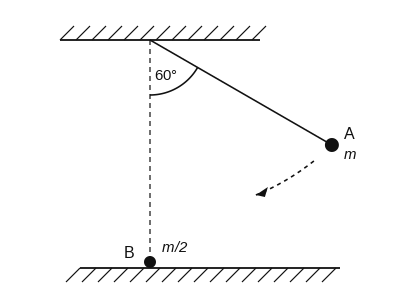
As shown below, bob A of a pendulum having massless string of length 'R' is released from 60∘ to the vertical. It hits another bob B of half the mass that is at rest on a friction less table in the center. Assuming elastic collision, the magnitude of the velocity of bob A after the collision will be (take g as acceleration due to gravity.)

जैसा कि नीचे दिखाया गया है, 'R' लंबाई की द्रव्यमानहीन डोरी वाले लोलक के गोलक A को ऊर्ध्वाधर से 60∘ पर छोड़ा जाता है। यह केंद्र में घर्षणरहित मेज पर विराम में रखे, आधे द्रव्यमान के दूसरे गोलक B से टकराता है। संघट्ट को प्रत्यास्थ मानते हुए, संघट्ट के बाद गोलक A के वेग का परिमाण होगा (g को गुरुत्वीय त्वरण लीजिए।)

  1. A43Rg
  2. B23Rg
  3. CRg
  4. D13Rg
Show answer

Concept: Energy conservation on the circular descent gives the speed before impact; in a 1-D elastic collision, v1′=m1−m2m1+m2u1.

  1. Height fallen: h=R(1−cos⁡60∘)=R2, so u=2gh=gR.
  2. Elastic collision of mass m (A) with mass m2 (B) at rest: vA′=m−m2m+m2u=13u.
  3. vA′=13gR.

Short trick: For target mass half the projectile mass, the projectile keeps 13 of its speed.

Answer: (D) 13Rg

अवधारणा: वृत्तीय अवरोहण में ऊर्जा संरक्षण से टक्कर से ठीक पहले की चाल मिलती है; एकविमीय प्रत्यास्थ संघट्ट में v1′=m1−m2m1+m2u1।

  1. गिरी हुई ऊँचाई: h=R(1−cos⁡60∘)=R2, अतः u=2gh=gR।
  2. विराम में रखे द्रव्यमान m2 (B) से द्रव्यमान m (A) का प्रत्यास्थ संघट्ट: vA′=m−m2m+m2u=13u।
  3. vA′=13gR।

शॉर्ट ट्रिक: लक्ष्य का द्रव्यमान प्रक्षेप्य का आधा हो, तो प्रक्षेप्य अपनी चाल का 13 भाग बनाए रखता है।

उत्तर: (D) 13Rg

JEE Main 2025 (January) – Paper 1 (B.E./B.Tech)PhysicsWork, Energy and Power – elastic collisionJEE Main 2025 (January) – Paper 1 (B.E./B.Tech) 2025 · 29 Jan Shift 1 →
Q1680.

Given below are two statements : one is labelled as Assertion (A) and the other is labelled as Reason (R).

Assertion (A) : Electromagnetic waves carry energy but not momentum.

Reason (R) : Mass of a photon is zero.

In the light of the above statements, choose the most appropriate answer from the options given below :

नीचे दो कथन दिए गए हैं : एक को अभिकथन (A) तथा दूसरे को कारण (R) कहा गया है।

अभिकथन (A) : विद्युत चुंबकीय तरंगें ऊर्जा का वहन करती हैं परंतु संवेग का नहीं।

कारण (R) : फोटॉन का द्रव्यमान शून्य होता है।

उपर्युक्त कथनों के आलोक में, नीचे दिए गए विकल्पों में से सबसे उपयुक्त उत्तर चुनिए :

  1. ABoth (A) and (R) are true and (R) is the correct explanation of (A)(A) तथा (R) दोनों सत्य हैं और (R), (A) की सही व्याख्या है
  2. BBoth (A) and (R) are true but (R) is not the correct explanation of (A)(A) तथा (R) दोनों सत्य हैं परंतु (R), (A) की सही व्याख्या नहीं है
  3. C(A) is false but (R) is true(A) असत्य है परंतु (R) सत्य है
  4. D(A) is true but (R) is false(A) सत्य है परंतु (R) असत्य है
Show answer

Concept: Electromagnetic waves carry both energy U and momentum p=U/c; a photon, though of zero rest mass, has momentum p=h/λ.

  1. (A) is false — EM waves do transport momentum (this is why light exerts radiation pressure).
  2. (R) is true — the rest mass of a photon is zero.

Short trick: Radiation pressure of sunlight is direct proof that EM waves carry momentum.

Answer: (C) (A) is false but (R) is true

अवधारणा: विद्युत चुंबकीय तरंगें ऊर्जा U और संवेग p=U/c दोनों का वहन करती हैं; फोटॉन का विराम द्रव्यमान शून्य होते हुए भी उसका संवेग p=h/λ होता है।

  1. (A) असत्य है — विद्युत चुंबकीय तरंगें संवेग का वहन करती हैं (इसी कारण प्रकाश विकिरण दाब डालता है)।
  2. (R) सत्य है — फोटॉन का विराम द्रव्यमान शून्य होता है।

शॉर्ट ट्रिक: सूर्य के प्रकाश का विकिरण दाब इसका प्रत्यक्ष प्रमाण है कि विद्युत चुंबकीय तरंगें संवेग ले जाती हैं।

उत्तर: (C) (A) असत्य है परंतु (R) सत्य है

JEE Main 2025 (January) – Paper 1 (B.E./B.Tech)PhysicsElectromagnetic Waves – energy and momentumJEE Main 2025 (January) – Paper 1 (B.E./B.Tech) 2025 · 29 Jan Shift 1 →