Question bank

Q&A: practice questions with answers

Search questions on any topic. Filter by exam category, exam, subject and topic, try the question, then open the answer and explanation.

Courses – airGurukul

53,050 questions in the question bank.

Q1681.
Two projectiles are fired with same initial speed from same point on ground at angles of (45∘−α) and (45∘+α), respectively, with the horizontal direction. The ratio of their maximum heights attained is :
दो प्रक्षेप्य, भूमि पर एक ही बिंदु से समान प्रारंभिक चाल से क्षैतिज दिशा से क्रमशः (45∘−α) तथा (45∘+α) कोणों पर दागे जाते हैं। उनके द्वारा प्राप्त अधिकतम ऊँचाइयों का अनुपात है :
  1. A1−tan⁡α1+tan⁡α
  2. B1−sin⁡2α1+sin⁡2α
  3. C1+sin⁡2α1−sin⁡2α
  4. D1+sin⁡α1−sin⁡α
Show answer

Concept: Maximum height H=u2sin2⁡θ2g, so H1H2=sin2⁡(45∘−α)sin2⁡(45∘+α).

  1. Using sin2⁡x=1−cos⁡2x2: sin2⁡(45∘−α)=1−cos⁡(90∘−2α)2=1−sin⁡2α2.
  2. Similarly sin2⁡(45∘+α)=1+sin⁡2α2.
  3. H1H2=1−sin⁡2α1+sin⁡2α.

Short trick: Complementary launch angles (45∘∓α) have equal ranges but heights in the ratio (1−sin⁡2α):(1+sin⁡2α).

Answer: (B) 1−sin⁡2α1+sin⁡2α

अवधारणा: अधिकतम ऊँचाई H=u2sin2⁡θ2g, अतः H1H2=sin2⁡(45∘−α)sin2⁡(45∘+α)।

  1. sin2⁡x=1−cos⁡2x2 से: sin2⁡(45∘−α)=1−cos⁡(90∘−2α)2=1−sin⁡2α2।
  2. इसी प्रकार sin2⁡(45∘+α)=1+sin⁡2α2।
  3. H1H2=1−sin⁡2α1+sin⁡2α।

शॉर्ट ट्रिक: पूरक प्रक्षेपण कोणों (45∘∓α) की परास बराबर होती है परंतु ऊँचाइयाँ (1−sin⁡2α):(1+sin⁡2α) के अनुपात में होती हैं।

उत्तर: (B) 1−sin⁡2α1+sin⁡2α
JEE Main 2025 (January) – Paper 1 (B.E./B.Tech)PhysicsKinematics – projectile motionJEE Main 2025 (January) – Paper 1 (B.E./B.Tech) 2025 · 29 Jan Shift 1 →
Q1682.
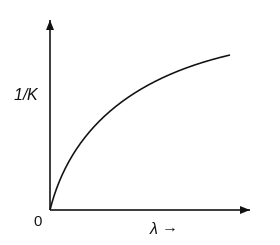
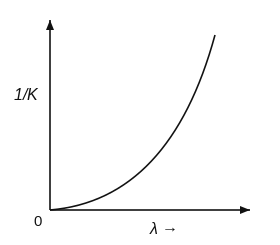
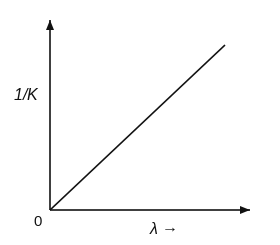
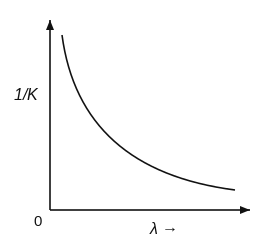
If λ and K are de Broglie wavelength and kinetic energy, respectively, of a particle with constant mass. The correct graphical representation for the particle will be
यदि नियत द्रव्यमान वाले किसी कण की डी ब्रॉग्ली तरंगदैर्घ्य तथा गतिज ऊर्जा क्रमशः λ तथा K हैं, तो कण के लिए सही आलेखीय निरूपण होगा
  1. A
  2. B
  3. C
  4. D
Show answer

Concept: De Broglie wavelength λ=h2mK, so K=h22mλ2 and 1K=2mh2λ2.

  1. 1K∝λ2: the graph of 1K versus λ is a parabola through the origin, rising with increasing slope (concave up).
  2. Option (A) saturates (concave down), (C) is a straight line (1K∝λ) and (D) decreases — all wrong; only (B) shows 1K∝λ2.

Short trick: λ∝1K⇒1K∝λ2 — a parabola, not a line.

Answer: (B)

अवधारणा: डी ब्रॉग्ली तरंगदैर्घ्य λ=h2mK, अतः K=h22mλ2 और 1K=2mh2λ2।

  1. 1K∝λ2: λ के सापेक्ष 1K का आलेख मूल बिंदु से गुजरती हुई, बढ़ती ढाल वाली (ऊपर की ओर अवतल) परवलय है।
  2. विकल्प (A) संतृप्त होता है (नीचे की ओर अवतल), (C) सरल रेखा है (1K∝λ) और (D) घटता है — ये सभी गलत हैं; केवल (B) में 1K∝λ2 है।

शॉर्ट ट्रिक: λ∝1K⇒1K∝λ2 — परवलय, सरल रेखा नहीं।

उत्तर: (B)

JEE Main 2025 (January) – Paper 1 (B.E./B.Tech)PhysicsDual Nature of Matter – de Broglie wavelengthJEE Main 2025 (January) – Paper 1 (B.E./B.Tech) 2025 · 29 Jan Shift 1 →
Q1683.

Given below are two statements : one is labelled as Assertion (A) and the other is labelled as Reason (R).

Assertion (A) : Emission of electrons in photoelectric effect can be suppressed by applying a sufficiently negative electron potential to the photoemissive substance.

Reason (R) : A negative electric potential, which stops the emission of electrons from the surface of a photoemissive substance, varies linearly with frequency of incident radiation.

In the light of the above statements, choose the most appropriate answer from the options given below :

नीचे दो कथन दिए गए हैं : एक को अभिकथन (A) तथा दूसरे को कारण (R) कहा गया है।

अभिकथन (A) : प्रकाश-विद्युत प्रभाव में इलेक्ट्रॉनों के उत्सर्जन को, प्रकाश-उत्सर्जक पदार्थ पर पर्याप्त ऋणात्मक इलेक्ट्रॉन विभव लगाकर रोका जा सकता है।

कारण (R) : ऋणात्मक विद्युत विभव, जो प्रकाश-उत्सर्जक पदार्थ की सतह से इलेक्ट्रॉनों का उत्सर्जन रोक देता है, आपतित विकिरण की आवृत्ति के साथ रैखिकतः परिवर्तित होता है।

उपर्युक्त कथनों के आलोक में, नीचे दिए गए विकल्पों में से सबसे उपयुक्त उत्तर चुनिए :

  1. A(A) is false but (R) is true(A) असत्य है परंतु (R) सत्य है
  2. B(A) is true but (R) is false(A) सत्य है परंतु (R) असत्य है
  3. CBoth (A) and (R) are true and (R) is the correct explanation of (A)(A) तथा (R) दोनों सत्य हैं और (R), (A) की सही व्याख्या है
  4. DBoth (A) and (R) are true but (R) is not the correct explanation of (A)(A) तथा (R) दोनों सत्य हैं परंतु (R), (A) की सही व्याख्या नहीं है
Show answer

Concept: The stopping potential V0 satisfies eV0=hν−ϕ, so photoemission can be cut off by a sufficiently negative potential, and V0 varies linearly with the frequency ν.

  1. (A) is true: making the emitting surface sufficiently negative (retarding potential equal to the stopping potential) suppresses the emission of photoelectrons.
  2. (R) is true: from V0=heν−ϕe, the stopping potential is a linear function of frequency.
  3. But (R) only describes how the stopping potential depends on frequency; it does not explain why emission is suppressed. So (R) is not the correct explanation of (A).

Answer: (D) Both (A) and (R) are true but (R) is not the correct explanation of (A)

अवधारणा: निरोधी विभव V0 के लिए eV0=hν−ϕ, अतः पर्याप्त ऋणात्मक विभव से प्रकाश-विद्युत उत्सर्जन रोका जा सकता है, तथा V0 आवृत्ति ν के साथ रैखिकतः बदलता है।

  1. (A) सत्य है: उत्सर्जक सतह को पर्याप्त ऋणात्मक (निरोधी विभव के बराबर मंदक विभव) करने पर प्रकाश-इलेक्ट्रॉनों का उत्सर्जन रुक जाता है।
  2. (R) सत्य है: V0=heν−ϕe से, निरोधी विभव आवृत्ति का रैखिक फलन है।
  3. परंतु (R) केवल यह बताता है कि निरोधी विभव आवृत्ति पर कैसे निर्भर करता है; यह उत्सर्जन रुकने का कारण नहीं बताता। अतः (R), (A) की सही व्याख्या नहीं है।

उत्तर: (D) (A) तथा (R) दोनों सत्य हैं परंतु (R), (A) की सही व्याख्या नहीं है

JEE Main 2025 (January) – Paper 1 (B.E./B.Tech)PhysicsDual Nature of Matter – photoelectric effectJEE Main 2025 (January) – Paper 1 (B.E./B.Tech) 2025 · 29 Jan Shift 1 →
Q1684.
Consider a long straight wire of a circular cross-section (radius a) carrying a steady current I. The current is uniformly distributed across this cross-section. The distances from the centre of the wire's cross-section at which the magnetic field [inside the wire, outside the wire] is half of the maximum possible magnetic field, any where due to the wire, will be
वृत्ताकार अनुप्रस्थ काट (त्रिज्या a) के एक लंबे सीधे तार पर विचार कीजिए जिसमें अपरिवर्ती धारा I प्रवाहित है। धारा इस अनुप्रस्थ काट पर एकसमान रूप से वितरित है। तार के अनुप्रस्थ काट के केंद्र से वे दूरियाँ, जिन पर चुंबकीय क्षेत्र [तार के भीतर, तार के बाहर], तार के कारण कहीं भी संभव अधिकतम चुंबकीय क्षेत्र का आधा है, होंगी
  1. A[a/4, 3a/2]
  2. B[a/4, 2a]
  3. C[a/2, 2a]
  4. D[a/2, 3a]
Show answer

Concept: By Ampere's law, inside the wire B=μ0Ir2πa2 (B∝r) and outside B=μ0I2πr (B∝1r); the field is maximum at the surface, Bmax=μ0I2πa.

  1. Inside: μ0Ir2πa2=12⋅μ0I2πa⇒r=a2.
  2. Outside: μ0I2πr=12⋅μ0I2πa⇒r=2a.

Short trick: B∝r inside, B∝1/r outside ⇒ half-field at a/2 and 2a.

Answer: (C) [a/2, 2a]

अवधारणा: ऐम्पियर के नियम से, तार के भीतर B=μ0Ir2πa2 (B∝r) तथा बाहर B=μ0I2πr (B∝1r); क्षेत्र सतह पर अधिकतम होता है, Bmax=μ0I2πa।

  1. भीतर: μ0Ir2πa2=12⋅μ0I2πa⇒r=a2।
  2. बाहर: μ0I2πr=12⋅μ0I2πa⇒r=2a।

शॉर्ट ट्रिक: भीतर B∝r, बाहर B∝1/r ⇒ आधा क्षेत्र a/2 और 2a पर।

उत्तर: (C) [a/2, 2a]

JEE Main 2025 (January) – Paper 1 (B.E./B.Tech)PhysicsMoving Charges and Magnetism – Ampere's lawJEE Main 2025 (January) – Paper 1 (B.E./B.Tech) 2025 · 29 Jan Shift 1 →
Q1685.
At the interface between two materials having refractive indices n1 and n2, the critical angle for reflection of an em wave is θ1C. The n2 material is replaced by another material having refractive index n3 such that the critical angle at the interface between n1 and n3 materials is θ2C. If n3>n2>n1; n2n3=25 and sin⁡θ2C−sin⁡θ1C=12, then θ1C is
अपवर्तनांक n1 तथा n2 वाले दो पदार्थों के अंतरापृष्ठ पर, विद्युत चुंबकीय तरंग के परावर्तन के लिए क्रांतिक कोण θ1C है। n2 पदार्थ को अपवर्तनांक n3 वाले दूसरे पदार्थ से इस प्रकार बदला जाता है कि n1 तथा n3 पदार्थों के अंतरापृष्ठ पर क्रांतिक कोण θ2C है। यदि n3>n2>n1; n2n3=25 तथा sin⁡θ2C−sin⁡θ1C=12 हो, तो θ1C है
  1. Asin−1⁡(16)
  2. Bsin−1⁡(13)
  3. Csin−1⁡(−56)
  4. Dsin−1⁡(23)
Show answer

Concept: For light going from the denser to the rarer medium, the critical angle satisfies sin⁡θC=nrarerndenser. Here n1 is the rarer medium in both cases.

  1. sin⁡θ1C=n1n2 and sin⁡θ2C=n1n3=n1n2⋅n2n3=25sin⁡θ1C.
  2. Given sin⁡θ2C−sin⁡θ1C=12:  25sin⁡θ1C−sin⁡θ1C=12
  3. −35sin⁡θ1C=12⇒sin⁡θ1C=−56, i.e. θ1C=sin−1⁡(−56).

Short trick: sin⁡θ2C=n2n3sin⁡θ1C — one substitution finishes the problem.

Answer: (C) sin−1⁡(−56)

अवधारणा: सघन से विरल माध्यम में जाते प्रकाश के लिए क्रांतिक कोण sin⁡θC=nrarerndenser से मिलता है। यहाँ दोनों स्थितियों में n1 विरल माध्यम है।

  1. sin⁡θ1C=n1n2 तथा sin⁡θ2C=n1n3=n1n2⋅n2n3=25sin⁡θ1C।
  2. दिया है sin⁡θ2C−sin⁡θ1C=12:  25sin⁡θ1C−sin⁡θ1C=12
  3. −35sin⁡θ1C=12⇒sin⁡θ1C=−56, अर्थात θ1C=sin−1⁡(−56)।

शॉर्ट ट्रिक: sin⁡θ2C=n2n3sin⁡θ1C — एक प्रतिस्थापन से ही हल पूरा।

उत्तर: (C) sin−1⁡(−56)

JEE Main 2025 (January) – Paper 1 (B.E./B.Tech)PhysicsRay Optics – total internal reflectionJEE Main 2025 (January) – Paper 1 (B.E./B.Tech) 2025 · 29 Jan Shift 1 →
Q1686.
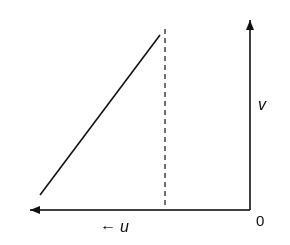
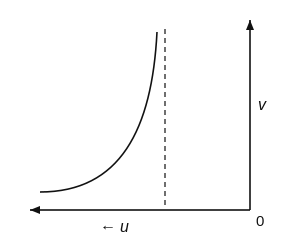
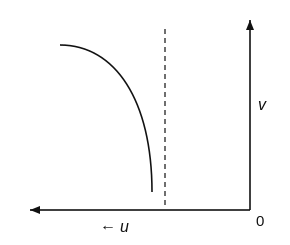
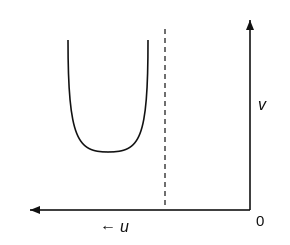
Let u and v be the distances of the object and the image from a lens of focal length f. The correct graphical representation of u and v for a convex lens when |u|>f, is
माना किसी f फोकस दूरी के लेंस से वस्तु तथा प्रतिबिंब की दूरियाँ क्रमशः u तथा v हैं। उत्तल लेंस के लिए, जब |u|>f हो, u तथा v का सही आलेखीय निरूपण है
  1. A
  2. B
  3. C
  4. D
Show answer

Concept: For a convex lens, 1v−1u=1f gives v=ufu+f (with u negative). For |u|>f the image is real (v>0).

  1. As |u|→∞, v→f: the curve starts near v=f for far-away objects.
  2. As |u|→f+, v→∞: the curve shoots up along the dashed line |u|=f (vertical asymptote).
  3. So v increases slowly and then diverges as |u| approaches f — the rising curve with a vertical asymptote, graph (C). Graph (A) (U-shape) and (D) (decreasing) contradict this behaviour, and (B) (straight line) has no asymptote.

Short trick: Object at infinity → image at focus; object at focus → image at infinity — only (C) shows both limits.

Answer: (C)

अवधारणा: उत्तल लेंस के लिए 1v−1u=1f से v=ufu+f (जहाँ u ऋणात्मक है)। |u|>f के लिए प्रतिबिंब वास्तविक होता है (v>0)।

  1. जब |u|→∞, तब v→f: दूर की वस्तुओं के लिए वक्र v=f के पास से प्रारंभ होता है।
  2. जब |u|→f+, तब v→∞: वक्र बिंदीदार रेखा |u|=f (ऊर्ध्वाधर अनंतस्पर्शी) के साथ ऊपर चढ़ जाता है।
  3. अतः |u| के f की ओर आने पर v धीरे-धीरे बढ़कर अनंत की ओर जाता है — ऊर्ध्वाधर अनंतस्पर्शी वाला बढ़ता वक्र, आलेख (C)। आलेख (A) (U-आकृति) और (D) (घटता) इस व्यवहार के विपरीत हैं, तथा (B) (सरल रेखा) में अनंतस्पर्शी नहीं है।

शॉर्ट ट्रिक: अनंत पर वस्तु → फोकस पर प्रतिबिंब; फोकस पर वस्तु → अनंत पर प्रतिबिंब — दोनों सीमाएँ केवल (C) में हैं।

उत्तर: (C)

JEE Main 2025 (January) – Paper 1 (B.E./B.Tech)PhysicsRay Optics – lens: u–v graphJEE Main 2025 (January) – Paper 1 (B.E./B.Tech) 2025 · 29 Jan Shift 1 →
Q1687.
Match List - I with List - II.
List - IList - II
(A) Electric field inside (distance r>0 from center) of a uniformly charged spherical shell with surface charge density σ, and radius R.(I) σ/ϵ0
(B) Electric field at distance r>0 from a uniformly charged infinite plane sheet with surface charge density σ.(II) σ/2ϵ0
(C) Electric field outside (distance r>0 from center) of a uniformly charged spherical shell with surface charge density σ, and radius R.(III) 0
(D) Electric field between 2 oppositely charged infinite plane parallel sheets with uniform surface charge density σ.(IV) σR2ϵ0r2

Choose the correct answer from the options given below :

सूची-I का सूची-II से मिलान कीजिए।
सूची - Iसूची - II
(A) पृष्ठ आवेश घनत्व σ तथा त्रिज्या R वाले एकसमान आवेशित गोलीय कोश के भीतर (केंद्र से दूरी r>0 पर) विद्युत क्षेत्र।(I) σ/ϵ0
(B) पृष्ठ आवेश घनत्व σ वाली एकसमान आवेशित अनंत समतल चादर से दूरी r>0 पर विद्युत क्षेत्र।(II) σ/2ϵ0
(C) पृष्ठ आवेश घनत्व σ तथा त्रिज्या R वाले एकसमान आवेशित गोलीय कोश के बाहर (केंद्र से दूरी r>0 पर) विद्युत क्षेत्र।(III) 0
(D) एकसमान पृष्ठ आवेश घनत्व σ वाली 2 विपरीत आवेशित अनंत समतल समांतर चादरों के बीच विद्युत क्षेत्र।(IV) σR2ϵ0r2

नीचे दिए गए विकल्पों में से सही उत्तर चुनिए :

  1. A(A)-(III), (B)-(II), (C)-(IV), (D)-(I)
  2. B(A)-(IV), (B)-(II), (C)-(III), (D)-(I)
  3. C(A)-(II), (B)-(I), (C)-(IV), (D)-(III)
  4. D(A)-(IV), (B)-(I), (C)-(III), (D)-(II)
Show answer

Concept: Standard Gauss's-law results for a shell and for charged sheets.

  1. (A) Inside a uniformly charged shell, E=0 → (III).
  2. (B) Infinite charged sheet: E=σ2ϵ0, independent of distance → (II).
  3. (C) Outside the shell, E=q4πϵ0r2 with q=σ⋅4πR2, i.e. E=σR2ϵ0r2 → (IV).
  4. (D) Between two oppositely charged parallel sheets the fields add: E=σ2ϵ0+σ2ϵ0=σϵ0 → (I).

Short trick: Shell: 0 inside, point-charge-like outside; sheet: σ/2ϵ0; capacitor-like pair: σ/ϵ0.

Answer: (A) (A)-(III), (B)-(II), (C)-(IV), (D)-(I)

अवधारणा: गोलीय कोश और आवेशित चादरों के लिए गाउस के नियम के मानक परिणाम।

  1. (A) एकसमान आवेशित कोश के भीतर E=0 → (III)।
  2. (B) अनंत आवेशित चादर: E=σ2ϵ0, दूरी पर निर्भर नहीं → (II)।
  3. (C) कोश के बाहर E=q4πϵ0r2, जहाँ q=σ⋅4πR2, अर्थात E=σR2ϵ0r2 → (IV)।
  4. (D) दो विपरीत आवेशित समांतर चादरों के बीच क्षेत्र जुड़ते हैं: E=σ2ϵ0+σ2ϵ0=σϵ0 → (I)।

शॉर्ट ट्रिक: कोश: भीतर 0, बाहर बिंदु-आवेश जैसा; चादर: σ/2ϵ0; संधारित्र जैसी जोड़ी: σ/ϵ0।

उत्तर: (A) (A)-(III), (B)-(II), (C)-(IV), (D)-(I)

JEE Main 2025 (January) – Paper 1 (B.E./B.Tech)PhysicsElectrostatics – Gauss's lawJEE Main 2025 (January) – Paper 1 (B.E./B.Tech) 2025 · 29 Jan Shift 1 →
Q1688.

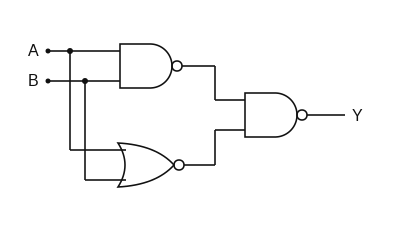
For the circuit shown above, equivalent GATE is :

ऊपर दर्शाए गए परिपथ के लिए, तुल्य गेट (GATE) है :

  1. AOR gateOR गेट
  2. BNAND gateNAND गेट
  3. CNOT gateNOT गेट
  4. DAND gateAND गेट
Show answer

Concept: Write the Boolean output stage by stage: the top gate is NAND, the bottom gate is NOR, and their outputs feed a NAND.

  1. Top: Y1=A⋅B―; Bottom: Y2=A+B―.
  2. Y=Y1⋅Y2―=AB―⋅A+B――=AB+(A+B)=A+B (De Morgan, and AB is absorbed in A+B).
  3. Truth check: inputs (0,0)→0; (0,1),(1,0),(1,1)→1 — exactly OR.

Short trick: NAND of (NAND, NOR) = OR, since AB―⋅A+B――=AB+A+B=A+B.

Answer: (A) OR gate

अवधारणा: चरण-दर-चरण बूलीय आउटपुट लिखिए: ऊपरी गेट NAND है, निचला गेट NOR है, तथा इनके आउटपुट एक NAND में जाते हैं।

  1. ऊपर: Y1=A⋅B―; नीचे: Y2=A+B―।
  2. Y=Y1⋅Y2―=AB―⋅A+B――=AB+(A+B)=A+B (डी मॉर्गन, तथा AB, A+B में समाहित हो जाता है)।
  3. सत्य-सारणी जाँच: निवेश (0,0)→0; (0,1),(1,0),(1,1)→1 — ठीक OR।

शॉर्ट ट्रिक: (NAND, NOR) का NAND = OR, क्योंकि AB―⋅A+B――=AB+A+B=A+B।

उत्तर: (A) OR गेट

JEE Main 2025 (January) – Paper 1 (B.E./B.Tech)PhysicsSemiconductors – logic gatesJEE Main 2025 (January) – Paper 1 (B.E./B.Tech) 2025 · 29 Jan Shift 1 →
Q1689.
The expression given below shows the variation of velocity (v) with time (t), v=At2+BtC+t. The dimension of ABC is :
नीचे दिया गया व्यंजक वेग (v) का समय (t) के साथ परिवर्तन दर्शाता है, v=At2+BtC+t। ABC की विमा है :
  1. A[M0L1T−3]
  2. B[M0L2T−2]
  3. C[M0L1T−2]
  4. D[M0L2T−3]
Show answer

Concept: Every term added to v must have the dimensions of velocity [LT−1], and quantities added together (C+t) must have the same dimensions.

  1. [At2]=[v]⇒[A]=LT−1T2=[LT−3].
  2. [C]=[t]=[T], so [BtC+t]=[B]⇒[B]=[LT−1].
  3. [ABC]=LT−3⋅LT−1⋅T=[M0L2T−3].

Short trick: C sits with t → it is a time; then B is just a velocity.

Answer: (D) [M0L2T−3]

अवधारणा: v में जुड़ने वाले प्रत्येक पद की विमाएँ वेग [LT−1] की होनी चाहिए, तथा जोड़े जाने वाली राशियों (C+t) की विमाएँ समान होनी चाहिए।

  1. [At2]=[v]⇒[A]=LT−1T2=[LT−3]।
  2. [C]=[t]=[T], अतः [BtC+t]=[B]⇒[B]=[LT−1]।
  3. [ABC]=LT−3⋅LT−1⋅T=[M0L2T−3]।

शॉर्ट ट्रिक: C, t के साथ जुड़ा है → यह समय है; तब B केवल वेग है।

उत्तर: (D) [M0L2T−3]

JEE Main 2025 (January) – Paper 1 (B.E./B.Tech)PhysicsUnits and Dimensions – dimensional analysisJEE Main 2025 (January) – Paper 1 (B.E./B.Tech) 2025 · 29 Jan Shift 1 →
Q1690.
The workdone in an adiabatic change in an ideal gas depends upon only :
आदर्श गैस में रुद्धोष्म परिवर्तन में किया गया कार्य केवल निर्भर करता है :
  1. Achange in its temperatureउसके ताप में परिवर्तन पर
  2. Bchange in its volumeउसके आयतन में परिवर्तन पर
  3. Cchange in its pressureउसके दाब में परिवर्तन पर
  4. Dchange in its specific heatउसकी विशिष्ट ऊष्मा में परिवर्तन पर
Show answer

Concept: In an adiabatic process Q=0, so by the first law W=−ΔU, and for an ideal gas ΔU=nCVΔT.

  1. W=−nCVΔT=nR(T1−T2)γ−1.
  2. With n and γ fixed for the given gas, W is determined solely by the change in temperature; pressure or volume changes matter only through ΔT.

Short trick: Q=0⇒W=−ΔU∝ΔT.

Answer: (A) change in its temperature

अवधारणा: रुद्धोष्म प्रक्रम में Q=0, अतः ऊष्मागतिकी के प्रथम नियम से W=−ΔU, तथा आदर्श गैस के लिए ΔU=nCVΔT।

  1. W=−nCVΔT=nR(T1−T2)γ−1।
  2. दी गई गैस के लिए n और γ नियत होने से, W केवल ताप-परिवर्तन से निर्धारित होता है; दाब या आयतन का परिवर्तन केवल ΔT के माध्यम से प्रभाव डालता है।

शॉर्ट ट्रिक: Q=0⇒W=−ΔU∝ΔT।

उत्तर: (A) उसके ताप में परिवर्तन पर

JEE Main 2025 (January) – Paper 1 (B.E./B.Tech)PhysicsThermodynamics – adiabatic processJEE Main 2025 (January) – Paper 1 (B.E./B.Tech) 2025 · 29 Jan Shift 1 →
Q1691.
The fractional compression (ΔVV) of water at the depth of 2.5 km below the sea level is ______ %. Given, the Bulk modulus of water =2×10⁹ N m−2, density of water =103 kgm−3, acceleration due to gravity =g=10 m s−2.
समुद्र तल से 2.5 km की गहराई पर जल का आंशिक संपीडन (ΔVV) ______ % है। दिया है, जल का आयतन प्रत्यास्थता गुणांक =2×10⁹ N m−2, जल का घनत्व =103 kgm−3, गुरुत्वीय त्वरण =g=10 m s−2।
  1. A1.25
  2. B1.0
  3. C1.75
  4. D1.5
Show answer

Concept: Bulk modulus B=ΔPΔV/V, and the pressure increase at depth h is ΔP=ρgh.

  1. ΔP=ρgh=103×10×2.5×103=2.5×10⁷ N m−2.
  2. ΔVV=ΔPB=2.5×1072×109=1.25×10−2=1.25%.

Short trick: ΔVV=ρghB — one line.

Answer: (A) 1.25

अवधारणा: आयतन प्रत्यास्थता गुणांक B=ΔPΔV/V, तथा गहराई h पर दाब वृद्धि ΔP=ρgh।

  1. ΔP=ρgh=103×10×2.5×103=2.5×10⁷ N m−2।
  2. ΔVV=ΔPB=2.5×1072×109=1.25×10−2=1.25%।

शॉर्ट ट्रिक: ΔVV=ρghB — एक पंक्ति में।

उत्तर: (A) 1.25

JEE Main 2025 (January) – Paper 1 (B.E./B.Tech)PhysicsMechanical Properties of Solids – bulk modulusJEE Main 2025 (January) – Paper 1 (B.E./B.Tech) 2025 · 29 Jan Shift 1 →
Q1692.
The pair of physical quantities not having same dimensions is :
भौतिक राशियों का वह युग्म, जिनकी विमाएँ समान नहीं हैं, है :
  1. APressure and Young's modulusदाब तथा यंग गुणांक
  2. BSurface tension and impulseपृष्ठ तनाव तथा आवेग
  3. CTorque and energyबल आघूर्ण तथा ऊर्जा
  4. DAngular momentum and Planck's constantकोणीय संवेग तथा प्लांक नियतांक
Show answer

Concept: Compare the dimensional formulae of each pair.

  1. (A) Pressure and Young's modulus: both FA=[ML−1T−2] — same.
  2. (B) Surface tension =Fl=[MT−2], impulse =Ft=[MLT−1] — different.
  3. (C) Torque and energy: both [ML2T−2] — same.
  4. (D) Angular momentum and Planck's constant: both [ML2T−1] — same.

Short trick: Surface tension is force per length, impulse is force times time — they cannot match.

Answer: (B) Surface tension and impulse

अवधारणा: प्रत्येक युग्म के विमीय सूत्रों की तुलना कीजिए।

  1. (A) दाब तथा यंग गुणांक: दोनों FA=[ML−1T−2] — समान।
  2. (B) पृष्ठ तनाव =Fl=[MT−2], आवेग =Ft=[MLT−1] — भिन्न।
  3. (C) बल आघूर्ण तथा ऊर्जा: दोनों [ML2T−2] — समान।
  4. (D) कोणीय संवेग तथा प्लांक नियतांक: दोनों [ML2T−1] — समान।

शॉर्ट ट्रिक: पृष्ठ तनाव = बल प्रति लंबाई, आवेग = बल × समय — ये मेल नहीं खा सकते।

उत्तर: (B) पृष्ठ तनाव तथा आवेग

JEE Main 2025 (January) – Paper 1 (B.E./B.Tech)PhysicsUnits and Dimensions – comparing dimensionsJEE Main 2025 (January) – Paper 1 (B.E./B.Tech) 2025 · 29 Jan Shift 1 →
Q1693.
Consider I1 and I2 are the currents flowing simultaneously in two nearby coils 1 & 2, respectively. If L1= self inductance of coil 1, M12= mutual inductance of coil 1 with respect to coil 2, then the value of induced emf in coil 1 will be
माना दो निकटवर्ती कुंडलियों 1 तथा 2 में एक साथ प्रवाहित धाराएँ क्रमशः I1 तथा I2 हैं। यदि L1= कुंडली 1 का स्वप्रेरकत्व, M12= कुंडली 2 के सापेक्ष कुंडली 1 का अन्योन्य प्रेरकत्व हो, तो कुंडली 1 में प्रेरित विद्युत वाहक बल का मान होगा
  1. Aε1=−L1dI2dt−M12dI1dt
  2. Bε1=−L1dI1dt−M12dI2dt
  3. Cε1=−L1dI1dt−M12dI1dt
  4. Dε1=−L1dI1dt+M12dI2dt
Show answer

Concept: Total flux through coil 1 is φ1=L1I1+M12I2; the induced emf is ε1=−dφ1dt.

  1. ε1=−ddt(L1I1+M12I2)
  2. ε1=−L1dI1dt−M12dI2dt.
  3. Self term carries coil 1's own current I1; the mutual term carries the neighbour's current I2 — so (A), (C) and (D) are wrong.

Short trick: Self-inductance goes with its own current, mutual inductance with the other coil's current, both with minus signs.

Answer: (B) ε1=−L1dI1dt−M12dI2dt

अवधारणा: कुंडली 1 से गुजरने वाला कुल फ्लक्स φ1=L1I1+M12I2 है; प्रेरित विद्युत वाहक बल ε1=−dφ1dt।

  1. ε1=−ddt(L1I1+M12I2)
  2. ε1=−L1dI1dt−M12dI2dt।
  3. स्वप्रेरण पद में कुंडली 1 की अपनी धारा I1 और अन्योन्य पद में पड़ोसी कुंडली की धारा I2 आती है — अतः (A), (C) तथा (D) गलत हैं।

शॉर्ट ट्रिक: स्वप्रेरकत्व अपनी धारा के साथ, अन्योन्य प्रेरकत्व दूसरी कुंडली की धारा के साथ, दोनों ऋण चिह्न सहित।

उत्तर: (B) ε1=−L1dI1dt−M12dI2dt

JEE Main 2025 (January) – Paper 1 (B.E./B.Tech)PhysicsElectromagnetic Induction – self and mutual inductanceJEE Main 2025 (January) – Paper 1 (B.E./B.Tech) 2025 · 29 Jan Shift 1 →
Q1694.

Given below are two statements : one is labelled as Assertion (A) and the other is labelled as Reason (R).

Assertion (A) : Time period of a simple pendulum is longer at the top of a mountain than that at the base of the mountain.

Reason (R) : Time period of a simple pendulum decreases with increasing value of acceleration due to gravity and vice-versa.

In the light of the above statements, choose the most appropriate answer from the options given below :

नीचे दो कथन दिए गए हैं : एक को अभिकथन (A) तथा दूसरे को कारण (R) कहा गया है।

अभिकथन (A) : पर्वत की चोटी पर सरल लोलक का आवर्तकाल, पर्वत के आधार की तुलना में अधिक होता है।

कारण (R) : गुरुत्वीय त्वरण का मान बढ़ने पर सरल लोलक का आवर्तकाल घटता है, तथा इसका विलोम भी सत्य है।

उपर्युक्त कथनों के आलोक में, नीचे दिए गए विकल्पों में से सबसे उपयुक्त उत्तर चुनिए :

  1. ABoth (A) and (R) are true and (R) is the correct explanation of (A)(A) तथा (R) दोनों सत्य हैं और (R), (A) की सही व्याख्या है
  2. B(A) is true but (R) is false(A) सत्य है परंतु (R) असत्य है
  3. C(A) is false but (R) is true(A) असत्य है परंतु (R) सत्य है
  4. DBoth (A) and (R) are true but (R) is not the correct explanation of (A)(A) तथा (R) दोनों सत्य हैं परंतु (R), (A) की सही व्याख्या नहीं है
Show answer

Concept: T=2πLg, and g decreases with altitude as g′=g(1+h/RE)2.

  1. (A) is true: at the mountain top g is smaller, so T=2πL/g is longer than at the base.
  2. (R) is true: T∝1g, so T decreases as g increases and vice-versa.
  3. (R) directly gives (A): smaller g at the top ⇒ longer T. Hence (R) is the correct explanation.

Short trick: Up the mountain: g↓⇒T↑ — pendulum clocks run slow at height.

Answer: (A) Both (A) and (R) are true and (R) is the correct explanation of (A)

अवधारणा: T=2πLg, तथा ऊँचाई के साथ g घटता है: g′=g(1+h/RE)2।

  1. (A) सत्य है: पर्वत की चोटी पर g छोटा है, अतः T=2πL/g आधार की अपेक्षा अधिक है।
  2. (R) सत्य है: T∝1g, अतः g बढ़ने पर T घटता है और विलोमतः।
  3. (R) से (A) सीधे प्राप्त होता है: चोटी पर छोटा g ⇒ बड़ा T। अतः (R) सही व्याख्या है।

शॉर्ट ट्रिक: पर्वत पर चढ़ने पर: g↓⇒T↑ — ऊँचाई पर लोलक घड़ियाँ सुस्त चलती हैं।

उत्तर: (A) (A) तथा (R) दोनों सत्य हैं और (R), (A) की सही व्याख्या है

JEE Main 2025 (January) – Paper 1 (B.E./B.Tech)PhysicsOscillations – simple pendulum and gJEE Main 2025 (January) – Paper 1 (B.E./B.Tech) 2025 · 29 Jan Shift 1 →
Q1695.
A body of mass 'm' connected to a massless and unstretchable string goes in verticle circle of radius 'R' under gravity g. The other end of the string is fixed at the center of circle. If velocity at top of circular path is ngR, where, n⩾1, then ratio of kinetic energy of the body at bottom to that at top of the circle is
'm' द्रव्यमान का एक पिंड, द्रव्यमानहीन तथा न खिंचने वाली डोरी से जुड़कर, गुरुत्व g के अधीन 'R' त्रिज्या के ऊर्ध्वाधर वृत्त में घूमता है। डोरी का दूसरा सिरा वृत्त के केंद्र पर स्थिर है। यदि वृत्तीय पथ के शीर्ष पर वेग ngR है, जहाँ n⩾1, तो वृत्त के निम्नतम बिंदु पर पिंड की गतिज ऊर्जा का शीर्ष पर गतिज ऊर्जा से अनुपात है
  1. An2n2+4
  2. Bn2+4n2
  3. Cn+4n
  4. Dnn+4
Show answer

Concept: Energy conservation between the top and bottom of the vertical circle: 12mvb2=12mvt2+mg(2R).

  1. vt2=n2gR, so vb2=n2gR+4gR=(n2+4)gR.
  2. KEbKEt=vb2vt2=(n2+4)gRn2gR=n2+4n2.

Short trick: vb2=vt2+4gR always holds across a vertical circle of radius R.

Answer: (B) n2+4n2

अवधारणा: ऊर्ध्वाधर वृत्त के शीर्ष और निम्नतम बिंदु के बीच ऊर्जा संरक्षण: 12mvb2=12mvt2+mg(2R)।

  1. vt2=n2gR, अतः vb2=n2gR+4gR=(n2+4)gR।
  2. KEbKEt=vb2vt2=(n2+4)gRn2gR=n2+4n2।

शॉर्ट ट्रिक: R त्रिज्या के ऊर्ध्वाधर वृत्त में सदैव vb2=vt2+4gR।

उत्तर: (B) n2+4n2

JEE Main 2025 (January) – Paper 1 (B.E./B.Tech)PhysicsWork, Energy and Power – vertical circular motionJEE Main 2025 (January) – Paper 1 (B.E./B.Tech) 2025 · 29 Jan Shift 1 →
Q1696.
In a hydraulic lift, the surface area of the input piston is 6 cm2 and that of the output piston is 1500 cm2. If 100 N force is applied to the input piston to raise the output piston by 20 cm, then the work done is _______ kJ.
एक द्रवचालित लिफ्ट में निवेशी पिस्टन का पृष्ठीय क्षेत्रफल 6 cm2 तथा निर्गत पिस्टन का 1500 cm2 है। यदि निर्गत पिस्टन को 20 cm ऊपर उठाने के लिए निवेशी पिस्टन पर 100 N बल लगाया जाए, तो किया गया कार्य _______ kJ है।
Show answer

Concept: Pascal's law: pressure is transmitted equally, so F1A1=F2A2; work done on the load is W=F2d2.

  1. Output force: F2=F1⋅A2A1=100×15006=25000 N.
  2. Output displacement: d2=20 cm =0.20 m.
  3. W=F2d2=25000×0.20=5000 J =5 kJ.

Answer: 5

अवधारणा: पास्कल का नियम: दाब समान रूप से संचरित होता है, अतः F1A1=F2A2; भार पर किया गया कार्य W=F2d2।

  1. निर्गत बल: F2=F1⋅A2A1=100×15006=25000 N।
  2. निर्गत विस्थापन: d2=20 cm =0.20 m।
  3. W=F2d2=25000×0.20=5000 J =5 kJ।

उत्तर: 5

JEE Main 2025 (January) – Paper 1 (B.E./B.Tech)PhysicsMechanical Properties of Fluids – hydraulic liftJEE Main 2025 (January) – Paper 1 (B.E./B.Tech) 2025 · 29 Jan Shift 1 →
Q1697.
The coordinates of a particle with respect to origin in a given reference frame is (1,1,1) meters. If a force of F→=i^−j^+k^ acts on the particle, then the magnitude of torque (with respect to origin) in z-direction is ______.
किसी निर्देश तंत्र में मूल बिंदु के सापेक्ष एक कण के निर्देशांक (1,1,1) मीटर हैं। यदि कण पर बल F→=i^−j^+k^ कार्य करे, तो (मूल बिंदु के सापेक्ष) z-दिशा में बल आघूर्ण का परिमाण ______ है।
Show answer

Concept: Torque about the origin is τ→=r→×F→; its z-component is τz=xFy−yFx.

  1. τ→=|i^&j^&k^1&1&11&−1&1|=i^(1⋅1−1⋅(−1))−j^(1⋅1−1⋅1)+k^(1⋅(−1)−1⋅1)
  2. τ→=2i^+0j^−2k^ N m.
  3. |τz|=|−2|=2 N m.

Answer: 2

अवधारणा: मूल बिंदु के सापेक्ष बल आघूर्ण τ→=r→×F→ है; इसका z-घटक τz=xFy−yFx।

  1. τ→=|i^&j^&k^1&1&11&−1&1|=i^(1⋅1−1⋅(−1))−j^(1⋅1−1⋅1)+k^(1⋅(−1)−1⋅1)
  2. τ→=2i^+0j^−2k^ N m।
  3. |τz|=|−2|=2 N m।

उत्तर: 2

JEE Main 2025 (January) – Paper 1 (B.E./B.Tech)PhysicsRotational Motion – torqueJEE Main 2025 (January) – Paper 1 (B.E./B.Tech) 2025 · 29 Jan Shift 1 →
Q1698.
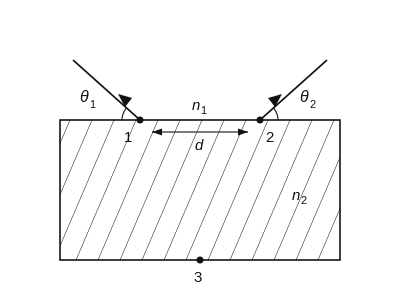
Two light beams fall on a transparent material block at point 1 and 2 with angle θ1 and θ2, respectively, as shown in figure. After refraction, the beams intersect at point 3 which is exactly on the interface at other end of the block. Given : the distance between 1 and 2, d=43 cm and θ1=θ2=cos−1⁡(n22n1), where refractive index of the block n2> refractive index of the outside medium n1, then the thickness of the block is ________ cm.

जैसा कि चित्र में दिखाया गया है, दो प्रकाश पुंज किसी पारदर्शी पदार्थ के गुटके पर बिंदु 1 तथा 2 पर क्रमशः कोण θ1 तथा θ2 पर आपतित होते हैं। अपवर्तन के बाद दोनों पुंज बिंदु 3 पर प्रतिच्छेद करते हैं, जो गुटके के दूसरे सिरे के अंतरापृष्ठ पर ही स्थित है। दिया है : बिंदु 1 तथा 2 के बीच की दूरी d=43 cm तथा θ1=θ2=cos−1⁡(n22n1), जहाँ गुटके का अपवर्तनांक n2> बाहरी माध्यम का अपवर्तनांक n1 है, तो गुटके की मोटाई ________ cm है।

Show answer

Concept: The angles θ1,θ2 in the figure are measured from the surface, so the angle of incidence (from the normal) is i=90∘−θ; apply Snell's law and then simple geometry inside the block.

  1. sin⁡i=cos⁡θ=n22n1.
  2. Snell's law at the top face: n1sin⁡i=n2sin⁡r⇒n1⋅n22n1=n2sin⁡r⇒sin⁡r=12, so r=30∘.
  3. By symmetry the refracted rays meet at point 3 midway below 1 and 2: each ray covers a horizontal distance d2=23 cm while crossing the thickness t, with tan⁡r=d/2t.
  4. t=23tan⁡30∘=23×3=6 cm.

Answer: 6

अवधारणा: चित्र में कोण θ1,θ2 पृष्ठ से मापे गए हैं, अतः (अभिलंब से) आपतन कोण i=90∘−θ है; स्नेल का नियम लगाकर गुटके के भीतर सरल ज्यामिति का प्रयोग कीजिए।

  1. sin⁡i=cos⁡θ=n22n1।
  2. ऊपरी पृष्ठ पर स्नेल का नियम: n1sin⁡i=n2sin⁡r⇒n1⋅n22n1=n2sin⁡r⇒sin⁡r=12, अतः r=30∘।
  3. सममिति से अपवर्तित किरणें बिंदु 1 और 2 के मध्य के ठीक नीचे बिंदु 3 पर मिलती हैं: मोटाई t पार करते हुए प्रत्येक किरण क्षैतिज दूरी d2=23 cm तय करती है, जहाँ tan⁡r=d/2t।
  4. t=23tan⁡30∘=23×3=6 cm।

उत्तर: 6

JEE Main 2025 (January) – Paper 1 (B.E./B.Tech)PhysicsRay Optics – refraction through a blockJEE Main 2025 (January) – Paper 1 (B.E./B.Tech) 2025 · 29 Jan Shift 1 →
Q1699.
A container of fixed volume contains a gas at 27∘C. To double the pressure of the gas, the temperature of gas should be raised to ______ ∘C.
नियत आयतन के एक पात्र में 27∘C पर गैस भरी है। गैस का दाब दोगुना करने के लिए, गैस का ताप बढ़ाकर ______ ∘C करना होगा।
Show answer

Concept: At constant volume (Gay-Lussac's law), P1T1=P2T2 with temperature in kelvin.

  1. T1=27+273=300 K.
  2. P2=2P1⇒T2=2T1=600 K.
  3. T2=600−273=327∘C.

Answer: 327

अवधारणा: नियत आयतन पर (गै-लुसाक का नियम), P1T1=P2T2, जहाँ ताप केल्विन में है।

  1. T1=27+273=300 K।
  2. P2=2P1⇒T2=2T1=600 K।
  3. T2=600−273=327∘C।

उत्तर: 327

JEE Main 2025 (January) – Paper 1 (B.E./B.Tech)PhysicsKinetic Theory of Gases – gas lawsJEE Main 2025 (January) – Paper 1 (B.E./B.Tech) 2025 · 29 Jan Shift 1 →
Q1700.
The maximum speed of a boat in still water is 27 km/h. Now this boat is moving downstream in a river flowing at 9 km/h. A man in the boat throws a ball vertically upwards with speed of 10 m/s. Range of the ball as observed by an observer at rest on the river bank, is _______ cm. (Take g=10 m/s2)
स्थिर जल में एक नाव की अधिकतम चाल 27 km/h है। अब यह नाव 9 km/h से बहती नदी में धारा की दिशा (अनुप्रवाह) में चल रही है। नाव में बैठा एक व्यक्ति एक गेंद को 10 m/s की चाल से ऊर्ध्वाधर ऊपर की ओर फेंकता है। नदी के किनारे विराम में खड़े प्रेक्षक द्वारा प्रेक्षित गेंद की परास _______ cm है। (g=10 m/s2 लीजिए)
Show answer

Concept: For the observer on the bank the ball is a projectile: it keeps the boat's horizontal velocity while rising and falling for the full time of flight T=2ug.

  1. Speed of boat relative to the bank =27+9=36 km/h =36×518=10 m/s.
  2. Time of flight of the ball: T=2×1010=2 s.
  3. Range = horizontal velocity × time =10×2=20 m =2000 cm.

Answer: 2000

अवधारणा: किनारे पर खड़े प्रेक्षक के लिए गेंद एक प्रक्षेप्य है: वह पूरे उड्डयन काल T=2ug के दौरान नाव का क्षैतिज वेग बनाए रखती है।

  1. किनारे के सापेक्ष नाव की चाल =27+9=36 km/h =36×518=10 m/s।
  2. गेंद का उड्डयन काल: T=2×1010=2 s।
  3. परास = क्षैतिज वेग × समय =10×2=20 m =2000 cm।

उत्तर: 2000

JEE Main 2025 (January) – Paper 1 (B.E./B.Tech)PhysicsKinematics – relative motion and projectileJEE Main 2025 (January) – Paper 1 (B.E./B.Tech) 2025 · 29 Jan Shift 1 →