Question bank

Q&A: practice questions with answers

Search questions on any topic. Filter by exam category, exam, subject and topic, try the question, then open the answer and explanation.

Courses – airGurukul

53,050 questions in the question bank.

Q1901.
Three infinitely long wires with linear charge density λ are placed along the x-axis, y-axis and z-axis respectively. Which of the following denotes an equipotential surface?
रेखीय आवेश घनत्व λ वाले तीन अनंत लंबे तार क्रमशः x-अक्ष, y-अक्ष तथा z-अक्ष के अनुदिश रखे गए हैं। निम्नलिखित में से कौन-सा एक समविभव पृष्ठ (equipotential surface) को निरूपित करता है?
  1. Axyz = constantxyz = नियतांक
  2. Bxy+yz+zx = constantxy+yz+zx = नियतांक
  3. C(x2+y2)(y2+z2)(z2+x2) = constant(x2+y2)(y2+z2)(z2+x2) = नियतांक
  4. D(x+y)(y+z)(z+x) = constant(x+y)(y+z)(z+x) = नियतांक
Show answer

Concept: The potential of an infinite line charge at perpendicular distance r is V=−λ2πε0ln⁡r+ constant; potentials add by superposition.

  1. Perpendicular distances of point (x,y,z) from the x-, y- and z-axes are y2+z2, z2+x2 and x2+y2.
  2. V=−λ2πε0[ln⁡y2+z2+ln⁡z2+x2+ln⁡x2+y2] =−λ4πε0ln⁡[(x2+y2)(y2+z2)(z2+x2)].
  3. V = constant ⇒(x2+y2)(y2+z2)(z2+x2) = constant.

Short trick: Sum of logarithms = logarithm of the product, so the product of the squared distances must stay constant.

Answer: (C) (x2+y2)(y2+z2)(z2+x2) = constant

अवधारणा: अनंत रेखीय आवेश से लंबवत दूरी r पर विभव V=−λ2πε0ln⁡r+ नियतांक होता है; अध्यारोपण से विभव जुड़ते हैं।

  1. बिंदु (x,y,z) की x-, y- तथा z-अक्षों से लंबवत दूरियाँ क्रमशः y2+z2, z2+x2 तथा x2+y2 हैं।
  2. V=−λ2πε0[ln⁡y2+z2+ln⁡z2+x2+ln⁡x2+y2] =−λ4πε0ln⁡[(x2+y2)(y2+z2)(z2+x2)]।
  3. V = नियतांक ⇒(x2+y2)(y2+z2)(z2+x2) = नियतांक।

शॉर्ट ट्रिक: लघुगणकों का योग = गुणनफल का लघुगणक, अतः वर्गित दूरियों का गुणनफल नियत रहना चाहिए।

उत्तर: (C) (x2+y2)(y2+z2)(z2+x2) = नियतांक

JEE Main 2025 (January) – Paper 1 (B.E./B.Tech)PhysicsElectrostatic Potential – equipotential surfacesJEE Main 2025 (January) – Paper 1 (B.E./B.Tech) 2025 · 28 Jan Shift 1 →
Q1902.
Given below are two statements: one is labelled as Assertion A and the other is labelled as Reason R
Assertion A: A sound wave has higher speed in solids than gases.
Reason R: Gases have higher value of Bulk modulus than solids.
In the light of the above statements, choose the correct answer from the options given below
नीचे दो कथन दिए गए हैं: एक को अभिकथन A तथा दूसरे को कारण R कहा गया है
अभिकथन A: ध्वनि तरंग की चाल ठोसों में गैसों की अपेक्षा अधिक होती है।
कारण R: गैसों के आयतन प्रत्यास्थता गुणांक (Bulk modulus) का मान ठोसों से अधिक होता है।
उपर्युक्त कथनों के आलोक में, नीचे दिए गए विकल्पों में से सही उत्तर चुनिए
  1. ABoth A and R are true but R is NOT the correct explanation of AA तथा R दोनों सत्य हैं परंतु R, A की सही व्याख्या नहीं है
  2. BA is true but R is falseA सत्य है परंतु R असत्य है
  3. CA is false but R is trueA असत्य है परंतु R सत्य है
  4. DBoth A and R are true and R is the correct explanation of AA तथा R दोनों सत्य हैं तथा R, A की सही व्याख्या है
Show answer

Concept: Speed of sound v=Bρ; it is the elastic modulus that decides the speed, and solids are far stiffer than gases.

  1. A: In solids the elastic modulus is enormously larger than in gases (the increase in modulus far outweighs the increase in density), so sound travels fastest in solids — A is true.
  2. R: Solids have a much higher Bulk modulus than gases (gases are easily compressible) — R is false.

Answer: (B) A is true but R is false

अवधारणा: ध्वनि की चाल v=Bρ; चाल प्रत्यास्थता गुणांक पर निर्भर करती है, और ठोस गैसों की तुलना में कहीं अधिक दृढ़ होते हैं।

  1. A: ठोसों में प्रत्यास्थता गुणांक गैसों की अपेक्षा अत्यधिक बड़ा होता है (गुणांक की वृद्धि घनत्व की वृद्धि से कहीं अधिक होती है), अतः ध्वनि ठोसों में सबसे तेज़ चलती है — A सत्य है।
  2. R: ठोसों का आयतन प्रत्यास्थता गुणांक गैसों से बहुत अधिक होता है (गैसें आसानी से संपीड्य होती हैं) — R असत्य है।

उत्तर: (B) A सत्य है परंतु R असत्य है

JEE Main 2025 (January) – Paper 1 (B.E./B.Tech)PhysicsWaves – speed of sound in mediaJEE Main 2025 (January) – Paper 1 (B.E./B.Tech) 2025 · 28 Jan Shift 1 →
Q1903.
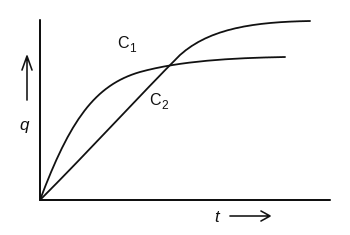
Two capacitors C1 and C2 are connected in parallel to a battery. Charge-time graph is shown below for the two capacitors. The energy stored with them are U1 and U2, respectively. Which of the given statements is true?
दो संधारित्र C1 तथा C2 एक बैटरी से समांतर क्रम में जुड़े हैं। दोनों संधारित्रों के लिए आवेश-समय ग्राफ नीचे दर्शाया गया है। इनमें संचित ऊर्जाएँ क्रमशः U1 तथा U2 हैं। दिए गए कथनों में से कौन-सा सत्य है?
  1. AC2>C1, U2<U1
  2. BC1>C2, U1>U2
  3. CC1>C2, U1<U2
  4. DC2>C1, U2>U1
Show answer

Concept: In parallel both capacitors reach the same final potential difference V of the battery, so the final charge Q=CV and energy U=12CV2 are both proportional to C.

  1. From the graph, the saturation (final) charge of C2 is greater than that of C1: Q2>Q1.
  2. Same V ⇒C2=Q2V>C1=Q1V.
  3. U=12CV2⇒U2>U1.

Short trick: In parallel, everything scales with the final charge — whichever curve saturates higher has the larger C and larger U.

Answer: (D) C2>C1, U2>U1

अवधारणा: समांतर क्रम में दोनों संधारित्र बैटरी के समान अंतिम विभवांतर V तक पहुँचते हैं, अतः अंतिम आवेश Q=CV तथा ऊर्जा U=12CV2 दोनों C के अनुक्रमानुपाती हैं।

  1. ग्राफ से, C2 का संतृप्त (अंतिम) आवेश C1 से अधिक है: Q2>Q1।
  2. समान V ⇒C2=Q2V>C1=Q1V।
  3. U=12CV2⇒U2>U1।

शॉर्ट ट्रिक: समांतर क्रम में सब कुछ अंतिम आवेश के साथ बढ़ता है — जो वक्र ऊँचे स्तर पर संतृप्त होता है उसका C तथा U दोनों बड़े होंगे।

उत्तर: (D) C2>C1, U2>U1

JEE Main 2025 (January) – Paper 1 (B.E./B.Tech)PhysicsCapacitance – capacitors in parallelJEE Main 2025 (January) – Paper 1 (B.E./B.Tech) 2025 · 28 Jan Shift 1 →
Q1904.
A thin prism P1 with angle 4∘ made of glass having refractive index 1.54, is combined with another thin prism P2 made of glass having refractive index 1.72 to get dispersion without deviation. The angle of the prism P2 in degrees is
अपवर्तनांक 1.54 वाले काँच से बना 4∘ कोण का एक पतला प्रिज़्म P1, अपवर्तनांक 1.72 वाले काँच से बने दूसरे पतले प्रिज़्म P2 के साथ इस प्रकार संयोजित किया जाता है कि विचलन रहित विक्षेपण (dispersion without deviation) प्राप्त हो। प्रिज़्म P2 का कोण (डिग्री में) है
  1. A3
  2. B16/3
  3. C4
  4. D1.5
Show answer

Concept: For a thin prism the deviation is δ=(μ−1)A. For zero net deviation the two deviations must cancel: (μ1−1)A1=(μ2−1)A2.

  1. (1.54−1)×4∘=(1.72−1)×A2
  2. A2=0.54×4∘0.72=3∘

Answer: (A) 3

अवधारणा: पतले प्रिज़्म के लिए विचलन δ=(μ−1)A होता है। कुल विचलन शून्य होने के लिए दोनों विचलन एक-दूसरे को निरस्त करें: (μ1−1)A1=(μ2−1)A2।

  1. (1.54−1)×4∘=(1.72−1)×A2
  2. A2=0.54×4∘0.72=3∘

उत्तर: (A) 3

JEE Main 2025 (January) – Paper 1 (B.E./B.Tech)PhysicsRay Optics – dispersion without deviationJEE Main 2025 (January) – Paper 1 (B.E./B.Tech) 2025 · 28 Jan Shift 1 →
Q1905.
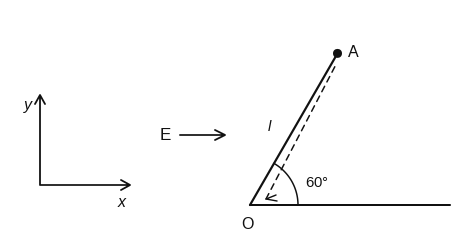
A particle of mass 'm' and charge 'q' is fastened to one end 'A' of a massless string having equilibrium length l, whose other end is fixed at point 'O'. The whole system is placed on a frictionless horizontal plane and is initially at rest. If uniform electric field is switched on along the direction as shown in figure, then the speed of the particle when it crosses the x-axis is
द्रव्यमान 'm' तथा आवेश 'q' का एक कण, साम्यावस्था लंबाई l वाली द्रव्यमानहीन डोरी के एक सिरे 'A' से बाँधा गया है, जिसका दूसरा सिरा बिंदु 'O' पर स्थिर है। पूरा निकाय एक घर्षणरहित क्षैतिज तल पर रखा है और प्रारंभ में विरामावस्था में है। यदि चित्र में दर्शाई गई दिशा में एकसमान विद्युत क्षेत्र चालू कर दिया जाए, तो x-अक्ष को पार करते समय कण की चाल होगी
  1. AqEl2m
  2. BqElm
  3. CqEl4m
  4. D2qElm
Show answer

Concept: The string tension does no work (always perpendicular to the circular motion about O), so the work-energy theorem needs only the work of the electric force qE along the x-direction.

  1. Initial position of the particle: A=(lcos⁡60∘, lsin⁡60∘)=(l2,3l2).
  2. When it crosses the x-axis (string taut): position (l,0), so displacement along E→ is Δx=l−l2=l2.
  3. W=qEΔx=qEl2=12mv2⇒v=qElm.

Short trick: Only the x-displacement matters: l−lcos⁡60∘=l2.

Answer: (B) qElm

अवधारणा: डोरी का तनाव कोई कार्य नहीं करता (O के परितः वृत्तीय गति के सदैव लंबवत), अतः कार्य-ऊर्जा प्रमेय में केवल x-दिशा में विद्युत बल qE का कार्य लेना है।

  1. कण की प्रारंभिक स्थिति: A=(lcos⁡60∘, lsin⁡60∘)=(l2,3l2)।
  2. x-अक्ष पार करते समय (डोरी तनी हुई): स्थिति (l,0), अतः E→ के अनुदिश विस्थापन Δx=l−l2=l2।
  3. W=qEΔx=qEl2=12mv2⇒v=qElm।

शॉर्ट ट्रिक: केवल x-विस्थापन मायने रखता है: l−lcos⁡60∘=l2।

उत्तर: (B) qElm

JEE Main 2025 (January) – Paper 1 (B.E./B.Tech)PhysicsElectrostatics – work-energy theoremJEE Main 2025 (January) – Paper 1 (B.E./B.Tech) 2025 · 28 Jan Shift 1 →
Q1906.
Given below are two statements: one is labelled as Assertion A and the other is labelled as Reason R
Assertion A: In a central force field, the work done is independent of the path chosen.
Reason R: Every force encountered in mechanics does not have an associated potential energy.
In the light of the above statements, choose the most appropriate answer from the options given below
नीचे दो कथन दिए गए हैं: एक को अभिकथन A तथा दूसरे को कारण R कहा गया है
अभिकथन A: केंद्रीय बल क्षेत्र में किया गया कार्य, चुने गए पथ पर निर्भर नहीं करता।
कारण R: यांत्रिकी में मिलने वाले प्रत्येक बल के साथ कोई संबद्ध स्थितिज ऊर्जा नहीं होती।
उपर्युक्त कथनों के आलोक में, नीचे दिए गए विकल्पों में से सर्वाधिक उपयुक्त उत्तर चुनिए
  1. AA is false but R is trueA असत्य है परंतु R सत्य है
  2. BBoth A and R are true but R is NOT the correct explanation of AA तथा R दोनों सत्य हैं परंतु R, A की सही व्याख्या नहीं है
  3. CA is true but R is falseA सत्य है परंतु R असत्य है
  4. DBoth A and R are true and R is the correct explanation of AA तथा R दोनों सत्य हैं तथा R, A की सही व्याख्या है
Show answer

Concept: A central force is conservative, and only conservative forces have an associated potential energy.

  1. A: A central force F→=f(r)r^ is conservative, so the work done between two points is path independent — A is true.
  2. R: Non-conservative forces such as friction have no associated potential energy, so indeed not every mechanical force has one — R is also true.
  3. But R talks about forces lacking a potential energy; it does not explain why work in a central field is path independent. Hence R is not the correct explanation of A.

Answer: (B) Both A and R are true but R is NOT the correct explanation of A

अवधारणा: केंद्रीय बल संरक्षी होता है, और केवल संरक्षी बलों के साथ ही स्थितिज ऊर्जा संबद्ध होती है।

  1. A: केंद्रीय बल F→=f(r)r^ संरक्षी है, अतः दो बिंदुओं के बीच किया गया कार्य पथ पर निर्भर नहीं करता — A सत्य है।
  2. R: घर्षण जैसे असंरक्षी बलों की कोई संबद्ध स्थितिज ऊर्जा नहीं होती, अतः वास्तव में हर यांत्रिक बल की स्थितिज ऊर्जा नहीं होती — R भी सत्य है।
  3. परंतु R उन बलों की बात करता है जिनकी स्थितिज ऊर्जा नहीं होती; यह नहीं समझाता कि केंद्रीय क्षेत्र में कार्य पथ-स्वतंत्र क्यों है। अतः R, A की सही व्याख्या नहीं है।

उत्तर: (B) A तथा R दोनों सत्य हैं परंतु R, A की सही व्याख्या नहीं है

JEE Main 2025 (January) – Paper 1 (B.E./B.Tech)PhysicsWork, Energy and Power – conservative forcesJEE Main 2025 (January) – Paper 1 (B.E./B.Tech) 2025 · 28 Jan Shift 1 →
Q1907.
Choose the correct nuclear process from the below options
[p: proton, n: neutron, e−: electron, e+: positron, ν: neutrino, ν¯: antineutrino]
नीचे दिए गए विकल्पों में से सही नाभिकीय प्रक्रिया चुनिए
[p: प्रोटॉन, n: न्यूट्रॉन, e−: इलेक्ट्रॉन, e+: पॉज़िट्रॉन, ν: न्यूट्रिनो, ν¯: प्रतिन्यूट्रिनो]
  1. An→p+e++ν¯
  2. Bn→p+e++ν
  3. Cn→p+e−+ν
  4. Dn→p+e−+ν¯
Show answer

Concept: In β− decay a neutron converts into a proton; charge and lepton number must both be conserved.

  1. Charge conservation: 0→(+1)+(−1), so an electron e− must be emitted — options with e+ (A) and (B) violate charge conservation.
  2. Lepton number conservation: e− carries lepton number +1, so a particle with lepton number −1, the antineutrino ν¯, must accompany it — option (C) with ν gives lepton number +2, which is wrong.
  3. Correct process: n→p+e−+ν¯.

Answer: (D) n→p+e−+ν¯

अवधारणा: β− क्षय में न्यूट्रॉन, प्रोटॉन में बदलता है; आवेश तथा लेप्टॉन संख्या दोनों संरक्षित रहनी चाहिए।

  1. आवेश संरक्षण: 0→(+1)+(−1), अतः इलेक्ट्रॉन e− उत्सर्जित होना चाहिए — e+ वाले विकल्प (A) तथा (B) आवेश संरक्षण का उल्लंघन करते हैं।
  2. लेप्टॉन संख्या संरक्षण: e− की लेप्टॉन संख्या +1 है, अतः उसके साथ लेप्टॉन संख्या −1 वाला कण, प्रतिन्यूट्रिनो ν¯, होना चाहिए — ν वाला विकल्प (C) लेप्टॉन संख्या +2 देता है, जो गलत है।
  3. सही प्रक्रिया: n→p+e−+ν¯।

उत्तर: (D) n→p+e−+ν¯

JEE Main 2025 (January) – Paper 1 (B.E./B.Tech)PhysicsNuclei – beta decayJEE Main 2025 (January) – Paper 1 (B.E./B.Tech) 2025 · 28 Jan Shift 1 →
Q1908.
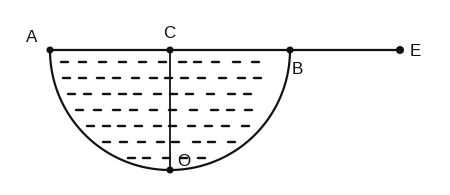
A hemispherical vessel is completely filled with a liquid of refractive index μ. A small coin is kept at the lowest point (O) of the vessel as shown in figure. The minimum value of the refractive index of the liquid so that a person can see the coin from point E (at the level of the vessel) is
एक अर्धगोलीय बर्तन, अपवर्तनांक μ वाले द्रव से पूर्णतः भरा है। चित्रानुसार बर्तन के निम्नतम बिंदु (O) पर एक छोटा सिक्का रखा है। द्रव के अपवर्तनांक का वह न्यूनतम मान, जिससे कोई व्यक्ति बिंदु E (बर्तन के तल के स्तर पर) से सिक्के को देख सके, है
  1. A3
  2. B32
  3. C32
  4. D2
Show answer

Concept: To be seen from E (grazing along the liquid surface), the ray O→B must refract at the surface at 90∘, i.e. hit the surface exactly at the critical angle: sin⁡θc=1μ.

  1. Let the radius be R. O is at depth R below the centre C of the flat surface, and B is on the rim at horizontal distance R from C.
  2. The ray OB therefore makes tan⁡θ=CBCO=RR=1⇒θ=45∘ with the normal (vertical) at B.
  3. For grazing emergence towards E: θ=θc⇒sin⁡45∘=1μ⇒μ=2.

Short trick: The O→rim ray of a hemisphere always meets the flat surface at 45∘, so μmin=1sin⁡45∘=2.

Answer: (D) 2

अवधारणा: E से दिखने के लिए (द्रव सतह के सहारे स्पर्शीय निर्गमन), किरण O→B को सतह पर 90∘ पर अपवर्तित होना चाहिए, अर्थात सतह पर ठीक क्रांतिक कोण पर पड़ना चाहिए: sin⁡θc=1μ।

  1. त्रिज्या R मानें। O, समतल सतह के केंद्र C से R गहराई पर है, तथा B किनारे पर C से क्षैतिज दूरी R पर है।
  2. अतः किरण OB, B पर अभिलंब (ऊर्ध्वाधर) से tan⁡θ=CBCO=RR=1⇒θ=45∘ कोण बनाती है।
  3. E की ओर स्पर्शीय निर्गमन के लिए: θ=θc⇒sin⁡45∘=1μ⇒μ=2।

शॉर्ट ट्रिक: अर्धगोले में O से किनारे तक की किरण समतल सतह से सदैव 45∘ पर मिलती है, अतः μmin=1sin⁡45∘=2।

उत्तर: (D) 2

JEE Main 2025 (January) – Paper 1 (B.E./B.Tech)PhysicsRay Optics – total internal reflectionJEE Main 2025 (January) – Paper 1 (B.E./B.Tech) 2025 · 28 Jan Shift 1 →
Q1909.
A Carnot engine (E) is working between two temperatures 473 K and 273 K. In a new system two engines - engine E1 works between 473 K to 373 K and engine E2 works between 373 K to 273 K. If η12, η1 and η2 are the efficiencies of the engines E, E1 and E2, respectively, then
एक कार्नो इंजन (E) दो तापों 473 K तथा 273 K के बीच कार्य कर रहा है। एक नए निकाय में दो इंजन हैं - इंजन E1, 473 K से 373 K के बीच तथा इंजन E2, 373 K से 273 K के बीच कार्य करता है। यदि η12, η1 तथा η2 क्रमशः इंजन E, E1 तथा E2 की दक्षताएँ हों, तो
  1. Aη12=η1η2
  2. Bη12≥η1+η2
  3. Cη12=η1+η2
  4. Dη12<η1+η2
Show answer

Concept: Carnot efficiency η=1−TcoldThot; just compute all three.

  1. η12=1−273473=200473≈0.423
  2. η1=1−373473=100473≈0.211,  η2=1−273373=100373≈0.268
  3. η1+η2≈0.479>0.423=η12, so η12<η1+η2.

Short trick: Exactly: η12=η1+η2−η1η2 (since 1−η12=(1−η1)(1−η2)), which is always less than η1+η2.

Answer: (D) η12<η1+η2

अवधारणा: कार्नो दक्षता η=1−TcoldThot; तीनों की गणना कीजिए।

  1. η12=1−273473=200473≈0.423
  2. η1=1−373473=100473≈0.211,  η2=1−273373=100373≈0.268
  3. η1+η2≈0.479>0.423=η12, अतः η12<η1+η2।

शॉर्ट ट्रिक: यथार्थतः: η12=η1+η2−η1η2 (क्योंकि 1−η12=(1−η1)(1−η2)), जो सदैव η1+η2 से कम है।

उत्तर: (D) η12<η1+η2

JEE Main 2025 (January) – Paper 1 (B.E./B.Tech)PhysicsThermodynamics – Carnot engineJEE Main 2025 (January) – Paper 1 (B.E./B.Tech) 2025 · 28 Jan Shift 1 →
Q1910.
Consider a long thin conducting wire carrying a uniform current I. A particle having mass "M" and charge "q" is released at a distance "a" from the wire with a speed v0 along the direction of current in the wire. The particle gets attracted to the wire due to magnetic force. The particle turns round when it is at distance x from the wire. The value of x is [μ0 is vacuum permeability]
एकसमान धारा I ले जा रहे एक लंबे पतले चालक तार पर विचार कीजिए। द्रव्यमान "M" तथा आवेश "q" वाला एक कण, तार से "a" दूरी पर, तार में धारा की दिशा के अनुदिश चाल v0 से छोड़ा जाता है। चुंबकीय बल के कारण कण तार की ओर आकर्षित होता है। तार से x दूरी पर कण मुड़ जाता (turns round) है। x का मान है [μ0 निर्वात की चुंबकशीलता है]
  1. Aae−4πmv0qμ0I
  2. Ba[1−mv02qμ0I]
  3. Ca[1−mvqμ0I]
  4. Da2
Show answer

Concept: Magnetic force does no work, so the speed stays v0. Writing Newton's law for the component parallel to the wire links the change of that component to ln⁡x.

  1. Let the wire lie along the y-axis with current I, and the particle move in the x-y plane; B=μ0I2πx.
  2. Component parallel to the wire: mdvydt=qμ0I2π1xdxdt.
  3. Integrating: m(vy−v0)=qμ0I2πln⁡xa.
  4. "Turns round" means the velocity has reversed: vy=−v0 (speed is still v0, perpendicular component zero at the turning point). So −2mv0=qμ0I2πln⁡xa.
  5. ln⁡xa=−4πmv0qμ0I⇒x=ae−4πmv0qμ0I.

Answer: (A) ae−4πmv0qμ0I

अवधारणा: चुंबकीय बल कोई कार्य नहीं करता, अतः चाल v0 ही रहती है। तार के समांतर घटक के लिए न्यूटन का नियम लिखने पर उस घटक का परिवर्तन ln⁡x से जुड़ जाता है।

  1. माना तार y-अक्ष के अनुदिश है जिसमें धारा I है, तथा कण x-y तल में चलता है; B=μ0I2πx।
  2. तार के समांतर घटक: mdvydt=qμ0I2π1xdxdt।
  3. समाकलन करने पर: m(vy−v0)=qμ0I2πln⁡xa।
  4. "मुड़ जाता है" का अर्थ है वेग उलट गया: vy=−v0 (चाल अब भी v0 है, मोड़-बिंदु पर लंबवत घटक शून्य)। अतः −2mv0=qμ0I2πln⁡xa।
  5. ln⁡xa=−4πmv0qμ0I⇒x=ae−4πmv0qμ0I।

उत्तर: (A) ae−4πmv0qμ0I

JEE Main 2025 (January) – Paper 1 (B.E./B.Tech)PhysicsMoving Charges and Magnetism – charge near a current-carrying wireJEE Main 2025 (January) – Paper 1 (B.E./B.Tech) 2025 · 28 Jan Shift 1 →
Q1911.
A wire of resistance R is bent into an equilateral triangle and an identical wire is bent into a square. The ratio of resistance between the two end points of an edge of the triangle to that of the square is
प्रतिरोध R के एक तार को समबाहु त्रिभुज के आकार में तथा एक सर्वसम तार को वर्ग के आकार में मोड़ा गया है। त्रिभुज की एक भुजा के दोनों सिरों के बीच के प्रतिरोध का, वर्ग की एक भुजा के दोनों सिरों के बीच के प्रतिरोध से अनुपात है
  1. A8/9
  2. B27/32
  3. C32/27
  4. D9/8
Show answer

Concept: Across one edge, the edge resistance is in parallel with the rest of the loop.

  1. Triangle: each side =R3. Across one edge: R3∥2R3=R3⋅2R3R=2R9.
  2. Square: each side =R4. Across one edge: R4∥3R4=R4⋅3R4R=3R16.
  3. Ratio =2R/93R/16=3227.

Short trick: For an n-sided loop of total R, resistance across one side =R(n−1)n2: triangle 2R9, square 3R16.

Answer: (C) 32/27

अवधारणा: किसी एक भुजा के सिरों के बीच, उस भुजा का प्रतिरोध शेष लूप के समांतर होता है।

  1. त्रिभुज: प्रत्येक भुजा =R3। एक भुजा के सिरों के बीच: R3∥2R3=R3⋅2R3R=2R9।
  2. वर्ग: प्रत्येक भुजा =R4। एक भुजा के सिरों के बीच: R4∥3R4=R4⋅3R4R=3R16।
  3. अनुपात =2R/93R/16=3227।

शॉर्ट ट्रिक: कुल प्रतिरोध R वाले n-भुजा लूप में एक भुजा के सिरों के बीच प्रतिरोध =R(n−1)n2: त्रिभुज 2R9, वर्ग 3R16।

उत्तर: (C) 32/27

JEE Main 2025 (January) – Paper 1 (B.E./B.Tech)PhysicsCurrent Electricity – equivalent resistanceJEE Main 2025 (January) – Paper 1 (B.E./B.Tech) 2025 · 28 Jan Shift 1 →
Q1912.
In the experiment for measurement of viscosity 'η' of given liquid with a ball having radius R, consider following statements.
A. Graph between terminal velocity V and R will be a parabola.
B. The terminal velocities of different diameter balls are constant for a given liquid.
C. Measurement of terminal velocity is dependent on the temperature.
D. This experiment can be utilized to assess the density of a given liquid.
E. If balls are dropped with some initial speed, the value of η will change.
Choose the correct answer from the options given below:
त्रिज्या R वाली गेंद से किसी दिए गए द्रव की श्यानता 'η' मापने के प्रयोग में, निम्नलिखित कथनों पर विचार कीजिए।
A. सीमांत वेग V तथा R के बीच ग्राफ एक परवलय होगा।
B. दिए गए द्रव के लिए विभिन्न व्यासों की गेंदों के सीमांत वेग नियत होते हैं।
C. सीमांत वेग का मापन ताप पर निर्भर करता है।
D. इस प्रयोग का उपयोग दिए गए द्रव का घनत्व ज्ञात करने में किया जा सकता है।
E. यदि गेंदों को कुछ प्रारंभिक चाल से गिराया जाए, तो η का मान बदल जाएगा।
नीचे दिए गए विकल्पों में से सही उत्तर चुनिए:
  1. AA, B and E Onlyकेवल A, B तथा E
  2. BB, D and E Onlyकेवल B, D तथा E
  3. CA, C and D Onlyकेवल A, C तथा D
  4. DC, D and E Onlyकेवल C, D तथा E
Show answer

Concept: Terminal velocity VT=2R2(ρ−σ)g9η.

  1. A: VT∝R2, so the V–R graph is a parabola — correct.
  2. B: VT depends on R2, so balls of different diameters have different terminal velocities — wrong.
  3. C: η (and hence VT) changes strongly with temperature — correct.
  4. D: The formula contains the liquid density σ, so measuring VT lets us assess it — correct.
  5. E: Terminal velocity (and hence the measured η) does not depend on the initial speed; the ball always settles to the same VT — wrong.

Answer: (C) A, C and D Only

अवधारणा: सीमांत वेग VT=2R2(ρ−σ)g9η।

  1. A: VT∝R2, अतः V–R ग्राफ परवलय है — सही।
  2. B: VT, R2 पर निर्भर करता है, अतः भिन्न व्यास की गेंदों के सीमांत वेग भिन्न होते हैं — गलत।
  3. C: η (और इसलिए VT) ताप के साथ तेज़ी से बदलता है — सही।
  4. D: सूत्र में द्रव का घनत्व σ आता है, अतः VT मापकर इसे ज्ञात किया जा सकता है — सही।
  5. E: सीमांत वेग (और इसलिए मापा गया η) प्रारंभिक चाल पर निर्भर नहीं करता; गेंद सदैव उसी VT पर पहुँचती है — गलत।

उत्तर: (C) केवल A, C तथा D

JEE Main 2025 (January) – Paper 1 (B.E./B.Tech)PhysicsViscosity – terminal velocity experimentJEE Main 2025 (January) – Paper 1 (B.E./B.Tech) 2025 · 28 Jan Shift 1 →
Q1913.
Due to presence of an em-wave whose electric component is given by E=100sin⁡(ωt−kx) NC−1, a cylinder of length 200 cm holds certain amount of em-energy inside it. If another cylinder of same length but half diameter than previous one holds same amount of em-energy, the magnitude of the electric field of the corresponding em-wave should be modified as
एक विद्युतचुंबकीय तरंग, जिसका विद्युत घटक E=100sin⁡(ωt−kx) NC−1 है, की उपस्थिति के कारण 200 cm लंबाई का एक बेलन अपने भीतर कुछ विद्युतचुंबकीय ऊर्जा रखता है। यदि समान लंबाई परंतु पहले से आधे व्यास वाला दूसरा बेलन उतनी ही विद्युतचुंबकीय ऊर्जा रखे, तो संगत विद्युतचुंबकीय तरंग के विद्युत क्षेत्र का परिमाण परिवर्तित करके होना चाहिए
  1. A400sin⁡(ωt−kx) NC−1
  2. B200sin⁡(ωt−kx) NC−1
  3. C50sin⁡(ωt−kx) NC−1
  4. D25sin⁡(ωt−kx) NC−1
Show answer

Concept: Average em-energy density u=12ε0E02; energy inside the cylinder =u× volume, and volume ∝d2 for fixed length.

  1. Half diameter ⇒ volume becomes 14 of the earlier volume.
  2. Same energy ⇒ energy density must become 4 times: u′=4u.
  3. u∝E02⇒E0′=2E0=200 NC−1.

Short trick: E0∝1d for equal energy in equal length.

Answer: (B) 200sin⁡(ωt−kx) NC−1

अवधारणा: औसत विद्युतचुंबकीय ऊर्जा घनत्व u=12ε0E02; बेलन के भीतर ऊर्जा =u× आयतन, तथा नियत लंबाई पर आयतन ∝d2।

  1. आधा व्यास ⇒ आयतन पहले का 14 हो जाता है।
  2. समान ऊर्जा ⇒ ऊर्जा घनत्व 4 गुना होना चाहिए: u′=4u।
  3. u∝E02⇒E0′=2E0=200 NC−1।

शॉर्ट ट्रिक: समान लंबाई में समान ऊर्जा के लिए E0∝1d।

उत्तर: (B) 200sin⁡(ωt−kx) NC−1

JEE Main 2025 (January) – Paper 1 (B.E./B.Tech)PhysicsElectromagnetic Waves – energy densityJEE Main 2025 (January) – Paper 1 (B.E./B.Tech) 2025 · 28 Jan Shift 1 →
Q1914.
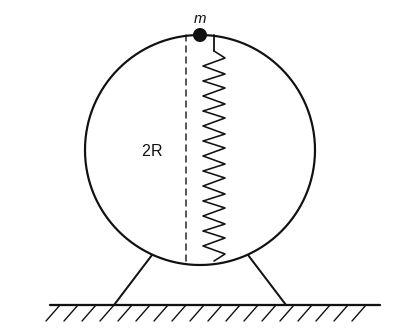
A bead of mass 'm' slides without friction on the wall of a vertical circular hoop of radius 'R' as shown in figure. The bead moves under the combined action of gravity and a massless spring (k) attached to the bottom of the hoop. The equilibrium length of the spring is 'R'. If the bead is released from top of the hoop with (negligible) zero initial speed, velocity of bead, when the length of spring becomes 'R', would be (spring constant is 'k', g is acceleration due to gravity)
द्रव्यमान 'm' का एक मनका (bead), चित्रानुसार त्रिज्या 'R' के ऊर्ध्वाधर वृत्ताकार हूप की दीवार पर बिना घर्षण फिसलता है। मनका, गुरुत्व तथा हूप के निचले बिंदु से जुड़ी द्रव्यमानहीन स्प्रिंग (k) की संयुक्त क्रिया में गति करता है। स्प्रिंग की साम्यावस्था लंबाई 'R' है। यदि मनके को हूप के शीर्ष से (नगण्य) शून्य प्रारंभिक चाल से छोड़ा जाए, तो स्प्रिंग की लंबाई 'R' हो जाने पर मनके का वेग होगा (स्प्रिंग नियतांक 'k' है, g गुरुत्वीय त्वरण है)
  1. A3Rg+kR2m
  2. B2gR+kR2m
  3. C2Rg+kR2m
  4. D2Rg+4kR2m
Show answer

Concept: Energy conservation: spring PE (initial extension R) and the fall in height both convert into kinetic energy.

  1. At the top, spring length =2R (diameter), so extension =2R−R=R and spring PE =12kR2.
  2. Spring length R means the bead is at chord distance R from the bottom point: 2Rsin⁡φ2=R⇒φ=60∘ from the bottom. Its height above the bottom =R(1−cos⁡60∘)=R2.
  3. Fall in height =2R−R2=3R2; final extension =0, so all spring PE is released.
  4. 12mv2=mg⋅3R2+12kR2⇒v=3Rg+kR2m.

Answer: (A) 3Rg+kR2m

अवधारणा: ऊर्जा संरक्षण: स्प्रिंग की स्थितिज ऊर्जा (प्रारंभिक विस्तार R) तथा ऊँचाई में गिरावट, दोनों गतिज ऊर्जा में बदलते हैं।

  1. शीर्ष पर स्प्रिंग की लंबाई =2R (व्यास), अतः विस्तार =2R−R=R तथा स्प्रिंग स्थितिज ऊर्जा =12kR2।
  2. स्प्रिंग की लंबाई R का अर्थ है मनका निचले बिंदु से R जीवा-दूरी पर है: 2Rsin⁡φ2=R⇒ निचले बिंदु से φ=60∘। निचले बिंदु से उसकी ऊँचाई =R(1−cos⁡60∘)=R2।
  3. ऊँचाई में गिरावट =2R−R2=3R2; अंतिम विस्तार =0, अतः पूरी स्प्रिंग ऊर्जा मुक्त होती है।
  4. 12mv2=mg⋅3R2+12kR2⇒v=3Rg+kR2m।

उत्तर: (A) 3Rg+kR2m

JEE Main 2025 (January) – Paper 1 (B.E./B.Tech)PhysicsWork, Energy and Power – energy conservation with springJEE Main 2025 (January) – Paper 1 (B.E./B.Tech) 2025 · 28 Jan Shift 1 →
Q1915.
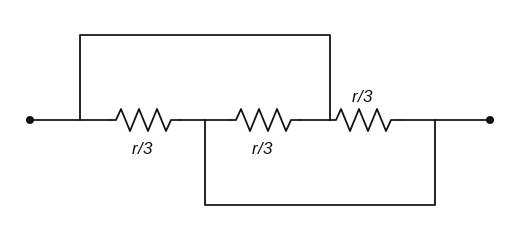
Find the equivalent resistance between two ends of the following circuit
निम्नलिखित परिपथ के दोनों सिरों के बीच तुल्य प्रतिरोध ज्ञात कीजिए
  1. Ar9
  2. Br3
  3. Cr
  4. Dr6
Show answer

Concept: Plain connecting wires have zero resistance, so points joined by them are the same node — redraw the circuit by labelling nodes.

  1. Call the left terminal P and the right terminal Q.
  2. The top wire connects P directly to the junction between the 2nd and 3rd resistors; the bottom wire connects the junction between the 1st and 2nd resistors directly to Q.
  3. So each r3 resistor has one end at P and the other at Q: all three are in parallel.
  4. Req=r/33=r9.

Short trick: Shorting wires collapse the chain into three parallel r3's.

Answer: (A) r9

अवधारणा: सादे जोड़ने वाले तारों का प्रतिरोध शून्य होता है, अतः उनसे जुड़े बिंदु एक ही नोड हैं — नोड नामांकित कर परिपथ पुनः बनाइए।

  1. बाएँ सिरे को P तथा दाएँ सिरे को Q कहें।
  2. ऊपरी तार P को सीधे दूसरे व तीसरे प्रतिरोधों के बीच के संधि-बिंदु से जोड़ता है; निचला तार पहले व दूसरे प्रतिरोधों के बीच के संधि-बिंदु को सीधे Q से जोड़ता है।
  3. अतः प्रत्येक r3 प्रतिरोध का एक सिरा P पर तथा दूसरा Q पर है: तीनों समांतर क्रम में हैं।
  4. Req=r/33=r9।

शॉर्ट ट्रिक: शॉर्ट करने वाले तार श्रेणी को तीन समांतर r3 में बदल देते हैं।

उत्तर: (A) r9

JEE Main 2025 (January) – Paper 1 (B.E./B.Tech)PhysicsCurrent Electricity – equivalent resistanceJEE Main 2025 (January) – Paper 1 (B.E./B.Tech) 2025 · 28 Jan Shift 1 →
Q1916.
Consider following statements:
A. Surface tension arises due to extra energy of the molecules at the interior as compared to the molecules at the surface, of a liquid.
B. As the temperature of liquid rises, the coefficient of viscosity increases.
C. As the temperature of gas increases, the coefficient of viscosity increases.
D. The onset of turbulence is determined by Reynold's number.
E. In a steady flow two stream lines never intersect.
Choose the correct answer from the options given below:
निम्नलिखित कथनों पर विचार कीजिए:
A. पृष्ठ तनाव, द्रव के पृष्ठ के अणुओं की तुलना में आंतरिक अणुओं की अतिरिक्त ऊर्जा के कारण उत्पन्न होता है।
B. द्रव का ताप बढ़ने पर श्यानता गुणांक बढ़ता है।
C. गैस का ताप बढ़ने पर श्यानता गुणांक बढ़ता है।
D. विक्षुब्धता (turbulence) का प्रारंभ रेनॉल्ड संख्या से निर्धारित होता है।
E. धारारेखीय प्रवाह में दो धारारेखाएँ कभी नहीं काटतीं।
नीचे दिए गए विकल्पों में से सही उत्तर चुनिए:
  1. AC, D, E Onlyकेवल C, D, E
  2. BA, D, E Onlyकेवल A, D, E
  3. CB, C, D Onlyकेवल B, C, D
  4. DA, B, C Onlyकेवल A, B, C
Show answer

Concept: Facts about surface tension, viscosity-temperature dependence and streamline flow.

  1. A: It is the surface molecules that have extra energy (unbalanced cohesive forces), not the interior ones — wrong.
  2. B: Viscosity of liquids decreases with temperature (cohesive forces weaken) — wrong.
  3. C: Viscosity of gases increases with temperature (faster molecular momentum transfer) — correct.
  4. D: Turbulence sets in when Reynold's number exceeds its critical value — correct.
  5. E: Two streamlines can never intersect, else velocity at the crossing point would have two directions — correct.

Answer: (A) C, D, E Only

अवधारणा: पृष्ठ तनाव, श्यानता की ताप-निर्भरता तथा धारारेखीय प्रवाह के तथ्य।

  1. A: अतिरिक्त ऊर्जा पृष्ठ के अणुओं में होती है (असंतुलित ससंजक बल), आंतरिक अणुओं में नहीं — गलत।
  2. B: द्रवों की श्यानता ताप बढ़ने पर घटती है (ससंजक बल दुर्बल होते हैं) — गलत।
  3. C: गैसों की श्यानता ताप बढ़ने पर बढ़ती है (तेज़ आण्विक संवेग स्थानांतरण) — सही।
  4. D: रेनॉल्ड संख्या क्रांतिक मान से बढ़ने पर विक्षुब्धता प्रारंभ होती है — सही।
  5. E: दो धारारेखाएँ कभी नहीं काट सकतीं, अन्यथा कटान-बिंदु पर वेग की दो दिशाएँ होतीं — सही।

उत्तर: (A) केवल C, D, E

JEE Main 2025 (January) – Paper 1 (B.E./B.Tech)PhysicsFluid Mechanics – surface tension and viscosityJEE Main 2025 (January) – Paper 1 (B.E./B.Tech) 2025 · 28 Jan Shift 1 →
Q1917.
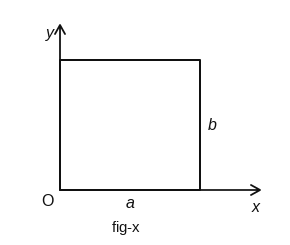
The center of mass of a thin rectangular plate (fig - x) with sides of length a and b, whose mass per unit area (σ) varies as σ=σ0xab (where σ0 is a constant), would be
भुजाओं a तथा b वाली एक पतली आयताकार प्लेट (चित्र-x), जिसका प्रति एकांक क्षेत्रफल द्रव्यमान (σ), σ=σ0xab (जहाँ σ0 एक नियतांक है) के अनुसार बदलता है, का द्रव्यमान केंद्र होगा
  1. A(23a,b2)
  2. B(a2,b2)
  3. C(13a,b2)
  4. D(23a,23b)
Show answer

Concept: xcm=∫xdm∫dm with strips dm=σbdx; density depends only on x, so the y coordinate stays at the middle.

  1. xcm=∫0ax⋅xdx∫0axdx=a3/3a2/2=2a3.
  2. By symmetry in y (σ independent of y): ycm=b2.

Short trick: For σ∝x over 0 to a, xcm=2a3 (triangle-like distribution).

Answer: (A) (23a,b2)

अवधारणा: पट्टियाँ dm=σbdx लेकर xcm=∫xdm∫dm; घनत्व केवल x पर निर्भर है, अतः y निर्देशांक बीच में ही रहता है।

  1. xcm=∫0ax⋅xdx∫0axdx=a3/3a2/2=2a3।
  2. y में सममिति से (σ, y से स्वतंत्र): ycm=b2।

शॉर्ट ट्रिक: 0 से a तक σ∝x के लिए xcm=2a3 (त्रिभुज-सदृश वितरण)।

उत्तर: (A) (23a,b2)

JEE Main 2025 (January) – Paper 1 (B.E./B.Tech)PhysicsCentre of Mass – continuous body with variable densityJEE Main 2025 (January) – Paper 1 (B.E./B.Tech) 2025 · 28 Jan Shift 1 →
Q1918.
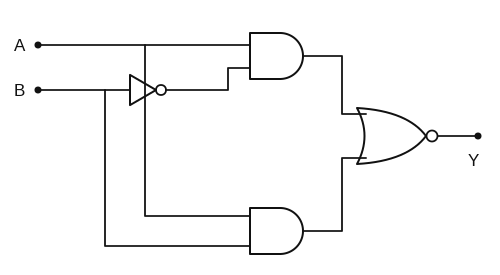
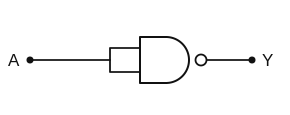
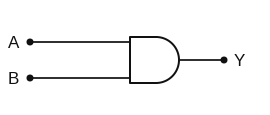
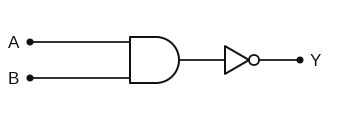
Which of the following circuits has the same output as that of the given circuit?
निम्नलिखित में से किस परिपथ का निर्गत (output), दिए गए परिपथ के निर्गत के समान है?
  1. A
  2. B
  3. C
  4. D
Show answer

Concept: Write the Boolean expression of the given circuit and simplify.

  1. Top AND gate: inputs A and B¯ → AB¯. Bottom AND gate: inputs A and B → AB.
  2. Both feed a NOR gate: Y=AB¯+AB―=A(B¯+B)―=A¯.
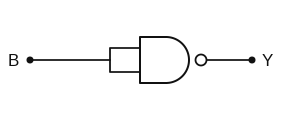
  3. So the circuit is simply a NOT gate on A. Option (B) — a NAND with both inputs tied to A — gives A⋅A―=A¯: same output.
  4. Option (A) gives B¯, option (C) gives AB, option (D) gives AB― — all different.

Answer: (B) NAND gate with both inputs tied to A (i.e. A¯)

अवधारणा: दिए गए परिपथ का बूलीय व्यंजक लिखकर सरल कीजिए।

  1. ऊपरी AND गेट: निवेश A तथा B¯ → AB¯। निचला AND गेट: निवेश A तथा B → AB।
  2. दोनों एक NOR गेट में जाते हैं: Y=AB¯+AB―=A(B¯+B)―=A¯।
  3. अतः परिपथ A पर केवल एक NOT गेट है। विकल्प (B) — दोनों निवेश A से जुड़ा NAND — A⋅A―=A¯ देता है: समान निर्गत।
  4. विकल्प (A) B¯ देता है, विकल्प (C) AB, विकल्प (D) AB― — सभी भिन्न हैं।

उत्तर: (B) दोनों निवेश A से जुड़ा NAND गेट (अर्थात A¯)

JEE Main 2025 (January) – Paper 1 (B.E./B.Tech)PhysicsSemiconductors – logic gatesJEE Main 2025 (January) – Paper 1 (B.E./B.Tech) 2025 · 28 Jan Shift 1 →
Q1919.
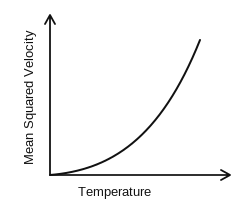
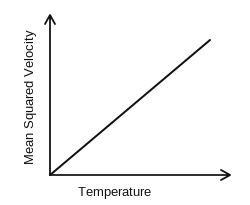
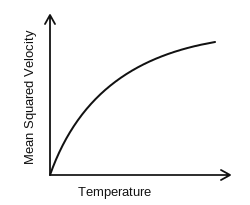
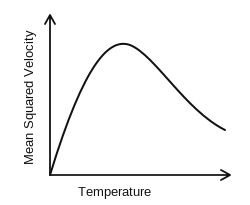
For a particular ideal gas which of the following graphs represents the variation of mean squared velocity of the gas molecules with temperature?
किसी विशेष आदर्श गैस के लिए निम्नलिखित में से कौन-सा ग्राफ, गैस अणुओं के माध्य वर्ग वेग (mean squared velocity) का ताप के साथ परिवर्तन दर्शाता है?
  1. A
  2. B
  3. C
  4. D
Show answer

Concept: From kinetic theory, 12mv2―=32kBT, so v2―=3kBTm.

  1. v2―∝T: the mean squared velocity is directly proportional to absolute temperature.
  2. So the graph is a straight line passing through the origin — graph (B).
  3. (A) and (C) show non-linear growth and (D) shows a maximum — none follows v2―∝T.

Short trick: vrms∝T, hence vrms2∝T: straight line through origin.

Answer: (B) the straight line through the origin

अवधारणा: अणुगति सिद्धांत से, 12mv2―=32kBT, अतः v2―=3kBTm।

  1. v2―∝T: माध्य वर्ग वेग परम ताप के अनुक्रमानुपाती है।
  2. अतः ग्राफ मूलबिंदु से गुज़रती सरल रेखा है — ग्राफ (B)।
  3. (A) तथा (C) अरेखीय वृद्धि दर्शाते हैं और (D) एक उच्चिष्ठ — कोई भी v2―∝T का पालन नहीं करता।

शॉर्ट ट्रिक: vrms∝T, अतः vrms2∝T: मूलबिंदु से सरल रेखा।

उत्तर: (B) मूलबिंदु से गुज़रती सरल रेखा

JEE Main 2025 (January) – Paper 1 (B.E./B.Tech)PhysicsKinetic Theory of Gases – mean squared velocity vs temperatureJEE Main 2025 (January) – Paper 1 (B.E./B.Tech) 2025 · 28 Jan Shift 1 →
Q1920.
A proton of mass 'mp' has same energy as that of a photon of wavelength 'λ'. If the proton is moving at non-relativistic speed, then ratio of its de Broglie wavelength to the wavelength of photon is.
द्रव्यमान 'mp' के एक प्रोटॉन की ऊर्जा, तरंगदैर्घ्य 'λ' वाले फ़ोटॉन की ऊर्जा के बराबर है। यदि प्रोटॉन अनापेक्षिकीय (non-relativistic) चाल से गतिमान है, तो उसके डी ब्रॉग्ली तरंगदैर्घ्य का फ़ोटॉन के तरंगदैर्घ्य से अनुपात है
  1. A1cEmp
  2. B1c2Emp
  3. C12cEmp
  4. D1cE2mp
Show answer

Concept: For the proton λp=h2mpE (non-relativistic, KE =E); for the photon λ=hcE.

  1. p=2mpE⇒λp=h2mpE.
  2. λpλ=h2mpE×Ehc=Ec2mpE=1cE2mp.

Answer: (D) 1cE2mp

अवधारणा: प्रोटॉन के लिए λp=h2mpE (अनापेक्षिकीय, गतिज ऊर्जा =E); फ़ोटॉन के लिए λ=hcE।

  1. p=2mpE⇒λp=h2mpE।
  2. λpλ=h2mpE×Ehc=Ec2mpE=1cE2mp।

उत्तर: (D) 1cE2mp

JEE Main 2025 (January) – Paper 1 (B.E./B.Tech)PhysicsDual Nature of Matter – de Broglie wavelengthJEE Main 2025 (January) – Paper 1 (B.E./B.Tech) 2025 · 28 Jan Shift 1 →