Question bank

Q&A: practice questions with answers

Search questions on any topic. Filter by exam category, exam, subject and topic, try the question, then open the answer and explanation.

Courses – airGurukul

53,050 questions in the question bank.

Q1941.
What is the freezing point depression constant of a solvent, 50 g of which contain 1 g non volatile solute (molar mass 256 g mol−1) and the decrease in freezing point is 0.40 K?
उस विलायक का हिमांक अवनमन स्थिरांक क्या है, जिसके 50 g में 1 g अवाष्पशील विलेय (मोलर द्रव्यमान 256 g mol−1) घुला है तथा हिमांक में कमी 0.40 K है?
  1. A3.72 K kg mol−1
  2. B1.86 K kg mol−1
  3. C4.43 K kg mol−1
  4. D5.12 K kg mol−1
Show answer

Concept: ΔTf=Kfm, where m is the molality of the solution.

  1. Moles of solute =1256 mol; mass of solvent =0.050 kg.
  2. m=1/2560.050=0.078125 mol kg−1.
  3. Kf=ΔTfm=0.400.078125=5.12 K kg mol−1.

Short trick: Plug straight into Kf=ΔTf×M×Wsolvent(g)wsolute×1000=0.40×256×501×1000=5.12.

Answer: (D)

अवधारणा: ΔTf=Kfm, जहाँ m विलयन की मोललता है।

  1. विलेय के मोल =1256 mol; विलायक का द्रव्यमान =0.050 kg।
  2. m=1/2560.050=0.078125 mol kg−1।
  3. Kf=ΔTfm=0.400.078125=5.12 K kg mol−1।

शॉर्ट ट्रिक: सीधे सूत्र में रखिए: Kf=ΔTf×M×Wविलायक(g)wविलेय×1000=0.40×256×501×1000=5.12।

उत्तर: (D)

JEE Main 2025 (January) – Paper 1 (B.E./B.Tech)ChemistrySolutions – depression in freezing pointJEE Main 2025 (January) – Paper 1 (B.E./B.Tech) 2025 · 28 Jan Shift 1 →
Q1942.
Given below are two statements:
Statement I: Et2N−CH2−CH2−Cl will undergo alkaline hydrolysis at a faster rate than Et2CH−CH2−CH2−Cl.
Statement II: In Et2N−CH2−CH2−Cl, intramolecular substitution takes place first by involving lone pair of electrons on nitrogen.
In the light of the above statements, choose the most appropriate answer from the options given below
नीचे दो कथन दिए गए हैं:
कथन I: Et2N−CH2−CH2−Cl का क्षारीय जल-अपघटन, Et2CH−CH2−CH2−Cl की अपेक्षा तीव्र दर से होगा।
कथन II: Et2N−CH2−CH2−Cl में, नाइट्रोजन के एकाकी इलेक्ट्रॉन युग्म की भागीदारी से पहले अंतराअणुक प्रतिस्थापन होता है।
उपर्युक्त कथनों के आलोक में, नीचे दिए गए विकल्पों में से सबसे उपयुक्त उत्तर चुनिए
  1. AStatement I is incorrect but Statement II is correctकथन I गलत है परन्तु कथन II सही है
  2. BStatement I is correct but Statement II is incorrectकथन I सही है परन्तु कथन II गलत है
  3. CBoth Statement I and Statement II are correctकथन I और कथन II दोनों सही हैं
  4. DBoth Statement I and Statement II are incorrectकथन I और कथन II दोनों गलत हैं
Show answer

Concept: A lone pair on an atom β to the leaving group can attack intramolecularly (anchimeric assistance / neighbouring-group participation), enormously speeding up substitution.

  1. In Et2N−CH2−CH2−Cl the nitrogen lone pair displaces Cl− intramolecularly to form a strained cyclic aziridinium (three-membered ammonium) ion.
  2. The strained ring is then opened rapidly by OH−, so overall alkaline hydrolysis is much faster than for the simple chloride Et2CH−CH2−CH2−Cl, which must react by ordinary SN2. Statement I is correct.
  3. Statement II states exactly this mechanism (intramolecular substitution first, using the N lone pair) — it is correct and explains Statement I.

Short trick: β-halo amines (and mustards) always hydrolyse abnormally fast — think "cyclic onium intermediate".

Answer: (C)

अवधारणा: निर्गमन समूह के β-स्थान पर स्थित परमाणु का एकाकी युग्म अंतराअणुक आक्रमण कर सकता है (पड़ोसी समूह सहभागिता), जिससे प्रतिस्थापन अत्यंत तीव्र हो जाता है।

  1. Et2N−CH2−CH2−Cl में नाइट्रोजन का एकाकी युग्म अंतराअणुक रूप से Cl− को विस्थापित कर तनावयुक्त चक्रीय ऐज़िरिडिनियम (तीन-सदस्यीय अमोनियम) आयन बनाता है।
  2. फिर OH− इस तनावयुक्त वलय को तेज़ी से खोल देता है, अतः कुल क्षारीय जल-अपघटन, साधारण क्लोराइड Et2CH−CH2−CH2−Cl (जो सामान्य SN2 से अभिक्रिया करता है) की अपेक्षा बहुत तीव्र होता है। कथन I सही है।
  3. कथन II ठीक यही क्रियाविधि बताता है (पहले N एकाकी युग्म द्वारा अंतराअणुक प्रतिस्थापन) — यह सही है और कथन I की व्याख्या करता है।

शॉर्ट ट्रिक: β-हैलो ऐमीन (और मस्टर्ड) सदैव असामान्य रूप से तेज़ जल-अपघटित होते हैं — "चक्रीय ओनियम मध्यवर्ती" याद रखिए।

उत्तर: (C)

JEE Main 2025 (January) – Paper 1 (B.E./B.Tech)ChemistryHaloalkanes – anchimeric assistance (NGP)JEE Main 2025 (January) – Paper 1 (B.E./B.Tech) 2025 · 28 Jan Shift 1 →
Q1943.
Ice and water are placed in a closed container at a pressure of 1 atm and temperature 273.15 K. If pressure of the system is increased 2 times, keeping temperature constant, then identify correct observation from following
एक बंद पात्र में बर्फ और जल, 1 atm दाब तथा 273.15 K ताप पर रखे गए हैं। ताप स्थिर रखते हुए यदि निकाय का दाब 2 गुना कर दिया जाए, तो निम्नलिखित में से सही प्रेक्षण पहचानिए
  1. AVolume of system increases.निकाय का आयतन बढ़ता है।
  2. BThe solid phase (ice) disappears completely.ठोस कला (बर्फ) पूर्णतः लुप्त हो जाती है।
  3. CLiquid phase disappears completely.द्रव कला पूर्णतः लुप्त हो जाती है।
  4. DThe amount of ice decreases.बर्फ की मात्रा घट जाती है।
Show answer

Concept: For water the solid–liquid line in the phase diagram slopes backwards (ice is less dense than water), so increasing pressure lowers the melting point.

  1. At 1 atm and 273.15 K ice and water coexist on the fusion curve.
  2. At 2 atm the melting point falls slightly below 273.15 K; the point (273.15 K, 2 atm) now lies in the liquid region of the phase diagram.
  3. Since temperature is held constant, equilibrium can no longer be maintained — all the ice melts; the solid phase disappears completely, not merely decreases.
  4. (A) is wrong: melting of ice to denser water decreases the volume; (C) is wrong because it is the solid, not the liquid, that vanishes.

Short trick: Water's fusion line leans left: squeeze ice at constant T ⇒ it melts (ice-skating principle).

Answer: (B)

अवधारणा: जल के कला आरेख में ठोस–द्रव रेखा का ढाल ऋणात्मक है (बर्फ, जल से कम सघन है), अतः दाब बढ़ाने पर गलनांक घटता है।

  1. 1 atm तथा 273.15 K पर बर्फ और जल गलन-वक्र पर साम्य में हैं।
  2. 2 atm पर गलनांक 273.15 K से थोड़ा नीचे आ जाता है; बिंदु (273.15 K, 2 atm) अब कला आरेख के द्रव क्षेत्र में है।
  3. ताप स्थिर है, अतः साम्य बना नहीं रह सकता — सारी बर्फ पिघल जाती है; ठोस कला पूर्णतः लुप्त हो जाती है, केवल घटती नहीं।
  4. (A) गलत है: बर्फ के सघन जल में पिघलने से आयतन घटता है; (C) गलत है क्योंकि लुप्त ठोस होता है, द्रव नहीं।

शॉर्ट ट्रिक: जल की गलन रेखा बाईं ओर झुकी है: स्थिर T पर बर्फ दबाओ ⇒ वह पिघलती है (आइस-स्केटिंग सिद्धांत)।

उत्तर: (B)

JEE Main 2025 (January) – Paper 1 (B.E./B.Tech)ChemistryStates of matter – phase equilibrium of waterJEE Main 2025 (January) – Paper 1 (B.E./B.Tech) 2025 · 28 Jan Shift 1 →
Q1944.
The incorrect decreasing order of atomic radii is
परमाणु त्रिज्याओं का गलत घटता क्रम है
  1. ASi > P > Cl > F
  2. BBe > Mg > Al > Si
  3. CAl > B > N > F
  4. DMg > Al > C > O
Show answer

Concept: Atomic radius decreases across a period and increases down a group (Be 112 pm, Mg 160 pm, Al 143 pm, Si 118 pm).

  1. (A) Si (118) > P (110) > Cl (99) > F (64): correct across period 3, F smallest. ✓
  2. (B) Be (112 pm) is smaller than Mg (160 pm) — Be > Mg is wrong, so this decreasing order is incorrect. ✗
  3. (C) Al (143) > B (85) > N (70) > F (64): correct. ✓
  4. (D) Mg (160) > Al (143) > C (77) > O (66): correct. ✓

Short trick: Down a group radius always grows: any order starting "Be > Mg" is instantly wrong.

Answer: (B)

अवधारणा: परमाणु त्रिज्या आवर्त में बाएँ से दाएँ घटती है और वर्ग में नीचे बढ़ती है (Be 112 pm, Mg 160 pm, Al 143 pm, Si 118 pm)।

  1. (A) Si (118) > P (110) > Cl (99) > F (64): आवर्त 3 में सही, F सबसे छोटा। ✓
  2. (B) Be (112 pm), Mg (160 pm) से छोटा है — Be > Mg गलत है, अतः यह घटता क्रम गलत है। ✗
  3. (C) Al (143) > B (85) > N (70) > F (64): सही। ✓
  4. (D) Mg (160) > Al (143) > C (77) > O (66): सही। ✓

शॉर्ट ट्रिक: वर्ग में नीचे त्रिज्या सदैव बढ़ती है: "Be > Mg" से शुरू होने वाला कोई भी क्रम तुरंत गलत।

उत्तर: (B)

JEE Main 2025 (January) – Paper 1 (B.E./B.Tech)ChemistryPeriodicity – atomic radiiJEE Main 2025 (January) – Paper 1 (B.E./B.Tech) 2025 · 28 Jan Shift 1 →
Q1945.
Consider 'n' is the number of lone pair of electrons present in the equatorial position of the most stable structure of ClF3. The ions from the following with 'n' number of unpaired electrons are
A. V3+
B. Ti3+
C. Cu2+
D. Ni2+
E. Ti2+
Choose the correct answer from the options given below:
मान लीजिए ClF3 की सर्वाधिक स्थायी संरचना में विषुवतीय (equatorial) स्थिति में उपस्थित एकाकी इलेक्ट्रॉन युग्मों की संख्या 'n' है। निम्नलिखित में से 'n' अयुग्मित इलेक्ट्रॉनों वाले आयन हैं
A. V3+
B. Ti3+
C. Cu2+
D. Ni2+
E. Ti2+
नीचे दिए गए विकल्पों में से सही उत्तर चुनिए:
  1. AA and C Onlyकेवल A और C
  2. BA, D and E Onlyकेवल A, D और E
  3. CB and D Onlyकेवल B और D
  4. DB and C Onlyकेवल B और C
Show answer

Concept: ClF3 is T-shaped (trigonal bipyramidal electron geometry) with both lone pairs equatorial; count d-electrons for each ion.

  1. In the most stable structure of ClF3 the two lone pairs occupy equatorial positions ⇒ n = 2.
  2. A. V3+: 3d2 → 2 unpaired. ✓
  3. B. Ti3+: 3d1 → 1 unpaired. ✗
  4. C. Cu2+: 3d9 → 1 unpaired. ✗
  5. D. Ni2+: 3d8 → 2 unpaired. ✓
  6. E. Ti2+: 3d2 → 2 unpaired. ✓

Short trick: Lone pairs always prefer equatorial sites in a trigonal bipyramid, so ClF3 gives n = 2; then just pick the d2 and d8 ions.

Answer: (B)

अवधारणा: ClF3 T-आकृति का है (त्रिकोणीय द्विपिरैमिडी इलेक्ट्रॉन ज्यामिति) जिसमें दोनों एकाकी युग्म विषुवतीय हैं; प्रत्येक आयन के d-इलेक्ट्रॉन गिनिए।

  1. ClF3 की सर्वाधिक स्थायी संरचना में दोनों एकाकी युग्म विषुवतीय स्थिति में होते हैं ⇒ n = 2।
  2. A. V3+: 3d2 → 2 अयुग्मित। ✓
  3. B. Ti3+: 3d1 → 1 अयुग्मित। ✗
  4. C. Cu2+: 3d9 → 1 अयुग्मित। ✗
  5. D. Ni2+: 3d8 → 2 अयुग्मित। ✓
  6. E. Ti2+: 3d2 → 2 अयुग्मित। ✓

शॉर्ट ट्रिक: त्रिकोणीय द्विपिरैमिड में एकाकी युग्म सदैव विषुवतीय स्थान चुनते हैं, अतः ClF3 से n = 2; फिर बस d2 और d8 आयन चुन लीजिए।

उत्तर: (B)

JEE Main 2025 (January) – Paper 1 (B.E./B.Tech)ChemistryChemical bonding & d-block – lone pairs and unpaired electronsJEE Main 2025 (January) – Paper 1 (B.E./B.Tech) 2025 · 28 Jan Shift 1 →
Q1946.
The formation enthalpies, ΔHf⊖, for H(g) and O(g) are 220.0 and 250.0 kJ mol−1, respectively, at 298.15 K, and ΔHf⊖ for H2O(g) is −242.0 kJ mol−1 at the same temperature. The average bond enthalpy of the O−H bond in water at 298.15 K is __________ kJ mol−1 (nearest integer).
298.15 K पर H(g) तथा O(g) की विरचन एन्थैल्पियाँ, ΔHf⊖, क्रमशः 220.0 तथा 250.0 kJ mol−1 हैं, और इसी ताप पर H2O(g) के लिए ΔHf⊖ का मान −242.0 kJ mol−1 है। जल में O−H आबंध की औसत आबंध एन्थैल्पी 298.15 K पर __________ kJ mol−1 है (निकटतम पूर्णांक)।
Show answer

Concept: The average O−H bond enthalpy is half the enthalpy of atomisation of H2O(g): H2O(g) → 2H(g) + O(g).

  1. ΔH=2ΔHf⊖[H(g)]+ΔHf⊖[O(g)]−ΔHf⊖[H2O(g)]
  2. ΔH=2(220.0)+250.0−(−242.0)=440.0+250.0+242.0=932.0 kJ mol−1.
  3. Two O−H bonds break, so average bond enthalpy =932.02=466 kJ mol−1.

Short trick: Products (atoms) minus reactant (molecule), then divide by the number of equivalent bonds.

Answer: 466

अवधारणा: औसत O−H आबंध एन्थैल्पी, H2O(g) की परमाण्वीकरण एन्थैल्पी की आधी है: H2O(g) → 2H(g) + O(g)।

  1. ΔH=2ΔHf⊖[H(g)]+ΔHf⊖[O(g)]−ΔHf⊖[H2O(g)]
  2. ΔH=2(220.0)+250.0−(−242.0)=440.0+250.0+242.0=932.0 kJ mol−1।
  3. दो O−H आबंध टूटते हैं, अतः औसत आबंध एन्थैल्पी =932.02=466 kJ mol−1।

शॉर्ट ट्रिक: उत्पाद (परमाणु) में से अभिकारक (अणु) घटाइए, फिर समतुल्य आबंधों की संख्या से भाग दीजिए।

उत्तर: 466

JEE Main 2025 (January) – Paper 1 (B.E./B.Tech)ChemistryThermochemistry – bond enthalpyJEE Main 2025 (January) – Paper 1 (B.E./B.Tech) 2025 · 28 Jan Shift 1 →
Q1947.
The molarity of a 70% (mass/mass) aqueous solution of a monobasic acid (X) is __________ ×10−1 M (Nearest integer)
[Given: Density of aqueous solution of (X) is 1.25 g mL−1; Molar mass of the acid is 70 g mol−1]
एक एकक्षारकी अम्ल (X) के 70% (द्रव्यमान/द्रव्यमान) जलीय विलयन की मोलरता __________ ×10−1 M है (निकटतम पूर्णांक)
[दिया है: (X) के जलीय विलयन का घनत्व 1.25 g mL−1 है; अम्ल का मोलर द्रव्यमान 70 g mol−1 है]
Show answer

Concept: M=10xdMsolute, where x = mass %, d = density (g mL−1).

  1. Take 100 g of solution: it has 70 g of acid =7070=1 mol.
  2. Volume of 100 g solution =1001.25=80 mL =0.080 L.
  3. M=10.080=12.5 M =125×10−1 M.

Short trick: M=10×70×1.2570=12.5 M in one line.

Answer: 125

अवधारणा: M=10xdMविलेय, जहाँ x = द्रव्यमान %, d = घनत्व (g mL−1)।

  1. 100 g विलयन लीजिए: इसमें 70 g अम्ल =7070=1 mol है।
  2. 100 g विलयन का आयतन =1001.25=80 mL =0.080 L।
  3. M=10.080=12.5 M =125×10−1 M।

शॉर्ट ट्रिक: एक पंक्ति में: M=10×70×1.2570=12.5 M।

उत्तर: 125

JEE Main 2025 (January) – Paper 1 (B.E./B.Tech)ChemistrySolutions – molarity from mass percentJEE Main 2025 (January) – Paper 1 (B.E./B.Tech) 2025 · 28 Jan Shift 1 →
Q1948.
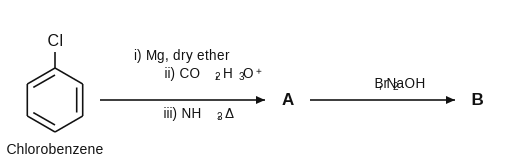
Consider the following sequence of reactions:

11.25 mg of chlorobenzene will produce __________ ×10−1 mg of product B. (Consider the reactions result in complete conversion.)
[Given molar mass of C, H, O, N and Cl as 12, 1, 16, 14 and 35.5 g mol−1 respectively]
निम्नलिखित अभिक्रिया अनुक्रम पर विचार कीजिए:

11.25 mg क्लोरोबेंज़ीन से __________ ×10−1 mg उत्पाद B प्राप्त होगा। (मान लीजिए अभिक्रियाओं में पूर्ण रूपांतरण होता है।)
[दिया है: C, H, O, N तथा Cl के मोलर द्रव्यमान क्रमशः 12, 1, 16, 14 तथा 35.5 g mol−1]
Show answer

Concept: Grignard carboxylation gives the acid; NH3/Δ gives the amide A; Br2/NaOH (Hofmann bromamide degradation) gives the amine B with one carbon less.

  1. C6H5Cl → (i) Mg/dry ether → C6H5MgCl; (ii) CO2, H3O+ → C6H5COOH; (iii) NH3, Δ → A = C6H5CONH2.
  2. A + Br2/NaOH → B = C6H5NH2 (aniline, M = 93 g mol−1).
  3. Moles of chlorobenzene =11.25×10−3112.5=10−4 mol; 1 : 1 stoichiometry throughout.
  4. Mass of B =10−4×93=9.3×10⁻³ g =9.3 mg =93×10−1 mg.

Short trick: 11.25 mg is exactly 10−4 mol of PhCl (M = 112.5); the answer is just the molar mass of aniline read in units of 10−1 mg.

Answer: 93

अवधारणा: ग्रीन्यार कार्बोक्सिलन से अम्ल; NH3/Δ से ऐमाइड A; Br2/NaOH (हॉफमान ब्रोमामाइड निम्नीकरण) से एक कार्बन कम वाली ऐमीन B बनती है।

  1. C6H5Cl → (i) Mg/शुष्क ईथर → C6H5MgCl; (ii) CO2, H3O+ → C6H5COOH; (iii) NH3, Δ → A = C6H5CONH2।
  2. A + Br2/NaOH → B = C6H5NH2 (ऐनिलीन, M = 93 g mol−1)।
  3. क्लोरोबेंज़ीन के मोल =11.25×10−3112.5=10−4 mol; पूरे अनुक्रम में 1 : 1 रससमीकरणमिति।
  4. B का द्रव्यमान =10−4×93=9.3×10⁻³ g =9.3 mg =93×10−1 mg।

शॉर्ट ट्रिक: 11.25 mg ठीक 10−4 mol PhCl है (M = 112.5); उत्तर, ऐनिलीन का मोलर द्रव्यमान ही 10−1 mg इकाई में है।

उत्तर: 93

JEE Main 2025 (January) – Paper 1 (B.E./B.Tech)ChemistryOrganic conversions – Grignard & Hofmann bromamide (stoichiometry)JEE Main 2025 (January) – Paper 1 (B.E./B.Tech) 2025 · 28 Jan Shift 1 →
Q1949.
Quantitative analysis of an organic compound (X) shows following % composition. C : 14.5%, Cl : 64.46%, H : 1.8%.
Empirical formula mass of the compound (X) is __________ ×10−1
(Given molar mass in g mol−1 of C : 12, H : 1, O : 16, Cl : 35.5)
एक कार्बनिक यौगिक (X) के मात्रात्मक विश्लेषण से निम्नलिखित % संघटन प्राप्त होता है। C : 14.5%, Cl : 64.46%, H : 1.8%।
यौगिक (X) का मूलानुपाती सूत्र द्रव्यमान __________ ×10−1 है
(दिया है: g mol−1 में मोलर द्रव्यमान C : 12, H : 1, O : 16, Cl : 35.5)
Show answer

Concept: The missing percentage is oxygen; find mole ratios and the simplest whole-number formula.

  1. O% =100−(14.5+64.46+1.8)=19.24%.
  2. Relative moles: C =14.512=1.208; H =1.81=1.8; Cl =64.4635.5=1.816; O =19.2416=1.203.
  3. Divide by 1.203: C : H : Cl : O =1:1.5:1.5:1; multiply by 2 → C2H3Cl3O2 (chloral hydrate, CCl3CH(OH)2).
  4. Empirical formula mass =2(12)+3(1)+3(35.5)+2(16)=24+3+106.5+32=165.5=1655×10−1.

Short trick: When ratios come out as 1 : 1.5, double everything — halves always mean a factor of 2.

Answer: 1655

अवधारणा: शेष प्रतिशत ऑक्सीजन का है; मोल अनुपात निकालकर सरलतम पूर्णांक सूत्र ज्ञात कीजिए।

  1. O% =100−(14.5+64.46+1.8)=19.24%।
  2. आपेक्षिक मोल: C =14.512=1.208; H =1.81=1.8; Cl =64.4635.5=1.816; O =19.2416=1.203।
  3. 1.203 से भाग देने पर: C : H : Cl : O =1:1.5:1.5:1; 2 से गुणा कीजिए → C2H3Cl3O2 (क्लोरल हाइड्रेट, CCl3CH(OH)2)।
  4. मूलानुपाती सूत्र द्रव्यमान =2(12)+3(1)+3(35.5)+2(16)=24+3+106.5+32=165.5=1655×10−1।

शॉर्ट ट्रिक: अनुपात 1 : 1.5 आए तो सबको दोगुना कीजिए — आधे का अर्थ सदैव गुणक 2 होता है।

उत्तर: 1655

JEE Main 2025 (January) – Paper 1 (B.E./B.Tech)ChemistrySome basic concepts – empirical formulaJEE Main 2025 (January) – Paper 1 (B.E./B.Tech) 2025 · 28 Jan Shift 1 →
Q1950.
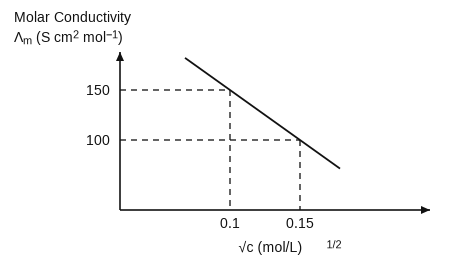
Given below is the plot of the molar conductivity vs concentration for KCl in aqueous solution.

If, for the higher concentration of KCl solution, the resistance of the conductivity cell is 100 Ω, then the resistance of the same cell with the dilute solution is 'x' Ω. The value of x is __________ (Nearest integer)
जलीय विलयन में KCl के लिए मोलर चालकता व सांद्रता का आलेख नीचे दिया गया है।

यदि KCl विलयन की अधिक सांद्रता के लिए चालकता सेल का प्रतिरोध 100 Ω है, तो तनु विलयन के साथ उसी सेल का प्रतिरोध 'x' Ω है। x का मान __________ है (निकटतम पूर्णांक)
Show answer

Concept: Λm=1000κc and, for the same cell, R=G∗κ (cell constant G∗ fixed), so R2R1=κ1κ2.

  1. From the plot: higher concentration — c=0.15, c1=0.0225 M, Λ1=100 S cm2 mol−1; dilute — c=0.1, c2=0.01 M, Λ2=150 S cm2 mol−1.
  2. κ1=100×0.02251000=2.25×10⁻³ S cm−1; κ2=150×0.011000=1.50×10⁻³ S cm−1.
  3. x=R2=R1×κ1κ2=100×2.251.50=150 Ω.

Short trick: R∝1Λc: x=100×100×0.0225150×0.01=150.

Answer: 150

अवधारणा: Λm=1000κc तथा एक ही सेल के लिए R=G∗κ (सेल स्थिरांक G∗ नियत), अतः R2R1=κ1κ2।

  1. आलेख से: अधिक सांद्रता — c=0.15, c1=0.0225 M, Λ1=100 S cm2 mol−1; तनु — c=0.1, c2=0.01 M, Λ2=150 S cm2 mol−1।
  2. κ1=100×0.02251000=2.25×10⁻³ S cm−1; κ2=150×0.011000=1.50×10⁻³ S cm−1।
  3. x=R2=R1×κ1κ2=100×2.251.50=150 Ω।

शॉर्ट ट्रिक: R∝1Λc: x=100×100×0.0225150×0.01=150।

उत्तर: 150

JEE Main 2025 (January) – Paper 1 (B.E./B.Tech)ChemistryElectrochemistry – molar conductivity & cell resistanceJEE Main 2025 (January) – Paper 1 (B.E./B.Tech) 2025 · 28 Jan Shift 1 →
Q1951.
Group A consists of 7 boys and 3 girls, while group B consists of 6 boys and 5 girls. The number of ways, 4 boys and 4 girls can be invited for a picnic if 5 of them must be from group A and the remaining 3 from group B, is equal to :
समूह A में 7 लड़के और 3 लड़कियाँ हैं, जबकि समूह B में 6 लड़के और 5 लड़कियाँ हैं। एक पिकनिक के लिए 4 लड़कों तथा 4 लड़कियों को आमंत्रित करने के तरीकों की संख्या, यदि उनमें से 5 समूह A से तथा शेष 3 समूह B से होने आवश्यक हैं, बराबर है :
  1. A8750
  2. B9100
  3. C8925
  4. D8575
Show answer

Concept: Split the selection by the number of boys taken from group A and use nCr for each group.

  1. Let group A give k boys and 5−k girls. A has only 3 girls, so 5−k≤3⇒k≥2; also the total of 4 boys needs k≤4.
  2. Group B then gives 4−k boys and k−1 girls (so that girls total 4).
  3. k=2: 7C23C3⋅6C25C1=21⋅1⋅15⋅5=1575.
  4. k=3: 7C33C2⋅6C15C2=35⋅3⋅6⋅10=6300.
  5. k=4: 7C43C1⋅6C05C3=35⋅3⋅1⋅10=1050.
  6. Total =1575+6300+1050=8925.

Short trick: Fix only the boys from A (k=2,3,4) – all the other counts are forced by the totals.

Answer: (C) 8925

अवधारणा: समूह A से लिए गए लड़कों की संख्या के अनुसार चयन को बाँटिए और प्रत्येक समूह के लिए nCr लगाइए।

  1. मान लीजिए समूह A से k लड़के और 5−k लड़कियाँ ली गईं। A में केवल 3 लड़कियाँ हैं, अतः 5−k≤3⇒k≥2; साथ ही कुल 4 लड़कों के लिए k≤4।
  2. तब समूह B से 4−k लड़के और k−1 लड़कियाँ आएँगी (ताकि लड़कियाँ कुल 4 हों)।
  3. k=2: 7C23C3⋅6C25C1=21⋅1⋅15⋅5=1575।
  4. k=3: 7C33C2⋅6C15C2=35⋅3⋅6⋅10=6300।
  5. k=4: 7C43C1⋅6C05C3=35⋅3⋅1⋅10=1050।
  6. योग =1575+6300+1050=8925।

शॉर्ट ट्रिक: केवल A से लिए गए लड़के (k=2,3,4) तय कीजिए – बाकी सभी संख्याएँ योगों से स्वयं निश्चित हो जाती हैं।

उत्तर: (C) 8925

JEE Main 2025 (January) – Paper 1 (B.E./B.Tech)MathematicsPermutations & Combinations – selection from groupsJEE Main 2025 (January) – Paper 1 (B.E./B.Tech) 2025 · 24 Jan Shift 2 →
Q1952.
If the system of equations x+2y−3z=2, 2x+λy+5z=5, 14x+3y+μz=33 has infinitely many solutions, then λ+μ is equal to :
यदि समीकरण निकाय x+2y−3z=2, 2x+λy+5z=5, 14x+3y+μz=33 के अपरिमित रूप से अनेक हल हैं, तो λ+μ बराबर है :
  1. A13
  2. B10
  3. C12
  4. D11
Show answer

Concept: For infinitely many solutions the third equation must be a linear combination of the first two (the system is dependent and consistent).

  1. Let (eq. 3) =m(eq. 1)+n(eq. 2). Comparing coefficients of x: m+2n=14; comparing constants: 2m+5n=33.
  2. Solving: m=4, n=5.
  3. Coefficient of y: 3=m⋅2+nλ=8+5λ⇒λ=−1.
  4. Coefficient of z: μ=m(−3)+n(5)=−12+25=13.
  5. λ+μ=−1+13=12.

Short trick: The two unknown-free columns (x-coefficients and constants) give m,n at once; then λ,μ drop out.

Answer: (C) 12

अवधारणा: अपरिमित रूप से अनेक हलों के लिए तीसरा समीकरण पहले दो का रैखिक संयोजन (linear combination) होना चाहिए (निकाय परतंत्र तथा संगत हो)।

  1. मान लीजिए (समी. 3) =m(समी. 1)+n(समी. 2)। x के गुणांकों की तुलना से: m+2n=14; अचरों की तुलना से: 2m+5n=33।
  2. हल करने पर: m=4, n=5।
  3. y का गुणांक: 3=m⋅2+nλ=8+5λ⇒λ=−1।
  4. z का गुणांक: μ=m(−3)+n(5)=−12+25=13।
  5. λ+μ=−1+13=12।

शॉर्ट ट्रिक: जिन दो स्तंभों में अज्ञात नहीं हैं (x-गुणांक और अचर), वे तुरंत m,n दे देते हैं; फिर λ,μ सीधे मिल जाते हैं।

उत्तर: (C) 12

JEE Main 2025 (January) – Paper 1 (B.E./B.Tech)MathematicsDeterminants – system of linear equationsJEE Main 2025 (January) – Paper 1 (B.E./B.Tech) 2025 · 24 Jan Shift 2 →
Q1953.
Let A={x∈(0,π)−{π2}:log(2/π)⁡|sin⁡x|+log(2/π)⁡|cos⁡x|=2} and B={x⩾0:x(x−4)−3|x−2|+6=0}. Then n(A∪B) is equal to :
माना A={x∈(0,π)−{π2}:log(2/π)⁡|sin⁡x|+log(2/π)⁡|cos⁡x|=2} तथा B={x⩾0:x(x−4)−3|x−2|+6=0} हैं। तब n(A∪B) बराबर है :
  1. A4
  2. B8
  3. C6
  4. D2
Show answer

Concept: Combine the logs into one; count solutions of |sin⁡2x|=c graphically. For B, substitute t=x and split the modulus.

  1. Set A: log(2/π)⁡|sin⁡xcos⁡x|=2⇒|sin⁡xcos⁡x|=(2π)2⇒|sin⁡2x|=8π2≈0.81.
  2. As x∈(0,π), 2x∈(0,2π), and |sin⁡θ|=c with 0<c<1 has 4 solutions there, so n(A)=4 (none at x=π2 since there cos⁡x=0).
  3. Set B: put t=x≥0: t2−4t−3|t−2|+6=0.
  4. t≥2: t2−7t+12=0⇒t=3,4 (both valid). 0≤t<2: t2−t=0⇒t=0,1 (both valid).
  5. So B={0,1,9,16}, n(B)=4. Elements of A are non-integer values in (0,π), so A∩B=∅.
  6. n(A∪B)=4+4=8.

Short trick: |sin⁡2x|=c∈(0,1) always gives 4 roots per full period of 2x – no need to find them.

Answer: (B) 8

अवधारणा: लघुगणकों (logs) को मिलाइए; |sin⁡2x|=c के हल आलेख से गिनिए। B के लिए t=x रखकर मापांक (modulus) के दो स्थिति लीजिए।

  1. समुच्चय A: log(2/π)⁡|sin⁡xcos⁡x|=2⇒|sin⁡xcos⁡x|=(2π)2⇒|sin⁡2x|=8π2≈0.81।
  2. x∈(0,π) से 2x∈(0,2π), और 0<c<1 के लिए |sin⁡θ|=c के वहाँ 4 हल होते हैं, अतः n(A)=4 (x=π2 पर कोई हल नहीं क्योंकि वहाँ cos⁡x=0)।
  3. समुच्चय B: t=x≥0 रखने पर: t2−4t−3|t−2|+6=0।
  4. t≥2: t2−7t+12=0⇒t=3,4 (दोनों मान्य)। 0≤t<2: t2−t=0⇒t=0,1 (दोनों मान्य)।
  5. अतः B={0,1,9,16}, n(B)=4। A के अवयव (0,π) में अपूर्णांक मान हैं, अतः A∩B=∅।
  6. n(A∪B)=4+4=8।

शॉर्ट ट्रिक: |sin⁡2x|=c∈(0,1) के 2x के प्रत्येक पूर्ण आवर्त में सदा 4 मूल होते हैं – उन्हें ज्ञात करने की आवश्यकता नहीं।

उत्तर: (B) 8

JEE Main 2025 (January) – Paper 1 (B.E./B.Tech)MathematicsSets – number of elements, trigonometric & modulus equationsJEE Main 2025 (January) – Paper 1 (B.E./B.Tech) 2025 · 24 Jan Shift 2 →
Q1954.
The area of the region enclosed by the curves y=ex, y=|ex−1| and y-axis is:
वक्रों y=ex, y=|ex−1| तथा y-अक्ष से परिबद्ध क्षेत्र का क्षेत्रफल है:
  1. A1−loge⁡2
  2. Bloge⁡2
  3. C1+loge⁡2
  4. D2loge⁡2−1
Show answer

Concept: Open the modulus region-wise, find where the two curves meet, and integrate (upper − lower).

  1. For x<0, ex<1, so |ex−1|=1−ex; for x>0 it is ex−1, which never meets ex.
  2. Intersection: ex=1−ex⇒ex=12⇒x=−loge⁡2.
  3. Between x=−loge⁡2 and the y-axis, upper curve =ex, lower =1−ex.
  4. Area =∫−loge⁡20(2ex−1)dx=[2ex−x]−loge⁡20=2−(1+loge⁡2)=1−loge⁡2.

Short trick: Only the x<0 branch of the modulus can close a region with y=ex and the y-axis.

Answer: (A) 1−loge⁡2

अवधारणा: मापांक को क्षेत्रानुसार खोलिए, वक्रों का प्रतिच्छेद बिंदु निकालिए, और (ऊपरी − निचला) का समाकलन कीजिए।

  1. x<0 के लिए ex<1, अतः |ex−1|=1−ex; x>0 के लिए यह ex−1 है, जो ex से कभी नहीं मिलता।
  2. प्रतिच्छेदन: ex=1−ex⇒ex=12⇒x=−loge⁡2।
  3. x=−loge⁡2 और y-अक्ष के बीच ऊपरी वक्र =ex, निचला =1−ex।
  4. क्षेत्रफल =∫−loge⁡20(2ex−1)dx=[2ex−x]−loge⁡20=2−(1+loge⁡2)=1−loge⁡2।

शॉर्ट ट्रिक: केवल मापांक की x<0 वाली शाखा ही y=ex और y-अक्ष के साथ बंद क्षेत्र बना सकती है।

उत्तर: (A) 1−loge⁡2

JEE Main 2025 (January) – Paper 1 (B.E./B.Tech)MathematicsArea under curves – definite integrationJEE Main 2025 (January) – Paper 1 (B.E./B.Tech) 2025 · 24 Jan Shift 2 →
Q1955.
The equation of the chord, of the ellipse x225+y216=1, whose mid-point is (3,1) is :
दीर्घवृत्त x225+y216=1 की उस जीवा का समीकरण, जिसका मध्य-बिंदु (3,1) है, है :
  1. A48x+25y=169
  2. B5x+16y=31
  3. C25x+101y=176
  4. D4x+122y=134
Show answer

Concept: Chord with mid-point (x1,y1): T=S1, i.e. xx1a2+yy1b2=x12a2+y12b2.

  1. Here 3x25+y16=925+116.
  2. Multiply by 400: 48x+25y=144+25=169.

Short trick: T=S1 gives the answer in one line – no need to find the end points.

Answer: (A) 48x+25y=169

अवधारणा: मध्य-बिंदु (x1,y1) वाली जीवा: T=S1, अर्थात xx1a2+yy1b2=x12a2+y12b2।

  1. यहाँ 3x25+y16=925+116।
  2. 400 से गुणा करने पर: 48x+25y=144+25=169।

शॉर्ट ट्रिक: T=S1 से उत्तर एक ही पंक्ति में मिल जाता है – जीवा के सिरे निकालने की आवश्यकता नहीं।

उत्तर: (A) 48x+25y=169

JEE Main 2025 (January) – Paper 1 (B.E./B.Tech)MathematicsEllipse – chord with given mid-pointJEE Main 2025 (January) – Paper 1 (B.E./B.Tech) 2025 · 24 Jan Shift 2 →
Q1956.
Let the points (112,α) lie on or inside the triangle with sides x+y=11, x+2y=16 and 2x+3y=29. Then the product of the smallest and the largest values of α is equal to :
माना बिंदु (112,α), भुजाओं x+y=11, x+2y=16 तथा 2x+3y=29 वाले त्रिभुज पर या उसके अंदर स्थित हैं। तब α के न्यूनतम तथा अधिकतम मानों का गुणनफल बराबर है :
  1. A44
  2. B22
  3. C33
  4. D55
Show answer

Concept: A point is on or inside the triangle iff for each side it lies on the same side as the opposite vertex.

  1. Vertices: x+y=11, x+2y=16⇒(6,5); x+y=11, 2x+3y=29⇒(4,7); x+2y=16, 2x+3y=29⇒(10,3).
  2. Side x+y=11, opposite vertex (10,3): 13≥11, so need 112+α≥11⇒α≥112.
  3. Side x+2y=16, opposite vertex (4,7): 18≥16, so need 112+2α≥16⇒α≥214.
  4. Side 2x+3y=29, opposite vertex (6,5): 27≤29, so need 11+3α≤29⇒α≤6.
  5. Hence α∈[112,6]; product =112×6=33.

Short trick: Test each side’s inequality with the opposite vertex – it fixes the direction of the inequality instantly.

Answer: (C) 33

अवधारणा: कोई बिंदु त्रिभुज पर या उसके अंदर तभी है जब वह प्रत्येक भुजा के सापेक्ष सम्मुख शीर्ष की ओर ही स्थित हो।

  1. शीर्ष: x+y=11, x+2y=16⇒(6,5); x+y=11, 2x+3y=29⇒(4,7); x+2y=16, 2x+3y=29⇒(10,3)।
  2. भुजा x+y=11, सम्मुख शीर्ष (10,3): 13≥11, अतः 112+α≥11⇒α≥112।
  3. भुजा x+2y=16, सम्मुख शीर्ष (4,7): 18≥16, अतः 112+2α≥16⇒α≥214।
  4. भुजा 2x+3y=29, सम्मुख शीर्ष (6,5): 27≤29, अतः 11+3α≤29⇒α≤6।
  5. अतः α∈[112,6]; गुणनफल =112×6=33।

शॉर्ट ट्रिक: प्रत्येक भुजा की असमिका सम्मुख शीर्ष पर जाँचिए – असमिका की दिशा तुरंत तय हो जाती है।

उत्तर: (C) 33

JEE Main 2025 (January) – Paper 1 (B.E./B.Tech)MathematicsStraight lines – point inside a triangle, linear inequalitiesJEE Main 2025 (January) – Paper 1 (B.E./B.Tech) 2025 · 24 Jan Shift 2 →
Q1957.
Let f:(0,∞)→R be a function which is differentiable at all points of its domain and satisfies the condition x2f′(x)=2xf(x)+3, with f(1)=4. Then 2f(2) is equal to :
माना f:(0,∞)→R एक ऐसा फलन है जो अपने प्रांत के सभी बिंदुओं पर अवकलनीय है तथा प्रतिबंध x2f′(x)=2xf(x)+3, जहाँ f(1)=4 है, को संतुष्ट करता है। तब 2f(2) बराबर है :
  1. A39
  2. B19
  3. C29
  4. D23
Show answer

Concept: Rewrite as a linear ODE f′−2xf=3x2 and use the integrating factor.

  1. Integrating factor =e∫−2xdx=x−2, so (fx2)′=3x4.
  2. Integrating: fx2=−1x3+C⇒f(x)=−1x+Cx2.
  3. f(1)=4: −1+C=4⇒C=5.
  4. f(2)=−12+20=392, so 2f(2)=39.

Short trick: x2f′−2xfx4=(fx2)′ – spot the quotient-rule pattern directly.

Answer: (A) 39

अवधारणा: इसे रैखिक अवकल समीकरण f′−2xf=3x2 के रूप में लिखकर समाकलन गुणक (integrating factor) लगाइए।

  1. समाकलन गुणक =e∫−2xdx=x−2, अतः (fx2)′=3x4।
  2. समाकलन करने पर: fx2=−1x3+C⇒f(x)=−1x+Cx2।
  3. f(1)=4: −1+C=4⇒C=5।
  4. f(2)=−12+20=392, अतः 2f(2)=39।

शॉर्ट ट्रिक: x2f′−2xfx4=(fx2)′ – भागफल-नियम (quotient rule) का प्रतिरूप सीधे पहचानिए।

उत्तर: (A) 39

JEE Main 2025 (January) – Paper 1 (B.E./B.Tech)MathematicsDifferential equations – linear first orderJEE Main 2025 (January) – Paper 1 (B.E./B.Tech) 2025 · 24 Jan Shift 2 →
Q1958.
If 7=5+17(5+α)+172(5+2α)+173(5+3α)+…∞, then the value of α is :
यदि 7=5+17(5+α)+172(5+2α)+173(5+3α)+…∞ है, तो α का मान है :
  1. A67
  2. B6
  3. C17
  4. D1
Show answer

Concept: Split the AGP into a GP part and an nrn part: ∑n≥0rn=11−r and ∑n≥1nrn=r(1−r)2.

  1. With r=17: sum =5∑n≥0rn+α∑n≥1nrn=51−17+α17(1−17)2.
  2. =356+α⋅1/736/49=356+7α36.
  3. Equate to 7: 7α36=7−356=76⇒α=6.

Short trick: Memorise ∑nrn=r(1−r)2 – AGP sums then take one line.

Answer: (B) 6

अवधारणा: समांतर-गुणोत्तर श्रेणी (AGP) को GP भाग और nrn भाग में बाँटिए: ∑n≥0rn=11−r तथा ∑n≥1nrn=r(1−r)2।

  1. r=17 के साथ: योग =5∑n≥0rn+α∑n≥1nrn=51−17+α17(1−17)2।
  2. =356+α⋅1/736/49=356+7α36।
  3. 7 के बराबर रखने पर: 7α36=7−356=76⇒α=6।

शॉर्ट ट्रिक: ∑nrn=r(1−r)2 याद रखिए – AGP का योग एक पंक्ति में निकल जाता है।

उत्तर: (B) 6

JEE Main 2025 (January) – Paper 1 (B.E./B.Tech)MathematicsArithmetico-geometric series – sum to infinityJEE Main 2025 (January) – Paper 1 (B.E./B.Tech) 2025 · 24 Jan Shift 2 →
Q1959.
Let [x] denote the greatest integer function, and let m and n respectively be the numbers of the points, where the function f(x)=[x]+|x−2|, −2<x<3, is not continuous and not differentiable. Then m+n is equal to :
माना [x] महत्तम पूर्णांक फलन को दर्शाता है, तथा m और n क्रमशः उन बिंदुओं की संख्याएँ हैं जहाँ फलन f(x)=[x]+|x−2|, −2<x<3, संतत नहीं है और अवकलनीय नहीं है। तब m+n बराबर है :
  1. A6
  2. B8
  3. C9
  4. D7
Show answer

Concept: [x] jumps at every integer; |x−2| is continuous everywhere with a corner at x=2. Discontinuity of the sum comes only from [x].

  1. Integers inside the open interval (−2,3): x=−1,0,1,2. At each, [x] jumps by 1 while |x−2| is continuous, so f is discontinuous there: m=4.
  2. Wherever f is discontinuous it is automatically non-differentiable, so x=−1,0,1,2 are all non-differentiability points.
  3. The only extra candidate is the corner of |x−2| at x=2, which is already counted. Elsewhere f is smooth: n=4.
  4. m+n=4+4=8.

Short trick: End points −2 and 3 are excluded (open interval) – a common trap that would give 6 integers.

Answer: (B) 8

अवधारणा: [x] प्रत्येक पूर्णांक पर उछाल (jump) लेता है; |x−2| सर्वत्र संतत है और x=2 पर कोना (corner) रखता है। योग की असांतत्यता केवल [x] से आती है।

  1. विवृत अंतराल (−2,3) के भीतर पूर्णांक: x=−1,0,1,2। प्रत्येक पर [x] में 1 का उछाल है जबकि |x−2| संतत है, अतः f वहाँ असंतत है: m=4।
  2. जहाँ f असंतत है वहाँ वह स्वतः अवकलनीय नहीं है, अतः x=−1,0,1,2 सभी अनवकलनीयता के बिंदु हैं।
  3. एकमात्र अन्य संभावित बिंदु |x−2| का कोना x=2 है, जो पहले से गिना जा चुका है। अन्यत्र f चिकना है: n=4।
  4. m+n=4+4=8।

शॉर्ट ट्रिक: सिरे −2 और 3 शामिल नहीं हैं (विवृत अंतराल) – यह सामान्य जाल है जो 6 पूर्णांक दिला देता।

उत्तर: (B) 8

JEE Main 2025 (January) – Paper 1 (B.E./B.Tech)MathematicsContinuity & differentiability – greatest integer and modulusJEE Main 2025 (January) – Paper 1 (B.E./B.Tech) 2025 · 24 Jan Shift 2 →
Q1960.
Let A=[aij] be a square matrix of order 2 with entries either 0 or 1 . Let E be the event that A is an invertible matrix. Then the probability P(E) is :
माना A=[aij], 2 कोटि का एक वर्ग आव्यूह है जिसकी प्रविष्टियाँ 0 अथवा 1 हैं। माना E वह घटना है कि A एक व्युत्क्रमणीय आव्यूह है। तब प्रायिकता P(E) है :
  1. A316
  2. B58
  3. C38
  4. D18
Show answer

Concept: A=(abcd) is invertible iff ad−bc≠0. Count over the 24=16 equally likely matrices.

  1. With entries in {0,1}, ad,bc∈{0,1}, so ad−bc≠0 means (ad,bc)=(1,0) or (0,1).
  2. ad=1 happens in 1 way (a=d=1); ad=0 in 3 ways. Same for bc.
  3. Favourable =1×3+3×1=6.
  4. P(E)=616=38.

Short trick: Count via the pair (ad,bc) instead of listing all 16 matrices.

Answer: (C) 38

अवधारणा: A=(abcd) व्युत्क्रमणीय है यदि और केवल यदि ad−bc≠0। कुल 24=16 समसंभाव्य आव्यूहों में गणना कीजिए।

  1. प्रविष्टियाँ {0,1} में होने से ad,bc∈{0,1}, अतः ad−bc≠0 का अर्थ है (ad,bc)=(1,0) अथवा (0,1)।
  2. ad=1 केवल 1 प्रकार से (a=d=1); ad=0 के 3 प्रकार। यही bc के लिए भी।
  3. अनुकूल आव्यूह =1×3+3×1=6।
  4. P(E)=616=38।

शॉर्ट ट्रिक: सभी 16 आव्यूह लिखने के बजाय युग्म (ad,bc) से गिनती कीजिए।

उत्तर: (C) 38

JEE Main 2025 (January) – Paper 1 (B.E./B.Tech)MathematicsProbability – counting invertible 0-1 matricesJEE Main 2025 (January) – Paper 1 (B.E./B.Tech) 2025 · 24 Jan Shift 2 →