Question bank

Q&A: practice questions with answers

Search questions on any topic. Filter by exam category, exam, subject and topic, try the question, then open the answer and explanation.

Courses – airGurukul

53,050 questions in the question bank.

Q1961.
Let the position vectors of three vertices of a triangle be 4p→+q→−3r→, −5p→+q→+2r→ and 2p→−q→+2r→. If the position vectors of the orthocenter and the circumcenter of the triangle are p→+q→+r→4 and αp→+βq→+γr→ respectively, then α+2β+5γ is equal to :
माना एक त्रिभुज के तीन शीर्षों के स्थिति सदिश 4p→+q→−3r→, −5p→+q→+2r→ तथा 2p→−q→+2r→ हैं। यदि त्रिभुज के लम्बकेन्द्र (orthocenter) तथा परिकेन्द्र (circumcenter) के स्थिति सदिश क्रमशः p→+q→+r→4 तथा αp→+βq→+γr→ हैं, तो α+2β+5γ बराबर है :
  1. A3
  2. B4
  3. C1
  4. D6
Show answer

Concept: On the Euler line the centroid G divides the segment from circumcentre O to orthocentre H in the ratio OG:GH=1:2, i.e. G→=2O→+H→3.

  1. Sum of the vertex vectors =(4−5+2)p→+(1+1−1)q→+(−3+2+2)r→=p→+q→+r→, so G→=p→+q→+r→3.
  2. O→=3G→−H→2=12[(p→+q→+r→)−p→+q→+r→4]=38(p→+q→+r→).
  3. So α=β=γ=38 and α+2β+5γ=38(1+2+5)=3.

Short trick: O→=3G→−H→2 is worth memorising for Euler-line questions.

Answer: (A) 3

अवधारणा: ऑयलर रेखा पर केन्द्रक G, परिकेन्द्र O से लम्बकेन्द्र H तक के रेखाखंड को OG:GH=1:2 में विभाजित करता है, अर्थात G→=2O→+H→3।

  1. शीर्ष सदिशों का योग =(4−5+2)p→+(1+1−1)q→+(−3+2+2)r→=p→+q→+r→, अतः G→=p→+q→+r→3।
  2. O→=3G→−H→2=12[(p→+q→+r→)−p→+q→+r→4]=38(p→+q→+r→)।
  3. अतः α=β=γ=38 तथा α+2β+5γ=38(1+2+5)=3।

शॉर्ट ट्रिक: ऑयलर-रेखा के प्रश्नों के लिए O→=3G→−H→2 याद रखने योग्य है।

उत्तर: (A) 3

JEE Main 2025 (January) – Paper 1 (B.E./B.Tech)MathematicsVectors – orthocentre, circumcentre and Euler lineJEE Main 2025 (January) – Paper 1 (B.E./B.Tech) 2025 · 24 Jan Shift 2 →
Q1962.
Let a→=3i^−j^+2k^, b→=a→×(i^−2k^) and c→=b→×k^. Then the projection of c→−2j^ on a→ is :
माना a→=3i^−j^+2k^, b→=a→×(i^−2k^) तथा c→=b→×k^ हैं। तब a→ पर c→−2j^ का प्रक्षेप है :
  1. A214
  2. B14
  3. C37
  4. D27
Show answer

Concept: Compute the cross products with determinants; projection of u→ on a→ is u→⋅a→|a→|.

  1. b→=a→×(i^−2k^)=|i^j^k^3−1210−2|=2i^+8j^+k^.
  2. c→=b→×k^=|i^j^k^281001|=8i^−2j^.
  3. c→−2j^=8i^−4j^; (c→−2j^)⋅a→=24+4+0=28; |a→|=14.
  4. Projection =2814=214.

Short trick: (xi^+yj^+zk^)×k^=yi^−xj^ – crossing with k^ just rotates the xy-part.

Answer: (A) 214

अवधारणा: सदिश गुणनफल सारणिकों से निकालिए; a→ पर u→ का प्रक्षेप u→⋅a→|a→| होता है।

  1. b→=a→×(i^−2k^)=|i^j^k^3−1210−2|=2i^+8j^+k^।
  2. c→=b→×k^=|i^j^k^281001|=8i^−2j^।
  3. c→−2j^=8i^−4j^; (c→−2j^)⋅a→=24+4+0=28; |a→|=14।
  4. प्रक्षेप =2814=214।

शॉर्ट ट्रिक: (xi^+yj^+zk^)×k^=yi^−xj^ – k^ से गुणन xy-भाग को केवल घुमा देता है।

उत्तर: (A) 214

JEE Main 2025 (January) – Paper 1 (B.E./B.Tech)MathematicsVector algebra – cross product and projectionJEE Main 2025 (January) – Paper 1 (B.E./B.Tech) 2025 · 24 Jan Shift 2 →
Q1963.
The number of real solution(s) of the equation x2+3x+2=min{|x−3|,|x+2|} is :
समीकरण x2+3x+2=min{|x−3|,|x+2|} के वास्तविक हल(हलों) की संख्या है :
  1. A1
  2. B0
  3. C2
  4. D3
Show answer

Concept: |x+2|=|x−3| at x=12; for x≤12 the min is |x+2|, for x≥12 it is |x−3|. Also x2+3x+2=(x+1)(x+2).

  1. −2≤x≤12: (x+1)(x+2)=x+2⇒(x+2)x=0⇒x=−2,0 – both lie in the range. ✓
  2. x<−2: (x+1)(x+2)=−(x+2)⇒(x+2)2=0⇒x=−2, not in x<−2. ✗
  3. 12≤x<3: (x+1)(x+2)=3−x⇒x2+4x−1=0⇒x=−2±5; neither lies in [12,3). ✗
  4. x≥3: x2+3x+2=x−3⇒x2+2x+5=0, discriminant <0. ✗
  5. Real solutions: x=−2 and x=0, i.e. 2 solutions.

Short trick: The midpoint x=−2+32=12 splits which modulus is smaller.

Answer: (C) 2

अवधारणा: x=12 पर |x+2|=|x−3|; x≤12 के लिए min =|x+2|, x≥12 के लिए min =|x−3|। साथ ही x2+3x+2=(x+1)(x+2)।

  1. −2≤x≤12: (x+1)(x+2)=x+2⇒(x+2)x=0⇒x=−2,0 – दोनों परास में हैं। ✓
  2. x<−2: (x+1)(x+2)=−(x+2)⇒(x+2)2=0⇒x=−2, जो x<−2 में नहीं है। ✗
  3. 12≤x<3: (x+1)(x+2)=3−x⇒x2+4x−1=0⇒x=−2±5; कोई भी [12,3) में नहीं। ✗
  4. x≥3: x2+3x+2=x−3⇒x2+2x+5=0, विविक्तकर <0। ✗
  5. वास्तविक हल: x=−2 तथा x=0, अर्थात 2 हल।

शॉर्ट ट्रिक: मध्य-बिंदु x=−2+32=12 तय करता है कि कौन-सा मापांक छोटा है।

उत्तर: (C) 2

JEE Main 2025 (January) – Paper 1 (B.E./B.Tech)MathematicsQuadratic & modulus equations – number of real solutionsJEE Main 2025 (January) – Paper 1 (B.E./B.Tech) 2025 · 24 Jan Shift 2 →
Q1964.
The function f:(−∞,∞)→(−∞,1), defined by f(x)=2x−2−x2x+2−x is :
फलन f:(−∞,∞)→(−∞,1), जो f(x)=2x−2−x2x+2−x द्वारा परिभाषित है, है :
  1. ANeither one-one nor ontoन तो एकैकी, न ही आच्छादक
  2. BOnto but not one-oneआच्छादक है परंतु एकैकी नहीं
  3. CBoth one-one and ontoएकैकी तथा आच्छादक दोनों
  4. DOne-one but not ontoएकैकी है परंतु आच्छादक नहीं
Show answer

Concept: Simplify to a strictly monotonic form and compare the range with the given codomain.

  1. Multiply numerator and denominator by 2x: f(x)=4x−14x+1=1−24x+1.
  2. 4x is strictly increasing, so f is strictly increasing ⇒ one-one.
  3. As x→−∞, f→−1; as x→∞, f→1. Range =(−1,1).
  4. Range (−1,1)≠ codomain (−∞,1) (e.g. −5 is never attained) ⇒ not onto.

Short trick: ax−a−xax+a−x is a tanh-type function: always strictly increasing with range (−1,1).

Answer: (D) One-one but not onto

अवधारणा: फलन को निरंतर एकदिष्ट (monotonic) रूप में सरल कीजिए और परिसर (range) की तुलना दिए गए सहप्रांत (codomain) से कीजिए।

  1. अंश व हर को 2x से गुणा करने पर: f(x)=4x−14x+1=1−24x+1।
  2. 4x निरंतर वर्धमान है, अतः f निरंतर वर्धमान है ⇒ एकैकी।
  3. x→−∞ पर f→−1; x→∞ पर f→1। परिसर =(−1,1)।
  4. परिसर (−1,1)≠ सहप्रांत (−∞,1) (जैसे −5 कभी प्राप्त नहीं होता) ⇒ आच्छादक नहीं।

शॉर्ट ट्रिक: ax−a−xax+a−x tanh-प्रकार का फलन है: सदा निरंतर वर्धमान, परिसर (−1,1)।

उत्तर: (D) एकैकी है परंतु आच्छादक नहीं

JEE Main 2025 (January) – Paper 1 (B.E./B.Tech)MathematicsFunctions – one-one and ontoJEE Main 2025 (January) – Paper 1 (B.E./B.Tech) 2025 · 24 Jan Shift 2 →
Q1965.
In an arithmetic progression, if S40=1030 and S12=57, then S30−S10 is equal to :
एक समांतर श्रेढ़ी में, यदि S40=1030 तथा S12=57 हैं, तो S30−S10 बराबर है :
  1. A525
  2. B510
  3. C515
  4. D505
Show answer

Concept: Sn=n2[2a+(n−1)d]; two conditions give a and d.

  1. S40=20(2a+39d)=1030⇒2a+39d=1032.
  2. S12=6(2a+11d)=57⇒2a+11d=192.
  3. Subtracting: 28d=42⇒d=32, then 2a=192−332=−7.
  4. S30=15(2a+29d)=15(−7+872)=10952; S10=5(2a+9d)=5(−7+272)=652.
  5. S30−S10=1095−652=515.

Short trick: S30−S10=∑k=1130Tk=20T11+302=20(a+392d)=10(2a+39d)=S402=515.

Answer: (C) 515

अवधारणा: Sn=n2[2a+(n−1)d]; दो प्रतिबंधों से a और d मिल जाते हैं।

  1. S40=20(2a+39d)=1030⇒2a+39d=1032।
  2. S12=6(2a+11d)=57⇒2a+11d=192।
  3. घटाने पर: 28d=42⇒d=32, फिर 2a=192−332=−7।
  4. S30=15(2a+29d)=15(−7+872)=10952; S10=5(2a+9d)=5(−7+272)=652।
  5. S30−S10=1095−652=515।

शॉर्ट ट्रिक: S30−S10=∑k=1130Tk=20T11+302=20(a+392d)=10(2a+39d)=S402=515।

उत्तर: (C) 515

JEE Main 2025 (January) – Paper 1 (B.E./B.Tech)MathematicsArithmetic progression – sums of n termsJEE Main 2025 (January) – Paper 1 (B.E./B.Tech) 2025 · 24 Jan Shift 2 →
Q1966.
Suppose A and B are the coefficients of 30th and 12th terms respectively in the binomial expansion of (1+x)2n−1. If 2A=5B, then n is equal to :
मान लीजिए (1+x)2n−1 के द्विपद प्रसार में 30वें तथा 12वें पदों के गुणांक क्रमशः A और B हैं। यदि 2A=5B है, तो n बराबर है :
  1. A22
  2. B20
  3. C21
  4. D19
Show answer

Concept: Tr+1 of (1+x)N has coefficient NCr, and NCr=NCN−r.

  1. With N=2n−1: A=NC29, B=NC11 and AB=52.
  2. Try the symmetric relation NC29=NC12, i.e. N−29=12⇒N=41.
  3. Then AB=41C1241C11=41−1112=3012=52 ✓ – both conditions hold, so N=41.
  4. 2n−1=41⇒n=21.

Short trick: NCr+1NCr=N−rr+1 turns consecutive-coefficient ratios into a one-step equation.

Answer: (C) 21

अवधारणा: (1+x)N के Tr+1 का गुणांक NCr होता है, तथा NCr=NCN−r।

  1. N=2n−1 के साथ: A=NC29, B=NC11 तथा AB=52।
  2. सममित संबंध NC29=NC12 लीजिए, अर्थात N−29=12⇒N=41।
  3. तब AB=41C1241C11=41−1112=3012=52 ✓ – दोनों प्रतिबंध संतुष्ट हैं, अतः N=41।
  4. 2n−1=41⇒n=21।

शॉर्ट ट्रिक: NCr+1NCr=N−rr+1 क्रमागत गुणांकों के अनुपात को एक-चरणीय समीकरण बना देता है।

उत्तर: (C) 21

JEE Main 2025 (January) – Paper 1 (B.E./B.Tech)MathematicsBinomial theorem – coefficients of termsJEE Main 2025 (January) – Paper 1 (B.E./B.Tech) 2025 · 24 Jan Shift 2 →
Q1967.
Let (2,3) be the largest open interval in which the function f(x)=2loge⁡(x−2)−x2+ax+1 is strictly increasing and (b,c) be the largest open interval, in which the function g(x)=(x−1)3(x+2−a)2 is strictly decreasing. Then 100(a+b−c) is equal to :
माना (2,3) वह सबसे बड़ा विवृत अंतराल है जिसमें फलन f(x)=2loge⁡(x−2)−x2+ax+1 निरंतर वर्धमान है तथा (b,c) वह सबसे बड़ा विवृत अंतराल है, जिसमें फलन g(x)=(x−1)3(x+2−a)2 निरंतर ह्रासमान है। तब 100(a+b−c) बराबर है :
  1. A420
  2. B360
  3. C160
  4. D280
Show answer

Concept: f increases where f′≥0; the end point of the largest interval makes f′ vanish. Then study the sign of g′.

  1. f′(x)=2x−2−2x+a on (2,∞). For (2,3) to be the largest increasing interval, f′(3)=2−6+a=0⇒a=4.
  2. Check: f′(x)=2x−2−2(x−2)=2[1−(x−2)2]x−2>0 exactly for x−2∈(0,1), i.e. on (2,3). ✓
  3. With a=4: g(x)=(x−1)3(x−2)2, g′(x)=(x−1)2(x−2)[3(x−2)+2(x−1)]=(x−1)2(x−2)(5x−8).
  4. g′<0⟺(x−2)(5x−8)<0⟺x∈(85,2), so b=85, c=2.
  5. 100(a+b−c)=100(4+85−2)=100×185=360.

Short trick: (x−1)2≥0 never changes sign – only (x−2)(5x−8) decides where g decreases.

Answer: (B) 360

अवधारणा: f वहाँ वर्धमान है जहाँ f′≥0; सबसे बड़े अंतराल के सिरे पर f′ शून्य होता है। फिर g′ का चिह्न देखिए।

  1. (2,∞) पर f′(x)=2x−2−2x+a। (2,3) के सबसे बड़ा वर्धमान अंतराल होने के लिए f′(3)=2−6+a=0⇒a=4।
  2. जाँच: f′(x)=2x−2−2(x−2)=2[1−(x−2)2]x−2>0 ठीक x−2∈(0,1) के लिए, अर्थात (2,3) पर। ✓
  3. a=4 के साथ: g(x)=(x−1)3(x−2)2, g′(x)=(x−1)2(x−2)[3(x−2)+2(x−1)]=(x−1)2(x−2)(5x−8)।
  4. g′<0⟺(x−2)(5x−8)<0⟺x∈(85,2), अतः b=85, c=2।
  5. 100(a+b−c)=100(4+85−2)=100×185=360।

शॉर्ट ट्रिक: (x−1)2≥0 कभी चिह्न नहीं बदलता – g कहाँ ह्रासमान है, यह केवल (x−2)(5x−8) तय करता है।

उत्तर: (B) 360

JEE Main 2025 (January) – Paper 1 (B.E./B.Tech)MathematicsApplication of derivatives – monotonicityJEE Main 2025 (January) – Paper 1 (B.E./B.Tech) 2025 · 24 Jan Shift 2 →
Q1968.
For some a, b, let f(x)=|a+sin⁡xx1ba1+sin⁡xxba1b+sin⁡xx|, x≠0, limx→0f(x)=λ+μa+νb. Then (λ+μ+ν)2 is equal to :
किन्हीं a, b के लिए, माना f(x)=|a+sin⁡xx1ba1+sin⁡xxba1b+sin⁡xx|, x≠0, limx→0f(x)=λ+μa+νb है। तब (λ+μ+ν)2 बराबर है :
  1. A16
  2. B25
  3. C9
  4. D36
Show answer

Concept: Write the matrix as sI+R with s=sin⁡xx and R the rank-one matrix whose every row is (a,1,b); then det(sI+R)=s3+s2tr(R).

  1. R has rank 1 with eigenvalues a+1+b,0,0, so det(sI+R)=s2(s+a+1+b).
  2. Hence f(x)=s3+(a+b+1)s2 with s=sin⁡xx→1 as x→0.
  3. limx→0f(x)=1+(a+b+1)=2+a+b, so λ=2, μ=1, ν=1.
  4. (λ+μ+ν)2=42=16.

Short trick: For a rank-one update, det(sI+R)=sn−1(s+trR) – no expansion needed.

Answer: (A) 16

अवधारणा: आव्यूह को sI+R लिखिए, जहाँ s=sin⁡xx तथा R वह कोटि-एक (rank-one) आव्यूह है जिसकी प्रत्येक पंक्ति (a,1,b) है; तब det(sI+R)=s3+s2tr(R)।

  1. R की कोटि 1 है और उसके आइगेनमान a+1+b,0,0 हैं, अतः det(sI+R)=s2(s+a+1+b)।
  2. अतः f(x)=s3+(a+b+1)s2, जहाँ x→0 पर s=sin⁡xx→1।
  3. limx→0f(x)=1+(a+b+1)=2+a+b, अतः λ=2, μ=1, ν=1।
  4. (λ+μ+ν)2=42=16।

शॉर्ट ट्रिक: कोटि-एक जोड़ के लिए det(sI+R)=sn−1(s+trR) – प्रसार की आवश्यकता ही नहीं।

उत्तर: (A) 16

JEE Main 2025 (January) – Paper 1 (B.E./B.Tech)MathematicsLimits – determinant with sin x/xJEE Main 2025 (January) – Paper 1 (B.E./B.Tech) 2025 · 24 Jan Shift 2 →
Q1969.
If the equation of the parabola with vertex V(32,3) and the directrix x+2y=0 is αx2+βy2−γxy−30x−60y+225=0, then α+β+γ is equal to :
यदि शीर्ष V(32,3) तथा नियता x+2y=0 वाले परवलय का समीकरण αx2+βy2−γxy−30x−60y+225=0 है, तो α+β+γ बराबर है :
  1. A7
  2. B9
  3. C8
  4. D6
Show answer

Concept: The vertex is the midpoint of the focus and the foot of the directrix along the axis; then use focus–directrix definition SP=PM.

  1. Unit normal to the directrix x+2y=0 is (1,2)5; distance of V from it =32+65=1525.
  2. Focus =V+1525⋅(1,2)5=(32+32, 3+3)=(3,6).
  3. Definition: (x−3)2+(y−6)2=(x+2y)25.
  4. Multiply by 5: 5x2+5y2−30x−60y+225=x2+4xy+4y2, i.e. 4x2+y2−4xy−30x−60y+225=0.
  5. α=4, β=1, γ=4⇒α+β+γ=9.

Short trick: In (xcos⁡θ+ysin⁡θ)-form, the second-degree part of a parabola is the perfect square (2x−y)2 here – a quick structural check.

Answer: (B) 9

अवधारणा: शीर्ष, नाभि (focus) और नियता के पाद का मध्य-बिंदु होता है; फिर नाभि-नियता परिभाषा SP=PM लगाइए।

  1. नियता x+2y=0 का इकाई अभिलंब (1,2)5 है; V की उससे दूरी =32+65=1525।
  2. नाभि =V+1525⋅(1,2)5=(32+32, 3+3)=(3,6)।
  3. परिभाषा से: (x−3)2+(y−6)2=(x+2y)25।
  4. 5 से गुणा करने पर: 5x2+5y2−30x−60y+225=x2+4xy+4y2, अर्थात 4x2+y2−4xy−30x−60y+225=0।
  5. α=4, β=1, γ=4⇒α+β+γ=9।

शॉर्ट ट्रिक: परवलय का द्वितीय-घात भाग पूर्ण वर्ग होता है – यहाँ (2x−y)2 – यह एक त्वरित संरचनात्मक जाँच है।

उत्तर: (B) 9

JEE Main 2025 (January) – Paper 1 (B.E./B.Tech)MathematicsParabola – equation from vertex and directrixJEE Main 2025 (January) – Paper 1 (B.E./B.Tech) 2025 · 24 Jan Shift 2 →
Q1970.
If α>β>γ>0, then the expression cot−1⁡{β+(1+β2)(α−β)}+cot−1⁡{γ+(1+γ2)(β−γ)}+cot−1⁡{α+(1+α2)(γ−α)} is equal to :
यदि α>β>γ>0 है, तो व्यंजक cot−1⁡{β+(1+β2)(α−β)}+cot−1⁡{γ+(1+γ2)(β−γ)}+cot−1⁡{α+(1+α2)(γ−α)} बराबर है :
  1. Aπ
  2. B0
  3. Cπ2−(α+β+γ)
  4. D3π
Show answer

Concept: β+1+β2α−β=1+αβα−β, and for α>β, cot−1⁡1+αβα−β=tan−1⁡α−tan−1⁡β; for a negative argument, cot−1⁡(−t)=π−cot−1⁡t.

  1. First term: cot−1⁡1+αβα−β=tan−1⁡α−tan−1⁡β (argument positive since α>β).
  2. Second term: similarly =tan−1⁡β−tan−1⁡γ.
  3. Third term: α+1+α2γ−α=1+αγγ−α<0, so it equals π−cot−1⁡1+αγα−γ=π−(tan−1⁡α−tan−1⁡γ).
  4. Sum =(tan−1⁡α−tan−1⁡β)+(tan−1⁡β−tan−1⁡γ)+π−tan−1⁡α+tan−1⁡γ=π.

Short trick: Options (C) mixes an angle with pure numbers α,β,γ – dimensionally odd; (B) and (D) are impossible for three angles each in (0,π) not all 0 or π; a quick numeric check (α,β,γ=3,2,1) also gives π.

Answer: (A) π

अवधारणा: β+1+β2α−β=1+αβα−β, और α>β के लिए cot−1⁡1+αβα−β=tan−1⁡α−tan−1⁡β; ऋणात्मक कोणांक के लिए cot−1⁡(−t)=π−cot−1⁡t।

  1. पहला पद: cot−1⁡1+αβα−β=tan−1⁡α−tan−1⁡β (कोणांक धनात्मक है क्योंकि α>β)।
  2. दूसरा पद: इसी प्रकार =tan−1⁡β−tan−1⁡γ।
  3. तीसरा पद: α+1+α2γ−α=1+αγγ−α<0, अतः यह π−cot−1⁡1+αγα−γ=π−(tan−1⁡α−tan−1⁡γ) के बराबर है।
  4. योग =(tan−1⁡α−tan−1⁡β)+(tan−1⁡β−tan−1⁡γ)+π−tan−1⁡α+tan−1⁡γ=π।

शॉर्ट ट्रिक: विकल्प (C) कोण में शुद्ध संख्याएँ α,β,γ मिलाता है – विमीय दृष्टि से असंगत; (B) व (D) तीन ऐसे कोणों के लिए असंभव हैं जो (0,π) में हों और सभी 0 या π न हों; संख्यात्मक जाँच (α,β,γ=3,2,1) से भी π ही मिलता है।

उत्तर: (A) π

JEE Main 2025 (January) – Paper 1 (B.E./B.Tech)MathematicsInverse trigonometric functions – telescoping sumJEE Main 2025 (January) – Paper 1 (B.E./B.Tech) 2025 · 24 Jan Shift 2 →
Q1971.
Let P be the image of the point Q(7,−2,5) in the line L:x−12=y+13=z4 and R(5,p,q) be a point on L. Then the square of the area of △PQR is ________.
माना रेखा L:x−12=y+13=z4 में बिंदु Q(7,−2,5) का प्रतिबिंब P है तथा R(5,p,q), रेखा L पर एक बिंदु है। तब △PQR के क्षेत्रफल का वर्ग ________ है।
Show answer

Concept: Find the foot of the perpendicular from Q on L to get the image P; then area =12|QP→×QR→|.

  1. R on L with x=5: 1+2t=5⇒t=2⇒R=(5,5,8).
  2. General point A(t)=(1+2t,−1+3t,4t); AQ→⋅(2,3,4)=0: 2(6−2t)+3(−1−3t)+4(5−4t)=29−29t=0⇒t=1.
  3. Foot F=(3,2,4); image P=2F−Q=(−1,6,3).
  4. QP→=(−8,8,−2), QR→=(−2,7,3); QP→×QR→=(38,28,−40).
  5. |QP→×QR→|2=1444+784+1600=3828; area2=38284=957.

Short trick: Asked for area2 – keep everything in squares, never take a square root.

Answer: 957

अवधारणा: Q से L पर लंब का पाद निकालकर प्रतिबिंब P प्राप्त कीजिए; फिर क्षेत्रफल =12|QP→×QR→|।

  1. L पर x=5 वाला बिंदु R: 1+2t=5⇒t=2⇒R=(5,5,8)।
  2. व्यापक बिंदु A(t)=(1+2t,−1+3t,4t); AQ→⋅(2,3,4)=0: 2(6−2t)+3(−1−3t)+4(5−4t)=29−29t=0⇒t=1।
  3. लंबपाद F=(3,2,4); प्रतिबिंब P=2F−Q=(−1,6,3)।
  4. QP→=(−8,8,−2), QR→=(−2,7,3); QP→×QR→=(38,28,−40)।
  5. |QP→×QR→|2=1444+784+1600=3828; क्षेत्रफल2=38284=957।

शॉर्ट ट्रिक: क्षेत्रफल का वर्ग पूछा गया है – सब कुछ वर्गों में रखिए, वर्गमूल कभी न लीजिए।

उत्तर: 957

JEE Main 2025 (January) – Paper 1 (B.E./B.Tech)Mathematics3D geometry – image of a point, area of a triangleJEE Main 2025 (January) – Paper 1 (B.E./B.Tech) 2025 · 24 Jan Shift 2 →
Q1972.
If ∫2x2+5x+9x2+x+1dx=xx2+x+1+αx2+x+1+βloge⁡|x+12+x2+x+1|+C, where C is the constant of integration, then α+2β is equal to ________.
यदि ∫2x2+5x+9x2+x+1dx=xx2+x+1+αx2+x+1+βloge⁡|x+12+x2+x+1|+C है, जहाँ C समाकलन अचर है, तो α+2β बराबर ________ है।
Show answer

Concept: Differentiate the given answer and compare coefficients, using ddxloge⁡|x+12+u|=1u for u=x2+x+1.

  1. ddx[xu]=u+x(2x+1)2u, ddx[αu]=α(2x+1)2u, and the log term gives βu.
  2. Total =2u+(x+α)(2x+1)+2β2u=4x2+(3+2α)x+(2+α+2β)2u.
  3. Set equal to 4x2+10x+182u: 3+2α=10⇒α=72; 2+α+2β=18⇒2β=252.
  4. α+2β=72+252=16.

Short trick: Only α+2β is needed – the constant-term equation 2+α+2β=18 gives it instantly as 18−2=16.

Answer: 16

अवधारणा: दिए गए उत्तर का अवकलन करके गुणांकों की तुलना कीजिए; u=x2+x+1 के लिए ddxloge⁡|x+12+u|=1u।

  1. ddx[xu]=u+x(2x+1)2u, ddx[αu]=α(2x+1)2u, तथा log पद से βu मिलता है।
  2. कुल =2u+(x+α)(2x+1)+2β2u=4x2+(3+2α)x+(2+α+2β)2u।
  3. 4x2+10x+182u के बराबर रखने पर: 3+2α=10⇒α=72; 2+α+2β=18⇒2β=252।
  4. α+2β=72+252=16।

शॉर्ट ट्रिक: केवल α+2β चाहिए – अचर पद का समीकरण 2+α+2β=18 तुरंत 18−2=16 दे देता है।

उत्तर: 16

JEE Main 2025 (January) – Paper 1 (B.E./B.Tech)MathematicsIndefinite integration – comparing coefficientsJEE Main 2025 (January) – Paper 1 (B.E./B.Tech) 2025 · 24 Jan Shift 2 →
Q1973.
Let y=y(x) be the solution of the differential equation 2cos⁡xdydx=sin⁡2x−4ysin⁡x, x∈(0,π2). If y(π3)=0, then y′(π4)+y(π4) is equal to ________.
माना y=y(x) अवकल समीकरण 2cos⁡xdydx=sin⁡2x−4ysin⁡x, x∈(0,π2) का हल है। यदि y(π3)=0 है, तो y′(π4)+y(π4) बराबर ________ है।
Show answer

Concept: Reduce to the linear form dydx+2ytan⁡x=sin⁡x and use the integrating factor sec2⁡x.

  1. Divide by 2cos⁡x: dydx+2ytan⁡x=sin⁡x (using sin⁡2x=2sin⁡xcos⁡x).
  2. IF =e∫2tan⁡xdx=sec2⁡x: (ysec2⁡x)′=sin⁡xsec2⁡x=sec⁡xtan⁡x.
  3. Integrating: ysec2⁡x=sec⁡x+C⇒y=cos⁡x+Ccos2⁡x.
  4. y(π3)=0: 12+C4=0⇒C=−2, so y=cos⁡x−2cos2⁡x.
  5. y(π4)=12−1; y′=−sin⁡x+4sin⁡xcos⁡x⇒y′(π4)=−12+2.
  6. Sum =(2−12)+(12−1)=1.

Short trick: The 12 terms must cancel – the integer answer confirms it.

Answer: 1

अवधारणा: रैखिक रूप dydx+2ytan⁡x=sin⁡x में लाकर समाकलन गुणक sec2⁡x लगाइए।

  1. 2cos⁡x से भाग देने पर: dydx+2ytan⁡x=sin⁡x (sin⁡2x=2sin⁡xcos⁡x का प्रयोग)।
  2. समाकलन गुणक =e∫2tan⁡xdx=sec2⁡x: (ysec2⁡x)′=sin⁡xsec2⁡x=sec⁡xtan⁡x।
  3. समाकलन से: ysec2⁡x=sec⁡x+C⇒y=cos⁡x+Ccos2⁡x।
  4. y(π3)=0: 12+C4=0⇒C=−2, अतः y=cos⁡x−2cos2⁡x।
  5. y(π4)=12−1; y′=−sin⁡x+4sin⁡xcos⁡x⇒y′(π4)=−12+2।
  6. योग =(2−12)+(12−1)=1।

शॉर्ट ट्रिक: 12 वाले पद परस्पर कट जाने चाहिए – पूर्णांक उत्तर इसकी पुष्टि करता है।

उत्तर: 1

JEE Main 2025 (January) – Paper 1 (B.E./B.Tech)MathematicsDifferential equations – linear first order (trigonometric)JEE Main 2025 (January) – Paper 1 (B.E./B.Tech) 2025 · 24 Jan Shift 2 →
Q1974.
Number of functions f:{1,2,…,100}→{0,1}, that assign 1 to exactly one of the positive integers less than or equal to 98 , is equal to ________.
उन फलनों f:{1,2,…,100}→{0,1} की संख्या, जो 98 से छोटे या बराबर धन पूर्णांकों में से ठीक एक को 1 प्रदान करते हैं, ________ के बराबर है।
Show answer

Concept: Multiplication principle – choose the single element of {1,…,98} mapped to 1, then let 99 and 100 be free.

  1. Exactly one of 1,2,…,98 gets the value 1: 98 choices (the other 97 get 0).
  2. f(99) and f(100) are unrestricted: 2×2=4 ways.
  3. Total =98×4=392.

Short trick: The condition touches only 1–98; every untouched element just multiplies the count by 2.

Answer: 392

अवधारणा: गुणन सिद्धांत – {1,…,98} का वह एक अवयव चुनिए जिसे 1 मिलता है, फिर 99 व 100 स्वतंत्र हैं।

  1. 1,2,…,98 में से ठीक एक को मान 1 मिलता है: 98 विकल्प (शेष 97 को 0)।
  2. f(99) तथा f(100) पर कोई प्रतिबंध नहीं: 2×2=4 प्रकार।
  3. कुल =98×4=392।

शॉर्ट ट्रिक: प्रतिबंध केवल 1–98 पर है; प्रत्येक शेष अवयव गिनती को 2 से गुणा कर देता है।

उत्तर: 392

JEE Main 2025 (January) – Paper 1 (B.E./B.Tech)MathematicsFunctions – counting mappingsJEE Main 2025 (January) – Paper 1 (B.E./B.Tech) 2025 · 24 Jan Shift 2 →
Q1975.
Let H1:x2a2−y2b2=1 and H2:−x2A2+y2B2=1 be two hyperbolas having length of latus rectums 152 and 125 respectively. Let their eccentricities be e1=52 and e2 respectively. If the product of the lengths of their transverse axes is 10010, then 25e22 is equal to ________.
माना H1:x2a2−y2b2=1 तथा H2:−x2A2+y2B2=1 दो अतिपरवलय हैं जिनकी नाभिलंब जीवाओं (latus rectum) की लंबाइयाँ क्रमशः 152 तथा 125 हैं। माना उनकी उत्केंद्रताएँ क्रमशः e1=52 तथा e2 हैं। यदि उनके अनुप्रस्थ अक्षों की लंबाइयों का गुणनफल 10010 है, तो 25e22 बराबर ________ है।
Show answer

Concept: For H1: LR =2b2a, e12=1+b2a2. For H2 (transverse axis along y): LR =2A2B, transverse axis =2B, e22=1+A2B2.

  1. e12=52⇒b2a2=32⇒b2=32a2.
  2. LR of H1: 2b2a=3a=152⇒a=52, so transverse axis of H1 =2a=102.
  3. Product of transverse axes: 102⋅2B=10010⇒2B=105⇒B=55.
  4. LR of H2: 2A2B=125⇒A2=65⋅55=150.
  5. e22=1+A2B2=1+150125=115; 25e22=55.

Short trick: For H2 the roles of A and B swap (conjugate orientation) – LR uses A2 over B, eccentricity uses A2B2.

Answer: 55

अवधारणा: H1 के लिए: नाभिलंब =2b2a, e12=1+b2a2। H2 (अनुप्रस्थ अक्ष y-दिशा में) के लिए: नाभिलंब =2A2B, अनुप्रस्थ अक्ष =2B, e22=1+A2B2।

  1. e12=52⇒b2a2=32⇒b2=32a2।
  2. H1 का नाभिलंब: 2b2a=3a=152⇒a=52, अतः H1 का अनुप्रस्थ अक्ष =2a=102।
  3. अनुप्रस्थ अक्षों का गुणनफल: 102⋅2B=10010⇒2B=105⇒B=55।
  4. H2 का नाभिलंब: 2A2B=125⇒A2=65⋅55=150।
  5. e22=1+A2B2=1+150125=115; 25e22=55।

शॉर्ट ट्रिक: H2 में A और B की भूमिकाएँ बदल जाती हैं (संयुग्मी अभिविन्यास) – नाभिलंब में B के ऊपर A2, उत्केंद्रता में A2B2।

उत्तर: 55

JEE Main 2025 (January) – Paper 1 (B.E./B.Tech)MathematicsHyperbola – latus rectum and eccentricityJEE Main 2025 (January) – Paper 1 (B.E./B.Tech) 2025 · 24 Jan Shift 2 →
Q1976.
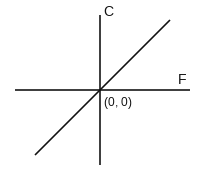
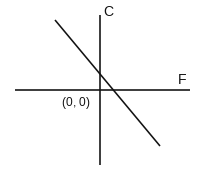
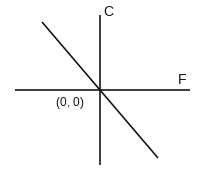
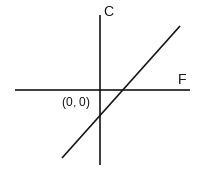
Which of the following figure represents the relation between Celsius and Fahrenheit temperatures ?
निम्नलिखित में से कौन-सा चित्र सेल्सियस तथा फ़ारेनहाइट तापों के बीच संबंध को निरूपित करता है ?
  1. A
  2. B
  3. C
  4. D
Show answer

Concept: The Celsius–Fahrenheit relation is C5=F−329, i.e. C=59F−1609 — a straight line.

  1. Slope =59 is positive, so the line rises to the right.
  2. Intercept on the C-axis is −1609≈−17.8 (negative); the line cuts the F-axis at F=32 (positive side of origin).
  3. Only the graph in option (D) shows a straight line of positive slope cutting the F-axis to the right of the origin. (A) and (C) pass through the origin, (B) has negative slope.

Short trick: Remember the two anchor points: 0∘C =32∘F and 100∘C =212∘F — positive slope, positive F-intercept.

Answer: (D)

अवधारणा: सेल्सियस–फ़ारेनहाइट संबंध C5=F−329 अर्थात C=59F−1609 — एक सरल रेखा है।

  1. ढाल (slope) =59 धनात्मक है, अतः रेखा दाईं ओर ऊपर उठती है।
  2. C-अक्ष पर अंतःखंड −1609≈−17.8 (ऋणात्मक) है; रेखा F-अक्ष को F=32 (मूल बिंदु के दाईं ओर) पर काटती है।
  3. केवल विकल्प (D) का ग्राफ धनात्मक ढाल वाली ऐसी रेखा दिखाता है जो F-अक्ष को मूल बिंदु के दाईं ओर काटती है। (A) व (C) मूल बिंदु से गुजरती हैं, (B) की ढाल ऋणात्मक है।

शॉर्ट ट्रिक: दो बिंदु याद रखें: 0∘C =32∘F तथा 100∘C =212∘F — धनात्मक ढाल, धनात्मक F-अंतःखंड।

उत्तर: (D)

JEE Main 2025 (January) – Paper 1 (B.E./B.Tech)PhysicsThermal properties – temperature scalesJEE Main 2025 (January) – Paper 1 (B.E./B.Tech) 2025 · 24 Jan Shift 2 →
Q1977.
The position vector of a moving body at any instant of time is given as r→=(5t2i^−5tj^) m. The magnitude and direction of velocity at t=2 s is,
किसी गतिमान पिंड का स्थिति सदिश किसी क्षण r→=(5t2i^−5tj^) m द्वारा दिया गया है। t=2 s पर वेग का परिमाण तथा दिशा है,
  1. A515 m/s, making an angle of tan−1⁡4 with −ve Y axis515 m/s, ऋणात्मक Y अक्ष से tan−1⁡4 कोण बनाते हुए
  2. B515 m/s, making an angle of tan−1⁡4 with +ve X axis515 m/s, धनात्मक X अक्ष से tan−1⁡4 कोण बनाते हुए
  3. C517 m/s, making an angle of tan−1⁡4 with +ve X axis517 m/s, धनात्मक X अक्ष से tan−1⁡4 कोण बनाते हुए
  4. D517 m/s, making an angle of tan−1⁡4 with −ve Y axis517 m/s, ऋणात्मक Y अक्ष से tan−1⁡4 कोण बनाते हुए
Show answer

Concept: Velocity is the time derivative of the position vector: v→=dr→dt.

  1. v→=ddt(5t2i^−5tj^)=10ti^−5j^.
  2. At t=2 s: v→=20i^−5j^ m/s.
  3. Magnitude: |v→|=202+52=425=517 m/s.
  4. Angle with the −ve Y axis: tan⁡θ=205=4, so θ=tan−1⁡4 from the −Y direction (the vector points towards +x, slightly below the x-axis).

Answer: (D)

अवधारणा: वेग, स्थिति सदिश का समय के सापेक्ष अवकलज है: v→=dr→dt।

  1. v→=ddt(5t2i^−5tj^)=10ti^−5j^।
  2. t=2 s पर: v→=20i^−5j^ m/s।
  3. परिमाण: |v→|=202+52=425=517 m/s।
  4. ऋणात्मक Y अक्ष से कोण: tan⁡θ=205=4, अतः −Y दिशा से θ=tan−1⁡4 (सदिश +x की ओर, x-अक्ष से थोड़ा नीचे है)।

उत्तर: (D)

JEE Main 2025 (January) – Paper 1 (B.E./B.Tech)PhysicsKinematics – two-dimensional motionJEE Main 2025 (January) – Paper 1 (B.E./B.Tech) 2025 · 24 Jan Shift 2 →
Q1978.
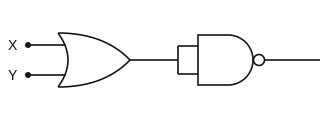
The output of the circuit is low (zero) for :

(A) X = 0, Y = 0   (B) X = 0, Y = 1   (C) X = 1, Y = 0   (D) X = 1, Y = 1
Choose the correct answer from the options given below :
परिपथ का निर्गत (output) निम्न (शून्य) होगा :

(A) X = 0, Y = 0   (B) X = 0, Y = 1   (C) X = 1, Y = 0   (D) X = 1, Y = 1
निम्नलिखित विकल्पों में से सही उत्तर चुनिए :
  1. A(B), (C) and (D) onlyकेवल (B), (C) तथा (D)
  2. B(A), (B) and (C) onlyकेवल (A), (B) तथा (C)
  3. C(A), (C) and (D) onlyकेवल (A), (C) तथा (D)
  4. D(A), (B) and (D) onlyकेवल (A), (B) तथा (D)
Show answer

Concept: A NAND gate with both inputs joined together works as a NOT gate. So the circuit is OR followed by NOT, i.e. a NOR gate.

  1. First gate: Z=X+Y (OR).
  2. Second gate: output =Z⋅Z―=Z―=X+Y―.
  3. Output is 1 only when X=0, Y=0 (case A); for cases (B), (C), (D), X+Y=1 so the output is 0 (low).

Short trick: OR + inverter = NOR: high only for all-zero inputs.

Answer: (A)

अवधारणा: दोनों निवेश जोड़ा हुआ NAND द्वार NOT द्वार की तरह कार्य करता है। अतः परिपथ OR के बाद NOT, अर्थात NOR द्वार है।

  1. पहला द्वार: Z=X+Y (OR)।
  2. दूसरा द्वार: निर्गत =Z⋅Z―=Z―=X+Y―।
  3. निर्गत केवल तभी 1 है जब X=0, Y=0 (स्थिति A); स्थितियों (B), (C), (D) में X+Y=1 होने से निर्गत 0 (निम्न) है।

शॉर्ट ट्रिक: OR + प्रतिलोमक (inverter) = NOR: केवल सभी निवेश शून्य होने पर ही उच्च।

उत्तर: (A)

JEE Main 2025 (January) – Paper 1 (B.E./B.Tech)PhysicsSemiconductors – logic gatesJEE Main 2025 (January) – Paper 1 (B.E./B.Tech) 2025 · 24 Jan Shift 2 →
Q1979.
Young's double slit inteference apparatus is immersed in a liquid of refractive index 1.44. It has slit separation of 1.5 mm. The slits are illuminated by a parallel beam of light whose wavelength in air is 690 nm. The fringe-width on a screen placed behind the plane of slits at a distance of 0.72 m, will be :
यंग का द्वि-झिरी व्यतिकरण उपकरण 1.44 अपवर्तनांक के द्रव में डुबोया गया है। इसमें झिरियों के बीच दूरी 1.5 mm है। झिरियों को प्रकाश के समांतर पुंज से प्रदीप्त किया जाता है जिसकी वायु में तरंगदैर्घ्य 690 nm है। झिरियों के तल से 0.72 m दूरी पर रखे पर्दे पर फ्रिंज-चौड़ाई होगी :
  1. A0.23 mm
  2. B0.33 mm
  3. C0.63 mm
  4. D0.46 mm
Show answer

Concept: In a medium of refractive index μ the wavelength shortens to λ/μ, so the fringe width becomes β=λDμd.

  1. λliquid=690 nm1.44=479.2 nm.
  2. β=479.2×10−9×0.721.5×10−3 m =2.3×10⁻⁴ m.
  3. β=0.23 mm.

Short trick: Compute the air fringe width λDd=0.33 mm and divide by μ=1.44.

Answer: (A)

अवधारणा: μ अपवर्तनांक के माध्यम में तरंगदैर्घ्य घटकर λ/μ हो जाती है, अतः फ्रिंज चौड़ाई β=λDμd होती है।

  1. λद्रव=690 nm1.44=479.2 nm।
  2. β=479.2×10−9×0.721.5×10−3 m =2.3×10⁻⁴ m।
  3. β=0.23 mm।

शॉर्ट ट्रिक: वायु में फ्रिंज चौड़ाई λDd=0.33 mm निकालकर μ=1.44 से भाग दें।

उत्तर: (A)

JEE Main 2025 (January) – Paper 1 (B.E./B.Tech)PhysicsWave optics – Young's double slit experimentJEE Main 2025 (January) – Paper 1 (B.E./B.Tech) 2025 · 24 Jan Shift 2 →
Q1980.
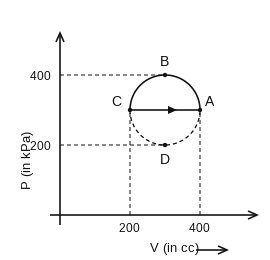
The magnitude of heat exchanged by a system for the given cyclic process ABCA (as shown in figure) is (in SI unit) :
दिए गए चक्रीय प्रक्रम ABCA (चित्रानुसार) के लिए निकाय द्वारा विनिमय की गई ऊष्मा का परिमाण (SI मात्रक में) है :
  1. A5π
  2. B40π
  3. C10π
  4. Dzeroशून्य
Show answer

Concept: For a complete cycle ΔU=0, so |Q|=|W|= area enclosed by the cycle on the P–V diagram.

  1. The path A→B→C is the upper half of a circle of radius 100 (in plot units) centred at (300 cc, 300 kPa), and C→A is the straight diameter back to A. The enclosed area is a semicircle.
  2. Enclosed area =12π(ΔV)(ΔP)=12π(100×10−6 m3)(100×103 Pa).
  3. |Q|=12π×10=5π J.

Short trick: Convert the enclosed area to SI at once — 100 cc×100 kPa=10 J, and the semicircle gives 12π×10=5π J.

Answer: (A)

अवधारणा: पूर्ण चक्र के लिए ΔU=0, अतः |Q|=|W|= P–V आरेख पर चक्र द्वारा परिबद्ध क्षेत्रफल।

  1. पथ A→B→C, (300 cc, 300 kPa) केंद्र तथा 100 (आरेख मात्रक) त्रिज्या वाले वृत्त का ऊपरी अर्धभाग है, और C→A व्यास के अनुदिश सीधा लौटता है। परिबद्ध क्षेत्र एक अर्धवृत्त है।
  2. परिबद्ध क्षेत्रफल =12π(ΔV)(ΔP)=12π(100×10−6 m3)(100×103 Pa)।
  3. |Q|=12π×10=5π J।

शॉर्ट ट्रिक: परिबद्ध क्षेत्रफल को सीधे SI मात्रकों में बदलकर गिनें — 100 cc×100 kPa=10 J, अर्धवृत्त का क्षेत्रफल =12π×10।

उत्तर: (A)

JEE Main 2025 (January) – Paper 1 (B.E./B.Tech)PhysicsThermodynamics – cyclic processJEE Main 2025 (January) – Paper 1 (B.E./B.Tech) 2025 · 24 Jan Shift 2 →