Question bank

Q&A: practice questions with answers

Search questions on any topic. Filter by exam category, exam, subject and topic, try the question, then open the answer and explanation.

Courses – airGurukul

53,050 questions in the question bank.

Q1981.
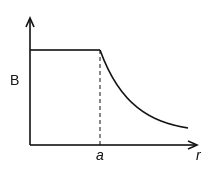
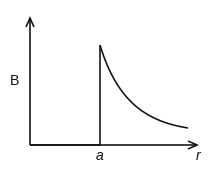
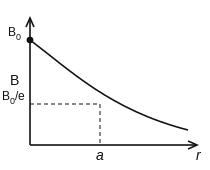
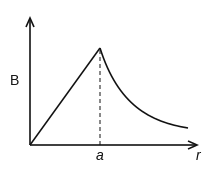
A long straight wire of a circular cross-section with radius 'a' carries a steady current I. The current I is uniformly distributed across this cross-section. The plot of magnitude of magnetic field B with distance r from the centre of the wire is given by
वृत्ताकार अनुप्रस्थ काट तथा त्रिज्या 'a' वाले एक लंबे सीधे तार में अपरिवर्ती धारा I प्रवाहित है। धारा I इस अनुप्रस्थ काट पर एकसमान रूप से वितरित है। तार के केंद्र से दूरी r के साथ चुंबकीय क्षेत्र के परिमाण B का आलेख (plot) है
  1. A
  2. B
  3. C
  4. D
Show answer

Concept: Ampere's circuital law for a uniformly distributed current in a wire of radius a.

  1. Inside (r<a): enclosed current =Ir2a2, so B=μ0Ir2πa2∝r — a straight line rising from zero.
  2. Outside (r>a): B=μ0I2πr∝1r — falls off hyperbolically.
  3. B is maximum at the surface r=a; the graph rises linearly then decays as 1/r — option (D). (A) shows constant B inside, (B) shows zero inside, (C) shows maximum at the centre — all wrong.

Short trick: Solid conductor: B–r graph looks like a mountain peak at r=a (linear up, 1/r down).

Answer: (D)

अवधारणा: त्रिज्या a के तार में एकसमान वितरित धारा के लिए ऐम्पियर का परिपथीय नियम।

  1. भीतर (r<a): परिबद्ध धारा =Ir2a2, अतः B=μ0Ir2πa2∝r — शून्य से उठती सरल रेखा।
  2. बाहर (r>a): B=μ0I2πr∝1r — अतिपरवलय की तरह घटता है।
  3. B पृष्ठ r=a पर अधिकतम है; आलेख रैखिक रूप से बढ़कर फिर 1/r से घटता है — विकल्प (D)। (A) में भीतर B नियत, (B) में भीतर शून्य, (C) में केंद्र पर अधिकतम — सभी गलत।

शॉर्ट ट्रिक: ठोस चालक: B–r आलेख r=a पर पर्वत-शिखर जैसा (रैखिक ऊपर, 1/r नीचे)।

उत्तर: (D)

JEE Main 2025 (January) – Paper 1 (B.E./B.Tech)PhysicsMagnetic effects of current – Ampere's lawJEE Main 2025 (January) – Paper 1 (B.E./B.Tech) 2025 · 24 Jan Shift 2 →
Q1982.
In photoelectric effect, the stopping potential (V0) v/s frequency (ν) curve is plotted. (h is the Planck's constant and ϕ0 is work function of metal)
(A) V0 v/s ν is linear.
(B) The slope of V0 v/s ν curve =ϕ0h
(C) h constant is related to the slope of V0 v/s ν line.
(D) The value of electric charge of electron is not required to determine h using the V0 v/s ν curve.
(E) The work function can be estimated without knowing the value of h.
Choose the correct answer from the options given below :
प्रकाश-विद्युत प्रभाव में निरोधी विभव (V0) तथा आवृत्ति (ν) के बीच वक्र खींचा गया है। (h प्लांक नियतांक है तथा ϕ0 धातु का कार्य फलन है)
(A) V0 व ν के बीच संबंध रैखिक है।
(B) V0–ν वक्र की ढाल =ϕ0h
(C) नियतांक h, V0–ν रेखा की ढाल से संबंधित है।
(D) V0–ν वक्र से h ज्ञात करने के लिए इलेक्ट्रॉन के आवेश के मान की आवश्यकता नहीं होती।
(E) h का मान जाने बिना कार्य फलन का आकलन किया जा सकता है।
निम्नलिखित विकल्पों में से सही उत्तर चुनिए :
  1. A(C) and (D) onlyकेवल (C) तथा (D)
  2. B(A), (C) and (E) onlyकेवल (A), (C) तथा (E)
  3. C(A), (B) and (C) onlyकेवल (A), (B) तथा (C)
  4. D(D) and (E) onlyकेवल (D) तथा (E)
Show answer

Concept: Einstein's photoelectric equation: eV0=hν−ϕ0, i.e. V0=heν−ϕ0e.

  1. (A) True — V0 vs ν is a straight line.
  2. (B) False — the slope is he, not ϕ0h.
  3. (C) True — h=e× slope, so h is related to the slope.
  4. (D) False — to get h from the slope you must know the electronic charge e.
  5. (E) True — the intercept on the V0 axis is −ϕ0e; knowing e, ϕ0 follows without h.

Answer: (B)

अवधारणा: आइंस्टाइन का प्रकाश-विद्युत समीकरण: eV0=hν−ϕ0, अर्थात V0=heν−ϕ0e।

  1. (A) सत्य — V0 व ν के बीच सरल रेखा होती है।
  2. (B) असत्य — ढाल he है, ϕ0h नहीं।
  3. (C) सत्य — h=e× ढाल, अतः h ढाल से संबंधित है।
  4. (D) असत्य — ढाल से h ज्ञात करने के लिए इलेक्ट्रॉन आवेश e चाहिए।
  5. (E) सत्य — V0 अक्ष पर अंतःखंड −ϕ0e है; e ज्ञात हो तो h के बिना ϕ0 मिल जाता है।

उत्तर: (B)

JEE Main 2025 (January) – Paper 1 (B.E./B.Tech)PhysicsModern physics – photoelectric effectJEE Main 2025 (January) – Paper 1 (B.E./B.Tech) 2025 · 24 Jan Shift 2 →
Q1983.
A solid sphere and a hollow sphere of the same mass and of same radius are rolled on an inclined plane. Let the time taken to reach the bottom by the solid sphere and the hollow sphere be t1 and t2, respectively, then
समान द्रव्यमान तथा समान त्रिज्या के एक ठोस गोले तथा एक खोखले गोले को आनत तल पर लुढ़काया जाता है। ठोस गोले तथा खोखले गोले द्वारा तल की तली तक पहुँचने में लिए गए समय क्रमशः t1 तथा t2 हों, तो
  1. At1>t2
  2. Bt1=t2
  3. Ct1<t2
  4. Dt1=2t2
Show answer

Concept: For rolling without slipping down an incline, a=gsin⁡θ1+k2R2; smaller k2R2 means larger acceleration and less time.

  1. Solid sphere: k2R2=25=0.4; hollow sphere: k2R2=23≈0.67.
  2. asolid=57gsin⁡θ>ahollow=35gsin⁡θ.
  3. Since t∝1a for the same incline, the solid sphere reaches earlier: t1<t2.

Short trick: In a rolling race the body with the smallest k2R2 always wins — solid sphere beats hollow sphere.

Answer: (C)

अवधारणा: आनत तल पर बिना फिसले लोटन के लिए a=gsin⁡θ1+k2R2; k2R2 जितना छोटा, त्वरण उतना बड़ा और समय उतना कम।

  1. ठोस गोला: k2R2=25=0.4; खोखला गोला: k2R2=23≈0.67।
  2. aठोस=57gsin⁡θ>aखोखला=35gsin⁡θ।
  3. समान तल पर t∝1a, अतः ठोस गोला पहले पहुँचता है: t1<t2।

शॉर्ट ट्रिक: लोटन की दौड़ में सबसे छोटे k2R2 वाला पिंड जीतता है — ठोस गोला खोखले गोले से आगे।

उत्तर: (C)

JEE Main 2025 (January) – Paper 1 (B.E./B.Tech)PhysicsRotational motion – rolling on inclineJEE Main 2025 (January) – Paper 1 (B.E./B.Tech) 2025 · 24 Jan Shift 2 →
Q1984.
A small uncharged conducting sphere is placed in contact with an identical sphere but having 4×10⁻⁸ C charge and then removed to a distance such that the force of repulsion between them is 9×10⁻³ N. The distance between them is (Take 14πϵ0 as 9×10⁹ in SI units)
एक छोटे अनावेशित चालक गोले को 4×10⁻⁸ C आवेश वाले सर्वसम गोले के संपर्क में रखकर इतनी दूरी पर ले जाया जाता है कि उनके बीच प्रतिकर्षण बल 9×10⁻³ N हो। उनके बीच दूरी है (14πϵ0 को SI मात्रकों में 9×10⁹ लीजिए)
  1. A3 cm
  2. B2 cm
  3. C4 cm
  4. D1 cm
Show answer

Concept: Identical conducting spheres in contact share charge equally; then Coulomb's law gives the separation.

  1. After contact, each sphere carries q=4×10−82=2×10⁻⁸ C.
  2. F=kq2r2⇒r2=9×109×(2×10−8)29×10−3=9×109×4×10−169×10−3=4×10⁻⁴ m2.
  3. r=2×10⁻² m =2 cm.

Answer: (B)

अवधारणा: संपर्क में रखे सर्वसम चालक गोले आवेश बराबर बाँट लेते हैं; फिर कूलॉम के नियम से दूरी मिलती है।

  1. संपर्क के बाद प्रत्येक गोले पर q=4×10−82=2×10⁻⁸ C।
  2. F=kq2r2⇒r2=9×109×(2×10−8)29×10−3=9×109×4×10−169×10−3=4×10⁻⁴ m2।
  3. r=2×10⁻² m =2 cm।

उत्तर: (B)

JEE Main 2025 (January) – Paper 1 (B.E./B.Tech)PhysicsElectrostatics – Coulomb's lawJEE Main 2025 (January) – Paper 1 (B.E./B.Tech) 2025 · 24 Jan Shift 2 →
Q1985.

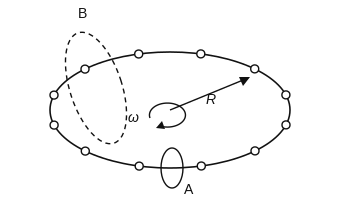
N equally spaced charges each of value q, are placed on a circle of radius R. The circle rotates about its axis with an angular velocity ω as shown in the figure. A bigger Amperian loop B encloses the whole circle where as a smaller Amperian loop A encloses a small segment. The difference between enclosed currents, IA−IB, for the given Amperian loops is

R त्रिज्या के वृत्त पर, q मान के N समान दूरी पर स्थित आवेश रखे हैं। चित्रानुसार वृत्त अपने अक्ष के परितः कोणीय वेग ω से घूर्णन करता है। बड़ा ऐम्पियरीय पाश (Amperian loop) B पूरे वृत्त को घेरता है जबकि छोटा ऐम्पियरीय पाश A एक छोटे खंड को घेरता है। दिए गए ऐम्पियरीय पाशों के लिए परिबद्ध धाराओं का अंतर IA−IB है
  1. A2πNqω
  2. BN22πqω
  3. CNπqω
  4. DN2πqω
Show answer

Concept: Enclosed current through an Amperian loop = total charge crossing any surface bounded by the loop per unit time.

  1. The rotating ring of charges is a circular current. Loop A threads the ring itself (encircles the 'wire'), so in one period T=2πω all N charges pass through its surface once: IA=NqT=Nqω2π.
  2. Loop B encloses the whole circle; the circulating charges never pierce a surface bounded by B, so IB=0.
  3. IA−IB=N2πqω.

Short trick: A rotating ring of total charge Nq is a current I=(Nq)ω2π — only a loop linked with the ring encloses it.

Answer: (D)

अवधारणा: ऐम्पियरीय पाश से परिबद्ध धारा = पाश द्वारा घिरे किसी पृष्ठ को प्रति इकाई समय पार करने वाला कुल आवेश।

  1. घूमता आवेश-वलय एक वृत्तीय धारा है। पाश A स्वयं वलय ('तार') को घेरता है, अतः एक आवर्तकाल T=2πω में सभी N आवेश उसके पृष्ठ से एक बार गुजरते हैं: IA=NqT=Nqω2π।
  2. पाश B पूरे वृत्त को घेरता है; परिक्रमण करते आवेश B से घिरे किसी पृष्ठ को पार नहीं करते, अतः IB=0।
  3. IA−IB=N2πqω।

शॉर्ट ट्रिक: कुल आवेश Nq का घूमता वलय धारा I=(Nq)ω2π है — केवल वलय से सलंकित (linked) पाश ही उसे परिबद्ध करता है।

उत्तर: (D)

JEE Main 2025 (January) – Paper 1 (B.E./B.Tech)PhysicsMoving charges – current and Amperian loopsJEE Main 2025 (January) – Paper 1 (B.E./B.Tech) 2025 · 24 Jan Shift 2 →
Q1986.
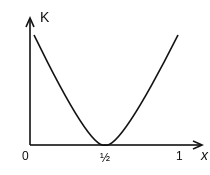
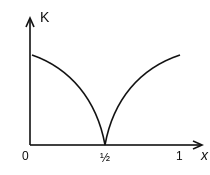
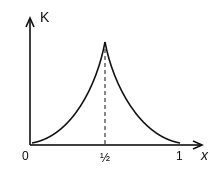
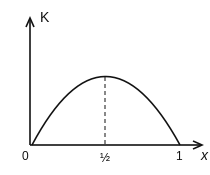
A particle oscillates along the x-axis according to the law, x(t)=x0sin2⁡(t2) where x0=1 m. The kinetic energy (K) of the particle as a function of x is correctly represented by the graph
कोई कण x-अक्ष के अनुदिश x(t)=x0sin2⁡(t2) नियम के अनुसार दोलन करता है, जहाँ x0=1 m है। कण की गतिज ऊर्जा (K) को x के फलन के रूप में कौन-सा ग्राफ सही निरूपित करता है
  1. A
  2. B
  3. C
  4. D
Show answer

Concept: Express the velocity in terms of x and use K=12mv2.

  1. x=sin2⁡t2=1−cos⁡t2, so cos⁡t=1−2x (SHM about x=12).
  2. v=dxdt=12sin⁡t⇒v2=14sin2⁡t=14[1−(1−2x)2]=x(1−x).
  3. K=12mx(1−x): zero at x=0 and x=1, maximum at x=12 — an inverted parabola, graph (D).
  4. (A) and (B) show minimum K at x=12 (wrong — the centre has maximum speed); (C) has a sharp non-parabolic peak.

Short trick: In SHM, K vs displacement is always an inverted parabola, maximum at the mean position (x=12 here).

Answer: (D)

अवधारणा: वेग को x के पदों में लिखकर K=12mv2 का उपयोग करें।

  1. x=sin2⁡t2=1−cos⁡t2, अतः cos⁡t=1−2x (x=12 के परितः सरल आवर्त गति)।
  2. v=dxdt=12sin⁡t⇒v2=14sin2⁡t=14[1−(1−2x)2]=x(1−x)।
  3. K=12mx(1−x): x=0 तथा x=1 पर शून्य, x=12 पर अधिकतम — उल्टा परवलय, ग्राफ (D)।
  4. (A) व (B) में x=12 पर K न्यूनतम है (गलत — मध्य स्थिति पर चाल अधिकतम होती है); (C) का शिखर परवलयाकार नहीं है।

शॉर्ट ट्रिक: सरल आवर्त गति में विस्थापन के सापेक्ष K सदैव उल्टा परवलय होता है, माध्य स्थिति (यहाँ x=12) पर अधिकतम।

उत्तर: (D)

JEE Main 2025 (January) – Paper 1 (B.E./B.Tech)PhysicsOscillations – kinetic energy in SHMJEE Main 2025 (January) – Paper 1 (B.E./B.Tech) 2025 · 24 Jan Shift 2 →
Q1987.
A photograph of a landscape is captured by a drone camera at a height of 18 km. The size of the camera film is 2 cm × 2 cm and the area of the landscape photographed is 400 km2. The focal length of the lens in the drone camera is :
18 km ऊँचाई पर स्थित ड्रोन कैमरे से किसी भू-दृश्य (landscape) का फोटोग्राफ लिया जाता है। कैमरा फिल्म का आकार 2 cm × 2 cm है तथा फोटोग्राफ किए गए भू-दृश्य का क्षेत्रफल 400 km2 है। ड्रोन कैमरे के लेंस की फोकस दूरी है :
  1. A1.8 cm
  2. B0.9 cm
  3. C2.8 cm
  4. D2.5 cm
Show answer

Concept: For a very distant object the image forms at the focal plane; linear magnification m=image sizeobject size=fu.

  1. Landscape: area 400 km2 ⇒ side =20 km; film side =2 cm.
  2. m=2 cm20 km=2×10−22×104=10−6.
  3. f=m×u=10−6×18×103 m=1.8×10⁻² m =1.8 cm.

Answer: (A)

अवधारणा: अत्यधिक दूर की वस्तु का प्रतिबिंब फोकस तल पर बनता है; रैखिक आवर्धन m=प्रतिबिंब का आकारवस्तु का आकार=fu।

  1. भू-दृश्य: क्षेत्रफल 400 km2 ⇒ भुजा =20 km; फिल्म की भुजा =2 cm।
  2. m=2 cm20 km=2×10−22×104=10−6।
  3. f=m×u=10−6×18×103 m=1.8×10⁻² m =1.8 cm।

उत्तर: (A)

JEE Main 2025 (January) – Paper 1 (B.E./B.Tech)PhysicsRay optics – lens magnificationJEE Main 2025 (January) – Paper 1 (B.E./B.Tech) 2025 · 24 Jan Shift 2 →
Q1988.

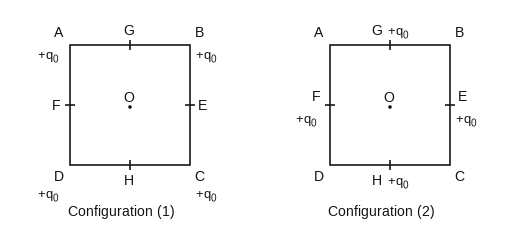
Four identical charges q0 are kept at the corners A, B, C and D of a square of side a as shown in Configuration (1). The charges are then shifted to the mid points G, E, H and F of the sides as shown in Configuration (2). The work done in changing the configuration of the system is :

चित्रानुसार विन्यास (Configuration) (1) में भुजा a के वर्ग के शीर्षों A, B, C तथा D पर चार सर्वसम आवेश q0 रखे हैं। फिर आवेशों को विन्यास (2) के अनुसार भुजाओं के मध्य-बिंदुओं G, E, H तथा F पर स्थानांतरित किया जाता है। निकाय का विन्यास बदलने में किया गया कार्य है :
  1. AKq02a(4−22)
  2. BKq02a(3−2)
  3. CKq02a(42−2)
  4. DKq02a(32−2)
Show answer

Concept: Work done by the external agent =Ufinal−Uinitial, with U=∑Kqiqjrij over all 6 pairs.

  1. Configuration (1) — corners of square of side a: 4 pairs at distance a and 2 diagonal pairs at a2: U1=Kq02a(4+22)=Kq02a(4+2).
  2. Configuration (2) — mid points form a square of side a2 with diagonals a: U2=Kq02a(42+2).
  3. W=U2−U1=Kq02a(42+2−4−2)=Kq02a(32−2).

Short trick: Shrinking a square of like charges by factor 2 multiplies U by 2: W=(2−1)U1=(2−1)(4+2)Kq02a=(32−2)Kq02a.

Answer: (D)

अवधारणा: बाह्य कारक द्वारा किया गया कार्य =Uअंतिम−Uप्रारंभिक, जहाँ U=∑Kqiqjrij (सभी 6 युग्मों पर)।

  1. विन्यास (1) — भुजा a के वर्ग के शीर्ष: दूरी a पर 4 युग्म तथा a2 पर 2 विकर्ण युग्म: U1=Kq02a(4+22)=Kq02a(4+2)।
  2. विन्यास (2) — मध्य-बिंदु a2 भुजा का वर्ग बनाते हैं जिसके विकर्ण a हैं: U2=Kq02a(42+2)।
  3. W=U2−U1=Kq02a(42+2−4−2)=Kq02a(32−2)।

शॉर्ट ट्रिक: समान आवेशों के वर्ग को 2 गुना छोटा करने पर U, 2 गुना हो जाता है: W=(2−1)U1=(2−1)(4+2)Kq02a=(32−2)Kq02a।

उत्तर: (D)

JEE Main 2025 (January) – Paper 1 (B.E./B.Tech)PhysicsElectrostatics – potential energy of a system of chargesJEE Main 2025 (January) – Paper 1 (B.E./B.Tech) 2025 · 24 Jan Shift 2 →
Q1989.
Arrange the following in the ascending order of wavelength (λ) :
(A) Microwaves (λ1)  (B) Ultraviolet rays (λ2)  (C) Infrared rays (λ3)  (D) X-rays (λ4)
Choose the most appropriate answer from the options given below :
निम्नलिखित को तरंगदैर्घ्य (λ) के आरोही क्रम में व्यवस्थित कीजिए :
(A) सूक्ष्म तरंगें (Microwaves) (λ1)  (B) पराबैंगनी किरणें (λ2)  (C) अवरक्त किरणें (λ3)  (D) X-किरणें (λ4)
निम्नलिखित विकल्पों में से सबसे उपयुक्त उत्तर चुनिए :
  1. Aλ4<λ3<λ2<λ1
  2. Bλ3<λ4<λ2<λ1
  3. Cλ4<λ3<λ1<λ2
  4. Dλ4<λ2<λ3<λ1
Show answer

Concept: In the electromagnetic spectrum, wavelength increases in the order: gamma rays, X-rays, UV, visible, infrared, microwaves, radio waves.

  1. X-rays (λ4) have the shortest wavelength here (∼10−10 m).
  2. Then ultraviolet (λ2) (∼10−8 m), then infrared (λ3) (∼10−5 m), and microwaves (λ1) (∼10−2 m) are the longest.
  3. Ascending order: λ4<λ2<λ3<λ1.

Short trick: Remember the decreasing-wavelength chain 'Radio-Micro-Infra-Visible-UV-X-Gamma' and read it backwards.

Answer: (D)

अवधारणा: विद्युत-चुंबकीय स्पेक्ट्रम में तरंगदैर्घ्य इस क्रम में बढ़ती है: गामा किरणें, X-किरणें, पराबैंगनी, दृश्य, अवरक्त, सूक्ष्म तरंगें, रेडियो तरंगें।

  1. यहाँ X-किरणों (λ4) की तरंगदैर्घ्य सबसे छोटी है (∼10−10 m)।
  2. फिर पराबैंगनी (λ2) (∼10−8 m), फिर अवरक्त (λ3) (∼10−5 m), और सूक्ष्म तरंगें (λ1) (∼10−2 m) सबसे लंबी हैं।
  3. आरोही क्रम: λ4<λ2<λ3<λ1।

शॉर्ट ट्रिक: घटती तरंगदैर्घ्य की श्रृंखला 'रेडियो-माइक्रो-अवरक्त-दृश्य-UV-X-गामा' याद रखें और उल्टा पढ़ें।

उत्तर: (D)

JEE Main 2025 (January) – Paper 1 (B.E./B.Tech)PhysicsElectromagnetic waves – spectrumJEE Main 2025 (January) – Paper 1 (B.E./B.Tech) 2025 · 24 Jan Shift 2 →
Q1990.
The energy E and momentum p of a moving body of mass m are related by some equation. Given that c represents the speed of light, identify the correct equation
m द्रव्यमान के गतिमान पिंड की ऊर्जा E तथा संवेग p किसी समीकरण द्वारा संबंधित हैं। यदि c प्रकाश की चाल है, तो सही समीकरण पहचानिए
  1. AE2=pc2+m2c2
  2. BE2=p2c2+m2c2
  3. CE2=pc2+m2c4
  4. DE2=p2c2+m2c4
Show answer

Concept: The relativistic energy–momentum relation is E2=p2c2+m2c4.

  1. Check dimensions: [E]= J; [pc]=kgms−1⋅ms−1= J and [mc2]= J, so every term of E2=p2c2+m2c4 has dimensions of J2.
  2. Options (A) and (C) contain pc2 and (A), (B) contain m2c2 — these terms are not J2, so those equations are dimensionally wrong.
  3. Limits also agree: for p=0, E=mc2; for a photon (m=0), E=pc.

Short trick: Think of the right triangle with sides pc and mc2 and hypotenuse E.

Answer: (D)

अवधारणा: आपेक्षिकीय ऊर्जा–संवेग संबंध E2=p2c2+m2c4 है।

  1. विमाएँ जाँचें: [E]= J; [pc]= J तथा [mc2]= J, अतः E2=p2c2+m2c4 के सभी पद J2 विमा के हैं।
  2. विकल्प (A) व (C) में pc2 और (A), (B) में m2c2 हैं — ये पद J2 नहीं हैं, अतः वे समीकरण विमीय रूप से गलत हैं।
  3. सीमाएँ भी मेल खाती हैं: p=0 पर E=mc2; फोटॉन (m=0) के लिए E=pc।

शॉर्ट ट्रिक: pc व mc2 भुजाओं और कर्ण E वाले समकोण त्रिभुज की कल्पना करें।

उत्तर: (D)

JEE Main 2025 (January) – Paper 1 (B.E./B.Tech)PhysicsModern physics – energy-momentum relationJEE Main 2025 (January) – Paper 1 (B.E./B.Tech) 2025 · 24 Jan Shift 2 →
Q1991.
The temperature of a body in air falls from 40∘C to 24∘C in 4 minutes. The temperature of the air is 16∘C. The temperature of the body in the next 4 minutes will be:
वायु में रखे किसी पिंड का ताप 4 मिनट में 40∘C से गिरकर 24∘C हो जाता है। वायु का ताप 16∘C है। अगले 4 मिनट में पिंड का ताप होगा:
  1. A143∘C
  2. B423∘C
  3. C283∘C
  4. D563∘C
Show answer

Concept: Newton's law of cooling (average form): θ1−θ2t=K(θ1+θ22−θs).

  1. First interval: 40−244=K(40+242−16)⇒4=K(16)⇒K=14 per min.
  2. Next interval (final temperature θ): 24−θ4=14(24+θ2−16)=14⋅θ−82.
  3. 2(24−θ)=θ−8⇒48−2θ=θ−8⇒3θ=56⇒θ=563∘C.

Short trick: Excess over surroundings falls by the same factor in equal times: 24→8 (factor 3), so 8→83, giving 16+83=563∘C.

Answer: (D)

अवधारणा: न्यूटन का शीतलन नियम (औसत रूप): θ1−θ2t=K(θ1+θ22−θs)।

  1. पहला अंतराल: 40−244=K(40+242−16)⇒4=K(16)⇒K=14 प्रति मिनट।
  2. अगला अंतराल (अंतिम ताप θ): 24−θ4=14(24+θ2−16)=14⋅θ−82।
  3. 2(24−θ)=θ−8⇒48−2θ=θ−8⇒3θ=56⇒θ=563∘C।

शॉर्ट ट्रिक: परिवेश से ताप-आधिक्य समान समय में समान गुणक से घटता है: 24→8 (गुणक 3), अतः 8→83, जिससे 16+83=563∘C।

उत्तर: (D)

JEE Main 2025 (January) – Paper 1 (B.E./B.Tech)PhysicsThermal properties – Newton's law of coolingJEE Main 2025 (January) – Paper 1 (B.E./B.Tech) 2025 · 24 Jan Shift 2 →
Q1992.
A solid sphere is rolling without slipping on a horizontal plane. The ratio of the linear kinetic energy of the centre of mass of the sphere and rotational kinetic energy is :
एक ठोस गोला क्षैतिज तल पर बिना फिसले लुढ़क रहा है। गोले के द्रव्यमान केंद्र की रैखिक गतिज ऊर्जा तथा घूर्णी गतिज ऊर्जा का अनुपात है :
  1. A34
  2. B43
  3. C52
  4. D25
Show answer

Concept: For rolling without slipping, v=ωR and Isolid sphere=25MR2.

  1. Translational KE =12Mv2.
  2. Rotational KE =12Iω2=12⋅25MR2⋅v2R2=15Mv2.
  3. Ratio =12Mv215Mv2=52.

Short trick: KEtransKErot=R2k2=52 for a solid sphere.

Answer: (C)

अवधारणा: बिना फिसले लोटन के लिए v=ωR तथा ठोस गोले का I=25MR2।

  1. स्थानांतरीय गतिज ऊर्जा =12Mv2।
  2. घूर्णी गतिज ऊर्जा =12Iω2=12⋅25MR2⋅v2R2=15Mv2।
  3. अनुपात =12Mv215Mv2=52।

शॉर्ट ट्रिक: KEरैखिकKEघूर्णी=R2k2=52 (ठोस गोले के लिए)।

उत्तर: (C)

JEE Main 2025 (January) – Paper 1 (B.E./B.Tech)PhysicsRotational motion – rolling kinetic energyJEE Main 2025 (January) – Paper 1 (B.E./B.Tech) 2025 · 24 Jan Shift 2 →
Q1993.
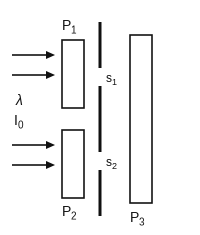
In a Young's double slit experiment, three polarizers are kept as shown in the figure. The transmission axes of P1 and P2 are orthogonal to each other. The polarizer P3 covers both the slits with its transmission axis at 45∘ to those of P1 and P2. An unpolarized light of wavelength λ and intensity I0 is incident on P1 and P2. The intensity at a point after P3 where the path difference between the light waves from s1 and s2 is λ3, is
यंग के द्वि-झिरी प्रयोग में चित्रानुसार तीन ध्रुवक (polarizer) रखे हैं। P1 तथा P2 के पारगमन अक्ष परस्पर लंबवत हैं। ध्रुवक P3 दोनों झिरियों को ढकता है और इसका पारगमन अक्ष P1 व P2 के अक्षों से 45∘ पर है। λ तरंगदैर्घ्य तथा I0 तीव्रता का अध्रुवित प्रकाश P1 तथा P2 पर आपतित होता है। P3 के बाद उस बिंदु पर तीव्रता, जहाँ s1 तथा s2 से आने वाली प्रकाश तरंगों के बीच पथांतर λ3 है, होगी
  1. AI02
  2. BI04
  3. CI03
  4. DI0
Show answer

Concept: An unpolarized beam loses half its intensity at a polarizer (Malus: I=Icos2⁡θ for polarized light); interference of two waves: I=I1+I2+2I1I2cos⁡ϕ.

  1. After P1 (and P2): intensity from each slit =I02, polarized along orthogonal axes.
  2. After P3 (at 45∘ to each): each beam gives I02cos2⁡45∘=I04, now both polarized along the same axis, so they interfere.
  3. Path difference λ3⇒ϕ=2π3, cos⁡ϕ=−12.
  4. I=I04+I04+2⋅I04(−12)=I04.

Answer: (B)

अवधारणा: ध्रुवक पर अध्रुवित पुंज की तीव्रता आधी रह जाती है (ध्रुवित प्रकाश के लिए मैलस का नियम: I=Icos2⁡θ); दो तरंगों का व्यतिकरण: I=I1+I2+2I1I2cos⁡ϕ।

  1. P1 (तथा P2) के बाद: प्रत्येक झिरी से तीव्रता =I02, परस्पर लंबवत अक्षों के अनुदिश ध्रुवित।
  2. P3 (प्रत्येक से 45∘ पर) के बाद: प्रत्येक पुंज से I02cos2⁡45∘=I04, अब दोनों एक ही अक्ष के अनुदिश ध्रुवित हैं, अतः व्यतिकरण करते हैं।
  3. पथांतर λ3⇒ϕ=2π3, cos⁡ϕ=−12।
  4. I=I04+I04+2⋅I04(−12)=I04।

उत्तर: (B)

JEE Main 2025 (January) – Paper 1 (B.E./B.Tech)PhysicsWave optics – interference with polarizersJEE Main 2025 (January) – Paper 1 (B.E./B.Tech) 2025 · 24 Jan Shift 2 →
Q1994.
Given below are two statements. One is labelled as Assertion (A) and the other is labelled as Reason (R).
Assertion (A) : In an insulated container, a gas is adiabatically shrunk to half of its initial volume. The temperature of the gas decreases.
Reason (R) : Free expansion of an ideal gas is an irreversible and an adiabatic process.
In the light of the above statements, choose the correct answer from the options given below :
नीचे दो कथन दिए गए हैं। एक को अभिकथन (A) तथा दूसरे को कारण (R) कहा गया है।
अभिकथन (A) : एक ऊष्मारोधी पात्र में किसी गैस को रुद्धोष्म रूप से उसके प्रारंभिक आयतन के आधे तक संपीडित किया जाता है। गैस का ताप घट जाता है।
कारण (R) : आदर्श गैस का मुक्त प्रसार एक अनुत्क्रमणीय तथा रुद्धोष्म प्रक्रम है।
उपर्युक्त कथनों के आलोक में, निम्नलिखित विकल्पों में से सही उत्तर चुनिए :
  1. ABoth (A) and (R) are true but (R) is NOT the correct explanation of (A)(A) तथा (R) दोनों सत्य हैं परंतु (R), (A) की सही व्याख्या नहीं है
  2. B(A) is false but (R) is true(A) असत्य है परंतु (R) सत्य है
  3. C(A) is true but (R) is false(A) सत्य है परंतु (R) असत्य है
  4. DBoth (A) and (R) are true and (R) is the correct explanation of (A)(A) तथा (R) दोनों सत्य हैं तथा (R), (A) की सही व्याख्या है
Show answer

Concept: In an adiabatic compression, work is done on the gas with Q=0, so its internal energy and temperature rise (TVγ−1= constant).

  1. Assertion: shrinking the gas to half its volume adiabatically gives T2=T12γ−1>T1 — the temperature increases, not decreases. (A) is false.
  2. Reason: free expansion is sudden (irreversible) and occurs in an insulated enclosure with no heat exchange (adiabatic). (R) is true.
  3. Hence (A) is false but (R) is true.

Answer: (B)

अवधारणा: रुद्धोष्म संपीडन में Q=0 रहते हुए गैस पर कार्य किया जाता है, अतः उसकी आंतरिक ऊर्जा और ताप बढ़ते हैं (TVγ−1= नियत)।

  1. अभिकथन: गैस का आयतन रुद्धोष्म रूप से आधा करने पर T2=T12γ−1>T1 — ताप बढ़ता है, घटता नहीं। (A) असत्य है।
  2. कारण: मुक्त प्रसार आकस्मिक (अनुत्क्रमणीय) होता है तथा ऊष्मारोधी पात्र में बिना ऊष्मा विनिमय (रुद्धोष्म) होता है। (R) सत्य है।
  3. अतः (A) असत्य है परंतु (R) सत्य है।

उत्तर: (B)

JEE Main 2025 (January) – Paper 1 (B.E./B.Tech)PhysicsThermodynamics – adiabatic processJEE Main 2025 (January) – Paper 1 (B.E./B.Tech) 2025 · 24 Jan Shift 2 →
Q1995.
Given below are two statements. One is labelled as Assertion (A) and the other is labelled as Reason (R).
Assertion (A) : A electron in a certain region of uniform magnetic field is moving with constant velocity in a straight line path.
Reason (R) : The magnetic field in that region is along the direction of velocity of the electron.
In the light of the above statements, choose the correct answer from the options given below :
नीचे दो कथन दिए गए हैं। एक को अभिकथन (A) तथा दूसरे को कारण (R) कहा गया है।
अभिकथन (A) : एकसमान चुंबकीय क्षेत्र के किसी क्षेत्र में एक इलेक्ट्रॉन नियत वेग से सरल रेखीय पथ पर गति कर रहा है।
कारण (R) : उस क्षेत्र में चुंबकीय क्षेत्र इलेक्ट्रॉन के वेग की दिशा के अनुदिश है।
उपर्युक्त कथनों के आलोक में, निम्नलिखित विकल्पों में से सही उत्तर चुनिए :
  1. A(A) is true but (R) is false(A) सत्य है परंतु (R) असत्य है
  2. BBoth (A) and (R) are true but (R) is NOT the correct explanation of (A)(A) तथा (R) दोनों सत्य हैं परंतु (R), (A) की सही व्याख्या नहीं है
  3. CBoth (A) and (R) are true and (R) is the correct explanation of (A)(A) तथा (R) दोनों सत्य हैं तथा (R), (A) की सही व्याख्या है
  4. D(A) is false but (R) is true(A) असत्य है परंतु (R) सत्य है
Show answer

Concept: Magnetic force on a moving charge: F→=qv→×B→; it vanishes when v→ is parallel (or antiparallel) to B→.

  1. If the electron moves undeflected with constant velocity in a region where only a uniform magnetic field acts, the magnetic force on it must be zero.
  2. qv→×B→=0 requires v→∥B→ — exactly what (R) states.
  3. So both statements are true and (R) correctly explains (A).

Answer: (C)

अवधारणा: गतिमान आवेश पर चुंबकीय बल: F→=qv→×B→; जब v→, B→ के समांतर (या प्रतिसमांतर) हो तो यह शून्य होता है।

  1. यदि केवल एकसमान चुंबकीय क्षेत्र वाले क्षेत्र में इलेक्ट्रॉन बिना विक्षेप नियत वेग से चलता है, तो उस पर चुंबकीय बल शून्य होना चाहिए।
  2. qv→×B→=0 के लिए v→∥B→ आवश्यक है — यही (R) कहता है।
  3. अतः दोनों कथन सत्य हैं और (R), (A) की सही व्याख्या है।

उत्तर: (C)

JEE Main 2025 (January) – Paper 1 (B.E./B.Tech)PhysicsMoving charges – force on a charge in magnetic fieldJEE Main 2025 (January) – Paper 1 (B.E./B.Tech) 2025 · 24 Jan Shift 2 →
Q1996.
The ratio of the power of a light source S1 to that the light source S2 is 2. S1 is emitting 2×10¹⁵ photons per second at 600 nm. If the wavelength of the source S2 is 300 nm, then the number of photons per second emitted by S2 is ________ ×1014.
प्रकाश स्रोत S1 की शक्ति का प्रकाश स्रोत S2 की शक्ति से अनुपात 2 है। S1, 600 nm पर प्रति सेकंड 2×10¹⁵ फोटॉन उत्सर्जित करता है। यदि स्रोत S2 की तरंगदैर्घ्य 300 nm है, तो S2 द्वारा प्रति सेकंड उत्सर्जित फोटॉनों की संख्या ________ ×1014 है।
Show answer

Concept: Power of a monochromatic source =nhcλ, where n is the number of photons emitted per second.

  1. P1P2=n1hc/λ1n2hc/λ2=n1λ2n2λ1=2.
  2. n2=n1λ22λ1=2×1015×3002×600=2×10154=5×10¹⁴ photons per second.
  3. So the required number is 5×10¹⁴, i.e. the blank is 5.

Answer: 5

अवधारणा: एकवर्णी स्रोत की शक्ति =nhcλ, जहाँ n प्रति सेकंड उत्सर्जित फोटॉनों की संख्या है।

  1. P1P2=n1hc/λ1n2hc/λ2=n1λ2n2λ1=2।
  2. n2=n1λ22λ1=2×1015×3002×600=2×10154=5×10¹⁴ फोटॉन प्रति सेकंड।
  3. अतः अभीष्ट संख्या 5×10¹⁴ है, अर्थात रिक्त स्थान 5।

उत्तर: 5

JEE Main 2025 (January) – Paper 1 (B.E./B.Tech)PhysicsModern physics – photonsJEE Main 2025 (January) – Paper 1 (B.E./B.Tech) 2025 · 24 Jan Shift 2 →
Q1997.

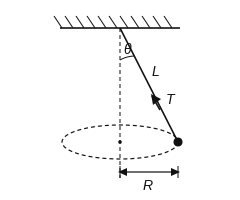
A string of length L is fixed at one end and carries a mass of M at the other end. The mass makes (3π) rotations per second about the vertical axis passing through end of the string as shown. The tension in the string is ________ ML.

L लंबाई की एक डोरी एक सिरे पर बँधी है और दूसरे सिरे पर M द्रव्यमान जुड़ा है। चित्रानुसार द्रव्यमान, डोरी के सिरे से गुजरने वाले ऊर्ध्वाधर अक्ष के परितः प्रति सेकंड (3π) चक्कर लगाता है। डोरी में तनाव ________ ML है।
Show answer

Concept: For a conical pendulum of string length L at angle θ: Tsin⁡θ=Mω2r with r=Lsin⁡θ, so T=Mω2L independent of θ.

  1. Frequency f=3π rev/s ⇒ω=2πf=2π×3π=6 rad/s.
  2. T=Mω2L=M×36×L=36ML (SI units).
  3. Hence the blank is 36.

Short trick: Whenever f has π in the denominator, ω=2πf becomes a clean number — here 6.

Answer: 36

अवधारणा: L लंबाई की डोरी व θ कोण वाले शंक्वाकार लोलक के लिए: Tsin⁡θ=Mω2r, जहाँ r=Lsin⁡θ, अतः T=Mω2L (θ से स्वतंत्र)।

  1. आवृत्ति f=3π चक्कर/सेकंड ⇒ω=2πf=2π×3π=6 rad/s।
  2. T=Mω2L=M×36×L=36ML (SI मात्रक)।
  3. अतः रिक्त स्थान 36 है।

शॉर्ट ट्रिक: जब f के हर में π हो, तो ω=2πf एक सरल संख्या बनता है — यहाँ 6।

उत्तर: 36

JEE Main 2025 (January) – Paper 1 (B.E./B.Tech)PhysicsCircular motion – conical pendulumJEE Main 2025 (January) – Paper 1 (B.E./B.Tech) 2025 · 24 Jan Shift 2 →
Q1998.
The increase in pressure required to decrease the volume of a water sample by 0.2% is P×105 Nm−2. Bulk modulus of water is 2.15×10⁹ Nm−2. The value of P is ________.
जल के किसी नमूने का आयतन 0.2% घटाने के लिए आवश्यक दाब वृद्धि P×105 Nm−2 है। जल का आयतन प्रत्यास्थता गुणांक (bulk modulus) 2.15×10⁹ Nm−2 है। P का मान ________ है।
Show answer

Concept: Bulk modulus: B=ΔPΔV/V⇒ΔP=B⋅ΔVV.

  1. ΔVV=0.2%=2×10⁻³.
  2. ΔP=2.15×109×2×10−3=4.3×10⁶ Nm−2.
  3. 4.3×106=43×105 Nm−2⇒P=43.

Answer: 43

अवधारणा: आयतन प्रत्यास्थता गुणांक: B=ΔPΔV/V⇒ΔP=B⋅ΔVV।

  1. ΔVV=0.2%=2×10⁻³।
  2. ΔP=2.15×109×2×10−3=4.3×10⁶ Nm−2।
  3. 4.3×106=43×105 Nm−2⇒P=43।

उत्तर: 43

JEE Main 2025 (January) – Paper 1 (B.E./B.Tech)PhysicsMechanical properties – bulk modulusJEE Main 2025 (January) – Paper 1 (B.E./B.Tech) 2025 · 24 Jan Shift 2 →
Q1999.
A tightly wound long solenoid carries a current of 1.5 A. An electron is executing uniform circular motion inside the solenoid with a time period of 75 ns. The number of turns per metre in the solenoid is ________.
[Take mass of electron me=9×10⁻³¹ kg, charge of electron |qe|=1.6×10⁻¹⁹ C, μ0=4π×10−7 N A−2, 1 ns =10−9 s]
कसकर लपेटी गई एक लंबी परिनालिका में 1.5 A धारा प्रवाहित है। परिनालिका के भीतर एक इलेक्ट्रॉन 75 ns आवर्तकाल से एकसमान वृत्तीय गति कर रहा है। परिनालिका में प्रति मीटर फेरों की संख्या ________ है।
[इलेक्ट्रॉन का द्रव्यमान me=9×10⁻³¹ kg, इलेक्ट्रॉन का आवेश |qe|=1.6×10⁻¹⁹ C, μ0=4π×10−7 N A−2, 1 ns =10−9 s लीजिए]
Show answer

Concept: Period of circular motion of a charge in field B: T=2πmqB; field inside a long solenoid: B=μ0nI.

  1. B=2πmeqeT=2π×9×10−311.6×10−19×75×10−9=2π×9×10−311.2×10−26=1.5π×10−4 T.
  2. n=Bμ0I=1.5π×10−44π×10−7×1.5=10−44×10−7=250 turns per metre.

Short trick: Combine directly: n=2πmeqeTμ0I — the π cancels with μ0=4π×10−7.

Answer: 250

अवधारणा: क्षेत्र B में आवेश की वृत्तीय गति का आवर्तकाल: T=2πmqB; लंबी परिनालिका के भीतर क्षेत्र: B=μ0nI।

  1. B=2πmeqeT=2π×9×10−311.6×10−19×75×10−9=2π×9×10−311.2×10−26=1.5π×10−4 T।
  2. n=Bμ0I=1.5π×10−44π×10−7×1.5=10−44×10−7=250 फेरे प्रति मीटर।

शॉर्ट ट्रिक: सीधे जोड़ें: n=2πmeqeTμ0I — π, μ0=4π×10−7 के साथ कट जाता है।

उत्तर: 250

JEE Main 2025 (January) – Paper 1 (B.E./B.Tech)PhysicsMagnetic effects of current – solenoidJEE Main 2025 (January) – Paper 1 (B.E./B.Tech) 2025 · 24 Jan Shift 2 →
Q2000.
Acceleration due to gravity on the surface of earth is 'g'. If the diameter of earth is reduced to one third of its original value and mass remains unchanged, then the acceleration due to gravity on the surface of the earth is ________ g.
पृथ्वी की सतह पर गुरुत्वीय त्वरण 'g' है। यदि पृथ्वी का व्यास घटाकर अपने मूल मान का एक-तिहाई कर दिया जाए और द्रव्यमान अपरिवर्तित रहे, तो पृथ्वी की सतह पर गुरुत्वीय त्वरण ________ g होगा।
Show answer

Concept: On the surface, g=GMR2.

  1. Diameter (and hence radius) becomes one third: R′=R3, mass M unchanged.
  2. g′=GM(R/3)2=9GMR2=9g.
  3. So the new acceleration due to gravity is 9g — the blank is 9.

Short trick: g∝1R2 at fixed mass: radius ÷3⇒g×9.

Answer: 9

अवधारणा: सतह पर g=GMR2।

  1. व्यास (अतः त्रिज्या) एक-तिहाई हो जाती है: R′=R3, द्रव्यमान M अपरिवर्तित।
  2. g′=GM(R/3)2=9GMR2=9g।
  3. अतः नया गुरुत्वीय त्वरण 9g है — रिक्त स्थान 9।

शॉर्ट ट्रिक: नियत द्रव्यमान पर g∝1R2: त्रिज्या ÷3⇒g×9।

उत्तर: 9

JEE Main 2025 (January) – Paper 1 (B.E./B.Tech)PhysicsGravitation – acceleration due to gravityJEE Main 2025 (January) – Paper 1 (B.E./B.Tech) 2025 · 24 Jan Shift 2 →