Q101.The percentage error in the calculated volume of a sphere, if there is 2% error in its diameter measurement, is _______.
यदि किसी गोले के व्यास के मापन में 2% त्रुटि है, तो उसके परिकलित आयतन में प्रतिशत त्रुटि _______ है।
- A1
- B2
- C6
- D8
Show answer
Concept: For , relative errors add with powers: .
- Volume of sphere in terms of diameter: .
- Percentage error in (percentage error in ) .
Short trick: Error multiplies by the power: → .
Answer: (C) 6
अवधारणा: के लिए आपेक्षिक त्रुटियाँ घात के साथ जुड़ती हैं: ।
- व्यास के पदों में गोले का आयतन: ।
- में प्रतिशत त्रुटि ( में प्रतिशत त्रुटि) ।
शॉर्ट ट्रिक: त्रुटि घात से गुणा होती है: → ।
उत्तर: (C) 6
JEE Main 2026 (April) – Paper 1 (B.E./B.Tech)PhysicsUnits & Measurements – error propagationJEE Main 2026 (April) – Paper 1 (B.E./B.Tech) 2026 · 6 Apr Shift 2
Q102.Match
List - I with
List - II.
| List - I | | List - II |
|---|
| A. | Boltzmann constant | I. | |
| B. | Stefan's constant | II. | |
| C. | Planck's constant | III. | |
| D. | Gravitational constant | IV. | |
Choose the
correct answer from the options given below :
सूची - I का
सूची - II से मिलान कीजिए।
| सूची - I | | सूची - II |
|---|
| A. | बोल्ट्ज़मान नियतांक (Boltzmann constant) | I. | |
| B. | स्टीफ़न नियतांक (Stefan's constant) | II. | |
| C. | प्लांक नियतांक (Planck's constant) | III. | |
| D. | गुरुत्वीय नियतांक (Gravitational constant) | IV. | |
नीचे दिए गए विकल्पों में से
सही उत्तर चुनिए :
- AA-I, B-II, C-III, D-IV
- BA-IV, B-III, C-II, D-I
- CA-III, B-IV, C-II, D-I
- DA-II, B-I, C-IV, D-III
Show answer
Concept: Write each constant from a defining relation and reduce to .
- Boltzmann: → → A-III.
- Stefan: → → B-IV.
- Planck: → → C-II.
- Gravitational: → → D-I.
- (A) and (D) give A-I / A-II (wrong for ); (B) gives A-IV (that is ). Only (C) fits all four.
Short trick: Only has and only has → B-IV, D-I picks (C) at once.
Answer: (C) A-III, B-IV, C-II, D-I
अवधारणा: प्रत्येक नियतांक को उसके परिभाषित संबंध से लिखकर में बदलें।
- बोल्ट्ज़मान: → → A-III।
- स्टीफ़न: → → B-IV।
- प्लांक: → → C-II।
- गुरुत्वीय: → → D-I।
- (A) तथा (D) में A-I / A-II है ( के लिए गलत); (B) में A-IV है (वह की विमा है)। केवल (C) चारों में सही बैठता है।
शॉर्ट ट्रिक: केवल में और केवल में है → B-IV, D-I से तुरंत (C)।
उत्तर: (C) A-III, B-IV, C-II, D-I
JEE Main 2026 (April) – Paper 1 (B.E./B.Tech)PhysicsUnits & Dimensions – dimensions of constantsJEE Main 2026 (April) – Paper 1 (B.E./B.Tech) 2026 · 6 Apr Shift 2
Q103.A solid sphere () of mass and a spherical shell () of mass , both having same radius, are placed on a rough surface. When a force of same magnitude is applied tangentially at the highest points of and , they start rolling without slipping with an acceleration of and , respectively. The ratio of and is _______.
द्रव्यमान का एक ठोस गोला () तथा द्रव्यमान का एक गोलीय कोश (), दोनों की त्रिज्या समान है, एक खुरदरी सतह पर रखे हैं। जब तथा के उच्चतम बिंदुओं पर समान परिमाण का बल स्पर्शरेखीय रूप से लगाया जाता है, तो वे क्रमशः तथा त्वरण के साथ बिना फिसले लोटन (rolling without slipping) प्रारंभ करते हैं। तथा का अनुपात _______ है।
- A5 : 21
- B6 : 10
- C21 : 25
- D1 : 5
Show answer
Concept: Force at the top with friction (forward) at the bottom: and . Adding, , so .
- Solid sphere: , → .
- Spherical shell: , → .
- .
Short trick: : .
Answer: (A) 5 : 21
अवधारणा: शीर्ष पर बल तथा तली पर घर्षण (आगे की ओर): तथा । जोड़ने पर , अतः ।
- ठोस गोला: , → ।
- गोलीय कोश: , → ।
- ।
शॉर्ट ट्रिक: : ।
उत्तर: (A) 5 : 21
JEE Main 2026 (April) – Paper 1 (B.E./B.Tech)PhysicsRotational Motion – rolling under a force at the topJEE Main 2026 (April) – Paper 1 (B.E./B.Tech) 2026 · 6 Apr Shift 2
Q104.A body of mass 1 kg moves along a straight line with a velocity . The work done by the body during displacement from to 5 m is _______ J.
1 kg द्रव्यमान की एक वस्तु एक सरल रेखा के अनुदिश वेग से गति करती है। से 5 m तक विस्थापन के दौरान वस्तु द्वारा किया गया कार्य _______ J है।
- A0
- B250
- C1250
- D1000
Show answer
Concept: Work-energy theorem: net work .
- At : . At m: m/s.
- J.
Short trick: Only end speeds matter: J.
Answer: (C) 1250
अवधारणा: कार्य-ऊर्जा प्रमेय: कुल कार्य ।
- पर: । m पर: m/s।
- J।
शॉर्ट ट्रिक: केवल प्रारंभिक व अंतिम चाल मायने रखती है: J।
उत्तर: (C) 1250
JEE Main 2026 (April) – Paper 1 (B.E./B.Tech)PhysicsWork, Energy & Power – work-energy theoremJEE Main 2026 (April) – Paper 1 (B.E./B.Tech) 2026 · 6 Apr Shift 2
Q105.A cylinder with adiabatic walls is closed at both ends and is divided into two compartments by a frictionless adiabatic piston. Ideal gas is filled in both (left and right) the compartments at same , , . Heating is started from left side until pressure changes to . If initial volume of each compartment was 9 litres then the final volume in right-hand side compartment is _______ litres. (for this ideal gas )
रुद्धोष्म दीवारों वाला एक बेलन दोनों सिरों पर बंद है तथा एक घर्षणरहित रुद्धोष्म पिस्टन द्वारा दो कक्षों में विभाजित है। दोनों (बाएँ तथा दाएँ) कक्षों में समान , , पर आदर्श गैस भरी है। बाईं ओर से तब तक ऊष्मा दी जाती है जब तक दाब नहीं हो जाता। यदि प्रत्येक कक्ष का प्रारंभिक आयतन 9 लीटर था, तो दाईं ओर के कक्ष का अंतिम आयतन _______ लीटर है। (इस आदर्श गैस के लिए )
- A3
- B4
- C14
- D9
Show answer
Concept: The right gas receives no heat (adiabatic walls and piston) and is compressed slowly, so constant. Pressure is equal on both sides of the frictionless piston.
- Right gas: .
- (since ).
- litres.
Short trick: L.
Answer: (B) 4
अवधारणा: दाईं गैस को कोई ऊष्मा नहीं मिलती (रुद्धोष्म दीवारें व पिस्टन) तथा उसका धीमे-धीमे संपीडन होता है, अतः नियत। घर्षणरहित पिस्टन के दोनों ओर दाब समान रहता है।
- दाईं गैस: ।
- (क्योंकि )।
- लीटर।
शॉर्ट ट्रिक: L।
उत्तर: (B) 4
JEE Main 2026 (April) – Paper 1 (B.E./B.Tech)PhysicsThermodynamics – adiabatic compressionJEE Main 2026 (April) – Paper 1 (B.E./B.Tech) 2026 · 6 Apr Shift 2
Q106.For an electromagnetic wave propagating through vacuum, , and represent propagation vector, electric field and angular frequency, respectively. The magnetic field associated with this wave is represented by :
निर्वात में संचरित एक विद्युत-चुंबकीय तरंग के लिए , तथा क्रमशः संचरण सदिश, विद्युत क्षेत्र तथा कोणीय आवृत्ति को निरूपित करते हैं। इस तरंग से संबद्ध चुंबकीय क्षेत्र को निरूपित किया जाता है :
- A
- B
- C
- D
Show answer
Concept: From Faraday's law for a plane wave : .
- gives .
- So ; magnitude ✓.
- (A) points opposite (wrong direction); (C), (D) have wrong dimensions ( is not ).
Short trick: is along , so , and .
Answer: (B)
अवधारणा: समतल तरंग के लिए फैराडे नियम से: ।
- से ।
- अतः ; परिमाण ✓।
- (A) विपरीत दिशा देता है (गलत); (C), (D) की विमाएँ गलत हैं (, नहीं है)।
शॉर्ट ट्रिक: की दिशा के अनुदिश होती है, अतः तथा ।
उत्तर: (B)
JEE Main 2026 (April) – Paper 1 (B.E./B.Tech)PhysicsElectromagnetic Waves – relation between E, B and kJEE Main 2026 (April) – Paper 1 (B.E./B.Tech) 2026 · 6 Apr Shift 2
Q107.Two identical bodies A and B of equal masses have initial velocities m/s and m/s respectively. The body A has acceleration m/s2 while the acceleration of the other body B is zero. The centre of mass of the two bodies moves in _______ path.
समान द्रव्यमान की दो सर्वसम वस्तुओं A तथा B के प्रारंभिक वेग क्रमशः m/s तथा m/s हैं। वस्तु A का त्वरण m/s2 है जबकि दूसरी वस्तु B का त्वरण शून्य है। दोनों वस्तुओं का द्रव्यमान केंद्र _______ पथ पर गति करता है।
- Acircularवृत्तीय
- Bparabolicपरवलयिक
- Cstraight lineसरल रेखीय
- Dellipticalदीर्घवृत्तीय
Show answer
Concept: With constant acceleration, the path is a straight line when is parallel to , otherwise a parabola.
- m/s.
- m/s2.
- Both are along → the centre of mass moves in a straight line.
Short trick: Both and have equal and parts → parallel → straight line.
Answer: (C) straight line
अवधारणा: नियत त्वरण में यदि , के समांतर हो तो पथ सरल रेखा होता है, अन्यथा परवलय।
- m/s।
- m/s2।
- दोनों के अनुदिश हैं → द्रव्यमान केंद्र सरल रेखा में गति करता है।
शॉर्ट ट्रिक: तथा दोनों के व घटक बराबर हैं → समांतर → सरल रेखा।
उत्तर: (C) सरल रेखीय
JEE Main 2026 (April) – Paper 1 (B.E./B.Tech)PhysicsSystem of Particles – motion of centre of massJEE Main 2026 (April) – Paper 1 (B.E./B.Tech) 2026 · 6 Apr Shift 2
Q108.Figure represents the extension (
) of a wire of length 1 meter, suspended from the ceiling of the room at one end with a load
connected to the other end. If the cross-sectional area of the wire is
m
2 then the Young's modulus of the wire is _______ N/m
2.
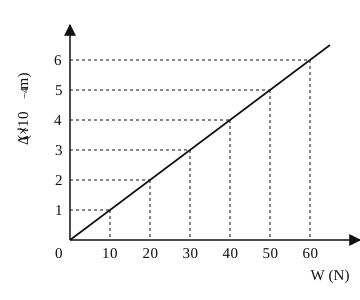
चित्र 1 मीटर लंबाई के एक तार का विस्तार (
) दर्शाता है, जिसका एक सिरा कमरे की छत से लटका है तथा दूसरे सिरे पर भार
जुड़ा है। यदि तार का अनुप्रस्थ-काट क्षेत्रफल
m
2 है, तो तार का यंग प्रत्यास्थता गुणांक (Young's modulus) _______ N/m
2 है।
- A
- B
- C
- D
Show answer
Concept: ; the graph gives as its slope.
- From the graph: N gives m.
- N/m2.
Short trick: Slope m/N, so .
Answer: (C)
अवधारणा: ; ग्राफ़ की प्रवणता देती है।
- ग्राफ़ से: N पर m।
- N/m2।
शॉर्ट ट्रिक: प्रवणता m/N, अतः ।
उत्तर: (C)
JEE Main 2026 (April) – Paper 1 (B.E./B.Tech)PhysicsMechanical Properties of Solids – Young's modulus from graphJEE Main 2026 (April) – Paper 1 (B.E./B.Tech) 2026 · 6 Apr Shift 2
Q109.A cylindrical vessel of 40 cm radius is completely filled with water and its capacity is 528 dm3 (dm : decimeter) The vessel is placed on a solid block of exactly same height as vessel. If a small hole is made at 70 cm below the top of water level, then horizontal range of water falling on the ground in the beginning is _______ cm.
40 cm त्रिज्या का एक बेलनाकार पात्र पूर्णतः जल से भरा है तथा इसकी धारिता 528 dm3 (dm : डेसीमीटर) है। पात्र को ठीक उसी ऊँचाई के एक ठोस ब्लॉक पर रखा गया है। यदि जल के शीर्ष तल से 70 cm नीचे एक छोटा छिद्र किया जाए, तो प्रारंभ में भूमि पर गिरने वाले जल की क्षैतिज परास _______ cm है।
- A
- B
- C
- D
Show answer
Concept: Efflux speed ( = depth of hole); fall height gives range .
- Height of vessel: cm3 → cm.
- Hole is cm below the water surface, i.e. cm above the vessel base.
- Height of hole above ground: cm.
- cm.
Short trick: with , → .
Answer: (B)
अवधारणा: बहिःस्राव वेग ( = छिद्र की गहराई); गिरने की ऊँचाई हो तो परास ।
- पात्र की ऊँचाई: cm3 → cm।
- छिद्र जल-तल से cm नीचे है, अर्थात् पात्र की तली से cm ऊपर।
- भूमि से छिद्र की ऊँचाई: cm।
- cm।
शॉर्ट ट्रिक: , जहाँ , → ।
उत्तर: (B)
JEE Main 2026 (April) – Paper 1 (B.E./B.Tech)PhysicsFluid Mechanics – Torricelli's theorem and rangeJEE Main 2026 (April) – Paper 1 (B.E./B.Tech) 2026 · 6 Apr Shift 2
Q110.If 2 mole of an ideal monoatomic gas at temperature , is mixed with 6 mole of another ideal monoatomic gas at temperature then the temperature of mixture is :
यदि ताप पर एक आदर्श एकपरमाणुक गैस के 2 मोल को ताप पर एक अन्य आदर्श एकपरमाणुक गैस के 6 मोल के साथ मिलाया जाए, तो मिश्रण का ताप है :
- A
- B
- C
- D
Show answer
Concept: Internal energy is conserved on mixing: . Both gases have the same .
- .
- .
Short trick: Same → mole-weighted average: .
Answer: (D)
अवधारणा: मिश्रण पर आंतरिक ऊर्जा संरक्षित रहती है: । दोनों गैसों का समान है।
- ।
- ।
शॉर्ट ट्रिक: समान → मोल-भारित औसत: ।
उत्तर: (D)
JEE Main 2026 (April) – Paper 1 (B.E./B.Tech)PhysicsKinetic Theory – temperature of a gas mixtureJEE Main 2026 (April) – Paper 1 (B.E./B.Tech) 2026 · 6 Apr Shift 2
Q111.A spring stretches by 2 mm when it is loaded with a mass of 200 g. From equilibrium position the mass is further pulled down by 2 mm and released. The frequency associated with the system and maxmimum energy in the spring are _______ Hz and _______ J, respectively. (Take m/s2)
200 g द्रव्यमान लटकाने पर एक स्प्रिंग 2 mm खिंच जाती है। साम्यावस्था से द्रव्यमान को 2 mm और नीचे खींचकर छोड़ दिया जाता है। निकाय से संबद्ध आवृत्ति तथा स्प्रिंग में अधिकतम ऊर्जा क्रमशः _______ Hz तथा _______ J हैं। ( m/s2 लीजिए)
- A and तथा
- B and 8 तथा 8
- C and तथा
- D and तथा
Show answer
Concept: , ; the spring's elastic energy is maximum at the lowest point, where its extension is .
- N/m.
- rad/s → Hz.
- Maximum extension mm → J.
- (C) gives not ; (B) and (D) have the wrong energy.
Short trick: ; energy uses total stretch 4 mm: mJ.
Answer: (A) and
अवधारणा: , ; स्प्रिंग की प्रत्यास्थ ऊर्जा निम्नतम बिंदु पर अधिकतम होती है, जहाँ उसका विस्तार है।
- N/m।
- rad/s → Hz।
- अधिकतम विस्तार mm → J।
- (C) में के स्थान पर है; (B) तथा (D) में ऊर्जा गलत है।
शॉर्ट ट्रिक: ; ऊर्जा के लिए कुल खिंचाव 4 mm: mJ।
उत्तर: (A) तथा
JEE Main 2026 (April) – Paper 1 (B.E./B.Tech)PhysicsOscillations – spring-mass systemJEE Main 2026 (April) – Paper 1 (B.E./B.Tech) 2026 · 6 Apr Shift 2
Q112.The electric potential as a function of , is given by V. The electric field at a point (2, 3) m is _______ V/m.
, के फलन के रूप में विद्युत विभव V दिया गया है। बिंदु (2, 3) m पर विद्युत क्षेत्र _______ V/m है।
- A
- B
- C
- D
Show answer
Concept: .
- , .
- .
- At (2, 3): V/m.
Short trick: Minus gradient: -part , -part .
Answer: (A)
अवधारणा: ।
- , ।
- ।
- (2, 3) पर: V/m।
शॉर्ट ट्रिक: ऋणात्मक प्रवणता: -भाग , -भाग ।
उत्तर: (A)
JEE Main 2026 (April) – Paper 1 (B.E./B.Tech)PhysicsElectrostatic Potential – field from potentialJEE Main 2026 (April) – Paper 1 (B.E./B.Tech) 2026 · 6 Apr Shift 2
Q113.A current of 30 A each flows in opposite directions in two conducting wires, placed parallel to each other at a distance of 8 cm. The magnetic field at the mid point between the two wires is _______ μT. ( N/A2)
एक-दूसरे से 8 cm की दूरी पर समांतर रखे दो चालक तारों में विपरीत दिशाओं में प्रत्येक में 30 A धारा प्रवाहित होती है। दोनों तारों के बीच मध्य बिंदु पर चुंबकीय क्षेत्र _______ μT है। ( N/A2)
- A30
- B300
- C150
- D0.0
Show answer
Concept: Field of a long wire . For opposite currents, the fields at the midpoint point the same way and add.
- Distance of midpoint from each wire: cm m.
- Each wire: T μT.
- Net: μT.
Short trick: Opposite currents → fields add at the midpoint: μT.
Answer: (B) 300
अवधारणा: लंबे तार का क्षेत्र । विपरीत धाराओं के लिए मध्य बिंदु पर दोनों क्षेत्र एक ही दिशा में होते हैं और जुड़ते हैं।
- प्रत्येक तार से मध्य बिंदु की दूरी: cm m।
- प्रत्येक तार: T μT।
- कुल: μT।
शॉर्ट ट्रिक: विपरीत धाराएँ → मध्य बिंदु पर क्षेत्र जुड़ते हैं: μT।
उत्तर: (B) 300
JEE Main 2026 (April) – Paper 1 (B.E./B.Tech)PhysicsMoving Charges & Magnetism – field of two parallel wiresJEE Main 2026 (April) – Paper 1 (B.E./B.Tech) 2026 · 6 Apr Shift 2
Q114.A square loop of side 2 cm is placed in a time varying magnetic field with magnitude as Tesla. The normal to the plane of loop makes an angle of with the field. The maximum induced emf produced in the loop is _______ mV.
2 cm भुजा का एक वर्गाकार लूप समय के साथ परिवर्ती चुंबकीय क्षेत्र में रखा है, जिसका परिमाण टेस्ला है। लूप के तल का अभिलंब क्षेत्र के साथ का कोण बनाता है। लूप में उत्पन्न अधिकतम प्रेरित विद्युत वाहक बल (emf) _______ mV है।
- A12
- B18
- C21
- D24
Show answer
Concept: , , so .
- m2, T, rad/s, .
- V mV.
Short trick: ; ; half of it mV.
Answer: (D) 24
अवधारणा: , , अतः ।
- m2, T, rad/s, ।
- V mV।
शॉर्ट ट्रिक: ; ; इसका आधा mV।
उत्तर: (D) 24
JEE Main 2026 (April) – Paper 1 (B.E./B.Tech)PhysicsElectromagnetic Induction – induced emf in a loopJEE Main 2026 (April) – Paper 1 (B.E./B.Tech) 2026 · 6 Apr Shift 2
Q115.A sphere of capacitance 100 pF is charged to a potential of 100 V. Another identical uncharged metal sphere is brought in contact with the charged sphere, then the change in the total energy stored on these spheres, when they touch is J. The value of is _______. (combined capacitance of spheres is 200 pF)
100 pF धारिता के एक गोले को 100 V विभव तक आवेशित किया जाता है। एक अन्य सर्वसम अनावेशित धातु गोले को आवेशित गोले के संपर्क में लाया जाता है, तब स्पर्श होने पर इन गोलों पर संचित कुल ऊर्जा में परिवर्तन J है। का मान _______ है। (गोलों की संयुक्त धारिता 200 pF है)
- A5
- B
- C
- D
Show answer
Concept: Charge is conserved; energy before and after contact.
- C.
- J.
- J.
- Change J → .
Short trick: Sharing with an identical uncharged body halves the energy: loss .
Answer: (B)
अवधारणा: आवेश संरक्षित रहता है; संपर्क से पहले व बाद में ऊर्जा ।
- C।
- J।
- J।
- परिवर्तन J → ।
शॉर्ट ट्रिक: सर्वसम अनावेशित वस्तु के साथ आवेश बाँटने पर ऊर्जा आधी हो जाती है: ह्रास ।
उत्तर: (B)
JEE Main 2026 (April) – Paper 1 (B.E./B.Tech)PhysicsCapacitance – energy loss on sharing chargeJEE Main 2026 (April) – Paper 1 (B.E./B.Tech) 2026 · 6 Apr Shift 2
Q116.The energy released if hydrogen atoms are combined to form is _______ MeV.
(Take binding energies per nucleon of and as 1.1 MeV and 7.2 MeV, respectively)
यदि हाइड्रोजन परमाणुओं को संयोजित करके बनाया जाए, तो मुक्त ऊर्जा _______ MeV है।
( तथा की प्रति न्यूक्लिऑन बंधन ऊर्जा क्रमशः 1.1 MeV तथा 7.2 MeV लीजिए)
- A6.1
- B24.4
- C26.6
- D5
Show answer
Concept: Energy released = (total binding energy of products) − (total binding energy of reactants). Reaction: .
- BE of He: MeV.
- BE of two deuterons: MeV.
- MeV.
Short trick: MeV (same 4 nucleons on both sides).
Answer: (B) 24.4
अवधारणा: मुक्त ऊर्जा = (उत्पादों की कुल बंधन ऊर्जा) − (अभिकारकों की कुल बंधन ऊर्जा)। अभिक्रिया: ।
- He की बंधन ऊर्जा: MeV।
- दो ड्यूट्रॉनों की बंधन ऊर्जा: MeV।
- MeV।
शॉर्ट ट्रिक: MeV (दोनों ओर समान 4 न्यूक्लिऑन)।
उत्तर: (B) 24.4
JEE Main 2026 (April) – Paper 1 (B.E./B.Tech)PhysicsNuclei – binding energy and fusionJEE Main 2026 (April) – Paper 1 (B.E./B.Tech) 2026 · 6 Apr Shift 2
Q117.Angle of minimum deviation is equal to the half of the angle of prism in an equilateral prism. The refractive index of the prism is _______.
एक समबाहु प्रिज़्म में न्यूनतम विचलन कोण, प्रिज़्म कोण के आधे के बराबर है। प्रिज़्म का अपवर्तनांक _______ है।
- A1.5
- B
- C
- D1.65
Show answer
Concept: .
- Equilateral prism: , so .
- .
Short trick: , → .
Answer: (C)
अवधारणा: ।
- समबाहु प्रिज़्म: , अतः ।
- ।
शॉर्ट ट्रिक: , → ।
उत्तर: (C)
JEE Main 2026 (April) – Paper 1 (B.E./B.Tech)PhysicsRay Optics – prism minimum deviationJEE Main 2026 (April) – Paper 1 (B.E./B.Tech) 2026 · 6 Apr Shift 2
Q118.Refer to the logic circuit given below. For two inputs (
,
) and (
,
), output (
) will be _______.
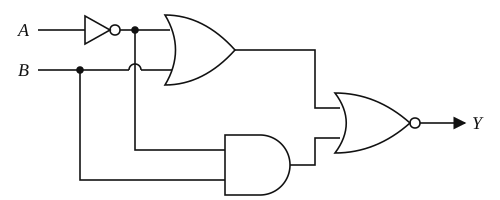
नीचे दिए गए लॉजिक परिपथ को देखिए। दो निवेशों (
,
) तथा (
,
) के लिए निर्गत (
) _______ होगा।
- A1, 0 respectivelyक्रमशः 1, 0
- B0, 1 respectivelyक्रमशः 0, 1
- C0, 0 respectivelyक्रमशः 0, 0
- D1, 1 respectivelyक्रमशः 1, 1
Show answer
Concept: is inverted to . The OR gate gets ; the AND gate gets ; their outputs go to a NOR gate: .
- : ; OR , AND ; NOR.
- : ; OR , AND ; NOR.
- So respectively.
Short trick: ; with in both cases, both times.
Answer: (C) 0, 0 respectively
अवधारणा: उत्क्रमित होकर बनता है। OR गेट को तथा AND गेट को मिलते हैं; इनके निर्गत NOR गेट में जाते हैं: ।
- : ; OR , AND ; NOR।
- : ; OR , AND ; NOR।
- अतः क्रमशः है।
शॉर्ट ट्रिक: ; दोनों स्थितियों में है, अतः दोनों बार ।
उत्तर: (C) क्रमशः 0, 0
JEE Main 2026 (April) – Paper 1 (B.E./B.Tech)PhysicsSemiconductor Electronics – logic gatesJEE Main 2026 (April) – Paper 1 (B.E./B.Tech) 2026 · 6 Apr Shift 2
Q119.The velocity at which 6 kg mass (shown in figure) strikes the ground when it is released from a height of 6 m above the ground is _______ m/s. Assume pulley is massless and string is light and inextensible. (Take
m/s
2)
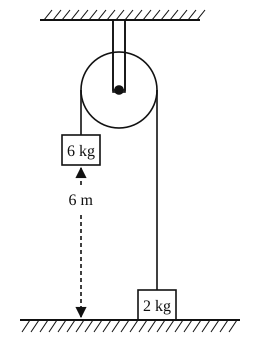
चित्र में दर्शाया 6 kg द्रव्यमान, भूमि से 6 m की ऊँचाई से छोड़े जाने पर जिस वेग से भूमि से टकराता है, वह _______ m/s है। मान लीजिए घिरनी द्रव्यमानरहित है तथा डोरी हल्की और अवितान्य है। (
m/s
2 लीजिए)
- A7.74
- B7.20
- C6.55
- D4.50
Show answer
Concept: Atwood machine: , then .
- m/s2.
- m/s ≈ 7.74 m/s.
Short trick: Energy: → .
Answer: (A) 7.74
अवधारणा: एटवुड मशीन: , फिर ।
- m/s2।
- m/s ≈ 7.74 m/s।
शॉर्ट ट्रिक: ऊर्जा से: → ।
उत्तर: (A) 7.74
JEE Main 2026 (April) – Paper 1 (B.E./B.Tech)PhysicsLaws of Motion – Atwood machineJEE Main 2026 (April) – Paper 1 (B.E./B.Tech) 2026 · 6 Apr Shift 2
Q120.In a Young double slit experiment, the wavelength of incident light is 6000 Å, the separation between slits
and
is 5 cm and the distance between slits plane and screen is 50 cm, as shown in the figure below. If the resultant intensity at
is equal to the intensity due to individual slits, the path difference between interfering waves is _______ Å.
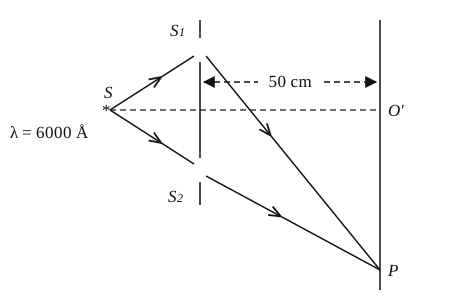
यंग के द्वि-झिरी प्रयोग में आपतित प्रकाश की तरंगदैर्ध्य 6000 Å, झिरियों
तथा
के बीच की दूरी 5 cm तथा झिरियों के तल और पर्दे के बीच की दूरी 50 cm है, जैसा कि नीचे चित्र में दर्शाया गया है। यदि
पर परिणामी तीव्रता, प्रत्येक झिरी के कारण तीव्रता के बराबर है, तो व्यतिकारी तरंगों के बीच पथांतर _______ Å है।
- A4000
- B3000
- C2000
- D1000
Show answer
Concept: and path difference .
- → → → least .
- Å.
- (B) gives and (D) gives . (, i.e. Å, also gives , but the path difference asked for is the least one, .)
Short trick: ↔ ↔ .
Answer: (C) 2000
अवधारणा: तथा पथांतर ।
- → → → न्यूनतम ।
- Å।
- (B) से तथा (D) से मिलता है। (, अर्थात् Å पर भी होता है, परंतु यहाँ पूछा गया पथांतर न्यूनतम वाला, , है।)
शॉर्ट ट्रिक: ↔ ↔ ।
उत्तर: (C) 2000
JEE Main 2026 (April) – Paper 1 (B.E./B.Tech)PhysicsWave Optics – YDSE intensity and path differenceJEE Main 2026 (April) – Paper 1 (B.E./B.Tech) 2026 · 6 Apr Shift 2

