Q141.Consider the following reaction.
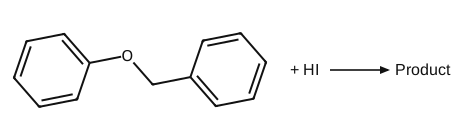
Statement I : In the above reaction, product formed will be a mixture of benzyl alcohol and iodobenzene.
Statement II : In the above reaction, the –O–CH2– bond is cleaved to give the product.
In the light of the above statements, choose the correct answer from the options given below :
निम्नलिखित अभिक्रिया पर विचार कीजिए।
कथन I : उपर्युक्त अभिक्रिया में बनने वाला उत्पाद बेन्ज़िल ऐल्कोहॉल तथा आयडोबेन्ज़ीन का मिश्रण होगा।
कथन II : उपर्युक्त अभिक्रिया में –O–CH2– आबंध विदलित होकर उत्पाद देता है।
उपर्युक्त कथनों के आलोक में, नीचे दिए गए विकल्पों में से सही उत्तर चुनिए :
- ABoth Statement I and Statement II are trueकथन I और कथन II दोनों सत्य हैं
- BBoth Statement I and Statement II are falseकथन I और कथन II दोनों असत्य हैं
- CStatement I is true but Statement II is falseकथन I सत्य है परंतु कथन II असत्य है
- DStatement I is false but Statement II is trueकथन I असत्य है परंतु कथन II सत्य है
Show answer
Concept: In aryl alkyl ethers the O–aryl bond has partial double-bond character and is never cleaved by HI; the O–alkyl (here benzylic) bond breaks.
- C6H5–O–CH2C6H5 is protonated by HI on oxygen.
- The O–CH2 bond breaks (stable benzyl carbocation / easy SN attack by I− at the benzylic carbon) → C6H5OH + C6H5CH2I.
- Products are phenol and benzyl iodide, not benzyl alcohol and iodobenzene (iodobenzene would need Ph–O cleavage) → Statement I false.
- The –O–CH2– bond is cleaved → Statement II true. Hence (A), (B), (C) are wrong.
Short trick: Ar–O stays intact: an aryl ether + HI always gives phenol.
Answer: (D) Statement I is false but Statement II is true
अवधारणा: ऐरिल ऐल्किल ईथरों में O–ऐरिल आबंध में आंशिक द्विआबंध लक्षण होता है और HI से कभी नहीं टूटता; O–ऐल्किल (यहाँ बेन्ज़िलिक) आबंध टूटता है।
- C6H5–O–CH2C6H5 का ऑक्सीजन HI द्वारा प्रोटॉनित होता है।
- O–CH2 आबंध टूटता है (स्थायी बेन्ज़िल कार्बधनायन / बेन्ज़िलिक कार्बन पर I− का सरल SN आक्रमण) → C6H5OH + C6H5CH2I।
- उत्पाद फ़ीनॉल तथा बेन्ज़िल आयोडाइड हैं, बेन्ज़िल ऐल्कोहॉल तथा आयडोबेन्ज़ीन नहीं (आयडोबेन्ज़ीन के लिए Ph–O विदलन चाहिए) → कथन I असत्य।
- –O–CH2– आबंध विदलित होता है → कथन II सत्य। अतः (A), (B), (C) गलत हैं।
शॉर्ट ट्रिक: Ar–O अक्षुण्ण रहता है: ऐरिल ईथर + HI सदैव फ़ीनॉल देता है।
उत्तर: (D) कथन I असत्य है परंतु कथन II सत्य है
JEE Main 2026 (April) – Paper 1 (B.E./B.Tech)ChemistryEthers – cleavage by HIJEE Main 2026 (April) – Paper 1 (B.E./B.Tech) 2026 · 6 Apr Shift 2
Q142.Consider the following organic reaction sequence. Choose the final product (X) from the following (consider the major product in all intermediate reactions)
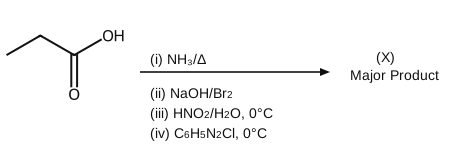
निम्नलिखित कार्बनिक अभिक्रिया अनुक्रम पर विचार कीजिए। निम्नलिखित में से अंतिम उत्पाद (X) चुनिए (सभी मध्यवर्ती अभिक्रियाओं में मुख्य उत्पाद पर विचार कीजिए)
- ABenzeneबेन्ज़ीन
- BPhenolफ़ीनॉल
- CPropanolप्रोपेनॉल
- DChlorobenzeneक्लोरोबेन्ज़ीन
Show answer
Concept: Acid → amide → amine (one C less) → alcohol; an alcohol (ethanol) reduces a diazonium salt to the arene.
- CH3CH2COOH + NH3, Δ → CH3CH2CONH2 (propanamide).
- Hofmann bromamide (NaOH/Br2) → CH3CH2NH2 (ethanamine).
- HNO2/H2O, 0 °C → unstable aliphatic diazonium → CH3CH2OH + N2.
- C6H5N2Cl + CH3CH2OH → C6H6 + N2 + CH3CHO + HCl. X = benzene.
- Phenol would need warm water, chlorobenzene needs CuCl (Sandmeyer), and propanol is never formed (Hofmann removes one carbon) – (B), (C), (D) are wrong.
Short trick: ArN2+ + ethanol (or H3PO2) → ArH.
Answer: (A) Benzene
अवधारणा: अम्ल → ऐमाइड → ऐमीन (एक C कम) → ऐल्कोहॉल; ऐल्कोहॉल (एथेनॉल) डाइऐज़ोनियम लवण को ऐरीन में अपचयित करता है।
- CH3CH2COOH + NH3, Δ → CH3CH2CONH2 (प्रोपेनैमाइड)।
- हॉफमान ब्रोमैमाइड (NaOH/Br2) → CH3CH2NH2 (एथेनैमीन)।
- HNO2/H2O, 0 °C → अस्थायी ऐलिफैटिक डाइऐज़ोनियम → CH3CH2OH + N2।
- C6H5N2Cl + CH3CH2OH → C6H6 + N2 + CH3CHO + HCl। X = बेन्ज़ीन।
- फ़ीनॉल के लिए गर्म जल, क्लोरोबेन्ज़ीन के लिए CuCl (सैंडमेयर) चाहिए, और प्रोपेनॉल कभी नहीं बनता (हॉफमान एक कार्बन हटाता है) – (B), (C), (D) गलत हैं।
शॉर्ट ट्रिक: ArN2+ + एथेनॉल (या H3PO2) → ArH।
उत्तर: (A) बेन्ज़ीन
JEE Main 2026 (April) – Paper 1 (B.E./B.Tech)ChemistryAmines – Hofmann bromamide and diazonium saltsJEE Main 2026 (April) – Paper 1 (B.E./B.Tech) 2026 · 6 Apr Shift 2
Q143.The number of compounds from the following which can undergo reaction with Br2/KOH (alcoholic) to give respective products and these respective products can also be obtained separately by Gabriel phthalimide reaction is :
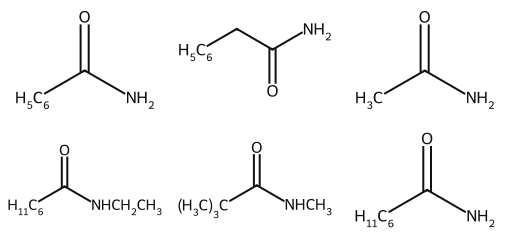
निम्नलिखित में से उन यौगिकों की संख्या जो Br2/KOH (ऐल्कोहॉलीय) से अभिक्रिया कर संबंधित उत्पाद देते हैं तथा ये संबंधित उत्पाद गैब्रिएल थैलिमाइड अभिक्रिया द्वारा भी अलग से प्राप्त किए जा सकते हैं, है :
- A5
- B4
- C3
- D6
Show answer
Concept: Hofmann bromamide works only on primary amides RCONH2 (gives RNH2); Gabriel synthesis gives only primary aliphatic amines (aryl halides do not undergo SN with phthalimide anion).
- C6H5CONH2 → C6H5NH2 (aniline): Hofmann ✓, Gabriel ✗.
- C6H5CH2CONH2 → C6H5CH2NH2 (benzylamine): both ✓.
- CH3CONH2 → CH3NH2: both ✓.
- C6H11CONHCH2CH3 and (CH3)3CCONHCH3 are N-substituted (secondary) amides → no Hofmann reaction ✗.
- C6H11CONH2 → C6H11NH2 (cyclohexylamine, a primary aliphatic amine): both ✓.
- Count = 3 (benzyl, methyl, cyclohexyl amides); hence 5, 4 and 6 are wrong.
Short trick: Keep only –CONH2 amides whose R is not aryl.
Answer: (C) 3
अवधारणा: हॉफमान ब्रोमैमाइड केवल प्राथमिक ऐमाइड RCONH2 पर कार्य करता है (RNH2 देता है); गैब्रिएल संश्लेषण केवल प्राथमिक ऐलिफैटिक ऐमीन देता है (ऐरिल हैलाइड थैलिमाइड ऋणायन से SN नहीं करते)।
- C6H5CONH2 → C6H5NH2 (ऐनिलीन): हॉफमान ✓, गैब्रिएल ✗।
- C6H5CH2CONH2 → C6H5CH2NH2 (बेन्ज़िलऐमीन): दोनों ✓।
- CH3CONH2 → CH3NH2: दोनों ✓।
- C6H11CONHCH2CH3 तथा (CH3)3CCONHCH3 N-प्रतिस्थापित (द्वितीयक) ऐमाइड हैं → हॉफमान अभिक्रिया नहीं ✗।
- C6H11CONH2 → C6H11NH2 (साइक्लोहेक्सिलऐमीन, प्राथमिक ऐलिफैटिक ऐमीन): दोनों ✓।
- संख्या = 3 (बेन्ज़िल, मेथिल, साइक्लोहेक्सिल ऐमाइड); अतः 5, 4 तथा 6 गलत हैं।
शॉर्ट ट्रिक: केवल वे –CONH2 ऐमाइड रखिए जिनका R ऐरिल नहीं है।
उत्तर: (C) 3
JEE Main 2026 (April) – Paper 1 (B.E./B.Tech)ChemistryAmines – Hofmann bromamide and Gabriel synthesisJEE Main 2026 (April) – Paper 1 (B.E./B.Tech) 2026 · 6 Apr Shift 2
Q144.Consider the following reactions. Total number of electrons in the π bonds and lone pair of electrons in the product (X) is :
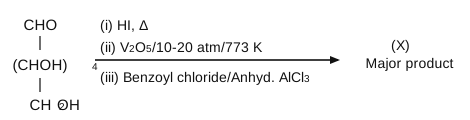
निम्नलिखित अभिक्रियाओं पर विचार कीजिए। उत्पाद (X) में π आबंधों के इलेक्ट्रॉनों तथा एकाकी युग्म इलेक्ट्रॉनों की कुल संख्या है :
- A12
- B16
- C14
- D18
Show answer
Concept: HI/Δ reduces glucose to n-hexane; V2O5 at 773 K and 10–20 atm aromatises n-hexane; Friedel–Crafts acylation then gives a ketone.
- Glucose CH3(CH2)4CH3 (n-hexane).
- n-Hexane C6H6 (benzene).
- C6H6 + C6H5COCl C6H5COC6H5 (benzophenone) = X.
- π bonds: 3 + 3 (two rings) + 1 (C=O) = 7 → 14 electrons.
- Lone pairs: 2 on carbonyl O → 4 electrons. Total = 14 + 4 = 18.
Short trick: Ph2C=O: 7 π bonds × 2 + 2 lone pairs × 2 = 18.
Answer: (D) 18
अवधारणा: HI/Δ ग्लूकोस को n-हेक्सेन में अपचयित करता है; 773 K तथा 10–20 atm पर V2O5 n-हेक्सेन का ऐरोमैटीकरण करता है; फिर फ्रीडेल–क्राफ्ट्स ऐसिलन से कीटोन बनता है।
- ग्लूकोस CH3(CH2)4CH3 (n-हेक्सेन)।
- n-हेक्सेन C6H6 (बेन्ज़ीन)।
- C6H6 + C6H5COCl C6H5COC6H5 (बेन्ज़ोफ़ीनोन) = X।
- π आबंध: 3 + 3 (दो वलय) + 1 (C=O) = 7 → 14 इलेक्ट्रॉन।
- एकाकी युग्म: कार्बोनिल O पर 2 → 4 इलेक्ट्रॉन। कुल = 14 + 4 = 18।
शॉर्ट ट्रिक: Ph2C=O: 7 π आबंध × 2 + 2 एकाकी युग्म × 2 = 18।
उत्तर: (D) 18
JEE Main 2026 (April) – Paper 1 (B.E./B.Tech)ChemistryBiomolecules / Aromatic Hydrocarbons – glucose to benzophenoneJEE Main 2026 (April) – Paper 1 (B.E./B.Tech) 2026 · 6 Apr Shift 2
Q145.Treatment of a gas ‘X’ with a freshly prepared ferrous sulphate solution gives a compound ‘Y’ as a brown ring. The compounds X and Y are.
एक गैस ‘X’ को ताज़े बने फेरस सल्फेट विलयन से उपचारित करने पर एक यौगिक ‘Y’ भूरे वलय के रूप में प्राप्त होता है। यौगिक X तथा Y हैं।
- ANO and [Fe(NO)]SO4NO तथा [Fe(NO)]SO4
- BNO2 and [Fe(NO2)]SO4NO2 तथा [Fe(NO2)]SO4
- CN2O and [Fe(N2O)]SO4N2O तथा [Fe(N2O)]SO4
- DN2O4 and [Fe(N2O4)]SO4N2O4 तथा [Fe(N2O4)]SO4
Show answer
Concept: Brown ring test for nitrate: Fe2+ reduces NO3− to NO, which binds to Fe2+.
- NO3− + 3Fe2+ + 4H+ → NO + 3Fe3+ + 2H2O.
- [Fe(H2O)6]2+ + NO → [Fe(H2O)5(NO)]2+ (brown) + H2O, i.e. the nitrosyl ferrous sulphate [Fe(NO)]SO4.
- So X = NO; NO2, N2O and N2O4 do not form the brown nitrosyl complex – (B), (C), (D) are wrong.
Short trick: Brown ring = Fe–NO (nitrosyl).
Answer: (A) NO and [Fe(NO)]SO4
अवधारणा: नाइट्रेट का भूरा वलय परीक्षण: Fe2+, NO3− को NO में अपचयित करता है, जो Fe2+ से बंधता है।
- NO3− + 3Fe2+ + 4H+ → NO + 3Fe3+ + 2H2O।
- [Fe(H2O)6]2+ + NO → [Fe(H2O)5(NO)]2+ (भूरा) + H2O, अर्थात नाइट्रोसिल फेरस सल्फेट [Fe(NO)]SO4।
- अतः X = NO; NO2, N2O तथा N2O4 भूरा नाइट्रोसिल संकुल नहीं बनाते – (B), (C), (D) गलत हैं।
शॉर्ट ट्रिक: भूरा वलय = Fe–NO (नाइट्रोसिल)।
उत्तर: (A) NO तथा [Fe(NO)]SO4
JEE Main 2026 (April) – Paper 1 (B.E./B.Tech)ChemistryQualitative Analysis – brown ring testJEE Main 2026 (April) – Paper 1 (B.E./B.Tech) 2026 · 6 Apr Shift 2
Q146.An excess of AgNO3 is added to 100 mL of a 0.05 M solution of tetraaquadichloridochromium (III) chloride. The number of moles of AgCl precipitated will be __________ × 10−3. (Nearest integer)
टेट्राऐक्वाडाइक्लोरिडोक्रोमियम (III) क्लोराइड के 0.05 M विलयन के 100 mL में AgNO3 का आधिक्य मिलाया जाता है। अवक्षेपित AgCl के मोलों की संख्या __________ × 10−3 होगी। (निकटतम पूर्णांक)
Show answer
Concept: Only counter-ions outside the coordination sphere are precipitated by Ag+.
- Formula: [Cr(H2O)4Cl2]Cl → [Cr(H2O)4Cl2]+ + Cl−: 1 ionisable Cl− per formula unit.
- Moles of complex = 0.05 mol L−1 × 0.100 L = 5 × 10⁻³ mol.
- Moles of AgCl = 1 × 5 × 10−3 = 5 × 10⁻³ mol.
Short trick: Count Cl outside [ ] × millimoles of complex = 1 × 5 = 5 mmol.
Answer: 5
अवधारणा: केवल उपसहसंयोजन मंडल के बाहर के प्रति-आयन ही Ag+ द्वारा अवक्षेपित होते हैं।
- सूत्र: [Cr(H2O)4Cl2]Cl → [Cr(H2O)4Cl2]+ + Cl−: प्रति सूत्र इकाई 1 आयननीय Cl−।
- संकुल के मोल = 0.05 mol L−1 × 0.100 L = 5 × 10⁻³ mol।
- AgCl के मोल = 1 × 5 × 10−3 = 5 × 10⁻³ mol।
शॉर्ट ट्रिक: [ ] के बाहर Cl की संख्या × संकुल के मिलीमोल = 1 × 5 = 5 mmol।
उत्तर: 5
JEE Main 2026 (April) – Paper 1 (B.E./B.Tech)ChemistryCoordination Compounds – ionisable chlorideJEE Main 2026 (April) – Paper 1 (B.E./B.Tech) 2026 · 6 Apr Shift 2
Q147.An alkane (Y) requires 8 moles of oxygen for complete combustion and on chlorination with Cl2/hν, (Y) gives only one monochlorinated product (Z). The total number of primary carbon atoms in (Y) is __________.
एक ऐल्केन (Y) को पूर्ण दहन के लिए 8 मोल ऑक्सीजन की आवश्यकता होती है तथा Cl2/hν से क्लोरीनन पर (Y) केवल एक एकलक्लोरीनीकृत उत्पाद (Z) देता है। (Y) में प्राथमिक कार्बन परमाणुओं की कुल संख्या __________ है।
Show answer
Concept: CnH2n+2 + O2 → nCO2 + (n+1)H2O.
- → 3n + 1 = 16 → n = 5: C5H12.
- Isomers: n-pentane (3 monochloro products), isopentane (4), neopentane C(CH3)4 (all 12 H equivalent → 1 product).
- Y = neopentane: four CH3 groups each bonded to one carbon → 4 primary carbons (the central C is quaternary).
Short trick: 8 O2 → C5; single monochloride → C(CH3)4 → 4.
Answer: 4
अवधारणा: CnH2n+2 + O2 → nCO2 + (n+1)H2O।
- → 3n + 1 = 16 → n = 5: C5H12।
- समावयव: n-पेन्टेन (3 एकलक्लोरो उत्पाद), आइसोपेन्टेन (4), नियोपेन्टेन C(CH3)4 (सभी 12 H तुल्य → 1 उत्पाद)।
- Y = नियोपेन्टेन: चार CH3 समूह, प्रत्येक एक कार्बन से जुड़ा → 4 प्राथमिक कार्बन (केंद्रीय C चतुष्क है)।
शॉर्ट ट्रिक: 8 O2 → C5; एक ही एकलक्लोराइड → C(CH3)4 → 4।
उत्तर: 4
JEE Main 2026 (April) – Paper 1 (B.E./B.Tech)ChemistryHydrocarbons – combustion and monochlorinationJEE Main 2026 (April) – Paper 1 (B.E./B.Tech) 2026 · 6 Apr Shift 2
Q148.500 mL of 0.2 M MnO4− solution in basic medium when mixed with 500 mL of 1.5 M KI solution, oxidises iodide ions to liberate molecular iodine. This liberated iodine is then titrated with a standard x M thiosulphate solution in presence of starch till the end point. If 300 mL of thiosulphate was consumed, then the value of x is __________.
क्षारीय माध्यम में 0.2 M MnO4− विलयन के 500 mL को 1.5 M KI विलयन के 500 mL के साथ मिलाने पर यह आयोडाइड आयनों को ऑक्सीकृत कर आण्विक आयोडीन मुक्त करता है। इस मुक्त आयोडीन का स्टार्च की उपस्थिति में अंतिम बिंदु तक मानक x M थायोसल्फेट विलयन से अनुमापन किया जाता है। यदि 300 mL थायोसल्फेट उपभुक्त हुआ, तो x का मान __________ है।
Show answer
Concept: In basic medium MnO4− + 2H2O + 3e− → MnO2 + 4OH− (n-factor 3); I2 + 2S2O32− → 2I− + S4O62− (thiosulphate n-factor 1).
- Moles of MnO4− = 0.2 × 0.5 = 0.1 mol → equivalents = 0.3.
- Moles of I− = 1.5 × 0.5 = 0.75 mol (0.75 equivalents) → MnO4− is limiting.
- 2MnO4− + 6I− + 4H2O → 2MnO2 + 3I2 + 8OH−: I2 = 0.15 mol (0.3 equivalents).
- Thiosulphate needed = 2 × 0.15 = 0.3 mol = x × 0.300 L → x = 1 M.
Short trick: eq. of MnO4− = eq. of S2O32−: 0.1 × 3 = x × 0.3 → x = 1.
Answer: 1
अवधारणा: क्षारीय माध्यम में MnO4− + 2H2O + 3e− → MnO2 + 4OH− (n-गुणांक 3); I2 + 2S2O32− → 2I− + S4O62− (थायोसल्फेट का n-गुणांक 1)।
- MnO4− के मोल = 0.2 × 0.5 = 0.1 mol → तुल्यांक = 0.3।
- I− के मोल = 1.5 × 0.5 = 0.75 mol (0.75 तुल्यांक) → MnO4− सीमांत है।
- 2MnO4− + 6I− + 4H2O → 2MnO2 + 3I2 + 8OH−: I2 = 0.15 mol (0.3 तुल्यांक)।
- आवश्यक थायोसल्फेट = 2 × 0.15 = 0.3 mol = x × 0.300 L → x = 1 M।
शॉर्ट ट्रिक: MnO4− के तुल्यांक = S2O32− के तुल्यांक: 0.1 × 3 = x × 0.3 → x = 1।
उत्तर: 1
JEE Main 2026 (April) – Paper 1 (B.E./B.Tech)ChemistryRedox Titration – iodometryJEE Main 2026 (April) – Paper 1 (B.E./B.Tech) 2026 · 6 Apr Shift 2
Q149.In a closed flask at 600 K, one mole of X2Y4(g) attains equilibrium as given below :
At equilibrium, 75% X2Y4(g) was dissociated and the total pressure is 1 atm. The magnitude of ΔrG⊖ (in kJ mol−1) at this temperature is __________. (Nearest Integer)
(Given : R = 8.3 J mol−1 K−1; ln 10 = 2.3, log 2 = 0.3, log 3 = 0.48, log 5 = 0.69, log 7 = 0.84)
600 K पर एक बंद फ्लास्क में X2Y4(g) का एक मोल नीचे दिए अनुसार साम्य प्राप्त करता है :
साम्य पर 75% X2Y4(g) वियोजित हो गया तथा कुल दाब 1 atm है। इस ताप पर ΔrG⊖ (kJ mol−1 में) का परिमाण __________ है। (निकटतम पूर्णांक)
(दिया है : R = 8.3 J mol−1 K−1; ln 10 = 2.3, log 2 = 0.3, log 3 = 0.48, log 5 = 0.69, log 7 = 0.84)
Show answer
Concept: ΔrG⊖ = −RT ln Kp = −2.3RT log Kp; partial pressure = mole fraction × total pressure.
- At equilibrium: X2Y4 = 1 − 0.75 = 0.25 mol, XY2 = 2 × 0.75 = 1.5 mol; total = 1.75 mol.
- .
- log Kp = log 36 − log 7 = 2(0.3) + 2(0.48) − 0.84 = 0.72.
- ΔrG⊖ = −2.3 × 8.3 × 600 × 0.72 = −8247 J mol−1 ≈ −8.25 kJ mol−1.
- Magnitude ≈ 8 kJ mol−1.
Short trick: For A ⇌ 2B with P = 1, Kp = 4α²/(1 − α²) = 4(0.5625)/0.4375 = 36/7.
Answer: 8
अवधारणा: ΔrG⊖ = −RT ln Kp = −2.3RT log Kp; आंशिक दाब = मोल अंश × कुल दाब।
- साम्य पर: X2Y4 = 1 − 0.75 = 0.25 mol, XY2 = 2 × 0.75 = 1.5 mol; कुल = 1.75 mol।
- ।
- log Kp = log 36 − log 7 = 2(0.3) + 2(0.48) − 0.84 = 0.72।
- ΔrG⊖ = −2.3 × 8.3 × 600 × 0.72 = −8247 J mol−1 ≈ −8.25 kJ mol−1।
- परिमाण ≈ 8 kJ mol−1।
शॉर्ट ट्रिक: A ⇌ 2B तथा P = 1 के लिए Kp = 4α²/(1 − α²) = 4(0.5625)/0.4375 = 36/7।
उत्तर: 8
JEE Main 2026 (April) – Paper 1 (B.E./B.Tech)ChemistryChemical Equilibrium – Kp and standard Gibbs energyJEE Main 2026 (April) – Paper 1 (B.E./B.Tech) 2026 · 6 Apr Shift 2
Q150.Decomposition of a hydrocarbon follows the equation . The activation energy of reaction is __________ kJ mol−1. (Nearest Integer)
Given : R = 8.3 J K−1 mol−1
एक हाइड्रोकार्बन का अपघटन समीकरण का पालन करता है। अभिक्रिया की सक्रियण ऊर्जा __________ kJ mol−1 है। (निकटतम पूर्णांक)
दिया है : R = 8.3 J K−1 mol−1
Show answer
Concept: Arrhenius equation .
- Comparing exponents: K.
- Ea = 28000 K × 8.3 J K−1 mol−1 = 232400 J mol−1 = 232.4 kJ mol−1.
- Nearest integer: 232.
Short trick: Ea = (number in the exponent) × R = 28 × 8.3 kJ.
Answer: 232
अवधारणा: आरेनियस समीकरण ।
- घातांकों की तुलना: K।
- Ea = 28000 K × 8.3 J K−1 mol−1 = 232400 J mol−1 = 232.4 kJ mol−1।
- निकटतम पूर्णांक: 232।
शॉर्ट ट्रिक: Ea = (घातांक में संख्या) × R = 28 × 8.3 kJ।
उत्तर: 232
JEE Main 2026 (April) – Paper 1 (B.E./B.Tech)ChemistryChemical Kinetics – Arrhenius equationJEE Main 2026 (April) – Paper 1 (B.E./B.Tech) 2026 · 6 Apr Shift 2
Q151.Let denote the greatest integer function. If the domain of the function is , then is equal to:
माना महत्तम पूर्णांक फलन को दर्शाता है। यदि फलन का प्रान्त है, तो बराबर है:
- A
- B
- C
- D
Show answer
Concept: needs , so . As is constant on each , check interval by interval.
- : – allowed. : – not allowed. So the right end is .
- : – allowed. : , always – not allowed.
- gives – allowed. Domain , so , .
- .
Short trick: is increasing and jumps over values; it never takes or , so the domain is from the start of the block to the end of the block .
Answer: (B)
अवधारणा: के लिए आवश्यक है, अतः । प्रत्येक अंतराल पर अचर है, इसलिए अंतराल-दर-अंतराल जाँच कीजिए।
- : – मान्य। : – अमान्य। अतः दायाँ सिरा है।
- : – मान्य। : , सदैव – अमान्य।
- में – मान्य। प्रान्त , अतः , ।
- ।
शॉर्ट ट्रिक: वर्धमान है और कुछ मानों को लाँघ जाता है; यह या कभी नहीं लेता, अतः प्रान्त खण्ड के आरम्भ से खण्ड के अंत तक है।
उत्तर: (B)
JEE Main 2026 (April) – Paper 1 (B.E./B.Tech)MathematicsFunctions – domain with greatest integerJEE Main 2026 (April) – Paper 1 (B.E./B.Tech) 2026 · 6 Apr Shift 1
Q152.Let one root of the quadratic equation in :
be twice the other. Then the length of the latus rectum of the parabola is equal to:
माना में द्विघात समीकरण:
का एक मूल दूसरे का दोगुना है। तब परवलय के नाभिलम्ब (latus rectum) की लम्बाई बराबर है:
- A
- B
- C
- D
Show answer
Concept: If the roots of are and , then and , which gives .
- Let . Then , i.e. .
- (then ; roots ✓).
- Parabola : latus rectum .
Short trick: Roots in ratio ⟺ – memorise it (general: ratio ⟺ ).
Answer: (D)
अवधारणा: यदि के मूल तथा हैं, तो और , जिससे प्राप्त होता है।
- माना । तब , अर्थात् ।
- (तब ; मूल ✓)।
- परवलय : नाभिलम्ब ।
शॉर्ट ट्रिक: मूलों का अनुपात ⟺ – याद रखें (व्यापक: अनुपात ⟺ )।
उत्तर: (D)
JEE Main 2026 (April) – Paper 1 (B.E./B.Tech)MathematicsQuadratic equations & parabola – latus rectumJEE Main 2026 (April) – Paper 1 (B.E./B.Tech) 2026 · 6 Apr Shift 1
Q153.Let and be two distinct roots of the equation . Let the sets
, and
.
Then is equal to:
माना तथा समीकरण के दो भिन्न मूल हैं। माना समुच्चय
, तथा
।
तब बराबर है:
- A
- B
- C
- D
Show answer
Concept: Hyperbola ⇒ ; ellipse ⇒ . Use location-of-roots conditions for .
- Both roots (distinct): , , vertex . So : , .
- One root in and one : ; product and sum keep both roots positive. So .
- .
Short trick: Everything hinges on : positive (with real roots right of 1) ⇒ both hyperbolas; negative ⇒ 1 lies between the roots.
Answer: (C)
अवधारणा: अतिपरवलय ⇒ ; दीर्घवृत्त ⇒ । के लिए मूलों की स्थिति की शर्तें लगाइए।
- दोनों मूल (भिन्न): , , शीर्ष । अतः : , ।
- एक मूल में और दूसरा : ; गुणनफल और योग से दोनों मूल धनात्मक रहते हैं। अतः ।
- ।
शॉर्ट ट्रिक: सब कुछ पर निर्भर है: धनात्मक (वास्तविक मूल 1 के दाईं ओर) ⇒ दोनों अतिपरवलय; ऋणात्मक ⇒ 1 मूलों के बीच।
उत्तर: (C)
JEE Main 2026 (April) – Paper 1 (B.E./B.Tech)MathematicsQuadratic equations – location of roots (conics)JEE Main 2026 (April) – Paper 1 (B.E./B.Tech) 2026 · 6 Apr Shift 1
Q154.Let the set of all values of such that the equation , , has at least one solution, be the interval . Then is equal to:
माना के उन सभी मानों का समुच्चय, जिनके लिए समीकरण , , का कम से कम एक हल है, अंतराल है। तब बराबर है:
- A
- B
- C
- D
Show answer
Concept: Put and separate real and imaginary parts: one gives a circle, the other a line. A solution exists iff the line meets the circle.
- , with .
- Real part: – circle, centre , .
- Imaginary part: . Distance of centre from it .
- Need . The ends are its roots, so .
- .
Short trick: Only the sum of roots of the boundary quadratic is needed – no need to solve it.
Answer: (A)
अवधारणा: रखकर वास्तविक और काल्पनिक भाग अलग कीजिए: एक से वृत्त, दूसरे से रेखा मिलती है। हल तभी है जब रेखा वृत्त को मिले।
- , जहाँ ।
- वास्तविक भाग: – वृत्त, केन्द्र , ।
- काल्पनिक भाग: । इससे केन्द्र की दूरी ।
- आवश्यक: । सिरे इसके मूल हैं, अतः ।
- ।
शॉर्ट ट्रिक: सीमा वाले द्विघात के केवल मूलों का योग चाहिए – उसे हल करने की आवश्यकता नहीं।
उत्तर: (A)
JEE Main 2026 (April) – Paper 1 (B.E./B.Tech)MathematicsComplex numbers – circle and lineJEE Main 2026 (April) – Paper 1 (B.E./B.Tech) 2026 · 6 Apr Shift 1
Q155.The value of is:
का मान है:
- A
- B
- C
- D
Show answer
Concept: Alternating sum (sum of all cubes) (sum of even cubes).
- .
- Even cubes: .
- Required .
Short trick: Odd cubes even cubes ; remember .
Answer: (B)
अवधारणा: एकान्तर योग (सभी घनों का योग) (सम संख्याओं के घनों का योग)।
- ।
- सम घन: ।
- अभीष्ट ।
शॉर्ट ट्रिक: विषम घन सम घन ; याद रखें ।
उत्तर: (B)
JEE Main 2026 (April) – Paper 1 (B.E./B.Tech)MathematicsSeries – alternating sum of cubesJEE Main 2026 (April) – Paper 1 (B.E./B.Tech) 2026 · 6 Apr Shift 1
Q156.The sum of the first ten terms of an A.P. is 160 and the sum of the first two terms of a G.P. is 8. If the first term of the A.P. is equal to the common ratio of the G.P. and the first term of the G.P. is equal to common difference of the A.P., then the sum of all possible values of the first term of the G.P. is:
एक समान्तर श्रेढ़ी (A.P.) के प्रथम दस पदों का योग 160 है तथा एक गुणोत्तर श्रेढ़ी (G.P.) के प्रथम दो पदों का योग 8 है। यदि A.P. का प्रथम पद G.P. के सार्वअनुपात के बराबर है तथा G.P. का प्रथम पद A.P. के सार्वअन्तर के बराबर है, तो G.P. के प्रथम पद के सभी सम्भव मानों का योग है:
- A
- B
- C
- D
Show answer
Concept: Write both conditions in terms of the G.P.'s first term and ratio and get a quadratic in .
- A.P. (first term , difference ): .
- G.P.: .
- , so .
- Discriminant , two real values; their sum .
Short trick: Once the quadratic in is formed, the answer is just .
Answer: (A)
अवधारणा: दोनों शर्तों को G.P. के प्रथम पद और सार्वअनुपात के पदों में लिखकर में द्विघात समीकरण बनाइए।
- A.P. (प्रथम पद , सार्वअन्तर ): ।
- G.P.: ।
- , अतः ।
- विविक्तकर , दो वास्तविक मान; उनका योग ।
शॉर्ट ट्रिक: में द्विघात बनते ही उत्तर है।
उत्तर: (A)
JEE Main 2026 (April) – Paper 1 (B.E./B.Tech)MathematicsSequences – A.P. and G.P.JEE Main 2026 (April) – Paper 1 (B.E./B.Tech) 2026 · 6 Apr Shift 1
Q157.The number of 4-letter words, with or without meaning, each consisting of two vowels and two consonants that can be formed from the letters of the word INCONSEQUENTIAL, without repeating any letter, is:
शब्द INCONSEQUENTIAL के अक्षरों से, किसी भी अक्षर को दोहराए बिना, ऐसे 4-अक्षरीय शब्दों (अर्थपूर्ण या अर्थहीन) की संख्या, जिनमें से प्रत्येक में दो स्वर और दो व्यंजन हों, है:
- A
- B
- C
- D
Show answer
Concept: “Without repeating any letter” means the four letters are distinct, so only the set of distinct letters matters.
- INCONSEQUENTIAL: distinct vowels – 5; distinct consonants – 6.
- Choose 2 vowels and 2 consonants: .
- Arrange the 4 distinct letters: . Total .
Short trick: Ignore repeated copies (N×3, I×2, E×2) completely – distinct letters only.
Answer: (D)
अवधारणा: “किसी भी अक्षर को दोहराए बिना” का अर्थ है कि चारों अक्षर भिन्न हैं, अतः केवल भिन्न अक्षरों का समुच्चय महत्त्वपूर्ण है।
- INCONSEQUENTIAL: भिन्न स्वर – 5; भिन्न व्यंजन – 6।
- 2 स्वर और 2 व्यंजन चुनना: ।
- 4 भिन्न अक्षरों की व्यवस्था: । कुल ।
शॉर्ट ट्रिक: दोहराई गई प्रतियों (N×3, I×2, E×2) को पूरी तरह अनदेखा कीजिए – केवल भिन्न अक्षर।
उत्तर: (D)
JEE Main 2026 (April) – Paper 1 (B.E./B.Tech)MathematicsPermutations & combinations – words from lettersJEE Main 2026 (April) – Paper 1 (B.E./B.Tech) 2026 · 6 Apr Shift 1
Q158.If the coefficients of the middle terms in the binomial expansions of and , , are equal, then the value of is:
यदि तथा , , के द्विपद प्रसारों में मध्य पदों के गुणांक बराबर हैं, तो का मान है:
- A
- B
- C
- D
Show answer
Concept: For even , the middle term of is .
- : middle term , coefficient .
- : middle term , coefficient .
- Equate: .
Short trick: .
Answer: (D)
अवधारणा: सम के लिए का मध्य पद है।
- : मध्य पद , गुणांक ।
- : मध्य पद , गुणांक ।
- बराबर रखने पर: ।
शॉर्ट ट्रिक: ।
उत्तर: (D)
JEE Main 2026 (April) – Paper 1 (B.E./B.Tech)MathematicsBinomial theorem – middle termsJEE Main 2026 (April) – Paper 1 (B.E./B.Tech) 2026 · 6 Apr Shift 1
Q159.A data consists of 20 observations . If and , then the ratio of mean to standard deviation of this data is:
एक आँकड़े में 20 प्रेक्षण हैं। यदि तथा है, तो इस आँकड़े के माध्य और मानक विचलन का अनुपात है:
- A
- B
- C
- D
Show answer
Concept: Expand both sums to get and ; then .
- and .
- Subtract: , .
- Add: .
- . Ratio .
Short trick: Difference of the two sums directly gives .
Answer: (B)
अवधारणा: दोनों योगों का प्रसार करके तथा ज्ञात कीजिए; फिर ।
- तथा ।
- घटाने पर: , ।
- जोड़ने पर: ।
- । अनुपात ।
शॉर्ट ट्रिक: दोनों योगों का अंतर , जिससे सीधे ।
उत्तर: (B)
JEE Main 2026 (April) – Paper 1 (B.E./B.Tech)MathematicsStatistics – mean and standard deviationJEE Main 2026 (April) – Paper 1 (B.E./B.Tech) 2026 · 6 Apr Shift 1
Q160.A bag contains coins – fair coins, and one coin with 'Head' on both sides. A coin is selected at random and tossed. If the probability of getting 'Head' is , then is equal to:
एक थैले में सिक्के हैं – उचित (fair) सिक्के, तथा एक सिक्का जिसके दोनों ओर 'चित' (Head) है। एक सिक्का यादृच्छया चुनकर उछाला जाता है। यदि 'चित' आने की प्रायिकता है, तो बराबर है:
- A
- B
- C
- D
Show answer
Concept: Theorem of total probability over the choice of coin.
- .
- .
Short trick: Check : ✓ – denominator already gives .
Answer: (B)
अवधारणा: सिक्के के चयन पर सम्पूर्ण प्रायिकता का प्रमेय।
- ।
- ।
शॉर्ट ट्रिक: जाँचें: ✓ – हर से ही मिल जाता है।
उत्तर: (B)
JEE Main 2026 (April) – Paper 1 (B.E./B.Tech)MathematicsProbability – total probabilityJEE Main 2026 (April) – Paper 1 (B.E./B.Tech) 2026 · 6 Apr Shift 1

