Q181.A solid sphere of radius 4 cm and mass 5 kg is rotating (rotation axis is passing through the centre of the sphere) with an angular velocity of 1200 rpm. It is brought to rest in 10 s by applying a constant torque. The torque applied and the number of rotations it made before it comes to rest are _____ and ________ respectively.
4 cm त्रिज्या तथा 5 kg द्रव्यमान का एक ठोस गोला 1200 rpm के कोणीय वेग से घूर्णन कर रहा है (घूर्णन अक्ष गोले के केन्द्र से गुजरता है)। एक नियत बल-आघूर्ण लगाकर इसे 10 s में विराम में लाया जाता है। लगाया गया बल-आघूर्ण तथा रुकने से पहले इसके द्वारा किए गए घूर्णनों की संख्या क्रमशः _____ तथा ________ हैं।
- A Nm, 100
- B Nm, 50
- C Nm, 50
- D Nm, 100
Show answer
Concept: with ; for uniform retardation, angle turned .
- rad/s; .
- .
- Nm.
- Rotations .
Short trick: 1200 rpm rps; average 10 rps for 10 s gives 100 turns — this rules out (B) and (C); has order, ruling out (A).
Answer: (D) Nm, 100
अवधारणा: , जहाँ ; एकसमान मंदन में घूमा गया कोण ।
- rad/s; ।
- ।
- Nm।
- घूर्णनों की संख्या (औसत rps × समय)।
शॉर्ट ट्रिक: 1200 rpm rps; 10 s तक औसत 10 rps से 100 चक्कर — इससे (B) व (C) हट जाते हैं; की कोटि है, अतः (A) गलत।
उत्तर: (D) Nm, 100
JEE Main 2026 (April) – Paper 1 (B.E./B.Tech)PhysicsRotational Motion – torque & angular kinematicsJEE Main 2026 (April) – Paper 1 (B.E./B.Tech) 2026 · 6 Apr Shift 1
Q182.A smooth inclined plane ends in a vertical circular loop, as shown in the figure. A small body is released from height
as shown. If the body exerts a force of three times its weight on the plane at the highest point of circle then the height
. The value of
is ________.
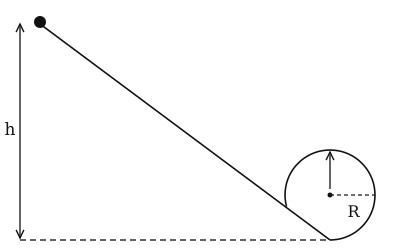
एक चिकना आनत तल एक ऊर्ध्वाधर वृत्तीय लूप में समाप्त होता है, जैसा कि चित्र में दर्शाया गया है। एक छोटी वस्तु को दर्शाए अनुसार ऊँचाई
से छोड़ा जाता है। यदि वृत्त के उच्चतम बिन्दु पर वस्तु तल पर अपने भार का तीन गुना बल लगाती है, तो ऊँचाई
है।
का मान ________ है।
- A2
- B4
- C3
- D6
Show answer
Concept: At the top of the loop, ; energy conservation links to .
- Given : .
- Energy from release point to top of loop (height ): .
- .
Short trick: At the top, .
Answer: (B) 4
अवधारणा: लूप के शीर्ष पर ; ऊर्जा संरक्षण से और का सम्बन्ध मिलता है।
- दिया है : ।
- छोड़ने के बिन्दु से लूप के शीर्ष (ऊँचाई ) तक ऊर्जा संरक्षण: ।
- ।
शॉर्ट ट्रिक: शीर्ष पर ।
उत्तर: (B) 4
JEE Main 2026 (April) – Paper 1 (B.E./B.Tech)PhysicsWork, Energy & Power – vertical circular loopJEE Main 2026 (April) – Paper 1 (B.E./B.Tech) 2026 · 6 Apr Shift 1
Q183.The position of center of mass of three masses 2 kg, 3 kg and 15 kg placed with respect to mid point (
) of normal bisector, as shown in the figure is_________.
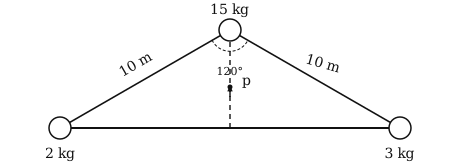
चित्र में दर्शाए अनुसार रखे तीन द्रव्यमानों 2 kg, 3 kg तथा 15 kg के द्रव्यमान केन्द्र की स्थिति, अभिलम्ब समद्विभाजक के मध्य बिन्दु (
) के सापेक्ष, _________ है।
- A
- B
- C
- D
Show answer
Concept: Fix coordinates with origin at (midpoint of the perpendicular from the 15 kg mass to the base) and use , .
- With sides 10 m and apex angle : half-base m, height m, so is 2.5 m from each end of the bisector.
- Positions: 15 kg at , 2 kg at , 3 kg at .
- m.
- m.
Short trick: shifts towards the heavier 3 kg (), and towards the 15 kg mass — only (A) has both non-zero with .
Answer: (A)
अवधारणा: मूल बिन्दु (15 kg द्रव्यमान से आधार पर डाले गए लम्ब का मध्य बिन्दु) पर रखकर , का प्रयोग कीजिए।
- भुजाएँ 10 m तथा शीर्ष कोण : आधा आधार m, ऊँचाई m, अतः समद्विभाजक के दोनों सिरों से 2.5 m दूर है।
- स्थितियाँ: 15 kg पर, 2 kg पर, 3 kg पर।
- m।
- m।
शॉर्ट ट्रिक: भारी 3 kg की ओर () तथा 15 kg की ओर खिसकता है — केवल (A) में दोनों शून्येतर हैं तथा ।
उत्तर: (A)
JEE Main 2026 (April) – Paper 1 (B.E./B.Tech)PhysicsSystem of Particles – centre of massJEE Main 2026 (April) – Paper 1 (B.E./B.Tech) 2026 · 6 Apr Shift 1
Q184.The two wires and of equal cross-section but of different materials are joined together. The ratio of Young's modulus of wire and wire is 20/11. When the joined wire is kept under certain tension the elongations in the wires and are equal. If the length of wire is 2.2 m, then the length of wire is ________m.
समान अनुप्रस्थ-काट परन्तु भिन्न पदार्थों के दो तार तथा आपस में जोड़े गए हैं। तार तथा तार के यंग प्रत्यास्थता गुणांकों का अनुपात 20/11 है। जब जुड़े हुए तार को किसी तनाव में रखा जाता है, तो तारों तथा में दैर्ध्य-वृद्धियाँ समान होती हैं। यदि तार की लम्बाई 2.2 m है, तो तार की लम्बाई ________m है।
- A1.1
- B2.22
- C1.21
- D4.44
Show answer
Concept: In series both wires carry the same tension ; .
- Same and , equal .
- m.
Short trick: for equal stretch: .
Answer: (C) 1.21
अवधारणा: श्रेणी में दोनों तारों में समान तनाव होता है; ।
- समान व तथा समान ।
- m।
शॉर्ट ट्रिक: समान खिंचाव हेतु : ।
उत्तर: (C) 1.21
JEE Main 2026 (April) – Paper 1 (B.E./B.Tech)PhysicsMechanical Properties of Solids – Young's modulusJEE Main 2026 (April) – Paper 1 (B.E./B.Tech) 2026 · 6 Apr Shift 1
Q185.Two closed vessels of same volume are joined through a narrow tube and both vessels are filled with air of pressure 90 kPa and temperature 400 K. Keeping the temperature of one vessel constant at 400 K the second vessel temperature is raised to 500 K. The final pressure in the vessels is ________kPa.
समान आयतन के दो बंद पात्र एक संकरी नली द्वारा जुड़े हैं तथा दोनों पात्र 90 kPa दाब तथा 400 K ताप की वायु से भरे हैं। एक पात्र का ताप 400 K पर स्थिर रखते हुए दूसरे पात्र का ताप 500 K तक बढ़ाया जाता है। पात्रों में अन्तिम दाब ________kPa है।
- A100
- B120
- C90
- D105
Show answer
Concept: Total moles are conserved and the final pressure is common: .
- .
- .
- kPa.
Short trick: (when ) kPa.
Answer: (A) 100
अवधारणा: कुल मोल संरक्षित रहते हैं तथा अन्तिम दाब दोनों में समान है: ।
- ।
- ।
- kPa।
शॉर्ट ट्रिक: (जब ) kPa।
उत्तर: (A) 100
JEE Main 2026 (April) – Paper 1 (B.E./B.Tech)PhysicsKinetic Theory – connected vesselsJEE Main 2026 (April) – Paper 1 (B.E./B.Tech) 2026 · 6 Apr Shift 1
Q186.In interference experiment the path difference between two interfering waves at a point on the screen is , where is the wavelength of these waves, and at another point the path difference is . The ratio of intensities at points and is_______.
व्यतिकरण प्रयोग में पर्दे के एक बिन्दु पर दो व्यतिकारी तरंगों के बीच पथान्तर है, जहाँ इन तरंगों की तरंगदैर्ध्य है, तथा एक अन्य बिन्दु पर पथान्तर है। बिन्दुओं तथा पर तीव्रताओं का अनुपात _______ है।
- A3
- B4
- C1/3
- D1/4
Show answer
Concept: For equal waves with .
- At : , .
- At : , .
- .
Short trick: .
Answer: (C) 1/3
अवधारणा: समान तरंगों के लिए , जहाँ ।
- पर: , ।
- पर: , ।
- ।
शॉर्ट ट्रिक: ।
उत्तर: (C) 1/3
JEE Main 2026 (April) – Paper 1 (B.E./B.Tech)PhysicsWave Optics – interference intensityJEE Main 2026 (April) – Paper 1 (B.E./B.Tech) 2026 · 6 Apr Shift 1
Q187.A particle is executing simple harmonic motion. Its amplitude is and time period is 5 sec. The time required by it to move from to is ________ sec.
एक कण सरल आवर्त गति कर रहा है। इसका आयाम तथा आवर्तकाल 5 sec है। इसके द्वारा से तक जाने में लगा समय ________ sec है।
- A1/4
- B5/4
- C5/8
- D3/8
Show answer
Concept: Starting from the extreme, .
- .
- s.
Short trick: Extreme to is a phase change, i.e. .
Answer: (C) 5/8
अवधारणा: चरम स्थिति से प्रारम्भ करने पर ।
- ।
- s।
शॉर्ट ट्रिक: चरम स्थिति से तक कला परिवर्तन है, अर्थात् ।
उत्तर: (C) 5/8
JEE Main 2026 (April) – Paper 1 (B.E./B.Tech)PhysicsOscillations – SHM time intervalJEE Main 2026 (April) – Paper 1 (B.E./B.Tech) 2026 · 6 Apr Shift 1
Q188.A thin half ring of radius 35 cm is uniformly charged with a total charge of coulomb. If the magnitude of the electric field at centre of the half ring is 100 V/m, then the value of is __________ nC.
( and )
35 cm त्रिज्या की एक पतली अर्धवलय पर कुल आवेश कूलॉम एकसमान रूप से वितरित है। यदि अर्धवलय के केन्द्र पर विद्युत क्षेत्र का परिमाण 100 V/m है, तो का मान __________ nC है।
( तथा )
- A2.14
- B2.44
- C3.25
- D0.7
Show answer
Concept: Field at the centre of a uniformly charged semicircle: with , i.e. .
- .
- .
- C nC.
Short trick: ; ; .
Answer: (A) 2.14
अवधारणा: एकसमान आवेशित अर्धवृत्त के केन्द्र पर क्षेत्र: , जहाँ , अर्थात् ।
- ।
- ।
- C nC।
शॉर्ट ट्रिक: ; ; ।
उत्तर: (A) 2.14
JEE Main 2026 (April) – Paper 1 (B.E./B.Tech)PhysicsElectrostatics – field of a charged half ringJEE Main 2026 (April) – Paper 1 (B.E./B.Tech) 2026 · 6 Apr Shift 1
Q189.The maximum rated power of the LED is 2 mW and it is used in the circuit with input voltage of 5 V as shown in the figure below. The current through resistance
is 0.5 mA.
The minimum value of the resistance of
, to ensure that the LED is not damaged is __________k
.
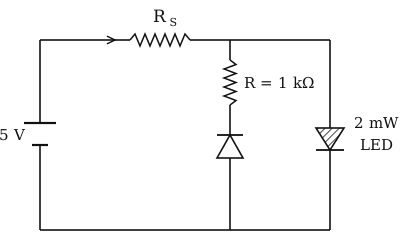
LED की अधिकतम निर्धारित शक्ति 2 mW है तथा इसे नीचे चित्र में दर्शाए अनुसार 5 V निवेशी वोल्टता वाले परिपथ में प्रयुक्त किया गया है। प्रतिरोध
से प्रवाहित धारा 0.5 mA है।
LED क्षतिग्रस्त न हो, यह सुनिश्चित करने के लिए
के प्रतिरोध का न्यूनतम मान __________k
है।
- A6
- B2
- C4
- D5
Show answer
Concept: The diode in the middle branch points upward (cathode towards the positive top wire), so it is reverse biased and its branch carries no current. All of the 0.5 mA through flows through the forward-biased LED.
- Maximum LED voltage: V.
- Drop across : V.
- k. A smaller would push more power into the LED.
Short trick: k.
Answer: (B) 2
अवधारणा: बीच की शाखा का डायोड ऊपर की ओर इंगित है (कैथोड धनात्मक ऊपरी तार की ओर), अतः यह पश्च बायसित है और इस शाखा में धारा नहीं बहती। की पूरी 0.5 mA धारा अग्र बायसित LED से बहती है।
- LED पर अधिकतम वोल्टता: V।
- पर विभवपात: V।
- k। इससे कम होने पर LED में अधिक शक्ति जाएगी।
शॉर्ट ट्रिक: k।
उत्तर: (B) 2
JEE Main 2026 (April) – Paper 1 (B.E./B.Tech)PhysicsSemiconductor Electronics – LED & diode circuitJEE Main 2026 (April) – Paper 1 (B.E./B.Tech) 2026 · 6 Apr Shift 1
Q190.A point light source emits E.M. waves in free space. A detector, placed at a distance of m, measures the intensity as . The detector is now shifted to another location on the same spherical surface ensuring the angle between original location and new location as . The measured intensity at new location will be _______.
एक बिन्दु प्रकाश स्रोत मुक्त आकाश में वि.चु. (E.M.) तरंगें उत्सर्जित करता है। m की दूरी पर रखा एक संसूचक तीव्रता मापता है। अब संसूचक को उसी गोलीय पृष्ठ पर किसी अन्य स्थान पर इस प्रकार खिसकाया जाता है कि मूल स्थान और नए स्थान के बीच कोण हो। नए स्थान पर मापी गई तीव्रता _______ होगी।
- A
- B
- C
- D
Show answer
Concept: An isotropic point source spreads power uniformly over spheres: depends only on , not on direction.
- The new location lies on the same sphere, so is unchanged.
- Hence ; the angle is irrelevant.
Short trick: Same distance from a point source same intensity. (A), (C), (D) wrongly bring in the angle.
Answer: (B)
अवधारणा: समदैशिक बिन्दु स्रोत की शक्ति गोलों पर एकसमान फैलती है: केवल पर निर्भर है, दिशा पर नहीं।
- नया स्थान उसी गोले पर है, अतः अपरिवर्तित है।
- अतः ; कोण का कोई प्रभाव नहीं।
शॉर्ट ट्रिक: बिन्दु स्रोत से समान दूरी समान तीव्रता। (A), (C), (D) गलत ढंग से कोण को सम्मिलित करते हैं।
उत्तर: (B)
JEE Main 2026 (April) – Paper 1 (B.E./B.Tech)PhysicsElectromagnetic Waves – intensity of a point sourceJEE Main 2026 (April) – Paper 1 (B.E./B.Tech) 2026 · 6 Apr Shift 1
Q191.A spherical interface lens of radius
separates two media of refractive indices 1 and 1.4 respectively as shown in the figure below. A point source is placed at a distance of
in front of spherical interface. The magnitude of the magnification of point source image is ________.
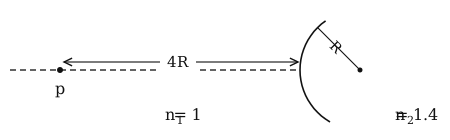
त्रिज्या
का एक गोलीय अन्तरापृष्ठ (लेंस) क्रमशः 1 तथा 1.4 अपवर्तनांक वाले दो माध्यमों को पृथक करता है, जैसा कि नीचे चित्र में दर्शाया गया है। एक बिन्दु स्रोत गोलीय अन्तरापृष्ठ के सामने
दूरी पर रखा है। बिन्दु स्रोत के प्रतिबिम्ब के आवर्धन का परिमाण ________ है।
- A1.66
- B2.33
- C2.66
- D1.33
Show answer
Concept: and . The surface is convex towards the source (centre in the 1.4 medium), so , .
- .
- (real image).
- , so .
Short trick: .
Answer: (A) 1.66
अवधारणा: तथा । पृष्ठ स्रोत की ओर उत्तल है (केन्द्र 1.4 माध्यम में), अतः , ।
- ।
- (वास्तविक प्रतिबिम्ब)।
- , अतः ।
शॉर्ट ट्रिक: ।
उत्तर: (A) 1.66
JEE Main 2026 (April) – Paper 1 (B.E./B.Tech)PhysicsRay Optics – refraction at spherical surfaceJEE Main 2026 (April) – Paper 1 (B.E./B.Tech) 2026 · 6 Apr Shift 1
Q192.A small cube of side 1 mm is placed at the centre of a circular loop of radius 10 cm carrying a current of 2 A. The magnetic energy stored inside the cube is J. The value of is _______.
( Tm/A, )
1 mm भुजा का एक छोटा घन 2 A धारावाही 10 cm त्रिज्या के वृत्ताकार लूप के केन्द्र पर रखा है। घन के अन्दर संचित चुम्बकीय ऊर्जा J है। का मान _______ है।
( Tm/A, )
- A6.28
- B
- C628
- D
Show answer
Concept: Field at the centre of a loop ; energy density ; energy volume (field nearly uniform over the tiny cube).
- T.
- .
- J .
Short trick: .
Answer: (A) 6.28
अवधारणा: लूप के केन्द्र पर क्षेत्र ; ऊर्जा घनत्व ; ऊर्जा आयतन (छोटे घन में क्षेत्र लगभग एकसमान)।
- T।
- ।
- J ।
शॉर्ट ट्रिक: ।
उत्तर: (A) 6.28
JEE Main 2026 (April) – Paper 1 (B.E./B.Tech)PhysicsMagnetism – magnetic energy densityJEE Main 2026 (April) – Paper 1 (B.E./B.Tech) 2026 · 6 Apr Shift 1
Q193.An inductor of inductance 10 mH having resistance of 100
is connected to battery of E.M.F. 1.0 V through a switch as shown in the figure below. After switch is closed, the ratio of instantaneous voltages across the inductor when the current passing through it is 2 mA and 4 mA is _________.
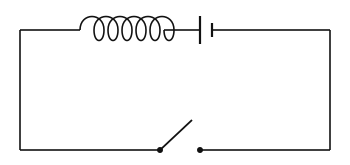
100
प्रतिरोध वाला 10 mH प्रेरकत्व का एक प्रेरक, नीचे चित्र में दर्शाए अनुसार, एक स्विच के माध्यम से 1.0 V वि.वा.बल (E.M.F.) की बैटरी से जुड़ा है। स्विच बंद करने के पश्चात्, जब प्रेरक से प्रवाहित धारा 2 mA तथा 4 mA हो, तब प्रेरक के सिरों पर तात्क्षणिक वोल्टताओं का अनुपात _________ है।
- A4/3
- B3/4
- C5/3
- D3/5
Show answer
Concept: Kirchhoff's loop law: , so the induced voltage across the inductance is .
- At mA: V.
- At mA: V.
- Ratio .
Short trick: ; (B) is the inverse.
Answer: (A) 4/3
अवधारणा: किरचॉफ का पाश नियम: , अतः प्रेरकत्व के सिरों पर प्रेरित वोल्टता ।
- mA पर: V।
- mA पर: V।
- अनुपात ।
शॉर्ट ट्रिक: ; (B) इसका व्युत्क्रम है।
उत्तर: (A) 4/3
JEE Main 2026 (April) – Paper 1 (B.E./B.Tech)PhysicsElectromagnetic Induction – LR circuit growthJEE Main 2026 (April) – Paper 1 (B.E./B.Tech) 2026 · 6 Apr Shift 1
Q194.The ratio of momentum of the photons of the 1st and 2nd line of Balmer series of Hydrogen atoms is . The possible values of and are:-
हाइड्रोजन परमाणुओं की बामर श्रेणी की 1ली तथा 2री रेखा के फोटॉनों के संवेगों का अनुपात है। तथा के सम्भावित मान हैं:-
- A27 and 2027 तथा 20
- B3 and 163 तथा 16
- C5 and 365 तथा 36
- D20 and 2720 तथा 27
Show answer
Concept: and , so .
- 1st line (): .
- 2nd line (): .
- , so , .
Short trick: The first line has the least energy, so the ratio must be less than 1 — (A) is inverted; (B) and (C) are the individual factors, not the ratio.
Answer: (D) 20 and 27
अवधारणा: तथा , अतः ।
- पहली रेखा (): ।
- दूसरी रेखा (): ।
- , अतः , ।
शॉर्ट ट्रिक: पहली रेखा की ऊर्जा सबसे कम है, अतः अनुपात 1 से कम होना चाहिए — (A) उल्टा है; (B) व (C) अलग-अलग गुणक हैं, अनुपात नहीं।
उत्तर: (D) 20 तथा 27
JEE Main 2026 (April) – Paper 1 (B.E./B.Tech)PhysicsAtoms – Balmer series photon momentumJEE Main 2026 (April) – Paper 1 (B.E./B.Tech) 2026 · 6 Apr Shift 1
Q195.A LCR series circuit driven with V at frequency Hz has resistance , an inductance with inductive reactance and capacitance with capacitive reactance . The power factor of the circuit is______.
V तथा आवृत्ति Hz से चालित एक श्रेणी LCR परिपथ में प्रतिरोध , प्रेरकीय प्रतिघात वाला एक प्रेरकत्व तथा धारितीय प्रतिघात वाली एक धारिता है। परिपथ का शक्ति गुणांक ______ है।
- A0.8
- B0.64
- C0.9
- D0.5
Show answer
Concept: with .
- .
- .
- .
Short trick: 60-80-100 is a 3-4-5 triangle: . and are not needed.
Answer: (A) 0.8
अवधारणा: , जहाँ ।
- ।
- ।
- ।
शॉर्ट ट्रिक: 60-80-100 एक 3-4-5 त्रिभुज है: । तथा की आवश्यकता नहीं है।
उत्तर: (A) 0.8
JEE Main 2026 (April) – Paper 1 (B.E./B.Tech)PhysicsAlternating Current – power factorJEE Main 2026 (April) – Paper 1 (B.E./B.Tech) 2026 · 6 Apr Shift 1
Q196.Refer to the circuit diagram given below. The heat generated across the 6
resistance in 100 second is
J. The value of
is ________. (Nearest integer)
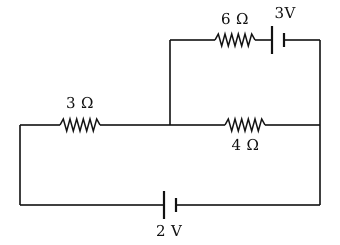
नीचे दिए गए परिपथ आरेख को देखिए। 100 सेकण्ड में 6
प्रतिरोध में उत्पन्न ऊष्मा
J है।
का मान ________ है। (निकटतम पूर्णांक)
Show answer
Concept: Node analysis. Call the right-hand junction (), the left corner and the junction between and . The longer plate of each cell is its positive terminal: the 2 V cell gives V; in the top branch the 3 V cell has its positive plate towards .
- Current from to through the top branch: .
- KCL at : . Multiply by 12: V.
- A, i.e. A flowing from to .
- Heat J.
- .
Short trick: Replace the top branch and by a Thevenin source: V, ; then solve one loop for and the current follows.
Answer: 3477
अवधारणा: नोड विश्लेषण। दायीं संधि को (), बाएँ कोने को तथा व के बीच की संधि को कहिए। प्रत्येक सेल की लम्बी प्लेट धन टर्मिनल है: 2 V सेल से V; ऊपरी शाखा में 3 V सेल की धन प्लेट की ओर है।
- ऊपरी शाखा में से की ओर धारा: ।
- पर KCL: । 12 से गुणा करने पर: V।
- A, अर्थात् A धारा से की ओर।
- ऊष्मा J।
- ।
शॉर्ट ट्रिक: ऊपरी शाखा तथा को थेवेनिन स्रोत से बदलिए: V, ; फिर एक पाश से ज्ञात कर की धारा निकालिए।
उत्तर: 3477
JEE Main 2026 (April) – Paper 1 (B.E./B.Tech)PhysicsCurrent Electricity – Kirchhoff's laws & Joule heatingJEE Main 2026 (April) – Paper 1 (B.E./B.Tech) 2026 · 6 Apr Shift 1
Q197.An unpolarized light of intensity passes through polarizer and then through a certain optically active solution and finally it goes to analyser. If the angle between analyser and polariser is and intensity of light emerged from analyser is , the angle of rotation of the light by the solution with respect to analyser is ______ degrees.
तीव्रता का एक अध्रुवित प्रकाश ध्रुवक (polarizer) से, फिर एक प्रकाशिक सक्रिय विलयन से गुजरता है तथा अन्त में विश्लेषक (analyser) पर जाता है। यदि विश्लेषक तथा ध्रुवक के बीच कोण है तथा विश्लेषक से निर्गत प्रकाश की तीव्रता है, तो विश्लेषक के सापेक्ष विलयन द्वारा प्रकाश का घूर्णन कोण ______ डिग्री है।
Show answer
Concept: The polariser passes ; the solution rotates the plane by , so by Malus' law the analyser (parallel to the polariser) passes .
- .
- .
- .
Short trick: .
Answer: 30
अवधारणा: ध्रुवक तीव्रता पारित करता है; विलयन ध्रुवण तल को से घुमाता है, अतः मैलस नियम से विश्लेषक (ध्रुवक के समान्तर) पारित करता है।
- ।
- ।
- ।
शॉर्ट ट्रिक: ।
उत्तर: 30
JEE Main 2026 (April) – Paper 1 (B.E./B.Tech)PhysicsWave Optics – polarisation & optical activityJEE Main 2026 (April) – Paper 1 (B.E./B.Tech) 2026 · 6 Apr Shift 1
Q198.The energy released when kg of is converted into by proton bombardment is eV. The value of is ____. (Nearest integer)
(Mass of u, mass of u, mass of proton u and and Avogadro number )
जब kg को प्रोटॉन बमबारी द्वारा में परिवर्तित किया जाता है, तब मुक्त ऊर्जा eV है। का मान ____ है। (निकटतम पूर्णांक)
( का द्रव्यमान u, का द्रव्यमान u, प्रोटॉन का द्रव्यमान u तथा और आवोगाद्रो संख्या )
Show answer
Concept: Reaction . Energy per reaction MeV; multiply by the number of Li nuclei.
- u.
- MeV eV per reaction.
- Moles of Li ; nuclei .
- eV (using 7.0183 g/mol gives ).
- .
Short trick: in MeV, so eV.
Answer: 6
अवधारणा: अभिक्रिया । प्रति अभिक्रिया ऊर्जा MeV; इसे Li नाभिकों की संख्या से गुणा कीजिए।
- u।
- MeV eV प्रति अभिक्रिया।
- Li के मोल ; नाभिक ।
- eV (7.0183 g/mol लेने पर )।
- ।
शॉर्ट ट्रिक: MeV में , अतः eV।
उत्तर: 6
JEE Main 2026 (April) – Paper 1 (B.E./B.Tech)PhysicsNuclei – Q-value & energy releasedJEE Main 2026 (April) – Paper 1 (B.E./B.Tech) 2026 · 6 Apr Shift 1
Q199.A three coulomb charge moves from the point to the point in an electric field expressed as N/C. The work done in moving the charge is ______J.
तीन कूलॉम का एक आवेश N/C द्वारा व्यक्त विद्युत क्षेत्र में बिन्दु से बिन्दु तक गति करता है। आवेश को गति कराने में किया गया कार्य ______J है।
Show answer
Concept: Work done by the field . The field is conservative (), so the path does not matter.
- .
- V.
- J.
Short trick: Treat as a potential function: .
Answer: 186
अवधारणा: क्षेत्र द्वारा किया गया कार्य । क्षेत्र संरक्षी है (), अतः पथ का कोई प्रभाव नहीं।
- ।
- V।
- J।
शॉर्ट ट्रिक: को विभव-फलन मानिए: ।
उत्तर: 186
JEE Main 2026 (April) – Paper 1 (B.E./B.Tech)PhysicsElectrostatics – work done by electric fieldJEE Main 2026 (April) – Paper 1 (B.E./B.Tech) 2026 · 6 Apr Shift 1
Q200.A certain gas is isothermally compressed to of its initial volume ( litre) by applying required pressure. If the bulk modulus of the gas is , the magnitude of work done on the gas is _____J.
किसी गैस को आवश्यक दाब लगाकर समतापीय रूप से उसके प्रारम्भिक आयतन ( लीटर) के भाग तक संपीडित किया जाता है। यदि गैस का आयतन प्रत्यास्थता गुणांक (bulk modulus) है, तो गैस पर किए गए कार्य का परिमाण _____J है।
Show answer
Concept: For an isothermal process const, so the isothermal bulk modulus . Hence the initial pressure is Pa. Work on the gas .
- J.
- J.
- Nearest integer: 989 J.
Short trick: Isothermal , so J.
Answer: 989
अवधारणा: समतापीय प्रक्रम में नियत, अतः समतापीय आयतन प्रत्यास्थता गुणांक । अतः प्रारम्भिक दाब Pa। गैस पर कार्य ।
- J।
- J।
- निकटतम पूर्णांक: 989 J।
शॉर्ट ट्रिक: समतापीय , अतः J।
उत्तर: 989
JEE Main 2026 (April) – Paper 1 (B.E./B.Tech)PhysicsThermodynamics – isothermal work & bulk modulusJEE Main 2026 (April) – Paper 1 (B.E./B.Tech) 2026 · 6 Apr Shift 1

